[Gold] Knight, J G, compilerBiblio.com
7 654 résultats
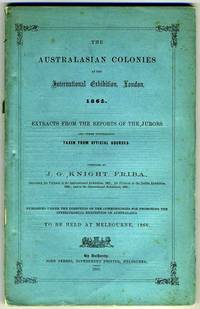
186618250Melbourne: Government Printer 1866. Second edition. Otherwise very good condition. International exposition in London held just ten years after the discovery and beginning of the Australian gold rush. The introduction nicely summarizes the increased presence of the Australian colonies: "In 1851 the Australasian colonies were but poorly represented although a few made some efforts to put in an appearance. . in 1862 the Australian colonies exhibit one of the most extensive and finest collections of the whole group. . New South Wales has a beautifully arranged collection of its gold products from all the principal fields in the several shapes of nuggets quartz grain gold washing stuff coin from the Sydney mint &c. . Victoria has gone to great expense . one of the most striking objects is a gilded obelisk representing the actual amount of gold found in the colony since 1851 about 800 tons or L103000000 sterling.:" Also information on wine with wine coming from South Australia; 4 exhibitors from Western Australia; Mr. Thomas Little of Dardanup won a medal for his light red Frontignac; Victoria 19 exhibitors with no wines older than 1858 shown putting them at a "taste disadvantage". Each district is represented with a short history of their products and resources. In Western Australia there are lead and copper mines iron ore mines Albany and Bunbury. <br /> <br /> Printed paper pamphlet. 8vo 101pp. Blue printed paper wrappers title in black at front cover no title at spine. Small unobtrusive Iibrary stamp at title page deaccession stamp at back cover. Lower corner back cover chipped. F11229. Otherwise very good condition. Government Printer unknown
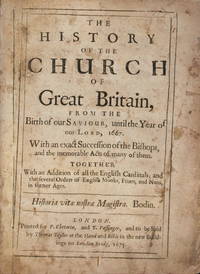
001143Hardcover. Poor. Printed for P Chetwin and T Passinger London 1675; 4to 170 x 215mm; pp xvi 441 xvi being the index; later half roan marbled boards binding very worn and both boards detached; book block firm and without loss but rather browned throughout and with some soiling on the title page as shown in the image. <br/> <br/> hardcover
1938312786N.p.: Privately printed for the members of the Royal Guild of Wisconsin Fisherman 1938. First edition one of a very few copies known. Illustrations from photographs. vi 25 pp. 1 vols. 8vo. White printed wrappers stapled. Very good. Some minor wear. Green quarter morocco slipcase. First edition one of a very few copies known. Illustrations from photographs. vi 25 pp. 1 vols. 8vo. Salmon fishing during four days in the first part of July 1938 by a party of six who styled themselves the Royal Guild of Wisconsin Fishermen comprising: Evan A. Evans Louis M. Hanks Roy F. Tomlinson Theodore G. Montague William S. Kies and George I. Haight to whom authorship is attributed by the Wisconsin Historical Society. The last page of text records their catch by weights. Rare. Wetzel p. 171 tentatively ascribed to William Kies. "A rare work."; Bruns K-45 not seen; Bibliotheca Salmo Salar 105. OCLC 2 copies Princeton Wisconsin Historical Society Privately printed for the members of the Royal Guild of Wisconsin Fisherman] unknown
190676610London:: John Long 1906. Fifth Impression. publisher's purple gilt cloth in dust jacket. Name and date heavily effaced from the front free endpaper with black felt-tip pen which has bled through to the verso; another 1907 notation below that; otherwise a bright copy in a slightly sunned dust jacket with a small abrasion on the rear panel. . 8vo. John Long, hardcover
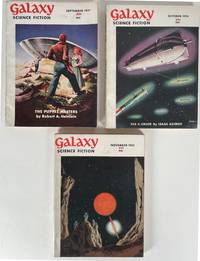
195133465New York: World Editions Inc. 1951. Tanning to text paper mild edge wear to covers very good to nearly fine copies. 33465. Small octavo three issues covers by Don Sibley Richard Arbib pictorial wrappers. Digest sized magazine. The complete first appearance of the Heinlein's THE PUPPET MASTERS in three serial parts. Reference: Tymm and Ashley Science Fiction Fantasy and Weird Fiction Magazines pp. 290-309. World Editions, Inc. unknown
1793340029Dublin: J. Exshaw L. White and Wm. Jones. Poor. 1793. Ex-library. Hardcover. Ex-library copies with ink stamps on each title page and at least two other pages of each volume. Library name impressed on the covers along the spine edge. Covers are detached but present. Rear cover of Volume Two is missing. Covers are rubbed with general edge and corner wear. Pages are slightly browned. Volume One: front blanks and title page are detached but present. Title page and first few leaves have holes from insect damage to the lower margin. ; In two volumes complete. Attributed to Charles John Ann Hereford or Rev. John Adams. The library which ownes this set put Adams on the spine. . J. Exshaw, L. White, and Wm. Jones hardcover
1793elala892London: Printed For C.&G.Kearlsey 1793. 1793. 3 Volumes. 8vo. pp. xii 1 leafads 455; x 491 5ads; viii 439 39index. contemporary sprinkled calf gilt backs front cover of Vol. I detached several joints cracked lacking spine labels. First Edition. 1st Edition. Hardcover. London: Printed For C.&G.Kearlsey, 1793. Hardcover
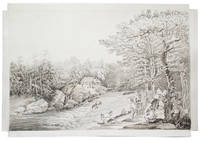
180052601Canada 1800. Graphite pen-and-ink and grey wash on wove paper watermarked "W. Elgar 1796". 13 5/8 x 20 inches. Corners clipped outside the image verso toned. Graphite pen-and-ink and grey wash on wove paper watermarked "W. Elgar 1796". 13 5/8 x 20 inches. Along the falls of a tree-lined river two First Nations men are pulling a canoe into the water directed by another in an elaborate feather headdress; a wigwam with mother and child is on the same shore to their left; across the river a longhouse and structure for smoking fish with another group of native people can be seen; at the far left a First Nations man is standing in his canoe fishing with a pole in the water just below the rapids.<br /> <br /> Although the 1796 watermark on the paper is consistent with drawings by Heriot the unfinished quality of this work make attribution difficult. However it is somewhat reminiscent of a smaller grisaille watercolor signed by Heriot titled FALLS OF THE POQUISQUE ON THE RIVER ST JOHN on verso sold at Waddington's March 15 2018 lot 137.<br /> <br /> Furthermore this scene is reminiscent of one described by Heriot in his Travels in the Canadas 1807 in which he describes Native American fishing on the cacasdes of St. Mary nine miles below the entrance to Lake Superior: "It is at the bottom of the rapids and even among their billows which foam with ceaseless impetuosity that innumerable quantities of excellent fish may be taken from the spring until the winter; the species which is found in the greatest abundance is denominated by the savages atticameg or white fish; the Michilimakinac trout and pickerell are likewise caught here. These aflford a principal means of subsistence to a number of native tribes. No small degree of address as well as strength is employed by the savages in catching these fish; they stand in an erect attitude in a birch canoe and even amid the billows they push with force to the bottom of the waters a long pole at the end of which is fixed a hoop with a net in the form of a bag into which the fish is constrained to enter. They watch it with the eye when it glides among the rocks quickly ensnare it and drag it into the canoe. In conducting this mode of fishing much practice is required as an inexperienced person may by the efforts which he is obliged to make overset the canoe and inevitably perish."<br /> <br /> Trained by Paul Sandby at the Royal Military Academy Woolwich London Heriot worked as a clerk for Board of Ordnance. "In 1792 Heriot was posted to Quebec and promoted clerk of the cheque in the Ordnance department. Heriot was to remain in Lower Canada until 1816 except apparently for two periods of absence in 1796-97 and in 1806. His first years at Quebec are not well documented. Sketches record visits in and about Quebec and Montreal perhaps on Ordnance business. In November 1792 he published a sketch of Jersey in the Quebec Magazine and the following year he prepared a view of Quebec perhaps also intended for publication. When he returned to Britain in 1796 he resided in London travelled to the south coast and made at least one sketching foray into Wales . A watercolour prepared from his sketches of Wales and two Canadian views were accepted by the Royal Academy of Arts for exhibition in the spring. Heriot probably sailed for Lower Canada soon afterwards taking notes and making sketches on the voyage. The impact of his visit to Britain was considerable. While there he had been stimulated by the art he had seen and by his success as an artist. He returned with a fresh enthusiasm for the Canadas; he began to read about their past and to make elaborate notes and numerous sketches of the places he visited and the peoples he encountered. His sojourn abroad had affected his artistic vision of the Canadas; his drawings and water-colours assumed a new confidence and his landscape forms developed a new strength and grandeur. In London he had probably studied the simply handled and remarkably strong water-colours of younger British artists such as Thomas Girtin Joseph Mallord William Turner and John Varley. Either in Britain or in Lower Canada he had also become familiar with Lieutenant George Bulteel Fisher's Six views of North America . London 1796. He was influenced by this work especially by Fisher's use of the Picturesque in depicting Canadian landscape" Dictionary of Canadian Biography. unknown
34031001China 1966~1967. A group of 6 b. w. photographs with red printed captions in Chinese each photo is 15 x 11.5 cm.with margins captions ca. 14 x 4 cm. printed on a separate paper tipped to the verso. No publisher indicated. RARE EARLY WORK . . . ORIGINAL PERIOD AUTHENTIC PHOTOGRAPHS . . . . A STUNNING GROUP OF SIX IMPORTANT & EARLY EXAMPLES . . This is an excellent RARE and OBSCURE early group of six b.w. original photographs documenting the activities of the "Hong Wei Bing" "Chinese Red Guards". . It shows early examples of street action at the beginning of the "Da Wen Hua Da Geming" "Cultural Revolution". This movement officially ran from 1966-1967 but in reality lasted until Mao's death on September 9 1976. . THE PHOTOS: . 1. Shows "Hong Wei Bing" "Chinese Red Guards" marching in the street carrying a large photo of Chairman Mao and slogan: "MAO ZUSHI MAN SUI" "LONG LIVE CHAIRMAN MAO" others in the rear carry the national flag of China. . The Pinyin of the caption reads: Wei da de dao shi wei da de ling wei da de ton shuai wei da de duo shou mao zhu xi gei wo men gei wo men zhi míng le qián jìn de fang xiàng. Wo men yong yuan zhong yú máo zhu xí yong yuan zhong yú máo zé dong si xiang yong yuan zhong yú dang hé rén mín de shì yè. . English translation: Great teacher great leader great commander and great helmsman chairman MAO indicate the direction of the forward direction to us. We are always loyal to chairman MAO always loyal to MAO Zedong's thought always loyal to the cause of the party and the people. . 2. A large number of young Hong Wei Bing "Chinese Red Guard" girls march through the street. They are holding Mao's Quotations from Chairman Mao Mao's "Little Red Book" while shouting slogans. Most also wear Red Guard badges on the left chest. A man walking adjacent calls cadence and holds up a Little Red book he also has twin cloth shoulder purses used to carry the Little Red books. . The Pinyin of the caption reads: Wo men wei dà de duò shou máo zhu xí jià yù zhe gé mìng de háng chuán suai ling zhe yì wàn gé mìng qún zhòng chéng feng pò làng xiàng qián jìn ! Máo zhu xí wo men yong yuan gen zhe ni gàn gé mìng ! Chuàng zào yi gè hóng tóng tóng de xin shì jiè ! . English translation: Our great helmsman chairman MAO steering the ship towards revolution led hundreds of millions of brave revolutionary masses forward ! Chairman MAO we always follow you to revolution! Create a new world of red! . 3. A large number of young "Hong Wei Bing" "Chinese Red Guards" both boys and girls carry China's national flag and photos of Chairman Mao through the street. . The Pinyin of the caption reads: Qian qian wàn wàn ke hóng xin xiàng zhe hóng tài yáng qian qian wàn wàn gè gé mìng xiao jiang qí sheng huan hu zhù zuì zuì jìng ài de ling xiù máo zhu xí wàn shòu wú jiang ! Máo zhu xí a wo men de zuì gao tong shuài wo men shì si bao wèi yi ni wéi dài biao de wú chan jie jí gé mìng lù xiàn che di pi pàn zi chan jie jí fan dòng lù xiàn ba wú chan jie jí wén huà dà gé mìng jìn háng dào di ! . English translation: Thousands of red hearts face toward the sun thousands of revolutionary young cheered. I wish the most dear leader chairman MAO's day ! Chairman MAO our commander in chief we will defend you as representative of the proletarian revolutionary line thoroughly criticizing the reactionary bourgeois line the great proletarian cultural revolution through to the end! . 4.Photograph #4 shows a date of 1967. A large group of "Hong Wei Bing" "Chinese Red Guards" celebrate 18 years of the Chinese Revolution 1948-1967. They carry photos of Chairman Mao the "Great Helmsman" and an anniversary plaque. . The Pinyin of the caption reads: Dà hai háng háng kào duò shou wàn wù sheng zhang kào tài yáng gàn gé mìng kào de shì Máo zédong si xiang. Jie jiàn kai shi yi qián jie fàng jun zhàn shì hé hóng wèi bing gé mìng shi sheng tóng sheng gao chàng "dà hai háng háng kào duò shou" deng gé mìng ge qu. . English translation: The sea voyage by Mao as pilot all living things depend on the sun for their growth stem revolution depends on MAO Zedong thought. Meeting started in the past the people's liberation army soldiers and Revolution of the Red Guards the teachers and students simultaneous singing revolutionary songs such as "Sea voyage with a pilot." . 5. A large number "Hong Wei Bing" "Chinese Red Guards" are seated while reading from 'Quotations from Chairman Mao' the most famous & iconic "Little Red Book." Commonly carried and brandished on street marches while shouting Mao's words & slogans. . The Pinyin of the caption reads: Wei dà de ling xiù máo zhu xí a wo men lái zì wu hú sì hai huì jí dào ni de shen páng wo men cóng ni de zhe zuò li xi qu lì liàng dao shan gan shàng huo hai gan chuang. Wo men yào yong yuan dú ni de shu ting ni de huà àn ni de zhi shì bàn shì zuò ni de hao xué sheng yong yuan gen zhe ni zài dà feng dà làng zhong qián jìn ! . English translation: Great leader chairman MAO we come from all over the world to you we draw strength from your works dare wheels inferno & aggressive. We will read your book listen to your words according to your instructions to be your good students we will always follow you in the difficult times ahead ! . 6. A large number of "Hong Wei Bing" "Chinese Red Guards" soldiers bearing rifles read from "Quotations from Chairman Mao's" famous "Little Red Book." This shows many armed Red Guard men with machine guns and rifles sitting on the ground reading Mao's precious Little Red books. . The Pinyin of the caption reads: Dú yi bèi zi máo zhu xí de shu gàn yi bèi zi gé mìng. Hóng Wèi Bing jian jué xiang ying lín biao tóng zhì guan yú ba xué xí Máo zhu xí zhe zuò de qún zhòng yùn dòng tí gao dào yi gè xin jie duàn de hào zhào jué xin ba máo zé dong si xiang zhen zhèng xué dào shou. Hóng Wèi Bing lì yòng jie jiàn qián de xiu xi shí jian tóng jie fàng jun1 zhàn shì yi qi xué xí "Máo zhu xí yu lù." . English translation: Reading life of chairman MAO's book do a lifetime revolution. Red Guards firm response comrade Lin Biao about increase the study chairman MAO's works of mass movement to a new stage is determined to MAO Zedong thought really learn. Use Red Guards to meet the time to rest together with the people's liberation army soldiers to learn "Quotations from chairman MAO." . . The "Hong Wei Bing" or "Chinese Red Guards" were officially sanctioned by Chairman Mao at a mass Tiananmen rally on August 1 1966. Although the "Da Wen Hua Da Geming" "Cultural Revolution" was later brutally put down throughout China by the People's Liberation Army with much force and large numbers of deaths the resistant anarchistic "Hong Wei Bing" "Chinese Red Guards" continued their chaotic run until the Mao's death. . Original photographs of the "Hong Wei Bing" "Chinese Red Guards" and the "Da Wen Hua Da Geming" "Cultural Revolution" are RARE and not commonly found. Therefore this group of original period photographs are a stunning primary and historical record of the early actions and events. . CONDITION: The group of photographs are in excellent condition no defects. Each comes with a red printed caption in Chinese tipped on to the edge of the photograph. We note that at the beginning of each caption paragraph the first character or perhaps a number was scratched out. This does not detract from the overall capton. . DATE: Circa 1966-1967 There is a printed date found on photo #4. showing these photos to be from 1966-1967 period which is the beginning of the "Cultural Revolution" & "Hong Wei Bing" "Red Guards" movement. . Color photos are posted to our website. . REFERENCES: . en-wikipedia-org/wiki/Red_Guards_China en-wikipedia-org/wiki/Mao_Zedong . . unknown
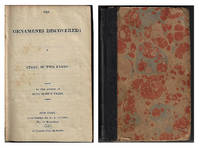
181719934New York: W.B. Gilley 1817. First American Edition. Hardcover. Good. 13 cm 180 pp. Contemporary marbled boards; spine recovered in black cloth tape. Some peeling to marbled paper one crack at center of binding where signature is partly sprung otherwise sound and clean. On oft-reprinted moral tale for children the "ornaments" are good manners and a well-regulated mind first published in London in 1815 by William Darnton Jr. This edition is scarce. Shaw & Shoemaker; 41095. W.B. Gilley hardcover
186932728Virginia City California 1869. Paper. Very good. Approx. 8" x 3" check with printed green borders information and 2 stamps. Check is drawn on the account and signed by Isaac L. Requa. The information printed on the check is "Gould & Curry Silver Mining Company W. C. Ralston Treasurer. Agency of the Bank of California Virginia City. The written date is Aug 3 1869. <br /> <br /> Requa was a mining engineer early Oakland pioneer and later President of Oakland Bank and Savings. unknown
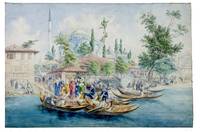
1840J37G5H5ISWE1Istanbul 1840. Mounted on a larger sheet of paper in a passe-partout. Watercolour drawing on wove paper 29.5 x 45 cm with highlights in shellac and a thin black border. A lively scene on the Tophane Quay in Istanbul with the background dominated by the dome and minaret of the 1580 Kilic Ali Pasha Mosque. The tip of a second minaret perhaps from a different mosque is visible in the distance. On the quay an opulently dressed black-bearded Ottoman a high official in the Emperor's court or a wealthy merchant stands in the centre of the scene with his entourage. He wears red robes trimmed with gold and with black decorations a white turban around a red fez and a gold waistband with the hilts of two guns sticking out and carries a walking stick in his left hand. His entourage includes a white-bearded Islamic holy man with a green turban around a red fez a Greek or Armenian man in a black hat a dark-skinned woman in green robes holding a bundle and several other men women and children. They appear to be preparing to depart in the boats that stand ready. Two more dark-skinned women in white robes with red and blue stripes follow the party deferentially. Several people appear in the boats in addition to their crews. Four more white-bearded Islamic holy men each again with a green turban around red fez sit in one with some women while two Ottoman infantrymen with bayonets stand in another one just stepping out. Other parts of the quay show various men busy with their trades or smoking long pipes. From the collection of Hooton Pagnell Hall in Yorkshire England. With a 1.5 cm tear in the water at the foot of the scene not approaching the boats and otherwise in very good condition. A lively and fascinating scene on a quay in Istanbul with the dome and minaret of Kilic Ali Pasha Mosque prominently shown.l For the King family: Debretts Peerage 1840 p. 423 & 1861 p. 338; Debretts Baronetage LXXV 1893 p. 127. unknown
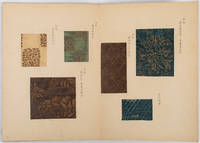
1618177408Japan.: No publisher. Meiji 16 1883. Japanese accordion style book orihon 10 numbered double page colour lithograph illustrations multiple images per page 24.7 x 17.5 cm patterned cloth-covered boards. Some soiling wear to cover extremities some even browning to pages but overall the contents are in very good condition. The illustrations feature details of brocade cloths with gold thread and silver thread as well as damask textile and gold foiled textile. Some of the samples are enlarged so that it is possible to see the details of the weave. The book is exquisitely printed in colour to give the effect of the real thing. It is an early example of Japanese colour lithography and an item of interest to fabric and clothing historians. The chop on the last page says that it was printed in the Printing Agency of the Treasury dated on July 28 Meiji 16 1883. . No publisher. hardcover
192062329Portland OR Spokane WA San Francisco CA & Seaside OR: Lyle E. Lewis Dance Orchestra ca. 1920-1944. Eight vols. 1st - 4to. 48 pp unpaginated. on thick black paper w/ 100’s of pieces of ephemera mounted and laid-in including 7 silver gelatin photographs sized from 5 x 7 in. up to 8 x 10 in. many different TLS and ALS most on stationery letterhead for assorted hotels KGW Radio and others many newspaper clippings tickets promotional brochures advertising cards dance tickets along with a spoof printed “Wanted†notice for Ted Mullen alias Sourdough Sullen with $ 500 million reward offered and large double-page advertising broadside on yellow-gold tinged thick paper stock at rear for gig in Astoria OR under the auspices of the Co. L 186th Infantry Oregon National Guard. Contemporary pebbled black boards punch-sewn at gutter margin chipping edgewear still VG- exemplar; 2nd - 4to. 92 pp unpaginated w/ majority of leaves on ruled paper including 18 leaves of mylar sleeves featuring the majority of the 23 silver gelatin photographs most sized 8 x 10 in. photographer’s imprints on versos remainder w/ clippings promotional announcements tickets broadsides ALS & TLS documents throughout along with a long radio program script. Contemporary 2-ring blue cloth binder rounded corners some edgewear rubbing still VG; 3rd-7th - 16mo. Five daily diaries Approx. 700 pp unpaginated. w/ approx. 4000 words manuscript annotations in ink & pencil throughout featuring some laid-in miniature photos receipts business cards including 1 photographic souvenir business card for Cole McElroy’s Dance Band and Cole McElroy’s Spanish Ballroom 1 tiny postage stamp photo of Lewis at his bungalow in Seaside all bound in cloth some wear still VG grouping; 8th - 12mo. Approx. 150 pp unpaginated. of ruled paper mostly typescript ink & pencil manuscript some ruling throughout annotations & checkmarks last 4th or so blank. Flexible black cloth 6-ring binder business card for Lewis as Commercial Agent for ACME Fast Freight taped in on front pastedown 3 blank routing order forms in red & black some scuffing edgewear still VG all from the library of Genevieve Martha Lewis Levin 1911-1994. This unusually well-preserved archive of a Roaring 20’s Jazz Orchestra musician and Band Leader in the Pacific Northwest reveals the exuberance and business success of this largely forgotten artist through his successful years before foundering during the Great Depression. Both scrapbooks open with clippings thank you and recommendation letters as well as dance broadsides and photographs during 1926 at the height of Lyle Lewis’s orchestra appreciation. Testimonials include B.J. Saad who owned the Garden Dancing Palace and stated “I have taken the Garden which is second to no other ballroom west of Chicago. That is why I have secured Lyle Lewis recognized as one of the best orchestra leaders on the Coast.†C.W. Craig of Lipman Wolfe & Co. department store extolls that Jazz music dance held at the Multnomah Hotel March 16 1926 that “I don’t think we have ever enjoyed better or more up to date dance music than that furnished by your splendid aggregation.†Broadsides and notices advertise the Lewis Jazz Orchestra playing the Grand Ball Room at the Masonic Temple Congress Hotel leading McElroy’s Oregonians at the McElroy’s Spanish Ballroom the Dessert Hotel Oasis near Spokane parties for Studebaker and more. One of the mounted letters includes a rather sad severance letter signed by Cole McElroy explaining the circumstances of Lyle Lewis’s leaving stating “I realise that you were a victim of circumstances. On account of the fact that you had a fine band organized. . . certain music masters of the theatre jobs saw fit to take your men away from you thereby breaking up your fine band and forcing me to make a deal for another organization.†McElroy 1888-1947 was known as “Pop†McElroy was a popular band leader who during the years before World War I and after played the Palm Gardens often and had great success in his McElroy Spanish Ballroom which opened in 1926 and then opened another Seattle McElroy Ballroom in 1928. Several TLS on letterheads include those for KXL Radio station KGW Radio Station and the KOIN Studio Director for The Portland News which played three nights a week on air for over six months. The many photographs capture the Lyle Lewis band joking around with their instruments on the road fully arrayed on stage in the Radio Station posing at various venues stages and even one as late as 1939 conducting the Lyle E. Lewis Dance Orchestra. The band included Cluet Mansfield formerly with Henry Halsted band William Webber on drums Eddie Scroggins & Frank Champion as sax players G. Berardinelli on Bass and also played dances at the Irvington Club Multnomah Athletic Club and for a while with the historic Congress Hotel in Portland which had been the City’s first reinforced concrete building erected during the Progressive Era and by 1924 expanded to 119 rooms with vibrant Jazz ballroom. The daily diaries for 1929 and 1930 show that Lewis regularly played at the Cotillion Hall now the Crystal Ballroom initially at $ 7.00 per night in 1929 and then steadily dropping to less than half by 1933. He writes about traveling for a gig in San Francisco with Mansfield in 1929 leaving Tuesday and arriving Wednesday Sept. 18 1929 driving 40 mph and getting 19 miles to the gallon with a drive made in 19 hours and 15 minutes. He played extensively at the Bungalow Club in Seaside OR which had opened originally June 19 1920 and for more than 25 years was the destination for the biggest names in the Big Band Jazz era including Lyle E. Lewis Cole McElroy Duke Ellington Bob Crosby Glenn Miller and tragically became connected with the death of Jimmie Lunceford who died from a heart attack just before playing his last set at the Bungalow after playing McElroy’s Ballroom in Portland 2 nights before. Lewis 1890-1948 was a popular Portland Oregon based jazz band & orchestra leader who managed to lie about his age and enlist at 15 in the Oregon National Guard Co. G 3rd Battalion served for three years and in May 1910 married Genevieve Franklin while working as salesman and musician before World War I Following the War he quickly became a successful band leader including successful stints with the Cole McElroy Spanish Ballroom Congress Hotel Multnomah Hotel Bungalow Garden Ballroom as well as the Coronado Hotel in California. As indicated by the daily diaries he maintained a fairly close relationship with his daughter Genevieve “Martha†but became largely estranged from his wife Genevieve living in separate rooming houses or hotels. Still in her position as a sales manager she managed to convince Meier & Frank to hire him as their house band for store functions and the restaurant while during the Great Depression he mostly worked for the US Forest Service mapping division while his show business largely disappeared. By 1943 he became the commercial agent for ACME Fast Freight where he worked as commercial agent until his death. This cataloguer could find no surviving recorded discography record for Lyle E. Lewis and his assorted incarnations although there are a few recordings for the Cole McElroy Band from 1926-1928 which most likely would have included him as band leader and musician. Lyle E. Lewis, Dance Orchestra, hardcover
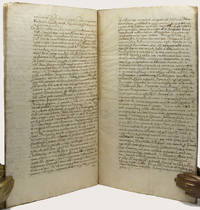
162134518Lisbon and Hangzhou China: Manuscripts ca.1623 and 1621. Very Rare A Similar Manuscript Exists in Brussels. We know of no others. The Latin text of both letters is written in a neat uniform cursive hand in brown. Folio leaves 33 x 20.5 cm The transcripts bound in 18th Century stiff blue wrappers the blank paste-downs and endpapers are late 18th century most likely the third quarter between 1745/1753 and 1776 since they contain a clear "lion/vryheit/pro patria" watermark with a crowned GR countermark which resembles Heawood 3148 3149 and 3154. The paper used for the manuscript contains a faint double-headed eagle watermark and it has been reinforced in the gutters. A very pleasing survival very well preserved edges slightly mellowed the wrappers show some signs of wear. VERY RARE MANUSCRIPT TRANSCRIPTS. Chrysostomus Johann Gall 1586-1643 was a German Jesuit and scholar. He left Ingolstadt Germany to teach astronomy mathematics and navigation in Lisbon fro 1620to 1627 before leaving to work in the Jesuit missions in India. The Colégio de Santo Antŕo benefitted from the arrival of many foreign mathematicians and other scholars as Lisbon serves as a gateway for all missionaries departing for Asia. The original letter by Gall was written in Lisbon September 1623 and concerns a newspaper style description of various events including details of the perseution of Christians in Japan particularly the execution of large numbers of the Christian community in Nagasaki in 1622.<br> The second letter in the present work is especially interesting as the original was written by Johannes Terentius also known as Johannes Schreck an Deng Yuhan Hanpo 1576-1630. Terentius was a prominent Jesuit scholar specialized in natural science and mathematics. Before joining the Jesuits as a novice1611 he already enjoyed a grea reputation in Germany as a scholar. In 1621 Terentius left for China to join the Jesuit mission. The original letter by Terentius was written in Hangzhou China on 30 August 1621 to the rector of teh Jesuit College in Munich Jakob Keller 1568-1631. He discusses his journey to China which he started in 1618 his intentions to participate in the planned calendar reform in China and his impressions of the city of Hangzhou which he reached in 1621 Terentius wrote several works on european medicine mathematics and technology in Chinese and together with Johann Adam Schall von Bell and G. Roho introduced European tigonometry and European astronomical instruments to China. In 1629 he began to reform the calendar which J.A. Schall von Bell ocmpleted after Terentius' early death a year later.<br><br>Backer & Sommervogel VII col. 1929-F<br> Manuscripts unknown
1904551484Winnipeg: Free Press No-Rodeneletekteyar 1904. Softcover. Fine. First edition. Slim 24mo. 54pp. Text in Deg Hit'an also knowns as Deg Xinag or Ingalik. Fine in stiff pebbled wrappers. Interestingly the book has several contemporary ink corrections in the text. An uncommon Catholic prayer book and hymnal for the use of the Deg Hit people who live along the lower portion of the Yukon River in Alaska. Free Press No-Rodeneletekteyar unknown
180424023New York: Printed by Isaac Collins and Son 1804. First Edition. Pamphlet. 4 72pp. Disbound. Includes Historical Sketch of the Institution Charter for Establishing the Hospital Rules and Orders for the Government of the Hospital Rules and Orders Concerning the Library Catalogue of the Books A General Summary of the Number of Patients Admitted into and Discharged from the New-York Hospital List of Officers and List of Members of the Corporation. Name in pen and stamp on title. Soiling and stains throughout. A fair copy. Scarce. Sabin 54481.; Octavo. Printed by Isaac Collins and Son unknown
4941No place 30 Aug. 1803. One page 4to minor defects. He asks Stockdale to send "six copies of Sr. B. Boothby's translation of Britannicus by Racine and a copy of the 'Cursory remarks on the State of Parties' see BLC" by the Birmingham coach of "tomorrow". Note: St Helens' original collection of books was destroyed when his house burned down in 1797DNB. WITH: Autograph Note third person one page Malham Water 30 Aug. no year Lord Ribblesdale 1752-1826 asking Stockdale to send "his Newspaper perhaps "LOndon Courant" to Gisburne park from this time". No place, 30 Aug. 1803. unknown
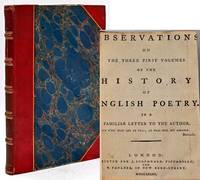
1782298728London: J. Stockdale; R. Faulder 1782. First Edition. Half Leather. Very Good binding. 8vo.; in an attractive later binding of red half-goat over marbled boards with raised bands with morocco label lettered vertically; with marbled endpapers; 2 49 1 pages.~~A note on this rather interesting binding: we assume that the binder was charged with binding a group of different books to a uniform size -- the title page is trimmed and mounted and all the other leaves are folded neatly to fit the bottom edge and then the leading edge over it. Rather astonishing actually.~~This is Ritson’s first book in which he attacks Thomas Warton’s History of English Poetry in such vitriolic tones -- Warton is a pretender a cheater and a liar -- as to cause quite a contretemps in late 18th century English literary circles. One assumes this actually pleased Ritson as he went on the next year to attack Samuel Johnson and George Steevens. Eventually Ritson went complete mad barricading himself in his rooms at Gray’s Inn and setting fire to a pile of manuscripts. Very Good binding. J. Stockdale; R. Faulder unknown
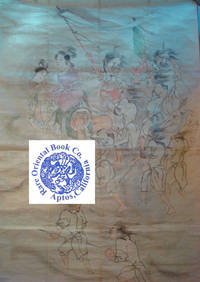
36023801Japan 1860 n.p. Large sheet 96 x 1m 44 cm. gouachevery clean work no worming or other condition issues painted on 16 joined sheets of Washi paper to make one large sheetfine water-color painting. THIS IS AN ORIGINAL PAINTED ART WORK . . . AM ORIGINAL COLOR PAINTING IN GRAND SIZE . . . FROM JAPAN'S OLDEST MYTHOLOGY: . . . THE KOJIKI & NIHON SHOKI PANTHEON . . . THE ORIGINS OF THE EMPEROR . . . OTOHIME GYO RETSU ZU: . . . THE PROCESSION OF OTOHIME DAUGHTER OF THE SEA GOD . . A stunning color painting by Kyosai. Probably done for a temple donation or as an expression of his faith to Japan's historic heroine. . OTOHIME is a goddess in Japanese mythology and is featured in the Kojiki as well as Nihon Shoki. Also known as "Luminous Jewel". A Japanese goddess the beautiful daughter of the sea-king Ryujin. She married Hoori and gave birth to a son after which she turned into a dragon. . Per the Japanese text brushed on the verso upper left corner: "239 ban dated Ansei 7th Kanoe-Saru-doshi 2 gatsu jojun end of February OTOHIME GYO RETSU ZU" . English: "#239 dated Ansei 7th monkey zodiac year end of Feb.: 1860 . PAINTING TITLE PER VERSO: "THE FIGURE OF PRINCESS OTOHIME'S PROCESSION THE DAUGHTER OF THE SEA GOD" . "Toyotama-hime" Japanese for "Lady Bountiful Soul" better known as Otohime is a goddess in Japanese mythology and is featured in the Kojiki as well as Nihon Shoki. She is the beautiful daughter of Ryujin the "God of the Sea." . A STUNNING ORIGINAL POLYCHROME GOUACHE PAINTING: . This original color watercolor painting shows the lively procession of OTOHIME and her hand maid. She is followed by a flag and umbrella bearer. Also following is a man with a pair of deer antlers good omen a man with a small red offering table with peaches the Wind God and his thunder-drum. Another flag bearer his helper followed by two others one holds a staff the other an offering of golden egg. . The items carries are symbolic good fortune and wealth in terms of deer antlers peaches and the golden egg represent ancient Chinese also used by the Japanese of omens of good fortune and good luck. . THE PAINTING: . Per the Japanese brushed text on the verso there is a number found meaning this panel of several was part of a larger work per the chronology found in Clark see below. . This panel of several paintings was part of a restoration of Zojo-ji temple in Shiba. In 1859 KANO Toei & Kyosai "participates in a repair project at the Zojo-ji temple." See Clark. . Although Kyosai had officially left the Kano school in 1854 by participating in the restoration of Tokugawa's family temple in Shiba he was showing loyalty to the Tokugawa family a good reason to volunteer his skills to the temple. It is also noteworthy that his mentor Kano Toei also participated in the restoration and in all likelihood Kyosai joined his master in a sign of respect and loyalty to him. . Based on this chronology it is clear Kyosai was one of the painters who worked at Zojo-ji temple along with his mentor and master teacher Kano Toei. It was not uncommon at this time for schools to volunteer teachers and students to do temple restoration and art work painting replacing or enhancing paintings and large murals. . This item's date matches the restoration dates for the Zojo-ji temple which began in 1859 and continued into 1860. . This panel was unused in the restoration it may have been a precursor to the final painting which was actually used in the restoration project. It matches the scenes found in Zojo-ji temple restoration. The work is the exact style of others painted by Kyosai and his genre. The caricatures of the people in this painting reflect Kyosai's style exactly the theme of his eccentric humor expressing his love for creativity and the joy of painting. . It is entirely within Kyosai's bizarre character to undertake and devote himself to such a project as illustrating the famous myth of OTOHIME in more than 200 deluxe extra-large-size format paintings. . This restoration project could also have been a 'paying job' for Kyosai as at that time he did not seem to be employed but in 1858 he began to design "Kyoga crazy pictures. It was in 1857 he married Okyo the daughter of a Rimpa painter Suzuki Kiitsu but Okyo died in 1859 and he remarried Tose who died in 1860. . It is more than likely Kyosai being a Buddhist he felt it was his religious obligation to do pennants by contributing to and drawing Buddhist or such traditional images as a way to placate the loss of his wife. . THE STORY OF OTOHIME DAUGHTER OF THE SEA GOD: . Because this work was part of the Zojo-ji temple restoration it cannot be considered a commercial painting one that was casually drawn and put on the market for sale. This was part of a commissioned restoration financed by some benefactor to the temple and most likely supported by the Tokugawa family. . ONE OF JAPAN'S EARLIEST AND MOST FAMOUS MYTHS: . The story of OTOHIME DAUGHTER OF THE SEA GOD is one of Japan's oldest and most famous myths known to all Japanese. Treasured as one of the most important in the ancient pantheon it is found in the earliest writing about the origin of Japan and the Emperor in the KOJIKI and the NIHON SHOKI. . This kind of larger paper illustrated story would take months to complete by It would also take devotion to the subject and focus with responsibility to produce a good number of paints daily. This was something Kyosai could and would do ! . THE ARTIST/PAINTER: This work is unsigned which is expected as part of a larger series of paintings. If this was the work of Kyosai it falls entirely within the dates during his period of work produced when he was 29 years old. . The caricature in the faces and fluid bodies in motion the "flowing" style are his. Although there is no signature and it is a true reflection of Kawanabe's work we are attributing it to him. . Another convincing point is that this kind of painting and meticulous style is also found in his famous instructional showing various 'schools' of painting in his KYOSAI GADEN. See below. . WHO WAS KAWANABE GYOSAI/KYOSAI: 1831-1889: Kawanabe Kyosai was a superb artist in the words of a critic "an individualist and an independent perhaps the last virtuoso in traditional Japanese painting". . Living through the Edo period to the Meiji period Kyosai witnessed Japan transform itself from a feudal country into a modern state. Born at Koga he was the son of a Samurai. His first aesthetic shock was at the age of nine when he picked up a human head apart from a corpse in the Kanda river. . After working for a short time as a boy with Utagawa Kuniyoshi he received his artistic training in the Kano school but soon abandoned the formal traditions for the greater freedom of the popular school. During the political ferment which produced and followed the revolution of 1867 Kyosai attained a reputation as a caricaturist. His very long painting on Makimono" scroll The battle of the farts" may be seen as a caricature of this ferment. . He was arrested three times and imprisoned by the authorities of the Shogunate. Soon after the assumption of effective power by the Emperor a great congress of painters and men of letters was held at which Kyosai was present. . He again expressed his opinion of the new movement in a caricature which had a great popular success but also brought him into the hands of the police this time of the opposite party. After this time he changed his name from Kyo crazy or wild to any one of 19 other "Go" studio names he used. However after the police jailed him he avoided use of "Kyo" but returned back to it with three other "GO" that used the same character "Kyo" crazy & wild such as #7 "Baiga Kyosha" #10 "Kyosai #12 Kyosha Gaishi #16 "Shosho Kyosai" Quoted from Roberts below see that reference for more details. . Kyosai is considered by many to be the greatest successor of Hokusai as well as the first political caricaturist of Japan. His work mirrored his life in its wild and undisciplined nature and occasionally reflected his love of drink. . Color photos are posted to our website. . REFERENCE: . More on OTO HIME: heon-org/articles/o/otohime-html KAWANABE Gyosai later known as Kyosai: Is well collected by world museums I GADAN: 1887 4 vol. set: In this work he outlines and exhibits a wide variety of "styles" of painting. In this work there are several examples of this kind or school of painting. Wikipedia stated about this book: "The most important work about Kyosai's art and life was written by himself: Kyosai Gadan or "Kyosai's Treatise on Painting" half autobiography and half painting manual. WESTERN APPRECIATORS: Many westerners came to visit Kyosai and their memoirs about the artist are valuable. The two important ones both rare were: Emile Etienne Guimet Promenades Japonaises Paris 1880. Josiah Conder: "Paintings and Studies by Kawanabe Kyosai" Tokyo 1911. Conder was a serious student of Japanese art; after some initial rejections he was accepted as Kyosai's pupil and accompanied him for ten years until the master's death. Timothy Clark Demon of painting: the art of Kawanabe Kyosai p.186 chronology and the drawing #21 p.58 is very similar to the pose found in our painting of OTOHIME Toyotama-hime both in pose facial quality hair style and the general perspective. ROBERTS Laurance P.: A DICTIONARY OF JAPANESE ARTISTS: PAINTING SCULPTURE CERAMICS PRINTS LACQUER p.100 stated of him: Kyosai ".was marked by a wild eccentric humor.caricatures of full of fantasy and invention." KAWANABE KYOSAI MEMORIAL MUSEUM. KAWANABE KYOSAI DOKU HON. OTOHIME: Nihon Jinmei Daijiten Toyotama-hime. Tokyo: Shogakukan. 2012. . . unknown
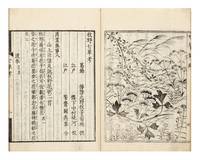
8333One full-page woodcut. .5 29 .5; 15.5 folding leaves. Two vols. 8vo orig. blue wrappers orig. block-printed title labels on upper cover later decorated wrappers later stitching. From the colophon at end of Vol. II: Edo Kyoto & Osaka: Hanabusaya Heikichi et al. 1812.<br /> <br /> <BR> <BR> with:<br /> <br /> <BR> <BR> —. Haru nanakusa ko Thoughts about Seven Herbs in Spring. Three full-page woodcuts & nine smaller woodcuts in the text. .5 36 folding leaves. 8vo orig. blue wrappers as above later decorated wrappers later stitching. From the colophon: Edo: Yamashiroya Sahei 1814.<br /> <BR> <BR> First editions a rare complete set of these two works which are concerned with two important seasonal celebrations. The first of the year is the Festival of Seven Herbs in Spring Nanakusa no sekku a traditional Japanese ritual of eating seven-herb rice porridge on the 7th of January; its consumption would bring longevity and health and ward off evil. The tradition derives from ancient China. The seven herbs are seri Japanese parsley nazuna shepherd’s purse gogyo cudweed hakobera chickweed tahirako nipplewort suzuna turnip and suzushiro daikon radish.<br /> <BR> <BR> The other is the Festival of Seven Autumn Herbs Akino nanakusa less well known then the spring celebration. These herbs are hagi bush clover obana/susuki Japanese pampas grass kuzu kudzu nadeshiko Japanese dianthus ominaeshi Patrinia scabiosifolia fujibakama Eupatorium fortunei and kikyo balloon flower. While many of them have medicinal qualities for this festival they are not for eating but for viewing and admiring.<br /> <BR> <BR> Kikuu Kitano 1762-1831 a native of Sendai came to Edo in the 1780s and opened an antiques gallery that enjoyed great success. In 1804 he purchased a large piece of land in the Mukojima section of Edo where he established a botanic garden today known as the Mukojima Hyakkaen Garden. It is Tokyo’s only surviving garden from the Edo period. There he planted a landscaped orchard of 360 plum trees and other plants including the seven herbs of both spring and autumn selected by Kitano and his literati friends both poets and painters. <br /> <BR> <BR> These works are very beautifully printed using a wide variety of character styles to express meanings and authorship. The first two volumes to be published — on the autumn festival — contain a fine full-page woodcut designed by the author showing all seven herbs. The text contains references to each herb in waka and kanshi Chinese poetry written by Japanese a guide to understanding the nuances of the poetry and the botanical literature.<br /> <BR> <BR> The spring festival volume published two years later describes each of the seven spring herbs and their uses in medicine and gastronomy with many references to the Japanese botanical literature. There is a long passage on how to prepare the springtime porridge. The woodcuts depicting each of the seven herbs are by prominent artists including Kita Busei 1776-1856 and an unidentified woman artist.<br /> <BR> <BR> PROVENANCE: With the seals of Mayori 1829-1906 and Mamichi 1866-1925 Kurokawa prominent father and son book collectors. Their collection was largely concerned with botanical and herbal books; most of the collection was destroyed in the great Kanto earthquake. Our set later entered the collection of Frank Hawley scholar and one of the most discerning collectors of Japanese books and manuscripts. His stamp appears on the first page of text. See R.H. van Gulik’s “In Memoriam. Frank Hawley 1906-1961†in Monumenta Nipponica Vol. 16 No. 3/4 Oct. 1960-Jan. 1961 pp. 434-47.<br /> <BR> <BR> Fine set preserved in a fine chitsu. With some mostly marginal worming much of which has been carefully repaired. unknown
190461076Chicago & New York: Union Book & Publishing Company ca. 1904. Folio. 12 x 13.75 in. pp. 201-216. With photo illustrations throughout. Illustrated printed khaki-coloured softcovers edgewear chipping to head of spine still VG copy. First edition thus of this installment in the bi-monthly “America Her Grandeur†released by Union Book during the opening decade of the 20th Century. This installment focuses on the Alaska and Yukon Territory with excellent gold mining Alaska & Yukon steamships and railroads and more. Although undated the work does specifically mention that the Tenana Railroad will be started in 1905 and that the gold rush had just recently launched with most miners trekking into the Cleary Fairbanks and Ester Creeks in the Fall of 1903. Worldcat locates 3 copies U of GA Clarke Hist. Lib. UTX Austin. Union Book & Publishing Company, paperback
196763083Portland OR: Metropolitan Press 1967. Thick 8vo. 4 419 5 pp. Photo frntsp. numerous photo illusts. Gray-black cloth blue lettering front cover & spine w/ d.j. cover art photo of gold miner minor scuffing toning to fore-edges 1 closed tear upper fore-edge front cover price-clipped still NF/VG- copy w/ former ownership markings on ffep. Alaska Centennial edition of this rousing first-hand account of the early days of the Klondike Gold Rush much of it drawn from the journals and notes of her father and grand father Edward Lung and Clement Lung who joined the stampede from Tacoma WA to the Klondike via Skagway Chilkoot Pass and the Yukon River. He met many of the famed Gold Rush figures including Joaquin Miller and despite the hardships kept a daily diary used in this memoir. See: Kurutz Klondike & Alaska Gold Rushes A Descriptive Bibliography 339b. Metropolitan Press, hardcover
184975634hLondon: For Private Circulation 1849. Book. Very Good. Hardcover. 1st Edition. 4to - over 9¾ - 12" tall. Contemporary half leather over marbled boards with some neat professional restoration to spine corners and hinges. Some toning and foxing to text; old owner's armorial bookplate inside front cover. Otherwise clean tight and unmarked. Very neat -- a sound and handsome copy. . For Private Circulation Hardcover
201028776Berkeley:: Counterpoint 2010. First Printing of the First US Edition. A Fine tight copy in a Fine bright unclipped dust jacket. In the years between 1896 and 1899 thousands of gold seekers journeyed into the remote wilderness of the Yukon Territory in search of quick riches but what many of them found was scurvy frostbite starvation and dysentery. But it was the lure of of Klondike fever that overtook these adventurers from all over the globe to subject themselves to the rowdy and often dangerous frontier towns and mining camps in search of gold. The author tells this Klondike story through the lives of six very different people: a miner a saintly priest a twenty-four year old business woman a British journalist a Northwest Mountie and writer Jack London. Illustrated. Counterpoint, unknown