9 302 résultats
18753700212London: Wertheimer Lea & Co 1875. Book. Good/Very Good. Decorative Cloth. 4to - over 9¾" - 12" tall. pp 148 28 A bright copy binding slightly strained but holding well tissue guard protecting the photo on the inside front cover foxed slight wear to cover. Wertheimer, Lea & Co Hardcover
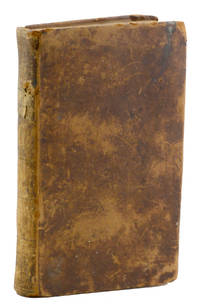
181719498Williamsburgh Mass.: Printed by Ephraim Whitman 1817. First edition. Somewhat rubbed with a small hole to the spine and label; somewhat stained; a good sound copy. 12mo original tree sheep brown leather spine label gilt lettering iv 300 pages all edges sprinkled. The Bard of the Berkshires Bodman 1766-1850 was perhaps the last great efflorescence of the New England Puritan poets in the lineage of Michael Wigglesworth; Bodman's four poems here include a piece "On the Great Mortality of the Women and Children in Williamsburgh in 1788" when six women and five infants died in childbirth: "Six mothers are departed hence! / Their consorts left in great suspense / Which way to go whither to run; / Nor can they their sore troubles shun." Stoddard & Whitesell 1157; Wegelin Addenda 23. Contemporary ink ownership signature on the front blank. Printed by Ephraim Whitman, unknown books
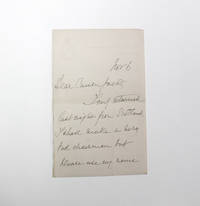
1890024734UK 1890. First Edition . Paper. Good. 48mo - over 3 - 4" tall. An Original Letter Headed Paper from the Commanding Chief Portsmouth and Signed by Admiral of the Fleet Richard James Meade 4th Earl of Clanwilliam. Undated but C1890. The letter to Canon Jacob is with regards a request for him to be a chairman and to arrange a date to discuss. Admiral of the Fleet Richard James Meade 4th Earl of Clanwilliam 1832-1907 was a Royal Navy officer. As a junior officer he served at the Battle of Escape Creek and at the Battle of Fatshan Creek during the campaign against Chinese pirates. He also took part in the Battle of Canton where he was severely wounded during the Second Opium War. As a senior officer Meade went on to be commander of the Steamship reserve at Portsmouth commander of the Flying Squadron and Commander-in-Chief North America and West Indies Station. His last appointment was as Commander-in-Chief Portsmouth Provenance: From the family of autograph collector Emily Mary Rose Lee 1869-1949 wife of Colonel William Crawford Walton 1864-1937. Emily was the daughter of William Lee Professor of Ecclesiastical History at the University of Glasgow from 1874 to 1886 and granddaughter of John Lee 1779-1859 Principal of Edinburgh University from 1840 to 1859. Size is 180m x 115mm. Condition is good. Folding crease. More images can be taken upon request. Ref17164 <br/> <br/> unknown
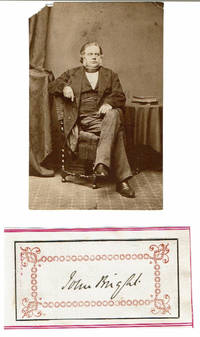
187036586Circa 1870. 1870. Good. - A sepia-toned original photograph of John Bright approximately 3-1/2 inches high by 2-3/8 inches wide. There is a small piece out of the top left corner of the photograph & its top right corner is slightly creased. Good.<p>Together with JOHN BRIGHT'S AUTOGRAPH penned on a 1-3/8 inch high by 3 inch wide slip of paper mounted onto a very slightly larger sheet of stiff paper. Very good. <p>John Bright's autograph together with a full-length portrait of Bright seated cross-legged and wearing a dark suit and waistcoat with a black silk band around his neck.<p>John Bright 1811-1889 was a British Radical and Liberal statesman one of the greatest orators of his generation and a promoter of free trade policies. He is famous for battling the Corn Laws and for promoting close interdependence between Britain and France. He served as Chancellor of the Duchy of Lancaster from September 30 1873 to February 17 1874 and as President of the Board of Trade from December 9 1868 to January 141871. Circa [1870]. unknown
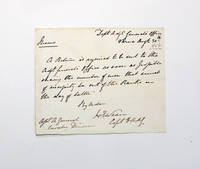
1854025835UK 1854. First Edition . Paper. Good. 24mo - over 5 - 5¾" tall. An Original Handwritten Letter from the Crimean War in the hand and signed by a Captain in the Cavalry H E Weares to Adjutant General Wetherall. Dated 1854. A letter stating that a return needs to be sent to Adjutant General's Office sharing the number of men that were out of ranks on the day of the battle. General George Wetherall 1788-1868 was a senior British Army officer. General Wetherall is most famous for his services during the rebellion in Canada of 1837/38 during which he was the Commander of the Royals' 2nd battalion in the Battle of Saint-Charles a battle part of the Lower Canada Rebellion fought on 25 November 1837 between Great Britain and Lower Canada Patriote rebels. Condition is good. Folding crease. More images can be taken upon request. Size is 165mm x 205mm <br/> <br/> unknown
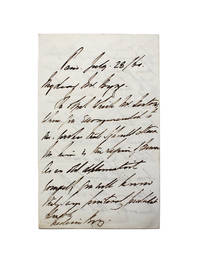
1860032210UK 1860. First Edition . Paper. Good. 48mo - over 3 - 4" tall. An Original Handwritten and Signed Letter by British Diplomat Henry Richard Charles Wellesley The Lord Cowley British Ambassador to France. Dated 1860. The handwritten letter dated July 28th 1860 Paris to a Mr B. signed sincerely Cowley discussing matters relating to the characteristics of a Mr Denton perhaps in relation to a position or appointment. Henry Richard Charles Wellesley 1st Earl Cowley 1804 - 1884 known as The Lord Cowley between 1847 and 1857 was a British diplomat. He served as British Ambassador to France between 1852 and 1867.Earl Cowley is a title in the Peerage of the United Kingdom. It was created in 1857 for the diplomat at the time he was serving in France. Size is 182mm x 142mm. Condition is good. Light folding crease. Gum residue to blank rear. Ref19257 <br/> <br/> unknown
1896010754New York: D. Appleton & Company 1896. Book. Very Good. Hardcover. First American Edition. 12mo - over 6¾ - 7¾" tall. 335 pp Conrad's 2nd novel. Gutter papers split fr and rear binding tight. 5" x 7.5" quarter bound maroon brown leather & marbled paper boards gilt titles and top edge - in fine slipcase - maroon brown cloth matching the color of the leather Spine top leather 1" starting spine bottom 1/16" chip. Book with glassine wrapper. . D. Appleton & Company Hardcover
1896091713Providence RI: Press of E.L. Freeman & Son 1896 Book. Good . Hardcover. Book has some exterior rub marks and speckling as well as edge and corner scuffs. . Press of E.L. Freeman & Son hardcover
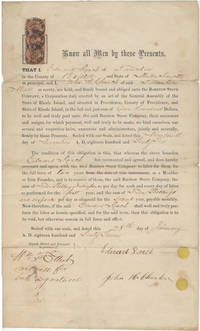
1867009296Bristol County Massachusetts: Barstow Stove Company 1867. Unbound. Very good. This partially printed two-year indenture measures 8.5" by 14". It is dated and signed twice: first on the "sixteenth day of November A.D. eighteen hundred and Sixty-Six" and again in January of 1867. A 25-cent revenue "Insurance" stamp Scott #46 has been affixed and cancelled with multiple strikes of a circular Bartow Stove Company handstamps. The document is in nice shape with splits starting along its storage folds. In this document the stove company agrees to pay Roach "Four Shilling & sixpence" per day for his first year of service and "Five Shillings and sixpence" per day during his second. In return Roach guarantees that if he leaves his job before two years have expired he will pay the company "the full and just sum of One Hundred Dollars."<br /><br />It seems odd that 74 years after Congress declared the dollar to be the official currency of the United States a company would pay employee wages calculated in shillings and pence. Yet the Bulletin of the United States Bureau of Labor Statistics pages 18-19 No. 604 October 1929 reported that "In the payrolls of some New England companies time and piece rates were given in shillings . . . up to 1845 and probably longer although the actual money payment in all cases would have been in American dollars." A very late and uncommon use of British currency by an American manufacturer to calculate the wages of an Iron Founder. <br /><br /> Barstow Stove Company books
189750323091086C J Clark London 1897. First Edition. Hardcover. Very Good Condition/No Dust Jacket. No dust-jacket. Quantity Available: 1. Shipped Weight: 1-2kg. Pictures of this item not already displayed here available upon request. Inventory No: 50323091086. All our books music and maps are sent by a tracked mail service. This book is heavier than 1kg and may incur additional delivery charges on some delivery services to some locations. C J Clark hardcover
18781311993Tübingen, Fues, 1878. 4to. 4 Bl., 73, (1) S. Rückenbroschur (Titel nässe- u. knickspurig, Buchblock m. Randläsuren).
18881083216Tübingen, 1888. 4to. 34 S. Br.
181749073Paris Crochard 1817. No wrappers. Extract from "Annales de Chimie et de Physique Par MM. Gay-Lussac et Arago." tome 5 Cahier 1. With titlepage and htitle to vol. 5. Pp. 21-42. <br/><br/><em>First French edition the German paper issued simutaneously in Gilbert's Annalen of this groundbreaking paper claiming to be the first to announce the isolation of pure morphine from opium. This process marks an importent step in the beginnings of alkaloid chemistry and the isolation of morphine is the first isolation of an alkali of vegetable origin. In his paper Sertuerner coined the word "morphine" after Morpheus the Greek God of sleep.The isolation of morphine from opium the first isolation of a natural product was a seminal event in the development of pharmacology as an independent discipline. The purification kick-started natural product chemistry and quickly led to the isolation of a host of other alkaloids. Within a few years in 1827 Heinrich Emanuel Merck of Darmstadt began selling morphine resulting in the development of the eponymous company. Sertürner reported his first observations on Opium in 1805 which was mainly concerned with the constituent of meconic acid but "it was only in 1817.in the paper offered that he unequivocally reported the isolation of pure morphine. He prepared it by extracting opium with hot water and precipitating morphine with ammonia. he obtained colorless crystals poorly soluble in water but soluble in acids and alcohol. In order to establish that his crystals carried the pharmacological activity of raw opium Sertuerner tested them on himself and three boys "none older than seventeen.". It was a near-catastrophe." Ryan J. Huxtable a. K.W. Schwarz.DEROSNE 1803 made claim of priority in the discovery of opium but he only "prepared a crude extract of opium with alcohol and water and obtained by potassium carbonate preciipitation what he called "sel de Derosne". Derosne's alkaloidal fraction lacked narcotic properties and was probably largely narcotine also known as noscapine perhaps with meconic acid both abundant in opium." Huxtable & Schwarz.Parkinson "Breakthroughs" 1817 CThe offered issue contains another importent paper by Alexander v. Humboldt: "Sur les Lignes isothermes. Extrait" pp. 102-111 and a large folded engraved plate. Here Humboldt introduced "Isothermes" in meteorology. This extract issued at the same time as the larger memoir which appeared in "Mémoires de physique et de chimie de la Société d’Arcueil" 1817. </em> unknown
181749073Paris, Crochard, 1817. No wrappers. Extract from ""Annales de Chimie et de Physique, Par MM. Gay-Lussac et Arago."", tome 5, Cahier 1. With titlepage and htitle to vol. 5. Pp. 21-42.
183549330Paris Crochard 1835. Contemp. hcloth. Gilt lettering to spine. In: "Annales de Chimie et de Physique Par MM. Gay-Lussac et Arago." 2e Series tome 59. 4462 pp. Entire volume offered. Some scattered brownspots. Laurent's papers: pp. 107-111 196-220376-397 a. 397-422. <br/><br/><em>First printing of these importent papers in the history of organic chemistry explaining the differences to Dumas' law of substitutions and introducing a "new type" and what he calls "fundamental and derived radicals". The introduction of the "Nucleus Theory" was the basis for the unitary theory formulated by Gerhardt."While studying the reactions of naphthalene and its compounds with the halogens and nitric acid Laurent was from the start characteristically concerned with the construction of an explanatory theory that would account for these phenomena. Like most creative scientists he generalized his solution to a specific problem through the imaginative use of analogy leading to the elaboration of the first comprehensive theory adequate for dealing with the whole domain of contemporaneous organic chemistry." DSB."A founder of modern organic chemistry Laurent was one of the most important chemists of the nineteenth century. He considered the behavior of matter to be a manifestation of its intimate internal structure which one cannot determine with certainty but which one has to investigate if one wants to understand. Laurent’s preoccupation was to construct a method that could guide the chemist forward along this path from facts to their causes. He was the first chemist to intimately associate crystallo-graphic data and chemical studies. Louis Pasteur and Charles Friedel later followed the way."DSB. </em> hardcover
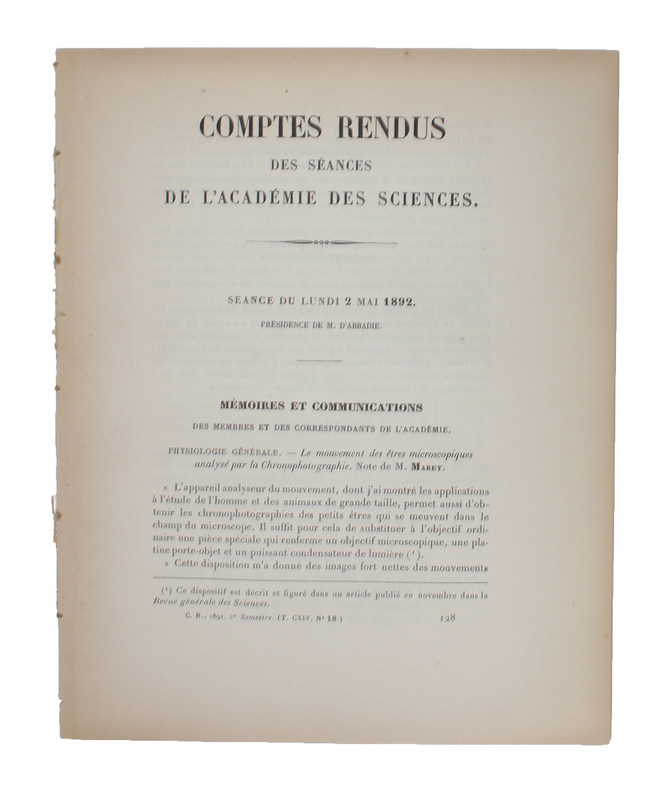
188248088Paris Gauthier-Villars 1882 1888 1892. 4to. No wrappers. 7 entire issues. In: "Comptes Rendus Hebdomadaires des Séances de L'Academie des Sciences" Tome 95 No 1 6 a. 14. Tome 107 No 16 17 a. 18 Tome 114 No 18. 7 entire issues offered. With halftitles and titlepages to Vol. 95 107 a. 114. The papers: pp. 14-16 No1 267-270 no 6 583-585 2 textillustr. no 14 - pp. 607-609 No 16 643-645 1 textillustr. No 17 677-678 No 18 - pp. 989-990 No. 18. Stamps on verso of titlepages. <br/><br/><em>First printing of the main papers CONSTITUTING THE INVENTION OF MODERN CINEMATOGRAPHY -- from his invention of 1888 of the "Chronophotograph" followed the modern "Cinematograph" first described here in the offered papers of 1888.It started with his invention of the chronographic apparatus with stationary plates and chronographic disk schutter. the paper of August 7 1882 later in 1882 his description of the photographic gun and in the 1892 paper "Marey constructs according to the reversible principle of the chronophotograph an apparatus for the projection on a screen of series of pictures taken by the afore-mentioned apparatus and thus realizes the photographic synthesis of motion" Joseph Maria Eder "History of Photography" p.510.Marey 1830-1904 was a French physician and his inventions sprang from his investigations in the physiology of the motion of men and animals."In 1882 Marey often claimed to be the 'inventor of cinema' constructed a camera or "photographic gun" that could take multiple 12 photographs per second of moving animals or humans - called chronophotography or serial photography similar to Muybridge's work on taking multiple exposed images of running horses. The term shooting a film was possibly derived from Marey's invention. He was able to record multiple images of a subject's movement on the same camera plate rather than the individual images Muybridge had produced. Marey's chronophotographs multiple exposures on single glass plates and on strips of sensitized paper - celluloid film - that passed automatically through a camera of his own design were revolutionary. He was soon able to achieve a frame rate of 30 images. Further experimentation was conducted by French-born Louis Aime Augustin Le Prince in 1888. Le Prince used long rolls of paper covered with photographic emulsion for a camera that he devised and patented. Two short fragments survive of his early motion picture film one of which was titled Traffic Crossing Leeds Bridge.The work of Muybridge Marey and Le Prince laid the groundwork for the development of motion picture cameras projectors and transparent celluloid film - hence the development of cinema. American inventor George Eastman who had first manufactured photographic dry plates in 1878 provided a more stable type of celluloid film with his concurrent developments in 1888 of sensitized paper roll photographic film instead of glass plates and a convenient "Kodak" small box camera a still camera that used the roll film. He improved upon the paper roll film with another invention in 1889 - perforated celluloid synthetic plastic material coated with gelatin roll-film with photographic emulsion." Tim Dirks "The History of Film. The Pre-1920s". </em> unknown
188248088Paris, Gauthier-Villars, 1882, 1888, 1892. 4to. No wrappers. 7 entire issues. In: ""Comptes Rendus Hebdomadaires des Séances de L'Academie des Sciences"", Tome 95, No 1, 6 a. 14. Tome 107, No 16, 17 a. 18, Tome 114, No 18. (7 entire issues offered). With halftitles and titlepages to Vol. 95, 107 a. 114. The papers: pp. 14-16 (No1), 267-270 (no 6), 583-585, 2 textillustr. (no 14) - pp. 607-609 (No 16), 643-645, 1 textillustr. (No 17), 677-678 (No 18) - pp. 989-990 (No. 18). Stamps on verso of titlepages.
183549330Paris, Crochard, 1835. Contemp. hcloth. Gilt lettering to spine. In: ""Annales de Chimie et de Physique, Par MM. Gay-Lussac et Arago."", 2e Series, tome 59. 446,(2) pp. (Entire volume offered). Some scattered brownspots. Laurent's papers: pp. 107-111, 196-220,376-397 a. 397-422.
185647113Paris Mallet-Bachelier 1856. 4to. No wrappers. In: "Comptes Rendus Hebdomadaires des Séances de L'Academie des Sciences" Tome 43 No 18. Pp. 825- 892. Entire issue offered. Bernard's paper: pp. 825-829. <br/><br/><em>First printin of an importent paper in toxicology in which Bernard describes how he "paralyzed motor nerve-endings with curare and demonstrated the independent excitability of muscle; his paper is the classical proof of Haller's doctrine of irretability" Garrison & Morton."Bernard was a true innovator in the study of the effects of toxic and medicinal substances. No one before him had understood so well the role of drug metabolization. He regarded poisoning as a local phenomenon and advocated the use of certain poisons in physiological research. Curare and carbon monoxide had served him he said as "chemical bistoury" making it possible to destroy specific structures selectively. "DSB.Garrison & Morton No 616 and 2079. </em> unknown
185647113Paris, Mallet-Bachelier, 1856. 4to. No wrappers. In: ""Comptes Rendus Hebdomadaires des Séances de L'Academie des Sciences"", Tome 43, No 18. Pp. (825-) 892. (Entire issue offered). Bernard's paper: pp. 825-829.
1862TS506London: Smith Elder & Co. 1862. 1st Edition . Hardback. Vg. 12mo. Preface 56pp 130 short notes relating to In Memorian by Tennyson. A nice copy in the original pebble-grained cloth with gilt titles to the front cover and blind rules borders to the front and rear. Minor wear to the foot of the spine. Rev. William Frederick Robertson of Brighton 1816-1853 16cms. All edges red. Brown end-papers. A near fine copy. <br/> <br/> Smith, Elder, & Co. hardcover
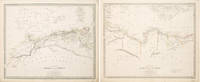
184767246London. c.1847. A pair of North African maps from western Egypt to Mauritania; depicted according to the knowledge of the ancient world. Published by Charles Knight for the S.D.U.K. Size: 352 x 430 mm each. Steel engraving with original outline colour. Good condition some marginal repairs to tears. unknown
1873008009London: William Blackwood and Sons 1873. SCARCE in the complete 28 volume set and in lovely condition. Published from 1873-1882. Overall a Near Fine set bound in quarter vellum over red buckram red morocco labels lettered in gilt edges dyed red the charming period bookplates of Elizabeth Mackintosh along with her name stamp. Light wear to boards small period bookseller's labels rear paste downs the most noticeable flaw a 1/2" tear to vellum at bottom edge of spine to one volume. Three volumes with fold-out maps NF small crease to Fine. Publisher's 16 pp. advertisement at end of Homer volume. Titles are: Iliad and Odyssey; Hesiod Theognis and the Greek Anthology; Plato and Lucian; Aristotle and Demosthenes; Aeschylus and Sophocles; Euripedes and Aristophanes; Herodotus and Xenophon; Thucydides and Livy; Ovid Catullus Tibulus and Propertius; Caesar and Tacitus; Cicero and Pliny; Juvenal Plautus and Terence; Lucretius and Pindar; Virgil and Horace. This multi-volume set will require additional postage for international orders please inquire before ordering. . First Edition. Quarter Vellum. Near Fine/No Jacket As Issued. 12mo - over 6¾" - 7¾" tall. William Blackwood and Sons Hardcover books
18953217The Newman Press. Very Good- in Good dust jacket. 1895 1954. Hardcover. Has Nihil Obstat and Imprimatur; 232 pages . The Newman Press hardcover
1840506959London 1840. Hardcover. Good/None. Hardcover. Volume Two. Rebound. Some pencil underlining and notation. Previous owner's signature on front end paper. Light markings to covers. Record # 506959 hardcover