[Pablo Picasso] Christian ZervosBiblio.com
1 544 résultats
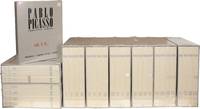
2014167067Paris: Cahiers d'Art 2014. Softcover. Revised Edition one of 1200 English language copies. Complete in 33 volumes. As New.<br /> <br /> Preceded in publication by the original French language editions published individually between 1932 and 1978 and the French language 33-volume set published in 1991.<br /> <br /> Catalogue raisonné published by Cahiers d'Art founder Christian Zervos in partnership with Picasso himself. Illustrated with over 16000 black-and-white images of Picasso's work. A monumental production.<br /> <br /> Fine and unread each volume in the original Near Fine glassine dust jacket. Housed in nine off-white linen slipcases as issued by the publisher. Still in publisher's shrinkwrap. <br /> <br /> Oversize set shipping billed at cost. Cahiers d'Art unknown
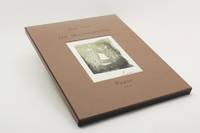
1969902981969. PICASSO Pablo. El Entierro del Conde de Orgaz. Three volumes. 12 XI 1 69 7 pp. Illustrated with one signed engraving and 12 etchings by Picasso and a preface by Rafael Alberti. Folio 370 x 470 mm bound loose as issued in the original wrappers and vellum-covered slipcase. The whole preserved in a cloth folding box. Barcelona: Gustavo Gili and Ediciones de la Cometa 1969. A Spanish production in every sense in this Picasso book Picasso illustrated his own poetry based upon his life and youth in Andalucia. The title bears reference to the painting by El Greco an artist very much admired by Picasso. Picasso began this poem in 1957 during a period of renewed interest in his Spanish heritage. Included in the work is a facsimile of Picasso's original manuscript of the poem written in coloured pencils. To illustrate his autobiographical poetry the artist selected one of his engravings from 1939 and etchings finished between 1966 and 1967. Printed and published by the publishing house Gustavo Gili of Barcelona with a prologue-poem by Rafael Alberti El Entierro del Conde de Orgaz includes a total of thirteen Picasso etchings of circus scenes and allegorical images infused with eroticism all echoing the artist's Spanish homeland and influences therefrom. One of an edition of 263 copies on Romani wove. It is notable that the present publication was the subject of a single exhibition at the Fundacion Picasso "Pablo Ruiz Picasso: El Entierro del Conde de Orgaz" May 2004. Goeppert 146. Bloch 1465-1477. Johnson Artists' Books in the Modern Era 1870-2000 No. 92. hardcover
196948574Barcelona.: Ediciones de la Cometa. 1969. Loose as issued in original publisher's printed wrappers and cloth-lined parchment-covered box. 2 vols. Folio. 470 x 370 mm or the reverse. Frontispiece engraving with burin signed in pencil by Picasso loose in paper portfolio as issued and Picasso's printed text illustrated with a further 12 original etchings by Picasso. Picasso's poetic and pictorial homage to El Greco and Velazquez.From the edition limited to 263 copies with this one of 220 examples with 12 original etchings together with an original etched frontispiece signed in pencil by Picasso.'From 1955 on the frequent visits of fellow Spaniards re-awakened Picasso's memories of Spain. In 1957 he began to write again in Spanish and he painted 'Las Meninas' after Velazquez. From January 6 1957 to August 20 1959 - the date of each text is meticulously noted - he wrote this dramatic poem and gave it the title of El Greco's masterpiece … Ten years later he suggested to Gustavo Gili a publisher in Barcelona that he should publish the piece. To illustrate it he chose 15 prints done between 1966 and 1967 … The prints depict fleshy women watched by a jealous cupid a male who is ferocious and ready for violence circus theatre and family scenes and the painter and his model. To these was added a burin engraving dated June 9 1939 in which a text in Spanish beginning 'Trozo de almíbar' 'bit of sirop' is enclosed by remarques.' Cramer.Cramer 146. Ediciones de la Cometa. hardcover
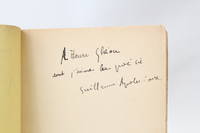
191371213Paris: Mercure de France 1913. Fine. “To Henri Ghéon whose poetry I love Guillaume Apollinaire” Mercure de France Paris 1913 11.50 x 18.50 cm broché First edition one of the first-issue copies press-numbered from a total limitation of just 23 deluxe copies on Holland paper. Illustrated with a frontispiece portrait of Guillaume Apollinaire by Pablo Picasso. Spine sunned with discreet restorations.Our copy is preserved in a red half morocco chemise spine with five raised bands date lettered at the foot paper-covered boards matching paper slipcase edged in red morocco the whole signed by Boichot. Rare signed autograph inscription by Guillaume Apollinaire: « à Henri Ghéon dont j'aime la poésie Guillaume Apollinaire ». Our copy further contains five manuscript corrections in ink by Apollinaire on pages 71 77 92 110 and 189. Also included is an autograph satirical quatrain by Apollinaire composed two years earlier offering a caustic critique of René Fauchois's mediocre play 'Rivoli' devoted to Napoleon. Apollinaire presented this copy to Henri Ghéon literary critic for La Nouvelle Revue Française. The poet took care to correct himself the typographical errors still present in this very first edition corrections likewise found in other presentation and review copies distributed by the author. Upon receiving his copy Ghéon devoted an article to Alcools «Alcools par Guillaume Apollinaire» Nouvelle Revue Française no. LVI 1 July 1913 describing the collection as a «démarche aventureuse». Presentation copies of this work inscribed by Apollinaire are rare and highly sought after. The small autograph satirical quatrain by Apollinaire composed two years earlier offers a caustic critique of René Fauchois's mediocre play 'Rivoli' devoted to Napoleon. Although it makes no claim to the poetic ambition of Alcools the poem nevertheless shares with that celebrated collection several features that illuminate the genesis of Apollinaire's masterpiece. Published under the pseudonym « Montade » in the Mercure de France of April 1911 with five commas the manuscript of the poem is written entirely without punctuation just like the avant-garde poems of Alcools. The very form of this brief poem reveals Apollinaire's curiosity and his constant search for the renewal of poetic expression as evidenced by the introductory note accompanying its publication in the Mercure: « Chantecler a été l'occasion pour les poètes français de reprendre un genre délaissé l'épigramme. . Le Rivoli de M. Fauchois a aussi inspiré des épigrammes. En voici deux qui sont bien tournés. L'une a été insérée dans l'Intransigeant :Après Beethoven Amen ! Après Rivoli au lit !La seconde parce qu'il y a plus de ruelles court les brasseries :Le grand Napoléon au jour de Rivoli Avait fait par ma foi une belle trouvaille Inutile vraiment puisque partout on lit Qu'à l'Odéon Fauchois a perdu la bataille » One also notes the poet's own assessment of his work and his desire for a poetry that wanders freely through the streets and cafés liberated from the constraints of print punctuation and formal rigidity much like the cascading calligraphy of these handwritten verses composed nine years before Calligrammes. Mercure de France hardcover
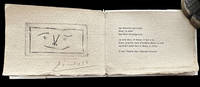
1956N - 2023 - 99<p>Rene Crevel first edition of is poem NUIT published in the "Autumn 1924 Winter 1925" issue of Little Review New York magazine illustrated with an original engraving with burin on celluloid by Picasso signed in pencil. Oblong tiny format 65 x 90mm published by PAB Alès May 1956. Limited numbered edition of 30 copies printed on fine Auvergne laid paper by Richard-de-Bas n. 29 signed in pencil by PAB Pierre Andre Benoit Ref: Cramer 74. Very Good lightly tanned.</p> PAB (Pierre Andre Benoit)
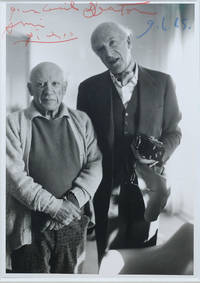
19652784France: np 1965. First edition. Very Good. Cecil Beaton. INSCRIBED BY PICASSO IN RED AND BLUE CRAYON TO THE PHOTOGRAPHER CECIL BEATON: "pour Cecil Beaton. Ami Picasso 9.6.65.". Cecil Beaton British 1904 -1980 photographed virtually every prominent person in public life over the course of his career which spanned more than half a century. Everyone from the Queen to the Rolling Stones sat before his lens. As an arbiter of glamor the opportunity to sit for Beaton represented the pinnacle of success for many but in some cases it was Beaton who pursued the sitter and he had followed Pablo Picasso Spanish 1881 - 1973 long before they first met.<br /> <br /> As one of the foremost artists of the twentieth century Picasso was sought after by many who wanted to rub elbows with success. He became one of those whom Beaton photographed several times over a period of many years first at the rue de la Boetie in Paris in 1933 then at the rue Augustins in 1944 and finally at Mougin in the south of France in 1965. Vickers. In addition to taking photographs Beaton wrote about Picasso in his private diary sketched his portrait and after the 1965 sitting wrote a profile of Picasso for Vogue Magazine.<br /> <br /> Photographs from Picasso's home in the hills above Mougin reveal a close bond between the two men. Here they appear relaxed comfortable with one another and with a gleam in their eyes. By then Picasso was 84 years old and still painting late into the nights. Writing in Vogue Beaton describes Picasso's energy as he gave Beaton a tour of the sprawling studio crowded with paintings some still wet with paint and others from decades before.<br /> <br /> Beaton wrote of Picasso's welcome: "Pablo said 'It has been twenty years since I last saw you!' A golden Picasso threw open his arms. 'After so long we must embrace.'" The two then made much fun about the passage of years and how they had aged. Beaton. A clear sign of affection Picasso inscribed select prints and dedicated them to Beaton. Picasso writes in red and blue crayon on this print: pour Cecil Beaton. Ami Picasso 9.6.65. The print stands as testament to the kinship between the two artists.<br /> <br /> Provenance: With stamp "From the Beaton Studio / Sotheby Parke Bernet" on verso sold Sothebys Parke Bernet 1978. Also with stamped notation "1/1" possibly indicating that this is a unique print. We have not been able to locate any others.<br /> <br /> Silver gelatin print. Signed inscribed and dated by Pablo Picasso "pour Cecil Beaton / Ami / Picasso 9.6.65" in red and blue ink recto. Image: 111â„4 x 73â„4 in. 28.5 x 19.6 cm.; sheet: 111â„2 x 91â„4 in. 29.2 x 23.4 cm. Majestically framed to an overall size of 24 x 19.5 in. Small abrasion evident to the right of Beaton's left ear; otherwise fine.<br /> <br /> References:<br /> <br /> Vickers Hugo ed. Cecil Beaton: Portraits & Profiles. London: Frances Lincoln 2017. P 152.<br /> <br /> Beaton Cecil. "Golden Picasso" Vogue Magazine volume 146 November 15 1965. np unknown
1965127727Paris: Galerie Louis Leiris 1965. Edition of 50. Signed in pencil lower right by Picasso numbered lower left. Etching and aquatint on Richard de Bas paper. Image size: 27.1 x 37.6 cm. Sheet size: 42 x 51 cm. Framed size: 63 x 56 cm. Excellent condition. Presented in a hand-made white gold leaf frame with acrylic glazing. Bloch 1218; Baer 1200 Bb1. unknown
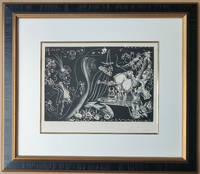
196674882<p>Pablo Picasso<br />Untitled from Le Cocu Magnifique 1966<br />Etching with aquatint<br />Hand signed lower right<br />Numbered 12 / 30<br />mage size: 22.5 × 32.5 cm<br />Frame size: 50.5 x 58 x 2 cm<br />Published by Crommelynck Paris</p><p>Reference Bloch 1249 Baer 1437</p><p>There was also an unsigned and unnumbered edition of 200 with narrow margins</p>
1967126012Paris: Galerie Louis Leiris 1967. Edition of 50. Signed in pencil lower right by Picasso numbered lower left. The plate was originally etched in 1963 of which one image was printed the edition was printed and released in 1967. Aquatint on Vélin de Rives paper. Image size: 31.2 x 41.2 cm. Sheet size: 45.1 x 55.2 cm. Framed size: 57 x 65.7 cm. Excellent condition. Presented in a handmade white gold leaf frame with conservation acrylic glazing. Bloch 1115; Baer 1108 IIIBb. unknown
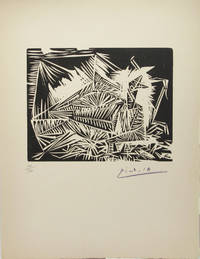
1939172347Paris: Jonquières 1939. Edition of 226. Signed in red pencil crayon lower right by Picasso numbered in pencil lower left. Linocut on Velin d'Arches paper lower edge deckled. Image size: 15.9 x 20.2 cm. Sheet size: 36.7 x 28 cm. Framed size: 48.6 x 43.3 cm. Toning to margins otherwise a bright impression. Presented in a handmade white gold leaf frame with conservation acrylic glazing. Bloch 326; Baer 1028; Cramer 84. unknown
194748620Paris.: Latitud Curenta y Uno. Le Degré Quarante et Un / 41º. 1947 / 1948. . Oblong folio. 396 x 620 mm. Etching grattoir and burin on copper by Picasso printed on a full sheet of parchment pierced at edges for printing and with central fold by Roger Lacourière Paris; sheet size: 396 x 310 mm folded 396 x 620 mm unfolded. A very rare signed proof of the cover for 'Pis'mo: Escrito por Iliazd / Grabado por Picasso' Picasso's 1948 collaboration with Iliazd.Picasso's etching with grattoir and burin is for the vellum cover of the 1948 book 'Pis'mo' also known as 'Escrito por Iliazd / Grabado por Picasso'. The text of the book is a love poem in Russian by Iliazd one of the very few he wrote after leaving Georgia inspired by his meeting with Olga Djordjadze - Picasso too met her later - in Cannes in 1946. Picasso's print includes the title in Russian correctly at the top and incorrectly and effaced beneath as well as at right the figure of a woman seen from behind and turned away from the viewer; Picasso has dated the print '3 mars 47' in the copperplate which is printed in reverse.The present proof is printed on a sheet of vellum as for the published book although slightly whiter and slightly thinner than the published version and while it does have a central fold it is unfolded at the head and foot and is pierced around the outer edge of the sheet with small pinholes as part of the printing process. Signed at lower right by Picasso the sheet is annotated by Iliazd verso above and beneath the visible platemark 'haut' and 'bas' and 'Plier à l'envers'; Iliazd appears too to have drawn a pencil frame it differs from the engraved area to the verso beneath the 'haut' and 'bas'. A different hand has annotated the foot of the blank area adjacent to the printed section: 'Picasso P. Eau-forte pour la couverture du livre d'Iliazd 'ESCRITO' 1er Epreuve d'essai sur parchemin / le livre a été tiré à 66 exemplaires'.Proofs of the cover are very rare and examples signed by Picasso rarer still. Baer suggests that several trials and proofs were taken from Picasso's plate noting the 'bon à tirer' example on 'vélin sans filigrane' Georges Bloch's copy on parchment inscribed 'tirage d'essai' by Iliazd and signed at a later date by Picasso 'environ 7 épreuves sur parchemin avec annotations d'Iliazd sur la préparation du parchemin et le séchage' as well as a final signed example sold by Sotheby's in the 1970s.'In his poem 'Rogelio Lacourière pêcheur de cuivres' published in 'Hommage à Roger Lacourière 1968 Iliazd recalls in poetic terms the genesis of the book's title etching. The story goes that Lacourière had given Picasso a plate which was too large and which had a white mark to indicate where it should later be cut. Picasso - tempted by this extra space and the unexpected freedom it gave him - etched a nude on it. Lacourière therefore refrained from cutting the plate and Iliazd noticed that the asymmetry thus created in the title etching echoed his conception of the folded pages: the 'magnaminous' painter had 'transfigured' the book.' Patrick Cramer.Baer 785Ba; Bloch 462; see Cramer 48. Latitud Curenta y Uno. (Le Degré Quarante et Un / 41º). unknown
193934506Paris: From the Press of Robert Blanchet ca. 1939. No. 161 of a Limited Edition of only 226 copies printed on vélin d'Arches. AN ORIGINAL GRAVURE A LA GOUGE PRINT SIGNED IN CRAYON BY PICASSO. Folio single sheet. A fine copy of the signed engraving. A very important print a signed impression of the original linogravure 'Le Pigeonneau' c. 1939 which is believed to be either Picasso's first or second effort in the technique. From the Press of Robert Blanchet unknown
19541604031Les Éditeurs Français Réunis Paris 1954. Limited Edition. Hardcover. Very Good. Signed Limited edition. 1/100 signed by Picasso of a total limited edition of 530. Picasso illustrated this essay of Diderot's with four portraits of the great thinker whose mind "anticipated and epitomized moral psychological and social opportunities and stresses attending the assimilation of science into culture" DSB 4: 84. The portraits are reproduced in lithograph print form by Mourlot Frères Paris. There were also 430 copies printed on vélin pur Lafuma. Text in French. Housed in publisher's slipcase. One of the smallest signed limited editions by Picasso. Les Éditeurs Français Réunis, Paris hardcover
28434Alès PAB mars 1967. 1 vol. 260 x 335 mm de 34 p. et 2 f. En feuilles sous emboîtage signé de Julie Nadot. . Première édition illustrée par Picasso : 4 cartalégraphies originales à pleine page 1966 représentant des masques telluriques. Un des 60 exemplaires sur Rives signés par Picasso et PAB n° 12. Exemplaire enrichi de 2 tirages supplémentaires de 2 des gravures l'un comportant un envoi signé : « Pour Char Picasso » l'autre signé par l'artiste. . L'édition PAB est la dernière qui sera donnée des Transparents qui ont fait l'objet de nombreuses rééditions depuis leur première parution en 1949 au Mercure de France. Avant Picasso Louis Fernandez Vieira da Silva Nicolas de Staël s'y étaient risqués. Les Transparents aux yeux de Char étaient les personnages de son enfance peu à peu disparus du paysage rural : jusqu'à dix-sept - tous des hommes - se trouveront décrits dans les différentes éditions que donnera le poète : Toquebiol Joseph Puissantseigneur Laurent de Venasque Crillon le brave Odin le Roc Raymond de Ridet entre autres formeront cette curieuse et respectée cohorte de figures d'errants. Picasso en donnera ici quatre saisissants portraits par un procédé nouveau pour lui mais qu'il avait vu utiliser par Georges Braque avec PAB : « Un carton plan ou ondulé souple ou plus rigide est découpé déchiré incisé ou gratté par l'artiste puis fixé par l'imprimeur sur un support à la hauteur typographique finalement encré et tiré » Coron Le Fruit donné p. 39. La cartalégraphie constitue un développement de la gravure sur celluloïd déjà pratiquée par Picasso avec PAB. Grâce à procédé PAB imprima huit livres de Braque dont le premier en 1959 Dans vos jardins. Après Picasso ce fut au tour de Joan Miró d'être conquis en 1975 ; il réalisa cinq découpes : trois furent employées dans Pour 1971. Exemplaire exceptionnellement enrichi conservé dans un délicat emboîtage de Julie Nadot. De la bibliothèque R. & B. Loliée ex-libris et Didier Pineau-Valencienne ex-libris. Bloch 1236. Alès, PAB, (mars) 1967. 1 vol. (260 x 335 mm) de 34 p. et [2] f. En feuilles, sous emboîtage signé de Julie Nadot. unknown
1956N - 2026 - 8<p>Au Vent d'Arles Paris 1956. Foreword by Antonina Vallentin. Limited numbered edition of 200 copies 26 H.C on Richard de Bas paper. Portfolio with 12 pochoirs of drawings after Picasso Guarded in the original pictorial cloth folder.</p> Au Vent d'Arles
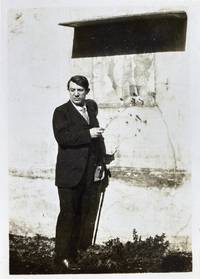
191778126Paris 1917. Fine. Paris 1917 6.30 x 8.60 cm une photographie Original photograph likely unique and unpublished of Pablo Picasso at the Casa di Marco Lucrezio Pompeii spring 1917 Paris 1917 63 x 86 cm one photograph Original photograph depicting Pablo Picasso in the spring of 1917 at the Casa di Marco Lucrezio in Pompeii holding a twig in front of a wall on which there is a Pompeian fresco. Contemporary silver print perhaps unique from Jean Cocteau's personal archives then the Maurice Sachs collection. Exceptional almost undiscovered and probably unpublished photograph taken by Jean Cocteau during the stay. On 16 April 1917 Picasso visits Pompeii accompanied by Jean Cocteau and Léonide Massine to prepare the ballet Parade the first work described as surrealist by Guillaume Apollinaire for the new season of Serge de Diaghilev's Ballets Russes. On his return this initiatory journey inspired his monumental painting: the Parade stage curtain a real visual signature of the ballet marking the beginnings of Picasso's neo-classical period and today preserved at the Musée national d'Art Moderne Georges Pompidou. Pierre Daix in his bibliography dedicated to the painter recounts the aesthetic shock caused by the discovery of the Pompeian frescoes: Giovanni Carandente to whom we owe the best studies on this trip highlights that Picasso was strongly struck by the animation and the sensuality that the cataclysm of the year 79 AD had brutally destroyed. If it is true as he wrote to Gertrude Stein that he immediately drew many Pompeian fantasies which are a little daring attracted as he was by the erotic elation that emerges from these licentious paintings . these memories settled in him to emerge with force thereafter. . Everything that had made up the Pompeian universe was preserved on the site as well as in the National Archaeological Museum of Naples . In its singularity this universe contributed to enriching Picasso's cultural heritage with something more alive more trembling than he had gained from his museum visits until then. He particularly loved the conciseness of the paintings: two or three years later the impressions felt in Pompeii were to translate into a real creative explosion a series of paintings which all bore traces of these never buried memories. This source was to remain alive until La Danse of 1925. Pierre Daix Picasso. Unique and early original photograph of Picasso taken and printed by his friend Jean Cocteau in a mythical place that will influence his aesthetic for the long-term. Provenance: Jean Cocteau's personal archives then the Maurice Sachs collection and Max-Philippe Delatte. unknown
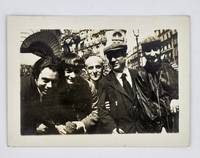
191678127Paris 1916. Fine. Paris 12 août 1916 6.30 x 8.60 cm une feuille Original photograph likely unique taken by Jean Cocteau showing Pablo Picasso and Co in Montparnasse in front of the café La Rotonde the 12 August 1916 Paris 12 august 1916 63 x 86 cm one photograph Original photograph by Jean Cocteau taken on 12 August 1916 showing Manuel Ortiz de Zárate Moïse Kisling Max Jacob Pablo Picasso and the model Pâquerette his girlfriend at the time posing in front of the famous café La Rotonde on Boulevard du Montparnasse in Paris. Contemporary silver print probably unique from Jean Cocteau's personal archives then the Maurice Sachs collection. This image was published in Billy Klüver's book entitled A day with Picasso: twenty-four photographs by Jean Cocteau 1997. However Klüver states that he didn't know the original photograph and used a modern reprint from the negative in the Cocteau archives for his work. We have not found any other copy of our original photograph in international public collections. Billy Klüver has assembled and commented on the twenty-one photographs taken by Jean Cocteau on 12 August 1916 in Montparnasse close to this intersection of the Boulevard Raspail and the Boulevard du Montparnasse which was named Place Pablo-Picasso in 1994. They take us to the café La Rotonde before which a beaming Picasso in a cap speaks with Max Jacob whose baldness shines in the sun behind them Henri-Pierre Roché in uniform and Manuel Ortiz de Zarate sit at a table on the terrace of the same café where Pablo is next to the glowing Pâquerette and the young Polish painter Moïse Kisling. Pâquerette with her hair in a headband a chic dress is the queen of the encounter. . It's the relaxed life at the back. Pâquerette or rather Émilienne Pâquerette Geslot was then a star model of the fashion designer Poiret who was all the rage at the time. A real one-day film of Picasso outside of his studio. Pierre Daix Picasso In his book Klüver questions the presence of all these artistic authorities in the making in a Paris that is deserted by war. The answer is according to him to search in the direction of the Salon d'Antin an exhibition organized by André Salmon in July 1916 in which all the protagonists of our photograph took part with the exception of Pâquerette. It is also on this occasion that Picasso reveals his Demoiselles d'Avignon to the public. This extremely rare image taken by Jean Cocteau with his mother's Kodak camera immortalizes a moment of joy that depicts the artistic all-Montparnasse of the early 20th century. Provenance: Jean Cocteau's personal archives then the Maurice Sachs collection and Max-Philippe Delatte. unknown
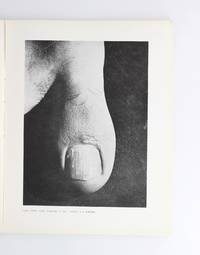
192988960Paris: Documents 1929. Fine. ""Documents . was made into a laboratory a genesis a crucible a rebellion a madness in short an avant-garde."" Jean Jamin Documents Paris 1929-1930 nº 1 à 7 avril 1929 - décembre 1929 ; nº 1 à 8 janvier 1930- octobre 1930 22 x 27.50 cm 15 volumes brochés sous coffret First edition 15 issues in 15 separate instalments abundantly illustrated with black and white photographs. Complete with the special issue Hommage à Picasso #3 1930 and the index for the year 1929 published as a separate 8-page stapled booklet. Some spines slightly faded not affecting the text occasional minor foxing along the margins of certain covers Presented in a custom slipcase with a flat spine in blue morocco title stamped in palladium and spine framed in palladium decorative blue paper boards sky-blue suede doublures; a handsome ensemble signed Boichot. Complete series of this legendary and non-conformist magazine founded by Georges Bataille which gave voice to fields of art and knowledge unrecognised by official culture or considered controversial: popular literature jazz cabaret advertising everyday life Annie Pirabot along with so-called primitive art and objects. Texts by Jean Babelon Jacques Baron Georges Bataille Alejo Carpentier Arnaud Dandieu Robert Desnos Carl Einstein Roger Gilbert-Lecomte Marcel Griaule Juan Gris Eugene Jolas Marcel Jouhandeau Michel Leiris Georges Limbour Marcel Mauss Léon Pierre-Quint Jacques Prévert Raymond Queneau Zdenko Reich Paul Rivet Georges Ribemont-Dessaignes Georges-Henri Rivière André Schaeffner Roger Vitrac among others. Numerous full-page artistic contributions by Hans Arp Constantin Brancusi Giorgio De Chirico Alberto Giacometti Juan Gris Henri Laurens Fernand Léger André Masson Joan Miró Pablo Picasso Joseph Sima etc. The journals pioneering and interdisciplinary approach established it as one of the most important publications of the century: a dissident voice against the doctrinaire surrealism of André Breton Documents was conceived as a war machine against received ideas in Batailles own words and gathered an eclectic array of contributorsacademics ex-Dadaist and Surrealist painters and poets philosophers. It remains renowned for its striking juxtapositions: Rather than assemble documents from separate fields rather than uphold the usual subordination of image to text the journal gives photography drawing and image the privilege of being the most primal substance or the most original trace of human expression Georges Sebbag. Ethnography Documents is remembered above all for Batailles radical ethnographic stance focused on the material and detached from aesthetic criteria and the usual fascination with exoticism. These groundbreaking views foreshadow the Collège de sociologie that Bataille would later found with Michel Leiris Roger Caillois and Jules Moncrot. They are also reflected in the journal through numerous photographs of masks stones and other non-Western artistic creations Siberian Chinese. set alongside modern artworks including drawings by Klee and paintings by Picasso. Bataille also collaborated with the notorious Hans Bellmer who would go on to illustrate the famous second edition of Histoire de lil to create a terrifying portrait of the Hindu goddess of destruction Kali. photography The journal places particular emphasis on photography. Among its most celebrated contributions are the close-up photographs of toes by Jacques-André Boiffard accompanying Batailles essay on the foot in issue no. 6: The point of this article lies in an insistence on directly and explicitly challenging what seduces without relying on poetic contrivances which ultimately amount to little more than diversion Bataille concludes. His fascination with the abnormal and the destructive is also evident in Boiffards fetishistic and sadomasochistic photograph of a woman wearing a Documents hardcover
19561288661956. Signed. PICASSO Pablo. Autograph letter signed. Cannes March 4 1956. One leaf measuring 5-1/4 by 8-1/4 inches writing in ink on recto; handsomely floated matted and framed with a later print of his self-portrait entire piece measures 17-1/2 inches by 15 inches. $13500.Autograph letter signed by Pablo Picasso written to his friend the banker Max Pellequer.The letter written from Picasso's studio ""La Californie"" in Cannes reads in full in translation: ""'La Californie' Cannes le 4.3.56. ""My dear friend Max I present to you my friend Roland Penrose who is writing a book about me. He would like me to see his words manuscript at your house. Thank you and best to you. Picasso."" The recipient of this letter Max Pellequer was a French banker who co- founded and later directed the Banque Nationale du Commerce et de l'Industrie. Over several decades Pellequer's astute financial advice and shrewd stewardship of Picasso's sprawling assets enabled the artist to become a millionaire. Pellequer was also a kindred spirit a serious art collector who acquired artwork by artists like Picasso Degas Cézanne Gauguin Matisse Miró Modigliani Dufy and others. Picasso purchased works from Pellequer's collection and the artist designed a bookplate for his beloved friend. During the Nazi occupation of France Pellequer is believed to have helped save some of Picasso's work by hiding it. This is no small accomplishment when one considers it would have probably been classified as ""degenerate"" by the Nazis and otherwise destroyed. Sir Roland Penrose 1900-1982 was a British surrealist artist and avid promoter of modern art. He wrote Portrait of Picasso in connection with an exhibition in celebration of Picasso's 75th birthday held from May to September 1956 at the Institute Contemporary of Contemporary Arts in London and MOMA in New York. With an introduction by Alfred Barr the volume included paintings and drawings personal photographs documents and souvenirs of Picasso as seen by himself and through the eyes of his friends.Fine condition. unknown
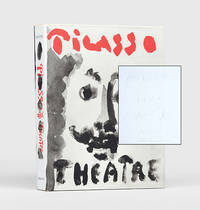
174163New York: Harry N. Abrams Inc. 1987. With an original drawing by Hockney Second edition first printing inscribed in pencil by Hockney on the front free endpaper "For Jonathan 'Love' David H Dec 23rd 1993" with a sketch of Salts Mill below the inscription. The recipient was Hockney's good friend Jonathan Silver 1949 - 1997 who in 1987 purchased the derelict former cloth factory building Salts Mill in Saltaire West Yorkshire and transformed it into a space for art and culture which now houses the largest and only permanent collection of Hockney art in the world. The book first published in 1968 with the co-operation of Picasso covers Picasso's passion for the theatre. It includes his paintings drawings watercolours lithographs photographs including some from Picasso himself and correspondence. Quarto. Includes 447 plates with 68 in full colour. Original beige cloth lettering to front cover and spine in gilt. With dust jacket designed by Picasso. Fine in fine unclipped dust jacket. hardcover
1924177844Paris: Galerie Simon 1924. Edition of 50. Signed in pencil lower right by Picasso numbered lower left. Printed by Charlot Freres. Provenance The Redfern Gallery Ltd.1973. Original lithograph from drawing in crayon and scraper on stone printed in black ink on Vélin Van Gelder watermarked wove paper all edges deckled. Image size: 29.5 x 21 cm. Sheet size: 37.8 x 29 cm. Framed size: 59.5 x 49.6 cm. Light horizontal creasing throughout otherwise in very good condition. Presented in a gold leaf frame with conservation acrylic glazing. Bloch 69; Baer 239; Mourlot XIX. unknown
1965176514Stuttgart: Verlag Gerd Hatje 1965. With two signed Picasso lithographs First edition first printing number 98 of 100 copies with a suite of 9 original lithographs printed by Mourlot Paris on BFK Rives paper and signed by the artists: 2 by Picasso and 1 each by Elie Lascaux André Beaudin André Masson Suzanne Roger Eugène de Kermadec Yves Rouvre and Sebastian Hadengue The picasso lithographs are titled Visage and Le femeur. Kahnweiler was a German-French art dealer who was a great supporter of burgeoning artists without dealers from the Montparnasse and Montmartre area. His initial purchases included works by Kees van Dongen André Derain André Masson Fernand Léger Georges Braque Juan Gris and Maurice de Vlaminck. He also represented all of the artists participating in this book. Quarto. Nine full-page lithographs including dust jacket tipped-in illustrations throughout. Original blue cloth boards lettering and design to front cover gilt. With dust jacket. Together with a blue cloth folder housing 9 original lithographs sheet sizes: 29.5 x 25 cm. All contained in publisher's cardboard slipcase. All in fine condition jacket unclipped. Bloch 1179 & 1180; Mourlot 403 & 404 Cramer 133. hardcover
193748609Paris.: G. L. M. Guy Lévis Mano. 1937. Loose as issued poster and invitation original publisher's orange glazed paper wrappers stitched as issued with illustration by Picasso printed titles and advertisments in black to covers. Folio. 502 x 325 mm. 12mo. 184 x 138 mm. 16mo. 138 x 104 mm. Poster of cream paper glazed red / orange recto and with Picasso's illustration from 'Grand Air' and printed text in black the title above and conference details beneath the invitation a bifolium of thick cream wove paper Picasso's illustration at left with printed details of the conference at right in black the catalogue on cream wove paper leaf with definition of 'Surréalisme' from the 1924 manifesto and list of conferences recto verso with advertisement for works by Eluard leaves with quotations by Eluard regarding poetry quotations from various Surrealist-approved poets 'Signe ce que tu approuves' inserted leaves of grey paper with advertisements for publications by GLM central spread with 'Programme' and final leaf with advertisments. The very rare poster by Picasso together with the catalogue and the invitation - also with the same image by Picasso - for Paul Eluard's 1937 conference 'Avenir de la Poésie'.Paul Eluard's conference 'Avenir de la Poésie' Future of Poetry was held on October 2nd 1937 at the Comédie des Champs-Elysées 15 Avenue Montaigne the 'Salon Dada' in 1921 had been held at number 13 at 16.15 p.m. as part of the Exposition Internationale 1937. It seems surprising at least with hindsight to imagine that a Surrealist conference might occur under such an umbrella but the Surrealists were nothing if not serious and Eluard's devotion to poetry cannot be questioned or underestimated.'Avenir de la Poésie' saw Eluard as well as a number of actors close to the Surrealists Michèle Alfa Marcel Herrand who had participated at the dada evening 'Le Coeur à Barbe' in 1921 Jean Marchat Jean-Louis Barrault and Sylvain Itkine whose group 'Le Diable Ecarlate' featured extensively in the Exposition reading poems. The list of poets is comprehensive and included Petrus Borel Charles Baudelaire Gérard de Nerval Germain Nouveau the Comte de Lautréamont Isidore Ducasse Rimbaud Charles Cros Jarry Apollinaire Reverdy Breton Henri Michaux Tzara Péret René Char Eluard himself and Picasso.The poster invitation and catalogue all feature to the front cover a reproduction of the engraved collaboration between Picasso and Eluard 'Grand Air'. The very rare print 'Grand Air' was issued - a few proofs aside - only with the ten copies of the édition de tête of Eluard's verse collection 'Les Yeux Fertiles'. Eluard and Picasso had each contributed to 'Grand Air' Eluard a poem of eighteen lines and Picasso the pictorial frame: at right a nude female minotaur a mask opposite at left out of which the minotaur seems to have snatched the left eye above a rocky landscape with a reclining smoking figure with cat beneath; that the cat appears to be suckling three small black fish underlines the essential Surrealism of the whole.'Le pain est plus utile que la poésie. Mais l'amour au sens complet humain du mot l'amour-passion n'est pas plus utile que la poésie.' Paul Eluard. For the material presented here Eluard's central verse has been replaced with the title of the conference 'Avenir de la Poésie' with his retained signature beneath while the entirety of Picasso's framing is present and the image is attributed to him for the catalogue and invitation at lower left. Details of the conference are printed above and beneath for the catalogue and poster and facing the illustration on the invitation.The poster is not described by Christophe Czwiklitzer in his 1968 'Catalogue Raisonné des Affiches de Pablo Picasso'. The first 'original' poster listed an original lithograph is from 1948 while the first 'exécutées par différents procédés de reproduction' is from 1939.While the catalogue 'Avenir de la Poésie' is rare and the invitation rarer still we trace no other examples of the poster in any collection public or private. G. L. M. (Guy Lévis Mano). unknown
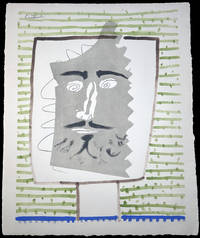
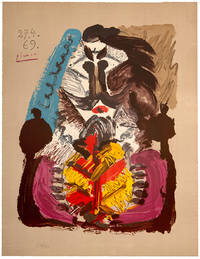
1203811969 . Lithograph in colours 1969 on wove paper with the artist's printed signature as issued numbered from the American edition of 250 marked 'A' Printed by Marcel Salinas New York with his blindstamp verso Published by Harry N. Abrahams inc. New York 65 x 50 cm. 25½ x 19¾ in.<br /> <br /> 1969 unknown
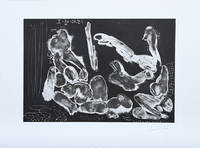
1966172734Paris: Galerie Louise Leiris 1966. Edition of 50. Signed in pencil lower right by Picasso numbered lower left. Printed by Piero and Aldo Crommelynck. Etching and aquatint on Rives watermarked wove paper all edges deckled. Image size: 31.8 x 47.1 cm. Sheet size: 45.6 x 62 cm. Framed size: 59.6 x 76.8 cm. Excellent condition. Presented in a black and gold leaf wooden frame with conservation acrylic glazing. Bloch 1387; Baer 1409. unknown