PICASSO, PABLOBiblio.com
1 544 résultats
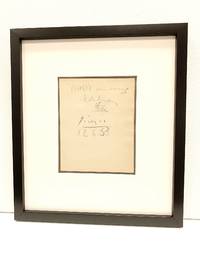
4667Picasso dedicated this charming sketch of a palm like tree and sun to his friend dated June 6 1958. In Spanish Picasso writes "For my friend.Picasso 12.6.58. " The signed drawing measures 4.75 x 6 inches on brown card stock of 6.75 x 9 inches and floats on a dark gray mat overlaid with a white mat matted and framed in museum quality materials with 5/8/inch black satin finished wood. Frame measures 12 ¼ x 13 3/4. Additional images on request. unknown
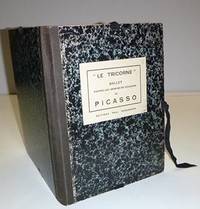
16-4178Paris: Éditions Paul Rosenberg 1920. 4to. 28 x 21 cm. Sheets loose as issued in original board chemise with cloth ties. One tie torn but torn part is present. One of 50 copies of the deluxe edition with the plates both colored and black and white. Collotype printing and handcoloring in the ateliers of André Marty and Daniel Jacomet. Some copies have a black and white reproduction of the rideau curtain which is not present here nor is the etching Bloch 34. There are a total of 31 colored collotypes and 31 uncolored for a total of 62 prints. Each print has a blindstamp in the lower right corner with the initials of the publisher for authenticity.References: Goeppert/Cramer 8; The Picasso Project From Cubism to Neoclassicism pp 206-227; Parmenia Migel Pablo Picasso Designs for the "Three Cornered Hat;" Picasso Le Tricorne: Musée des Beaux-Arts de Lyon 1992.Here is a list of the plates. We can also provide concordances of each print to the references cited.Décor definitif.Le Meunier.La Meunière.Le Corrregidor.Costume pour un groupe de voisines.Le Dandy.Costume pour un groupe de voisines.Costume pour des deux serviteurs.La Majorique.Costume des Aragonaises.Costume de la femme du Corrregidor.Costume des Aragonaises.Le Corregidor dans le manteau du Meunier.Costume du Picador.Costume des danseuses de la sevillana.Project de costume pour le torero.Project de costume pour le torero.Costume de l'un des fous.Costume d'un voisin.Costume des Aragonais.Costume d'un voisin.Project de costume pour une vieille femme.Costume de l'un des fous.Costume du béquillard.Costume d'un vieux nègre.Costume pour un alguazil.Costume des alguazils porteurs de lanternes.La Chale de la La Menuère.La chaise a porteurs de la femme de Corrregidor.La cape du béquillard .Pièces des costumes du torero de l'Aragonais es des Aragonaises.Le Tricorne.Paris Éditions Paul Rosenberg 1920. In-4 chemise à rabats et rubans de l'éditeur.Portfolio contenant 31 pochoirs sur 32 de Pablo Picasso reproduisant les maquettes en couleurs des costumes et décors du ballet éponyme.Tirage limité à 250 exemplaires numérotés celui-ci un des 50 exemplaires accompagnés d'une eau-forte originale inédite de Picasso et d'une EPREUVE DE L'ETAT EN NOIR DE CHACUNE DES PLANCHES.Le Tricorne créée en 1919 fut produite par les Ballets Russes et marqua le début de la collaboration entre Picasso et la Compagnie. Le ballet fut donné à Londres en 1919 et à Paris en 1920.Manque une planche et l'eau-forte inédite lacets fatigués.Expertise by : Jean Lequoy Librairie Giraud-Badin 22 rue Guynemer 75006 Paris Paris: Éditions Paul Rosenberg, 1920. hardcover
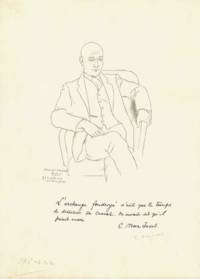
191033635Montrouge Paris: 1910 1910. Original Litho. Original Litho. PICASSO. MAX JACOB. Double Signed Litho. Montrouge Paris Seine. 1910. 14" 7/8 X 10" 3/4 on plain paper stock with the lithograph printed in two tones: Greenish grey for Picasso's drawing and handwriting and black for Max Jacob. Number 17 of only 30 copies. A rare early illustration of Picasso's close friend Max Jacob done in celebration of Jacob's conversion to Christianity. Jacob who had Jewish origins claimed to have had a vision of Christ in 1909 causing his conversion. The illustration of Jacob the first of Picasso's drawings of Max Jacob seated comfortably in a fine armchair dressed in his three piece suit. The printed text: Top A mon ami Max Jacob / Picasso .10 / 22 R. Victor Hugo / Montrouge Seine - Middle L'archange foudroyé n'eut que le temps / de desserrer sa cravate . On aurait sit qu'il / priait encore./ C. Max Jacob. Signed in pencil with his new Christian name: "C. Max Jacob" and by "Picasso" at the bottom. A very good or better example of this rare piece - Max Jacob is regarded as an important link between the symbolists and the surrealists as can be seen in his prose poems Le cornet à dés The Dice Box 1917. Throughout the year of 1901 Picasso traveled to Barcelona & Paris for art exhibitions. During an exhibition in Paris Picasso met Max Jacob. Max Jacob was a poet painter & art critic with connections in the Parisian cultural scene. The two artists developed a friendship after Jacob left an admiring note for Picasso at the art gallery displaying Picasso's work Richardson Vol. I 203. Jacob introduced Picasso to the French language and to French theatre; Jacob was also an actor. Jacob took Picasso to see operas which possibly included I Pagliacci & La Bohème Richardson Vol. I 338. "At night there were frequent visits to the cabarets of Montmartre such as the Chat Noir and when tickets could be found to the Moulin Rouge" Penrose Picasso 76. Picasso & his friends also enjoyed the artistic atmosphere of Le Lapin Agile. Artists & writers would congregate at the small café to listen to recitals exchange ideas & celebrate special occasions such as the opening of an exhibition Penrose Picasso 117. The walls of the café were lined with work by artists that were used as payment for debts. Theatrical entertainment was a prominent part of Picasso's social life in Paris. By 1904 Picasso had established a foothold in Paris and would remain in the cultural center of Europe for the rest of his life. Picasso & Max Jacob cultivated their talents in a dwelling known as the Bateau Lavoir. According to Penrose this place was ". . . composed it seemed of nothing but lofts & cellars all in such a sad state of repair. . . " Picasso 96. Artists of all endeavors were attracted to this bohemian style of living. Picasso's neighbors included painters sculptors writers & actors Penrose Picasso 102. One of Picasso's most influential friends entered his life in 1905: Guillaume Apollinaire. "From the first encounter Pablo Picasso and Guillaume Apollinaire established a creative dialogue that fostered and inspired some of their finest art & poetry". Apollinaire was a poet & playwright identified as a Surrealist who kept close connections with literary & artistic figures in Paris including Max Jacob & André Salmon. He was a great source for Picasso to meet writers & theatre artists. Many of Picasso's friends encouraged him to frequent the theatre with artists & poets from Paris Picasso Penrose 177. Even though Picasso was not in Paris he managed to find groups of artistic individuals to stay abreast of cultural gossip & happenings. Picasso's connections with writers led him to create several illustrations for books of poetry for friends. For example during summer 1910 in Cadaques Catalonia painting with Derain Picasso was commissioned to illustrate a poetic novel written by Max Jacob titled Saint Matorel issued by Daniel-Henry Kahnweiler in 1911. Penrose Picasso 179. This was only the first of a collections of poetry they collaborated on. 1910 unknown
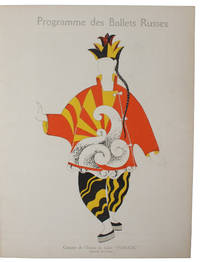
191760103Paris Mai 1917. Folio. Original illustrated extra wrappers with a picture by Picasso on the front and the décor for "Baba Iaga" on the back; original illustrated wrappers for "Théatre du Chatelet" drawing by André Marty on front and advertisements on back in grey and red; original illustrated coloured wrappers for "Programme des Ballets Russes" front wrapper illustrated by Picasso with the Chinaman-costume from "Parade". A bit of soiling to the extra-wrappers and small professional restorations to upper front cover and top of spine this barely noticeable as well as to blank margin of back wrapper. Apart from that an excellent and very well perserved copy with only slight browning to some leaves. Apart from the described wrappers and extra-wrappers there are in all 24 leaves with -mostly photographic- illustrations four of them with original hand-colouring on top and 6 leaves of text.With the original errata-leaf laid in loose stating also that the illustrations "Femmes de bonne humeaur" and "Parade" have been hand-painted by Carlos Socrate after the designs of Bakst and Picasso and that the front wrapper for "Parade" the Chinaman has been handpainted by Picasso himself. <br/><br/><em>Scarce original printing of this seminal avantgarde-publication the May 1917 "Théatre du Chatelet"- publication that presents Diaghilev's "Ballets Russes" in Paris - here containing the entire separate publication mainly devoted to Jean Cocteau's groundbreaking ballet "Parade" - being one of the most important publications in the history of modern art. It is here in his presentation-article to "Parade" that Apollinaire coins the term "surrealism" and thus lays the foundation for the seminal cultural movement that Bréton came to lead. Furthermore the ballet "Parade" represents a historical collaboration between several of the leading artistic minds of the early twentieth century: Erik Satie Jean Cocteau Pablo Picasso Léonide Massine and Serge Diaghilev and is famous not only for its contents and its music but also for its magnificent costumes designed by Picasso the drawings of which are presented in the present publication for the first time - most famously the front cover for the "Parade"-programme which depicts the "Costume de Chinois du ballet "PARADE"/ Aquarelle de Picasso" an etching with original stunning pochoir-colouring hand-painted by Picasso himself!.It is the 1917 ballet "Parade" - the first of the modern ballets - originally presented for the first time in the present publication that marks Picasso's entry into the public and bourgeois institutions of ballet and theatre and presents Cubism on the stage for the first time. The present publication constitutes an outright revolution in the history of art theatre and ballet.Several variants of this spectacular publication exist but the one we have here is as original and complete as it comes containing the entire contents of the different variants. We not only have the extremely scarce and fragile dust-wrapper and the equally scarce illustrated coloured double-wrappers front: "Peinture de Picasso"; back: Décor de Larionow pour le ballet "BABA IAGA"" but also the entire 1917 "Théatre du Chatelet"-programme in original illustrated wrappers with the entire separate "parade"-issue -also entitled "Programme des Ballets Russes"- also in original illustrated wrappers with more than 20 leaves of photographic illustrations containing pictures of the actors and actresses also in their spectacular avant-garde-costumes Bakst's portrait of Leonide Massine Picasso's portrait of Stavinski Bakst's portrait of Picasso Picasso and Massine in the ruins of Pompei Picasso's drawings of a scene from "Parade" and of Massine as well as several mostly humorous advertisements. But more importantly we have apart from the above-mentioned famous Chinaman by Picasso in original pochoir-colouring the other famous etching by Picasso "Costume d'acrobate du ballet "Parade"/ Aquarelle de Picasso" also in original pochoir-colouring bright blue the seminal presentation-article by Apollinaire which coins the term "surrealism" see bottom of description for full translation of this groundbreaking preface the two "Les Femmes de Bonne Humeur"-figures by Bakst Constanza and Battista printed and heightened in gold pochoir the printed costume by Larionow "Les contes russes" which is with original bright red and blue pochoir-colouring and the "Le Mendiant"-costume by Bakst for "Parade" and of course the texts by Bakst on choreography and décor Georges-Michel Ballets Russes after the War as well as the texts for the various ballets listing the actors and their rôles as well as a resume of the plot. " "Tact in audacity consists in knowing how far we may go too far." Jean Cocteau poet writer and arts advocate made this statement in his 1918 manifesto The Cock and Harlequin. Cocteau in collaboration with Erik Satie and Pablo Picasso discovered "how far" to "go too far" in the circus-like ballet Parade-one of the most revolutionary works of the twentieth century. Parade incorporates elements of popular entertainment and uses extra-musical sounds such as the typewriter lottery wheel and pistol combining them with the art of ballet. Cocteau wrote the scenario for the one-act ballet and contracted the other artists. Satie wrote the score to the ballet first in a piano four-hands version and then in full orchestration while Picasso designed the curtain set and costumes. Later Léonide Massine a dancer with the Ballet Russes was brought in as the choreographer. Serge Diaghilev's Ballet Russes premiered the ballet Parade on May 18 1917. The program notes for the ballet were written by the poet Apollinaire. They became a manifesto of l'esprit nouveau or "the new spirit" which was taking hold in Paris during the early twentieth-century. Apollinaire described the ballet Parade as "surrealistic" and in doing so created a term which would develop into an important artistic school." Tracy A. Doyle Erik Satie's ballet PARADE p. 1.When the French poet and army officer Guillaume Apollinaire wrote the program notes For "Parade" he created the manifesto of the "l'esprit nouveau" - "the new spirit". Cocteau had called the ballet "realistic" but Apollinaire took it an important step further and described it as "surrealistic" thus coining a term that would soon develop into an important artistic movement. With Picasso Apollinaire had established the aesthetic principals of Cubism and was considered a leader in the European avant-garde. ENGLISH TRANSLATION OF APOLLINAIRE'S PROGRAMME NOTES TO "PARADE": "Definitions of Parade are blossoming everywhere like the lilac bushes of this tardy spring.It is a scenic poem transposed by the innovative musician Erik Satie into astonishingly expressive music so clear and simple that it seems to reflect the marvelously lucid spirit of France. The cubist painter Picasso and the most daring of today's choreographers Léonide Massine have here consummately achieved for the first time that alliance between painting and dance between the plastic and mimetic arts that is a herald of the more comprehensive art to come. There is nothing paradoxical about this. The Ancients in whose lives music played such an important role were totally unaware of harmony which constitutes the very basis of modern music. This new alliance - I say new because until now scenery and costumes were linked only by factitious bonds - has given rise in Parade to a kind of surrealism which I consider to be the point of departure for a whole series of Manifestations of the New Spirit that is making itself felt today and that will certainly appeal to our best minds. We may expect it to bring about profound changes in our arts and manners through universal joyfulness for it is only natural after all that they keep pace with scientific and industrial progress. Having broken with the choreographic tradition cherished by those who used to be known in Russia under the strange name 'balletomanes' Massine has been careful not to yield to the temptation of pantomime. He has produced something totally new-a marvelously appealing kind of dance so true so lyrical so human and so joyful that it would even be capable if it were worth the trouble of illuminating the terrible black sun of Dürer's Melancholy. Jean Cocteau has called this a realistic ballet. Picasso's cubist costumes and scenery bear witness to the realism of his art. This realism - or this cubism if you will - is the influence that has most stirred the arts over the past ten years. The costumes and scenery in Parade show clearly that its chief aim has been to draw the greatest possible amount of aesthetic emotion from objects. Attempts have often been made to return painting to its barest elements. In most of the Dutch painters in Chardin in the impressionists one finds hardly anything but painting. Picasso goes further than any of them. This is clearly evident in Parade a work in which one's initial astonishment is soon replaced by admiration. Here the aim is above all to express reality. However the motif is not reproduced but represented-more precisely it is not represented but rather suggested by means of an analytic synthesis that embraces all the visible elements of an object and if possible something else as well: an integral schematization that aims to reconcile contradictions by deliberately renouncing any attempt to render the immediate appearance of an object. Massine has Adapted himself astonishingly well to the discipline of Picasso's art. He has identified himself with it and his art has become enriched with delightful inventions such as the realistic steps of the horse in Parade Formed by two dancers one of whom does the steps of the forelegs and the other those of the hind legs. The fantastic constructions representing the gigantic and surprising features of The Managers far from presenting an obstacle to Massine's imagination have one might say served to give it a liberating impetus. All in all Parade will change the ideas of a great many spectators. They will be surprised that is certain; but in a most agreeable way and charmed as well; Parade will reveal to them all the gracefulness of the Modern movements a gracefulness they never suspected. A magnificent vaudeville Chinaman will make their imaginations soar; the American Girl cranking up her imaginary car will express the magic of their daily lives whose wordless rites are celebrated with exquisite and astonishing agility by the acrobatin blue and white tights." </em> unknown
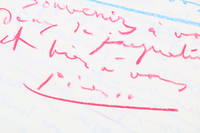
195789530Cannes 1957. Fine. ""The 7th Bull races"" Cannes 13 juin 1957 21 x 27 cm 2 pages sur un feuillet Multi-coloured autograph letter from Pablo Picasso to Max Pellequer signed and dated by the author on June 13 1957. The document includes the autograph address of his villa La Californie. 2 pages on one sheet 22 lines in green blue and red pencils on a watermarked sheet. Minor folds. An exceptional account of Pablo Picasso's passion for bullfighting a recurring theme in his art since his very first works painted at the age of eight ""The Little Yellow Picador"" 1899. Pablo Picasso gives Max Pellequer and his wife details regarding a trip to Arles on July 5 6 and 7 1957 to which the artist has invited them along with a handful of friends. With undisguised enthusiasm he announces that he has booked their rooms at the ""Norpinus"" Nord-Pinus and their seats for the bullfight. Only after providing this essential information does the painter mention the opening of his exhibition at the Réatu Museum and the official dinner with Douglas Cooper the great collector and the mayor of Arles Charles Privat: ""Dinner with Cooper & the mayor"". A performance of ""Aïda at the bullring"" is also scheduled during this Arlesian getaway which ends on the 7th with an intriguing ""bull run with the presence of a black king"". In the 1950s Pablo Picasso and Jacqueline Roque are regular visitors to the Arles bullrings. At that time the painter is not discovering the city. Fascinated by Van Gogh's portraits he paints his first Arlésienne in 1912 and his last featuring Jacqueline just after writing this letter in 1958. But it is his love of bullfighting that will ultimately bind the Andalusian to the bullfighting capital of Provence. From his early Barcelona works Scène de corrida and courses de Taureaux presented to Ambroise Vollard in 1901 to the famous and omnipresent theme of the Minotaur Picasso was one of the main promoters of bullfighting in France. In the late 1950s Arles becomes the painter's mecca for his passion immortalised in 1956 by David Douglas Duncan who photographed Pablo in the Arles bullring captivated by the bullfights. This exceptional letter bears witness to the excitement of the artist who at the height of his international fame becomes for the time being a groupie happy to accommodate his friends in the legendary ""Norpinus"" hotel known for hosting toreros after their bullfights. Bullfighting also features in the other major events presented by the artist in the 22 lines of our sheet. He announces the opening of his first exhibition at the Musée Réattu which gives pride of place to the figure of the bull in Picasso's work. Among the paintings on display from July 6 to September 2 1957 38 of the artist's artworks will be exhibited for the first time. Picasso the main lender for this event will ironically be absent from the opening too busy painting portraits of Jacqueline using pigeon feathers. The author continues his letter by proposing a dinner with British collector Douglas ""Cooper"" who along with the Barcelona Museum will also be invited to contribute to the exhibition. The ""mayor"" of Arles Charles Privat is the second personality invited to this dinner. Picasso and Privat who meet for the first time in April 1957 will maintain a fruitful relationship that will conclude in 1971 with the artist's donation of 57 artworks to the Musée Réattu. In the second part of the letter Pablo Picasso adds a performance of Verdi's opera ""Aïda"" to the schedule demonstrating the artist's continued keen interest in operatic works more than 30 years after designing sets for the Ballets Russes. Finally the only possible conclusion for Picasso's letter and stay with his friends is to attend of course one final bullfight whose announcement itself seems like the title of a painting: bullfight with the presence of a black king"". We do not know which African dignitary attended the 1957 bullfight but the pain unknown
1996129566Kornfeld Et Klipstein & Editions Kornfeld. As New. 1996. Hardcover. 3857730269 .CORRESPONDES TO ISBN: 3857730269/ INCLUDES VOLUMES 1 - VII PLUS ADDENDUM - IN STOCK AND IMMEDIATELY AVAILABLE FOR SHIPMENT - AS NEW THE TEXT BLOCK IS PRISTINE CLEAN UNMARKED AND IN EXCELLENT CONDITION - - Catalogue Raisonné Catalogue Raisonne Catalog Raisonnee Complete Works One Two Three Four Five Six Seven Il Ill IV V VI VII 2 3 4 5 6 7 Kornfeld Et Klipstein & Editions Kornfeld hardcover
195048463Paris.: Bordas Editeur. 1950. Original publisher's printed paper wrappers with flaps artist's and author's names in black to front cover and publisher's and details to rear additional vellum jacket with flaps and printed titles to front cover. Small folio. 328 x 258 mm. Half-title printed title with original lithograph illumination copyright verso and the 4 sections of Tzara's text in verse and prose illustrated with 8 full-page original lithographs in black by Picasso 3 leaves with 'Table' and final leaf with justification and achevé d'imprimer verso; also included loose is the additional suite of all of the lithographs on Japon. The édition de tête of Tzara's collection with a suite of Picasso's finger-drawn lithographs on Japon and with the additional vellum jacket.From the edition limited to 350 copies with this one of 30 on Hollande Van Gelder Zonen signed by the author and artist and with the additional suite of the plates on Japon Impérial paper; the 300 copies issued on Arches and the 20 hors commerce copies on Alfa Mousse were initialled by Tzara only.For Tzara's four-section collection the sections are 'Le Temps Détruit' 'Le Déserteur' 'Le Boeuf sur la Langue' and 'Le Poids du Monde' Picasso drew the illustrations directly and spontaneously on the lithographic stone with his finger. Although Tzara had been specific in what illustration he desired the lithographs he produced for the book were ultimately Picasso's own. The illustration for the title does not feature printed text in the suite.'This great poem which is in both verse and prose and which is formed of four parts was written by Tzara between 1946 and 1949. To some degree the poem represents the sum of the poet's experiences . Although Picasso agreed to illustrate the poem he kept putting off the work. He finally got around to it when Mourlot paid him a visit at Vallauris on April 16 1950. This same day he made the cover for the second volume of Picasso Lithographe as well as the 9 lithographs for De Mémoire d'Homme using a somewhat unusual procedure; he dipped his painting finger into the lithographic ink and then drew flora and fauna designs which are at once familiar and strange; he then marked their contours with lithographic chalk.' Patrick Cramer.Cramer 59; Berggruen 35. Bordas Editeur. hardcover
26670Lisle-sur-Sorgue et Alès PAB été 1960. 1 vol. 210 x 260 mm de 23 p. et 5 planches. En feuilles sous couverture imprimée. Édition originale. Illustré de 5 empreintes naturelles composées par Picasso. Tirage unique à 50 exemplaires sur Arches celui-ci justifié à l’encre par l’auteur : « Exemplaire de Picasso R.C. ». Les pierres et le fer qui ont servi aux empreintes ont été trouvés dans les monts du Vaucluse par René Char PAB et Jacques Polge sur le site du massif des « Dentelles de Montmirail » du latin « mons mirabilis » signifiant « mont ou montagne admirable ». Le lieu tient son nom de l'érosion qui a façonné la forme de ces montagnes de telle façon que la roche taillée par le temps semble ciselée comme un ruban dentelé à la silhouette unique. Elles se situent aux premiers abords du Mont Ventoux dans le Vaucluse à une trentaine de kilomètres de Lisle-sur-la-Sorgue où Char résidait. Les Dentelles de Montmirail sont publiées au même moment pendant l'été 1960 ; Picasso séjourne alors à Cannes en compagnie de Jacqueline Roque qu'il allait épouser l'année suivante. Cette dédicace est l'une des premières marques d'une amitié et d'une association naissante que la mort de Braque en 1963 renforceront. Si les premiers échanges datent d'avant-guerre par l'intermédiaire d'Eluard ce n'est qu'à partir de 1958 que Char et Picasso collaboreront. Eluard disparu c'est essentiellement grâce à la persévérance de Pierre André Benoit que les contacts se renouent et que Picasso accepte en marge des grands illustrés qu'il donne chez Broder de collaborer aux minuscules de PAB grâce au procédé des celluloïds : « lorsque PAB rencontre Picasso en 1956 il a 35 ans Picasso en a 75. En mai 1956 pour illustrer un texte de jeunesse de René Crevel compagnon de route des surréalistes que Picasso répond à PAB lui retournant par la poste sans un mot la minuscule plaque de celluloïd gravée d'un visage. Ce sera Nuit. Picasso lui si célèbre et si sollicité pourquoi répond-il finalement à ce jeune éditeur cévenol Peut-être parce que PAB propose des textes de personnes proches de Picasso ou de personnes qui l'ont été : Crevel Tzara René Char. Mais PAB sait aussi le séduire en l'invitant à jouer avec des techniques nouvelles : le celluloïd puis la cartalégraphie. Il interpelle Picasso qui a le goût du défi technique insistant toujours dans ses courriers sur l'aspect ludique « amusant » de ses propositions : « voyez si mon projet vous chante » lui écrit-il le 7 mai 1958 en lui adressant le poème L'Escalier de Flore de René Char. » Picasso et le livre d'artiste Exposition 2018 préface. Char préfacera en 1973 le catalogue de l'exposition Picasso à Avignon qui paraîtra juste après la mort du peintre le 8 avril 1973. C'est au total dix-sept livres que PAB réalise avec Picasso entre 1956 et 1974 ce qui fait de lui l'éditeur avec qui l'artiste a le plus collaboré. Lisle-sur-Sorgue et Alès, PAB, été 1960. 1 vol. (210 x 260 mm) de 23 p. et 5 planches. En feuilles, sous couverture imprimée unknown
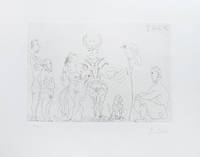
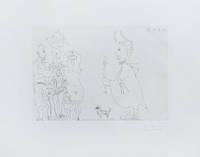
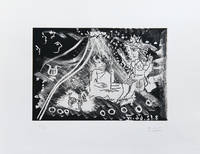
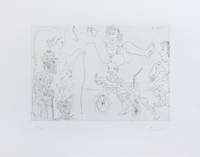
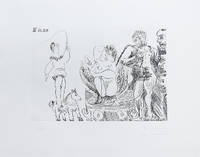
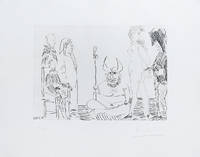
1066681968 . Etching 1968 on Auvergne Richard-de-Bas wove paper signed in pencil numbered from the edition of 30 printed and published by Atelier Crommelynck Paris 37 x 47.8 cm. 14½ x 18¾ in.<br /> Le Cocu Magnifique is a farcical play written by Belgian dramatist Fernand Crommelynck about a jealous man Bruno who because of this jealously ends the play by losing his wife Stella. Bruno is the kind of man who sees an enemy in the other sex; he seeks to control a woman but he can never obtain this dominance because the female soul eludes him. It is because he cannot bear Stella's love that he will in the end be cuckolded. The play premiered in Paris in December 1920 and in 1968 Picasso produced a series of 12 etchings and aquatints based on the play's text. Picasso and Crommelynck knew each other for many years and for some time Picasso had intended to illustrate the play. Picasso's dramatic and often explicit depiction of Crommelynck's story is well suited to the stark black and white media of aquatint and etching. <br /> B. 1244-1255; BA. 1432-1443; C. BKS 140 1968 unknown
1066751968 . Etching 1968 on Auvergne Richard-de-Bas wove paper signed in pencil numbered from the edition of 30 printed and published by Atelier Crommelynck Paris 37 x 47.8 cm. 14½ x 18¾ in.<br /> Le Cocu Magnifique is a farcical play written by Belgian dramatist Fernand Crommelynck about a jealous man Bruno who because of this jealously ends the play by losing his wife Stella. Bruno is the kind of man who sees an enemy in the other sex; he seeks to control a woman but he can never obtain this dominance because the female soul eludes him. It is because he cannot bear Stella's love that he will in the end be cuckolded. The play premiered in Paris in December 1920 and in 1968 Picasso produced a series of 12 etchings and aquatints based on the play's text. Picasso and Crommelynck knew each other for many years and for some time Picasso had intended to illustrate the play. Picasso's dramatic and often explicit depiction of Crommelynck's story is well suited to the stark black and white media of aquatint and etching. <br /> B. 1244-1255; BA. 1432-1443; C. BKS 140 1968 unknown
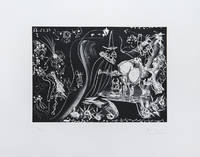
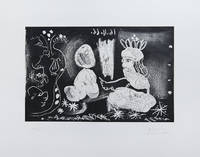
1066811968 . Etching and aquatint 1968 on Auvergne Richard-de-Bas wove paper signed in pencil numbered from the edition of 30 printed and published by Atelier Crommelynck Paris 37 x 47.8 cm. 14½ x 18¾ in.<br /> 107 MP22mod Le Cocu Magnifique is a farcical play written by Belgian dramatist Fernand Crommelynck about a jealous man Bruno who because of this jealously ends the play by losing his wife Stella. Bruno is the kind of man who sees an enemy in the other sex; he seeks to control a woman but he can never obtain this dominance because the female soul eludes him. It is because he cannot bear Stella's love that he will in the end be cuckolded. The play premiered in Paris in December 1920 and in 1968 Picasso produced a series of 12 etchings and aquatints based on the play's text. Picasso and Crommelynck knew each other for many years and for some time Picasso had intended to illustrate the play. Picasso's dramatic and often explicit depiction of Crommelynck's story is well suited to the stark black and white media of aquatint and etching. <br /> B. 1244-1255; BA. 1432-1443; C. BKS 140 1968 unknown
1066741968 . Etching 1968 on Auvergne Richard-de-Bas wove paper signed in pencil numbered from the edition of 30 printed and published by Atelier Crommelynck Paris 37 x 47.8 cm. 14½ x 18¾ in.<br /> Le Cocu Magnifique is a farcical play written by Belgian dramatist Fernand Crommelynck about a jealous man Bruno who because of this jealously ends the play by losing his wife Stella. Bruno is the kind of man who sees an enemy in the other sex; he seeks to control a woman but he can never obtain this dominance because the female soul eludes him. It is because he cannot bear Stella's love that he will in the end be cuckolded. The play premiered in Paris in December 1920 and in 1968 Picasso produced a series of 12 etchings and aquatints based on the play's text. Picasso and Crommelynck knew each other for many years and for some time Picasso had intended to illustrate the play. Picasso's dramatic and often explicit depiction of Crommelynck's story is well suited to the stark black and white media of aquatint and etching. <br /> B. 1244-1255; BA. 1432-1443; C. BKS 140 1968 unknown
1066731968 . Etching and aquatint 1968 on Auvergne Richard-de-Bas wove paper signed in pencil numbered from the edition of 30 printed and published by Atelier Crommelynck Paris 37 x 47.8 cm. 14½ x 18¾ in.<br /> Le Cocu Magnifique is a farcical play written by Belgian dramatist Fernand Crommelynck about a jealous man Bruno who because of this jealously ends the play by losing his wife Stella. Bruno is the kind of man who sees an enemy in the other sex; he seeks to control a woman but he can never obtain this dominance because the female soul eludes him. It is because he cannot bear Stella's love that he will in the end be cuckolded. The play premiered in Paris in December 1920 and in 1968 Picasso produced a series of 12 etchings and aquatints based on the play's text. Picasso and Crommelynck knew each other for many years and for some time Picasso had intended to illustrate the play. Picasso's dramatic and often explicit depiction of Crommelynck's story is well suited to the stark black and white media of aquatint and etching. <br /> B. 1244-1255; BA. 1432-1443; C. BKS 140 1968 unknown
1066711968 . Etching 1968 on Auvergne Richard-de-Bas wove paper signed in pencil numbered from the edition of 30 printed and published by Atelier Crommelynck Paris 37 x 47.8 cm. 14½ x 18¾ in.<br /> Le Cocu Magnifique is a farcical play written by Belgian dramatist Fernand Crommelynck about a jealous man Bruno who because of this jealously ends the play by losing his wife Stella. Bruno is the kind of man who sees an enemy in the other sex; he seeks to control a woman but he can never obtain this dominance because the female soul eludes him. It is because he cannot bear Stella's love that he will in the end be cuckolded. The play premiered in Paris in December 1920 and in 1968 Picasso produced a series of 12 etchings and aquatints based on the play's text. Picasso and Crommelynck knew each other for many years and for some time Picasso had intended to illustrate the play. Picasso's dramatic and often explicit depiction of Crommelynck's story is well suited to the stark black and white media of aquatint and etching. <br /> B. 1244-1255; BA. 1432-1443; C. BKS 140 1968 unknown
1066771968 . Etching and aquatint 1968 on Auvergne Richard-de-Bas wove paper signed in pencil numbered from the edition of 30 printed and published by Atelier Crommelynck Paris 37 x 47.8 cm. 14½ x 18¾ in.<br /> Le Cocu Magnifique is a farcical play written by Belgian dramatist Fernand Crommelynck about a jealous man Bruno who because of this jealously ends the play by losing his wife Stella. Bruno is the kind of man who sees an enemy in the other sex; he seeks to control a woman but he can never obtain this dominance because the female soul eludes him. It is because he cannot bear Stella's love that he will in the end be cuckolded. The play premiered in Paris in December 1920 and in 1968 Picasso produced a series of 12 etchings and aquatints based on the play's text. Picasso and Crommelynck knew each other for many years and for some time Picasso had intended to illustrate the play. Picasso's dramatic and often explicit depiction of Crommelynck's story is well suited to the stark black and white media of aquatint and etching. <br /> B. 1244-1255; BA. 1432-1443; C. BKS 140 1968 unknown
1066721968 . Etching 1968 on Auvergne Richard-de-Bas wove paper signed in pencil numbered from the edition of 30 printed and published by Atelier Crommelynck Paris 37 x 47.8 cm. 14½ x 18¾ in.<br /> Le Cocu Magnifique is a farcical play written by Belgian dramatist Fernand Crommelynck about a jealous man Bruno who because of this jealously ends the play by losing his wife Stella. Bruno is the kind of man who sees an enemy in the other sex; he seeks to control a woman but he can never obtain this dominance because the female soul eludes him. It is because he cannot bear Stella's love that he will in the end be cuckolded. The play premiered in Paris in December 1920 and in 1968 Picasso produced a series of 12 etchings and aquatints based on the play's text. Picasso and Crommelynck knew each other for many years and for some time Picasso had intended to illustrate the play. Picasso's dramatic and often explicit depiction of Crommelynck's story is well suited to the stark black and white media of aquatint and etching. <br /> B. 1244-1255; BA. 1432-1443; C. BKS 140 1968 unknown
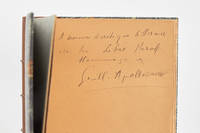
191878956Paris: Mercure de France 1918. Fine. Mercure de France Paris 1918 14.50 x 23 cm relié First edition a first impression copy numbered in the press. Binding in half brown morocco spine in five compartments gilt date at the foot geometric pattern paper boards and endpapers in the same paper top edge gilt wrappers and spine preserved in perfect condition binding signed by T. Boichot. Apollinaire's second major poetic work with bold graphic innovations and a portrait of Guillaume Apollinaire by Pablo Picasso as frontispiece. Some of the best war poems all languages combined are brought together in this collection alongside experimental works such as Les Fenêtres close to Cubism and La Jolie Rousse which were far ahead of their time Cyril Connolly Cent livres-clés de la littérature moderne n° 32. A beautiful copy on non-brittle paper which is unusual and a rare and surprising handwritten inscription signed by Guillaume Apollinaire: à monsieur le critique littéraire de La Libre Parole hommage de Guill. Apollinaire."" To the literary critic of La Libre Parole tribute by Guill. Apollinaire. Who could be the recipient of this inscription unnamed but addressed to a collaborator of the famous anti-Semitic newspaper founded by Édouard Drumont The ostensibly philo-Semitic position of Guillaume Apollinaire is well-known. In an 1899 letter he boasts to Toussaint Luca that he tried to provoke Henri Rochefort who was reading La Libre Parole by deploying L'Aurore in front of him but as the young Dreyfusard regrets without daring to engage the controversy. In 1902 he publicly marked his fraternity with the Jewish people with a new publication in La Revue blanche Le Passant de Prague"": I love Jews because all Jews suffer everywhere. Then in Alcools he will dedicate a poem to the Hebrew religion: ""La Synagogue"". But it is undoubtedly through his poem Le Juif latin published in L'Hérésiarque et Cie that Apollinaire poetically reveals the essence of his particular link with Judaism: that he shares the condition of eternal stranger the feeling of uprooting and the search for identity. It may therefore seem very surprising that this poet whose only trace of political commitment was in favor of Dreyfus dedicated his work to a La Libre Parole journalist even if he is a literary critic. And in fact La Libre Parole does not contain literary columns! A few months before the poet's death this laconic inscription thus proves to be a formidable and final scoff of poetic impertinence to political intolerance. Mercure de France hardcover
195768709Paris: Louis Broder 1957. Fine. Louis Broder Paris 1957 13.50 x 16.50 cm relié sous chemise et étui Antonin ARTAUD & Pablo PICASSO .Autre chose que de l'enfant beau .Something Other than a Beautiful Child Louis Broder Paris 1957 13.5 x 16.5 cm full box in custom chemise and slipcase First edition printed in 120 numbered copies on Japon paper ours is one of 100 copies numbered in Arabic numerals. Illustrated with an original drypoint in colour by Pablo Picasso printed in Georges Leblanc's workshops in Paris. Handwritten signature of Pablo Picasso on the print details page. Binding in full grey box title and names of the author and illustrator gold-stamped on the spine boards decorated with an abstract and geometric decoration of gilt and black fillets mouse grey box endpapers covers and spine preserved top edge gilt chemise in half mouse grey box marbled paper boards slipcase edged in mouse grey box marbled paper boards contemporary binding signed Desmules. Using a process used the previous year for the illustration of Autre chose by P. A. Benoit the artist pierced the black mould giving the appearance of an empty circle in the engraving. This circle not pressed by the plate forms a white half-sphere in relief a unique and empty eye of a dismembered character very surely inspired by one of Artaud's great drawings from 1946 L'Homme et sa douleur preserved at the Cantini museum in Marseille. Rare and very beautiful copy perfectly set in a decorative binding comprising the only intaglio produced in colour by Picasso to illustrate the book. Louis Broder hardcover
1965138159Paris: Galerie Louise Leiris 1965. Edition of 50. Signed in pencil lower right by Picasso numbered lower left. Drypoint etching on Richard de Bas paper. Plate size: 23 x 33 cm. Sheet size: 33 x 45.4 cm. Framed size: 55 x 65.5 cm. A very minor soft crease to upper right corner otherwise in excellent condition. Presented in a hand made white gold leaf frame. Bloch 1202; Baer 1186. unknown
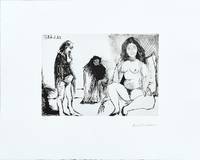
1969155791Paris: Galerie Leiris 1969. Edition of 50. Signed in pencil lower right by Picasso numbered lower left. At the age of 86 Picasso created 347 etchings between 16 March - 5 October 1968. This is plate no. 193 from the series. Aquatint scraper and drypoint on wove paper all edges deckled. Image size: 14.8 x 20.8 cm. Sheet size: 28 x 35.3 cm. Framed size: 38.3 x 43 cm. Excellent condition. Presented in a gold leaf frame with conservation acrylic glazing. Bloch 1673; Baer 1689 IV Bb1. unknown
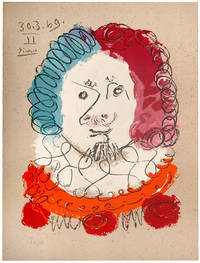
1203761969 . Lithograph in colours 1969 on wove paper with the artist's printed signature as issued numbered from the American edition of 250 marked 'A' Printed by Marcel Salinas New York with his blindstamp verso Published by Harry N. Abrahams inc. New York 65 x 50 cm. 25½ x 19¾ in.<br /> <br /> 1969 unknown
1203841969 . Lithograph in colours 1969 on wove paper with the artist's printed signature as issued numbered from the American edition of 250 marked 'A' Printed by Marcel Salinas New York with his blindstamp verso Published by Harry N. Abrahams inc. New York 65 x 50 cm. 25½ x 19¾ in.<br /> <br /> 1969 unknown
1966112218Cannes 1966. Unpublished and heavily corrected manuscript of Brassai's account of his visit to Picasso A superb unpublished and heavily corrected manuscript in French in which Brassaï recounts his visit to Picasso a long-standing friend at his home near Cannes. Brassaï who photographed much of Picasso's work in the 1940s had published Conversations with Picasso in 1964 in which he created an intimate portrait of Picasso covering their friendship and artistic collaboration and recording each of their meetings with minute detail. Picasso said of the volume "Read this book if you want to understand me". This account is written in a similar style and during the course of the afternoon Picasso speaks about his nostalgia for his old studios his health his enthusiasm for the recently invented felt-tip pen his opinion of his own writings his relationship with his wife Jacqueline and his views on feminism. Though unmarked as such it is from the collection of Brassaï's close friend and colleague photographer Stefan Lorant who founded Picture Post the pioneering pictorial magazine. Quarto 285 x 233. 20 typed sheets in French rectos only legibly hand-corrected throughout by Brassai in black ink. Housed in a black cloth album with each sheet in a separate clear plastic file. In excellent condition the final page a little creased and with minor loss to right-hand side affecting one letter. Overall fresh and clean. hardcover
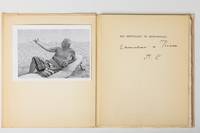
1962D17822Monaco: Éditions du Rocher 1962. First Edition. Paperback. Near Fine. Inscribed and signed by Cocteau for editor Jean Denoël with a drawing at the front and signed by Picasso and Cocteau on the colophon. Among a number of copies on Rives reserved for collaborators from a total edition of 255. 24 original lithographs 11 of them hors-texte including the front wrapper and 2 double-page by Picasso printed in black by Mourlot. Folio contents loose as issued in original wrappers with cut-out design revealing title on front cover; 1/4 calf gilt-backed chemise and board slipcase split. Contents are fine. Prospectus laid in. "On the occasion of Picasso's 80th birthday Pierre Bertrand who was Cocteau's publisher assembled eleven of the poet's texts which reflected his friendship with Picasso. The latter illustrated these texts with 24 lithographs some of which are drawn in Cocteau-esque style "---Cramer 117; Monod 292; Bloch 1037-1060. <br/><br/> Éditions du Rocher paperback
1996129565Kornfeld Et Klipstein & Editions Kornfeld. As New. 1996. Hardcover. 3857730269 . - IN STOCK AND IMMEDIATELY AVAILABLE FOR SHIPMENT - AS NEW THE TEXT BLOCK IS PRISTINE CLEAN UNMARKED AND IN EXCELLENT CONDITION - Complete seven 7 volume set - Catalogue Raisonné Catalogue Raisonne Catalog Raisonnee Complete Works Kornfeld Et Klipstein & Editions Kornfeld hardcover