114 507 résultats
192365487Leipzig, Insel-Verlag, 1923. 8vo (136 x 232 mm). 422, (2) pp. With 1 folded plate. Original half cloth, blue paper-covered boards with "Der Dom" gilt to upper board.
151496205ABStraßburg, Greiniger, (Grüninger), 1514. Folio. Mit 8 Textholzschnitten u. einigen Holzschnitt-Initialen. 92 Blätter. Schweinslederband m. reicher Blindprägung auf Holzdeckeln u. 2 Metallschließen. - Paginierung springt vereinzelt, jedoch vollständig. - Rücken etwas berieben - Wenige Blätter m. kl. Flecken, teils sehr gering wasserrandig oder leicht gebräunt. Zu I: Titelblatt m. 2 kl. hinterlegten Löchlein. Kl. hs. Besitzvermerk von 1669.- Insgesamt außerordentlich gut erhaltener Sammelband mit drei frühen, kostbaren Holzschnittbüchern.
64883Venedig, Franz Renner von Heilbronn u. Nikolaus von Frankfurt, 1473. Fol. 404 nn. Bll. (Got. Type, 2 Kol., 52 Zeilen), durchg. rubriziert u. mit zahlr. eingemalten Initialen in Rot u. Blau. HSchweinsldr.-Bd. d. 18. Jhds. a. 3 Bünden m. goldgepr. Rückenschild.
158030561Jena, Donat Richtzenhayn, Thomas Rebart, Rebarts Erben, Christian Rödingers Erben, 1557-1580. 8 Bände. Mit 8 teils wdh. Holzschnitt-Titelvignetten und 8 Textholzschnitten. Blindgepr. Schweinslederbände der Zeit über Holzdeckeln, teils monogrammiert und datiert, teils mit erhaltenen Schließen. Folio.
163860372Rome, 13. II. 1638. Oblong folio (390 x 280 mm). Latin manuscript on vellum. 1 p. With Urban's lead bulla attached on a hemp cord. Sewn together with four contemporary French legal documents in connection with the bull. Various formats. Together 10? pp. on 11 ff.
175243326[Rome], Matba`at Malak [i.e. Angelo] Rutili, 1752. Small folio (218 x 290 mm). 2 pts. in 1 vol. 688 pp. Near-contemporary half vellum with red label to gilt spine.
14502626101/01/1450. <blockquote><p>Records show only a small number of such mathematical devices having reached the public market</p><p> </p><p>The manuscript bears markings of subsequent owners including a poem from the 16th century to Saint Basil normally associated with the East</p></blockquote><p>video width=""1920"" height=""1080"" mp4=""https://cdn.raabcollection.com/wp-content/uploads/20231204130536/Computus-Youtube-Template-1.mp4""/video</p><p> </p><p>Prior to 1420 devotional books such as Books of Hours or Breviaries were made to order and reflected the particular interests of the patron. A breviary usually formatted in a writing block of two columns as opposed to its single column relative the Book of Hours contains excerpts of psalm gospel hymns and prayers to guide the reader in his or her daily prayer at the fixed Canonical Hours. Because these books were created at this time for a specific use they could be catered to that use including the use of alternate texts. This would also be the case for clergymen.</p><p>One of the most important branches of medieval learning was computus the science of calculating times and dates using a combination of mathematics and astronomy. The use of poetry to transmit scientific material would have made it easier for students to memorize. These calculations were often applied to the tricky and at times controversial calculation of the date of Easter a highly variable and occasionally contentious date relying on lunar calendars the date of the Jewish celebration of Passover and whether or not the observer is on the Julian or Gregorian calendar. Easter remains celebrated on different days in the West than the East.</p><p><img class=""alignnone wp-image-26267 size-post-window"" src=""https://cdn.raabcollection.com/wp-content/uploads/20231204133327/Medieval-cipher-4-1600x1105.jpg"" alt="""" width=""1600"" height=""1105"" /></p><p>In 1408 a Yorkshire man named John de Foxton ca. 1369-1450 wrote an encyclopaedic work called Liber Cosmographiae now housed at Cambridge Trinity College MS. R.15.21. John’s extensive work includes a poem on fol. 19v. The poem includes the line “Quaerit amor Christi multos dum regnat iniqus†The love of Christ seeks many while the unjust reign. It appears in a very limited number of other manuscripts. It is a cipher. The poem also includes seemingly unrelated letters written in red above each of the words. These letters would accompany the poetic text making the poem into a memory-based mnemonic device to figure out the date of Easter John de Foxton’s Liber Cosmographiae: An Edition and Codicological Study 1988 p. xxiii-xxiv.</p><p>Such computational texts which can combine a description of the calculation process along with the paired poetic text / letters are occasionally found in texts of this period but finding them on the market would be very uncommon.</p><p>Within the first decade of the fifteenth century an ecclesiastical man a member of the clergy had a breviary commissioned for him.</p><p>Breviary in Latin ca. 1410 Flanders or Luxembourg 2- 3- and 4- line initials in blue and pink with white penwork shellgold illumination; 23 partial borders consisting of a pink and blue bar extending the length of the text illuminated with gold and often terminating in penwork floral sprays.</p><p>Within this book which he would use for his daily prayers he had an unusual selection incorporated — a paraphrase of a computus text along with the Foxton poetic mnemonic computistical text to further solidify his study and understanding of the dating of Easter. The letters of the Foxton text were added though in a slightly different structure.</p><p><img class=""alignnone wp-image-26269 size-post-window"" src=""https://cdn.raabcollection.com/wp-content/uploads/20231204133315/Medieval-cipher-3-1-1-1600x746.jpg"" alt="""" width=""1600"" height=""746"" /></p><p>Combined these instructions describe the dating of easter and include an alphabet written out to help the ciphering. The text also mentions a Charles Karolus who says or teaches on the matter in “m cccc lvxxiiiâ€. The year 1478 is a scribal error inserting an extra century for what should have been m ccc lvxxiii. On November 29 1378 Charles of Luxembourg better known as the Holy Roman Emperor died. This portion of text of the ecclesiastic’s breviary is a paraphrase and therefore not published as is in any source we could determine.</p><p>A curious manuscript likely refering to the computistical ideas of Charles IV the Holy Roman Emperor influenced by the English cultural diffusion of John de Foxton’s mnemonic and cipher a bespoke production for a clergy man interested in this complex medieval science of dating Easter. A later 16th century prayer to Saint Basil has been added in space left after the text on fol. 399v by a reader.</p><p><img class=""alignnone wp-image-26333 size-post-window"" src=""https://cdn.raabcollection.com/wp-content/uploads/20231204132843/Medieval-cipher-1-2-1600x224.jpg"" alt="""" width=""1600"" height=""224"" /></p><p>A note on location and paleography</p><p>Several of the saints’ names in the liturgy have been copied with the French spelling conventions. While the illumination in the later liturgical portion of the text appear at first glance to be French— for example the pale yellow touches to capitals to draw the readers eyes— the hand lacks some of the sophistication of French manuscript production one would expect. In a Book of Hours the blue tipped three-petalled flowers would certainly indicate Bruges but this gets diffused further away from the city in other liturgical books. The spiky seed pods that flourish the borders are indicative of Flanders and were often emulated by English artists. During this time books were commonly being produced in the Low Countries for English audiences creating a fusion of paleographic and illustration styles. The paleography and orthography reveal the mystery. The hook-like descenders on the letter h go far beyond the baseline which is a distinctly Flemish feature. The spelling of “ewangelia†on the verso of the folio numbered in modern pencil as 367 proves the Germanophone claim moving the manuscript firmly into the liminal sphere of BeNeLux Belgium Netherlands Luxembourg region with its changing boarders and political statuses.</p><p><img class=""alignnone wp-image-26270 size-post-window"" src=""https://cdn.raabcollection.com/wp-content/uploads/20231204133310/Medieval-cipher-2-1-1600x600.jpg"" alt="""" width=""1600"" height=""600"" /></p><p>See also:</p><p>Neues Archiv der Gesellchaft für ältere deutsche Geshichtskunde: zur Beförderung einer Gesammtausgabe der Quellenschriften deutscher Geschichten des Mittelalters Sechster Band Vol. 6 Hannover: Hahnsche Buchhandlung 1881.</p><p>J. Van den Gheyn Catalogue des manuscrits de la Bibliothèque Royale de Belgique: Tome Deuxieme Vol. 2 Bruxelles: Henri Lamertin 1902.</p><p>Friedman John “John Siferwas and the Mythological Illustrations in the Liber Cosmographiae of John de Foxton†Speculum 58:2 1983. Pp. 391-418.</p><p>Friedman John “The Cipher Alphabet of John de Foxton’s Liber Cosmographiae†Scriptorium 36:2 1982. Pp. 219-235.</p><p><img class=""alignnone wp-image-25018 size-post-window"" src=""https://cdn.raabcollection.com/wp-content/uploads/20231204144051/Folder-site-11-1600x1327.jpg"" alt="""" width=""1600"" height=""1327"" /></p> unknown
156127989Basel, Johann Herwagen, 1561. (18) SS., 1 w. Bl., 551 (recte: 549), (4), 552-651, (41) SS. Mit 3 Holzschnittdruckermarken. Blindgepr. Schweinslederband der Zeit auf 4 Doppelbünden mit hs. Rückentitel und 2 intakten Schließen. Folio (230:340 mm).
64882Nürnberg, [Johann Sensenschmidt, nicht nach 1471]. Fol. 20 nn. Bll. u. ein weiteres, einseitig bedrucktes kleineres Blatt (23 Zeilen), eingefügt zwischen den Bll. 16 u. 17. Mod. flex. Pgmt. m. durchzogenen Bünden u. Schließbändern.
178262323Istanbul, Hohannis and Pogos, [1782]. Large 4to (212 x 265 mm). (2), 639, (1) pp. With woodcut devices on title-page, woodcut borders, woodcut initials and headers. Contemporary speckled calf, elaborately tooled in gilt, all edges gilt and goffered.
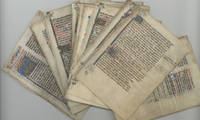
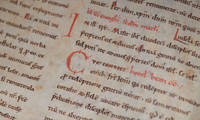
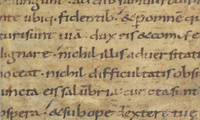
251671050. <blockquote><p>The important messages Gregory spoke nearly 500 years before the manuscript was made—that he spoke during the aftermath of a plague and collapse of an empire—were still relevant to the scribe who carefully copied out the homilies</p><p>“Earthly substance compared to heavenly happiness is a weight not a support.â€</p></blockquote><p>Modernity’s view of Pope Gregory the Great derives from his own words and from an imaging of the zeitgeist of the 6th century that the saint navigated. One early 20th century historian wrote of Pope Gregory that:</p><p>Growing up amid the relics of a greatness that had passed daily reminded by the beautiful broken marbles of the vanity of things he Gregory was accustomed to look on the world with sorrowful eyes. The thrill the vigour the joy of life were not for him.…He never attained a perfect sanity of view. From his birth he was sick—a victim of the malady of the Middle Ages. Dudden</p><p>Though this description may be consistent with the romanticized view of the 18th century antiquarian Edward Gibbon more than it accurately depicts Gregory Leyser the tumult and transition of the era must have impacted Gregory.</p><p>Born around 540 C.E. Gregory was immediately thrust into a world stricken with plague. This pestilence which would be known as the Black Death in the later Middle Ages was at this time called the Plague of Justinian due to the Emperor’s recovery from it and was the first occurrence of this strain of Yersinia pestis in Europe. In 590 Pope Pelagius II was not as fortunate as Emperor Justinian and succumbed to the disease— leaving the Holy See open for Gregory to assume as the natural successor to Pelagius Leyser.</p><p>From 590 until his death in 604 Pope Gregory achieved his appellation of “the Great.†During his papacy he began to shift the power centre back from Constantinople to Rome. He reformed and reshaped liturgy and arguably the most well known style of music from the Middle Ages the Gregorian chant described as such in the 9th century took his name because of his impact on plainchant centuries earlier. His influence was felt both on the Italic peninsula and in the far flung reaches of Germany and Britain.</p><p>While a unified Italy would not be achieved for another nearly 13 centuries the battle for a unified Christian theology across boundaries had already begun. With some groups still rejecting Christianity wholesale other groups believed different dogmas of the religion. One particularly popular version was Arianism which did not believe in the equality of the Holy Trinity rather that Jesus born of a human woman could not be of the same status as God and the Holy Spirit. As the Germanic Lombards amassed their kingdom in the North of Italy they staked out their Arian belief system. Gregory however befriended the Lombard Queen-by-marriage the Bavarian Theoldelinda who became a follower; she in turn influenced her husband Autori to adopt a Romanitas and convert to Nicean Christianity.</p><p>In 596 the Gregorian mission— the pope’s effort to convert the Anglo-Saxon peoples in Britain— was under way. Though after the Romans withdraw from Britain in 410 a good portion of the population remained Christian the Anglo-Saxon peoples were still practicing pagans and the separation from Rome led to distinct differences between Continental and Insular Christianity. Gregory saw an opportunity to complete the conversion of the British peoples in the Kentish King Æthelberht’s marriage to the Frankish and Christian Bertha. Thus he sent Augustine of Canterbury and Paulinus of York to the Islands and the conversion was under way.</p><p>Shortly before his mission efforts to Britain in 592-593 or 590-592 C.E. Pope Gregory delivered the Holimiae in Euangelia Homily on the Evangelists. These sermons would have been preached by Gregory and written down by scribes who were also able to read the sermons for him if need be Markus 16. These homilies come to us through an extant collection of around 400 still extant manuscripts Judic p. 233 n. 2.</p><p>Medieval manuscript Two vellum leaves from Books 1 and 2 of Gregory the Great’s Homiliae in Evangelia Italy 11th century written in beautiful Romanesque script.</p><p>The text of these folios are primarily from Book 2 Homily 27 and 37 with one section from Book 1 Homily 4 explaining the works of Evangelists John Matthew and Luke. In these sermons he expounds how to be a good Christian and the heavenly promises awaiting. In one exemplary passage from these leaves Gregory combines his passionate description of the kingdom of heaven with his acute sense of the Apocalyptic return of Christ as well as providing guidance for becoming more spiritually worthy. He writes:</p><p>“If we consider dearest brothers what and how great things are that are promised to us in the heavens we despise in our hearts all that is held on earth. For earthly substance compared to heavenly happiness is a weight not a support. The temporal life compared to the eternal life is rather to be said to be death than life. For what is the daily lack of corruption but a kind of prolongation of death But what language is sufficient to say or what understanding is sufficient to comprehend the joys of the heavenly city to participate in the choir of angels to assist with the most blessed spirits of the glory of the founder to behold the present face of God to see the uncircumscribed light to be affected by no fear of death to rejoice in the gift of perpetual incorruption But when he heard these things his heart was inflamed and he now desired to attend there where he hoped to rejoice without end. But great rewards cannot be attained except through great labors.†fol. 2 r.</p><p>This set of manuscript leaves lets us glimpse into the world immediately following the turn of the first millennium. The human touch behind the production of the manuscript comes to the fore through the unusual remains of the note from the scribe to his rubricator to add the section heading in red. The important messages Gregory spoke nearly 500 years before the manuscript was made—that he spoke during the aftermath of a plague and collapse of an empire—were still relevant to the scribe who carefully copied out the homilies paying attention to add delicate serifs on the feet of the descending strokes to make the physical manifestation of the words as impactful as their message.</p><p><strong>More details:</strong></p><p>Two vellum bifolium with sections from Books 1 and 2 of Gregory the Great’s Homiliae in Evangelia Italy 11th century second half in Latin four leaves two sets of two leaves conjoint 364 x 265 written space: 288 x 188 mm with double columns of 38 lines in fine Romanesque script Æ in ligature prepositions joined to the words they govern. Both tall & uncial-type d; ampersand for et. Consistent use of common abbreviations. Brown ink for main text headings in rubrication red with letters beginning sections tipped in red. Two and three-line initials in red.</p><p>These leaves demonstrate the production process of the manuscript. The leaves would have been folded in the centre leaving two columns of text on each side and stacked into each other and sewn to create packets called quires or gatherings of leaves. Thus the front and back recto/verso of the leaves are consecutive text but the leaves themselves are non-consecutive reflecting the stacking. Further remnants of the production process can be seen: the scribe’s directions to his rubricator— the person in charge of adding in the red letters— can be seen on the extreme edge of fol. 1 v beginning with “audio merit orare.â€. The letters written perpendicular to the main text correspond with the red letters on Column B reading in abbreviated letters “Lectio sancti evangelii secundum Matthaeum.†These types of directions are usually trimmed off during either the first stage of contemporary book production or in subsequent bindings making the finding of one highly unusual.</p><p><strong>Text Description:</strong></p><p>All from Gregory the Great’s Homiliae in Evangelia Homilies on the Evangelists</p><p>Fol. 1:</p><p>Book 2 Homily 27 sections 5- 8 “Addressed to the people in the Basilica of St. Pancratius the Martyr on the Day of his birthâ€</p><p>Fol. 1v:</p><p>Continued from recto Book 2 Homily 27 sections 8- 9.</p><p>Book 1 Homily 4 section 1 “Addressed to the people in the Basilica of Saint Stephan the Martyr on the Apostlesâ€</p><p>Fol. 2:</p><p>Book 1 Homily 17 section 18 “Addressed to the Bishops in the Lateran Baptistryâ€</p><p>Book 2 Homily 37 sections 1-2 “Addressed to the people in the Basilica of the Blessed Saint Sebastian the Martyr on the day of his birthâ€</p><p>Fol. 2v:</p><p>Continued from recto Book 2 Homily 37 sections 2- 6.</p><p><strong>Provenance:</strong></p><p>Ex Bruce Ferrini accompanied by a document prepared by Prof. Martin Colker of the University of Virginia.</p><p><strong>Further reading:</strong></p><p>Dudden F. Homes Gregory the Great: His Place in History and Thought 2 vols. London 1905 i. 15.</p><p>Leyser Conrad Authority and Asceticism from Augustine to Gregory the Great Oxford UP 2000.</p><p>Markus R.A. Gregory the Great Cambridge UP 2012.</p><p><img class=""alignnone wp-image-25018 size-post-window"" src=""https://cdn.raabcollection.com/wp-content/uploads/20231204144051/Folder-site-11-1600x1327.jpg"" alt="""" width=""1600"" height=""1327"" /></p> hardcover
1563058361Wittemberg, Hans Krafft, 1563. Borchling-Claussen 1880, 1882, 1881, 1883, gr 4°, blindgeprägter Ganzledereinbd. d. Zeit auf Holzdeckeln m. Metallschließen, Winterteil, Sonntagspostille, 14 nn. Bl., 276 Bl. m. Titelvignette, die Luther und Friedrich d. Weise neben dem Kreuz knieend zeigen, 2 kleine u. 21 große, von dem Cranach-Schüler Meister C.E. monogrammierte Holzschnitte nebst zahlr. Initialen / Winterteil, Festpostille, 8 nn. Bl., 89 Bl. m. demselben Titelholzschnitt, 18 Holzschnitten u. zahlr. Initialen / Sommerteil, Sonntagspostille, 18 nn. Bl., 374 Bl. m. 40 Holzschnitte, zahlr. Initialen u. der Verlegermarke Samuel Seelfischs, Boeckförers tho Wittemberch / Sommerteil, Festpostille, 106 Bl, 5 Bl. Register (ohne das letzte einseitig bedruckte Blatt) m. 22 Holzschnitten. - Rückenüberzug teilw. angeplatzt und im unteren Bereich mit Verlust, Schließbänder fehlen, der vordere Einbanddeckel und die ersten Lagen etwas wurmstichig, nahezu durchgehender leichter Wasserrand im oberen Bereich, alte handschriftliche Widmung, sonst innen gutes Exemplar in kräftigem Druckbild. In dieser Vollständigkeit von äußerster Seltenheit.
65274[Basel, Michael Wenssler, nicht nach 1474]. Fol. 190 nn. Bll. (das letzte weiß; Got. Typ., 34 Z.), durchg. rubriziert u. mit zahlr. in Rot eingemalten Initialen. HLdr. d. 20. Jhds. m. goldgepr. Rückentitel.
149565636[Paris, Pierre Le Dru für] Jacques Moerart, o. J. (um 1495). 8°. Titel m. einer fast blattgr. Holzschn.-Druckermarke. 95 (statt 96, fehlt das letzte weiße) Bll. (Got. Type, 32 Zeilen, rubriziert), Brauner Maroquin-Bd. d. frühen 20. Jhds., der Vorderdeckel m. grünen Intarsien u. reicher floraler Vergoldung, Rücken-, Deckel- u. Innenkantenverg., goldgepr. Rückentitel u. Goldschnitt.
3504801/01/1025. <blockquote><p>It is fascinating to think that the men and women who said this prayer lived early enough to have perhaps lived concurrently with Charlemagne himself who died in 814 but almost ertainly with his son Louis who lived into the 840s.</p><p> </p><p>Documents of any import or interest from this early era are very uncommon</p><p> </p><p>The Rise of Charlemagne</p></blockquote><p>The late eighth century saw a new power rising in Europe in the form of the empire of Charlemagne 747-814. Originally from the region of north-eastern France and the adjacent territories of the Low Countries within a few decades most of Europe from the Channel to the Pyrenees eastwards into much of Germany and downwards into Italy had fallen under his sway. It is clear that he saw the correct fostering of religion writing reading and learning in general as a vehicle to give this unit a collective identity remaking the Roman Empire as he saw it out of the fragmented and disparate communities left behind when that power structure fell in the fifth century.</p><p>In 800 Charlemagne was crowned Emperor of the Romans by Pope Leo III reviving the ancient imperial title in the West.</p><p>Charlemagne’s only surviving legitimate son Louis the Pious inherited the entire empire. Louis was deeply religious and capable but lacked his father’s political and military authority. He ruled as Emperor 814–840 and sought to maintain unity but his own reforms and family disputes soon undermined that goal.</p><p>These conflicts ended with the Treaty of Verdun 843 which permanently divided Charlemagne’s empire into three main kingdoms: West Francia ruled by Charles the Bald became the foundation of modern France; East Francia ruled by Louis the German evolved into Germany; Middle Francia ruled by Lothair I included northern Italy Burgundy and the Low Countries; this area later fractured further.</p><p>Louis the German ruled East Francia from 843-876 followed by Carloman of Bavaria Louis the Younger and Charles the Fat.</p><p>Although politically divided Charlemagne’s empire left a lasting legacy. The idea of a Christian emperor ruling Europe persisted inspiring the later Holy Roman Empire begun in 962 under Otto I. His reforms in education administration and law profoundly shaped medieval Europe.</p><p>The Sacramentary was one of the oldest tools of the Western clergy. It combined the various readings needed for Masses and the liturgy in a single convenient volume for use by a bishop or a priest. The earliest examples to survive are the Leonine and Gelasian Sacramentaries both with origins in the seventh century but as with the Bible and other key Christian books the careful reform and correction of such texts was at the forefront of the earliest waves of the Carolingian renaissance. Between 781 and 791 Charlemagne wrote to Pope Hadrian I asking him for an approved copy of the service-book of the Roman Church. That was examined added to on numerous occasions and disseminated and became the Gregorian Sacramentary. It is likely to have been further added to in the provinces of Europe and the text dominated liturgical practice for the next three centuries.</p><p>Votive Masses for those on voyages and at sea for one’s enemies and for the Bishop and congregation. Reading in part: ""Almighty and everlasting God who alone work great marvels stretch forth upon your servant N. Bishop and upon all the peoples committed to him the spirit of saving grace; and that they may truly be pleasing to you pour upon them the continual dew of your blessing. O God Who didst bring our fathers through the Red Sea and didst guide them in safety through the overflowing waters whilst they sang praises to Thy name we humbly pray that Thou wouldst keep in safety Thy servants on board ship and grant them a calm voyage to the haven they desire. O God of infinite mercy and immeasurable majesty whom neither the expanse of places nor the intervals of times separate from those whom you protect be present to your servants who everywhere place their trust in you and deign to be for them—through the whole journey they are about to undertake—a guide and a companion. Let nothing of adversity harm them; let nothing difficult stand in their way. Let all things be healthful for them all things prosperous; and under the help of your right hand may they swiftly obtain with effect whatever they seek with just desire.â€</p><p><strong>Leaf</strong> measuring 230 x 99 mm blind-ruled for two columns of 27 lines written in large and rounded Carolingian minuscule rubrics in orange-red recovered from reuse in a later binding.</p><p>It is fascinating to think that the men and women who said this prayer lived early enough to have perhaps lived concurrently with Charlemagne who died in 814 but certainly with his son Louis. These changes would have been uttered at a time when the consolidation of their empire was a recent and not distant event and Charlemagne’s grandchild was on the throne. These were events of real import to them and had daily consequences.</p><p>Our gratitude to manuscript expert Dr. Timothy Bolton who aided in the research of this document.</p><p>PROVENANCE</p><p>Produced in an abbey within the Holy Roman Empire</p><p>Cut up for use in a binding probably in the 16th century</p><p>Maggs Bros Catalogue 1002 1980</p><p>Mark Lansburgh 1925–2013 teacher hand-press printer and book collector on whom see Dutschke 2024; presumably sold by him to:</p><p>Neil F. Phillips 1924–1997 QC of Montreal New York and Virginia: his MS 698; sold at Sotheby's 2 December 1997 lot 42; bought by:</p><p>The Boehlen Collection Bern MS 804.</p><p><img class=""alignnone wp-image-25018 size-post-window"" src=""https://cdn.raabcollection.com/wp-content/uploads/20231204144051/Folder-site-11-1600x1327.jpg"" alt="""" width=""1600"" height=""1327"" /></p> unknown
7672CBBasel, Nikolaus Kessler, 1489. 4° (32 x 23 cm). 46 Bl. (letztes leer); 188 Bl.; 229 (von 230) Bl.; 320 Bl. (das letzte leer), 2 Spalten, 57 Zeilen. Mit 3 sich wiederholenden Holzschnitten (nachgeschnitten nach der Strassburger Ausgabe) sowie mit durchgehenden Rubrizierungen und eingemalten Initialen in Rot und Blau. Verfärbte Schweinslederbände über Holzdeckeln der Zeit, mit Stempel- und Plattenprägung. + Wichtig: Für unsere Kunden in der EU erfolgt der Versand alle 14 Tage verzollt ab Deutschland / Postbank-Konto in Deutschland vorhanden +, 7672CB|7672CB_2|7672CB_3|7672CB_4 4 Teile in 3 Bänden. [4 Warenabbildungen]
165660374Rome, "Non[is] Martii", i. e. 7 March 1656. Oblong 4to (290 x 175 mm). Latin manuscript on vellum. 1 p. With Alexander's lead bulla attached on a hemp cord.
in-4 (200x150), ff. 28 n.n. (A2 B-D4 E2 a-c4), legatura del XIX secolo in mezza pelle e angoli, titolo e fregi oro sul dorso. Con 12 belle silografie a piena pagina raffiguranti le Sibille e numerose iniziali istoriate. Rara e bella edizione variamente datata tra 1495 (Sander) e 1520 (Edit16) di questa raccolta di ''Opuscula'' pubblicati la prima volta nel 1481. L'autore, nato a Siracusa verso la metà del XV sec., entrò nell'Ordine dei Predicatori, insegnò filosofia e teologia ed ebbe l'incarico di inquisitore del S.Uffizio. La raccolta comprende varie opere tra cui solo la prima le ''Discordantiae sanctorum doctorum Hieronymi et Augustini'' del Barbieri e da lui ritenuta a sua più importante produzione di carattere scientifico. In questo trattato composto per volontà dell'imperatore difende, quasi polemicamente, la scuola tomistica, secondo la quale nel pensiero di San Tommaso sono contenute la scienza e la verità. Il contenuto degli altri scritti degli ''Opuscula'' (i vaticini delle sibille, i carmi della poetessa Falconia, il simbolo anastasiano ...) induce a pensare che questa raccolta fosse destinata a uso scolastico; conobbe una certa fortuna e varie edizioni, alcune delle quali successive alla morte del Barbieri. Annotazioni di antica mano sul contenuto dell'opera al titolo e ai primi ff., numerose sottolineature n.t. Esemplare un po' corto al margine superiore.. Sander 775. Essling 2316. ISTC Italian (16th century), p. 348.
164560373Rome, "apud Sanctum Petrum", 1. XII. 1645. Oblong folio (410 x 285 mm). Latin manuscript on vellum. 1 p. With Innocent's lead bulla attached on a hemp cord.
177133489Konstantinopel, (Astuacaturi, 1771). 2 Bde. in einem. 601, (7) SS. Mit 2 gleichen Titelholzschnitt-Bordüren, nahezu ganzseit. Holzschnitt und zahlr. figuralen Initialen. Blind- und goldgepr. Lederband der Zeit über Holzdeckeln (Schließen fehlen). 8vo.
8vo. 2 vols. in one. 601, (7) pp. With 2 identical woodcut title borders, nearly full-page woodcut, and numerous historiated initials. Contemp. blind- and giltstamped full calf over wooden boards (wants clasps). First edition of this Armenian grammar, composed by the learned Pagtasar (Balthasar) who for 50 years served as as proof-reader and copy-editor at the Astuacaturi printing office, which also published the present work. - Armenian ownership entry to flyleaf; some browning. The black oriental binding is slightly bumped at the extremeties, and the giltstamped ornamental cover decoration is largely oxydized. Extremely rare. Anassian II, 1074. Cf. Nersessian 229 (1791 ed. only). Not in Vater/Jülg.
194721650Grand Rapids MI 1947-1948. Very good. Three original typescripts all containing extensive manuscript additions and corrections with printed front matter. Plus one shorter holographic manuscript. Two of the typescripts are fastened together with string in the upper left corner the remaining typescript and manuscript are bound with tape along the top edge all consisting of more or less roughly 11" x 8" leaves. BIBOLUTION contains numerous original illustrations selections left. Some general wear toning and soiling with one of the extensive folding additions detached from the original leaf but present overall in very good condition. Included: 1. INDIAN HISTORICAL LEGENDS 1942 fastened with string to printed card stock upper wrapper printed title page preliminary autograph index and 56 type pages rectos only on onionskin with manuscript additions pasted-down interpolations and cancels in typescript and autograph. 2. THE GREAT SPIRIT RELEASE AND INDIAN HISTORICAL LEGEND 1943 fastened with string to a printed and pencil-decorated card stock upper wrapper with four prelims. including printed title page and leaf of printer instructions in autograph plus 60 pages in typescript and autograph rectos only with extensive pasted-on “riders” folding out from the lower edge of pages some going several pages and extensive revisions. 3. OUR UNIVERSE bound along top edge ten pages autograph ink; perhaps a fragment. 4. THE THEORY OF BIBOLUTION 1948 tape-bound along top edge with two prelims 143 pages rectos only largely typescript but interleaved with 43 lively original illustrations either on Simmons’ own or Michigan Trust Company letterhead with numerous manuscript corrections. <br/><br/>Wonderfully eccentric assemblage that while clearly intended for eventual publication remains an impressive and elaborate creation of an engaging outsider artist. V. L. R. Simmons was a self-professed Native American: “I am an Indian by choice and applied study not by birth or adoption. Part of my story comes from theory and inspiration” Preface GREAT SPIRIT. But he was also an anthropo-religio-philoso-scholar and in this cataloguer's biased opinion an unheralded folk artist. Simmons and his wife Nellie appear to have held curious theories about the role of light and color in evolution—or as they would have it Bibolution or “the Simmons theory of life”: life was formed when light creates life force; light as souls transmigrate or leave the body; adultery changes your spirit color etc. The couple also seems to have developed idiosyncratic anthropological views tending toward an Old Testament lineage for the American Indians possibly influenced by Mormonism. There is much in these manuscripts suggesting deep and fruitful study of the subjects Simmons provides an extensive American Indian sign vocabulary for example though also much in the way of untutored but entertaining religious and scientific speculation deeply in the American grain. At least as much as the particulars of the content however are the particulars of the execution. The typescript of GREAT SPIRIT exhibits a kind of overflowing exuberance with fold-out charts and maps including one of the migration of Nimrod's descendants tipped in holograph additions and even an extraordinary five-foot-long lineage of Adam. But it is BIBOLUTION's illustrations that capture a true folk artist at work. While these pen and ink drawings of animals and other creatures with mounted typed captions are meant to illustrate the Simmons’ theories of evolution taken in total they reveal a distinctive outsider voice. Crude on first examination they soon coalesce around a bold confidence and singular vision — powerful and compelling. They show the influence of Native American cave paintings and other primitive arts but filtered through Simmons' auto-didactic and peculiar point-of-view. OCLC notes three locations for a 1950 published version of BIBOLUTION and NUC locates a 1939 work entitled A LEXICON OF NORTH AMERICAN INDIAN LANGUAGES AND DIALECTS and an expanded 1945 edition that evidently incorporating material from GREAT SPIRIT held at the Library of Congress. Weird and quintessentially American worthy of further study and exhibition. unknown books
65279[Köln, Drucker des Salomon et Marcolphus (Ludwig von Renchen), nicht nach 1478). Fol. Mit einer rot eingemalten Initiale am Beginn. 66 nn. Bll. (ohne das erste u. letzte weiße; 40 Zeilen, Got. Type). HLdr. d. 20. Jhds. m. goldgepr. Rückentitel u. Rotschnitt.
"In-8°piccolo, (4cc), 643pp, (33cc), legatura in piena pergamena coeva con unghiature, titolo manoscritto al dorso. Prima edizione, curata da Peiresc. Raguseo, un chierico che arrivò a Padova come secondo professore ordinario di filosofia,diventando amico di Galileo, fu uno dei maggiori esponenti di quella corrente contraria all'astrologia, così in voga in quel periodo. Questo volume contiene le sue lettere sulla divinazione e sull'astrologia, che condanna assieme ad altre scienze occulte quali la chiromanzia, la fisiognomica e la geomanzia. ""Inizialmente coltivò l'eloquenza, quindi la filosofia e teologia, poi si dedicò interamente alla medicina e alla matematica...E non si fermò qui, ché diventò presto seguace dell'arte di Lullo...Possedeva una famosa biblioteca, che sfortunatamente venne venduta dopo la sua morte"" (Thorndike, VI, pp 201-02) Riccardi I. 336. Cantamessa 3693. In-8 ° small, (4cc), 643pp, (33cc), contemporary full vellum binding with overlapping fore-edges, handwritten title on the spine. First edition, published by Peiresc. Raguseo, a cleric who arrived in Padua as a second professor of philosophy, becoming a friend of Galileo, was one of the leading exponents of that current contrary to astrology, so in vogue at that time. This volume contains his letters on divination and astrology, which he condemns along with other occult sciences such as palmistry, physiognomy and geomancy. ""Initially he cultivated eloquence, then philosophy and theology, then he devoted himself entirely to medicine and mathematics ... And he didn't stop there, as he soon became a follower of Llull's art ... He owned a famous library, which unfortunately was sold after his death ""(Thorndike, VI, pp 201-02) Riccardi I. 336. Cantamessa 3693. "
149565314Basel, Johann Froben, ?M.cccc.xcv. sexto Kalendas Novembres? (d. i. 27. Oktober 1495). 8°. Mit einem fast ganzs. Textholzschnitt. 508 nn. Bll. (Bl. A1 weiß; Got. Typ., 2 u. 3 Kol., 54 Zeilen, rubriziert u. mit Initialen in Rot u. Blau), Ldr. d. 16. Jhds. a. 4 Bünden m. 8 Eckbeschlägen, 2 Mittelstücken u. 2 kl. Metallsternchen, marmor. Schnitt.