114 507 résultats
4to. 2 parts in one volume. (2), 122, 161, (1) pp. Lithographically printed Chinese text, one leaf apparently bound out of sequence, some pages incorrectly numbered or not numbered. In total, the title-page, 283 pp. and 2 blanks (the last page and the verso of the title page). Bound in a sturdy green half calf, ca. 1900. The doctrines of the Chinese philosopher Mengzi (fl. 300 BC), the principal successor to Confucius. This is one of the earliest Chinese texts to be printed in Europe and a landmark in lithographic printing. The Chinese text here is complete in two parts. Lasteyrie had produced a Latin translation by Stanislas Julien (1797-1893) in 1824-26 ("Meng tseu, vel, Mencium inter Sinenses philosophos ingenio, doctrina, nominisque claritate Confucio proximum"), and while the Latin text is not particularly rare, the lithographed set (which was to serve as a supplement) is very much so. The plates were lithographed by the Comte de Lasteyrie, Charles Philibert Lasteyrie du Saillant (1759-1849), an innovator in lithographic printing in France. He carried out the work at his own cost. - Title-page browned and laid down, pp. 150ff. have a stain affecting several leaves, p. 162 patched. Much of the text is remarkably fresh and the binding is entirely solid. Incorrectly stamped 'Confucius' on the spine. Provenance: bookplate of George May Elwood (1844-1906) on rear pastedown (designed by Harold M. Ellis, dated 1898), his label on the front pastedown. Not in OCLC.
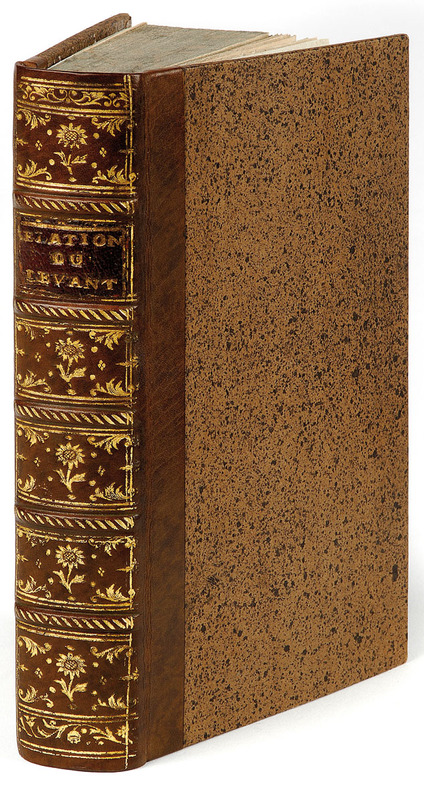
8vo (104 x 152 mm). 3-480 (instead of 496) pp., lacking title and remaining 3 leaves of preliminaries, first leaf of text, and 8 leaves between p. "276" and "294". 17th century full calf with gilt spine and labels "Essais de Montaig" - "Tom I", leading edges gilt. Edges sprinkled blue. First edition of one of the most important works written and published in French in the 16th century. Incomplete copy of the first part only, lacking the first five leaves as well as the eight leaves comprising the 29 sonnets. - Montaigne's groundbreaking essays on an eclectic array of subjects - from cannibals to solitude, from sleep to sadness - constituted an entirely unique and unprecedented literary genre, and a philosophy of knowledge that was based on his own personal experience and observations, epitomizing 16th century enlightened scepticism. "The most elaborate essay, the 'Apologie de Raimond Sebonde', is second to no other modern writing in attacking fanaticism and pleading for tolerance" (PMM). - The publishing history of this work is complex, both for the rather careless printing of the first edition, and in large part because the changes to the text between editions were considerable: Montaigne's text was by no means static but constantly evolved under the eye of the author who "considered each new edition as the last". This first edition, printed by Millanges in the spring of 1580, is unsophisticated and rather hastily composed, as betrayed by the innumerable misprints, font and type inconsistencies, errors in page numbering and textual variants. This copy has G2 and Aa5 missigned as 2G and A5, while Aa2 is correctly signed thus (not as Aa; see Sayce & Maskell, p. 2), and the corrected states of C8 and O8 (ibid., p. 5, note 7), as well as the letters 'gsit' accidentally printed at the foot of Gg3 (ibid., p. 6, no. 9). The irregular spacing of lines on the page - occasionally very cramped - indicates composition by forme. - Copies of early editions of Montaigne's work are extremely rare. Fewer than 100 examples are estimated to exist in private and institutional collections worldwide, suggested by some to point to a small original print run of only 300 to 400 copies (Bibliotheca Desaniana, no. 8, 2011; Balsamo, p. 160). - Corners bumped, spine-ends chipped, hinges starting. Paper somewhat browned. PMM 95. Sayce & Maskell 1. Tchemerzine IV, 870. Brunet III, 1835.
159919380Brescia, Compagnia Bresciana, (1599). 4 Teile in 1 Bd. 24 Bll. (letztes weiß), 536 S., 4 Bll., 227 S., 6 Bll., 268 S., 4 Blm., 112 S. mit 1 Kupfertitel und 111 Kupferkarten im Text. 8°. Pgmt. der Zeit (fleckig und berieben, etw. wellig). [4 Warenabbildungen]
39363In-8 (203 x 125 mm), demi-veau fauve de lépoque, dos lisse orné de compartiments garnis dun fleuron répété au centre et cloisonnés dune roulette dorée en place des nerfs, pièce de titre de maroquin vert, tranches mouchetées de rouge, xxxv, (1), 137 et (2) pages derrata (faux-titre et titre compris). Paris, Brunot-Labbe, 1817.
1729172857Leipzig, Zedler / Breitkopf, 1729. 4. Aufl. 22 Teile und Register in 12 Bde. Mit 22 wiederholten gestochenen Titelvignetten sowie 22 wiederholten gestochenen Kopfvignetten mit dem Porträt Luthers in zwei Versionen von J. G. Mentzel, Porträtstecher in Leipzig. 4° (33,5x22cm), Pergamentbände der Zeit mit goldgeprägten Rückentiteln. 1734, 1740 (Register).
179953609Greifswald, Berlin, Jena, Stralsund, 1797-1799. Deutsche, schwedische, französische, lateinische und niederländische Handschrift auf Papier. 266 (recte 262) SS. mit 137 Einträgen und einem aquarelliertem Frontispiz. Mit 4 eingeklebten Silhouetten, 3 Tuschezeichnungen und 1 Bleistiftzeichnung. Roter Ledereinband der Zeit (stellenweise berieben) mit reicher Rücken- und Deckelvergoldung, Goldschnitt und marmorierten Vorsätzen. Mit vergoldetem Monogramm "C. F." am Vorderdeckel und der Jahreszahl 1797 am Rückdeckel. Qu.-8vo (114:196 mm).
158331508(Sankt Gallen, Leonhard Straub für Josias Geßner in Zürich), 1582(-1583). 2 Teile in 1 Band. (8), 368, (18) SS., l. w. Bl. (8), 305 (recte: 307), (13) SS. Beide Titel in rot und schwarz gedruckt. Mit 2 versch. Holzschnittvignetten an den Titeln und zahlreichen Textholzschnitten. Blindgepr. Schweinslederband der Zeit über Holzdeckeln mit abgeschrägten Deckelkanten auf vier Doppelbünden. Reste von Schließen. Dreiseitiger Rotschnitt. 4to.
149564829(Brescia, Angelus und Jacobus Britannicus, 26. März 1495. 8°. 94 nn. Bll. (1-2 Spalten, 40 Zeilen, Got. Typ.), Pgmt. d. 16. Jhds. m. durchzogenen Bünden.
1891F92326Parisiis [Paris], Ludovicus Vives 1891-1895 Complete set in 26 volumes, together 18.236 pages, text printed in 2 columns, nice uniform hardcover bindings in very good condition (marbled boards, spines in black leather with gilt lettering), 28cm., some foxing at fore edges, stamp at first title page and at verso of title page, text in Latin, pages clean with only few occasional foxing, with an index at the end of each volume, good condition, [Content: Volume 1: De modis significandi sive grammatica speculativa etc. (vi,608pp.) // 2: Quaestiones super libros Elenchorum Aristotelis, super lib. I-II Priorum-posteriorum, in libros I, II et III Physicorum (685pp.) // 3: Quaestiones in libros IV, V, VI, VII, VIII Physicorum Aristotelis, In libros Aristotelis de Anima (782pp.) // 4: Quaestiones Meteorologicae, de rerum principio, De primo rerum omnium Principio (807pp.) // 5: Theoremata, Collationes, Tractatus imperfectus de cognitione Dei, Quaestiones Miscellaneae de formalitatibus, Metaphysicae textualis libri I, II, III, IV (732pp.) // 6: Metaphysicae textualis libri V-XII, Conclusiones Metaphysicae (672pp.) // 7: Quaestiones subtilissime super libros Metaphysicorum Aristotelis (711pp.) // 8: Quaestiones in primum librum sententiarum distinctio prima et secunda (650pp.) // 9: Id. distinctio 3 usque ad 13 (916pp.) // 10: Id. a distinctione 14 usque ad 48 (789pp.) // 11: Quaestiones in secundum librum sententiarum a distinctione prima usque ad secundam (569pp.) // 12: id. a distinctione 3 usque ad 14 (683pp.) // 13: id. a distinctione 15 usque ad 44 (506pp.) // 14: Quaestiones in tertium Librum Sententiarum a distinctione prima usque ad vigesimam secundam (785pp.) // 15: id. a distinctione 23 ad 40 (1104pp.) // 16: Quaestiones in quartum librum sententiarum a distinctione prima usque ad septimam (712pp.) // 17: id. a distinctione 8 usque ad 13 (779pp.) // 18: Id. a distinctione 14 usque ad 22 (830pp.) // 19: Id. a distinctione 23 usque ad 42 (570pp.) // 20: Id. a distinctione 43 usque ad 48 (544pp.) // 21: Id. a distinctione 49 usque ad 50 (575pp.) // 22: Reportata Parisiensia Liber primus dist.1-48, liber secundus dist.1-11 (692pp.) // 23: Id. liber secundus dist.12-44, Liber tertius dist.1-35, Liber quartus dist.1-6 (674pp.) // 24: Id. liber quartus a dist. 7 usque ad 49 (696pp.) // 25: Quaestiones Quodlibetales, a quaestione prima usque ad tertiam decimam (588pp.) // 26: Quaestiones quodlibetales XIV-XXI, Concilationes, Opusculum de contradictionibus, De perfectione statuum (571pp.)], F92326
Complete set in 26 volumes, together 18.236 pages, text printed in 2 columns, nice uniform hardcover bindings in very good condition (marbled boards, spines in black leather with gilt lettering), 28cm., some foxing at fore edges, stamp at first title page and at verso of title page, text in Latin, pages clean with only few occasional foxing, with an index at the end of each volume, good condition, [Content: Volume 1: De modis significandi sive grammatica speculativa etc. (vi,608pp.) // 2: Quaestiones super libros Elenchorum Aristotelis, super lib. I-II Priorum-posteriorum, in libros I, II et III Physicorum (685pp.) // 3: Quaestiones in libros IV, V, VI, VII, VIII Physicorum Aristotelis, In libros Aristotelis de Anima (782pp.) // 4: Quaestiones Meteorologicae, de rerum principio, De primo rerum omnium Principio (807pp.) // 5: Theoremata, Collationes, Tractatus imperfectus de cognitione Dei, Quaestiones Miscellaneae de formalitatibus, Metaphysicae textualis libri I, II, III, IV (732pp.) // 6: Metaphysicae textualis libri V-XII, Conclusiones Metaphysicae (672pp.) // 7: Quaestiones subtilissime super libros Metaphysicorum Aristotelis (711pp.) // 8: Quaestiones in primum librum sententiarum distinctio prima et secunda (650pp.) // 9: Id. distinctio 3 usque ad 13 (916pp.) // 10: Id. a distinctione 14 usque ad 48 (789pp.) // 11: Quaestiones in secundum librum sententiarum a distinctione prima usque ad secundam (569pp.) // 12: id. a distinctione 3 usque ad 14 (683pp.) // 13: id. a distinctione 15 usque ad 44 (506pp.) // 14: Quaestiones in tertium Librum Sententiarum a distinctione prima usque ad vigesimam secundam (785pp.) // 15: id. a distinctione 23 ad 40 (1104pp.) // 16: Quaestiones in quartum librum sententiarum a distinctione prima usque ad septimam (712pp.) // 17: id. a distinctione 8 usque ad 13 (779pp.) // 18: Id. a distinctione 14 usque ad 22 (830pp.) // 19: Id. a distinctione 23 usque ad 42 (570pp.) // 20: Id. a distinctione 43 usque ad 48 (544pp.) // 21: Id. a distinctione 49 usque ad 50 (575pp.) // 22: Reportata Parisiensia Liber primus dist.1-48, liber secundus dist.1-11 (692pp.) // 23: Id. liber secundus dist.12-44, Liber tertius dist.1-35, Liber quartus dist.1-6 (674pp.) // 24: Id. liber quartus a dist. 7 usque ad 49 (696pp.) // 25: Quaestiones Quodlibetales, a quaestione prima usque ad tertiam decimam (588pp.) // 26: Quaestiones quodlibetales XIV-XXI, Concilationes, Opusculum de contradictionibus, De perfectione statuum (571pp.)], F92326
149857335[Augsburg, Johann Froschauer, nicht nach 1498]. 4°. Mit einem Titelholzschnitt u. einer großen Holzschn.-Initiale. 1 nn., 105 röm. num., 2 nn. Bll. - Angeb. - Henricus de Langenstein. Secreta sacerdotum. Mit Messgebeten. Bearbeitet und Herausgegeben von Michael Lochmayr. (Ebda., 1497). 11 (statt 12; das letzte weiß) nn. Bll., Blindgepr. Schweinsldr. d. 16. Jhds. a. 4 Bünden m. dreiseitigem Farbschnitt.
45549Straßburg, [Martin Flach], 1487. 4°. Mit rot eingemalten Initialen. 32 nn. (das letzte weiß), 285 num. Bll. (ohne das letzte weiße; Got. Typ., 2 Kol., 37 Zeilen), Späterer blindgepr. Ldr.-Bd. aus älterem Material auf 3 Bünden über Holzdeckeln mit Metallbeschlägen.
149629528Straßburg, [Georg Husner], 1496. 195 Bl. (a8 weiß). Mit zahlreichen rot eingemalten Lombarden. 4° (20,5 x 14 cm). Blindgeprägtes braunes Leder der Zeit auf Holzdeckeln.
150054897Straßburg, [Georg Husner], 15. Juli 1500. 4°. Mit 2 großen eingemalten Initialen in Rot u. Blau sowie zahlr. dreizeiligen Initialen in Rot. 207 nn. Bll. (ohne das letzte weiße; Got. Typ., 2 Kol., 51 Zeilen), Ldr. d. 18. Jahrhunderts a. 5 Bünden m. blindgepr. Deckelfileten, goldgepr. Rückentitel u. dreiseitig gespränkeltem Rotschnitt.
149365208Venedig, Bonetus Locatellus für Octavianus Scotus, 4. Juni 1493. Fol. Mit großer Metallschnitt-Druckermarke am Schluss u. einigen meist schwarzgrundigen Holzschn.-Initialen. 313 num., 5 nn. Bll. (2 Kol., 66 Z., Got. Typ.), HPgmt. d. 19. Jhds. m. marmor. Deckeln u. Schnitt.
0014-20Zürich, Getruckt, in Bürcklischer Truckerey. 5 Tle. in 1 Bd. [Verlegts David Herrliberger, Basel, gedruckt bey Daniel Eckenstein 1739-48]. 2°. 16 S. (Erklärung d. Kupfertitels), 27, 40, 22 [2], 18, 85 [1], 198, 217 S., 1 Bl. (Vorrede), 19 Bll. (Register). Mit gestoch. Frontispiz u. gest. Portrait Picards sowie 227 (teils gefalt. od. doppelbl.-gr.) Kupfertaf. Mit 6 gest. Tit. u. 5 Tit. in Rot u. Schwarz. Ldr. d. Zt. über 7 Bünde. Mit Rückensch. u. reicher Blindpräg. In ausgezeichnetem Zutand. [9 Warenabbildungen]
1508202113Augsburg, Hannßen (Hans) Otmar, 1508. 1. Aufl. Mit 3 blattgroßen altkolorierten Holzschnitten von H. Burgkmair sowie 4 Holzschnitt-Medaillons auf dem Titel (Evangelistensymbole) und 4 altkolorierten größeren rot- oder schwarzgrundigen Holzschnitt-Initialen. Mehrere kurze Textpassagen in Rotdruck. Ferner mit zahlr. eingemalten Lombarden in Rot, 156 röm. nummerierte Bll. 28,5 x 20 cm, aufwendig restaurierter blindgeprägter Kalbslederband der Zeit über Holzdeckeln mit 2 Messing-Schließen.
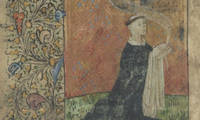
1420254921420. <blockquote><p>It is unusual to find an English example particularly one which so well demonstrates the unique factors at play in such pieces at the time</p></blockquote><p>Throughout the Middle Ages true visionaries put into place systems of intellectual and social organisation. Saint Dominic’s foundation of the Dominican Order responded to a need for a new kind of monasticism as Medieval Europe shifted towards an increased urbanisation which would give rise to the great cities that we now know. In the city of Toulouse France Dominic based his Order on the Rule of Saint Augustine— a system of tenets to organize the lives of the monks which focused heavily on salvation through preaching. Dominic’s order valued education as the vehicle for effective preaching and therefore effective saving of souls. Dominic’s vision saw his followers establishing schools alongside newly burgeoning universities in Paris and Bologna and later in Palencia Montpellier and even Oxford within his lifetime. Members of the Dominican Order took their message of educated understanding of God from the continent to the British Isles settling in Oxford by 1221.</p><p>Thomas Aquinas and Albertus Magnus were also of the Dominican Order.</p><p>Given the wealth of expressions of interiority that arise in later Medieval arts . scholars philosophers and ideologues have often turned to this era when seeking the putative origins of modern selfhood"" Sands 1; the inclusion of patron portraits acts as a reflection of the self reflecting on the divine personalizes the book. After book productions shifted towards catering to the wealthy rather than the monastic lay-patrons were able to emulate ""monastic patterns of reading prayer and meditation"" Sands 15. Rather than allowing a wealthy lay patron to emulate the monastic way of life the patron portrait of this Dominican monk is a glimpse into the monastic way of life and an individual's development of his sense of self.</p><p>This leaf from a Dominican’s personal prayer book features a portrait of the owner himself. This little peak into a 15th century private sphere shows the book’s owner depicted in his traditional black cloak— which gave rise to the appellation of the Dominicans as “the Black Friarsâ€â€” over top his white habit and his tonsure to better allow God to see his thoughts and to demonstrate his renunciation of worldly aesthetics. From his outstretched hands a banderole twirls upwards around a now faded woman’s face framed in the blue associated with the Virgin. The leaf is blank on the back. These two features— the heavy fading in a specific area and the blank verso— make suggestions about the production and the reception of the book.</p><p>This portrait leaf was likely a bespoke product that was tipped into an on-spec ready-to-buy book. That is to say at this point books were no longer being made entirely to the patron’s demand; books had become commodities that more people could afford so a stationer would have books ready made with minor customization available such as the addition of a patron portrait. This addition without text on the back would not interrupt the flow of the set selection of prayers in the Book of Hours. With this customization the owner literally sees himself in his daily worship of the Virgin Mary. Here is where the importance of the fading comes into play.</p><p>This is likely not just the wear and tear of history but the toll of the owner’s ritual touching of the Virgin’s face in conjunction with his portrait. This action is called ‘affective piety’ and though chiefly associated with women’s rituals it was not uncommon for men particularly those aligned with mysticism to engage in this method of worship. In the same way that Saint Dominic’s Order responded to the rise of cities in the thirteenth century affective piety provides a new way of interacting with Christianity. As people moved towards understanding Christ as a man and through his bodily identity they also moved towards an “emotional understanding of Christ as accessible through his humanity and imitable through affective piety and the new ways of thinking feeling and imitating Christ that it fostered resulted in innovative modes of individual and communal devotion through prayer reading and liturgy†Zimbalist. We notice on this leaf that the border the background the grass even the Friar’s own body and face are not as faded as the banderole of holy words and the image of the holy face now nearly imperceivable. This suggests that the wear was focused on these significant areas and were likely touched rubbed even cried upon frequently during his reverent worship. The size of the folio also underscores its use as a personal devotional item indicating a book small enough to fit in the hand and be carried discreetly.</p><p>London was the capital of fashion for manuscripts in England in the 1300 and 1400s. Trends from the Continent would arrive in London and be incorporated into newly made manuscripts and these trends would radiate outwards to other centers of manuscript production. The border around the Dominican friar demonstrates the transition of preference for curving rather than straight borders occurring from 1405 to the end of the century; the incorporation of several specific styles of foliage indicate that this manuscript was on the cutting edge of fashion fairly early on and therefore likely made in London.</p><p>This book owner whose name is now lost to us but whose face remains in this miniature tells the story of an Order who rode the tide of urbanisation through a devotion to God and education and who saw the destruction of Europe and its own numbers during the Black Death. The owner living circa 1420 likely in London based on the style of background and border of this leaf would be heartened to know that his Order endured further European upheavals from the Early Modern to the Modern Period just like this piece of his book.</p><p>While patron portraits have made their way to the market particularly in bound books it is unusual to have an English example particularly one which so well demonstrates the production process of creating a bespoke product from an on-spec liturgical book.</p><p>Further details:</p><p><strong>Leaf from an English Book of Hours</strong> Use of Sarum with a miniature of a Dominican friar in prayer in Latin illuminated manuscript on parchment England probably London c. 1420 104 by 69mm. Single leaf with a large rectangular miniature of a tonsured friar in Dominican robes kneeling in a grassy area as a banderole emerges from his hands and curves upwards to enclose a woman's face most probably the Virgin the whole before a tessellated background decorated with red and blue dots within a full border of rinceaux foliage terminating in gold ivy leaves and coloured seed pods and acanthus leaves reverse blank signs of water damage to top of reverse slight scuffing and fading.</p><p>See also:</p><p>Hamburger Jeffrey. The Visual and the Visionary: Art and Female Spirituality in Late Medieval Germany New York N.Y.: Zone Books 1998</p><p>Zimbalist Barbara. ""Chapter 10: Medieval Affective Piety and Christological Devotion: Juliana of Mont Cornillon and the Feast of Corpus Christi"". Illuminating Jesus in the Middle Ages. Leiden The Netherlands: Brill 2019.</p><p>Sands Alex Vision Devotion and Self-Reprsentation in Late Medieval Art Cambridge University Press 2014</p><p><img class=""alignnone wp-image-25018 size-post-window"" src=""https://cdn.raabcollection.com/wp-content/uploads/20231204144051/Folder-site-11-1600x1327.jpg"" alt="""" width=""1600"" height=""1327"" /></p> unknown
167116086Lyon, Jean Thioly, 1671 ; in-12 ; demi-veau havane pastiche du XVIIIe, tranches marbrées, dos décoré et doré, pièce de titre ; (28), titre, Épître, Préface, 481, (17) pp.
166049107Zürich, Johann Jakob Bodmer, 1660. (20), 600, (24) SS. Zeitgenöss. Pergamentband auf 4 durchzogenen Bünden mit übergreifenden Deckelkanten. 4to.
150038587(Hagenau, Heinrich Gran für Johann Rynmann, 18. September bzw. 8. Dezember 1500). Fol. 250 (davon 2 weiße); 366 (davon 2 weiße) nn. Bll. (Got. Typ., 2 Kol., 58 Zeilen, Min. f. Init.), Blindgepr. Ldr.-Bd. d. Zt. über Holzdeckeln a. 3 Bünden m. handschriftl. Deckelschild.
51138ABBasel, Johannes Froben, November 1521, (für Cyprianus); und Strassburg, Johann Knobloch, 1522 (für Athanasius). Folio (33,5 x 22,5 cm). [12] Bll., 515 S., [16] Bll. (Index und Schlussblatt) für Cyprianus; 1 Titelbl., 5 Bl., 10 Bl. Index, CCCXIIII Bl. für Athanasius. Schweinslederband d. Zt. über Holzdeckeln, mit reicher Blindpägung (ohne die beiden Schliessen).
17443820DBZürich, zu finden bey David Herrliberger; Basel, gedr. bey Daniel Eckenstein, 1744-48. Folio. Seitenkollation folgend. Mit gesamthaft 189 Kupfertafeln. Kalbleder d. Zt., Rücken auf 6 Bünden mit reicher Vergoldung und Rückenschildchen. + Wichtig: Für unsere Kunden in der EU erfolgt der Versand alle 14 Tage verzollt ab Deutschland / Postbank-Konto in Deutschland vorhanden + 3 Teile in 2 Bdn.
192660787ABMünchen, Bremer-Presse, 1926-1928. 35,5x26,5 cm. Leder-Bde. mit Kopfgoldschnitt in privaten Papp-Schubern mit Papierrückenschildern. 5 Bde. [5 Warenabbildungen]