Louis MoreriLivre Rare Book
114 477 résultats
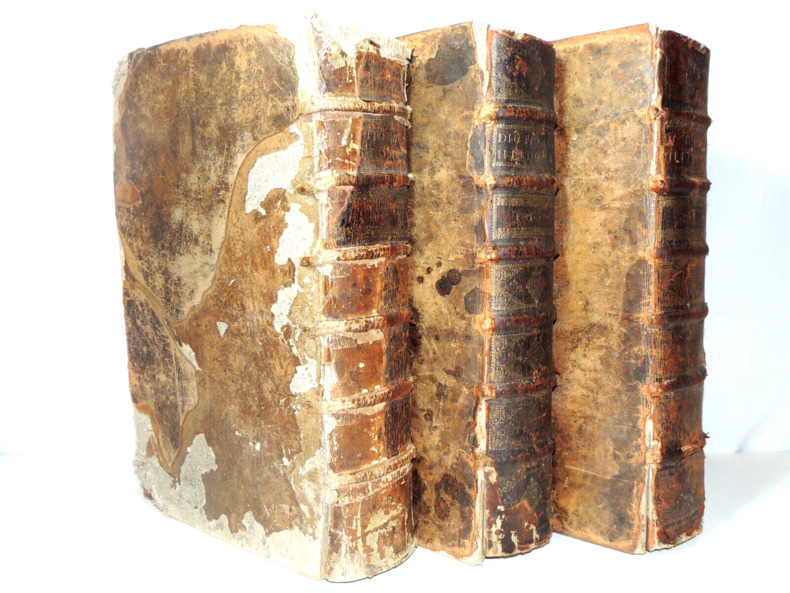
CZC-4qui contient, Les vies & les actions remarquables, des Roys, des Empereurs, des Princes illustres & des Grands Capitaines, L’établissement & le Progrez des Ordes Religieux & Militaires, Les Vies des Hérafiques & des Autheurs de Schifmes, Les Généalogies, l'Histoire fabuleuse des Dieux & des Héros de l"Antiquité Payenne, La description des Empires, Royaumes, Républiques, Villes, Iles, Montagnes, Fleuves & autres, Avec Hiftoire des Conciles Généraux & Particuliers, Etc... Par Louis Moreri édition revue, corrigée et augmentée en deux volumes, Complet en deux volumes de A à Z + Tome de Supplément ( A à Z) forts volumes in-4, 385x250, relié basane époque, accrocs et manque de cuir, méritent une restauration, Bel état intérieur, complet; 1297, 1362 & 1238 pages , poids de l'ensemble 16kg Lyon, Jean Baptiste de Ville, Paris chez Denys Thierry, MDCLXXXVIII, MDCLXXXIX
1927R42483Antwerpen, 1927-1997 Volledige collectie van jaargangen 1 (1927) t.e.m. 71 (1997) [slechts 1 nummer ontbreekt: nr.1 jg.51 (1977)], jg.1-38 per jaar ingebonden in halflinnen banden, stempeltje, mooie staat, [jg.25 bevat ook de Registers op deel I-XXV (1927-1951) 268pp.]
Volledige collectie van jaargangen 1 (1927) t.e.m. 71 (1997) [slechts 1 nummer ontbreekt: nr.1 jg.51 (1977)], jg.1-38 per jaar ingebonden in halflinnen banden, stempeltje, mooie staat, [jg.25 bevat ook de Registers op deel I-XXV (1927-1951) 268pp.]
155897319ABFrankfurt am Main, Zephelium, 1558. Folio. Mit zahlr. Holzschnitt-Initialen. 8 Bll, CCCLXXXVI Bll., 5 Bll. Brauner Ganzlederband (um 1800) mit reicher Blindprägung auf beiden Deckeln. - Stellenweise fleckig, oberer w. Seitenrand stellenweise m. Fleckenrand. Erste vier Blätter m. sehr kl., hinterlegter Fehlstelle (im weißen Rand), Registerblätter m. wenigen sehr kl. Wurmgängen i. unt. weissen Rand. - Ingesamt wohlerhaltenes Expl.
23205o.J. Fol. Holzdeckelband der Zeit mit blindgeprägtem Schweinslederbezug und 2 Schließen. Einband etwas berieben, unteres Schließband ohne das Metallteil.
172910145Augsburg, Veith, 1729. 2 in 1 Bd. 6 Bll., 499, 503 S. 17 Kupfertafeln und 4 gefalt. Kupferkarten. 4°. Blindgeprägtes SchweinsLdr. der Zeit auf Holzdeckeln und 5 Bünden mit Rückenschild (es fehlen die Schließen, etw. fleckig, berieben und bestoßen).
151915613(Am Ende:) Basel, Froben, 1519. 6 Bll., 229 S., 1 Bl. mit 2 Holzschnitt-Druckermarken und 4 Holzschnitt-Bordüren von Hans Franck. 4°. Blindgeprägtes Ldr. der Zeit auf Holzdeckeln (lädiert).
160317244Dresden, Hieronymus Schütz, 1603. 1 Bl., 36 S., 1 Bl. 8°. Ohne Einband (Rücken mit modernem Buntpapierstreifen geklebt). [5 Warenabbildungen]
169111508Sulzbach, Bleul, 1691. 4 Teile plus 2 Teile "Schlüssel" und Register in 1 Bd. Mit 32 Textkupfern (es fehlen die S. 57 - 64 in Teil 3). 1 Kupfer-Frontisp. 8°. Mod. HPgmt unter Verwendung alten Materials mit Rückenschild (fleckig).
17688378ABWien, F. L. Grund, o. J. [1768]. Frontispiz, 447 + 7 S. Goldgeprägter roter Maroquineinband, mit fünfbündigen R. in zweiteiliger Orig. Lederhülle der Zeit., Einband u. Schatulle
17854467CBBingii ad Rhenum - Venetiis, G. C. Voigt - Remondini, 1785 - 1790. Pag. Fünfbündige OLd. der Zeit mit floraler Goldprägung des R. sowie ein OPgm. 10 Bde.
175312792ABMannheim, Pierron, 1753. 208 S. (recte 209). Blindgeprägter OLdr. der Zeit., Beispiel
1927S7746Auguste Picard 1927-1932. Good. In French. Six volumes. Auguste Picard unknown
1720621428Nürnberg, Endter, 1720. Fol. M. 2 gest. Front., 1 Portr., 6 Kpfr.-Taf., 11 Kurfürstentaf. u. zahlr. Text-Holzschn. 35, 10 Bl., 1181 S., 11 Bl. Ldrbez. Holzdeckelbd. m. Holzwurmeinstichen. Berieben. Bezug d. hint. Einbd.-Decke beschäd. Die re. unt. Ecke beschäd. Rücken eingerissen. Beide Schließen fehlen.
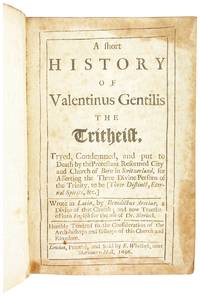
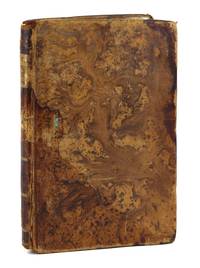
169631015London: E. Whitlock 1696. Very Good. London: Printed and Sold by E. Whitlock near Stationers-Hall 1696. First English Edition. Small octavo 17cm.; full contemporary speckled paneled calf spine in five compartments; 161342pp. collated complete. Leather quite dried especially at margins and spine with exposure at corners and top spine chord textblock a bit toned and foxed two early leaves with recent blue pencil underlining 20th-century ex libris of the Hope Trust Edinburgh to front pastedown else a Very Good internally clean and sound example. The work is dotted throughout with small woodcut manicules and printed marginal text sometimes chattily addressed to Dr. Sherlock. <br /> <br /> The Swiss Protestant theologian Benedictus Aretius's defense of the execution of Valentinus Gentilis in Bern in 1566 where Aretius himself was serving as professor of theology at the time of the trial. Originally written in Latin this edition was translated "for the use of Dr. Sherlock. Humbly Tendered to the Consideration of the Arch-bishops and Bishops of this Church and Kingdom." The translation has been attributed to English theologian Robert South 1634-1716.<br /> <br /> ESTC R006675; WING A-3629. E. Whitlock unknown
180833579Mexico: Per Don Mariano de Zuniga y Ontiveros 1808. Very Good. Mexico: Per Don Mariano de Zuniga y Ontiveros 1808. First Edition. Small quarto. 20; 153; 11pp. Engraving by Jose Maria Montes de Oca. Full calf binding with leather spine label. Worn along edges; brief exposure; chipping; split to bottom of front joint. Binding sound; a few marks and staining to endpapers; else unmarked and Very Good. <br /> <br /> History and artistic description of the Virgin of Los Remedios including an extensive description of the Spaniards led by Hernan Cortes imposing Christianity on the Native Americans and supplanting their religion as part of their conquest. The Templo Mayor of Tenochtitlan was dedicated to Huitzilopochtli god of war and Tlaloc god of rain and agriculture. The Spaniards "purified" the temple with a crucifix and an image of the Virgin Mary leading to arguments over the competing faiths tensions rose and Cortes promised rain would fall as a demonstration of his god's power. According to the legend rain unexpectedly fell the next day was interpreted as a miracle and strengthened the conqueror's position among the indigenous people. An uncommon narrative by a native Mexican on the power of story relics and iconography spanning the colonial period of Mexico's history. <br /> <br /> Sabin 11056. Per Don Mariano de Zuniga y Ontiveros unknown
In 8° (cm. 12,5) Legatura P.Pelle coeva impressa a secco. Dorso muto, con nervi, tagli dorati con fregi impressi a secco; 771+ (26) Index + 3 bianche . Marca tipografica in xilogr. al frontespizio raffigurante un uomo che istruisce un bambino con motto "Initium sapientiae timor domini" ed intorno altro motto "Beati omnes qui timent Dominum " . Capolett. in xilogr. Ex libris manoscr. datato 1557 alla sguardia ant.. Timbretto di biblioteca estinta al front., piccoli difetti alle legatura, ma bell'esemplare fresco e nitido. Prima edizione poco comune. Manca all'Adams ed al BM STC French. Solo 4 copie nelle biblioteche italiane. IT\ICCU\TO0E\017532.
26234Coloniæ, Apud Nicolaum Schouten (Leiden, Jean Elzevier), 1658. (32), 608 pp. 8vo. Contemporary overlapping vellum, handwritten title to spine. Willems 829; Brunet, iv, 396; Tchemerzine-Scheler, v, p. 69; Peignot, Livres Condamnés, ii, 27; En Français dans le Texte 96; PMM 140 (both for the original edition). First Latin edition of the famous Lettres Provinciales, translated by Pierre Nicole (and with additions (p. 510-608) by Pierre Nicole (as "Willem Wendrockius" and as "Paulus Irenaeus")), published under the pseudonym Wilhelm Wendrock, a few months after the original French edition and just as that edition forbidden (by the Conseil d'État on September 23, 1660) and burnt. The book was printed by Jean Elzevier "pour le compte de ses parents d'Amsterdam" who had very good relations with the jansenists and were about to publish the first collective edition of the Provinciales (see Willems). Born in 1623, Pascal came under Jansenist influence in 1646. 'In 1654, after a period of discouragement and repeated meditations, he underwent a mystical experience which effected his definite conversion to a religious life ..... He now, in 1655, took up his residence in Port Royal ..... Attacks by the Jesuits on the Jansenist cause and on Antoine Arnauld led to the publication in 1656-7 of eighteen Lettres de Louis de Montalte à un Provincial de ses amis et aux RR. PP. Jesuites sur la morale et la politique de ces peres; they were composed by Pascal and are known as his Lettres provinciales. They deal with two subjects: divine grace, and the ethical code of the Jesuits ... Against the relaxed morality which the Jesuits were said to teach, he makes a vigorous appeal to public opinion by means of quotations from Jesuit works and by dialogues in which Jesuits are made, by their admissions, to cast discredit on themselves. The Lettres provinciales, written with polite irony and the utmost simplicity, lucidity, and objectivity, were an enormous success and dealt the Jesuits a blow from which they never recovered. The work was placed on the Index and was ordered by the Royal Council to be burnt (1660)' (Oxford Companion to French Literature, p. 541).After his mystical experience Pascal brought into this new existence "the gift of concrete precision which was the mark of his genius. The Lettres Provinciales are masterpieces of both the esprit de géométrie and the esprit de finesse. The first carried to the extreme the demands of a morality that was sincerely Christian and did not permit of serving two masters at the same time; the second unmasked one by one the abstract formulae, seemingly framed for juridical and secular purposes, behind which lay hidden the complaisance of the casuists. He forced the faithful Christian to scrutinize his own conscience, laying bare the depths of desire and the libido which testifies to the persistence of the original sin. (.....) If the influence of Pascal, which has been decisive in the history of positive science, in the history of French literature and in the history of Christian thought, continues to be felt in our own days, the reason is that no work invites us more to pass byond discursive abstractions and to uncover by direct contact with the realities of nature and of the soul the springs of vivifying intuition (Léon Brunschvicg in ESS, vol 12, pp. 7-8).'L'ouvrage le plus lu à son epoque, Les Provinciales ont contribué à imposer un art d'écrire classique' (En Français dans le Texte).'The Lettres Provinciales, as they are called, are the first example of French prose as we know it today, perfectly finished in form, varied in style, and on a subject of universal importance ... Pascal's weapon was irony, and the freshness with which the gravity of the subject contrasts with the lightness of the manner is an enduring triumph. The vividness of and distinction of his style recalls the prose of Milton at its best' (Printing and the Mind of Man). - Provenances: Guillaume Hoffman with engraved ex-libris "G.H.", manuscript ex-libris C. Stahl and a small stamp in blank portion of the title "Bibl. Familiæ Pajacsich."
Pont-à-Mousson, Melchior Bernard, 1614; in-8, manque la page de titre XVI-616 pp. + table des matières, 344 pp. + table des matières, reliure plein veau d'époque, dos orné à trois nerfs, tranches jaspées, plats estampés à froid et dorés d'une couronne de lauriers. Hoefer NBG V/809, Brunet I/828. Deux volumes reliés en un. Annotations manuscrites sur la première page blanche, Ex-libris et tampons d'instituts religieux. Belle impression mussipontaine avec des annotations imprimées dans les grandes marges. Pierre de Besse, né en 1567 à Meymond, village de Laroche-près-Feyt, et mort le 11 novembre 1639 à Paris est un prêtre français, prédicateur du roi Louis XIII, passé à la postérité pour ses prêches et ouvrages publiés au début du XVIIème siècle. Fort de cette notoriété, il devient le prédicateur du Prince de Condé puis du roi Louis XIII en 1611. En 1618, il est nommé chanoine de l’Église Saint-Germain-l’Auxerrois. Il meurt en 1639 à Paris et est inhumé devant la chaire de l'Église Saint-Germain-l’Auxerrois. Première édition. Il manque la belle page de titre gravée, mais heureusement la page de titre de la suite des conceptions est conservée dans l'ouvrage.
17707996London [d. i. Paris?] (und Brüssel), (Antoine D'Ours), 1770. (4), XII, 183, (1) SS. Marmorierter Halblederband der Zeit mit goldgepr. Rückenschildchen und -vergoldung. Dreiseitiger Rotschnitt. 8vo.
152238943Straßburg, Johannes Knobloch, März 1522. 6 nicht numerierte, CCCXIV numerierte, 10 nicht numerierte Bl. Mit breiter figürlicher Titelbordüre und zahlreichen schwarzgrundigen Holzschnittinitialen. Fol. (33 x 22 cm). Blindgeprägtes Schweinsleder der Zeit auf Holzdeckeln. [5 Warenabbildungen]
174458836Copenhagen, Gottman Friedrich Kisel, 1744. 12mo (90 x 149 mm). (8), 604 pp. (including engraved frontispiece of a pilgrim knocking at the gates of Heaven). Bound in early 20th-century crushed calf with gilt-and-brown title label on spine. Purple private ownership stamps of "N. Chr. Pedersen" of Svendborg on letterpress title and a few leaves of prelims. Insignificant tear to margin of frontispiece, well outside of engraved image; contents certainly dusty, but well-preserved.
12mo (90 x 149 mm). (8), 604 pp. (including engraved frontispiece of a pilgrim knocking at the gates of Heaven). Bound in early 20th-century crushed calf with gilt-and-brown title label on spine. Purple private ownership stamps of "N. Chr. Pedersen" of Svendborg on letterpress title and a few leaves of prelims. Insignificant tear to margin of frontispiece, well outside of engraved image; contents certainly dusty, but well-preserved. Excessively rare, early edition of the first translation of Bunyan's "The Pilgrim's Progress" into Danish. Written while Bunyan was in prison for his extreme Puritanism, this extended allegory enjoyed popular translations in other Protestant countries during the late 17th and early 18th centuries. "It is [the] image of Bunyan as English that has come to dominate the way he is remembered today. In both the popular and academic domain, Bunyan stands as an icon of Englishness. Indeed, existing Bunyan scholarship is almost obsessive in its focus on him as a national figure of 17th-century England. His broader transnational presence is largely excised from the critical record" (Hofmeyr, The Portable Bunyan: A Transnational History of The Pilgrim's Progress, preface). - The two English parts were first published in 1678 and 1684 respectively, and the present translation by Jens Godsen first appeared in 1704-07. However, as a pocket-sized specimen of vernacular literature, it seems to have survived exceptionally poorly in all editions. We have been able to trace just two copies of any 18th century edition outside of Denmark, residing at Oxford and the British Library (1732); the latter however is in lamentable condition, lacking over 100 pages and with title-page "mutilated". The only record listed in RareBookHub is a Quaritch catalogue entry, where a copy of the 1758 edition was offered in 1971 for a princely $48. OCLC 911248490 (giving a collation). Not noted in Hofmeyr, The Portable Bunyan: A Transnational History of The Pilgrim's Progress (2004), who does however note the first Swedish translation of 1727.
1540STGT12024SchwBasilae (d.i. Basel), Ex Officina Hervagian [d.i. Herwagen, Johannes d.Ä.] 1540. Gr.-4°. Tit., 13 Bll., 527(1) S., 14 Bll. (Index). Mit 3 wiederh. Druckermarken sowie zahlreichen, kleineren und größeren Initalen in Holzschnitt. Schweinslederband d. Zeit auf 4 Bünden mit reicher Blindprägung von Rollenstempeln, Rückenbeschriftung v. alter Hand und (fragmentarisch erhaltenen) Schließbändern. Einband mit altersbedingten Gebrauchsspuren, Untere Ecke am hinteren Deckel beschädigt, Vorsätze etwas fleckig u. wurmstichig, mit kleineren nicht störenden Wurmspuren am weißen Rand, im Text sauber und kaum abgegriffen. Adams C 3155, VD16 C 6514. Erasmus von Rotterdam gab, unterstützt durch zahlreiche Mitarbeiter, zusammen mit dem Basler Buchdrucker Johann Froben(ius), der die meisten seiner Werke druckte, zwischen 1520 und 1530 mehrere wissenschaftliche Ausgaben der Schriften der Kirchenväter heraus. "Er begann mit den Schriften des hl. Hieronymus, die er in Basel 1516-1520 in neun Foliobänden edierte und seinem Freunde, dem Erzbischofe von Wareham, widmete. Durch diese Arbeiten war sein Ruhm auf's Höchste gestiegen und er unter den Gelehrten Europa's unstreitig der gefeiertste." (vgl. dazu Wetzer/Welte IV, 736). - Die Schriften des hl. Cyprian Thascius Caecilius (um 200-258) gehören zu den wichtigsten Quellen der Kirchengeschichte und sind seit 1471 immer wieder aufgelegt worden, wobei die kritische Gesamtausgabe durch Erasmus zu den Besten zu zählen hat. Die erste, durch E. besorgte Ausgabe von Cyprians Schriften erschien 1521. Hier vorliegend die erste Ausgabe bei Herwagen, die siebente insgesamt. Mit Widmungsbrief des Erasmus an Lorenzo Pucci.