17 864 résultats
Nikolayevsk-on-Amur, Chita, Sretensk, Blagoveshchensk, TransBaikal villages, 17 May 1861 - 23 September 1880. Two manuscript journals of an English Engineer in Russian Far East, contracted to test and repair some of the pioneering steamships on the Rivers Amur and Shilka, and other important works in the Trans-Baikal region, beginning his work some 24 years before the founding of the Eastern Siberian Inland Navigation Company, and interacting several notables who were involved in the development projects. 8vo. The earliest volume comprises 113 pages of manuscript entries dating from 17 May 1861 to 22 July 1861 and then a few pages from and then from 1 January 1868 to 22 May 1870, with a tipped-in folding map of the Amur River. The subsequent volume contains 135 pages in manuscript and dates from 14 August 1876 to 23 September 1880. Cloth over marbled boards. Volumes measure approximately 19 x 24 cm and 17 x 20 cm, respectively. Map measures approximately 46 x 20 cm. Wear to boards, hinges loose, otherwise internally clean, an exceedingly scarce and early primary source account of early developments of steam navigation in the Far East of Russia. This account is very early for the region, particularly the inner reaches of the Amur river and its tributaries, where there were scarce inhabitants or even visitors, and thus are even fewer surviving manuscript accounts. It pre-dates the founding of the important "Eastern Siberian Inland Navigation Company" which would be founded in 1885, twenty-four years after the writer began his pioneering work. It also pre-dates the Trans-Siberian Railway which would be built between 1891 and 1916 under the supervision of Russian government ministers personally appointed by Tsar Alexander III and his son, the Tsarevich Nicholas (later Tsar Nicholas II). The writer's arrival occurs only three years after the Aigun Treaty in 1858, through which the area north of the Amur belonging to the Manchu Qing dynasty since the 1689 Treaty of Nerchinsk was suddenly ceded to Russia. The Amur River has formed Russia's border with China since the 1858 Aigun Treaty and the 1860 Treaty of Peking. A folding map compiled in 1858 according to contemporary Russian sources, delineates the winding route of the Amur River throughout the Russian-Chinese borderlands, from Lake Baikal, to the mountainous Transbaikal region, to the Sea of Okhotsk snd the Strait of Tartary. Manuscript
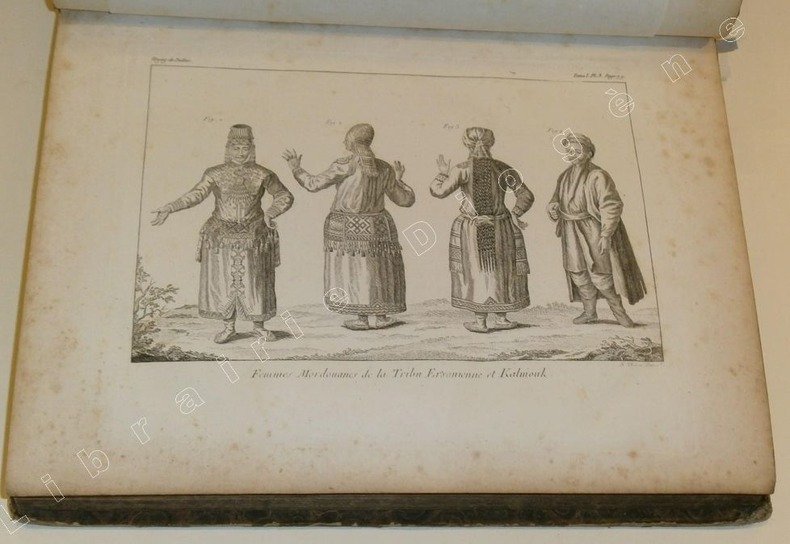
88415aafParis, de l’imprimerie de J. P. Jacob à Paris chez Deterville et à la Librairie Economique, 1805, gr. in-4to (oblong), page de titre poussiéreuse et renforcée + au total 55 planches gravées, sur le titre pt. timbre rouge ‘Cabinet Topographique du Roi’ et cote ms. (E. 5 / 48), cartonnage du XIXe s. couvert de papier marbré, pièce de titre maroquin rouge au dos. Bel exemplaire.
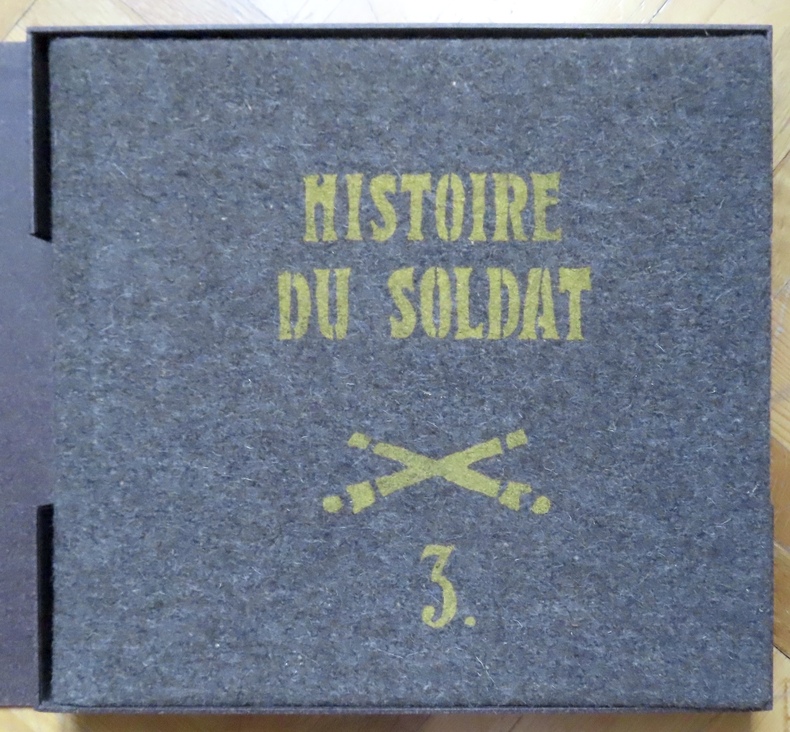
200526362Saint-Pétersbourg / Lausanne, Chez l'artiste / Oh 7e Ciel, 2005. In-folio non paginé, imprimé en sérigraphie, relié dans une authentique veste de soldat russe (!), titre au pochoir au premier plat, présenté dans son étui assorti à pièce de titre manuscrite. A l'état de neuf. Illustré par l'artiste russe Yuri Shtapakov d'un portrait de Ramuz en frontispice, d'un autorportrait au justificatif et de 14 très belles linogravures réhaussées à la main par l'artiste.
1919223031919. Photographs measuring 6 x 4 inches and smaller. 1 vols. Oblong 8vo 8 3/4 x 6 1/2 inches. Contemporary gray cloth ms. title to upper board upper joint wearing but holding nicely. Photographs measuring 6 x 4 inches and smaller. 1 vols. Oblong 8vo 8 3/4 x 6 1/2 inches. A rare survival from a distinguished World War One veteran. Born in India Nightingale was educated at Rugby and Sandhurst and joined the Royal Fusiliers in 1910. He survived the landing on V beach Cape Helles Gallipoli April 25th 1915 and the following year he was awarded both the Military Cross and the Legion D'Honneur for his services. <br /> Nightingale subsequently served with the 46th Battalion Royal Fusiliers in the North Russian Relief Force part of the invasion of Russia by the English Irish and the Americans. The operation was conducted under the command of General H. de V. Sadleir-Jackson.<br /> Arriving in Archangel on 5 June 1919 the 46th proceeded along the Dvina River to Osinova where preparations were made for an attack on rail and river transport. The objective was to repel the Red Army from their established positions and generally improve the position of the White Russian forces. The hope was that the NRRF would be able to subsequently withdraw without significant casualties. In addition smaller raids on Red Army positions were carried out to the south partly to destabilize them partly as reconnaissance. Nightingale was in command of the Borok Column on the right bank of the Dvina River for the August 10 offensive.<br /> The first photos are of the H.M.T. "War Summit" & H.M.T. "Pretorian" chugging through the Arctic Ocean and White Sea in Midsummer June 1919 on its way to Archangel. They were billeted at Troitsa and among the many images of the town and its surroundings is one of where the mutiny of Dyer's Battalion took place. Equally there are shots of Russian batteries Allied defenses company headquarters and regimental aid posts as well as images of the Dvina River Yaroslovskoe and Selso. A page is devoted to "Col. Davies Headquarters at Commencement of Action Aug 10th" and shows how the British troops organized themselves in the Selmenga Forest namely with three shots of "Piccadilly Circus Selmenga Forest with Shaftesbury Avenue and Regent Street."<br /> The attack commenced at noon and despite the difficulty of the terrain was successful. We know that Borok Nightingale's objective was reported captured along with 80 POWs by eleven o'clock that evening. Nightingale was evacuated in late September.<br /> This is not only a record of the battle but includes many poignant personal touches too. Namely there are several shots of men with whom he served and the Russians with whom he stayed. The captions not only name the men in each photograph but in many cases reveal their fate: "Lt Taylor killed Aug 10th Lt Grant wounded Aug 1st Capt. Driver killed Aug 10th."<br /> The album also includes a typed order - dated September 9 1919 - which is a reminder that despite the success of the August attack the Russian Civil War was ongoing and would ultimately be won by the Bolsheviks. "You will send one platoon to SELMENGA to hold the SELMENGA BRIDGE and the beach road to GORODOK. The enemy are known to be in force in the vicinity of BOROK and GORODOK and may attempt an outflanking movement . The platoon remain in position there and will withdraw when Captain de Miremont with the GORODOK Infantry comes through there tonight . The Platoon should form a right flank guard to Captain de Miremont from SALMENGA to PLESS."<br /> The photographs of Russia occupy the first half of the album the rest is devoted to Nightingale's time in Ireland with the 7th Cadet Battalion. Despite his distinguished service in the military Nightingale's fate was a melancholy one. He died in 1935 reportedly either by suicide using his own revolver of from alcoholism. unknown
1919223031919. Photographs measuring 6 x 4 inches and smaller. 1 vols. Oblong 8vo 8 3/4 x 6 1/2 inches. Contemporary gray cloth ms. title to upper board upper joint wearing but holding nicely. Photographs measuring 6 x 4 inches and smaller. 1 vols. Oblong 8vo 8 3/4 x 6 1/2 inches. RARE PHOTOGRAPHS OF THE NORTH RUSSIAN RELIEF FORCE 1919. A rare survival from a distinguished World War One veteran. Born in India Nightingale was educated at Rugby and Sandhurst and joined the Royal Fusiliers in 1910. He survived the landing on V beach Cape Helles Gallipoli April 25th 1915 and the following year he was awarded both the Military Cross and the Legion D'Honneur for his services. <br/>Nightingale subsequently served with the 46th Battalion Royal Fusiliers in the North Russian Relief Force part of the invasion of Russia by the English Irish and the Americans. The operation was conducted under the command of General H. de V. Sadleir-Jackson.<br/>Arriving in Archangel on 5 June 1919 the 46th proceeded along the Dvina River to Osinova where preparations were made for an attack on rail and river transport. The objective was to repel the Red Army from their established positions and generally improve the position of the White Russian forces. The hope was that the NRRF would be able to subsequently withdraw without significant casualties. In addition smaller raids on Red Army positions were carried out to the south partly to destabilize them partly as reconnaissance. Nightingale was in command of the Borok Column on the right bank of the Dvina River for the August 10 offensive.<br/>The first photos are of the H.M.T. "War Summit" & H.M.T. "Pretorian" chugging through the Arctic Ocean and White Sea in Midsummer June 1919 on its way to Archangel. They were billeted at Troitsa and among the many images of the town and its surroundings is one of where the mutiny of Dyer's Battalion took place. Equally there are shots of Russian batteries Allied defenses company headquarters and regimental aid posts as well as images of the Dvina River Yaroslovskoe and Selso. A page is devoted to "Col. Davies Headquarters at Commencement of Action Aug 10th" and shows how the British troops organized themselves in the Selmenga Forest namely with three shots of "Piccadilly Circus Selmenga Forest with Shaftesbury Avenue and Regent Street."<br/>The attack commenced at noon and despite the difficulty of the terrain was successful. We know that Borok Nightingale's objective was reported captured along with 80 POWs by eleven o'clock that evening. Nightingale was evacuated in late September.<br/>This is not only a record of the battle but includes many poignant personal touches too. Namely there are several shots of men with whom he served and the Russians with whom he stayed. The captions not only name the men in each photograph but in many cases reveal their fate: "Lt Taylor killed Aug 10th Lt Grant wounded Aug 1st Capt. Driver killed Aug 10th."<br/>The album also includes a typed order - dated September 9 1919 - which is a reminder that despite the success of the August attack the Russian Civil War was ongoing and would ultimately be won by the Bolsheviks. "You will send one platoon to SELMENGA to hold the SELMENGA BRIDGE and the beach road to GORODOK. The enemy are known to be in force in the vicinity of BOROK and GORODOK and may attempt an outflanking movement . The platoon remain in position there and will withdraw when Captain de Miremont with the GORODOK Infantry comes through there tonight . The Platoon should form a right flank guard to Captain de Miremont from SALMENGA to PLESS."<br/>The photographs of Russia occupy the first half of the album the rest is devoted to Nightingale's time in Ireland with the 7th Cadet Battalion. Despite his distinguished service in the military Nightingale's fate was a melancholy one. He died in 1935 reportedly either by suicide using his own revolver of from alcoholism. unknown books
180319922London: for William Miller by Howlett and Brimmer 1803. First edition. Illustrated with 73 hand-colored stipple engravings text in both English and French. Folio bound in contemporary full blue straight-grain morocco gilt lettered in two panels richly decorated in gilt in the remaining three and on the bands; the covers with a fine gilt dentelle border enclosing a blind-tooled border gilt turn-ins a.e.g. 73 plates and 73 text leaves the text is in English on the recto and French on the verso. A very handsome copy with just light rubbing to the binding. The plates are fine and clean. With the engraved bookplate of Hugh Cecil Earl of Lonsdale. A BEAUTIFUL BOOK AND SCARCE NOW. Abbey records a copy printed for Miller by S. Gosnell and states that "the Cat. Russica records what it calls another edition in 1803 and an edition printed by Howlett and Brimmer in 1803 but other references to these have not been found"<br> The others in the series were THE PUNISHMENTS OF CHINA THE COSTUME OF TURKEY THE COSTUME OF AUSTRIA and THE COSTUME OF GREAT BRITAIN. For a full account of the series see Abbey Travel 533. The plates for this book are closely copies but somewhat enlarged from a book by J. G. Georgi published by Müller in St. Petersburg four volumes quarto in 1776-80 under the patronage of the Empress. for William Miller by Howlett and Brimmer unknown
Very Good Turkish, Ottoman (1500-1928) Contemporary quarter brown morocco. Red boards. Staining on the red cloth. Roy. 8vo. (25 x 17 cm). In Ottoman script (Turkish with Arabic letters). 64 p. Extremely rare first and only edition of this Turkish guide to the Turkish delegation of intelligence officers formed within the Niedermayer-Hentig Expedition, also known as the Kabul Mission to carry out counter-activities in the region against the British and Russian alliance, to return from India, through Russia, Afghanistan, and Iran, published after the expedition failed in 1916. This work both in very rare institutional holdings and market rarity is probably printed in no more than 100 copies. It was expected from the Turkish delegation, organized by Ömer Fevzi Bey, who was in charge of the Eastern Branch of the Turkish Intelligence (Teskilât-i Mahsûsa), by reaching Afghanistan through Iran and bringing "Jihad-i Akbar" to this country, to provide an important ally on the Indian border and to support the pro-independence Indian committees and an uprising against the British rule in India and the region. This book was prepared by the Ottoman Army Headquarters-General Intelligence Branch in 1916, during the First World War. In its introduction, the commission described their purpose of publishing this book, which is providing secret information to officers and other staff of the Ottoman army who will travel to Iran, Afghanistan, and Russia, telling them which roads to use, how to use their passports, where and how much food they need to take with them, etc., otherwise being a very comprehensive and detailed guide to the officers. The first chapter includes Iran and its environment, and the second chapter includes Russia and its environment. The first addendum contains detailed passport information, and the second part consists of the routes and towns requiring passports. According to the introduction, references of this book are some early British sources and reports by "Kralliik siyasi ve sehbenderhane zâbitâni, sabik müsahid atasemiliteri" H. Smith, "Harbiye Nezâreti Erkân-i Harbiye-i Ummiyesinden" A. D. Geddesi and "Istihbarat Subesinden" Captain S. M. Gibbon. Additionally, they are Foreign Ministry's 'tahrirât' documents, Intelligence Branch's 'kuyudâti', and a Russian railways guide printed in 1909. The Niedermayer-Hentig Expedition was a diplomatic mission to Afghanistan sent by the Central Powers in 1915-1916. The purpose was to encourage Afghanistan to declare full independence from the British Empire, enter World War I on the side of the Central Powers, and attack British India. The expedition was part of the Hindu-German Conspiracy, a series of Indo-German efforts to provoke a nationalist revolution in India. Nominally headed by the exiled Indian prince Raja Mahendra Pratap, the expedition was a joint operation of Germany and Turkey and was led by the German Army officers Oskar Niedermayer and Werner Otto von Hentig. Other participants included members of an Indian nationalist organization called the Berlin Committee, including Maulavi Barkatullah and Chempakaraman Pillai, while the Turks were represented by Kazim Bey, a close confidante of Enver Pasha. The mission failed in its main task of rallying Afghanistan, under Emir Habibullah Khan, to the German and Turkish war effort, but it influenced other major events. In Afghanistan, the expedition triggered reforms and drove political turmoil that culminated in the assassination of the Emir in 1919, which in turn precipitated the Third Anglo-Afghan War. It influenced the Kalmyk Project of nascent Bolshevik Russia to propagate socialist revolution in Asia, with one goal being the overthrow of the British Raj. Other consequences included the formation of the Rowlatt Committee to investigate sedition in India TBTK 13568.; Not in OCLC.
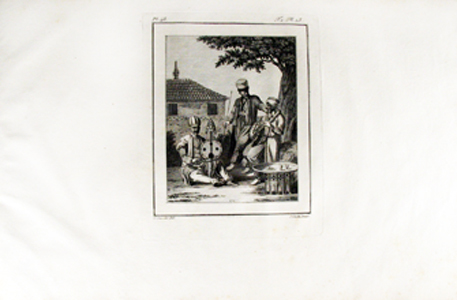
181315666Nepveu Paris 1813 6 vol. 6 volumes in-12 (15 x 9 cm, grandes marges) de XXXII 163 pp. 1 f.n.ch. (table), 2 ff.n.ch. 186 pp. 1 f.n.ch. (table), 2 ff.n.ch. 190 pp. 1 f.n.ch. (table), 2 ff.n.ch. 196 pp. 1 f.n.ch. (table), 2 ff.n.ch. 192 pp. 1 f.n.ch. (table) et 2 ff.n.ch. 198 pp. 1 f.n.ch. (table), plein cartonnage illustré de l'époque, dos lisse orné.
17696640Lausanne, François Grasset & comp., 1769. In-8 de (2)-XIV pp. 1 f.bl. 204 pp. (mal chiffré 160), 2 feuillets manuscrits reliés respectivement entres les pages 44-45 et 48-49, maroquin citron, dos lisse orné, pièce de titre en maroquin noir, filet et frise dorés d'encadrement sur les plats, tranches dorées (reliure de la fin du XVIIIe siècle).
In folio (mm. 480x326), mz. pelle mod., filetti e titolo oro al dorso, piatti in cartonato coevo, pp. 46, all’antiporta ritratto di Giacomo Quarenghi inciso da Sanders da uno schizzo di Antonio Vighi (manca la carta con l’elenco degli Associati). Il volume è illustrato da 59 belle tavole inc. in rame di cui 3 in acquatinta (tutte dettagliatam. descritte), tratte dai suoi disegni originali; vi figurano: il teatro dell'Hermitage, il maneggio delle Guardie a Cavallo, l'Istituto delle nobili fanciulle, la casa del Principe Gagarin, la cappella dei Cavalieri di Malta, l'Arco Trionfale eretto per l'ingresso dell'Imperatore Alessandro, a Pietroburgo; a Carskoe Selo il paIazzo Alessandro che è il suo capolavoro. Prima e più importante opera monografica sul grande architetto bergamasco (1744-1817). Realizzata dal figlio, a quattro anni dalla sua scomparsa, venne poi ristampata a Mantova nel 1843 ed ampliata nel 1844 con la pubblicazione di nuovi progetti raccolti e curati sempre dal figlio. Rara "edizione originale". Cfr. Berlin Katalog,2776 - Millard Collection,108. Bell’esemplare con barbe. "Il Quarenghi, formatosi specialmente su Andrea Palladio, lo interpretò non scolasticamente ma con attenzione particolare a quell'armonia di spazi e di masse verso cui lo portava il suo gusto, già in precedenza classicheggiante. Tale interpretazione semplice e severa trovò vasto campo di attuazione in Russia, dove si recò nel 1779, divenendo architetto di Caterina II. Il volto di San Pietroburgo in particolare è segnato dallo stile di ispirazione palladiana che l'architetto adottò per i progetti di edifici pubblici, palazzi, teatri, ponti che ancor oggi caratterizzano il profilo neoclassico di quella che è considerata la città più europea di tutta la Russia". Così Diz. Treccani, p. 23.
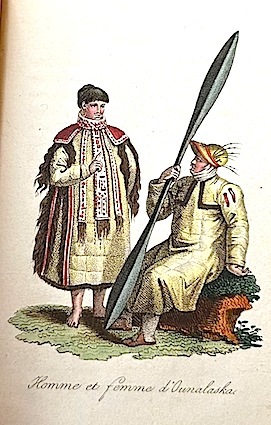
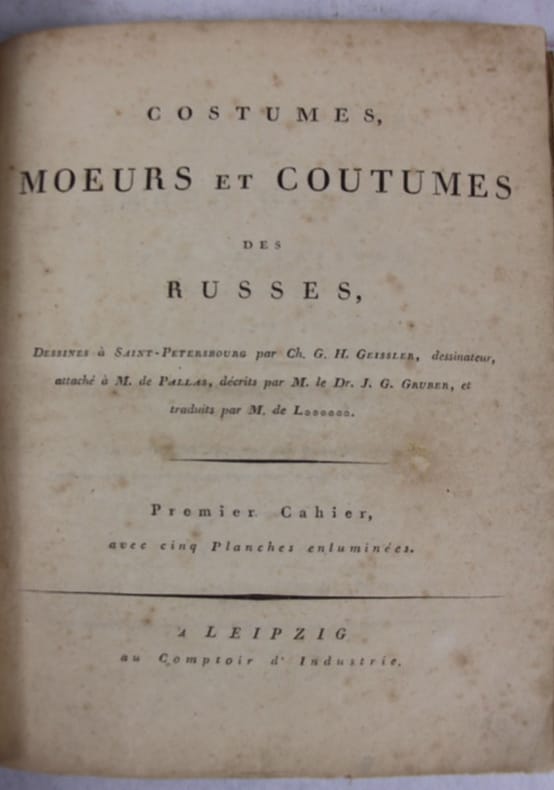
1801138259Au Comptoir d' Industrie, Leipzig, [1801-1804] 1801 In-4, demi-basane, dos lissedeux titres, un en français et un en allemand, ainsi que le descriptif à chaque planche, XII- 95 pp. & 40 planches gravées sur cuivre coloriées à la main. Rousseurs soutenues pour le texte, légères et éparses pour les planches. Quelques taches de peinture sur la première planche.
225 pages. "Beneath the great westward flow of our civilization, there are undercurrents moving eastward. These are impelled by a spirit which looks back to the east, to the days of tyrant and slave, of luxury and misery, and incidentally to the suppression of western culture... The following pages are designed to cast light on these eastern undercurrents which have undermined western states." - Preface. Black and white photographic portrait of Sergius A. Nilus. Erratum list affixed inside front cover. Unmarked. Above-average wear. Age-yellowing to card covers and contents. Covers nearly detached. Binding tender. Singerman 0221. Book
WB16908Paris. Hardcover. Near Fine. 1764-1774 but circa 1820 paper watermarked 18181 4to 280 x 222 mm comprising 87 engraved or aquatint plates including engraved titles modern morocco backed boards minor foxing. In 1758 Le Prince journeyed to Russia to work for Catherine the Great at the Imperial Palace St Petersburg. He remained in Russia for five years and also travelled extensively throughout Finland Lithuania and Siberia When Le Prince returned to Pans in December 1763 he brought with him an extensive collection of drawings which served as the source material for the present suites. As usual the present album contains plates from several of Le Prince's suites not necessarily bound in order including the following Divers Ajustements et Usages de Russie; Divers Habillements des Femmes de Moscovie lie. Suitte d'Habiliement des Femmes de Moscovie Divers Habillements des Pretres de Russie- Les Strelits Premier Suite de Cris et Divers Marchands de Petersbourg et de Moscou- 2me Suitte de Divers Cns de Marchands de Russie- Ille Suitte de Divers Cns de Marchands de Russie- Habillements de Diverses Nations; Suite de divers Habillements des Peuples du Nord Vue des Environs de St Peterbourg Diverses Vues de Livonte and Ile Suitte d'Habillements de Diverses Nations Cf. Colas 1838-1850 cf Hiler p539; cf Cohen/de Ricci 625-626. <br/><br/> hardcover books
WB16908Paris. Hardcover. Near Fine. 1764-1774 but circa 1820 paper watermarked 18181 4to 280 x 222 mm comprising 87 engraved or aquatint plates including engraved titles modern morocco backed boards minor foxing. In 1758 Le Prince journeyed to Russia to work for Catherine the Great at the Imperial Palace St Petersburg. He remained in Russia for five years and also travelled extensively throughout Finland Lithuania and Siberia When Le Prince returned to Pans in December 1763 he brought with him an extensive collection of drawings which served as the source material for the present suites. As usual the present album contains plates from several of Le <br />Prince's suites not necessarily bound in order including the following Divers Ajustements et Usages de Russie; Divers Habillements des Femmes de Moscovie lie. Suitte d'Habiliement des Femmes de Moscovie Divers Habillements des Pretres de Russie- Les Strelits Premier Suite de Cris et Divers Marchands de Petersbourg et de Moscou- 2me Suitte de Divers Cns de Marchands de Russie- Ille Suitte de Divers Cns de Marchands de Russie- Habillements de Diverses Nations; Suite de divers Habillements des Peuples du Nord Vue des Environs de St Peterbourg Diverses Vues de Livonte and Ile Suitte d'Habillements de Diverses Nations Cf. Colas 1838-1850 cf Hiler p539; cf Cohen/de Ricci 625-626. <br/><br/> hardcover
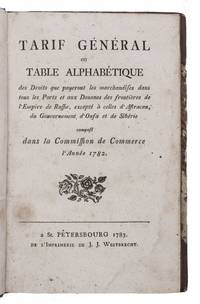
178318774St. Petersburg: J.J. Weitbrecht 1783. Contemporary half calf marbled sides sprinkled edges. 8vo. Second known copy of a commercial publication of statutes promulgated in French by the Russian Empress Catharine the Great concerning import duties for commercial merchandise in Russian ports and at other frontiers of the Russian Empire as they were determined and accepted in 1782. There is an exception for Astrakhan a major port and market city in southern Russia at the head of the Volga river which was under the government of Siberia which apparently maintained its own commercial regulations.This publication is very rare WorldCat lists only 1 copy Kress Library of Business and Economics Harvard University. Other libraries worldwide have only the microfilm of the Kress copy.A faint stain and one tiny hole in the margin of the first 20 pp. Cover slightly rubbed. Otherwise in good condition.l Goldsmiths'-Kress 12431.16. J.J. Weitbrecht, unknown
Cartella completa contenente 12 acqueforti e due disegni firmati Decroix che raffigurano due dei ritratti incisi. “Il a été tiré de cette suite 75 exemplaires numérotés sur papier de hollande. Exemplaire n. 3” con firma autografa dell’autore. I ritratti raffigurano siberiani, tartari, coreani, “enfants de troupe” ecc. Ogni acquaforte (il foglio misura cm 33x26) reca la firma di Decroix a matita, e il titolo del ritratto. Lo stesso Decroix (Lille 1878-1936 Parigi) fu prigioniero di guerra e passò due anni in un campo in Germania, liberato nel 1916 raggiunse la familgia a Berna per poi trasferirsi a Parigi. Assai raro.
87232A Paris, chez Lagrange, Libraire/Chez Maradan, 1788-1793, 5 volumes de 200x265 mm environ et 1 atlas de 245x340x40 mm environ, xxxij-763, 539, 491, 722-(1) f., 559 pages, demi reliure en veau rouge, titres et tomaisons dorés, dos très ornés de motifs dorés, tranches et coupes marbrées. Coupes et coins émoussés, coiffes de l'atlas ébréchées avec début de fente sur le bas du dos, frottements sur les plats et sur les coiffes, des rousseurs, sinon belle série rare et recherchée avec 122 planches (dont 4 cartes dépliantes, manque la carte générale de l'Empire de Russie.
1770648241770. St. Petersburg 1770. 4th & best ed. St. Petersburg 1770. 4th & best ed. "The Best and Most Luxurious" Four-Language Edition of Catherine the Great's Nakaz Catherine II 1762-1796 Empress of Russia. Kozitzki Grigorii Vasil'yevich d. 1775 Latin translation. Nakaz Eia Imperatorskago Velichestva Ekateriny Vtoryia Samoderzhitsy Vserossiiskiia Dannyi Kommissii o Sochinenii Proekta Novago Ulozheniia. Instructions of Her Imperial Majesty Catherine II to the Commission on the Work of the Projected New Code of Laws. St. Petersburg: Imperatorskaya Akademii Nauk 1770. viii 403 pp. Four title pages one in each language. Printed in double columns Russian and Latin on one page and German and French on the opposite page. Allegorical engravings by C. M. Roth at head and tail pieces. Latin translation by Grigorii Vasil'yevich Kozitzki. Quarto 9-1/2" x 8". Contemporary calf raised bands lettering piece and black-stamped ornaments to spine edges rouged patterned endleaves Light rubbing faint stains scratches and ink marks to boards which are slightly bowed moderate rubbing to extremities corners bumped and worn. Large copperplate vignettes at beginning and end of text. Light toning to text somewhat heavier in places faint dampstaining to margins in a few places internally clean. A nice copy. $3500. Only four-language edition the fourth and best edition overall. Described by Count M.A. Korf then director of the Imperial Library as "The Best and Most Luxurious Edition." The Nakaz or Instruction is a statement of legal principles written by Catherine II between 1764 and 1766. It was among her most ambitious and significant undertakings. Infused with the ideas of the French Enlightenment and copied mostly from the work of Voltaire Montesquieu and Beccaria it was compiled as a guide for the All-Russia Legislative Commission convened by the Empress in 1767 to create a new code to replace the 1649 Muscovite Code. Revised in consultation with Frederick the Great and Voltaire the Instruction proclaimed the equality of all men before the law and denounced torture and the death penalty. Unfortunately her proposed code was never completed. Catherine's manuscript was written in French and she later produced a Russian translation. Editions in German and Russian were published in Moscow in 1767. The book was initially banned in. unknown books
280 pages. Signed and inscribed upon front free endpaper by author to Roman Fast in June of 1949. Gouzenko was the Soviet embassy cipher clerk whose defection in 1945 marked the beginning of the Cold War. His revelations resulted in major investigations and dozens of arrests. Above-average wear to red boards. Binding intact. Unmarked. What appears to be a clipping from the dust jacket of a Second Printing copy is neatly affixed at half-title page. Said clipping provides major contemporary media reviews of this work. A treasure for your Espionage or Cold War collection. Book
Inscribed and initialed by Polanyi to "Sir Ernest and Lady Simon", Sir Ernest Simon, The Lord Simon of Wythenshawe, and his wife, upon front free endpaper. Simon, a British industrialist, politician and public servant, had a long association with the University of Manchester where Polanyi was a professor at the time of publication. Ink stamp reading "University of Manchester Broomcroft Hall" atop front free endpaper and inside back board solidifies this provenance as it was then the residence of the Simons. ix, [1], 116 pages. Includes these essays: The Rights and Duties of Science (1939), Collectivist Planning (1940), Soviet Economics - Fact and Theory (1935), and Truth and Propaganda (1936). "In those years the ideas of liberty... were left almost uncultivated." - from Preface. Minimal faint pencil markings to contents. Average wear and some fading to publisher's pale green cloth which is sunned at spine. Binding intact. Heavy wear to dust jacket which is now preserved in archival-grade Brodart. Today, the thoughts of the author, a scientist and philosopher who lived from 1891 to 1976, are faithfully upheld by a society named in his honour. Book
1999BIBLIO-45059M. Moleiro Editor Barcelona limited edition facsimile 1999 and commentary. Limited edition of 987 numbered copies. 2 vols facsimile: original blind-stamped calf folio 31 cm; commentary: cloth 4to. facsimile: 298 pages and 115 miniatures most heightened in gold commentary: 4961 pp ills. A superb high-quality facsimile of and separate commentary on 'The book of Treasures' which is an encyclopaedia by Brunetto Latini circa 1230-1294 a Florentine politician poet historian and philosopher teacher and friend of Dante's written in French during the author's exile in France 1260-1267. From the publisher's description: " It consists of three books: the first begins with the biblical history the history of Troy Rome and the Middle Ages followed by a natural history: a comprehensive compilation of information about astronomy and geography. It also addresses certain animal and bird species in depth. The second book concerns ethics: it features the thinking of modern and classical moralists and studies the vices and virtues that characterise humanity. The third book the most original part of this work deals with matters related to politics and the art of government which is according to the author the most important and noblest of all sciences. The miniatures in this codex are extremely rich and varied. The artist's boundless imagination fills the margins of the 18 folios with countless arabesques and drolleries which constitute one of the most highly developed most interesting and earliest series of this genre in the history of the European miniature. There are also countless beasts grotesque and peculiar figures dwarves up to all sorts of tricks acrobats doing balancing acts and juggling musicians playing trumpets flutes violas tambourines organs and bagpipes. Birds hares fawns lions and hounds hunting boars and even the creation of Eve are depicted too." The commentary volume includes in both English and Spanish: Foreword by V.N. Zaitsev Director of the National Library of Russia St Petersburg; Codicological and palaeographic study of Li Livres dou Tresor by Brunetto Latini by L.I. Kisseleva National Library of Russia St Petersburg; Artistic and iconographical traits of the St Petersburg manuscript by I.P. Mokretsova State Research Institute for Restoration GosNIIR; The animal chapters in the Saint Petersburg Li Livres dou Tresor by W.B. Clark Marlboro College; and Technical research and manuscript restoration; by I.P. Mokretsova G.Z. Bykova V.N. Kiréyeva State Research Institute for Restoration GosNIIR. Copy No. 80. . A Fine set in the publisher's leather box which has the leather booklabel of Robert M. Wilson on the inside face. M. Moleiro Editor, Barcelona, limited edition facsimile, 1999 and commentary hardcover
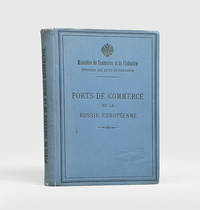
1908189307St- Petersburg: R. Golicke & A. Willborg for the Ministère du Commerce et de l'industrie 1908. Havens for Tsarist maritime commerce First and only edition. Officially sanctioned painstaking survey of the Russian ports of Europe recorded at the height of their influence. Rare WorldCat locates a single copy in the University of Genoa. Altogether sixty-five ports are described in great detail accompanied by photographs plans and engineer's sections for aspects of their construction. This sort of close scrutiny would very soon be confined behind a wall of Soviet state secrecy. The report covers the White Sea Black Sea Baltic Sea and Sea of Azov; more than a half of the ports analyzed are now located outside of Russia in the Baltic states Ukraine and Georgia. This volume was never intended for general distribution but rather was passed through official channels a presentation of the ports as a manifestation of the of Russian Empire's influence on European maritime commerce. Finely produced the presswork was carried out by R. Golicke & A. Willborg a house known for its involvement in Russian livres d'artiste and other fine editions the binding was commissioned from the workshop of M. Uleman small gilt on white ticket to the front pastedown. Two pre-Revolutionary ink stamps to the title page one repeated on the front cover. Crossed out on the title is of that of the Imperial Library of the Central Statistical Committee of Ministry of Internal Affairs the repeated stamp is for "Professor Emeritus of the St Petersburg Institute of Communication Routes Vsevolod Evgenievich Timonov". Timonov 1862-1936 was a hydraulic engineer hydrologist and transportation engineer typical of the intended constituency for the volume. From 1886 to 1895 he served in the Ministry of Railways working on the Commission for the Construction of Commercial Ports. During this time Timonov supervised the first work on the construction of stone block breakwaters for ports on the Baltic 1887 organized and implemented the initial marine dredging works there 1889 explored the mouths of the Dnieper Don and Volga rivers 1890 selecting the branches for development drew up a project for improving the rapids on the Dnieper carrying out exploratory work on one section 1894 explored the shores of the Pacific Ocean to assist in the selection Vladivostok as the location for the Pacific port terminal of the Siberian railway and explored the rivers of the Amur region developing measures to increase navigability 1895. Octavo 280 203 mm. pp. 24 33 94 128 91 vii. Printed throughout on coated paper numerous half-tone illustrations maps and plans to the text large folding three-colour printed map 695 x 560 mm retained by a band at the rear endpaper. Original light greenish blue cloth lettered in black on the spine and front cover French fillet panel to both covers in black to the front in blind on the back light greenish grey endpapers. Slightly rubbed and a little bumped some short splits to head and tail of the spine endpapers a touch browned at the edges; text-block marginally toned but clean and sound; very good. hardcover
In folio (mm. 380x280), mz. pelle moderna con ang., dorso a cordoni con fregi e tit. oro, pp.nn. 12 (doppio frontespizio in inglese e francese, dedica, Indice delle tavole, introduzione), con bella antiporta a colori che raffigura la colossale statua equestre di Pietro il Grande e 72 tavole di costumi dell’Impero Russo, all’epoca di Caterina la Grande. Sono magnifiche tavole finemente incise e acquarellate, su disegno di Edward Harding (come indicato sulle tavv., con la data della prima ediz. Jan. 1, 1803), numerate da 1 a 70 (la 5 e la 20 sono bis) e accompagnate da altrettante carte non numerate che contengono il testo descrittivo in inglese e francese. La dedica a S.A. Reale la Principessa Elizabeth, è firmata da Edward Harding. La successione delle illustrazioni è la seguente: le tavv. 1-17 sono relative a quelle nazioni che hanno avuto origine dai Finlandesi - le tavv. 18-41 descrivono le moltitudini di Tartari sottomessi alla Russia - nelle tavv. 42-61 troveremo le varie tribu di Samoyèdes e quelle che abitano la parte più orientale della Siberia e le isole dell’Oceano orientale - dalla tav. 62 in poi sono raffigurati i Kalmuk, i Mongoli e altre tribù meno note. Le descrizioni, attribuite a William Alexander, derivano dalle più accreditate fonti dell’epoca, inclusi: “Description de toutes les Nations de l’Empire de Russie” del Prof. Mueller - “Voyage en Sibérie” di D’Auteroche - “Description du Kamtshatka” di Kracheninnikow, e dai viaggi del Prof. Pallas e di altri. Cfr. Colas,704 per l’ediz. del 1810: “Le tirage des planches de cette seconde édit. parait etre aussi bon que dans la première. Il existe des exemplaires datés de 1811 - Lipperheide,I,1341. Esemplare molto ben conservato.
110609Stockholm Ignatius Meurer 1615. 4to. 3 blanks 12 111 4 2-274 2 36 2 15 3 33 3 50 pp. Title-page with woodcut border. Woodcut arms on verso of title-page. Contemporary paper boards. Spine worn. Rubbed. PP. 33-40 loosely inserted from another copy. Some browning and staining. Small piece torn from title-page to part II no loss. One of the earliest accounts of Muscovite Russia. The Swedish traveller and historian Petrus Petrejus Peer Persson 1570-1620 visited Russia several times between 1608 and 1620. He provides an important eye-witness account particulary for the history of Boris Godunov and the false Dimitri as well as descriptions of places lifestyle language customs and rituals in Russia at the beginning of the 17th century. . hardcover
1798132180St Petersburg: A l'Academie Imperiale des Sciences 1798. First and only edition. Single location on WorldCat at BL KVK adds a copy in the Austrian National Library lacking 2 plates; and copies in the Zentralbibliothek der Bundeswehr Düsseldorf and Universitäts- und Landesbibliothek Sachsen-Anhalt Halle. Decidedly uncommon infantry manual for the Imperial Russian Army from the brief reign of Tsar Paul I r.1796-1801. Paul had travelled extensively in Europe and had developed a taste for French and Italian architecture and Prussian military practice taking immense pleasure in rigidly drilling his private brigade of troops in the Versailles-inspired grounds of his estate at Gatchina. When he ascended the throne he attempted to remodel the army along Prussian lines introducing entirely impractical uniforms a regime of elaborate ceremonials and parades and as shown here the implementation of rigourous regulations and drill. The present manual was directly translated into French from its Prussian equivalent the words of command also being given in phonetically rendered Russian. Paul was assassinated by a group of disaffected army officers after just 4 years on the throne. Octavo 196 x 110 mm. 13 folding plates at the rear; somewhat erratically numbered no plate 1 2 plans numbered 4 but apparently complete. Recent mottled sheep-backed marbled boards by G. Gauché Paris red morocco label gilt rules to the spine. Spine lightly sunned light soiling to the title page pale toning to the text-block throughout overall very good. hardcover