17 864 résultats
Lot of 15 unique passports from various countries, featuring the occupied Baltics during the Great War, nineteenth century travellers to Russia, some notable names, and assorted matters of interest. Some were issued for one specific journey, others for longer term open travel, with examples concerning citizenship and immigrant travel. These documents vary greatly in format, including early and large single leaf printed declarations completed and signed in manuscript, to modern day wallet-sized hardcover portfolios. Together with a poem stamped by the British Passport Control office at Budapest, titled "A Morning in the Life of a Passport Control Officer." Some creasing and age-toning, the earliest passport with professionally repaired folds, otherwise the lot in very good condition overall, and containing a few examples of certain specimens seldom procured today. Unique design motifs, security elements, signatures and stamps, together these official and historical documents form a wide-reaching study of travel, including incidents of limitation on domestic movement, international travel freedom, and collaboration between nations for open borders. A fascinating collection touching upon a subject which is so prevalent on the minds of citizens all around the globe today. The earliest examples, four from the nineteenth century, include a very specific courier passport dated 1846 relating to Portuguese government affairs, a well-known clergy and author who travelled on the continent for 10 years, going as far as Russia in 1875, and a British subject who travelled to Russia in 1897. A "Passport de Courrier" issued 23 November 1846 in Paris, permitting a Portuguese courier who was carrying despatches to the Portuguese legation in Madrid, Spain, clear passage through France, specifically by way of Bordeaux and Bayonne. Also from the nineteenth century is a passport for Reverend and well-known author John Aldwell Nicholson (1830-1902), Rector of New Chapel and Prebendary in Cathedral of Cashel, valid also for his wife Caroline Editha (née Hunt 1846-1932), to travel the continent together, featuring numerous stamps and annotations from places visited, for example Sweden, Italy, and Russia. A large single-leaf passport featuring 2 Russian stamps, issued in London on 18 August 1897 Alexander Kidd, a "British subject travelling on the continent" who went to Russia. We also find a German certificate of citizenship, "Heimatschein" [Homeland Certificate] issued 14 Mai 1856 to a person whose surname is Daitz, who had evidently arrived in Germany on 26 November 1834. The numbered document being #20 and the date is approaching mid-year, which suggests that not many of these were granted annually.
1770648241770. St. Petersburg 1770. 4th & best ed. St. Petersburg 1770. 4th & best ed. "The Best and Most Luxurious" Four-Language Edition of Catherine the Great's Nakaz Catherine II 1762-1796 Empress of Russia. Kozitzki Grigorii Vasil'yevich d. 1775 Latin Translation. Nakaz Eia Imperatorskago Velichestva Ekateriny Vtoryia Samoderzhitsy Vserossiiskiia Dannyi Kommissii o Sochinenii Proekta Novago Ulozheniia. Instructions of Her Imperial Majesty Catherine II to the Commission on the Work of the Projected New Code of Laws. St. Petersburg: Imperatorskaya Akademii Nauk 1770. viii 403 pp. Four title pages one in each language. Printed in double columns Russian and Latin on one page and German and French on the opposite page. Allegorical engravings by C. M. Roth at head and tail pieces. Latin translation by Grigorii Vasil'yevich Kozitzki. Quarto 9-1/2" x 8". Contemporary calf raised bands lettering piece and black-stamped ornaments to spine edges rouged patterned endleaves. Light rubbing faint stains scratches and ink marks to boards which are slightly bowed moderate rubbing to extremities corners bumped and worn. Large copperplate vignettes at beginning and end of text. Light toning to text somewhat heavier in places faint dampstaining to margins in a few places internally clean. A nice copy. $3000. Only four-language edition the fourth and best edition overall. Described by Count M.A. Korf then director of the Imperial Library as "The Best and Most Luxurious Edition." The Nakaz or Instruction is a statement of legal principles written by Catherine II between 1764 and 1766. It was among her most ambitious and significant undertakings. Infused with the ideas of the French Enlightenment and copied mostly from the work of Voltaire Montesquieu and Beccaria it was compiled as a guide for the All-Russia Legislative Commission convened by the Empress in 1767 to create a new code to replace the 1649 Muscovite Code. Revised in consultation with Frederick the Great and Voltaire the Instruction proclaimed the equality of all men before the law and denounced torture and the death penalty. Unfortunately her proposed code was never completed. Catherine's manuscript was written in French and she later produced a Russian translation. Editions in German and Russian were published in Moscow in 1767. The book was initially banned i. unknown
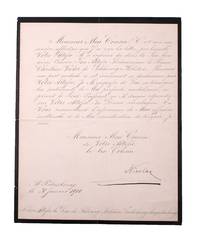
1901346384St. Petersburg 1901. One-page secretarial letter in French on mourning stationery with a secretarial copy marked in ink Copie . signé Nicolas. 1 vols. 10 x 8 inches. Old folds generally fine. With transcription and translation. One-page secretarial letter in French on mourning stationery with a secretarial copy marked in ink Copie . signé Nicolas. 1 vols. 10 x 8 inches. A formal note of condolence from Nicholas II Emperor of all the Russias styled "le bon Cousin" in the closing addressed to Ernst Gunther II 1863-1921 third Duke of Schleswig-Holstein "Monsieur Mon Cousin!" after learning of the death of Prince Christian Victor of Schleswig-Holstein a grandson of Queen Victoria and British officer who died of malaria in Pretoria on 29 October 1900.<br /> <br /> A somber and attractive autograph documenting the close connections between the royal and imperial household of prewar Europe. Provenance: Dr. Herbert Ernest Klingelhofer 1915-2015 collector and former President of the Manuscript Society bought from Karl Faber 1957 unknown
Paris, Fournier, s.d. (1842 c.) (mm. 250 x 180) In oblungo. Cartonato editoriale illustrato (due lievi macchie) Frontespizio illustrato e 12 tavole con uniformi, tutte a colori Rarissimo deantiquislibris@gmail.com 393 8246419
Placchetta (12x19 cm) di 30 pagine, su carta forte porosa. In lingua russa, caratteri cirillici. Contiene poesie di Nikolai Aduev, Agra, Iakov Apushkin, N. Bogoslovskii, Georgii Deshkin, V. Lapin, T. Levit, Osip Mandelshtam, N. Minaev, A. Olenin, Boris Pasternak, Ia. Polonskii, Matvei Roizman, S. Rubanovich, Evgenii Shilling. Brossura originale con copertina disegnata da Gustav Klutzis. Raro. La pubblicazione è esposta al MoMA di New York e al Getty Research Institute (Russian Modernism). Una copia è stata venduta da Shapiro Auction il 3 novembre 2019.
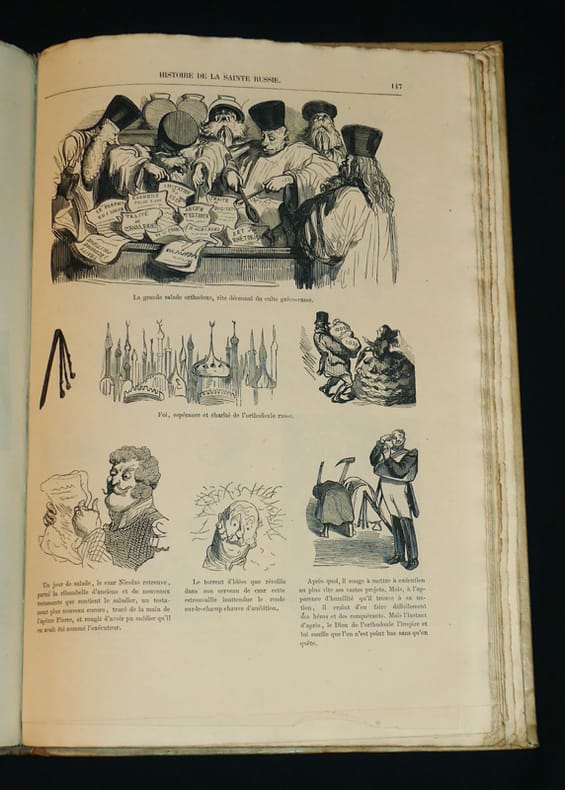
1854es293J. Bry Ainé, éditeur Sélection Le Seanachi, Sélection Abraxas-libris Relié 1854 "EDITION ORIGINALE--LETTRE MANUSCRITE DE GUSTAVE DORE. ""Histoire dramatique, pittoresque et caricaturale de la sainte Russie, d'après les chroniqueurs et historiens Nestor, Nikan, Sylvestre, Karamsin, Ségur, etc. commentée et illustrée de 500 magnifiques gravures de Gustave Doré gravées sur bois par toute la nouvelle école sous la direction générale de Sotain, graveur de l'histoire de Russie, de batailles, de protraits, de paysages, de genre, de fleurs, d'animaux, de crustacés et de plantes rares"". Un volume in-4 (20,8 x 31 cm), reliure pleine toile beige de Behrends, dos lisse orné d'une pièce de titre et d'un fer estampé à froid, ex-libris de Maurice Decroix, couverture conservée, 207 pages imprimées uniquement au recto, la page 89 porte la tache rouge caractéristique de l'édition originale rare et recherchée de cet ouvrage satirique critiquant les menées de la Russie en Europe, notamment en Crimée, qui fut par la suite censuré par le gouvernement de Napoéon III en 1856. Il est aussi considéré comme la première bande dessinée française. Notre exemplaire est en outre doté d'une lettre manuscrite de Gustave Doré à son éditeur. ""Cher Monsieur, je vous prie de croire que je ne donnerais pas un dessin à un graveur sans que vous le vissiez et sans qu'il vous l' [apporte?]. Aussi je m'empresse de vous écrire pour vous exprimer mon étonnement de ce que M. Viand n'ait pas, comme je le lui ai recommandé expressément, été vous porter son bois. Il [demeure?] 133 avenue de Châtillon au Grand Montrouge. Vous aurez demain deux nouveaux dessins sans faute. Votre bien dévoué, Gustave Doré ; dos bruni, rousseurs et taches aux plats, manque dans le coin inférieur de la page 49 avec légère atteinte de quelques mots au texte et sans atteinte à l'illustration, par ailleurs intérieur frais et bien conservé, bel exemplaire. Livraison a domicile (La Poste) ou en Mondial Relay sur simple demande."
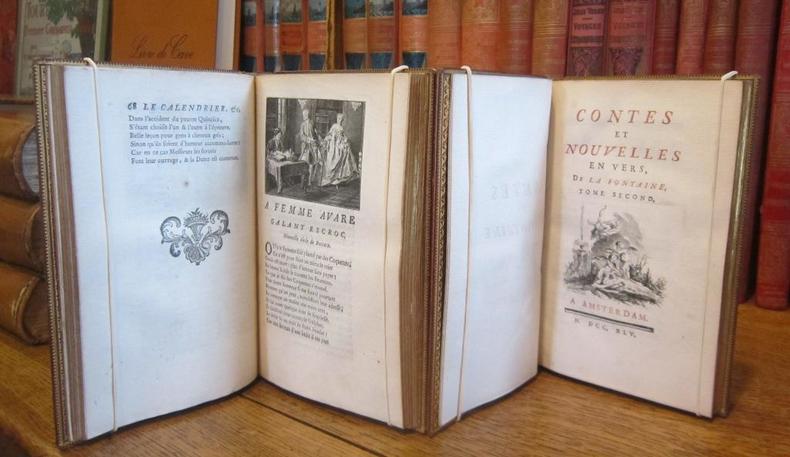
1745003058A Amsterdam, 1745
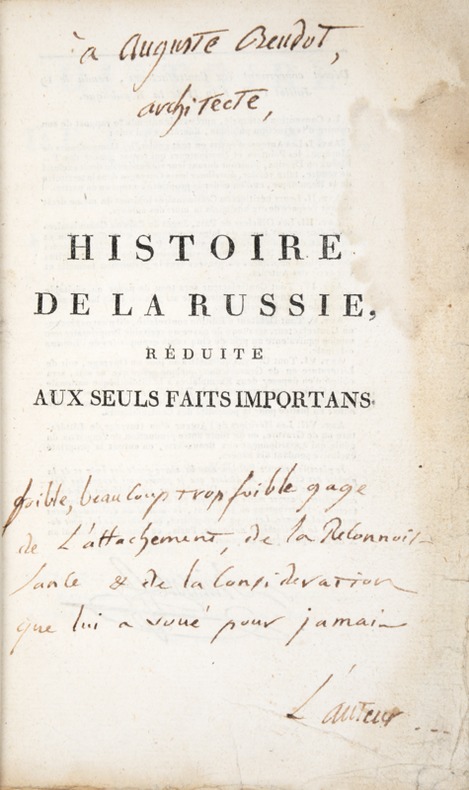
180213695Londres, Paris, Rouen, Buisson, Mongie l'aîné, Frère, 1802. In-8 de (4)-VIII-390 pp., demi-veau aubergine, dos lisse orné de filets dorés (relié vers 1850).
111421aafBruxelles, Chez J.B. Petit Libr.-Éditeur pour l’Art Militaire, 1840, gr. in-4°, oblong, Feuille de titre lithogr. avec vignette + 36 p. à double col. + 1 ff. ‘désignation des cartes’ + 37 cartes, num. de I à XXXVI (avec une carte II BIS, VI & VII sur 1 f. et la carte générale de l’Allemagne sans n° ), dont 19 doubles et 17 simples, traces d’eau au milieu des qqs cartes, reliure en d.-cuir originale plats en papier marbré, pièce de titre en cuir brun au milieu du premier plat. Mouillures.
5013Paris, Maradan, An II (1794), 8 volumes in-8° de XL- 422 pp. ; 2 ff.n.ch.- 490 ; 2 ff.n.ch.- 492 ; 2 ff.n.ch.- 499 ; 448 ; 455 ; 448 ; 2 ff.n.ch.- VIII- 463 pp. ; reliés pleine basane mouchetée d'époque, dos lisses dorés très ornés, pièces de titre et de tomaison de maroquin rouge et vert ; et un atlas petit in-folio relié demi-veau, dos lisse, titre or sur pièce de maroquin rouge, compartiments orné de fleurons et roulettes, roulette en tête et en pied. Des coins émoussés, coiffe très légèrement arasée au tome 2, mouillure aux 3 premiers feuillets du tome 1, galerie de vers au tome III des pages 163 à 209 sans perte de texte, déchirure avec petits manques sans atteinte au texte à 3 feuillets (F, F4, Ff 6) et mouillures au tome VIII. Coins émoussés à l'atlas.
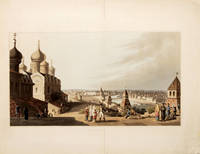
181671411London: Robert Bowyer. c.1816. A very fine hand coloured aquatint by Robert Bowyer 1758-1834 published in 1815. From; 'An Illustrated Record of Important Events in the Annals of Europe During the Years 1812 1813 1814 & 1815 Comprising a series of Views of Paris Moscow The Kremlin Dresden Berlin. together with a History of those Momentous Transactions'. This delightful view shows Muscovites in the foreground with parts of The Kremlin and the greater city in the background whilst The Moskva River is seen carrying mercantile craft. The colouring is soft and subtle and gives a this view a wonderful depth and clarity. Size: 465 x600 mm. Original hand coloured aquatint. In good condition. Central fold with old repairs to splits some soiling and minor staining. unknown
17916424A Paris, Chez F. Buisson, Imprimeur-Libraire, rue Hautefeuille, n°20. (1791). 1791 2 vol. in-8° (200 x 125 mm.) de : I. [2] ff. (titre, f. t.), viii, 466 pp.; II. [2] ff. (titre, f. t.), 486 pp. Initiales manuscrites à l'encre "L R" surles faux titres. Demi-basane dépoque, dos lisses ornés et titrés à l'or, coins de parchemin, plats recouverts de papier à la colle bleu.
In-8 p. (mm. 228x136), 2 volumi, mz. pelle mod. con ang., dorso a cordoni con decoraz. e tit. oro, conservata la brossura orig. - Volume 1°: pp. XI (occhietto, frontesp., dedica a Messieurs Robert Frères, “notice sur Careme par M. le Marquis de Cussy”, il celebre gastronomo), 352; con bella antiporta incisa, disegnata da Carème per la prima ediz. del 1822 - 12 ‘tableaux’ di menus, più volte ripieg. - 2 tavole (più e più volte ripieg.) con la disposizione dei “coperti” per un considerevole numero di persone. - Volume 2°: pp. 4 (occhietto, frontespizio), 282; con 12 ‘tableaux’ di menus, più volte ripieg. - 3 tavole (più e più volte ripieg.) con la disposizione dei “coperti” - 2 grandi tavole con la raffigurazione del “grand buffet de la cuisine moderne”, tutte inc. in rame. "Seconda edizione" di questa importante opera, con un totale di 24 ‘tableaux’, una antiporta allegorica e 7 (su 10) tavv. più volte ripieg. Nella prefazione l’A. spiega la divisione del suo studio in 5 trattati. - I traité: Remarques et considération sur l’ordonnance des menus de l’ancienne cuisine. - II traité: Considération et développements sur l’ordonnance des menus de la cuisine moderne, selon les 4 saisons, pour le service des tables opulentes depuis le premier janvier jusqu’à la fin de décembre inclusivement. - III traité: Des menus servis à la russe par l’auteur à S. M. I. l’empereur Alexandre, pendant son séjour à Paris, en 1814 et 1815. - IV traité: Des menus servis par l’auteur à S.A.R. le prince régent d’Angleterre, depuis George IV, pendant le grand voyage de la cour au pavillon de Brighton, en 1816 et 1817. - V traité: Des menus servis à Vienne par l’auteur à S. Exc. lord Stewart, ambassadeur extraordinaire de S.M.B. près la cour d’Autriche, en 1821. Suivis de considérations et remarques curieuses sur les productions en comestibles de Londres, Vienne et Saint-Pétersbourg, comparées à celles de la capitale de France, relativement à la cuisine; enrichi de planches représentant le service des tables et buffets pour les grandes réunions de famille et les fetes civiles et militaires. Cfr. Vicaire, p. 146 - Bitting, p. 75: 8 tavv. (di cui 7 ripieg.) e 24 ‘tableaux’. Pagine ingiallite per la qualità della carta e con qualche fiorit. ma complessivam. buon esemplare. "Il grande chef francese Marie Antoine Careme (1784-1833), fu cuoco di Talleyrand e poi degli imperatori di Russia e d’Austria. Il suo nome è divenuto quasi proverbiale per indicare l’ideale del cuoco perfetto. Scrisse varie opere fra cui “Il cuoco parigino o L’arte della cucina nel secolo XIX”". Così Diz. Larousse,III, p. 405.
In 8, cm 18 x 24,5, pp. (4) + 222 + (2) con 5 ( su 6) tavole fuori testo incise all'acquaforte e un'insegna incisa posta all'ultima carta (Diversa per aequora). Manca gran parte della pianta di Mosca. Brunitura uniforme alle tavole. Piena pergamena coeva. Rara edizione italiana di questa traduzione tratta dai Viaggi di Moscovia di Adam Olschlager stampata nel 1646 e edizione originale della Relatione del Barberini, scritta nel 1565 e mai pubblicata. Olearius venne inviato nel 1633 da Federico III Duca di Hoeltein in Russia e in persia, al fine di stringere rapporti commerciali con questi paesi e contiene la descrizione dei paesi attraversati durante il viaggio, descrive la Livonia, Riga, Vvolmar, Dorp, Narva, Caporio, Notemburg, Novogordia ecc. Ampia descrizione di usi e costumi russi, delle udienze pubbliche con le quali furono ricevuti, i ricevimenti degli ambasciatori turchi e tartari ecc. La relazione del Barberini, poi, si presenta sotto forma di lettera al Conte di Nubarola il quale narra della Russia e dei paesi attraversati durante il viaggio. Importante testimonianza del rinato interesse per la Russia di questo periodo ribadito nell'Avvertimento al lettore, nel quale si danno delucidazioni sul paese e note relative all'etimologia di alcune parole. La relazione del Barberini risale al viaggio fatto da questi nel 1564 al fine di vendere allo Zar Ivan il terribile, il brevetto per l'estrazione del sale. Mazzitelli, Slavica biblioteconomica, p. 47 - 49. rhode, 1963, 141.
1923105690BBMünchen, Orchis-Verlag, o. J. (1923). 8°. 11 (!) Orig.-Holzschnitte (20 x 15 cm.). Marmorierte Orig.-Flügelmappe mit Deckelschild. [10 Warenabbildungen]
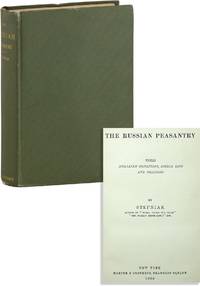
188884805New York: Harper and Brothers 1888. First Edition. Octavo. 17.5cm. Publisher's green pebble grain cloth titled in gilt to spine. vi; 1; 401pp.6pp. ads to rear. Light rubbing to corners slight scuffing and some minor bumping to spine ends with a small spot stain at the very head of the spine small dent to upper edges of the boards; internally clean with some superficial soiling to the page edges ownership of Pennsylvania historian Gertrude Bosler Biddle to front flyleaf. A very good clean and handsome copy.<br /> <br /> WITH<br /> <br /> London: 1890-93. Three ALS autograph letters signed on folded stationery sheets as follows: <br /> <br /> 1. Dated "March 31" without year; from context ca. 1888-1890. 2pp ca. 250 words in black ink; datemarked St. John's Wood March 31. Requesting the publisher's permission to commission a German translation of his Russian Peasantry which first appeared in 1888 with a second edition in 1890. Stepniak proposes 50/50 division of royalties and identifies the translator as Victor Adler who has just been sentenced to three months in prison and thus now has "ample leisure" for undertaking the translation. Adler 1852-1918 was founder and first chairman of the Austrian Socialist Democratic Workers Party in 1888. Signed at close "S. Stepniak." Near Fine. <br /> <br /> 2. Dated November 6 1890. 1pp ca. 75 words in blue ink. Declines a request from his publisher to undertake a book on the Jewish Question: ".it is impossible for me to write upon any question upon Jews or anything else for I am quite full with preparing a series of American lectures." Signed at close "S. Stepniak." Slight smudging final two lines and left margin not affecting legibility. Very Good. <br /> <br /> 3. Dated May 15 1893. 2pp ca. 120 words in black ink. Addressed to "Dear Mrs i.e. messieurs Sonnenschein" accepting an invitation to visit but stating he cannot arrive early. Signed at close "S. Stepniak." Light soil; Near FIne. <br /> <br /> Sergei Stepniak aka Sergius; aka Sergey Stepnyak-Kravchinskii 1851-1895 made his revolutionary bones during the Narodnik Rebellion of 1877-78 by openly assassinating Nikolai Mezentsov the head of the Czar's secret police on the streets of St. Petersburg. Kravchinskii committed the act in broad daylight and made no attempt to disavow his guilt living publicly if dangerously for several months before finally escaping to Switzerland. He arrived in London around 1880 and quickly became the center of a lively Russian revolutionary exile scene. He founded the Society of Friends of Russian Freedom in 1891 and wrote a number of well-received books on revolutionary Russia including Underground Russia which had in fact been published in translation prior to his exile The Russian Peasantry 1888; and a fictionalized account of his own exploits The Career of a Nihilist 1889. He was killed somewhat mysteriously we think by an onrushing train in December of 1895 depriving him of any opportunity to witness the fruit of his labors in the Revolutions of 1905 and 1917. Dying young Stepniak did not leave a great body of manuscript material behind him and relatively few letters with good content have appeared in commerce. Harper and Brothers unknown
D11717England Russia India 19th century. Hardcover. Very Good. Half morocco and green cloth gilt-stamped ornament and lettering "Memories / E.C.B. / E.A.T.B." in spine compartments; small 4to 200x245mm; two sections of typed textpp. 95 109 divided by illustrations see below mounted to heavy cardstock leaves. The first section is dictated by Edward Clive Bayley to his wife Lady Emily and deals with his childhood years in Russia then moves on to India. It is accompanied by seven 100x145mm and eight 63x88mm view of Russia. The second section is dictated by Lady Emily beginning her story when she is 17 and moves to India and also including her time spent in England. It is accompanied by 4 sepia photographs 150x205mm showing interior and exterior views of a sprawling Delhi home. <br/><br/>Sir Edward Clive Bayley was an antiquary and administrator in India employed at East India College Haileybury in Bengal civil service in Meerut in Gujarat and in Punjab. He arrived in India in 1842 where he met and married Emily Metcalf in 1850; they had 13 children to whom this volume is dedicated. The couple returned to England so that Edward could study law then returned to India on the outbreak of the uprising -- in September Edward was ordered to Allhabad to assist John Peter Grant in his provisional goverment of the Central Provinces. Thereafter Edward served in a judicial capacity in Benares Azamargh Allahabad and Agra. He was a respected antiquarian and the foremost authority on India numismatics. Lady Emily returned to England with her husband upon his retirement in 1878 where she worked on their memoirs a portion of them published as "The Golden Calm" in 1980 and SOLD WITH a copy cloth in dust jacket. hardcover books
142264aafLondon, Printed for W. Miller, MDCCCIII, (1803), in-folio, 4 ff. (titres anglais / franç. + 2 ff. dédications / 4 ff. préfaces / 1 f. de Table + 73 planches en couleurs accompagnies de 73 ff. de descriptions,II + 140 pages of descriptions + 73 handcoloured engraved plates including the engraved title (by J. Dadley, published 1803 by E. Harding), Exlibris (Armorial bookpates:) F. H. Goodyear (devise: Possunt quia posse videntur) / + John Arden (devise: Patientia vinces), full red leather binding with gilt decorations on spine and covers. Light signes of use on extremites.
DJ browned (as usual) and chipped. DJ spine laid-in book. Top DJ professionally repaired. Former owner's address on front endpaper. ; 1st and only edition. One of the most scarce and precious titles of the Baedeker series. A description of the country before the revolution. 40 fold out maps in color and 78 plans. A very well preserved copy - especially rare with DJ. Marbled edges nicely preserved - this is the best copy we have ever seen ; 12mo; 590 pages
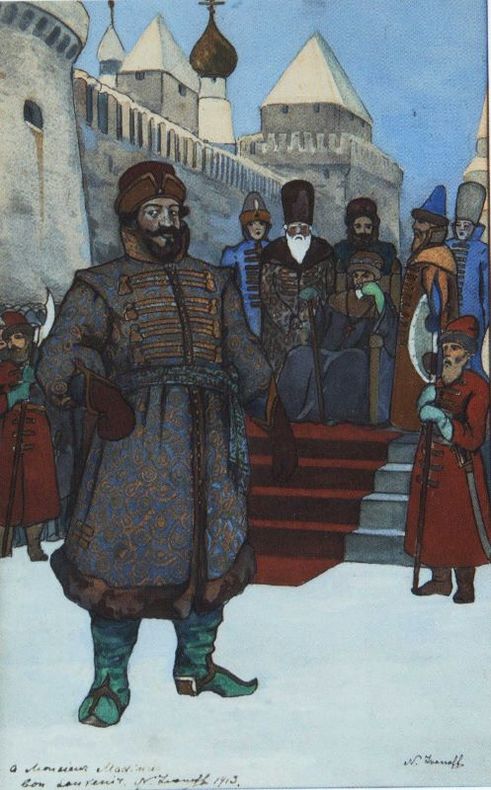
19920Gouache, aquarelle, signée en bas à droite et envoi daté en bas à gauche, 1913, 33,5 x 21 cm., encadrée.
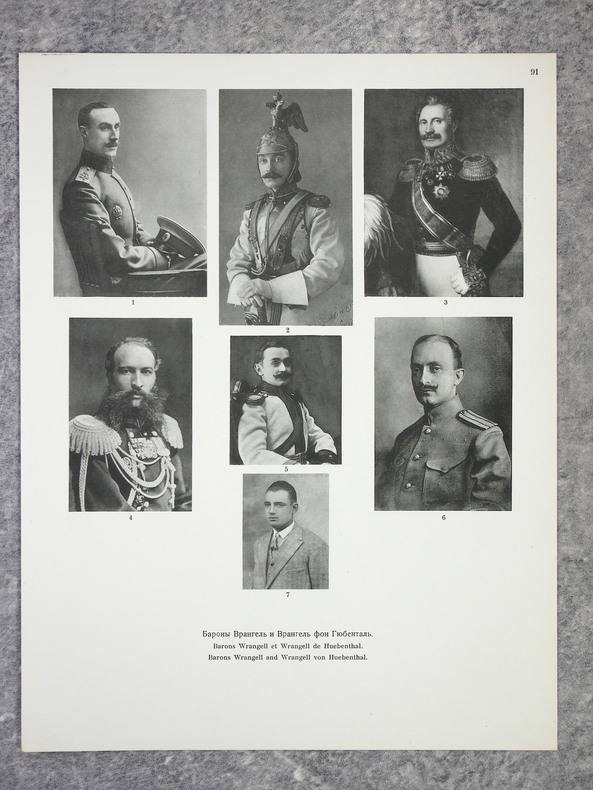
19611523(PARIS). PRINCE BELOSSELSKY-BELOZERSKY. 1961. 13 VOLUMES GRAND IN-4, 12 VOLUMES DE PLANCHES SOUS CHEMISES REMPLIEES ET UN VOLUME DE TEXTE BROCHE, LE TOUT SOUS EMBOITAGE TOILE NOIR DE L’EDITEUR (27 X 34 X 7,5 CENTIMETRES ENVIRON), PLAT SUPERIEUR ILLUSTRE D’UNE GRANDE COMPOSITION EN COULEURS A L’AIGLE BICEPHALE PAR ZWORIKINE. TEXTE TRILINGUE: RUSSE-FRANCAIS-ANGLAIS. ILLUSTRE DE 244 PLANCHES HORS TEXTE, 198 EN NOIR ET 46 EN COULEURS EDITION ORIGINALE. TIRAGE LIMITE A 300 EXEMPLAIRES NUMEROTES, NON MIS DANS LE COMMERCE, CELUI-CI PORTANT LE NUMERO 236. COMPREND:- TEXTE. HISTOIRE DU REGIMENT DE LA GARDE A CHEVAL. (6) + 39 ET (1) PAGES. BIEN COMPLET DE SON FEUILLET D’ERRATA.- I. UNIFORMES DU REGIMENT. 25 PLANCHES, DONT 12 EN COULEURS.- II. MEMBRES DE LA FAMILLE IMPERIALE, CHEFS ET OFFICIERS DE LA GARDE IMPERIALE. 47 PLANCHES, DONT 21 EN COULEURS.- III. PALAIS IMPERIAUX ET EDIFICES HISTORIQUES. 23 PLANCHES, DONT 1 EN COULEURS.- IV. JOURNEES MEMORABLES DANS LA VIE DES OFFICIERS DE LA GARDE A CHEVAL. 16 PLANCHES, DONT 8 EN COULEURS.- V. PORTRAITS D’OFFICIERS DE LA GARDE A CHEVAL. 25 PLANCHES, DONT 1 EN COULEURS.- VI. ANCIENNES FAMILLES DES GARDES A CHEVAL. 14 PLANCHES EN NOIR.- VII. OBJETS D’ART AYANT RAPPORT A LA GARDE A CHEVAL. 11 PLANCHES, DONT 1 EN COULEURS.- VIII. CHATEAUX ET DOMAINES DES OFFICIERS DE LA GARDE A CHEVAL. 19 PLANCHES, DONT 1 EN COULEURS.- IX. LES CASERNES DU REGIMENT. 18 PLANCHES EN NOIR.- X. LE REGIMENT DE LA GARDE A CHEVAL EN TEMPS DE PAIX. 22 PLANCHES EN NOIR.- XI. LE REGIMENT DE LA GARDE A CHEVAL PENDANT LA GUERRE. 17 PLANCHES, DONT 1 PLANCHE EN COULEURS.- XII. LES ANCIENS DE LA GARDE A CHEVAL DANS L’EMIGRATION. PLANCHES SUPPLEMENTAIRES. 7 PLANCHES EN NOIR.PETITE FENTE A L’EMBOITAGE, QUELQUES FINES ROUSSEURS EPARSES SUR LA PREMIERE PLANCHE DE CHAQUE POCHETTE, SINON BON EXEMPLAIRE DE CETTE MONUMENTALE EDITION.
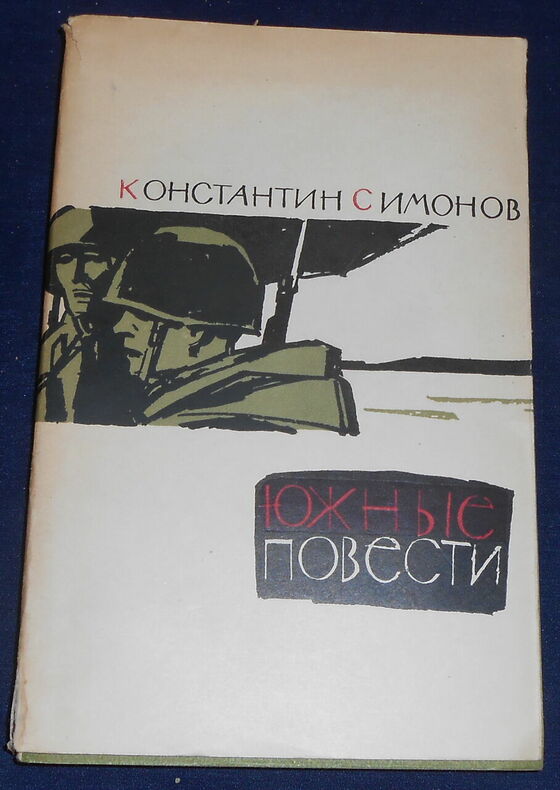
1943100073656Moscou. 13 cm x 20 cm. 1943. Broché. 155 pages. Moscou Les Ecrivains Soviétiques 1943 - Broché bien complet de la jaquette 13 cm x 20 cm 155 pages - Textes de Constantin Simonov - Bon état
Boards browned and with small ink soiling to front and back. ; The rare supplement to the French edition of the Russia Baedeker; 16mo 6" - 7" tall; 108 pages
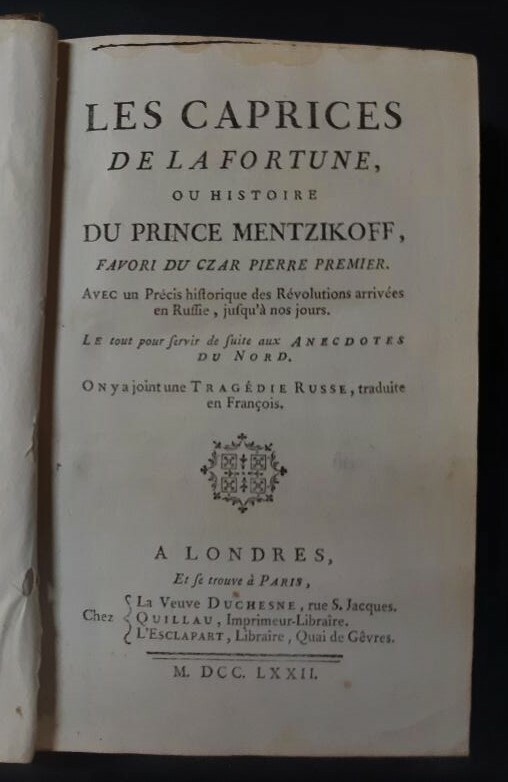
1780116989à Londres ; et se trouve à Paris - À Utrecht (Genève) - Amsterdam, et Paris, chez la Veuve Duchesne, Quillau, L’Esclapart, Cramer, Gueffier 1780 4 ouvrages en 1 volume. In-12 19,5 x 11,5 cm. Reliure de l’époque demi-basane havane, dos lisse orné de fers dorés encadrés de filets dorés, pièce de titre maroquin vert-émeraude, VII-189-X-56-240-189 pp. Accroc en tête et pied de dos, coiffe de pied arasée, plats et coupes frottées, corps de l’ouvrage frais avec infimes rousseurs.
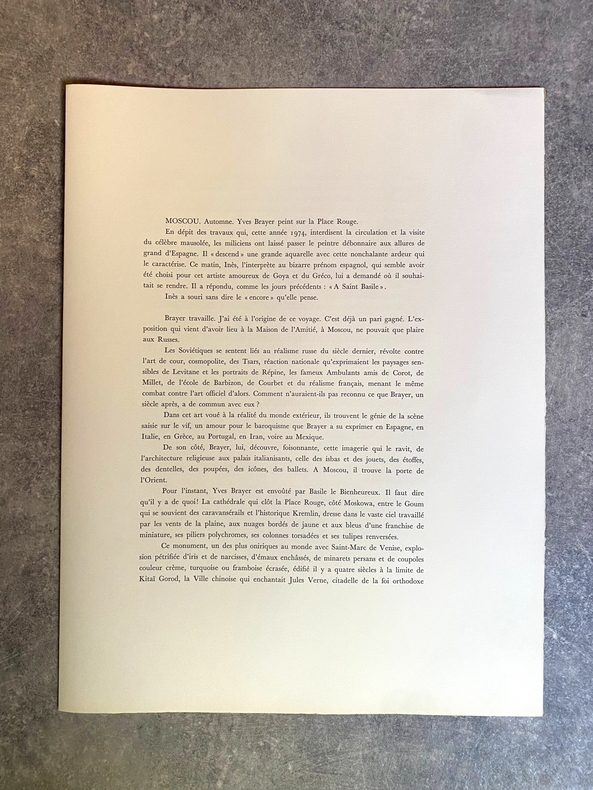
19762115PARIS. EDITIONS CERCLE D’ART. 1976. GRAND IN-PLANO EN FEUILLES (53 X 69 X 3,5 CENTIMETRES ENVIRON) DE (8) PAGES ET 12 LITHOGRAPHIES EN COULEURS SUR VELIN D’ARCHES (50 X 65 CENTIMETRES ENVIRON), SOUS EMBOITAGE TOILE GREGE DE L'EDITEUR. CHAQUE LITHOGRAPHIE SIGNEE ET NUMEROTEE 69/185 PAR YVES BRAYER. PREMIER TIRAGE LIMITE A 185 EXEMPLAIRES NUMEROTES, UN DES 170 SUR VELIN D’ARCHES, CELUI-CI PORTANT LE NUMERO 69. BEL ETAT POUR CET ENSEMBLE DEVENU RARE, DE NOMBREUX EXEMPLAIRES AYANT ETE VENDUS A LA PLANCHE.