17 864 résultats
Very Good Persian First Edition of this extremely rare bilingual tractate including Prince Reza Khan's thoughts on Anglo-Persian agreement in1919. Mirza Reza Khan also known as Prince Rezâ Arfa', was a diplomat and poet of the late Qajar period who serviced in Constantinople. During his years of service abroad Reza became acquainted with a number of European political leaders. He was reported to entertain Russian sympathies and was certainly instrumental in negotiating the first Russian government loan to Persia, in 1317 / 1900. Nevertheless, he also appears to have supported the Anglo-Persian Agreement of 1919. In 1332 / 1914 he served as minister of justice (wazîr-e 'adlîya) in Tehran for about a year. This agreement in 1919 was a provisional agreement made between the British and the Persian governments which, if ratified, would have granted the British a paramount position of control over the financial and military affairs of Iran. From the days when Napoleon conceived the idea of invading India with the help of Alexander I, the Tsar of Russia, Great Britain contemplated with apprehension the invasion of India by Russia via Persia and Afghanistan. Under the Anglo-Russian Convention of 1907 (q.v.), which divided Persia into rival spheres of influence, southern Persia was assigned to Britain while Russia controlled the northern portion. Later, according to the terms of "The Secret Treaties of Constantinople" of 18 March 1915, Constantinople was promised to Russia, and England was allowed to incorporate within her sphere of influence the neutral zone of Persia. (Source: Encyclopedia Iranica). Original wrappers. Slightly chipped on extremities and occasionally foxing on cover. Otherwise a very good copy. Roy. 8vo. (23 x 16 cm). Bilingual in Persian and Ottoman script. [34] p., 7-18 pp. text in Persian, 19-34 pp. translation to Ottoman Turkish, a portrait of Prince Mirza Riza Han with a printed signature and inscription, and facsimile litho page of his manuscript poem in his calligraphy. Turkish chapter is in nashkh, Persian chapter is in taliq script. Lithography. Not in OCLC.; Özege 25155.; TBTK 8061. First Edition. Extremely rare.
Good Turkish, Ottoman (1500-1928) Original wrappers. Roy. 8vo. (23 x 16 cm). In Ottoman script (Old Turkish with Arabic letters. 120 p., several tables of zones and routes. Slight foxing on cover, fading on pages, chippings on extremities of cover and some pages, repaired spine. Otherwise a good copy. First and only Turkish edition of this rare description of the Black Sea, including the historical geography of the western shores of the region, written in a travelogue style, by Bulgarian admiral Ivanov when he was the head of the Naval School in Varna (1928-1931) where he lectured on meteorology, oceanography and naval aviation for officers and conducted the seamanship course for the civil navy. Ivanov was a Bulgarian officer and admiral and a freemason, who was a member of the "Black Sea Friends" Lodge. He is a descendant of Kolyo Ficheto. In 1910, he graduated from the Military School in Sofia, and in 1914, he also completed a naval cadet course in St. Petersburg. From 1912 to 1913 he served in the Port Company of the Navy. During the period March 30, 1913 - September 1, 1913, he was the chief of the ship "Druzki". In the same year, he also served on the ship "Nadezhda". From 1914 he was adjutant of the Mobile Defense and flag officer of the destroyer detachment. He participated in World War I. Özege 10186.; Six copies can be traced in OCLC: 977483558.; 949487717.; 67339656.; 1030754762.
1966ZB1278337London Math Soc 1966. Russian Mathematical Surveys. v. 21; 22; 25; 27; 32; 33; 34; 35 including postage to Germany. - If you are reading this this item is actually physically in our stock and ready for shipment once ordered. We are not bookjackers. Buyer is responsible for any additional duties taxes or fees required by recipient's country. Photos available upon request. London Math Soc unknown
18367409Paris, Londres, St. Pétersbourg, Bellizard, Barthès, Dufour et Lowell, 1836. In-8 de [8]-290-[6] pages, plein velours de soie verte émeraude décoré d'un décors estampé figurant une femme avec une ombrelle, sous deux palmiers dans un paysage oriental, répété sur les deux plats, tranches dorées, gardes de papier argenté à motif floral.
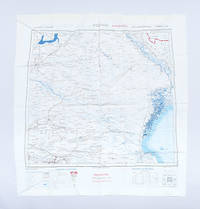
1952183941London: Ordnance Survey 1952. Later editions marked "restricted" revised from those produced by the War Office in 1919 and 1916 with isogonals correct to 1953. These maps were issued in the early years of the Cold War only a decade after the region was ravaged in the Battle of Stalingrad. Stepnoy now Elista was renamed only five years after this map's publication. In the early years of the Cold War the CIA attempted to gather information on the Soviet Union through aerial spying missions flown with the co-operation of the British government. "The RAF formed a top-secret reconnaissance outfit in the spring of 1951. Churchill approved the RAF overflight program knowing that if one of the planes came down on Russian territory Labour MPs in an embarrassed and angered House of Commons undoubtedly would force a vote of confidence to bring down his government. But he balanced that possibility against the desperate need for radar pictures of Soviet military targets that would held SAC and RAF bombers in the event of war" Burrows pp. 131-33. In 1952 John Crampton flew a high-speed high-altitude test run over the Berlin corridor which Bomber Command followed with three simultaneous sorties reaching as far as Moscow itself. After a ten-hour mission that triggered the Soviet air defences "All three planes made it back to Sculthorpe with their radar imagery and without a scratch" Burrows p. 134 angering the Kremlin and prompting a review of the nation's air warning systems. The map of Stalingrad is the fourth edition and the map of Stepnoy is the fifth. Single sheet of cloth 605 x 554 mm colour maps with key on each side pale border on Stalingrad side lettered in red blue and black. Map bright sometime folded and creased edges a little frayed: a very good copy. William Burrows By Any Means Necessary: America's secret air war in the Cold War 2001. hardcover
013359[Russie] François-Timoléon de Choisy dit l'abbé de Choisy ou Joseph-Gaspard Lambert de Guérin, Le prince Kouchimen, histoire tartare et Dom Alvar del Sol, histoire napolitaine. Paris, Jacques Estienne, 1710. In-12, [4]-150-[2]p. Edition originale de cet ouvrage attribué à l'abbé de Choisy par Barbier et Quérard mais que certains attribuent à l'ancien ingénieur au service de la Russie, Joseph-Gaspard Lambert de Guérin. Il avait quitté la Russie sans l'autorisation du tsar Pierre 1er en 1706, fut arrêté en Prusse en 1711, accusé de désertion, mais réussit à s'enfuit en Italie. L'ouvrage aura 4 éditions au XVIIIe siècle et son titre évoluera et deviendra Histoire de l'origine du prince Menzikow en 1728. Le premier texte est une critique d'Alexandre Danilovitch Menchikov (1673-1729), proche du tsar Pierre Ier, à l'ambition démesurée. Le nom du personnage est évidemment un anagramme de Menchikov, du verlan avant l'heure ! Le tsar devient le Grand Cam, monarque de la Grande Tartarie. C'est le premier livre à s'intéresser à ce personnage, capable de corruption pour arriver à ses fins, devenu richissime et puissant. Le second texte est une petite nouvelle romançant la rencontre entre Anna Caraffa (1607-1644), princesse de la maison napolitaine Carafa, et Ramiro Núñez de Guzmán (ca.1600-1668), grand d'Espagne, 2e duc de Medina de las Torrès. Ils apparaissent ici sous des noms quasi transparents, Anna devenant Diana et Ramiro devenant Philippes Ramires. Le duc s'est alors présenté à Naples sous le pseudonyme de Dom Alvar del Sol. Plein veau, dos à nerfs orné, pièce de titre maroquin, tranches rouges. Accroc à la coiffe supérieur, épidermures, deux coins un peu usés, petit travail de vers principalement marginale en pied de pages (sans empêcher la lecture). L'ouvrage, présent dans de nombreux catalogues anciens de ventes, est devenu rare.
8 volumi, cm. 21, cartonato rustico originale con tit. manoscritto al dorso, pag. 296; 328; 347 (5); 301; 278 (2); 282 (1 c.b.); 376; 305 (1 c.b.). Esemplare perfetto, con barbe.
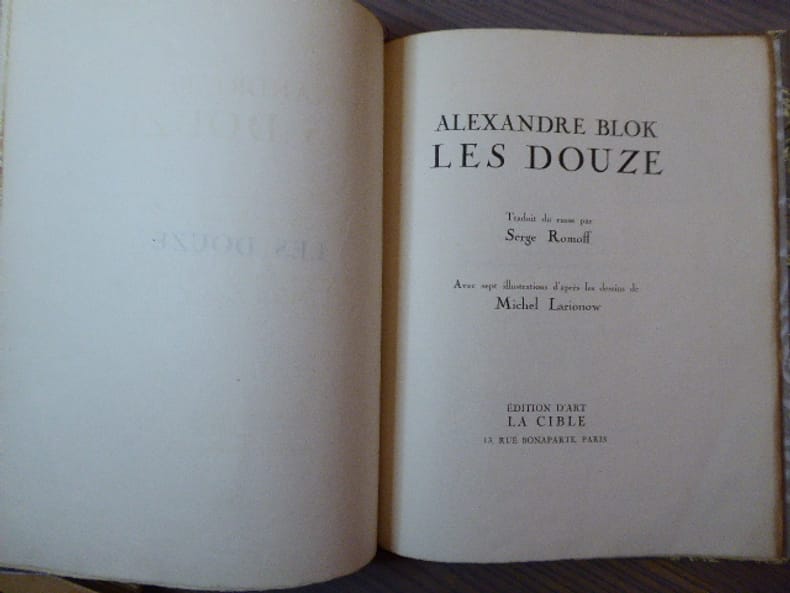
837409Éditions D Art La Cible ( Presses De L Imprimerie «Union» ) Paris 1920 In-4 carré ( 290 X 225 mm ), demi-basane vert sapin, dos à nerfs orné de filets dorés, couvertures violines conservées ( Reliure de l'époque ). EDITION ORIGINALE de la traduction du russe par Serge ROMOFF, illustrée de 7 dessins de Michel LARIONOV, imprimés sur papier couché et monté hors texte. Tirage à 510 exemplaires, 1 des 500 sur vergé d'Arches, celui-ci non numéroté. Signature manuscrite sur une garde, bel exemplaire.
ORD-2643Traduit de l'anglais, enrichi de notes & des éclaircissemens nécessaires, & augmenté d'un Voyage en Norvège. Par M. P. H. MALLET. Ouvrage orné de Cartes géographiques, Portraits, Plans & Figures en taille-douce. Genève. Barde, Manget & Comp. Paris. Buisson. 1786. 4 volumes in-8 (128 x 198mm) plein moucheté de noir, dos à 5 nerfs ornés or, pièces de titre maroquin rouge, de tomaison maroquin noir, tranches rouges, XII, 380; 1f., 404; 1f., 393 et 1f., 303 pages. Bien complet des 19 planches hors texte. Ex-libris Duhamel. 2 coiffes supérieures habilement restaurées, petits accidents aux derniers plats des tomes 1 et 2 sinon très bel exemplaire.
Un volume de format in 8° de XII pp.( faux titre, titre, avertisement, préface de l'auteur); 508 pp.; 4 planches hors texte en couleurs dont le frontispice; et trois en noir; une grande carte dépliantes en fin (rousseurs). Le voyage en lui-même couvre 306 pp.; viennent ensuite de nombreux suppléments d'érudits russes concernant les monnaies les langues, l'histoire naturelle de la Boukharie (sic)... Dos lisse richement orné; demi basane violine; titre doré. Brunet III; col.1690. Importante rousseurs sur le titre et le frontispice puis rousseurs éparses plus rares. Bien complet . Parfaitement relié. Ouvrage peu fréquent; voir les photos.
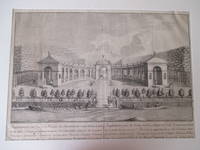
175014523AB1750. Sta. Petersburg Academie Imp. des Scien et des Arts ca. 1750 48 : 69 cm Original engraving with text in Russien and Frenche below the image. Rare engraving of the Amphitheatre near St. Petersburg. unknown
1769647731769. Early French-Language Edition of Catherine's Nakaz Catherine II 1762-1796 Empress of Russia. Landres J. Rodolphe Frey de Translator. Instructions Adressees par Sa Majeste L'Imperatrice de Toutes les Russies: A la Commission Etablie Pour Travailler a L'Execution du Projet d'un Nouveau Code de Lois. Traduit de l'Allemand. "A Petersbourg" i.e. Yverdon Switzerland: s.n. 1769. 286 pp. 12mo. 6" x 4". Early quarter vellum over marbled boards untrimmed edges a few unopenened signatures. Light soiling corners lightly bumped and worn. Moderate toning to interior somewhat heavier in places some leaves have light foxing a few have light dampstaining to margins internally clean. Ex-library with a small inkstamp to title page. A handsome copy. $1000. Reissue of the first edition in French published by the St. Petersburg Academy of Sciences for private distribution in 1769. This important text also known as the Nakaz or Instruction is a statement of legal principles written by Catherine II from 1764 and 1766. Permeated with the ideas of the French Enlightenment and copied mostly from the work of Voltaire Montesquieu and Beccaria it was compiled as a guide for the All-Russia Legislative Commission convened by the Empress in 1767 to create a new code to replace the 1649 Muscovite Code. Revised in consultation with Beccaria Frederick the Great and Voltaire the Instruction proclaimed the equality of all men before the law and disapproved of death penalty and torture. Unfortunately her proposed code was never completed. Catherine's manuscript was written in French and she later produced a Russian translation. Editions in German and Russian were published in Moscow in 1767. The book was initially banned in France because it was too liberal which is why the first French-language edition was produced in Switzerland with a false imprint. French and Latin editions were eventually published in 1770. OCLC locates 6 copies of this imprint in North American law libraries Columbia George Washington University Harvard Library of Congress UC-Berkeley Yale. Butler The Nakaz of Catherine the Great 531 Entry 40. unknown
1769647731769. Early French-Language Edition of Catherine's Nakaz Catherine II 1762-1796 Empress of Russia. Landres J. Rodolphe Frey de Translator. Instructions Adressees par Sa Majeste Instructions Adressees par Sa Majeste L'Imperatrice de Toutes les Russies L'Impratrice de Toutes les Russies: A la Commission Etablie Pour Travailler a L'Execution du Projet d'un Nouveau Code de Lois. Traduit de l'Allemand. "A Petersbourg" i.e. Yverdon Switzerland: s.n. 1769. 286 pp. 12mo. 6" x 4". Early quarter vellum over marbled boards untrimmed edges a few unopenened signatures. Light soiling corners lightly bumped and worn. Moderate toning somewhat heavier in places some leaves have light foxing a few have light dampstaining to margins internally clean. Ex-library. Small inkstamp to title page. A handsome copy. $1000. Reissue of the first edition in French published for by the St. Petersburg Academy of Sciences for private distribution in 1769. This important text also known as the Nakaz or Instruction is a statement of legal principles written by Catherine II from 1764 and 1766. Permeated with the ideas of the French Enlightenment and copied mostly from the work of Voltaire Montesquieu and Beccaria it was compiled as a guide for the All-Russia Legislative Commission convened by the Empress in 1767 to create a new code to replace the 1649 Muscovite Code. Revised in consultation with Beccaria Frederick the Great and Voltaire the Instruction proclaimed the equality of all men before the law and disapproved of death penalty and torture. Unfortunately her proposed code was never completed. Catherine's manuscript was written in French and she later produced a Russian translation. Editions in German and Russian were published in Moscow in 1767. The book was initially banned in France because it was too liberal which is why the first French-language edition was produced in Switzerland with a false imprint. French and Latin editions were eventually published in 1770. OCLC locates 6 copies of this imprint in North American law libraries Columbia George Washington University Harvard Library of Congress UC-Berkeley Yale. Butler The Nakaz of Catherine the Great 531 Entry 40. unknown books
19990008049Boulder CO: Westview Press 1999. First English language edition. Hardcover. As New/issued without. 8vos; xxxiv 562; ix 389 pages maroon cloth in original shrinkwrap. Not x-library. Scarce. O.P. <br/><br/>This English translation contains an autobiography by Mironov which was not in the Russian edition. It details his anti-Marxism philosophy while a student in Leningrad. "The author has assimilated a large body of foreign scholarship primarily "new social history" produced by Anglo-American authors along with a sprinkling of more broadly European economic and demographic history from the 1970s and 1980s which is effectively incorporated into his own very deep empirical knowledge. . The reader does not find in this extensively researched account the standard Soviet answers to specific historical questions. Mironov has abandoned most Soviet cliches though he still assumes that laws of Russian history can be identified based on social science theory and quantitative analysis Elise Kimerling Wirtschafter." "This is a massterful work that provides other scholars with a wealth of useful information while confrontimg them with an argument that compels a response - William G. Wagner." Maps. Westview Press hardcover
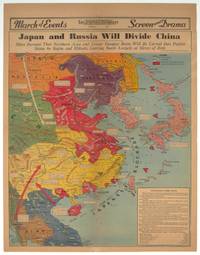
1940209821Los Angeles.: Los Angeles Examiner. 1940. Printed colour pictorial map on a single newspaper leaf 42.3 x 39.9 cms; 54.3 x 42.5 cms sheet archivally laid down on linen slight discoloration to lower centrefold and sheet slightly age-toned but in very good condition. A striking geopolitical map by Los Angeles Examiner artist Howard Burke covering China Japan Southern Russia and the northern part of French Indochina and Siam showing how the "Aggressors Divide China." Areas under Japanese occupation are shown in red and their naval blockade shown by an arc of naval vessels with vivid arrows indicating lines of supply. Text labels including sources of agricultural and raw materials provide a dynamic overview of the geopolitical situation and show the influence of American scientific illustrator and cartographer Richard Edes Harrison who argued for examining geographic issues from multiple perspectives and Los Angeles Times artist Charles Owens. . Los Angeles Examiner. unknown
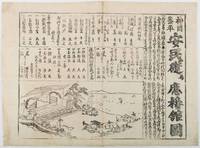
1854177799Japan. Circa1854. Black and white woodblock kawaraban printed on two joined sheets vertical central crease 41 x 63cm a little worming mainly on margins and repaired with paper on the reverse a little light browning but still presents very well. This kawaraban reports on how foreign visitors from the United States and Russia were treated in order to keep the peace and safety of God's country Japan. <br> <br>It reports that foreigners had arrived in Uraga this being the time of the second visit of Perry to Japan in 1854. The kawaraban goes on to list official gifts from the Shogunate to the President and his delegation members from the United States as well as to the Russian delegation. The gifts include lacquer boxes silk textiles as well as rice and chickens for the crew. <br> <br>The attractive black and white image at the foot of the report depicts a meeting in Yokohama at which a high ranking Tokugawa official received foreign visitors. The visitors are shown prostrating themselves in the open outdoor space in front of the building where the official sits. . unknown
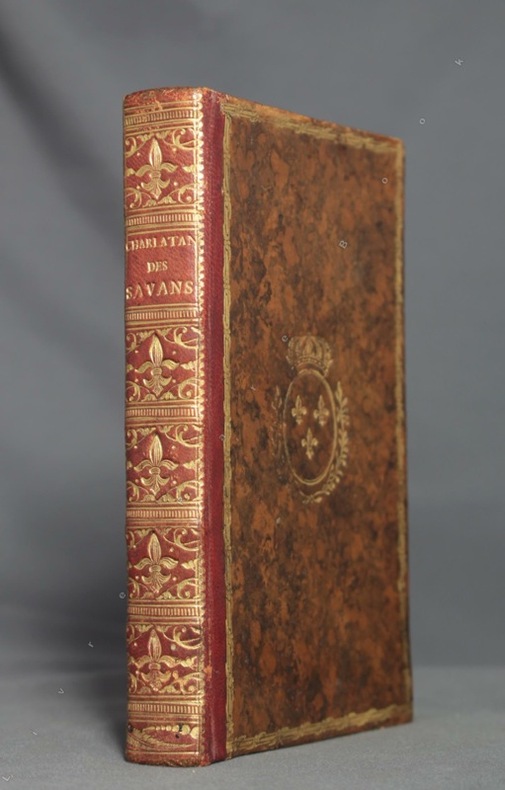
17218746La Haye, Jean van Duren, 1721. In-12 de [40]-242-[38] pages, dos lisse de maroquin rouge, orné de filets, fleurons et fleurs de lys dorés, plat de veau brun, roulette dorée encadrant les plats, filet doré sur les coupes, armes de Louis XV dorées au centre du premier plat. Ex-libris de la bibliothèque du comte Sergueï Dmitrievitch Cheremetiev, et du comte Nikolaï Dmitrievitch Cheremetiev (?).
180194432Paris, Maradan 1801 6 volumes in-8, plein veau raciné époque, dos lisses teintés en vert et richement ornés, roulette dorée encadrant les plats et sur les coupes, XX-400- 451- 464- 432- 419- 384 pp. Bel exemplaire
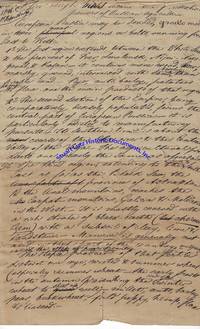
4678JOSEPH SLOCUM 1800-1853. Slocum was a merchant from Syracuse New York who attempted to sell farm equipment to Russia in the nineteenth century. He was unable to turn a profit from his endeavors and his family fell into financial hardship. His daughter Margaret Olivia Scolum Sage became an influential philanthropist and teacher. She endowed a building and a now-defunct agricultural school at Syracuse University both named after him.Archive. 9 pieces. 1830s-40s. An archive related to Joseph Slocum and his business with Russian agriculture. There are nine letters and documents predominately letters written to Slocum from various Americans and Russians. Highlights are listed below and the best piece is the first one the lengthy manuscript detailing Russian agriculture and natural resources:Handwritten document. 4pgs. September 12 1846. St. Petersburg Russia. The four page handwritten manuscript is entitled Some Rough Hints About the Productive Power of Russian Agriculture. It states in part: European Russia it may be divided grosso muto in three great regions or belts running from East to West. 1st - The first region extends between the White Sea and the provinces of Tver Smolensk Nijni-Novogorod & Kazan - it contains more wood low marshy ground intermixed the sand Baron then arable land. Rye oats barley potatoes hemp and flax are the main products of that region. 2nd - the second section of the Empire being comparatively densely populated forms a central part of the European Russia it is particularly addicted to manufacturing pursuits. It's Southern limits is about the course of the Oka River & the Central Valley of the Volga. The agricultural products are nearly the same as aforesaid. 3rd - the third region extending to the south and southeast as far as the Black Sea the provinces of Ashnaklan and the Ural Mountains reaches the Carpathian mountains Galicia & Moldavia in the West. It is mostly covered with a rich strata of black earth with a subsoil of clay lime & sandstone. Minoru is generally not used in this part of the country vulgarly called the step or prairie count the staple products of the fertile district are rye winter and summer wheat especially summer wheat - the summer frosts in the autumn preventing the seeds of the winter week to start up well millet oats barley peas buckwheat field poppy hemp flax & linseed. Cotton & Vine are raised merely in the most remote districts of the South such as Georgia Astrakhan the territory of the Cossacks of the Don Crimea & Bessarabia. Three other very important staples of Steph region are livestock & saltworks & fisheries. The stock consists mainly of horned cattle and horses grazing in large herds on the pastorate of the steps of the Black Sea As well as on both sides a lower Volga. Sheep both Merinos Saxon & form and main object of the agricultural industry of the step and owners. The Russian or common sheep is generally the property of the peasantry. The wool and tallow are usually sent overland in the winter to the manufacturing districts of the central belt of Russia Moscow. Or exported via Odessa Taganrog Riga & Petersburg to England and France. The saltworks are especially remarkable on the left sure the Volga on the verge of the province of Astrakhan as well as near the Ural River not far from the city of Orenburg. The Lake Elton alone of a circumference of nearly 180 miles is a solid mass of salt inexhaustible in its mineral riches. The stone saltworks of Gletznaia.As well as the saltworks a Crimea produce an immense quantity of that precious mineral. Besides that all the basin of the Caspian is full of an infinity of small salt lakes. The main fisheries are at the mouth of the Volga on the Caspian they produce an enormous quantity of fish of all kind. Besides that of the fisheries of the Ural River on the Don. The main fluvial artery of Russia is the Volga it is a Mississippi of our country. Its length is upwards 3000 miles. Unfortunately it is frozen up during nearly 6 months of the year. There are but very few steamboats in it. This year a large steam tow boat has been put into action on the Volga attended with great success. The manuscript continues extolling Russias natural resources. It is uncertain who wrote it and the condition is good with folds and fold separations. A partial typewritten transcript is included.LS. 1pg. August 1843. Russia. A letter signed L. Perovsky by Russian nobleman Lev Perovski 1792-1856 as Russian Minister of the Interior. Perovski thanked Slocum: The Directo fo the AgronomicalSchool having informed me that you presented to the museum of this Institution several agronomical instrument I feel myself much gratified to acknowledge. Agronomy is crop and soil science. The letter is in very good condition with folds and short fold separations.ALS. 4pg. 5 x 8 . November 7 1846. St. Peterburg Russia. An autograph letter signed by an American working for the United States Legation at St. Petersburg. He wrote in part to Slocum: The only reproach I ever heard from the Minister as I told you at that time and which certainly stands on a misunderstanding concerns the establishment of a cast iron fabrication. The Minister is in full belief you had spoken to him about ain the Union that as soon as a new colony any where is establishedThis seemed to His Excellency excellent means to introduce in Russia and toin this way thepossibility to the peasants to have their implements cheap & well one. The letter is in fine condition.ANS. 1pg. 1834. New York. A brief note acknowledging money received from Slocum signed Ja J Roosevelt by Jacobus James Roosevelt III 1760-1847 the New York state businessman and politician who was great-grandfather of FDR. In fine condition.ALS. 1pg. June 6 1834. New York. An autograph letter signed Jab J Roosevelt by Jacobus Roosevelt. Roosevelt wrote to Slocum requesting the return of an item. In very good condition.ALS. 3pgs. October 22 1846. St. Petersburg Russia. A lengthy letter to Slocum signed Chas Cramer to Slocum. Charles Cramer 1799-1879 was an important trader to Russian and his letter concerns finance: he gave you an order for the purchase of Implements for Agricultural purposes & that he assigned you a credit againstof the Government. He fully confirmed the contents of the letter you communicated to me & promised to reply to your letterMr. Clay stated when I asked him on your behalf that he could do nothing in the case to further your interest. Major Whistler whom I called on several time but missed has not yet returned my calls. I rather think he will not be able to serve you better than I can with the Government of this EmpireWe merchants often meet with heavy losses Do consider your Adventure to Russia misfortune & think no more about it for you will not gain anything. The penciled letter is in very good condition with a tear in the address leaf.Letter. 1pg. 5 x 8 . 1846. St. Petersburg. A contemporary copy of an 1846 letter by Rhesa Griffin a Syracuse area merchant: Received St. Petersburg 31 July 1846 of the Russian Imperial Departmentfive hundred thirty six silver rubles and sixteen seven coppers in full satisfaction of all and every claim or Demand on the above Department or if any other Department of the Russian Government and in full satisfaction of all and every agreement or understanding made by me with Joseph Slocum as an agent of the Russian Government. The document is wrinkled and in very good condition. unknown
4678JOSEPH SLOCUM 1800-1853. Slocum was a merchant from Syracuse New York who attempted to sell farm equipment to Russia in the nineteenth century. He was unable to turn a profit from his endeavors and his family fell into financial hardship. His daughter Margaret Olivia Scolum Sage became an influential philanthropist and teacher. She endowed a building and a now-defunct agricultural school at Syracuse University both named after him. Archive. 9 pieces. 1830s-40s. An archive related to Joseph Slocum and his business with Russian agriculture. There are nine letters and documents predominately letters written to Slocum from various Americans and Russians. Highlights are listed below and the best piece is the first one the lengthy manuscript detailing Russian agriculture and natural resources: •Handwritten document. 4pgs. September 12 1846. St. Petersburg Russia. The four page handwritten manuscript is entitled “Some Rough Hints About the Productive Power of Russian Agricultureâ€. It states in part: “European Russia it may be divided grosso muto in three great regions or belts running from East to West. 1st - The first region extends between the White Sea and the provinces of Tver Smolensk Nijni-Novogorod & Kazan - it contains more wood low marshy ground intermixed the sand Baron then arable land. – Rye oats barley potatoes hemp and flax are the main products of that region. 2nd - the second section of the Empire being comparatively densely populated forms a central part of the European Russia – it is particularly addicted to manufacturing pursuits. It's Southern limits is about the course of the Oka River & the Central Valley of the Volga. The agricultural products are nearly the same as aforesaid. 3rd - the third region extending to the south and southeast as far as the Black Sea the provinces of Ashnaklan and the Ural Mountains reaches the Carpathian mountains Galicia & Moldavia in the West. It is mostly covered with a rich strata of black earth with a subsoil of clay lime & sandstone. Minoru is generally not used in this part of the country vulgarly called the step or prairie count the staple products of the fertile district are rye winter and summer wheat especially summer wheat - the summer frosts in the autumn preventing the seeds of the winter week to start up well millet oats barley peas buckwheat field poppy hemp flax & linseed. Cotton & Vine are raised merely in the most remote districts of the South such as Georgia Astrakhan the territory of the Cossacks of the Don Crimea & Bessarabia. Three other very important staples of Steph region are livestock & saltworks & fisheries. The stock consists mainly of horned cattle and horses grazing in large herds on the pastorate of the steps of the Black Sea… As well as on both sides a lower Volga. Sheep both Merinos Saxon & form and main object of the agricultural industry of the step and owners. – The Russian or common sheep is generally the property of the peasantry. The wool and tallow are usually sent overland in the winter to the manufacturing districts of the central belt of Russia Moscow. Or exported via Odessa Taganrog Riga & Petersburg to England and France. The saltworks are especially remarkable on the left sure the Volga on the verge of the province of Astrakhan as well as near the Ural River not far from the city of Orenburg. The Lake Elton alone of a circumference of nearly 180 miles is a solid mass of salt inexhaustible in its mineral riches. The stone saltworks of Gletznaia.As well as the saltworks a Crimea produce an immense quantity of that precious mineral. Besides that all the basin of the Caspian is full of an infinity of small salt lakes. The main fisheries are at the mouth of the Volga on the Caspian – they produce an enormous quantity of fish of all kind. Besides that of the fisheries of the Ural River on the Don. The main fluvial artery of Russia is the Volga – it is a Mississippi of our country. Its length is upwards 3000 miles. Unfortunately it is frozen up during nearly 6 months of the year. There are but very few steamboats in it. This year a large steam tow boat has been put into action on the Volga attended with great success…â€. The manuscript continues extolling Russia’s natural resources. It is uncertain who wrote it and the condition is good with folds and fold separations. A partial typewritten transcript is included. LS. 1pg. August 1843. Russia. A letter signed “L. Perovsky†by Russian nobleman Lev Perovski 1792-1856 as Russian Minister of the Interior. Perovski thanked Slocum: “The Directo fo the Agronomical…School having informed me that you presented to the museum of this Institution several agronomical instrument I feel myself much gratified to acknowledge…â€. Agronomy is crop and soil science. The letter is in very good condition with folds and short fold separations. ALS. 4pg. 5 ½†x 8 ½â€. November 7 1846. St. Peterburg Russia. An autograph letter signed by an American working for the United States Legation at St. Petersburg. He wrote in part to Slocum: “…The only reproach I ever heard from the Minister as I told you at that time and which certainly stands on a misunderstanding concerns the establishment of a cast iron fabrication. The Minister is in full belief you had spoken to him about a…in the Union that as soon as a new colony any where is established…This seemed to His Excellency excellent means to introduce in Russia and to…in this way the…possibility to the peasants to have their implements cheap & well one…â€. The letter is in fine condition. ANS. 1pg. 1834. New York. A brief note acknowledging money received from Slocum signed “Ja J Roosevelt†by Jacobus “James†Roosevelt III 1760-1847 the New York state businessman and politician who was great-grandfather of FDR. In fine condition. ALS. 1pg. June 6 1834. New York. An autograph letter signed “Jab J Roosevelt†by Jacobus Roosevelt. Roosevelt wrote to Slocum requesting the return of an item. In very good condition. ALS. 3pgs. October 22 1846. St. Petersburg Russia. A lengthy letter to Slocum signed “Chas Cramer†to Slocum. Charles Cramer 1799-1879 was an important trader to Russian and his letter concerns finance: “…he gave you an order for the purchase of Implements for Agricultural purposes & that he assigned you a credit against…of the Government. He fully confirmed the contents of the letter you communicated to me & promised to reply to your letter…Mr. Clay stated when I asked him on your behalf that he could do nothing in the case to further your interest. Major Whistler whom I called on several time but missed has not yet returned my calls. I rather think he will not be able to serve you better than I can with the Government of this Empire…We merchants often meet with heavy losses – Do consider your ‘Adventure to Russia’ misfortune & think no more about it for you will not gain anything…â€. The penciled letter is in very good condition with a tear in the address leaf. Letter. 1pg. 5 ¼†x 8 ¼â€. 1846. St. Petersburg. A contemporary copy of an 1846 letter by Rhesa Griffin a Syracuse area merchant: “Received St. Petersburg 31 July 1846 of the Russian Imperial Department…five hundred thirty six silver rubles and sixteen seven coppers in full satisfaction of all and every claim or Demand on the above Department or if any other Department of the Russian Government and in full satisfaction of all and every agreement or understanding made by me with Joseph Slocum as an agent of the Russian Government…â€. The document is wrinkled and in very good condition. unknown books
1996012534<p>New York New York U.S.A.: Doubleday 1996. 769pp/illus. Gorbachev's autobiography Gorbachev has autographed the title page. Signature guaranteed original. Was purchased at Gorbachev's booksigning in Washington DC in 1996. Clean no marks. 1st Printing. Hard Cover. Near Fine/Very Good. 8vo - over 7¾" - 9¾" tall.</p> Doubleday hardcover
242266À Paris, Chez Plancher, Delaunay, 1817 in-8, XII-232 pp., demi-maroquin rouge à la Bradel (reliure postérieure). Petite mouillure angulaire à la fin de l'ouvrage.
43057Document imprimé recto-verso,mentionnant l'attestation de noblesse et décrivant les armoiries.Celles-ci sont dessinées et peintes et occupent le tiers du recto.(Haut:50 cm.Larg: 32). Très beau document au blason riche et fourni.
ARTARIA. Neuste karte des Russischen Reiches. Mit der Eintheilung in die neu errichteten Statth alterschaften und Kreise. Zu haben in Wien bey Artaria und Compagnie. Nouvelle Carte de la Russie en trois feuilles. Wien, 1807 ca. Cm. 80x175 on three sheets. Large engraved map dissected and mounted on linen, hand-coloured in outline. Titles in german and french. Half calf slipcase.
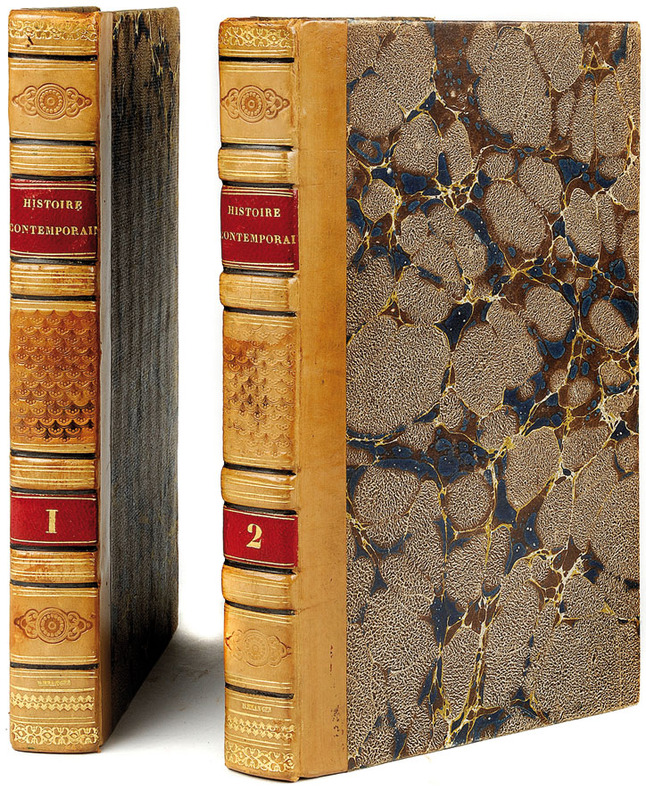
182517472Paris, Vernarel et Tenon (imp. de Lebel), 1825 ; 2 tomes in-8, demi veau blond glacé, dos à quatre nerfs plats encadrant les pièces rouges de titre et de tomaison, dos décoré de roulettes dorées et fleurons à froid, tranches marbrées (Beranger) ; XVI, 433, (2) pp. ; XXVII, 363 pp.