17 864 résultats
In 8° (16,8x12,5 cm); due opere in un volume: (2), 231, (1 b.), V, (1) pp. e (2), 167, (1 b.), III, (1 b.) pp. Legatura coeva in mezza pelle rossa con titolo, iniziali dell’autore, data e filetti in oro ai tasselli ed ai filetti. Dorso a 4 nervi. Iniziali dell’autore in oro anche al piatto anteriore. Qualche leggerissima e rara fioritura, alcune rare note a matita e nel complesso esemplare, in buone-ottime condizioni di conservazione. Seconda edizione della prima opera e prima edizione della seconda opera. Celebre e rara raccolta di poesie del Granduca di Russia, Konstantin Konstantinovic Romanov (Strel'na, 22 agosto 1858 – Pavlovsk, 15 giugno 1915). Nipote dell’Imperatore Nicola I di Russia fu un poeta e drammaturgo di motevole importanza. Quarto figlio del granduca Konstantin Nikolaevic di Russia e della moglie, la principessa Alessandra di Sassonia-Altenburg, Konstantin Romanov nacque nel palazzo di Costantino a Strelna. Nonostante che fin dalla giovanissima età dimostrasse grande predisposizione per la letteratura e assai minor interesse per la corriera militare, venne, come ogni Romanov, avviato a questa carriera nella Marina Imperiale Russa. Nella Marina non rimase a lungo, insoddisfatto dall’ambiente, passando ben presto nell'elitario reggimento Izmajlovskij della Guardia Imperiale dove, fra l’altro, si distinse, durante il servizio. Omosessuale dichiarato, nonostante questo, considerava di primaria importanza i propri “doveri” verso la famigli imperiale e così sposò, nel 1884, la principessa Elisabetta di Sassonia-Altenburg, sua seconda cugina, la quale, con il matrimonio, divenne la granduchessa Elizaveta Mavrikievna (in famiglia meglio conosciuta come Mavra) e dalla quale ebbe nove figli. Come padre e marito fu devoto e sempre attento alle necessità della moglie e dei figli. Pianista di talento, fu mecenate di numerosi artisti e divenne anche, per meriti, presidente della Società Musicale Russa. Amico di Pëtr Il'ic Cajkovskij, è comunque nella letteratura che diede il meglio. Poliglotta, a lui si devono alcune apprezzate traduzioni in russo di grandi classici tedeschi (Schiller e Goethe in primis) ed inglesi (era particolarmente orgoglioso della sua traduzione dell'Amleto). Esperto drammaturgo e poeta, produsse e diresse diverse rappresentazioni teatrali da lui scritte (ed almeno in un caso, vi prese parte anche come attore). Konstantin, insieme alla sua famiglia, fu tra i pochi membri della famiglia reale ad essere sempre accolti con piacere a corte da Alessandro III e dalla zarina Alessandra Feodorovna prima, poi da Nicola II che vedevano nella sua slavofilia artistica e nella sua devozione al dovere, un ottimo esempio, da contrapporre allo stile di vita mondano e frivolo di molti altri granduchi. Proprio per il suo carattere aperto e gioviale, fu uno dei più intimi amici della sorella della zarina, Elizaveta Fëdorovna moglie Sergej Aleksandrovic (fu uno dei pochi membri della famiglia reale ad esser presente al funerali di questi quando il Granduca venne ucciso con un attacco dinamitardo). Se pubblicamente la sua vita era caratterizzata da morigeratezza ed equilibrio, nel privato fu confusionaria e piena di contrasti. Anche la sua omosessualità non venne conosciuta in vita, ma divenne pubblica solo dopo la sua morte quando i suoi diari, videro la luce. Questi scritti schietti e diretti dimostrarono tutta la sensibilità e l’amore del Granduca per sua moglie e la sua famiglia ma anche i suoi sensi di colpa per i tradimenti con altri uomini ai quali non seppe resistere. Nei suoi diari Konstantin Romanov affermò che tra il 1893 ed 1899 egli si astenne dalla pratica di quello che egli definiva come il suo "peccato principale"; però, dopo la nascita del settimo figlio, Konstantin divenne un assiduo frequentatore dei numerosi bordelli maschili di San Pietroburgo. Nel 1904 egli scrisse nel suo diario che «ordinai al mio cocchiere [...] di andare, e continuai a piedi fin dopo la bath-house. Avevo intenzione di proseguire dritto [...] ma prima ancora di raggiungere il ponte Pevceskij, mi girai ed entrai. E così mi ero arreso ancora una volta, senza lottare poi molto contro le mie inclinazioni depravate». Il ciclo di resistenze e capitolazioni alle tentazioni è un tema molto frequente delle pagine di diario di Konstantin Romanov. Strinse diverse lunghe relazioni con uomini ma negli ultimi anni della sua vita, Konstantin scrisse nei suoi diari che la sua omosessualità, diventava sempre meno pressante, sia perché egli aveva raggiunto una propria pace interiore, sia a causa dell'età avanzata e della cattiva salute. Allo scoppio della Prima Guerra Mondiale, la coppia Granducale con l’intero entuorage, fu colta di sorpresa in territorio tedesco mentre era in vacanza. Fatta prigioniera come ostaggio, venne poi liberata su intervento diretto del Kaiser che permise alla famiglia di ritornare in Russia. Accompagnati al fronte, dovettero affrontare a piedi il passaggio dalle linee tedesche a quelle russe, cosa che segno profondamente la salute, già precaria del Granduca. La morte di uno dei figli in guerra segnò di nuovo Konstantin portandolo ad un tale livello di prostrazione che la morte lo colse il 15 giugno del 1915. La morte gli risparmiò di assistere allo sterminio di buona parte della sua famiglia dopo la fine dello Zar e della sua famiglia. Sopravvissero alla “Rivoluzione” solo la moglie e tre dei suoi figli (uno salvato per intercessione di Maksim Gor'kij che aveva cercato di salvare tutti i Romanov). L’opera qui presentata raccoglie i componimenti poetici scritti dal Granduca tra gli anni 1879 e 1888. I suoi componimenti, seppur anonimi, incontrarono il favore della critica, tanto che furono numeorsi gli articoli a lui dedicati su riviste specializzate e altrettanti furono i commenti entusiasti di numerosi celebri poeti russi che li lessero senza sapere chi ne fosse l’autore. Per ragioni legate alla sua posizione nella famiglia imperiale, Konstantin non firmò l’opera se non con le iniziali, anche se verso la fine della sua vita, l’attribuzione divenne pubblica, tanto che moltissime sue opere furono distrutti durante la “Rivoluzione” rendendole rare, quando non rarissime, specialmente quelle stampate prima del 1900 quando ancora, il Granduca, stampava le sue opere, anonime, in poche copie. Si sa ad esempio che la prima edizione dei suoi componimenti (qui presenti in seconda edizione), edita nel 1886, venne stampata in meno di mille copie, non per la vendita, ma regalate direttamente dal Granduca a personalità ed amici a lui vicini. Allo stesso modo si comportò il Granduca per la stampa della seconda parte dei suoi componimenti nel 1889. Stampò, sempre in circa 1000 copie, la seconda raccolta dei suoi componimenti e decise di ristampare alcune copie, in seconda edizione, della prima raccolta da donare a personalità ed artisti che non conosceva ancora, al momento della stampa della prima edizione. Probabilmente Konstantin curò anche la legatura dei volumi, cosa che spiegherebbe la curiosa presenza delle sue iniziali al piatto anteriore del volume che noi presentiamo. Una terza raccolta poetica che raccoglieva i componimenti scritti tra il 1889 ed il 1899 venne pubblicata nel 1901. Rarità bibliografica.
1771647971771. Amsterdam 1771. 2nd Dutch ed. Amsterdam 1771. 2nd Dutch ed. Early Amsterdam Edition of Catherine's Nakaz Catherine II 1762-1796 Empress of Russia. Instruction de Sa Majeste Imperiale Catherine II. Pour la Commission Chargee de Dresser le Projet d'un Nouveau Code de Loix. Amsterdam: Chez Marc Michel Rey 1771. vii 229 pp. Frontispiece engraved copperplate medallion portrait of Catherine II by C.A. Boily. Octavo 7-3/4" x 4-3/4"; 19.68 x 12.06 cm. Contemporary mottled calf blind rules to boards gilt spine with lettering piece edges rouged marbled endpapers. A few minor scuffs to boards moderate rubbing to extremities spine ends worn front joint starting at ends corners bumped and somewhat worn. Light toning to text dampstaining and light foxing to a few leaves internally clean. An attractive copy. $1250. Second Dutch edition. This important text also known as the Nakaz or Instruction is a statement of legal principles written by Catherine II from 1764 and 1766. Permeated with the ideas of the French Enlightenment and copied mostly from the work of Voltaire Montesquieu and Beccaria it was compiled as a guide for the All-Russia Legislative Commission convened by the Empress in 1767 to create a new code to replace the 1649 Muscovite Code. Revised in consultation with Beccaria Frederick the Great and Voltaire the Nakaz proclaimed the equality of all men before the law and disapproved of death penalty and torture. Unfortunately her proposed code was never completed. Catherine's manuscript was written in French and she later produced a Russian translation. Editions in German and Russian were published in Moscow in 1767. Several editions followed in nations ranging from Italy to Latvia. The first Dutch edition in Dutch translation was published in Amsterdam in 1769. The 1771 Amsterdam edition was the first Dutch edition in French. This is a scarce imprint. OCLC locates 2 copies in North American law libraries Library of Congress UC-Berkeley. Butler and Tomsinov Eds. The Nakaz of Catherine the Great 528 entry 28. unknown
1771648601771. Amsterdam: Chez Marc Michel Rey 1771. Amsterdam: Chez Marc Michel Rey 1771. Attractive Early Amsterdam Edition of Catherine's Nakaz Catherine II 1762-1796 Empress of Russia. Instruction de Sa Majeste Imperiale Catherine II. Pour la Commission Chargee de Dresser le Projet d'un Nouveau Code de Loix. Amsterdam: Chez Marc Michel Rey 1771. vii 229 pp. Copperplate portrait frontispiece. Octavo 7-3/4" x 4-3/4". Later patterned-paper covered boards calf lettering piece to spine patterned endpapers. Minor wear to spine ends and corners front joint starting at ends. Negligible light toning to text dampstaining to bottom and fore-edges of text block very faint in most places in preliminaries somewhat darker. A nice copy. $1250. Second Dutch edition. This important text also known as the Nakaz or Instruction is a statement of legal principles written by Catherine II from 1764 and 1766. Permeated with the ideas of the French Enlightenment and copied mostly from the work of Voltaire Montesquieu and Beccaria it was compiled as a guide for the All-Russia Legislative Commission convened by the Empress in 1767 to create a new code to replace the 1649 Muscovite Code. Revised in consultation with Beccaria Frederick the Great and Voltaire the Nakaz proclaimed the equality of all men before the law and disapproved of the death penalty and torture. Unfortunately her proposed code was never completed. Catherine's manuscript was written in French and she later produced a Russian translation. Editions in German and Russian were published in Moscow in 1767. Several editions followed in nations ranging from Italy to Latvia. The first Dutch edition in Dutch translation was published in Amsterdam in 1769. The 1771 Amsterdam edition was the first Dutch edition in French. It is a scarce imprint. OCLC locates 2 copies in North American law libraries Library of Congress UC-Berkeley. Butler The Nakaz of Catherine the Great 528 entry 28. unknown
1907653411907. The First Edition of the Nakaz Published in the Twentieth Century Catherine II 1762-1796 Empress of Russia. Chechulin Nikolai Dmitrevich 1863-1927 Editor. Nakaz Imperatritsy Ekateriny II Dannyi Kommissii o Sochinenii Proekta Novago Ulozheniia. St. Petersburg: Izd. Iurid. Knizhnago Sklada "Pravo" 1907. ii cliv 174 pp. Three folding plates of facsimile manuscript leaves. Text of Nakaz in Russian with parallel French translation. Contemporary pebbled cloth light rubbing to extremities with minor wear to spine ends and corners which are bumped. Light toning to text a few leaves have carefully repaired tears. Early inscription and owner inkstamp to title page interior otherwise clean. $1250. The first edition published in the twentieth century. Title two in the series Pamiatniki Russkago Zakonodatel'stva 1649-1832. The Nakaz or Instruction is a statement of legal principles written by Catherine II between 1764 and 1766. It was among her most ambitious and significant undertakings. Infused with the ideas of the French Enlightenment and copied mostly from the work of Voltaire Montesquieu and Beccaria it was compiled as a guide for the All- Russia Legislative Commission convened by the Empress in 1767 to create a new code to replace the 1649 Muscovite Code. Revised in consultation with Frederick the Great and Voltaire the Instruction proclaimed the equality of all men before the law and denounced torture and the death penalty. Unfortunately her proposed code was never completed. The first two editions one with parallel texts in Russian and German were published in 1767. Our 1907 edition may have been inspired by a spirit of reform fired by the Russian Revolution of 1905. OCLC locates 1 copy in a North American law library Columbia. Another copy located at Harvard Law School. Butler The Nakaz of Catherine the Great 526 Entry 19. unknown
1907653411907. The First Edition of the Nakaz Published in the Twentieth Century Catherine II 1762-1796 Empress of Russia. Chechulin Nikolai Dmitrevich 1863-1927 Editor. Nakaz Imperatritsy Ekateriny II Dannyi Kommissii o Sochinenii Proekta Novago Ulozheniia. St. Petersburg: Izd. Iurid. Knizhnago Sklada "Pravo" 1907. ii cliv 174 pp. Three folding plates of facsimile manuscript leaves. Text of Nakaz in Russian with parallel French translation. Contemporary pebbled cloth light rubbing to extremities with minor wear to spine ends and corners which are bumped. Light toning to text a few leaves have carefully repaired tears. Early inscription and owner inkstamp to title page interior otherwise clean. $1250. The first edition published in the twentieth century. Title two in the series Pamiatniki Russkago Zakonodatel'stva 1649-1832. The Nakaz or Instruction is a statement of legal principles written by Catherine II between 1764 and 1766. It was among her most ambitious and significant undertakings. Infused with the ideas of the French Enlightenment and copied mostly from the work of Voltaire Montesquieu and Beccaria it was compiled as a guide for the All- Russia Legislative Commission convened by the Empress in 1767 to create a new code to replace the 1649 Muscovite Code. Revised in consultation with Frederick the Great and Voltaire the Instruction proclaimed the equality of all men before the law and denounced torture and the death penalty. Unfortunately her proposed code was never completed. The first two editions one with parallel texts in Russian and German were published in 1767. Our 1907 edition may have been inspired by a spirit of reform fired by the Russian Revolution of 1905. OCLC locates 1 copy in a North American law library Columbia. Another copy located at Harvard Law School. Butler The Nakaz of Catherine the Great 526 Entry 19. unknown books
1771648601771. Early Amsterdam Edition of Catherine's Nakaz Catherine II 1762-1796 Empress of Russia. Instruction de Sa Majeste Imperiale Catherine II. Pour la Commission Chargee de Dresser le Projet d'un Nouveau Code de Loix. Amsterdam: Chez Marc Michel Rey 1771. vii 229 pp. Copperplate portrait frontispiece. Octavo 7-3/4" x 4-3/4". Later patterned-paper covered boards calf lettering piece to spine patterned endpapers. Minor wear to spine ends and corners front joint starting at ends. Negligible light toning to text dampstaining to bottom and fore-edges of text block very faint in most places in preliminaries somewhat darker. A nice copy. $1250. Second Dutch edition. This important text also known as the Nakaz or Instruction is a statement of legal principles written by Catherine II from 1764 and 1766. Permeated with the ideas of the French Enlightenment and copied mostly from the work of Voltaire Montesquieu and Beccaria it was compiled as a guide for the All-Russia Legislative Commission convened by the Empress in 1767 to create a new code to replace the 1649 Muscovite Code. Revised in consultation with Beccaria Frederick the Great and Voltaire the Instruction proclaimed the equality of all men before the law and disapproved of death penalty and torture. Unfortunately her proposed code was never completed. Catherine's manuscript was written in French and she later produced a Russian translation. Editions in German and Russian were published in Moscow in 1767. Several editions followed in nations ranging from Italy to Latvia. The first Dutch edition in Dutch translation was published in Amsterdam in 1769. The 1771 Amsterdam edition was the first Dutch edition in French. It is a scarce imprint. OCLC locates 2 copies in North American law libraries Library of Congress UC-Berkeley. Butler The Nakaz of Catherine the Great 528 entry 28. unknown books
1929505546Paris: Editions J. Oliven 1929. Book. Good / État Satisfaisant. Soft cover. Signed and inscribed by the Author. Inscribed to previous owner and signed in English by the Grand Duke Alexander of Russia. Text in French. A good copy. . Editions J. Oliven Paperback
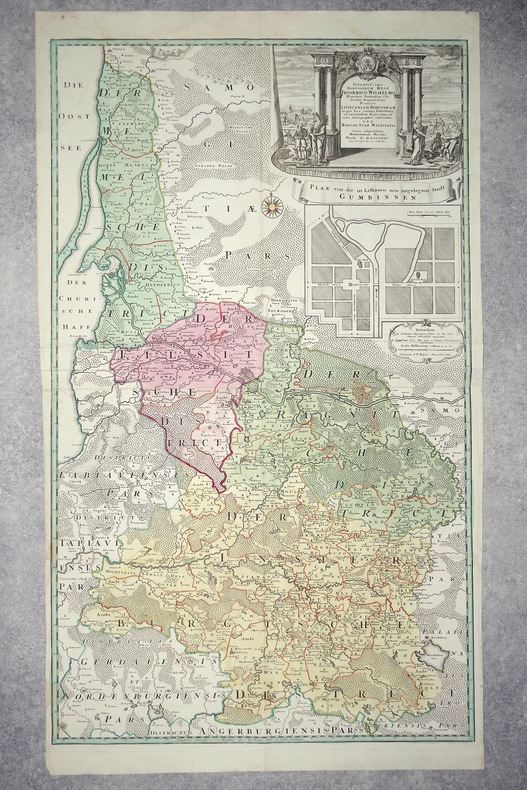
17352334NORIMB. (NUREMBERG). HOMMANIANI HEREDES (LES HERITIERS D'HOMANN). 1735. GRANDE ET BELLE CARTE GEOGRAPHIQUE TRES DETAILLEE (96,5 X 58,5 CENTIMETRES ENVIRON, 104 X 61 AVEC LES MARGES) D'UNE REGION DE LA LITUANIE ET DE LA PRUSSE ORIENTALE, COLORIEE A LA MAIN D'EPOQUE, CARTOUCHE DONNANT LE TITRE DE LA CARTE, S'ETENDANT DE KLAIPEDA (MEMEL) DANS LE NORD A GOLDAP DANS LE SUD, TILSIT ET GUMBINNEN. AVEC UN PLAN DE LA VILLE DE GUMBINNEN, AUJOURD'HUI GUSEV, CONSTRUITE PAR FREDERIC-GUILLAUME 1° DE PRUSSE, APRES LES RAVAGES DE LA PESTE EN 1711. BEL ETAT.
18036307CBLondon, Printed for W. Miller, 1803. (9), 73 Bl. Mit 72 (von 73) kol. Kupfertafeln (Punktiermanier) nach Johann Gottlieb Georgi. Halblederband der Zeit. + Wichtig: Für unsere Kunden in der EU erfolgt der Versand alle 14 Tage verzollt ab Deutschland / Postbank-Konto in Deutschland vorhanden +, bild
242326Paris, Ambroise Dupont et Cie, 1828 in-8, [4]-270 pp., demi-chagrin rouge, dos à nerfs, couv. cons. (reliure moderne).
214189Paris, Rey et Gravier, 1820 3 vol. in-8, VI-355, [4]-387 et [4]-347 pp., avec 12 pl., dont 5 cartes ou plans et 5 vues à l'aquatinte, bradel papier vert, dos orné, dentelle dorée encadrant les plats (reliure de l'époque). Usure des coins, rousseurs. Manque de papier sur les mors grossièrement reteinté. Dos passé. Ex-libris Comte de La Ferronays, Trie-Château.
17386066]. Mit gest. Frontispiz. Frankfurt u. Leipzig, J. L. Montag, Buchhändler in Regensburg, 1738. 8vo. (16,3 x 10,0 cm). 69 Bl., 816 S., 64 Bl. Register. Halbpergamentband d. Zt. mit Rückenschild u. Sprenkelpapierbezug.
In-4°, in brossura editoriale originale con titolo stampato, e invio autografo dell’autore a Mr le docteur Vacca. pp. 40. Inoltre: Prix Lobatchefsky (3° concorso), pp. (4), con autografo dell’autore”Forse a rivederci caro amico a Heidelberg”. E un opuscolo stampato in russo di geometria (pp. 6); e di Vassilief: Les Idees d’Auguste Comte sur la philosophie des mathematiques, estratto, pp. (16), con legatura in cartoncino azzurro. Vassilief (1855-1929) fu uno dei primi esponenti della scuola matematica russa, e presidente della Società di Fisica e MAtematica di Kazan. matematica mathematics fisica physics geometria scienza science russia vacca autografo russo
1692PHO-709Paris, Claude Barbin, Jean Boudot, Georges & Louis Josse, 1692. In-4, plein veau époque, Édition originale, illustrée d'un portrait-frontispice, une carte dépliante de la Sibérie et Kitay, 6 vignettes et 2 planches hors texte gravées en taille-douce par Vallet figurant des traîneaux et des esquifs cosaques , un portrait du dédicataire le général polonais Stanisaw Jan Jablonowski (1634-1702) gravé par Étienne Picart, dit Le Romain (le père du célèbre graveur Bernard Picart). Reliure usagée( à refaire) , plusieurs pages détachées ,mouillures en début d’ouvrage, manque la table des matières et le titre.
202215Paris, Champion, 1907 gr. in-8 carré, XX-256 pp., nbses ill. in-t., demi-chagrin vert, dos à nerfs, couv. cons. (reliure moderne). Bon exemplaire.
18594901London, Trübner & Co., 1859. In-8 de XVI-352 pp., veau glacé, dos lisse orné, pièce de titre en veau blond, fleuron doré sur les plats (reliure de l'époque).
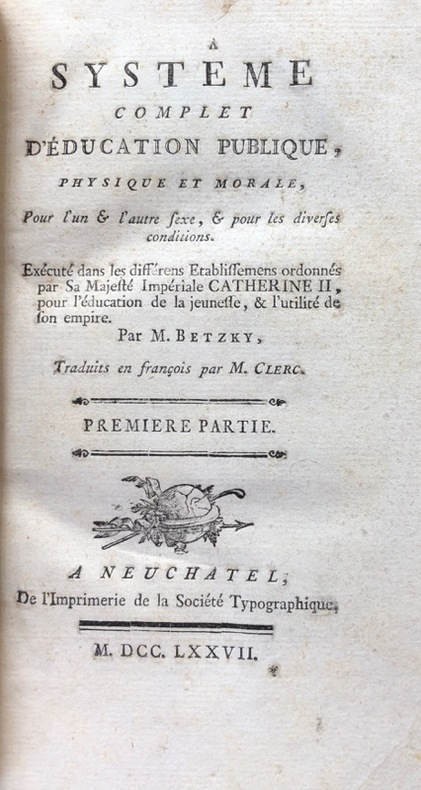
1777668A Neuchatel, de l'Imprimerie de la Société Typographique, 1777. 2 parties en 1 vol. in-8 de (2)-286 pp. ; (2)-330 pp., demi-basane havane à petits coins, dos à nerfs, pièce de titre en maroquin rouge (reliure de l'époque).
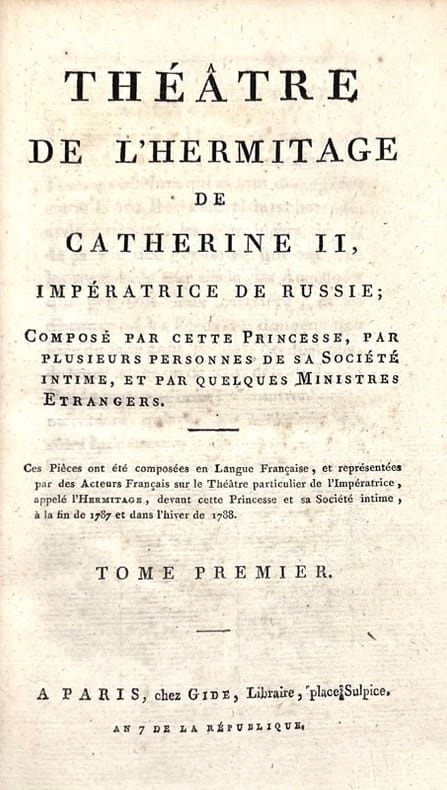
179843395A Paris, chez Gide, 1798-1799, an VII. 2 vol. in-8 de (4)-438 pp. ; (4)-432 pp., demi-basane blonde, dos lisses ornés de filets dorés (reliure de l'époque).
184346400983Paris, Amyot, 1843 ; 4 volumes in-12°, demi chagrin rouge, filets dorés, tranches jaspées. Reliure de l'époque. - PREMIERE EDITION IN-12°, en partie originale, parue la même année que la première édition publiée par le même éditeur en format in-8°. Le chef-d'œuvre du Marquis de Custine. Entrepris pour plaider personnellement la cause de son ami Ignace Gurowski, ce voyage en Russie sera une révélation. Le livre de Custine, ouvrage tout de circonstance, bien fait pour ne pas survivre à ce qu'il peint, après plus d'un siècle nous surprend et nous fascine parce qu'il a de prémonitoire. L'aristocrate dans l'âme qu'est Custine devient une sorte de révolutionnaire "" face à la servitude et plus encore à l'effrayant silence où tout un peuple est muré "". "" Le despotisme n'est jamais si redoutable que lorsqu'il prétend faire du bien, car alors il croit excuser ses actes les plus révoltants par ses intentions ! "". Les dures réflexions de Custine sur le gouvernement des tsars, jalonnent l'ouvrage en un crescendo de plus en plus vigoureux. Ce qui frappe le plus dans "" l'âme russe "" c'est cette acceptation de la servitude. Il parle de mystique et de volupté de la servitude. Custine justifie et annonce la révolution russe : "" nos petits enfants ne verront peut-être pas l'explosion que nous ne pouvons cependant présager dès aujourd'hui comme inévitable "". La conclusion du volume parait écrite aujourd'hui par un figarotier ; "" Quand votre fils sera mécontent en France, usez de ma recette, dites lui : Allez en Russie "". C'est un voyage utile... quiconque aura bien vu ce pays se trouvera content de vitre partout ailleurs ! "". Le livre connut un grand succès en France et fut interdit en Russie. Balzac qui passait la fin de l'été 1843 à Saint Petersbourg, chez Madame Hanska, le lit en cachette et le blâme ouvertement. Il est tellement lâche qu'il supprimera la dédicace à Custine qu'il comptait mettre en tête du Colonel Chabert. Le bruit a même couru que Balzac a été sollicité d'écrire une réfutation de la Russie en 1839 et qu'on lui a offert beaucoup de roubles. - Peu à peu on oublia ce livre. En 1930 on publie à Moscou une nouvelle traduction du livre qui condamne le gouvernement des tsars. En 1946 l'U.R.S.S parait constituer pour l'Europe une menace semblable à celle de la Russie de 1839 et l'on imprime à Paris des extraits du voyage. Après la France, l'Amérique s'intéresse à lui. On le relit, on en parle. Diplomates, journaliste et hommes politiques de tous bords, s'en font à peu de frais un allié. Quelques rousseurs"
662391Paris, Eymery, Delaunay, 1817-1818 6 vol. in-8, planche dépliante en couleurs (tome 2), demi-veau blond, dos à nerfs, filets dorés et à froid, tête marbrée (reliure vers 1860). Petits frottements à certaines coiffes, petits travaux de vers à qqs dos ou mors. Intérieur frais, excepté au tout début du tome II qui comporte des mouillures.
176713136Desaint Paris 1767 2 vol. 2 vol. in-12 de XXII 430 pp. et 2 ff.n.ch. III 324 pp. 2 ff.n.ch.; veau fauve de l'époque, dos à nerfs orné, pièces de titre et de tomaison, tranches marbrées (petits accrocs sur deux coiffes).
35915Amsterdam, Marc-Michel Rey en 1770. 2 vols.In-12 en reliure d'époque. Volumes faisant partie du Voyage en Sibérie sur Ordre du Roi en 1761 de l'Abbé Jean Chappe d'Auteroche. Texte indépendant et complet. Traduit du russe. Tome I: Ière Partie: Les Moeurs et les Coutumes des Habitants du Kamtchatka, 2ème Partie: La Géographie du Kamtchatka et des Pays circonvoisins. Avec deux cartes détaillées et 7 Figures en taille-douce dont certaines dépliantes. Tome II: 3ème Partie: Les avantages et les désavantages du Kamtchatka , 4ème Partie: La réduction du Kamtchatka par les Russes, les révoltes arrivées en différents temps, et l'état actuel des Forts de la Russie dans ce Pays. ( 2 cartes et figures réunies dans le Tome I.) - 439 et 492 pages -Etat moyen des reliures-
662471A Paris, chez Cuchet, 1788 2 tomes en 1 vol. in-8, XII-293-[2] pp. et VI-259-[1] pp., basane fauve marbrée, dos lisse orné d'encadrement de filets et de frises dorés, fleurons dorés au centre et en écoinçon, chaînette dorée sur les coupes, tranches jaunes (reliure de l'époque). Petits trous de vers sur les mors et qqs épidermures sur les plats. Mouillures claires en tout début d'ouvrage.
1st Yiddish edition. Period boards with original green, red, and white modernist illustrated wrappers mounted front and rear, 12mo, 95 pages. Modernist cover with original typeface initialed in the text in Yiddish Y.T; possibly for Yosef Tchaikov. Includes drawings (not by Tchaikov) and photo plates. In Yiddish. Title translates as In the Heavenly Ocean: With 3 Drawings in the Text and 4 Pictorial Plates. Part of the series, Populer-Visnshaftlekhe Bibliotek; Natur un Kultur: Unter der Redaktsye fun Y. Yashunski, Nr. 3. 1 of 1000 copies printed. Tchaikov is known to have designed other covers for Kultur-Lige publications, often with creative Yiddish typefaces, for example: Di Kupe, by Peretz Markish; Samet, by Lipa Reznik; & Otem, by Ezra Feinenberg (all 1922). Joseph Moisevich Tchaikov (Also spelled, among other spellings, Tshaykov, Chaikov, and Tchaikovsky; 1888 - 1979) was a Russian Imperial and Soviet Russian sculptor, graphic designer and teacher of Ukrainian Jewish descent. Born in Kiev (present-day Kyiv, Ukraine) and initially trained as an engraver, Chaikov studied in Paris in the years 1910 through 1914. In 1912 he co-founded a group of young Jewish artists called Mahmad, and published a Hebrew-language magazine with that name; in 1913 he participated in the Salon d'Automne.He returned to Kiev in 1914. He was co-founder, along with El Lissitzky, Boris Aronson and others, of the Jewish socialist Kultur Lige in Kiev, led sculpture classes there, supervised a children's art studio and illustrated children's books, and in post-revolutionary Kiev focused on billboards and agitational propaganda. In 1921 he published the Yiddish-language book Skulptur, advocating avant-garde sculpture as a contribution to a new Jewish art. This book was also the first book on sculpture to be published in Yiddish.Chaikov moved to Moscow to teach at Vkhutemas from 1923 to 1930, alongside fellow sculptors Boris Korolev and Vera Mukhina. All three designed and taught cubist sculpture in the distinctively Russian Cubo-Futurism style, radically geometric and highly dynamic. From 1929 Chaikov was the head of the Society of Russian Sculptors. In 1932, after the end of the period of artistic freedom, all of these cubists turned back to Socialist Realism and produced more classically styled work.In the 1930s his work was prominently shown at the two Soviet world's fair pavilions, for the 1937 Paris Exposition and the 1939 New York World's Fair .He was named an Honored Artist of the USSR in 1959, and his work is in the permanent collection of MOMA (Wikipedia). For more on Chaikov, see: Apter-Gabriel, Ruth (1987). Tradition and revolution: the Jewish renaissance in Russian avant-garde art, 1912-1928 (Israel Museum); and Futur Antérieur: L'avant-Garde Du Livre Yiddish (1914-1939). Paris: Skira Flammarion: Musée d'art et d'histoire du Judaïsme, 2009.SUBJECT(S): Astronomy -- Popular works. Sciences naturelles -- Ouvrages de vulgarisation. OCLC: 970887673. OCLC lists 3 copies worldwide (YIVO, NYBC, HUC), none at any Ivy League Institution. Includes series title page, which has broken loose, laid in. Paper browning as is common with books of this vintage, a few corner chips, no text or other margins affected. Some staining and toning to cover, which retains its dramatic modernist design. Scarce work with unusual design, possibly by the leading Yiddish modernist. (YID-36-9-E)
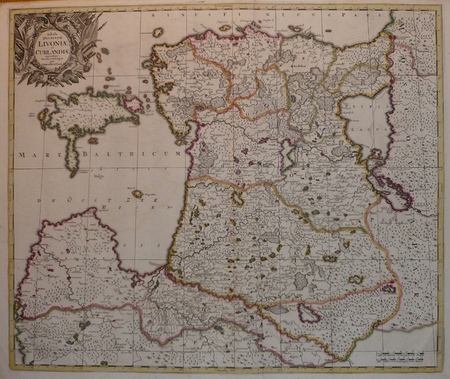
LBW04172Amsterdam, [circa 1700]. 487 x 578 mm.