Poland, MargueriteBiblio.com

4 198 résultats
BAY_24_SH_050016Penguin Global. Used - Good. Binding is unblemished text block is clean boards straight without highlights or markings. Mild rubbing/chipping to dust wrapper edges. Very clean very nice example. Supporting Bay Area Friends of the Library since 2010. Well packaged and promptly shipped. Penguin Global hardcover
20083072jFernwood Press 2008. First Edition. Hardcover. Very Good/No Jacket. 0x0x0. Signed. A special collectors' edition number 27 of 100 copies made signed by the author on the limitation page and bound in beautiful quarter leather. This particular volume was presented to Duggie Jooste. The boards are a touch rubbed but remain otherwise strong and sturdy with raised bands and gold gilt to the front and spine. Internally there are no other markings or inscriptions and the pages within are crisp clean and complete. Securely bound and handsome indeed. JK. Our orders are shipped using tracked courier delivery services. Fernwood Press hardcover
1965143689San Francisco: Sexual Freedom League 1965. Original flyer from an early West Coast event by the Sexual Freedom League taking place on Saturday October 30 1965 at Union Square in San Francisco. <br/><br/>The Sexual Freedom League was founded in New York in 1963 by Jefferson Poland and Leo Koch and advocated for sexual activity and sexual political reform especially the repeal of anti-abortion and censorship laws. Jefferson Poland founded the West Coast branch of the league when he moved to the Bay area in the mid-1960s. <br/><br/>Members of the lewd satirical protest band The Fugs were known to be in attendance at the event and played the Orb Theater the previous evening and a copy of the handbill appears in vocalist Ed Sanders' book "Fug You." <br/><br/>8.5 x 11 inches. Mimeograph duplication. Light toning at the extremities and a small dampstain to one corner Near Fine. Single crease to the center. Sexual Freedom League unknown books
1823elala1279Paris: Chez Raynal Libraire 1823. 1823. 8vo. pp. 2 p.l. 112. 2 lithographed portraits. contemporary quarter calf some foxing. Second Edition. BOUND WITH: LOUIS XVIII King of France 1755-1824. Relation DUn Voyage À Bruxelles Et À Coblentz 1791. 8vo. pp. 2 p.l. 120. some foxing. Paris: Baudouin Frères 1823. First Edition. 1st Edition. Paris: Chez Raynal, Libraire, 1823. unknown
19565Poland's letter to Harington on letterhead of 28 Sloane Gardens S.W. London ; 1 May 1897. Harington's draft letter to the Attorney General from 87 Eaton Terrace S.W. London ; 2 May 1897. The background to the present correspondence is dealt with exhaustively in C. J. W. Allen's 'The Law of Evidence in Victorian England' 1997 and David Bentley's 'English Criminal Justice in the 19th Century' 1998 chapters 17 'The Campaign for a Prisoners' Evidence Act' and 18 'Reform'. ONE: Autograph Letter Signed from Poland 'Harry Bodkin-Poland' to Harington 'His Honour Judge Sir Richard Harington Bart.'. 4pp. 12mo. Bifolium. In good condition lightly aged. He begins by informing Harington that he has sent a letter to The Times but that he fears it is 'too long for this busy time with the newspapers'. He asks him his opinion of 'the calm & sober judgment of Stephen' i.e. Sir Herbert Stephen 1857-1932. The letter continues: 'The Bill will not be in Committee for a week or ten days so you have plenty of time to consider your letter to the A. G. When notice of all the Amendments has been given the Lord Chancellor will no doubt I should think consult the Cabinet as to which if any of them the Government will accept. The L. C. Lord Cross Lord James Sir Matthew Ridley Lord Salisbury & others in Cabinet with actual experience & the A. G. & Solicitor. General. & men like Sir Edmund Clarke & others out of the Cabinet ought to make a good working Bill.' He concludes by stating his point of view: 'The more I think of the subject the more I am convinced that no safeguards can be of any use & that everything must be left as at present to the good sense & judgment of the Court & Counsel.' TWO: Two Autograph documents by Poland headed by him 'Rider A' and 'Rider B' giving his legal opinion for insertion in Item Three below. The first 2pp. 8vo is in poor condition aged and frayed. It begins: 'Poland thinks the instructing Solicitors or Counsel or both on behalf of prisioners is absolutely impracticable. See the Calendars of the Central. Criminal. Court. the London Sessions & of large towns.' The second 1p. 12mo is in fair condition lightly aged. It begins: 'Poland thinks that care must be taken that prisoners should not be able to say that the Prosecutor & his witnesses have sworn so & so &c & the Prisoner and his wife only stated so & so. The affirmation must be like the affirmation of people who object to be sworn.' THREE: Autograph Draft of Letter from Harington to the Attorney General Sir Richard Webster. 9pp. 12mo. With emendations by both Harington and Poland including directions by the latter for the insertion of the two riders Item Two above. Begins: 'I have had a long talk with Poland over the prisoner's evidence bill on the assumption that its principle is taken to be established & is not open to argument. We agree very decidedly that its operation should extend equally to every class of criminal case whether triable on indictment at a General Session of Oyer & Terminer or Quarter Sessions or <> at Police Courts & Petty Sessions'. Harington proceeds to argue his position forcefully and in great detail. At one point Poland writes: 'Poland cannot go so far as this & the danger of injustice already exists from incompetent judges Chairmen of Q. S. & Recorders & magistrates'. From the papers of Sir Richard Harington 1835-1911 of Ridlington 11th Baronet. Poland's letter to Harington on letterhead of 28 Sloane Gardens, S.W. [ London ]; 1 May 1897. Harington's draft letter to the At unknown
8vo., First Edition, with plates and maps; blue cloth, gilt back, a near fine copy in unclipped dustwrapper. A PRESENTATION COPY FROM THE AUTHOR WITH HIS SIGNED HOLOGRAPH INSCRIPTION ON TITLE. Scarce and important contribution by an eminent Polish author to the (largely unwritten) history of SOE in Poland, with a foreword by the organisation's wartime head. PRESENTATION COPIES ARE EXTREMELY SCARCE. Enser, p.342.
Birobidzhan-Shtot [USSR], The Committee, 1974. Newspaper, Elephant Folio, 4 pages each issue. "Organ fonem Gegntlekhn Komitet fun der Komunistisher Partay fun Sovetntnforbond un fonem Gegentlekhn Sovet fun Deputatn fun di Arbetndike fun der Yidisher Avtonomer Gegnt. " Yiddish daily established in 1930 in the Jewish Autonomous region of the USSR. "Stalin's suppression of Yiddish culture in 1948-1952, however, stopped the production of Yiddish periodical literature [in the USSR] except in the Jewish Autonomous Region (Birobidzhan) , where the newspaper Birobidzhaner shtern (Birobidzhan Star) , which had begun publication in 1930, was able to continue" (Yivo, "Yiddish Newspapers and Periodicals, N. D. ) . No Copies listed on OCLC, and only 1 holding (Columbia) with microfilm (Y-35)
Varshe [Warsaw]: Farlag "di Velt", 1928. Paper Wrappers, 8vo, 95 pages. Monthly Bundist periodical ran from Vol. I, Nr, 1 (Oct. 1927) to 1932. 23 cm. In Yiddish. Unobtrusive Bund rubber stamp on some volumes. For example, Levin (1977) reports that it was in UNZER TSAYT that the very first reports of the Bund's split over the National Question with the Russian Social Democrats were published (in 1927). The Bund in Poland, here providing its unique Polish Jewish Socialist anti-Zionist perspective. The General Jewish Labour Bund in Lithuania, Poland and Russia (Yiddish: algemeyner yidisher arbeter-bund in lite, poyln un rusland), generally called The Bund or the Jewish Labour Bund, was a secular Jewish socialist party.... founded in Vilnius on October 7, 1897 ..In 1917 the Polish part of the Bund, which dated to the times when Poland was a Russian territory, seceded from the Russian Bund and created a new Polish General Labor Bund which continued to operate in Poland in the years between the two world wars .The Bund sought to unite all Jewish workers in the Russian Empire into a united socialist party, and also to ally itself with the wider Russian social democratic movement to achieve a democratic and socialist Russia. The Russian Empire then included Lithuania, Latvia, Belarus, Ukraine and most of present-day Poland, areas where the majority of the world's Jews then lived. They hoped to see the Jews achieve a legal minority status in Russia. Of all Jewish political parties of the time, the Bund was the most progressive regarding gender equality, with women making up more than one-third of all members. The Bund actively campaigned against anti-Semitism. It defended Jewish civil and cultural rights and rejected assimilation. However, the close promotion of Jewish sectional interests and support for the concept of Jewish national unity (klal yisrael) was prevented by the socialist universalism of the Bund. The Bund avoided any automatic solidarity with Jews of the middle and upper classes and generally rejected political cooperation with Jewish groups that held religious, Zionist or conservative views. Even the anthem of the Bund, known as "the oath" (di shvue in Yiddish), written in 1902 by Sh. An-ski, contained no explicit reference to Jews or Jewish suffering. At the heart of the vision of the future of the Bund was the idea that there is no contradiction between the national aspect on the one hand and the socialist aspect on the other. As a strictly secular organization, the Bund renounced the Holy Land and the sacred language (Hebrew) and chose to speak Yiddish .In its early years the Bund had remarkable success, gaining an estimated 30,000 members in 1903 and an estimated 40,000 supporters in 1906, making it the largest socialist group in the Russian Empire . the Bund was a founding collective member at the RSDLP's first congress in Minsk in March 1898. For the next 5 years, the Bund was recognized as the sole representative of the Jewish workers in the RSDLP, although many Russian socialists of Jewish descent, especially outside of the Pale of Settlement, joined the RSDLP directly .The Bund generally sided with the party's Menshevik faction led by Julius Martov and against the Bolshevik faction led by Vladimir Lenin during the factional struggles in the run-up to the Russian Revolution of 1917 .In the Polish areas of the [Russian] empire, the Bund was a leading force in the 1905 revolution. At that time the organization probably reached the height of its influence. It called for an improvement in living standards, a more democratic political system and the introduction of equal rights for Jews. At least in the early stages of the first Russian Revolution, the armed groups of the "Bund" were likely the strongest revolutionary force in Western Russia. During the following years, the Bund went into a period of decay .The Bund eventually came to strongly oppose Zionism, arguing that emigration to Palestine was a form of escapism. The Bund did not advocate separatism. Instead, it focused on culture, rather than a state or a place, as the glue of Jewish nationalism. . The Bund also promoted the use of Yiddish as a Jewish national language and to some extent opposed the Zionist project of reviving Hebrew. The Bund won converts mainly among Jewish artisans and workers, but also among the growing Jewish intelligentsia. It led a trade union movement of its own. It joined with the Poalei Zion (Labour Zionists) and other groups to form self-defense organisations to protect Jewish communities against pogroms and government troops. During the Russian Revolution of 1905 the Bund headed the revolutionary movement in the Jewish towns, particularly in Belarus and Ukraine ..In 1921, the Communist Bund [in the USSR] dissolved itself and its members sought admission to the Communist Party....Many former Bundists, like Mikhail Liber and David Petrovsky, perished during Stalin's purges in the 1930s. The Polish Bundists continued their activities until 1948. During the latter half of the 20th century the Bundist legacy was represented through the International Jewish Labor Bund, a federation of local Bundist groups around the world .Among the exiled Bundists who went on with Socialist politics in America was Baruch Charney Vladeck (18861938), elected to the New York Board of Aldermen as a Socialist in 1917 [and] 1937 [and] manager of The Jewish Daily Forward Moishe Lewis (18881950)....the father of David Lewis (19091981), a leader of the New Democratic Party in Canada .David Dubinsky (18921982), though never formally a member of the party, had joined the bakers' union, which was controlled by the Bund, and was elected assistant secretary within the union by 1906 ..He later became a member of the Socialist Party of America, helped found the American Labor Party in 1936 and was from 1932 till 1966 the leader of the International Ladies' Garment Workers' Union ..under the name Max Goldfarb, David Petrovsky (18861937) was a member of the Central Committee of the Jewish Socialist Federation of America, a member of the Socialist Party of America, and the labor editor of The Forward (Wikipedia). SUBJECT(S) : Jews -- Poland -- Periodicals. Jewish labor unions -- Periodicals. Socialism and Judaism -- Periodicals. Yiddish literature -- Poland -- Periodicals. OCLC Number: 642969688. OCLC lists only 4 runs (Arizona State, Stanford, LOC, U of Washington), all of which appear to be incomplete. Nr. 3-4 was printed as Nr. 3 (Dec. 15, 1927), but then has Nr. 4 (Dec. 20, 1927) on a superimposed lable--not sure if Nr. 3 actually existed or in what form. Interestingly, evey copy of this issue that we have ever seen has had pages 1-6 removed, perhaps by the publisher and related to the re-issuing as a later number. We offer pages 1-6 here in facimile. Good Condition. (Y-1-10) xx
Original Cloth. 8vo. 414 pages. 24 cm. First edition. In Yiddish. The Yeshiva. "The monumental, two-volume novel Tsemakh Atlas (19671968; translated as The Yeshiva) is Grade's richest work about the Musar world and its attempt to shape the ethical personality. Through the memorable character of Tsemakh Atlas, a tortured teacher of Musar who is trapped between its self-abnegating demands, the enticements of the secular world, and his own elemental desires, readers enter a universe of high religious ideals, intellectual and moral debate, and intense spiritual struggle. " - YIVO Encyclopedia. "Grade was one of the rare interpreters of yeshivah life in modern Yiddish literature, recreating the daily life of the yeshivah student with photographic accuracy, objectivity, and affection, and illustrating it with such scenes as rabbis discussing talmudic law, as in the novel Tsemakh Atlas" - EJ 2008. Printed by Shulsinger Bros, New York. Subjects: Yeshiva Yiddish Fiction. Chaim Grade. Light stain and touch of wear to cloth, about Very good condition. (YID-21-50A) xx
In 8, pp. 18. Testo italiano con traduzione francese a fronte (le 2 pp. a fronte presentano lo stesso numero per un totale di 18 cc. a stampa per 36 pp. effettive). Br. rifatta. Pubblicazione del testo e delle osservazioni ad esso in cui si sanci' la partecipazione della Francia, insieme ad altre potenze europee, alla lotta per la successione polacca.
321942 volumes in-8, demi-toile chagrinée noir, titres dorés, (4), 523 p. et (4), 499 p. Paris, Librairie du Luxembourg (impr. de Simon Raçon), 1874.
2 volumes in-8, demi-toile chagrinée noir, titres dorés, (4), 523 p. et (4), 499 p. Rarissime première et unique édition. Historique classé chronologiquement. Important appareil d'appendices au tome II. L'ouvrage a été édité à la librairie polonaise du Luxembourg dirigée par W adys aw Mickiewicz, fils d’Adam Mickiewicz. Historienne, publiciste, philanthrope, née Iwanowska, Dionizja Poniatowska (1816-1868) épousa Dariusz Poniatowski. "Dzielo wyd. anonimowo, autorka Dionizja Poniatowska ustalona na podst. bibliografii i PSB" (Nukat Union Cat. of Polish Res. librs). Reliure amateur. Cachet de bibliothèques. Quelques défauts de papier. Rousseurs éparses.
1715020791La Haye Henri Scheurleer 1715 un volume in-12°, (4) puis 5-156 pp. Reliure de l'époque en basane marbrée, dos à nerfs orné d'une pièce de titre et de caissons à fleuron doré, tranches marbrées. (reliure frottée, manques à la coiffe en pied, aux plats et à un mors, coins très émoussés, pâles rousseurs, cerne claire marginale à quelques feuillets, il manque le faux-titre). Relié à la suite : "ACTES DE CE QUI S'EST PASSÉ DE PLUS REMARQUABLE A LA DIÉTE DE SUÈDE, des années 1755 et 1756; Tirés des Regîstres de cette Diète, & traduits du Duédois : avec Une Relation circonstantiée de la dernière Révolte.", sans lieu, sans nom, 1756, XXIV 132 pp. (il manque le faux-titre); [Charles-Geneviève-Louis-Auguste-André-Timothée d'ÉON de BEAUMONT ]" ESSAI POLITIQUE SUR LA POLOGNE.", Warsovie, Imprimerie de Psombka, 1764, (4) 239 (1) pp.
Honor y deber, o El Fiel Polaco. Relacion historica del alzamiento de Varsovia ocurrido en 29 de noviembre de 1830, y de varios sucesos de la rebelion del reino de Polonia [ Con : ] Causas secretas y anecdotas curiosas concernientes a la Insurreccion de Polonia, sacadas de la Vida del General Diebitz, que acaba de publicarse en Francia, por D. Gregoria Perez de Miranda, 1 vol. in-18 reliure de l'époque demi-basane marron, Imprenta de Jose de Orga, Valencia, 1831, 2 ff., iii-172 pp. et 1 f., 2 ff., vi-95 pp. Rare exemplaire de cette édition espagnole, contemporaine des événements tragiques de Pologne. Etat très satisfaisant (qq. petits frott., bon état par ailleurs). Espagnol
LBW061f6Augsbourg circa 1730 En deux feuilles jointes de 156 x 405 mm.
26066sd,cachet tampon de la collection du poète Guillaume APOLLINAIRE (1880-1918), comportant comme élément principal un serpent tête en bas avec une fleur dans la gueule, entortillé autour d'une flèche, entre ses deux initiales. Ce serpent est la figure héraldique principale du blason de la famille polonaise des KOSTROWITZKY, qui se lit : d'azur au serpent entortillé autour d'une flèche posée en pal et tenant un rameau, le tout d'or.
287701391 Un acte notarié sur parchemin, format : 29 x 32 cm écrit d'un seul côté, manuscrit à l'encre brune en vieux français , daté du 20 Janvier 1583, avec une très belle signature calligraphiée du tabelion COSTES (DE RODEZ) , ACTE NOTARIE SUR PARCHEMIN : DIVISION D'UN PRE A THOLET (GABRIAC - AVEYRON) D'ENTRE ANTOINE RAVIGNAN ET GUILLAUME DE CRUEJOULS (SAINT-CÔME-D'OLT - AVEYRON), (rodez) LE 20 JANVIER 1583
2 volumi in-8° (205x130mm), pp. 282; 276. Bella legatura in mezza pelle con titolo su tassello e fregi in oro. Con 3 tavole illustrative su carta azzurrina f.t. (mappa della Norvegia meridionale, mappa di un canale di navigazione, un apparecchio per congelare il mercurio); Prima edizione. Il Coxe (Londra, 1747-ivi, 1828), valente storico, fu membro di numerose accademie inglesi ed estere e, fra le numerose cariche che ricoprì, cappellano del Duca di Marlborough.
1968UUI-12563In-8 broché, Éditions Pierre Belfond, 1968, 230 pp. Légèrement gauchi, dos ridé et légèrement insolé, intérieur frais. Bon état général, bon exemplaire de l’édition originale, un des 30 numérotés sur vélin de Rives, seul grand papier. Poids 400 g. Envoi lettre verte. Frais d’envoi 6 euros sur la France, 12,90 euros pour l’étranger (tarifs de base hors envois suivis). Possibilité de remise en mains propres sur Paris, possibilité d’envoi MONDIAL RELAY, n'hésitez pas à me contacter avant de passer commande. Twitter : @Pontneuf06.
213137Paris, Berger-Levrault, 1882 2 vol. petit in-8, XIV-543 pp. et 473 pp., 2 cartes et 8 tableaux dépliants, demi-basane aubergine, dos à nerfs ornés de filets à froid (reliure postérieure). 2 cartes sont manquantes. Dos insolé. Qqs annotations au crayon dans les marges.
233335Paris, Berger-Levrault, 1882 2 vol. in-12, XIV-543 pp. et 473 pp., 4 cartes et 8 tableaux dépliants, broché. Qqs rousseurs.
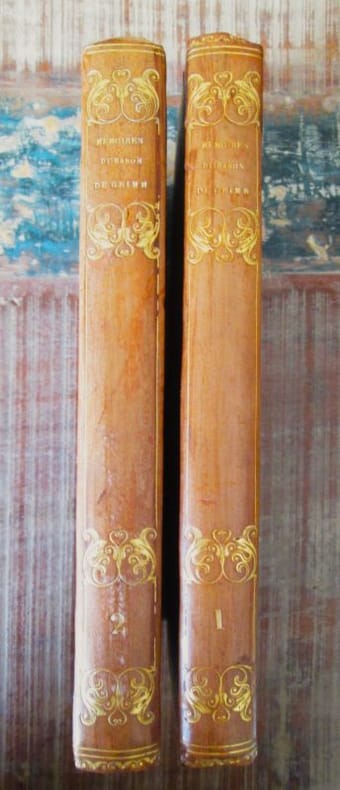
183431988Lerouge-Wolf, Paris 1834. Edition originale. 2 volumes reliés demi-basane fauve (21,7 x 13 cm), 345-428 pages.- Mors ouverts bien que reliures solides, dos ornées du titre et d'arabesques doées, coiffe supérieure manquante (reliure de l'époque)., intérieur frais. Complet en deux volumes, rare.
Acquaforte misure: mm 220 x 167 I Sadeler furono una famiglia di artisti fiamminghi, principalmente incisori di riproduzione, attivi in tutta Europa tra il XVI e il XVII secolo. Lo stile dei membri della famiglia è molto simile e non sempre facilmente distinguibile ma per tre generazioni, spostandosi dall’Olanda all’Italia, fermandosi in Germania e a Praga, questi incisori, editori e commercianti di stampe hanno giocato un ruolo centrale nella diffusione delle immagini. Dal 1572 Jan/Johan lavorò ad Anversa centro mondiale della stampa, e divenne anche un maestro della Corporazione di San Luca. Con suo fratello minore Rafael il Vecchio si trasferì inizialmente a Colonia ma i tumulti della rivolta olandese costrinsero gli artisti di Anversa a spostarsi e così i Sadeler giunsero in Italia nel 1593 in particolare a Venezia dove aprirono una stamperia. Il culto di San Giacinto, santificato da Clemente VIII nel 1594, ebbe larga diffusione tra il XVI e il XVII secolo. Jacko Odrovaz è stato un Predicatore polacco, nato in Slesia nel 1183 e morto a Cracovia nel 1257, dopo l'incontro in Italia con Domenico di Cuzman decise di farsi domenicano ricevendo l'ordine di diffondere l'ordine domenicano in Europa Orientale. Fondò i conventi di Danzica, Cracovia, Friesach e Kiev, favorì l'unione della chiesa d'oriente con quella d'occidente. A Kiev, durante un attacco dei Tartari si dice che gli apparse la Vergine chiedendogli di portare in salvo una sua statua. Questa stampa è tratta da una pala d'altare, oggi al Museo del Louvre (Louvre), commissionata dalla famiglia emiliana Turrini a Ludovico Carracci nel 1594 per la cappella di famiglia in San Domenico a Bologna raffigura esattamente l'apparizione della Vergine. Rispetto al dipinto lo sfondo appare semplificato, tra le rigonfie nubi non ci sono angeli ma teste di cherubini, e la lapide che occupa la parete di sinistra nel dipinto scompare nell'incisione. Tuttavia le parole scritte su di essa ora escono della bocca della Vergine “Gaude fili Iacinte quia oraziones tuae / gratae sunt filio meo, et quidquid ab eo / per me petiris impetrabis“. La Vergine è comodamente seduta su di una nuvola, avvolta nel suo abito panneggiato, il Bambin Gesù a figura stante accanto alla Madre guarda il santo inginocchiato sulla destra il quale, con le braccia in segno di devozione, ascolta e osserva le figure divine. L'atmosfera argentea ottenuta grazie all'uso controllato del bulino, zone d'ombra costruite con equidistanti linee parallele, l'impiego di aree non incise in corrispondenza delle superfici del panneggio colpite dalla luce, conferiscono viva solennità alla composizione. Firma in basso a sinistra: “J. Sadeler sculp. Venetiis”. Oltre l'immagine due righe in latino "S.Iacinctus Polonus, S. Dominici socius et discipulus, et ordinis Praedicatorum/primus in septentrione fundator”. Impressione eccellente, fresca e ben contrastata. Ottimo stato di conservazione. Minimi margini oltre la battuta del rame. Filigrana: mezza luna. Bibliografia: Un altro esemplare è conservato presso la Biblioteca Casanatense di Roma.
1967241011967 Paris, Galerie Alice Juillard, Lacourière, 1967, in-folio en feuilles, couverture titrée rempliée, pointe sèche de Louis Marcoussis numérotée, 16 pages.
1st edition. Later boards. 8vo. 153 pages, 25 cm. In Yiddish. Title translates to From My Notebook. Medem (1879-1923) was a Russian Jewish activist and ideologue of the Jewish Labor Bund. The Jewish Labour Bund, founded in 1897 in the Lithuanian Vilnius, was committed to the cultural and national rights of Jews in Eastern Europe. In this regard, Medem dared to oppose the view of Russian Marxists, and even of Lenin. These objectives received support in Central and Western Europe, e.g. from Austromarxists, and especially in several Jewish immigrant workers' clubs in Paris, whose members described themselves as Bundists. One such club, which also saw the education of the workers as its main task was given the name Arbeter-klub afn nomen Vladimir Medem (Workers' Club on behalf of Vladimir Medem). His educational policy ambitions culminated in 1929 in the founding of the Medem Library, which at 30,000 volumes is now the largest Yiddish cultural institution in Europe (Wikipedia, 2019). SUBJECTS: Socialism - Zionism - Nationalism and socialism. OCLC lists 11 copies worldwide (OCLC:144652941). Pages toning, Very good condition. First Edition of an Important Memoir. (YID-33-58-LX-'e)