19 576 résultats
1870R67021Parisiis, apud Victorem Palmé / Vivès 1870-1871 / 1872 6 volumes: xxviii,630 + xxxviii,814 + x,696 + xviii,788 + 526 + 454pp., text printed in 2 columns, 'Editio novissima pluribus mendis expurgata', vols.1-4: cart.cover (spine in leather with gilt title and decorations, 39cm.), vol.5-6: cart.cover (spine in cloth, 28cm.), small stamp, some foxing, nice set, texts in latin, [accedit ejusdem auctoris Brevis expositio litterae Magistri Sententiarum (vol.4 pp.579-788) // MARTINEZ DE RIPALDA Joannis, born in Pamplona in 1594 & died in Madrid on 26 april 1648, cfr. De Backer-Sommervogel V-640-1]
6 volumes: xxviii,630 + xxxviii,814 + x,696 + xviii,788 + 526 + 454pp., text printed in 2 columns, 'Editio novissima pluribus mendis expurgata', vols.1-4: cart.cover (spine in leather with gilt title and decorations, 39cm.), vol.5-6: cart.cover (spine in cloth, 28cm.), small stamp, some foxing, nice set, texts in latin, [accedit ejusdem auctoris Brevis expositio litterae Magistri Sententiarum (vol.4 pp.579-788) // MARTINEZ DE RIPALDA Joannis, born in Pamplona in 1594 & died in Madrid on 26 april 1648, cfr. De Backer-Sommervogel V-640-1]
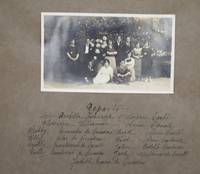
19202465<p>8-1/4 x 11 inches. 60pp recto only. Burgundy cloth photo album with gilt title and ornament stamped to spine brown paper leaves reinforced with cloth at the gutter. 55 b&w photographs 6 cyanotypes 3-1/2 x 5-1/2 inches each; holograph text in verse in Spanish. All but two photos are pasted in one per page; two additional photographs are laid in one a duplicate possibly removed from another album and one on a loose leaf of black construction paper and seemingly unrelated to the text. Light wear to spine ends and corners; front hinge gently split; light dampstaining to edge of front endpaper; text of one page smeared from contact with moisture although there is no damp-staining and the text is still readable.</p><p>An original proto-fotonovella relating in dramatic fashion the tale of four young couples who fall in love despite opposition from their guardians -- who it turns out are themselves a pair of star-crossed lovers who fell in love during an unnamed 19th-century war in the United States presumably the Civil War. Their tales are told through detailed staged photographs of amateur actors paired with occasionally rather clumsy verse.</p><p>The story begins with four sisters -- Betty Jilly Molly and Nelly -- who live with their stern spinster aunt Miss Arabella Arrowrock in a palatial home in New York City. The sisters are romantically involved with four brothers -- Dick Fred John and Jack -- who are under the care of their uncle Florentin Williamson. Although the brothers are supposed to be immersed in their studies they are much more interested in romance and sneak out to meet their beloveds standing on the girls' windowsills to woo them under cover of night. However they are spotted by a maid Judith who immediately reports to Miss Arrowrock that "instead of being asleep each one of the girls is at their window making love with strange men." </p><p>The young women and men get in serious trouble with their respective guardians and Arrowrock and Williamson forbid their charges from seeing their as-yet-unknown lovers again threatening to disown them if they disobey. Arrowrock and Williamson who are friends then meet and resolve to marry of their charges quickly not realizing that they are already intimately acquainted with each other. Neither the sisters nor the brothers know who the others' guardian is and the sisters hatch a plan to scare off their suitors through grotesque makeup and outlandish outfits. The brothers are disgusted but the sisters recognize them at once and all four couples secretly resume their relationships believing they are capable of duping their elders.</p><p>Naturally Arrowrock and Williamson overhear them gloating about their successful charade and are furious. Arrowrock sits on a bench to recover herself and Williamson approaches and recounts the story of how they met in their youth. An extended flashback scene follows set during what this cataloguer presumes is meant to be the American Civil War although that is never explicitly stated. Arrowrock like many daughters of the aristocracy worked as a nurse in a hospital tending to the war wounded and Williamson who was a soldier then was sent to the hospital to recover from being wounded. As Arrowrock nurses Williamson back to health he develops strong romantic feelings for her but never dares to tell her; even on their last night together when they both attend a ball at the close of the war Williamson can't work up the courage to confess his love.</p><p>Back in the present the nieces and nephews have been eavesdropping. They convince Arrowrock and Williamson to marry and let them marry each other since it was they who brought their aunt and uncle back together to make their feelings known. All five couples are then married simultaneously in a mass ceremony and the nieces leave home presumably to live with their new husbands; Arrowrock and Williamson remain in the former's palatial home.</p><p>The story's emphasis on finding true love is strongly reminiscent of the fotonovelas rosas pink photonovels or fotonovelas suaves smooth photonovels that were popular in the Spanish-speaking world in the mid-20th century albeit without some of the tropes of those later creations. Photonovels as we know them today emerged in Italy in the late 1940s and the present album presents as a sort of prototype of the photonovel resembling its content and use of visual narrative. It also has an extremely high production value for being homemade: the night scenes are presented in cyanotypes; indoor scenese that take place at night show electric lights switched on; and their are numerous costume changes and multiple extras.</p><p>A cast photo and list at the beginning reveals that many of the actors were related. That the fact that this album is likely unique or at least one of a very limited quantity and the photo laid in at the rear which seems to be of a real wedding between two older people in 1922 suggests that this may have been a keepsake or even a wedding gift. Moreover the album's final lines read "Y adios amigo lecter: esta historia . que ahora empieza / para ti ya termino." "Farewell dear reader: this story . which has now begun has for you now ended."</p> hardcover
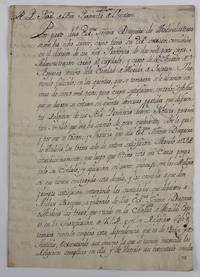
171812727Madrid 1718. 3pp. on a folded folio sheet. Minor toning and creasing. Very good. An interesting pair of communications from Spain to colonial Mexico involving debts owed by local religious orders in the Yucatan and how to enforce collection of said debts. The transcripts of these letters were sent to the Spanish administrator at Yucatan by Father Joseph Sanz the Commissary General for New Spain. Here Sanz instructs the Provincial to identify which orders within the Yucatan owe money payable to the estate of the "Duquesa de Medina las torres" a title within Spanish peerage since 1625. In the second letter which begins on page two Father Sanz orders the local Commissary General to make sure that his orders to the Provincial are duly carried out. An instructive instance documenting the regular practice by Spanish authorities in extracting wealth from local Mexican subjects to send back to the gentry in Spain. unknown
16108272Aranda 1610 Dated July 8 1610. 12 1/8 x 7 7/8 inches. 1pp. Printed paper woodcut seal. Minor creases where folded. Right upper edge a bit rough small split to one crease repaired with acid-free document repair tape small light stain to portion of first two lines but a fine example. As with all other Spanish royal signatures Philip has signed "Yo el Rey" I the King. With the words "El Rey" at the top this document grants permission to the town of Canical to withhold 20000 Maravedis coin of the time from the sum it owes in taxes in order to settle a municipal debt. Includes 18 lines in brown ink in a miniscule script. Next to the King's signature is a mounted printed paper woodcut seal with the emblem of the College of Notaries of Madrid. Countersigned in a bold dark script Jorge de Tovar. At the bottom are three lines by officials of the town of Canical acknowledging the permission granted. Philip III was King of Spain and King of Portugal from 1598 until his death. He inherited essentially a bankrupt nation with a disastrous economy. His father Philip II had drained Spain's resources with her wealth based on the silver mines of Latin America. Spain's internal economy was weak with little industry and a backward agriculture and large estates worked by peasants ruined by excessive taxation. This document is typical of the economic weakness of Spain with the town of Canical requiring monetary help. An attractive official document with bold signatures. unknown books
173936319London: Printed for T. Cooper. 1739. 63 1 blank pp. Bound in modern vellum. Early leaves dusted minor scattered foxing. Else Very Good. <br/><br/> "In Spanish and English and relates principally to affairs in America" Sabin with particular emphasis on Florida. The book charges that the King of England authorized Captains of the ships 'Pompey Galley' and 'Fortune' to cruise the Florida coast and collect loot from ship-wrecks. With a force of 600 men the English overpowered Spaniards who were guarding their own collection of salvaged loot and "did rob about 400000 pesoes without any other pretense but that of their greediness." <br/> The Madrid printing in Spanish issued earlier in 1739.The document sets forth Spanish grievances dating from the early 1700s relating to conflicts in the New World-- from Newfoundland to Florida and the West Indies. The conflicts came to a head in the War of Jenkins' Ear commenced in October 1739. <br/>Sabin 17026. Servies 334. Bartlett John Carter Brown Library 618. ESTC N27944. Printed for T. Cooper... unknown books
1923313637Madrid: E. Gonzalez y Cia Fototipia 1923. Pochoir title page and back wrapper by Larraya plate of posters in full color ornamental dedication leaf 28 illustrations from photographs 1 folding. 15 leaves with text in Spanish and English. 1 vols. Oblong 4to. Cloth spine glazed yellow pictorial boards preserving wrappers. Some minor soiling chips at edges of back wrapper generally fine. Pochoir title page and back wrapper by Larraya plate of posters in full color ornamental dedication leaf 28 illustrations from photographs 1 folding. 15 leaves with text in Spanish and English. 1 vols. Oblong 4to. Sport & Wine in Jerez Spain. "The merchant the sportsman the man of business or the man of leisure will always find a welcome in Jerez." Lavishly produced album of the sherry wine and brandy house of Marqués del Mérito in Jerez documenting in equal parts the wine-making activities of the firm and the sporting traditions of the lands around Jerez de la Frontera including pigsticking in the swamps stag and ibex hunting waterfowling and bird shooting with numerous pictures of the bag of princely hunting parties. Uncommon and striking. E. Gonzalez y Cia, Fototipia unknown books
1790403582Seville: Imprenta Mayor de la cuidad 1790. 4to 302 x 211 mm. 4pp. Unbound folded sheets. Tears to folds. Red cloth slipcase. FIRST EDITION OF THE SEVILLE PRINTING OF THE 1790 ROYAL ACT PROHIBITING THE RUNNING OF THE BULLS: ". considering the bad consequences that it have and will always come from the overindulgence by the King's people when the bulls run . through the streets day and night; and with the receipt of the news by our King of the recent misfortunes from some of these amusements . desiring to cut these pernicious deaths wounds and other excesses . we instruct our Council to take the appropriate measures to contain such damage." The printed provision concludes with a note from Martin Perez referencing the original document located in the Senior Notary office and accompanied by a signature presumably of Perez. Only one copy of this notice has appeared at auction in at least the last fifty years according to the available databases and Worldcat/OCLC list only two copies. <br/><br/> Imprenta Mayor de la cuidad hardcover books
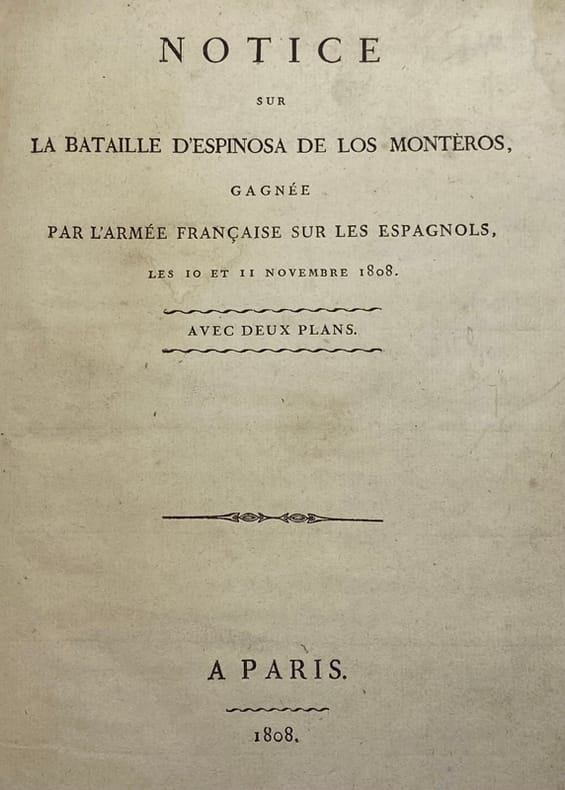
188966À Paris, 1808 in-4, 11 pp., 2 plans dépl., bradel papier vert, pièce de titre en long (rel. moderne). Un plan restauré (bord doublé et manque angulaire comblé).
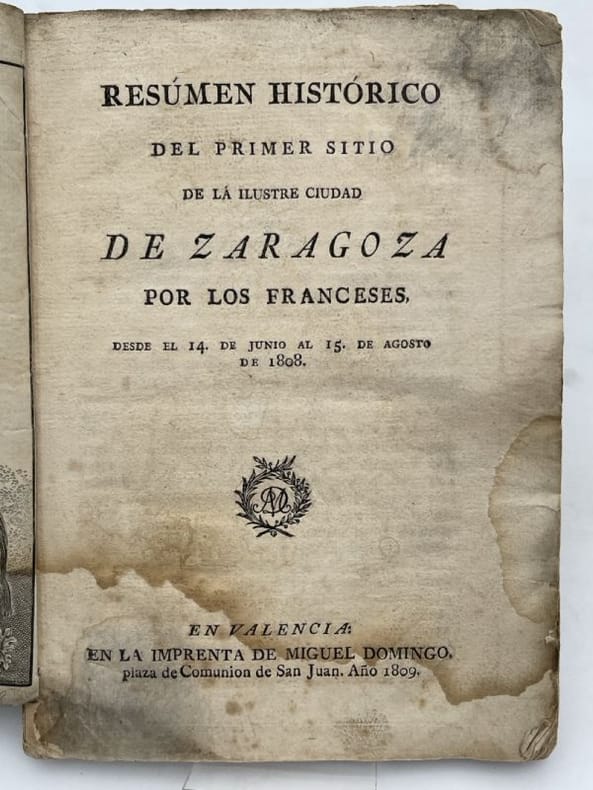
1809190614Miguel Domingo En Valencia, 1809. En la Imprenta de Miguel Domingo, plaza de Comunion de San Juan. In-8 broché (15 x 20 cm) sous couverture d'attente, 24 pages, gravure en frontispice " El Exmo. Sr. Dn. José Revolledo de Palafox y Melci, capitan general del Exrto y Reyno de Aragon (auteur anonyme). Il manque un petit morceau de papier dans la légende de la gravure avec une petite perte de texte, cette gravure étant célèbre nous avons pu reconstituer la petite partie manquante. Notre exemplaire est enrichi de la très rare gravure dépliante "Vista interior de la destruccion de Zaragoza, en el segundo sitio" par J. Antonio Soler et Tomàs Rocafort. Dimensions 20 cm x 29 cm. Cette gravure, de belle qualité, est en état correct elle présente une déchirure sur environ 5 cm mais sans perte de papier. En suivant on trouve le texte "Idea historica de los principales sucesons ocurridos en Zaragoza durante el ultimo sitio. Recopilados por el P. Capellan de Exercito, Dr D. Sebastian Hernandez de Morejon, testigo y casi victima de aquella gloriosa catastrofe. Valencia, en la imprenta de D. Beneito Monfort, 1809. 28 pages. En suivant "Suplemento al papel intitulado idea historica de los principales sucesos ocurridos en Zaragoza durante su ultimo sitio recopilados por el P. Capellan de Exerciton. Dr D. Sebastian Hernandez de Morejon, testigo y casi victima de aquella gloriosa catastrofe" En Valencia por José Ferrer de Orga y compania, 1809. 17 pages. Rarissime ensemble de 3 pièces essentielles sur le siège de Zaragosse, témoignage d'époque de la plus grande importance. Edition originale imprimée pendant le conflit. Très rares sont les exemplaires enrichis de la gravure du siège de Zaragosse. L'ouvrage est affecté de taches d'humidité parfois importantes dont notre prix tient compte. Son exceptionnelle rareté mériterait une soigneuse restauration et la reliure.
222233Lyon, Thomas Amaulry, 1685 petit in-4, [2] ff. n. ch. (titre, préface), 76 pp., demi-chagrin cerise, dos lisse (reliure du XIXe s.).
218738A Dresde, 1753 petit in-12, (2)-173 pp., veau fauve marbré, dos à nerfs orné, tranches rouges (reliure de l'époque). Mors et coins restaurés. Cachet (annulé). Bon exemplaire.
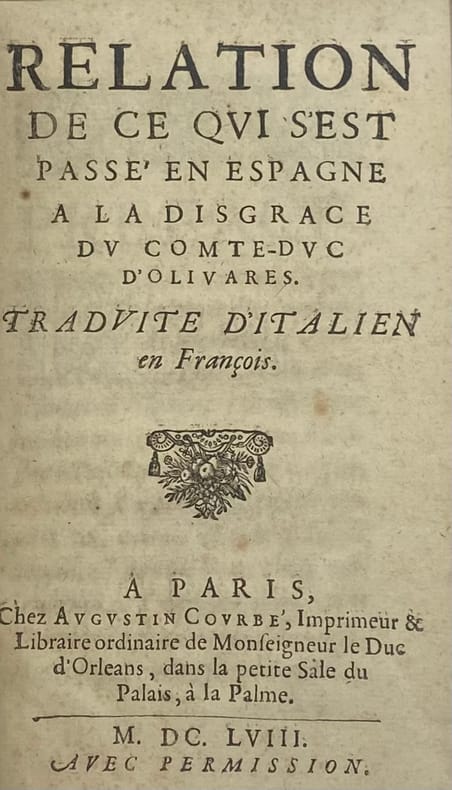
208270Paris, Augustin Courbé, 1658 petit in-8, [8] ff. n. ch. (titre, préface), 128 pp., vélin souple, dos lisse muet (reliure de l'époque). Bon exemplaire.
[Lerida, en casa de Pedro Robles, 1569]. 12vo.; 11 hojas sin numerar, 261 hojas numeradas, 3 hojas de Tabla. Ejemplar falto de portada. Encuadernación de época en piel, con lomera ornada y tejuelo. Ligeras pérdidas y desgaste en los planos.
166243613S.l.n.d. (Paris,, , 1662). 3 parties en 1 vol. petit in-8 de (1) f. de titre, 80, 112, (2)-32 pp., veau brun granité, dos orné à nerfs (reliure de l'époque).
222443A Bayonne, chez Gosse, 1821 in-4, 32 pp., carte dépl., demi-percaline verte, titre sur le contreplat, couv. cons. (reliure postérieure).
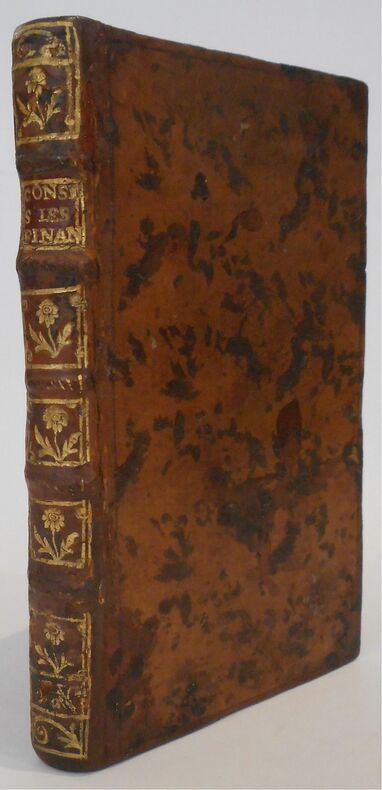
In-8 (114 x 175 mm), demi-basane fauve à la Bradel, dos lisse orné d’une guirlande dorée répétée en place des nerfs, pièce de titre de veau noir (reliure du XVIIIe), 309, (71) p., page de titre entièrement gravée dans un encadrement architectonique. Importante édition des Constitutions de la Société de Jésus, l’acte fondateur et le texte de base de l'organisation de la Compagnie, rédigé en espagnol par Ignace de Loyola et traduit en latin par Juan de Polanco, son secrétaire et assistant. Cette édition de 1583 est la première à contenir le dernier état du texte révisé en latin par Ignace de Loyola avant sa mort ainsi que ses notes et commentaires, disposés en marge ou intégrés dans des blocs de texte en caractères italiques. Ces commentaires avaient été d’abord publiés séparément. Elle est également la première à contenir, en pagination continue, "L’examen général", soit les conditions requises pour être admis au sein de la Société ("Primum ac generale examen iis omnibus qui in Societatem Iesu admitti petent proponendum" : p. [3]-48) ainsi qu'un index général. (Olschki, II, 2499: "Edition fort bien imprimée et peu commune". Backer-Sommervogel, V, 77. Manque à Palau. A.F. Johnson, ‘Catalogue of Italian engraved title pages in the 16e c.’, 19, 20). Petit cachet ex-libris de bibliothèque jésuite. Mors et dos frottés. Bon exemplaire, frais, assez grand de marges, bien conservé.
210376Collection Documents Inédits sur l'Histoire de FranceParis, Imprimerie Royale, 1835-1842 4 vol. in-4, demi-veau rouge, dos à nerfs orné de filets et de guirlandes dorés (reliure de l'époque). Rousseurs, fortes parfois. Inscription sur une page de garde du tome I : "Donné par Madame de Clermont-Tonnerre, le 1er janvier 1846".
242300Bruxelles, s.n., 1785 in-8, [2] ff. n. ch., 117 pp., maroquin fauve, dos lisse cloisonné et fleuronné, pièces de titre cerise, encadrement de simple guirlande dorée sur les plats, hachuré doré sur les coupes, tranches dorées, gardes de papier marine (reliure de l'époque). Accroc en coiffe supérieure, rousseurs, petites galeries de vers marginales stoppées en début d'ouvrage, plus nombreuses à la fin.
222556Paris, Magimel, 1814 in-4, IV-67 pp., 2 grands plans dépliants, demi-basane brune à petits coins en vélin, dos lisse orné de filets et fleurons dorés (reliure de l'époque). Manque à la coiffe, mors supérieur fendu sur 4 cm avec traces de colle, épidermures sur les plats, coupes et coins usés. Mouillures claires et petits trous de vers en marge.
162210543ABMadrid, Correa para M. Belae, 1622. 29 : 21,5 cm. 4 hojas, 213 hojas numeradas, 17 hojas Con escudo cortado en madera en el titulo. Pergamino de época.
1947009992Barcelona, Amigos del Libro, 1947. 233 S., 2 Blatt. Großformatige gefalzte Bögen mit farbig lithographiertem Umschlag in Orig.-Pappkassette (ca. 40 x 34 cm). Eins von 300 numerierten Exemplaren (gesamt 315) auf von Casa Guarro eigens gefertigtem Büttenpapier mit dem Wasserzeichen der Amigos del Libro. Letzte graphische Arbeit des bedeutenden katalanischen Bildhauers und Graphikers Manolo Hugué (1876-1945), deren Druck und Fertigstellung als Buch er nicht mehr erlebte. Die Kassette etwas angestaubt, sonst schönes, gut erhaltenes Exemplar in einwandfreiem Zustand. Folded sheets with coloured lithographed envelope in original clam shell slipcase (approx. 40 x 34 cm). One of 300 numbered copies (315 in total) on handmade paper specially made by Casa Guarro with the watermark of the Amigos del Libro. Last graphic work of the important Catalan sculptor and graphic artist Manolo Hugué (1876-1945), whose printing and completion as a book he did not live to see. The slipcase a little dusty, otherwise a beautiful, well-preserved copy in perfect condition.
200512952Simbach am Inn / Reinbek-Berlin, Müller & Schindler / Coron bei Kindler Verlag, 2005. "Gr.-8° (22,5-25 cm). 273 num. Bll. (Faksimile); 336 S. (Kommentarband)." "Blindgeprägtes Ganzleder über vier falschen Bünden mit zwei Schließen (Faksimile); OLeinwand mit vergoldetem Rückentitel und montierter Deckelillustration (Kommentarband)" [3 Warenabbildungen]
A livre d'artiste illustrated with 37 original etchings by Edy-Legrand, one of the greatest and most underrated graphic artists and book-illustrators of the 20th century. Includes 25 full-page hors-texte etchings and 12 smaller etchings. The justification mentions 166 copies in all, including 20 on Imperial Japan paper, and says nothing about the existence of extra suites. This is a special copy printed on Imperial Japan paper with an extra suite of the 25 hors-texte etchings, and an extra suite of the 12 smaller etchings printed without text, all on Japan paper. 4to, original wraps. Suites wrapped separately in rice paper. Fine and bright. Housed in the original chemise and slipcase.