FALKENHAYN (Erich von).Livre Rare Book

79 565 résultats
1914123637Mézières 1914 1 vol. en feuilles 5 p. manuscrites en langue allemande (+ 3 p. blanches), format 33 x 21 cm, pliées en 4, sur papier à en-tête de l'Etat-major général. Rapport secret du plus grand intérêt, signé et daté du 18 novembre 1914, rédigé au Quartier général allemand de Mézières.Erich von Falkenhayn (1861-1922), ministre de la guerre et fraîchement nommé chef de l'Etat-Major général, dresse ce 18 novembre 1914 un rapport sur la situation de l'armée allemande partagée entre les fronts de l'Est et de l'Ouest. Commandant le front de l'Ouest, il fait un point sur la situation à son homologue du front de l'Est Hindenburg : l'envoi de troupes de choc du front de l'Ouest vers le front russe ont permis de remporter plusieurs victoires mais Falkenhayn s'inquiète d'une possible attaque de l'ennemi sur le front Ouest qui risquerait de les obliger à évacuer les côtes de la Baltique. Or, tant qu'ils sont maîtres des débouchés sur la mer, les Allemands restent supérieurs à leurs plus dangereux ennemis : les Anglais."Les Français sont inoffensifs tant qu'ils ne sont pas surexcités par un espoir très passionné. Il ne faut absolument pas donner l'éveil à leurs aspirations patriotiques, comme en septembre par exemple ou après une diminution des effectifs de l'armée de l'Ouest au profit du front de l'Est, ils nous firent reculer..."Falkenhayn reste pourtant résolu à envoyer de nouveaux bataillons à l'Est ne serait-ce que pour montrer à leurs alliés autrichiens qu'il est bien décidé à les aider dans leur lutte en Galicie.Excellent document.
304 pages. Index. Chapters include: The Genius of the Jew; What the Jews Have Done; The Jew in America; American Jews and Their Occupations; The Jew in Great Britain; The Jews in the British Dominions; The Jews in Germany and Austria; How the Jew Stands in France; Russian and Polish Jews; The Jews of Southern Europe; The Jews of Lesser Lands; The Jews of the East; The Jew in the World of Art. Average wear and soiling. Binding sound. Bit of writing atop front free endpaper else unmarked. Half-inch opening to bottom of backstrip. Gilt lettering and decorations upon front board and backstrip clearly visible. A sound copy. Book
First edition. Original paper wrappers. 8vo. Ca. 60-90 pages each; 23.5 cm. Written in German. Title translates to Exchanges on Jewish Folklore. In 1898, Max Grunwald (18711953) , a rabbi living in Hamburg and then Vienna, established the Gesellschaft für Jüdische Volkskunde, Mitteilungen (der Gesellschaft) für Jüdische Volkskunde (18981929) and Museum für Jüdische Volkskunde, having issued a call to collect materials and a questionnaire in 1896. Grunwald hoped that Jewish Volkskunde would preserve a record of a disappearing way of life and, by demonstrating the beauty of traditions and encouraging their revival, help stem the tide of assimilation; he also hoped that by showing the connectedness of Jews to other peoples and their universal values, Jewish Volkskunde might counteract anthropological characterizations of Jews as an immutable and degenerate race (YIVO encyclopedia 2010) . SUBJECT (S) : German language; Jews folklore periodicals; Jews social life and customs -- Periodicals. OCLC lists four copies worldwide (George Washington University, Baltimore Hebrew University, University of Minnesota, Bibliotheek van de Univ. Van Amsterdam) . Good condition. (GER-14-17A)
1787163171787 2 boites cartonnées, avec étiquette. 17 cartes gravées sur cuivre de 15 sections montées sur toile et pliées, chacune formant une carte de 500 x 675 mm. Frankfurt H. L. Brönner 1787-1804
178258914ABLeipzig, Weidmanns Erben und Reich, 1782. VIII, 898 S.; 2 Bl., 875 S. Halblederbände der Zeit mit Rückenschild und -vergoldung.
1807DLIT0711Wien, Im Verlage bey Anton Pichler 1801-1807. Kl.-8°. 1) Reihent., gest. Frontisp. (Weinrauch fc.), Titelbl., 4 nn. Bll. (Vorrede), S. 129-176, S. 1-16, S. 65-128, S. 17-64; S. 177-180; 2) Reihent., gest. Frontisp. (Weinrauch del. et sc.), Titelbl., 273 (=243) S.; 3) Titelbl., gest. Fontisp. (Weinrauch del. et fc.), Reihent., 226 (= 234) S.; 4) Reihent., Titelbl., 248 S., 2 nn. Bll.(Verlagsanzeigen); 8) Reihent., gest. Frontisp. (Weinrauch fec.), Titelbl., 308 S.; 9) Reihent., gest. Frontisp. (Weinrauch fec.), Titelbl., 212 S.; 10) Reihent., gest. Frontisp. (Weinrauch f.), Titelbl., 250 S.; 11) Reihent., gest. Frontisp. (Weinrauch fec.), Titelbl., 268 S.; 12) Reihent., gest. Frontisp. (Weinrauch f.), Titelbl., 271 S.; 13) Reihent., gest. Frontisp. (Weinrauch fec.), Titelbl., 260 S.; 14) Reihent., gest. Frontisp. (Weinrauch f.), Titelbl., 258 S.; 15) Reihent., gest. Frontisp. (Weinrauch fec.), Titelbl., 322 S.; 16) Reihent., gest. Frontisp., Titelbl., 192 S.; 17) Reihent., gest. Frontisp., Titelbl., 234 S.; 18) Reihent., gest. Frontisp., Titelbl., 220 S.; 19) Reihent., gest. Frontisp., Titelbl., 201 S.; 20) Reihent., gest. Frontisp. (Weinrauch f.), Titelbl., 6 nn. Bll., 222 S.; 21) Reihent., gest. Frontisp. (F. Weber sc.), Titelbl., 198 S., mit 1. gef. Tab.; 22) Reihent., gest. Frontisp. (Fr. Weber sc.), Titelbl., 234 S.; 23) Reihent., gest. Frontisp. (Fr. Weber sc.), Titelbl., 255 S.; 24) Reihent., gest. Frontisp. (J. Blaschke sc.), Titelbl., 195 S.; 25) Reihent., Titelbl., 200 S.; 26) Gest. Frontisp. (Weinrauch sc.), 20, 217 S.; 27) Gest. Frontisp. (Weinrauch), XXIV, 248 S.; 28) 7 (= 8) S., mit 1 gest. Frontisp. (F. Weber sc.), 302 S., 1 n. Bl.; 29) XII S., mit 1 gest. Frontisp., (Weinrauch del. G. J. Mansfeld sc.), 284 S.; 30) Reihent., gest. Frontisp. (Weinrauch f.), Titelbl., 304 S.; 31) Reihent., gest. Frontisp. (F. Weber sc.), Titelbl., 290 S.; 32) Reihent., gest. Frontisp. (Weinrauch del. J. Mansfeld sc.), Titelbl., 324 S.; 33) Reihent., gest. Frontisp. (Weinrauch fec.), 283 S.; 34) Reihent., gest. Frontisp. (Weinrauch f.), Titelbl. 239 S.; 35) 319 S., mit je zwei Zierleisten auf den Titelblättern u. wenigen Zierleisten im Text. Ansprechende Halblederbändchen d. Zeit, mit hellem marmoriertem Rückenleder, zwei goldgeprägten Rückenschildchen und geprägten Rückenzierlinien, Einbanddeckel mit einfärbig bedrucktem Buntpapier überzogen, Buchschnitte rot gesprenkelt, mit je e. Lesebändchen, insg. wenig fleckig, Ecken meist bestoßen, teilw. berieben, mit mäßigem Wurmfraß. Seiten meist nur wenig vergilbt, teilw. stockfleckig oder gebräunt, einige wasserrandig, mehrere Lagen des 1. Bandes, sowie Ss. 129 bis 136 u. 137 bis 144 des 23. Bandes verbunden, der 3. Band zählt ? bei gleichem Textabschluss - nur 234 statt der sonst in den Bibliothekskatalogen genannten 239 Seiten, im 4. u. 25. Band fehlt das gestochene Frontispiz. Mit e. Besitzvermerk (Unterschriftsstempel) auf jedem vorderen fliegenden Vorsatzblatt avers (Stefan von Auspitz), lediglich der 8. Band trägt an dieser Stelle einen handschriftlichen Besitzvermerk (S. von Auspitz) und wenigen Bleistiftanmerkungen. Goedeke 4,I,344,3. Muncker 536f. Vgl. ADB 6,346f. - 32 Bände eines frühen Wiener Nachdrucks einer Gesamtausgabe der Werke des bedeutenden Dichters der Aufklärung, Gotthold Ephraim Lessing (1729-1781), lediglich der fünfte bis siebente, sowie der letzte, der 36. Band fehlen. Die erste, teilw. noch von Lessing selbst besorgte und von J. J. Eschenburg fertiggestellte, Gesamtausgabe erschien 1771-1794 in Berlin. Lessing war seit 1770 Bibliothekar in der Herzog August Bibliothek in Wolfenbüttel und korrespondierte mit bedeutenden Persönlichkeiten seiner Zeit. Der Literaturhistoriker J. J. Eschenburg (1743-1820) lehrte am Collegium Carolinum in Braunschweig und gab Teile aus Lessings literarischem Nachlass heraus "Besonders groß ist sein Verdienst um Sichtung und Herausgabe des Lessing?schen Nachlasses, zu welcher Arbeit er als Lessings Freund und Studiengenosse,?in hohem Grade geeignet war. (ADB)". Die Kupfertafeln der vorliegenden Ausgabe stammen von vielbeschäftigen Wiener Künstlern d. Zeit wie J. C. Weinrauch und J. Mansfeld. Die guterhaltenen Bände stammen aus der Bibliothek des Wiener Bankiers und Kunstsammlers Stefan von Auspitz (1869-1945).
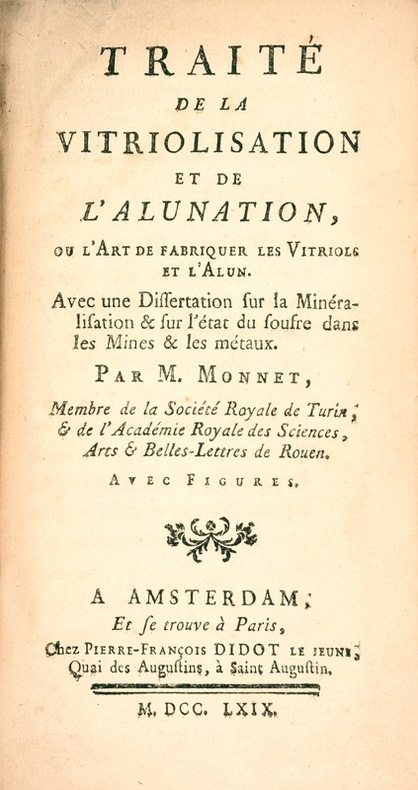
176921546Amsterdam et Paris, Pierre-François Didot le Jeune, 1769 ; in-12, vélin ivoire postérieur ; [4], XXXIV, [2], 288, [2] pp., 4 planches sur [2] ff. dépliants, gravées sur cuivre. (Sign. [ ]2, a12, b6, A-M12, [ ]1, [2] pl. dépliantes gravées par Melle Fonbonne) ; fleurons au titre, bandeaux dont deux signés PH.
RO80083891NIEMEYER G.W.. XIXe siècle. In-12. Cartonnage d'éditeurs. Bon état, Couv. légèrement passée, Dos satisfaisant, Quelques rousseurs. Très rare ouvrage composé de 36 planches de gravures (16.5 x 12.5 cm) en noir et blanc, avec serpentes roses + 3 planches de panoramas dépliants gravés en noir et blanc. Légendes en allemand, et quelques-unes en français et anglais.. . . A l'italienne. Classification Dewey : 943-Allemagne, Autriche, Hongrie
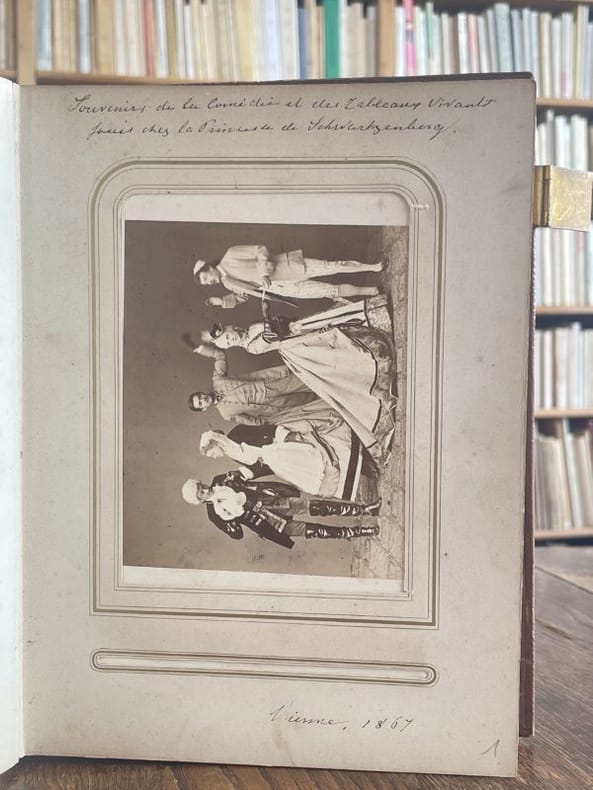
1867123714Vienne 1867 1 vol. relié album petit in-4, pleine basane brune chagrinée, armes en laiton incrustées sur le premier plat (épée férue en pal dans une couronne avec la devise "J'attends"), tranches dorées, fermoirs. Ce précieux album photographique immortalise une série de tableaux vivants interprétés par de jeunes aristocrates au palais Schwarzenberg à Vienne, à travers 28 tirages originaux sur papier albuminé au format 10 x 13 cm portant au verso le tampon "Atelier-portrait Adèle, Praterstrasse 18, Hôtel de l'Europe, Wien". La photographe Adèle Perlmutter-Heilperin avait fondé à Vienne en 1862 un atelier spécialisé dans les portraits de familles princières. On peut rapprocher cet album de celui conservé à la BNF, "Un Viennois dans l'Isère, revue féerique internationale en trois actes, mêlée de chants, tableaux et ballet, représentée pour la première fois sur le théâtre de S.A.S. Mme la Princesse Eléonore de Schwarzenberg le 14 mars 1868". La comparaison des portraits, qui proviennent également du studio Adèle, permet d'identifier plusieurs des modèles de notre album, en particulier la princesse L. Fürstenberg, les comtesses Hanna et Valerie Erdödy, Ernestine Pallavicini, le comte Eugène Louis de Waldner de Freundstein et le baron Othon de Bourgoing. Il semble que le prince Edmond de Polignac apparaisse également sur trois de nos photos. La reliure d'époque est fortement abîmée (plat supérieur détaché, dos manquant, un fermoir absent), mais les tirages photographiques sont bien conservés, avec des contrastes marqués.
1867123714Vienne 1867 1 vol. relié album petit in-4, pleine basane brune chagrinée, armes en laiton incrustées sur le premier plat (épée férue en pal dans une couronne avec la devise "J'attends"), tranches dorées, fermoirs. Ce précieux album photographique immortalise une série de tableaux vivants interprétés par de jeunes aristocrates au palais Schwarzenberg à Vienne, à travers 28 tirages originaux sur papier albuminé au format 10 x 13 cm portant au verso le tampon "Atelier-portrait Adèle, Praterstrasse 18, Hôtel de l'Europe, Wien". La photographe Adèle Perlmutter-Heilperin avait fondé à Vienne en 1862 un atelier spécialisé dans les portraits de familles princières. On peut rapprocher cet album de celui conservé à la BNF, "Un Viennois dans l'Isère, revue féerique internationale en trois actes, mêlée de chants, tableaux et ballet, représentée pour la première fois sur le théâtre de S.A.S. Mme la Princesse Eléonore de Schwarzenberg le 14 mars 1868". La comparaison des portraits, qui proviennent également du studio Adèle, permet d'identifier plusieurs des modèles de notre album, en particulier la princesse L. Fürstenberg, les comtesses Hanna et Valerie Erdödy, Ernestine Pallavicini, le comte Eugène Louis de Waldner de Freundstein et le baron Othon de Bourgoing. Il semble que le prince Edmond de Polignac apparaisse également sur trois de nos photos. La reliure d'époque est fortement abîmée (plat supérieur détaché, dos manquant, un fermoir absent), mais les tirages photographiques sont bien conservés, avec des contrastes marqués.
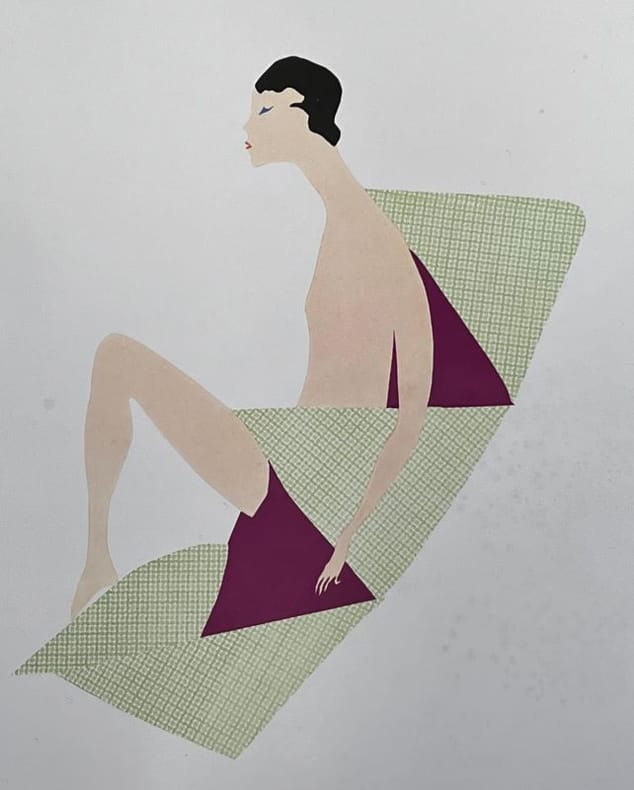
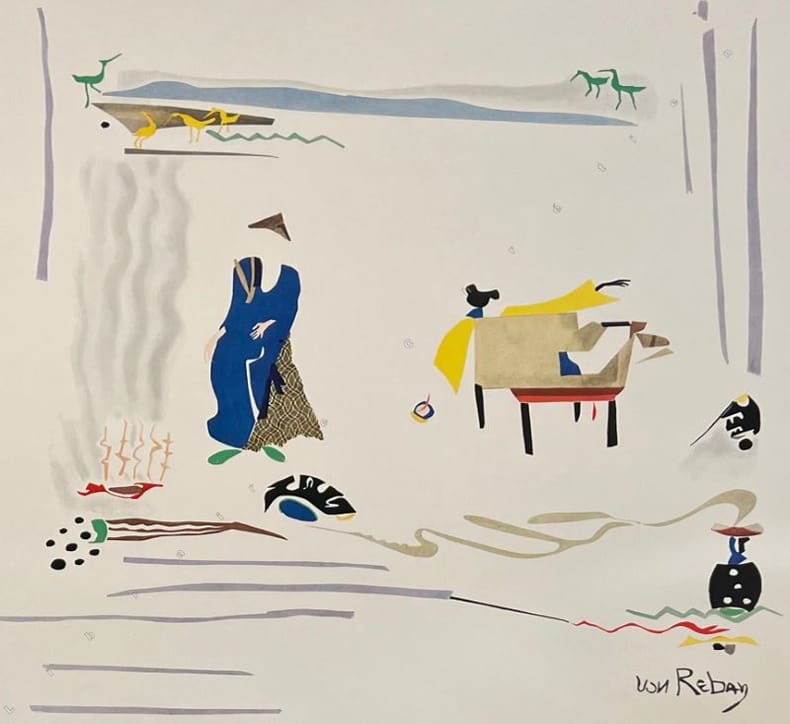
1925245521925 Illustrations de Hilla Rebay. Rudolf Bauer, (1925), broché, couverture illustrée en couleurs, in-folio (50 x 44.5 cm.), 13 planches,
192524661Rudolf Bauer 1925 Illustrations de Hilla Rebay. Rudolf Bauer, (1925), in-folio (62 x 43.5 cm.), en feuilles, sous portfolio crème à rabats, 13 planches.
260 pages. Index. List of main sources. Black and white photographic plates. Organizational chart of the German Broadcasting Company (RRG) in 1942 and its links to the Ministry of Propaganda. Organizational chart of the Ministry of Public Enlightenment and Propaganda in 1942. "The first complete account of the gigantic propaganda organization of the Third Reich. Reveals and describes: The inner workings of the Nazi propaganda organization; The network of Party speakers; The German radio's war effort; The Nazi press system; The German stage and screen in 1942; Propaganda for the armed forces; The men in control. Access to unique German documentary material and an intimate knowledge of German wartime broadcasting and of the Nazi press have enabled the authors to paint a full-length picture of Hitler's political warfare machine." - dust jacket. Printed to wartime standard, apparently without a front free endpaper. Unmarked with average wear and soiling to publisher's canary yellow cloth. Average wear and half-inch of loss to decorated orange dust jacket at top of spine. Binding sound. A quality vintage copy of this vital and incisive wartime study. KEHR & LANGMAID 2950. Book
32 x 21 cm. Teil 1: 20 Bl., 616 S., 12 Bl. - Teil 2: 694 S., 13 Bl. Lederband der Zeit auf 5 Bünden (Kanten etwas beschabt). *VD17 39:128468X. Graesse VI/2, 204. Heyd 4901. Wegele 67-84 (bes. 74 f.). ADB XXXVIII, 629. - Zweite und beste Ausgabe, recht selten. War erstmals 1559 in Basel als "Chronicon monasterii Hirsaugiensis" erschienen und liegt hier in erweiterter Bearbeitung vor. "In jeder Beziehung die wichtigsten der historischen Schriften Trithemius` sind seine Chronik des Klosters Hirsau (in Schwaben) u. die angeblich älteste Geschichte der Franken" (ADB). Behandelt den Zeitraum von 830 bis 1514. - Provenienz: Bibliothek des letzten Basler Fürstbischofs Franz Xaver von Neveu (1749 - 1828) mit dessen Exlibris auf dem Innendeckel. - Sauber und insgesamt sehr gut erhalten. Bücher la
32 pages. This issue is twice as long as previous issues due to its blockbuster treatment of "The Case of Belgium" with reproductions of documents incriminating to Belgium. Features: The (New York) "Times" in Despair; Irish Home Rule Bill; Government Control of Public Utilities, by Frank Koester; "I Protest", by Clara Viebig - one of the foremost novelists of Europe; We Demand Real Neutrality; What is an American German?, by Representative Richard A. Bartholdt of Missouri; The Case of Belgium - In the light of official reports found in the secret archives of the Belgium Government after the occupation of Brussels with facsimiles of the documents - a major article; cartoon shows a German dog being taken before an English firing squad; England's Embarrassment is Ireland's Opportunity; and more. Unmarked. Average wear. Binding intact. A sound copy. Magazine
139971aaf1848, in-8vo, Titel + III + 62 S. hs. in feiner deutscher Kurrentschrift (ca. 17 Linien/S.), mit 12 ganzseitigen farbigen Originalzeichnungen auf starkem Papier u. lose farbigen Kartenzeichnung des besuchten Teils der Schweiz, sehr guter Zustand, Leineneinband mit Bildprägung und goldgepr. Titelschild auf Vorderdeckel, kleine Fehlstelle unten auf Vorderdeckel, ansonsten guter Zustand.
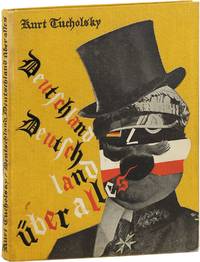
192984810Berlin: Neuer Deutscher Verlag 1929. First German Edition. First Printing cloth issue with 1.-20. Tausend printed on title page. Octavo 24cm; yellow decorative cloth with photomontage by John Heartfield applied to covers and titles stamped in black on spine; yellow topstain; 231pp 5; illus; text is in German. Contemporary October 1929 owner's name penciled to front endpaper; slight forward lean light overall dust-soil to cloth with pictorial elements well-preserved and largely unrubbed; browning to endpapers with mild wear to base of spine; a presentable copy Very Good lacking the rare dustjacket. A powerful piece of social criticism by Tucholsky one of the most prominent German-Jewish authors and journalists of the Weimar Republic. Produced with graphic designer John Heartfield Tucholsky managed to combine vicious attacks on everything he disliked about Germany with a declaration of love for his country. He warned of a government with anti-democratic tendencies and the impending threat of National Socialism - a plea almost to revolutionize a dormant country - though his fears were realized in 1933 when Hitler assumed the position of Chancellor of Germany. Axel Eggebrecht one of Tucholsky's contemporaries said of Deutschland: "If this book were to turn out to be quite a big success it might be realized that the dream of awakening is still very vivid in Germany." Deutschland was listed on the Nazis list of censored books and though it did go through a second printing few enough survived destruction. <br /> <br /> The present example is one of apparently two variant bindings for the first printing with no extablished priority known to us. While the pictorial cloth binding is the variant we have seen and handled most often we note another in yellow cloth without the pictorial elements and titles stamped in black on spine and front cover. A well-preserved example and a high-point of Heartfield's graphic design and layout work. Pachnicke & Honnef 60a-69 p.148-161. Neuer Deutscher Verlag unknown
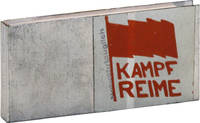
196947929Hamburg: Quer-Verlag 1969. Second Expanded edition. Oblong 16mo ca. 7x13cm.; original red staplebound card wrappers taped into cloth tape-backed sharp aluminum boards decorative element mounted to upper cover; 61ll. printed mimeographed on white and red paper. Old ballpoint manuscript spine title boards a bit tarnished else Very Good or better contents fresh and fine. Rubberstamp to upper cover: "Notwehrtauglich" "suitable for self-defense" the title page describing this as "Handliche mit scharfen kanten ausgestettatet kampfausgabe für die phase des revolutionären widerstands" a "handy sharp-edged combat edition for the next phase in revolutionary resistance" - our/google's translation. Collection of rhymed chants first issued by the author's publishing house Quer-Verlag in 1968 for members of the German Student Movement and the protests staged that year. The author the son of a dock worker was himself a member of the leftist literary group Hamburg Linksliteratisch. This work a curious example of a book as weapon in the literal sense the boards' fore-edges extending beyond the text block and are both sharp and the corners quite pointed so that while the book is small enough to fit in the palm of one's hand one can imagine the harm it could do to a vulnerable jugular. Quite scarce OCLC locates three copies of any edition in the United States as of March 2020 at Yale U. Iowa and Harvard. Quer-Verlag unknown books
171312383Leipzig, Johann Ludwig Gleditsch & M.G. [Moritz Georg] Weidmann, 1713. Pergamenteinband, 6 durchgezogene Bünde, 8°, Rotschnitt, Titelblatt, 18 Bl., 758 S., 11 Bl., verblasster handschriftlicher Rückentitel; -handschriftlicher Eintrag auf dem Titelblatt zum Autoren, sauberes, festes Exemplar.
1919q5s237bDeutsch-Baltischer Ausschuss, Stettin, 1919. Alphabetische Liste von baltischen Flüchtlingen, Stand 15. März 1919 mit Angabe von Vorname, Familienname, Heimatort, jetziger (1919) Wohnort bzw. Aufenthalt, Straße und Hausnummer. 69 S. Typoskript (Siebdruck? Xerox?), gebunden. (Ca. 2000 Namen) Einband und Rücken berieben, etwas bestoßen, angebräunt, etwas angeschmutzt, leicht beschädigt. Seiten etwas angebräunt, etwas lichtrandig, teils gering angeschmutzt, kein Textverlust. Beiliegend 15 Einzelblätter, Folio, Typoskript-Lichtpausen: Alphabetische Liste, wahrscheinlich Ergänzungen zu obengenannter Liste, hier mit Angabe der vollständigen Namen, bei den Frauen mit Mädchennamen, teils mit Geburtsdatum, teils mit Berufsbezeichnung bzw. Funktion, teils mit Familienverhältnissen. Die Blätter sind etwas bestoßen, gering angeschmutzt, gut lesbar. Folio [5 Warenabbildungen] Broschiert
138386aafStuttgart, E. Schreiber, 1965-1968, in-4to (28 x 18 cm), 164 faks.( beidseitig farb. bedruckter) Blätter, 316 farb. Abb., 162 Schmuckinitiale / Textband: 409 S. + 1 Bl. (S. 295-337 mit zahlr. schwarz-weissen Abb.), Ganzpergament über 5 Bünden, Rückentitel, Sehr schönes Exemplar.
86871aafSüddeutschland, o.J., um 1760, in-8vo, 50 Bl., davon 2 Bl. mit repetierendem Farbmuster, 37 Bl. mit deutscher, hs. Kursivschrift und 19 farb. Orig.-Zeichnungen + 11 Kupfertafeln (von G.B. Göz), Zeitgenössicher Ledereinband mit floraler Deckel- und Rückenvergoldung und goldgesprägtem Deckelmonogramm ‘K.W.’, im Orig.-Steckschuber (Boden des Schubers etwas gespalten).
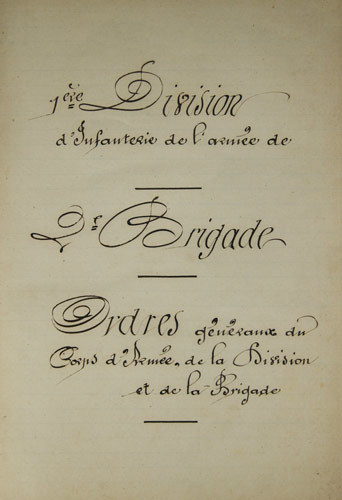
76339aafin-4to, 2 ff. (table d. mat.) + titre + 35 p. + 132 p. vierges, avec 17 lettres et notes d'ordres entre les feuilles, dont une partie portant le sceau du Général Commandant, rel. orig. en demi-toile avec titre manuscrit sur le plat sup., plats usées et lég. abîmés, mais en bon état.
94349aafvers 1890 - 1900, in-folio, 37 photographies et phototypies originales en grand format (27 x 21 cm) collées sur carton (46.5 x 36.5 cm), dont 7 coloriées (Nürnberg, Westerland-Sylt) + 3 héliogravures + 3 gravures d’art coloriées, dans une chemise en carton recouverte en velours vert style ‘Art Nouveau’.
139089aafUm 1904, quer gr. in-4to (37x26 cm), 25 feste Albumseiten mit insg. 143 montierten s/w-Abzügen in verschiedenen Formaten: 8.5x5.5 cm (private Aufnahmen), 15.5.x9.5 cm, 27x21 cm (ganzseitig), gewisse Seiten mit handschriftl. Angaben in schwarzer Tinte, Albumblätter am Rand etwas stockfleckig, Fotos in gutem Zustand, Album in Halbledereinband mit Ecken (P.H. Beyer & Sohn, Leipzig), Titel in Goldprägung auf Vorderdeckel, Rotschnitt, an den Ecken und Rücken berieben, hinteres Scharnier fast ganz abgelöst.