79 524 résultats
110814Edité par Militar, Kunst, Verlag "Mars" (éditeurs d'art militaire "Mars") - Sans date - In Folio, feuillets libres dans emboîtage rouge décoré - 32 planches, complet selon la Table des matières et numéros des tables (voir photos) + documents hors-texte
197166392ABKöln. London. Hellnar., Edition Hansjörg Mayer., 1971. 23 x 17 cm. Seiten nummeriert von 255-540, 6 Blatt. OKarton mit Umschlag (Schumgummimatte)., 66392AB Auflage 1000 Exemplare. Ohne das Verschlußgummi für die Matte, sonst sehr gutes Exemplar.
197466391ABStuttgart. London. Reykjavik., Edition Hansjörg Mayer., 1974. 23 x 17 cm. Ca. 530 S. Illustrierter OKarton mit separatem, eingefalteten Umschlag., 66391AB Auflage 100 Exemplare. Buchrücken gebräunt, etwas angestaubt, vorderer Einbanddeckel minimal stockig. Sonst sehr gutes Exemplar. Gesammelte Werke Band 7.
1840000265Hamburg, Perthes 1840-1841, 1840. 435; XII, 554 S., 1 Blatt Druckfehler. Halbleinenbände von ca. 1920 mit dekorativ marmorierten Bezugspapieren und goldgeprägtem Rückentitel. Band 2 mit dem beigebundenen Subskribentenverzeichnis, das sich wie ein Adressbuch der jüngeren deutschen Romantik liest. Die bis heute maßgebliche Ausgabe enthält neben Runges kunsttheoretischen Schriften auch die beiden plattdeutschen Märchen "Machandelboom" und "Der Fischer un syne Fru", die die Grimms in die Kinder- und Hausmärchen aufnahmen, sowie den Briefwechsel mit Goethe über die Farbenlehre, Briefe von und an Arnim, Brentano, Steffens, Tieck u. a. Das Titelblatt von Band 2 rückseitig mit kleinem, altem Stempel "Künstler Verein in Bremen" und beide Bände etwas stockfleckig, insgesamt handelt es sich jedoch um ein gut erhaltenes Exemplar mit nur leichten Gebrauchsspuren. Erste Ausgabe.
1st Edition. Modern boards. 12mo. 48 pages. 18 cm. In German. Title translates into English as "The Current [Reform] Movement in Judaism: Its Legitimacy and Meaning. Important period work on the Reform Movement by one of its key leaders. Sigismund Stern (18121867) was a German teacher and leader of the Berlin Reform movement. After studying philology in Berlin, in 1835 Stern succeeded I. M. Jost as headmaster of the Berlin Jewish boys' school. In 1845 he gave a series of lectures on the tasks of Judaism which aroused wide interest and controversy. He wished to bring about a revival of religious life, waking it from its then current lethargy, which he felt was caused by the contradictions and frustrations faced by Jews in the modern world. Following his proposal calling for the erection of a German-Jewish church, leading classes of Berlin Jewry responded by forming an Association for Reform in Judaism, in which Stern played a central role. Contending that Judaism must free itself from its national heritage, he initiated radical reforms and the separate organization of the reformers in Berlin. In 1848, after standing unsuccessfully as candidate for that year's National Assembly, Stern accepted the directorship of the Frankfurt on the Main Philanthropin Jewish school. He enlarged the institution, raised its academic standards, and introduced pedagogic (but not religious) innovations, which made him an acknowledged leader of the German methods (EJ, 2007) . See also: A. Galliner, Sigismund Stern (1930) ; idem, in: YLBI, 3 (1958) , 17781; W. G. Plaut, Rise of Reform Judaism (1963) , 288; M. A. Meyer, Response to Modernity: A History of the Reform Movement in Judaism (1988) , 12529. SUBJECT(S) : Reform Judaism -- Germany. Reform Judaism. OCLC lists not a single hard copy anywhere worldwide. Stamp on front. Very good condition. Very Rare and Very Important. (Ger 50-5)
122627aafArnhem, Johann Janssen, 1614-1614-1620, gr. in-4°, zweispalt. Text, mit insgesamt 3 Frontispiz-Titelblättern und 69 (von 70) Porträttafeln davon 67 ganzseitig und 36 kleinere Porträts auf 2 Tafeln, (Karte fehlt), stellenweise etwas fleckig und gebräunt, hs. Besitzeinträge unten auf den Titelblättern, beschabte und bestossene Lederbände auf Bünden, starke Beschädigungen und Fehlstellen an den Kapitalen, Schliessresten.
1759AQ19198London: Printed for J. Warcus.and J. Ross 1759. Two volumes bound as one. 2 viii 460; 136pp. With an engraved frontispiece and a further 12 engraved plates 10 folding. Early sheep-backed paper boards. Extremities heavily worn. Very occasional chipping to margins. Contemporary inked ownership inscription of James Wallis to title page dedication page verso of first plate alongside later inscription of Stephen Cummins head of first leaf of text and above caption title of Vol. II; with his occasional marginal annotations primarily recording for easy reference the placement of plates within the volume. An interesting anthology of translations of selected German articles from various late-seventeenth and early-eighteenth century periodicals including numerous by G. Leibniz mathematics mechanics logic philology and Philipp Jacob Sachs a Lewenheimb alchemy medicine. Initially published in parts under the title Acta Germanica or The literary memoirs of Germany &c. London 1742 the first collected two-volume edition appeared in 1743 printed by and for the editor Godfrey Smith. In his dedication to the fourth edition of The laboratory; or School of Arts 1755 Smith notes that he has suspended continuation of Acta Germanica for want of encouragement but hopes 'not only to finish the Second Volume but likewise to compleat my Design'. However no material appears to have been added after 1750 and the present work is a re-issue with cancel title page of the original sheets of Acta Germanica. Volume II is substantially smaller than volume I and has no index or title page but the text concludes with 'Finis'. ESTC records copies at three locations in the British Isles BL Cambridge and Wellcome and a further three in North America American Philosophical Society Boston and Minnesota. ESTC N19480. Second edition. Quarto. Printed for J. Warcus...and J. Ross hardcover
1927153862Bln., Stuffer, 1927. (6) Bl., 3 Schablonen, farbig illustr. Or.Pbd., gr.8°. Die erste Ausgabe von Tom Seidmann-Freuds Bilderbuch, das mit seinen klar konturierten, zart kolorierten Bildern der Neuen Sachlichkeit nahesteht. Tom Seidmann-Freuds Spielbilderbücher sind zudem "ungewöhnlich einfallsreich und die Effekte ergeben sich so organisch und sinnvoll, wie es in dieser Gattung nicht allzu häufig geschieht." Als Bilderbuchmacherin erreicht Tom Seidmann-Freud "jenen pädagogischen Idealfall, bei dem Spielen und Lernen zu einer Einheit verschmelzen." (Hans Ries: Versuch über deutsche Bilderbücher, 39). Hardcover Einige Seiten gering fleckig, eine Schablone mit Knickspur, zwei Faltelemente und ein Einriss in einer Schablone professionell neu befestigt respektive unterlegt. Bleistiftnotiz auf vorderem Innendeckel. Insgesamt trotz all' dem ein schönes Exemplar.
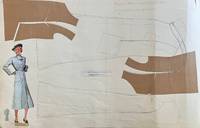
193059525Hannover: Schneidermister ca. 1930-1933. Oblong elephant folio. 23.5 x 14.5 in. 25 leaves unnumbered. Original women’s fashion patterns in pencil throughout many with tipped-in pattern cutouts mounted on the sheets as well as colour images of the finished design tipped-in and mounted manuscript pencil notes & directions in some colour pencil additions to a a few patterns. Stiff limp beige covers black cloth spine title mounted on front cover scutting edgewear repair to corners of front cover corner still a remarkable manuscript w/ tipped-in instructions for taking measurements and fashion by the Nazi Party on first leaf including one entitled “Ein Modewart macht Propaganda.†This German fashion pattern tailoring and pattern manuscript provides an exceptional original artifact of the period when the Nazi Party began to force educational and cultural changes upon German Society against the tailoring and fashion industry in Germany during the early 1930’s. By 1930 Berlin had emerged as an international fashion capital drawing Parisian fashion designers and most of the tailoring schools and fashion houses were operated by generations of Jewish family owners. Tailors and fashion designers were constantly reminded that they must create a wholly Aryan fashion and that they were to avoid French or other outside influences. Despite the pressure most women tailors and fashion designers in the tailoring or cutting schools continued to still draw their influences from Parisian and American couturiers by creating their own patterns and pattern books from which these internationally themed clothing designs could be made. This fashion pattern book by Bode focuses on women’s suits skirts capes coats and knickerbockers. However the Party never succeeded in creating a unique Fashion industry especially because of the drive to dress women in peasant costumes or uniforms even as the Nazi Party would confiscate the assets of over 2700 Jewish fashion houses retailers and manufacturers with 1000’s of tailors and seamstresses forced into labor and concentration camps to produce clothes for military and high society. See: Uwe Westphal Fashion Metropolis Berlin 1836-1939: The Story of the Rise and Destruction of the Jewish Fashion Industry 2019. Schneidermister, hardcover
175329557-zn4Nürnberg: Christopf Riegels seel. Witwe 1753. Frontispiz, 5 Blatt und 1249 (1) Seiten. Pergament der Zeit mit handschriftichem Rückentitel (der Einband etwas fleckig und etwas sperrend, ein kleiner zeitgenössischer Besitzvermerk auf dem Vorsatz, auf dem hinteren Vorsatz, ebenfalls von zeitgenössischer Hand die Tabula Genealogica gentis Albertinae, das vordere Innengelenk etwas gelockert, sonst gutes und sauberes, nahezu fleckenfreies Exemplar) Gr.-8°. [2 Warenabbildungen] fest gebunden
175012633Augsburg, Seutter, ca. 1750. Ca. 49 cm x 57 cm. [3 Warenabbildungen]
154017965Basel, Münster, 1540. Ca. 30 cm x 39 cm (gesamte Blatt). [2 Warenabbildungen]
170017341Amsterdam, de Wit, 1675 (recte um 1700). Ca. 49,5 cm x 57 cm. [4 Warenabbildungen]
179022174Nürnberg, Hom(ann) Erben, 1790. Kolorirte Kupferstichkarten bestehend aus 32 auf Lwd. aufgezogenen Segmenten. Ca. 110 cm x 91 cm. In Pp.-Schuber der Zeit mit Deckelschild (bestoßen).
1617D3698Berlin 16 April 1738. Hardcover. Very Good. Manuscript on vellum in German. 14 leaves 1 blank folio 350 x 243 mm. 17 lines written in a dark brown ink in an ornate gothic bookhand opening leaf with an elaborate penwork border the upper half with densely drawn scrollwork that interlocks with intermittent flower buds each additional leaf with a repeated penwork border of scrolling acanthus in free-form loops that create geometric patterns many in-text penwork flourishes. Fol. 13r signed "Carl" of Charles VI and signed by the scribe notary E. F. F. von Glandorff. In contemporary crimson velvet two holes in the hinges of the leaves where the cord and seal of Charles VI would have appeared slightly thumbsoiled some darkening to vellum; spine rubbed and velvet binding faded at edges. <br/><br/>A fine example of German 18th-century penmanship by Von Glandorff. The three brothers von Bruhl were sons of Heinrich von Bruhl who had been ennobled the previous year and who became Minister of Saxony under King August. hardcover
1st edition. Later Paper Wrappers, 12mo, 196, viii pages ; 20 cm. In German.Title translates as, The Legal Situation of the Jews in Bavaria: Based On The Most Recent Bavarian Laws. Includes bibliographical references. SUBJECT(S): Jews -- Germany -- Bavaria. -- Legal status, laws, etc. -- Recht. OCLC: 474713190. OCLC lists 6 copies worldwide (Danish Nat Lib, British Lib, UHaifa, UStrasbourg, UMunster, Staatsbib Berlin), none in the US. Period stamp and signature on title page, occasional light foxing, Very Good Condition (GER-60-20)
1st Edition. Later boards. 8vo. Vi, 194 pages; 25 cm. 6 word initialled inscription by the author. In German. Title translates to Prophecy. Bibliographical footnotes. Extremely rare first edition of Abraham Joshua Heschels (1907-1972) dissertation on the Hebrew prophets, the work that became key to his close relationship with Martin Luther King, jr as Kings closest Jewish colleague. Martin Luther King, jr, and Heschel "initially bonded over the prophets. King was drawn to Heschels intimate knowledge of the topic (Heschels masterwork, in a body of masterworks, was his book The Prophets) , and Heschel in turn admired Kings devotion to the Exodus story of Moses and the Israelites, adapted to the narrative of the civil rights struggle in the 1950s and 60s....Heschel...can also be considered a kind of prophet himself. The main job of the prophets of the Bible, after all, is to hold their peoples feet to the fire. Moses railed at the weak and foolish Israelites who strayed from the path the minute their leader ascended to the mountaintop to commune with God. King fulminated against the war in Southeast Asia as well as against the injustices rampant in white American culture toward those whom it had enslaved for hundreds of years. Heschel supported both these causes, incurring the disapproval of some Jewish leaders when he did not hesitate to vigorously excoriate U. S. Involvement in Vietnam, preaching widely on the subject, writing letters to presidents, and being a spokesman for other religious leaders in meetings with high-level military strategists like Secretary of State Dean Rusk...Heschel, like King, had the charisma a prophet needs. He was impossible to dismiss, even when his message stung. The consummate gadfly, he shined a bright light on the ills of American society and also on those of American Judaism in the mid-20th century, which he saw as stultifying, airless, soulless, moribund. He was an outlier on one crisis we face today: how to make Judaism not only appealing but actually indispensable for Jews of future generations. His words were bracing and his exhortations powerful, but, rendered in such breathtakingly poetic language (as well as expressed verbally in his disarming Polish accent) , they seem like a loving gift from a benevolent elder, not a rebuke: He even warned warmly. He was a Jew who had suffered and seen too much suffering, and who, unlike the rest of us, was capable of vision on a greater scale, the prophetic scale. He knew what he was talking about, and, like King, he believed people could rise up, be their best selves, and behave with righteousness and even with holiness. Heschel died in 1972, four years after his friend King was shot dead. Its a long time ago now. The prophets we have today dont speak in Kings mellifluous rhetoric or write in Heschels enchanting prose. Maybe we have murdered or hounded to death those with the capacity to make our hearts soar with their words of justice and compassion; weve gotten pretty cynical, maybe too cynical for those kinds of voices" (Sian Gibby in Tablet Magazine, 2016) . Abraham Joshua Heschel (January 11, 1907 December 23, 1972) was a Polish-born American rabbi and one of the leading Jewish theologians and Jewish philosophers of the 20th century....In late October 1938, when Heschel was living in a rented room in the home of a Jewish family in Frankfurt, he was arrested by the Gestapo and deported to Poland. He spent ten months lecturing on Jewish philosophy and Torah at Warsaw's Institute for Jewish Studies. Six weeks before the German invasion of Poland, Heschel left Warsaw for London with the help of Julian Morgenstern, president of Hebrew Union College, who had been working to obtain visas for Jewish scholars in Europe....Heschel believed the teachings of the Hebrew prophets were a clarion call for social action in the United States and worked for African Americans' civil rights and against the Vietnam War. He also specifically criticized what he called pan-halakhism, or an exclusive focus upon religiously compatible behavior to the neglect of the non-legalistic dimension of rabbinic tradition. Heschel is a widely read Jewish theologian whose most influential works include Man Is Not Alone...At the Vatican Council II, as representative of American Jews, Heschel persuaded the Roman Catholic Church to eliminate or modify passages in its liturgy that demeaned the Jews, or referred to an expected conversion to Christianity. His theological works argued that religious experience is a fundamentally human impulse, not just a Jewish one. He believed that no religious community could claim a monopoly on religious truth. " (WIkipedia, 2016) . Heschel was the Polish-born American rabbi who became one of the leading Jewish theologians and Jewish philosophers of the 20th century. Heschel was professor of Jewish mysticism at the Jewish Theological Seminary of America, authored a number of widely read books on Jewish philosophy, and was active in the American Civil Rights movement. Heschel wrote the dissertation in German and later expanded and published it in English in 1962. Includes tables. Polska Akademia Umiejetnosci, Krakow. Komisja Orientalistyczna. Prace, Nr. 22 SUBJECT(S) : Hebrew prophets, Philosophy. Ex-library markings. Slight toning. Very minimal edgewear. Very minimal staining. Very good condition. (RAB-36-11A)
19050041551905 Paris, Hachette, sans date [1905]. Grand in-quarto (270 X 328 mm) reliure à la Bradel cartonnage papier crème illustré en couleurs, tête dorée (reliure de l'éditeur); (2) ff. blancs, (2) ff. de faux-titre et titre illustré imprimé en rouge et noir, 380 pages, 41 planches sous serpente, (2) ff. blancs.
184440297Paris, Jules Labitte, 1844. 2 vol. in-8 de (6)-422 pp. et (4)-370 pp., demi-veau blond, dos lisse orné (reliure de l'époque).
154531061ABBasel, Froben, 1545. 4°. (3) Bl., 171 S., (6) Bl. (Register und Druckermarke). Mit ganzs. Frontispiz und Wappenholzschnitt. Pergamentband der Zeit mit handschrftlichem Rückentitel. + Wichtig: Für unsere Kunden in der EU erfolgt der Versand alle 14 Tage verzollt ab Deutschland / Postbank-Konto in Deutschland vorhanden +, A|B|C [3 Warenabbildungen]
Quer-Folio (29 x 38 cm). 5 (statt 6) lithogr. Tafeln mit Ansichten von Bad Dürkheim lithographiert von Cuvillier nach Chapuy. Lithographierte Orig.-Broschur. *Außerordentlich selten, kein Exemplar im KVK. - 1. Gesamtansicht vom Michelsberg. - 2. Das Dürkheimer Thal vom Signal. - 3. Kloster Limburg. - 4. Hartenburg. - 5. Seebach. - Blattformat je 29 x 38 cm. Bücher de
1826RO80101428RORET. 1824 - 1826. In-8. Broché. Etat passable, Couv. légèrement passée, Dos satisfaisant, Quelques rousseurs. 410 + 477 + 511 + 507pages. Dos renforcés avec de la bande, Code sur la coiffe en-tête et tampons de bibliothèque sur la page de titre et dans quelques marges. Quelques pages cornées. Dos plié sur le 1er volume, légèrement débroché. Quelques traces d'humidité en marges, dans le dernier volume.. . . . Classification Dewey : 943-Allemagne, Autriche, Hongrie
A PARIS, chez Nicolas Gosselin, 1714 à 1719 -E.O. - In-4 - Pleine basane de l'époque (frottée, coiffes usées, épidermures - Pièces de titre et de tomaison cerise - Dos à cinq nerfs et à caissons fleuronnés dorés - Toutes tranches rouges - Page de titre bicoloire avec vignette - 4 volumes sur 8 - T. I, VI, VII & VIII : T. I) - XCVIII-[5]-399-[23 de table] pages, 102 planches PP HT gravées par P. GIFFART, THOMASSIN, DUFLOS. T. VI) - (6)-446-(26 de Table) pages - 100 planches T. VII) - (5)-493-(33 de Table) pages - 71 planches T. VIII) - (6)- 446-37 de Table) - 99 planches Les planches sont d'une grande fraîcheur.- Ensemble homogène très frais intérieurement Ex-Libris Armorié : Bibliothéca Stephan Alexandre Javelle Canonisi et Magistri Chori Eclestae Beatae Marie Montisbrisonis
197568712ABKöln., Elsass Express., 1975. 37,4 x 30,9 cm. [54] unpaginierte Blätter. OKarton mit schwarzweisser Originalradierung recto mit Plattenabdruck., 68712A Erste Auflage. Rücken materialbedingt wenig lesespurig, sonst sehr gutes Exemplar.
volumes 1 till 41 but vol.24 is missing, together +/- 24000pp. with some ills., in-8, text in german, blue cloth with gilt imprinting (some covers are bit discoloured or have few stains, back of few vols.repaired, some corners bumped or used), foxing on some vols.'edges, good condition (interior/text VG)