SARTON, GEORGE / A ROME / J MOGENETBiblio.com
29 735 résultats
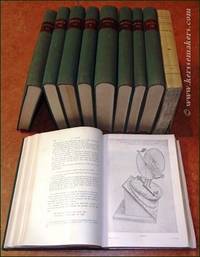
193530490Bruges: The Saint Catherine Press / "De Tempel" 1935. - 1952. 10 vols. 1-9 green cloth hardcovers and vol. 10 paperback Together over 6000 pages with ill. plates; 25 cm. - first 10 vols. of the series cloth sl. soiled corners sl. bumped paper sl. browned/ sl. dampstained Although still very good set see image. ¶ Dedicated to the scholars: 1. D.E. Smith 1936. 2. Sir Thomas Heath 1936. 3. E. O. von Lippmann 1937. 4. P. and M. Tannery 1938. 5. Julius Ruska 1938. 6. Joseph Bidez 1939. 7. Gino Loria 1939. 8. P. Ver Eecke 1948. 9. M. Meyerhof 1950. 10. Henri Berr 1952. The Saint Catherine Press / "De Tempel" paperback
17674468EBRom, Nicolai Roisechii, 1767. 2°. 45,5 cm. 4 Blatt, XXXII, 254 und 252 Seiten. Neue Halblederbände mit illustriertem Bezugspapier. [2 Warenabbildungen]
921CGOel auf Holz. Bildausschnitt: 20 x 30 cm.
33659A Paris, chez Deroy, 1796. In-4°, 221-[3]p. Reliure demi-veau à coins, dos lisse avec pièce de titre rouge, tranches rouges.
94328Napoli, Per Serafino Porfile Regio Stampatore 1748-1750, 265x210mm, reliés demi-parchemin de l’époque, titre au dos manuscri, timbres de possesseur sur page de titre. Bon état.
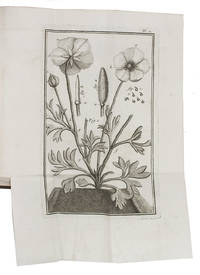
1763K7AAI1IR0DS2Avignon 1763. 12mo. Louis Chambeau Contemporary mottled calf richly gold-tooled spine. With 6 folding engraved plates. 6 16 342 pp. Third and last edition of a manual on ranunculi by the French priest and botanist Jean Paul Rome d'Ardène 1689-1769. "Ardène retired about 1750 from his duties as sepérieur of the college at Marseilles to the Château d' Ardène diocese of Sisteron where he created a botanical garden and gave himself to the study of flowers" Hunt.Ranunculus is a genus of toxic flowering plants including buttercups spearworts and water crowfoots. It is divided into two parts. The first pp. 1-30 deals with the history of ranunculi how they got their name and where they originated and gives a description of the physical appearance of the plant. The second part pp. 31-336 deals in great depth with its cultivation commenting on the perfect soil how and when to water them and place them in sunlight how to get rid of aphids and plant diseases etc. followed by descriptions of the plates. A very good copy binding rubbed at the foot.l Nissen BBI supplement 45na; cf. Cat. Lindley libr. p. 10 1st ed.; Hunt 526 1st d. unknown
Pianta di Roma antica, orientata con il nord a sinistra."A proiezione obliqua; orografica. Veduta a volo d'uccello con la raffigurazione dei soli edifici e monumenti pubblici principali, rappresentati in alzato" (cfr. Scaccia Scarafoni p. 36).La mappa deriva da quella di Johannes Blaeu del 1663, della quale è una perfetta riedizione, non derivante dalla stessa lastra: "Quella del Mortier non è dunque un ristampa della precedente del 1663, come si legge in qualche repertorio, ma una perfetta riedizione […] lo dimostrano alcune varianti, il titolo in latino al centro in alto rialzato per far posto alla sottostante traduzione in francese, i toponimi interamente riscritti e leggermente più grandi dell'originale, soprattutto la scomparsa del ricco stemma del nobile Simone van Hoorn e del cartiglio con la dedica allo stesso, a firma del Blaeu" (cfr. Caldana, p. 98).Opera tratta dal terzo volume del Nouveau Theatre de l’Italie.Acquaforte, con margini, in perfetto stato di conservazione. Map of ancient Rome, oriented with the north to the left."A proiezione obliqua; orografica. Veduta a volo d'uccello con la raffigurazione dei soli edifici e monumenti pubblici principali, rappresentati in alzato" (cfr. Scaccia Scarafoni p. 36).The map derives from Johannes Blaeu's map of 1663, of which it is a perfect re-edition, nor derived from the same plate: "Mortier's map is therefore not a reprint of the previous one of 1663, as we read in some repertoire, but a perfect re-edition [...] this is demonstrated by some variations, the Latin title in the center at the top raised to make way for the underlying French translation, the place names entirely rewritten and slightly larger than the original, especially the disappearance of the coat of arms of the noble Simone van Hoorn and the cartouche with the dedication signed by Blaeu" (cf. Caldana, p. 98).Work taken from the third volume of the Nouveau Theatre de l'Italie.Etching, with margins, in perfect condition. Caldana, "Roma Antica", 2013, p. 98, n. I.45; Scaccia Scarafoni, "Le Piante di Roma", n. 36.
2025SKU1742974Maretti Editore 2025-01-02. hardcover. New. 11x1x9. New Book Ships with Tracking Maretti Editore hardcover
A Rome, chez l’Auteur, 1815. In 8vo (cm. 17,8); cartonato rigido coevo; pp. IV, 234 (2) + una carta inc. rip.: “Voyage de Rome a Naples” e 26 incisioni a p pagina f. testo di vedute.
17481167<p>Lugdunum Batavorum: Samuelem Luchtmans1748. Illustrated with folding map. Thick 8vo full calf upper cover detached blindstamp and ink notation to titlepage part 2 titlepage misbound some staining along foredges otherwise very good. BMC Vol 17 p. 172; For a similar map see the Samourka Map Collection #A9109 cartouche is different. Mela was an early Roman geographer originally from Spain. He theorized that the world was divided into five parts of which only two were habitable. The map is particularly odd showing an oversized Indian subcontinent and a much widened Africa. Below Africa is a very large land mass. Mela's De Situ Orbis was originally published in 1471 and saw many subsequent editions published.</p>
Lutetiae, Ioannem Bene, 1569, 23 x 17 cm., piel de época, hilos dorados en ambas tapas, lomo con adornos, 18 h. + 700 págs.
Very Good Turkish, Ottoman (1500-1928) Original fine black quarter leather bdg. Marbled endpaper. Ottoman lettered gilt on spine. 2 volumes in 1. Demy 8vo. (20 x 14 cm). In Ottoman script (Old Turkish with Arabic letters). 2 volumes set: (303, [7] p; 238, [6] p). Hegira: 1305 = Gregorian: 1888. First and only edition of this extremely rare first separate Roman history (as well as the Byzantine history) in the Ottoman/Turkish literature. Ahmed Cevdet Pasha had already dealt briefly in Roman and Byzantine history as part of an outline of ancient and medieval European history (Avrupa'nin Ahval-i Sabika ve Lahikasi): Tarih-i Cevdet (first edition) vol. 6 (Istanbul 1294 AH /1877). The Roman history until Constantine the Great is limited to the first ten pages of this account, the remainder deals with Byzantine history. ABOUT THE AUTHOR: Ahmed Cevdet Pasha was an Ottoman scholar, intellectual, bureaucrat, administrator, historian, and a prominent figure during the Tanzimat reforms of the Ottoman Empire. He was the head of the Mecelle commission that codified Islamic law for the first time in response to the Westernization of law. He is often regarded as a pioneer in the codification of civil law based on the European legal system. The Mecelle remained intact in several modern Arab states in the early and mid-20th century. In addition to Turkish, he was proficient in Arabic, Persian, French, and Bulgarian languages. He wrote numerous books on history, law, grammar, linguistics, logic, and astronomy. (Source: Wikipedia). Özege 12220. Only one copy in OCLC: 776805075. (Universiteitsbibliotheek Leiden).
pp. (2), 352. Cancellans at A2 & H3. 4to. [295 x 230 mm.] Printed on Baskerville's fine, smooth Writing Royal paper. Worn full contemporary mottled calf. All edges decorated red. Caius Valerius Catullus (Ca. 84-54 B.C.), Roman poet, born in Verona, of a well-to-do family. He went to Rome (62 B.C.) where he fell deeply in love, probably with Clodia, sister of Cicero's opponent Publ us Clodius. She was suspected of murdering her husband. Catullus wrote to his beloved, addressed as Lesbia (to recall Sappho of Lesbos), a series of superb little poems that run from early passion and tenderness to the hatred and disillusionment that overwhelmed him after his mistress was faithless. His works include, besides the Lesbia poems, poems to his young friend Juventius; epigrams, ranging from the genial to the obscenely derisive; elegies; a few long poems, notably "Attis" and a nuptial poem honoring Thetis and Peleus; and various short pieces. His satire is vigorous and flexible, his light poems joyful and full-bodied. He was influenced by the Alexandrians and drew much on the Greeks for form and meter, but his genius outran all models. Catullus is one of the greatest lyric poet s of all time. John Baskerville (1706-1775) was the greatest printer of his era. Born in Wolverley, Hereford - Worcester, England, he became a writing master in Birmingham. He also carried on a successful japanning (varnishing) business there. In about 1750 he began to make experiments in letter founding, and produced the wonderful series of types now named after him. His first book, the Virgil of 1757, was also the first to be printed upon wove paper (manufactured by a process that he invented). In 1758 he be came printer to Cambridge University. All of his books bear show fine craftsmanship and a refined sense of design. In the last few years before his death, Baskerville published a few Latin classics in quarto and duodecimo. "All these bear the marks of unabated genius even in his declining days: and suffice, had he printed nothing else, to distinguish him as the first typographer of his time" - T. B. Reed, in 'Old English Letter Foundries'. **PRICE JUST REDUCED! Gaskell 44. W113
Apparently lacks the general title page with Jean Petit's device, and probably the following 17 preliminary leaves. ff. CXL [i.e. 141] leaves. Woodcut initials. Some repeats in foliation. Small 4to. 190 mm. Latin text. Some old marginal dampstain. A few marginal manuscript notes. Attractive in a later full vellum binding. Armorial bookplate of Wm. G. Mack, LLB. A decent post-Incunabula edition of classic texts of Roman history. Edited by Marco Antonio Sabellico. SAFE ADD 1
pp. (4), 318. 4to. Beautiful polished Baskerville paper. Wide margined. Contemporary leather backed boards binding. Engraved armorial bookplate of Asa P. French, U.S. District Attorney for Massachusetts, 1906-1914. Leather bookplates of Howard Lehman Goodhart and Phyllis Goodhart Gordon. John Baskerville (1706-1775) was the greatest printer of his era. Born in Wolverley, Hereford - Worcester, England, he became a writing master in Birmingham. He also carried on a successful japanning (varnishing) business there. In about 1750 he began to make experiments in letter founding, and produced the wonderful series of types now named after him. His first book, the Virgil of 1757, was also the first to be printed upon wove paper (manufactured by a process that he invented). In 1758 he be came printer to Cambridge University. All of his books bear show fine craftsmanship and a refined sense of design. In the last few years before his death, Baskerville published a few Latin classics in quarto and duodecimo. "All these bear the marks of unabated genius even in his declining days: and suffice, had he printed nothing else, to distinguish him as the first typographer of his time" - T. B. Reed, in 'Old English Letter Foundries' Gaskell 51; Brunet V:87; Grasse VI:242. Some age stain on the title page, but otherwise an attractive copy of a Baskerville classic. **PRICE JUST REDUCED! W113
Due opere riunite in un volume (13x20,5 cm) in legatura coeva di piena pelle, dorso muto a nervi, difetti in testa e fondo, spellatura a un angolo; risguardia con carta policroma del tempo. 1) COSTITUZIONE... paginazione: (4)-64 pagine; stemma della Repubblica romana alla pagina di titolo. 2) LEGGI RELATIVE... Paginazione continua ma divisa in due parti: (4)-80 e (4) 81-135 pagine; stemma della Repubblica romana alla pagina di titolo; pagina di titolo con stemma ripetuto anche dopo p.80. Sette carte bianche rilegate in fine. Condizioni molto buone; solo qualche brunitura sparsa. Edizione originale della Costituzione romana modellata su quella francese, e proclamata dal “Général en chef de l'Armee de Rome, Massena” come dice la Proclamation in lingua francese (e con traduzione italiana al verso) premessa al testo costituzionale. Esiste (v. Sbn) una variante con 4 pp finali di indice, ma questa è l'E.O. come possibile verificare dalle copie digitalizzate delle Biblioteche nazionali. “l 17 marzo 1798 fu emanata la Costituzione formata di 372 articoli, ripresa da quella dell’anno terzo, con adattamenti che si giovarono del contributo del grande archeologo Ennio Quirino Visconti. Dopo le dichiarazioni dei diritti e dei doveri, era fissato il principio della separazione dei poteri con un esecutivo di cinque consoli, con il potere legislativo affidato ad un sistema bicamerale (il Tribunato e il Senato), ma con intelligenti funzioni diverse: al Tribunato era riservato il potere di iniziativa legislativa, al Senato funzioni di Corte suprema. Il potere giudiziario era formato da magistrati eletti in assemblee popolari, inamovibili e indipendenti dagli altri organi dello stato. Nel governo provvisorio di febbraio furono nominati il matematico Gioacchino Pessuti, il mercante Domenico Maggi, il Visconti, il medico Camillo Corona, il duca Pio Bonelli, il mercante Angelo Stampa. Tra i consoli del periodo repubblicano ci furono poi il chirurgo Liborio Angelucci, gli anconetani Pietro Panazzi e Pietro Reppi, il medico frusinate Giacomo De Mattheis. Fu quindi il ceto medio dei professionisti, dei mercanti, degli uomini di cultura a formare l'ossatura del personale politico, amministrativo e militare della Repubblica romana del 1798” (v. Nicola Terracciano).
In Roma, nella Stamperia De Romanis, 1821 - 1823, volumi 2, in-4, cartonatura originale (lievi difetti), pp. XII, 617, (3) - VII, da V a VII, 576. Con 13 tavole fuori testo nella prima parte (11 in rame e 2 di iscrizioni) e 20 nella seconda (19 in rame e 1 di iscrizioni). Primo volume completo.
In Roma, presso G.o Antonelli in Piazza di Sciarra n. 233, [anni '30 del XIX sec.], in-4 piccolo, formato album, legatura ottocentesca in mezza pelle, fregi neoclassici impressi a secco al dorso (spellature) frontespizio calcograficco + 47 belle vedute incise in rame (mm. 143x193 circa, l'impronta della lastra, mm. 200x270 le carte, compresi i margini bianchi). Due tavole sono sottoscritte "Achille Parboni inc., 1826". Ex-libris Walfredo della Gherardesca. Buon esemplare.
In-4°; pp. 212, (6) frontespizio illustrato inciso su rame con l’immagine della madonna che raccoglie sotto il manto i fratelli, i santi Pietro e Polo e stemma cardinalizio. Legatura in mezza pelle con titolo impresso in oro al dorso. Rossetti 10262
in-8°; pp. (8), al frontespizio stemma papale inciso su legno, legatura in cartonato colorato.
Roma, 1839. In folio (cm. 33); buona ed elegante legatura in mezza pelle con titolo e fregi in oro di epoca posteriore; pp. 53, (1) + una tavola incisa con un Virtuoso con l’uniforme ufficiale + grande tavola più volte ripiegata con “Dettaglio de ricamo in oro dell’Uniforme accordato dal Governo Pontificio ai Virtuosi di merito residenti e corrispondenti della Insigne Artistica Congregazione de’ Virtuosi al Pantheon”. Fin dalla fondazione, i Virtuosi al Pantheon hanno annoverato i più importanti artisti che hanno lasciato a Roma tracce imperiture del loro ingegno. Dal XVII secolo furono periodicamente allestite mostre sotto il pronao del Pantheon, che ebbero amplissima risonanza. Nel 1839 fu pubblicato un nuovo Statuto, e così, con fondi del pubblico erario, venne istituita una rendita annua per bandire concorsi fra artisti. Axs
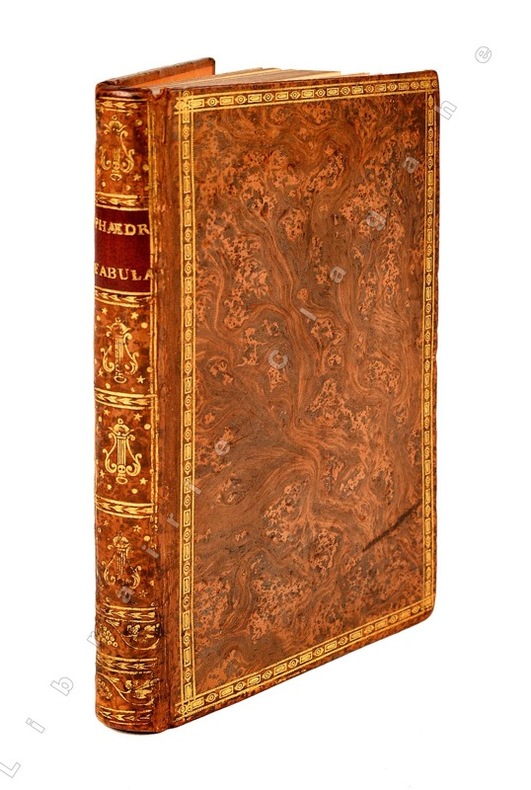
174221423Parisiis, apud Coustelier, 1742 ; in-12, veau raciné, dos lisse à faux nerfs dorés, fleurons à la lyre, palette à la grappe de raisins, pièce de titre rouge, belle roulette d’encadrement et roulette sur les coupes, tranches dorées, gardes oranges (reliure de l’époque) ; [24], 132 pp., frontispice de Coypel gravé par Fessard, bandeau répété cinq fois, par Pierre, gravé par Fessard.
197234881972 aucune reliure 25 x 16,9 cm et 25 x 16,8, tirages gélatino-argentiques d'époque, sans autre mention qu'un "F" au verso de la main du tireur.
In 8 gr. pp. 156 + (2). Pieno marocchino nero con bordure, fregi oro ai piatti e monogramma (A. F.) al piatto anteriore. Raro testo della discussione parlamentare relativa ai fatti iniziati a Terni nel giugno del 1867, da dove parti' il tentativo di presa di Roma poi fallito con la battaglia di Villa Glori. Di questo fatto sono riportate le missive tra Prefetti, forze dell'ordine ecc. relativi alle indagini sul Faustini e i suoi sodali. Sono poi raccolte tutte le informative relative agli spostamenti del Generale Garibaldi, di Menotti, i movimenti di volontari, l'arresto di Garibaldi a Sinalunga del settembre '67, l'arresto di altri Gartibaldini a Firenze, la sorveglianza del confine con lo Stato Pontificio, la sorveglianza del litorale tra Genova e Livorno ecc. Interessante documento in legatura di pregio.