1 281 résultats
1928022784Paris Éditions MORNAY 1928 un volume in-4°, (10) 237 pp., couverture crème illustrée en couleur. (entaille de 5cm en milieu de couverture, dos fendu en trois endroits, bruni en queue et comportant trois petits manques de papier). 123 compositions ( vignette de titre, frontispice, très nombreuses lettrines, culs-de-lampe et ornements ) rehaussées à la main à la gouache et à l'aquarelle de Clarence GAGNON. Un des plus beaux livres publiés aux éditions Mornay. Tirage limité à 725 exemplaires numérotés, un des 650 sur Rives (n° 288). Intérieur très frais. Exemplaire à relier.
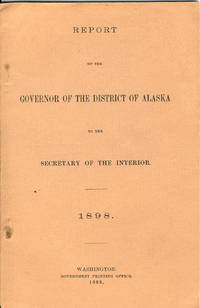
189832865Washington: Government Printing Office 1898. 1898. First edition. 8vo. Salmon-colored printed wrappers 49 pp. map. Large portion of the report deals with more effectually carrying out the law prohibiting the sale of intoxicating liquors in Alaska. Mention is made of a tribe on the Admiralty Island known as the "Hoochinoos" who used to smuggle to the soldiers at Sitka a beverage known as "hoochinoo" and "hooch." "Hooch" was made from a mash of black molasses imported from the Hawaiian Islands. Smuggling and the control of smugglers is of great concern to the law as well as effectively enforcing the laws to protect both saloon keepers and the citizens. The governor further reports on criminal and penal laws land laws population taxable property agricultural development stock raising reindeer fur seals sea otters mining etc. Disasters are included in the report with the mention of the schooner Lady Jane Grey that went down off Cape Flattery with only a few saved. A map of the longitudinal section of workings of the Alaska/Mexican Gold Mine is also present. A fine clean copy. WICKERSHAM 227. Government Printing Office, 1898. unknown
SONG1591981247Creative Teaching Press 0000-00-00. paperback. Used: Good. 9.00x0.25x11.25. Buy with confidence. Excellent Customer Service & Return policy. Creative Teaching Press paperback
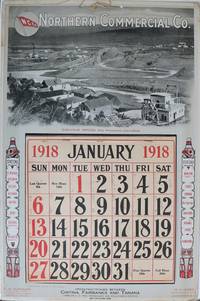
1918137331San Francisco: International Printing Co. 1918. Undetermined. very good. Colour calendar on heavy cardstock. 21" X 14". Occasional very light chipping and to edges. Corners bumped with some creasing. A few other light creases to edges. Full calendar pad Jan - Dec present with penciled notation in most days. Original string hanger present. Colours bright and unfaded. This poster is in very good condition. A scarce advertising calendar for the Northern Commercial Company N.C.Co. a retail company which maintained rural village stores across Alaska and in the Yukon. N.C.Co also operated steamships through Alaskan trade routes. The image on the poster features mining at Iditarod Alaska. Two totem poles on either side of the calendar pad list several stations of the N.C.Co. including Fairbanks Dawson Yukon Territory Bettles Iditarod and many others. The verso of the calendar is a full-page map of Alaska showing sea routes and locations of N.C.Co posts. A later incarnation of the business still maintains 30 stores across rural Alaska. See two other examples in this catalogue. 1918 International Printing Co. unknown
1917List1730Chicago: Poole Brothers 1917. Folding map measuring 38 ½ x 26 ¾ inches. Tape repairs to verso some tears at folds and edges still bring and attractive good to very good overall with excellent restoration potential. A map of the canneries in Alaska British Columbia and Washington operated by the Deming and Gould Company who were influential in the growth of the Alaskan salmon trade. The map’s date of printing 1917 suggests that perhaps it was related to the war effort as salmon demand increased during this period. The Demings based in Chicago were influential in the growth of the salmon trade in Alaska and the Pacific Northwest founding Pacific American Fisheries Inc. in 1899 and continuing in various iterations until their sale of the firm in 1934 due to president E.B. Deming’s ailing health. The map shows seventeen different canneries several on the Alaska peninsula and the one in Bellingham. We find no record of this imprint only a later and small version held at the University of Washington. Poole Brothers unknown
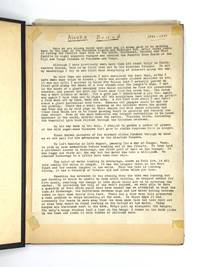
74398Typescript account of 32 pages accompanied by 31 black and white photographs gathered in a scrapbook album documenting an unidentified Washington’s man’s hiking climbing and sight-seeing adventures in Alaska. Written along the top edge of the first page is “Alaska Bound 1946-1947.†Twenty-three of the onion skin paper pages are scotch taped to the album pages and the final nine pages of the typescript are loose and laid into the back of the string-tied album. The black and white photographs measure 4 ½ x 2 ¾†and are affixed to the album pages with black photo corners. The tape affixed to the pages has oxidized but otherwise overall on very good condition.<br/> <br/> The unknown author was a crewman on a cargo ship and wrote that he had made more than 150 prior trips to Southeastern Alaska. On this trip his ship set out from Seattle to the Aleutian Islands and made a stop at Anchorage to drop off some dogs for the Army. “As part of the cargo which we were carrying we had on deck sixty-one sled dogs raised in Nebraska†he wrote. “They were supposed to be mostly huskies but in reality were a mixture of almost everything…It was remarked: ‘They are nothing but a darned bunch of Nebraska coyotes.’â€<br/> <br/> Beyond Anchorage the ship’s itinerary included Adak Attu Shemya Whittier and Amchitaka. The narrative covers his experiences on board but is mainly devoted to his shore adventures oftentimes with other members of his crew which include mountain climbing hiking fishing trips and sight-seeing during his free days while cargo is being off loaded. One of his first adventures was a trip to Wasilla and Palmer. “Back in Palmer once more we made the acquaintance of one of the old timers who gave us quite a history of Alaskan mining from the early gold rush days up to the present time†he wrote. “He tried to persuade us to go back into the mountains with him to take pictures of his claims.<br/> <br/> On the way to Adak he spotted “whale birds†and soon whales were also seen. “During the war whales in these waters were frequently attacked by both bombers and submarines in error†he wrote. “It was it seems difficult to detect the difference between submarines and whales.â€<br/> In addition to being an avid and skillful storyteller and photographer the diarist had a wide-ranging knowledge and interest in the flora and fauna of the region. During a port stop in Attu he explored Holty Holtz Bay and traveled to the summit of Jarmin Pass where the Japanese once maintained a principal base until it was recaptured by the United States during World War II. “In the foreground and also in the distance some dummy guns and other equipment could be seen scattered about†he wrote. “I followed along the stream and before long came across a few small willow bushes less than three feet in height bravely struggling for existence against the elements. They were located in a thicket of Russian thistles wild cherry tanzzy monk hood and numerous other kinds of vegetation. That was my first glimpse of anything in the form of wood growing in the Aleutians.â€<br/> <br/> On this break he undertook the first of several climbing expeditions – this one of Gilbert Ridge. It was a near catastrophe after the weather turned foggy while he was climbing the jagged peaks made the wrong decision dead-ending against sheer cliffs and fell while back tracking his route. “In that next instant I found myself bouncing over the wet cozy ground like a toboggan over a snowbank…I started flying through space at what seemed to me a mile a minute. In the next instant there was a big swoosh as I cut a path three feet wide and five feet long through a patch of Indian celery Russian thistle and Monk’s Hood and landed with a flop in the creek bed below and that was that.†Although he was fortunate to escape with a sore shoulder and sprained thumb he was soaking wet and faced a long journey back to the ship.<br/> <br/> The scrapbook is filled with numerous descriptive accounts of his adventures during the journey. The photographs complement the text and include various images of his explorations ranging from Whittier Glacier to two men holding a crippled Bald Eagle a trading store in Wasilla and fishing at Finger Arm. At the end of the trip before returning to Seattle he and his shipmates went into the woods and cut Christmas trees which they delivered to families on the treeless remote Aleutians. unknown
1898WRCAM32668Washington: United States Geological Survey 1898. 244pp. plus folding colored map. Original printed wrappers detached. Map with four neat closed tears. Text bright and clean. Very good. Report issued by the United States Geological Survey for the use of prospectors and miners including descriptions of routes to the Klondike and notes on the probable extent of gold-bearing deposits. The large folding map of Alaska is particularly fine and has some of the gold region shaded in bright yellow. WICKERSHAM 8223. United States Geological Survey unknown books
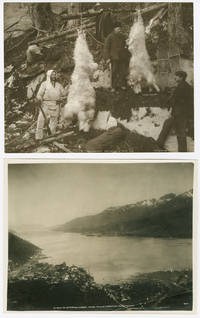
1907WRCAM54628Juneau; White Pass 1907. Two photographs each approximately 7 1/2 x 9 1/2 inches. Slight wear at edges. Captioned in negative. Very good. Two attractive original photographs by noted Skagway photography firm Case & Draper. William Case and Horace Draper followed the excitement of the Klondike Gold Rush and went North in 1898. They stayed and worked in partnership from a studio in Skagway until 1907-1908. The first of these photos depicts three armed men on a hillside at White Pass Alaska with two large mountain goats strung up after a hunt. The second is a captivating landscape of Juneau and the Gastineau Channel with the town of Douglas in the distance. Impressive examples from these significant Alaskan photographers. unknown books
Abundant black and white illustrations and reproductions of photos. Features: The Human Fly - Excellent photo-illustrated article on Jack Williams, a man who scales lofty buildings with no equipment other than his fingers and toes - article with great photos ; The Last Fight of the Five Hundred - Part II - Tragedy befalls French troops overwhelmed by the overwhelming force of Mustapha Kemal Pasha's rebel Kurds and Turks during the siege of Urfa; The Disappearance of Ivan Varlamoff - an epic fight in Uleaborg, Finland; Locked in a Freezing Chamber - a meat inspector's ordeal in South Africa; "UMRI" - the tragic story of a panther, once a police officer's pet, which becomes a terror of the district in India; The "White Man's Grave" - Filming The "Gold Coast" of Africa - article with great photos; The Friend of the Birds - photo-illustrated article on Jack Miner, Ontario's friend of the Canada Goose; My Jiu-Jitsu Combats - Captain S.L. McLaglen is a Jiu-Jitsu expert; A Treasure-Hunt in the Land of Thirst - Part III - an exciting trip to the "Mysterious Richtersveld" of Southern Africa - article with photos; Adrift in the Atlantic - Grenfell of Labrador sets down a remarkable experience related by a former engineer of his; A Man's Luck (conclusion) - the author met the girl of his dreams and tried to build a dream home for them in Alaska, but he keeps being jailed; A Film-Hunter in the Amazon - Part V - Probably the most adventurous expedition ever undertaken in the interests of the movies - article with excellent photos; The "King of the Brushwood" - the brigand chief of Corsica; Roping a Bear - foolish youngster ropes a cinnamon bear; A Barbed Wire Frontier - people not allowed to pass between Hungary and Czechoslovakia; and more. pp. 8 [ads], [3] 88, 9-16 [ads]. Clean and unmarked with light wear. A quality vintage copy of this wonderful issue. Book
Abundant black and white illustrations and reproductions of photos. Features: The Last Fight of the Great Green Eel - three-day battle with a Conger eel in Trinidad; De Rougemont Right After All! - Shortly after his passing, the incredible stories by Louis de Rougement of adventures with the wild blacks (aborigines) of Australia are proven true! - article with great photos; The Lure of the Jewel - The Forcing of the Duke of Brunswick's safe; Crossed Trails - A remarkable tale of linked lives; The Midnight Visitor - A grim tale of the famous North-West Mounted Police of Canada; Trapped in a Well - two men in Nebraska set out to deepen a well; The Moffat County Mystery - an odd tale from Colorado; A Film-Hunter on the Amazon - Part II - Probably the most adventurous expedition ever undertaken in the interest of film-making - article with interesting photos; A Christmas Hunt in East Africa - sometimes 'exiles' can have a good Christmas; A Double Escape a thrilling royal tiger hunt in India; A Man's Luck - Part V - the true story of a man who set out to build an Alaskan home for the girl of his dream but kept being jailed; The Accursed Lake - The strange story of David Burton and Charles Snisted in New Zealand; The Living Death - an explorer's grim story from the South American jungle; Anthropop - Apology; and more. pp. 8 [ads], [2] 268-351, 9-16 [ads]. Clean and unmarked with light wear. A quality vintage copy of this wonderful issue. Book
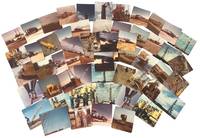
1966233371966. Cook Inlet offshore drilling photo archive of 57 chromogenic color photographs documenting the transport assembly and field operation of oil platform equipment in Alaska in 1966 including derrick sections drill pipe draw works components service trucks staging yards flare fire and rig floor assembly during the period when offshore construction expanded rapidly across the basin between 1964 and 1968. Alaska's first offshore platform was erected in Cook Inlet in 1964 exploration drilling peaked in 1966 and the photographs place the group within the short formative period when Cook Inlet became the proving ground for Alaska's offshore petroleum industry. The photographs record named individuals large platform components drill pipe derrick sections service trucks and specialized machinery moving from yard to worksite and from transport into operation.<br /> <br /> Photo archive of 57 chromogenic color photographs Kodacolor snapshot prints ranging from 3.5 x 3.5 to 3.5 x 4.5 inches Cook Inlet Alaska 1966. The derrick and draw works sections are hauled on heavy trucks across dirt roads rig components unloaded in open staging yards drill pipe rising within the derrick structure and crews in hard hats and work clothes working at the base of drilling machinery. Several photographs isolate specific stages of petroleum work rather than completed structures including a float identified on the verso as "Flatt & Doghouse" a "Tool box & work area on float" machinery captioned "Unloading Draworks from our truck #103 to Gary Bobs Road truck" pipe identified as "13000 ft pipe in deric" and repeated views of muddy haul roads flare fire active equipment and rig floor assembly from both elevated and ground level vantage points. The versos preserve contemporaneous functional captions and named personnel including "Front view with Jerry Blackwood driving" "Little Red & Ramdro discussing plans" "Putting Deric on the floor" "two trucking the Deric" "Bottom 1/2 of the Deric. This is the way we haul it" and "My truck hauling top 1/2 deric pulled over for the day too muddy to proceed to location" giving the archive unusual specificity at the level of individual labor and task sequence. A yard sign for Canadian Superior places part of the group within the corporate landscape of Cook Inlet petroleum development.<br /> <br /> Cook Inlet's offshore fields were the first large scale petroleum infrastructure projects in Alaska waters and the photographs preserve the hauling stages yard transfer pipe handling rig erection truck transport and field conditions through which the basin moved from exploration into sustained production. Named workers truck numbers hauling stages yard transfer pipe handling rig erection and field conditions place the group within the daily labor structure of offshore oil development rather than in finished platform views alone. The seller's Spurr attribution merits caution since later platform compendia place Platform Spurr in Trading Bay in 1968 but that discrepancy does not alter the archive's value as a 1966 record of Cook Inlet drilling logistics and offshore construction practice. Front surfaces show scattered paper residue or adhesion from prior storage with light wear minor discoloration and ordinary handling marks. Overall good condition. A 1966 Cook Inlet drilling archive centered on truck haulage derrick assembly pipe handling named workers and offshore construction logistics during the basin's first major oil boom. unknown
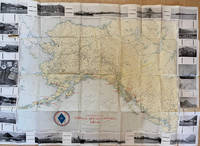
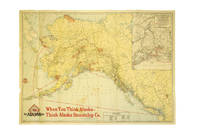
191737386Chicago: Poole Bros. 1917. 1917. ALASKA. First edition. A full-color folded map of Alaska showing both the coastal and seagoing routes that leave from Seattle to Alaska by the Alaska Steamship Company. Points of interest are indicated in red and include the Klondike Region Fairbanks Gold Placers Mt. McKinley National Park Kennecott Copper Mines etc. In the upper right corner is an 11" x 8" inset black & white map of the Copper River & Northwestern RY. and the Alaska Railroad showing Copper River Region in Alaska Prince William Sound the Richardson Automobile Highway Mt. McKinley National Park and Government Telegraph Line and Tributary Territory. Map has a few tears at folds some soiling to the map's surface and general wear from handling and use. Overall a good map of Alaska. Poole Bros., 1917. unknown
Three different formats. Thirteen photographs. Original photographs, black-white. Mostly full-page format, without a framing. With commentaries at the back sides (Swedish Language). Photographs with some minor crinkles at corners and little rubbing. Partly a bit faded at the edges but mostly still with good contrasts. Paper is a bit bent. Appropriate to its age and origin still in good condition. The thirteen photographs include different views on the former copper smelting town Hadley at the Prince of Wales Island (Alaska, US). In Hadley once the mined copper ores have been melted and processed, later the extracted copper was shipped to other places. The photographs exist in three different formats: a small one (ca. 16,4 x 21,5 cm), a middle size (ca. 19,1 x 24,1 cm) and a bigger format (ca. 20 x 25,2 cm). The black-white photographs still own their contrast although a few of them are fading a little bit at the edges. The thirteen photographs give us very different perspectives on this historical place: smelter buildings seen from the near and distanced overviews from a ship. Detailled views on the pier with rails, on a building in construction (in snow), on a ship at the pier and on a cleared piece of land probably for new buildings. One photograph is even showing one of the ships (for travelling) called "Marion". A main overview owns a small stamp and note at the front: "Alaska Smelting & Refining Co. / General View Smelter Buildings". Most of the photographs own commentaries on the back sides in swedish language. Some with two or three lines, a few with ten lines of text (Please see the given fotografic examples). The photographs very probably have been made by a swedish engineer working at Hadley. There has been copper mining and extracting in Sweden long before Alaska became a part of the US. One photograph shows two little girls with blond hair staying in the wood. It seems to be a family portrait, maybe they have been the daughters of this swedish man. There is also an envelope (newer one by Svenska Handelsbanken) with the handwritten swedish title: "Fotografier fran Hadley Alaska". Very rare historical material from Alaska in the first two decades of the 20th century!
19303726Juneau Ak.: Winter & Pond 1930. Good. Panoramic photograph 10 x 34.5 inches. A few heavy creases a handful of short closed tears minor surface soiling and rubbing. An early-20th century panoramic image showing the development of the Alaskan capital city of Juneau produced by prolific local studio Winter & Pond. The image features the downtown portion of Juneau complete with paved streets telephone and electrical wires and hundreds of houses set between nearby Mount Juneau and the Gastineau Channel. <br /> <br /> "Lloyd Winter and Percy Pond preserved the legacy of Alaska's past through their photographs taken over a period of 50 years. The studios of Winter and Pond Company in Juneau Alaska provided local residents and visitors with a rich perspective of Alaska that is now considered a unique reflection of the state in the early 20th century. During the company's existence Alaska expanded mining fishing and resource development into profitable ventures that transformed it from a frontier district to a thriving territory of the United States. The portraits that Winter and Pond produced show the diversity of Alaska's people through the years from the gold rush of the Klondike in 1898 to the end of the mining operations in the Juneau Gold Belt District during the 1940s" - Alaska State Library's Historical Note for the Winter and Pond Collection. <br /> <br /> OCLC reports a few different Winter & Pond views of Juneau from 1909 to 1928 with the present example likely dating from a bit later but nonetheless rare. Winter & Pond unknown
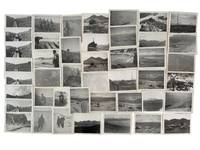
1942218151942. Photograph archive circa 1920s-1944 documenting the construction of the Alaska Highway and related military infrastructure during World War II. The material records wartime military logistics and infrastructure development through photographs of road construction engineering operations heavy machinery and military transport routes in Alaska and western Canada during the war. The photographs include terrain modification machinery deployment bridge construction and coordinated labor by military and civilian crews working under wartime conditions.<br /> <br /> Archive comprises 30 black-and-white photographs including approximately 21 captioned images issued by the Public Roads Administration and War Information Board dating from circa 1942-1944 alongside 10 earlier vernacular snapshots from the 1920s-1930s. Sizes range from approximately 2.5 x 1.5 inches to 5.5 x 3.5 inches. Official photographs depict graded roadways cutting through mountainous and forested terrain heavy machinery including tractors and graders clearing timber and earth and crews working in challenging conditions such as permafrost excavation. Several images show pontoon bridges early roadbeds and military vehicles including jeeps and convoys positioned along newly constructed routes. Captions reference wartime labor and engineering activity. Vernacular photographs depict earlier regional life including individuals traveling by sled posing with fish working in sawmills and operating equipment. Additional scenes include a Chinese barber shaving a client and frontier couples posed outdoors with handwritten verso captions referencing locations such as Juneau and Valdez.<br /> <br /> The photographs record the rapid development of the Alaska Highway following the strategic urgency created by World War II particularly after the attack on Pearl Harbor and military concerns in the Aleutian region. Official photographs focus on wartime infrastructure projects while the vernacular photographs record prewar labor and daily life in Alaska and the Yukon. The archive includes military construction transportation systems sawmill labor travel and regional commercial activity before and during wartime expansion. Light curling and handling wear to vernacular photographs; minor edge wear and occasional markings to official prints; overall very good condition. A visual archive of wartime engineering and northern frontier life during a period of military expansion. unknown
1945215781945. AArchive of 64 original black-and-white photographs documenting American military operations and engineering activities in the Aleutian Islands during World War II. Photographs measure approximately 4.5" x 3.5" and provide an extensive visual record of one of the most remote and environmentally challenging theaters of the war. The images chronicle the daily work of U.S. Army personnel and Army Engineers stationed across the Aleutian chain where military forces confronted not only the threat of enemy action but also some of the harshest conditions faced by American troops anywhere during the conflict. Soldiers appear throughout the archive wearing cold-weather gear field jackets heavy boots and M1 steel helmets while working patrolling and constructing infrastructure amid windswept volcanic landscapes.<br /> <br /> A significant portion of the collection documents the enormous logistical effort required to sustain military operations in the islands. Engineers are shown surveying terrain operating equipment cutting and processing timber and building facilities essential to maintaining isolated military outposts. Several striking photographs depict large timber-log chutes descending steep hillsides toward the shoreline apparently designed to move heavy equipment and supplies through terrain where conventional transportation proved difficult. Other images record lumber operations construction projects and the continual adaptation of military infrastructure to the rugged environment. The archive also contains numerous panoramic views of the Aleutian landscape itself. Snow-covered mountains barren volcanic ridges isolated coastlines glacial valleys and treeless tundra dominate many photographs illustrating why the campaign became as much a battle against geography and weather as against enemy forces. The Aleutian chain stretching deep into the North Pacific and containing dozens of active and dormant volcanoes represented one of the most isolated regions under American military control during the war.<br /> <br /> Naval and maritime operations are likewise represented. Several photographs show transport and supply vessels anchored offshore or approaching remote coastal installations highlighting the dependence of Aleutian bases upon sea-borne logistics. Military camps consisting of Quonset huts and tent encampments appear throughout the collection while one particularly notable image captures an aircraft flying above a military installation underscoring the importance of aerial reconnaissance and patrol operations in protecting the northern approaches to Alaska. Although often overshadowed by campaigns in Europe and the Central Pacific the Aleutian campaign held considerable strategic importance. Following the Japanese occupation of Attu and Kiska in 1942 American forces undertook a costly effort to secure the islands and maintain control of the northern Pacific. These photographs document the infrastructure manpower and determination required to operate in a theater where extreme weather isolation and difficult terrain shaped every aspect of military life. A substantial and visually compelling archive documenting the engineering logistical and environmental realities of America's northernmost front during World War II. Photographs remain in very good condition with minor surface wear and occasional light creasing. unknown
4499KODIAK ALASKA HUNTING PHOTOGRAPH ARCHIVE. An archive of nearly 100 black and white photographs emanating from a mens hunting trip to Kodiak Alaska about 1950. There are images of men with fishing rods and rifles and dead bears crabs fish moose and seals. Some photographs show the men inside the cabin relaxing reading sleeping and cooking. There are also photographs of the early planes that brought tourists Alaskan scenery and small Alaskan towns. The images are in three sizes 5 x 7 5 x 3 and 2 x 4 and all are in fine condition with minor faults such as chipped corners. A fine frontier photography archive. unknown
1875WRCAM18480San Francisco 1875. 43pp. Original front wrapper bound into later half morocco. Very good. A propagandistic appeal by the unsuccessful bidders for a fur seal contract for the repeal of the so-called monopoly of the Alaska Commercial Company. Claims to present only the "facts" and calls on the people and press of America to petition Congress for the repeal the government granted to the Company for a monopoly in the fur seal trade. Includes a brief historical sketch of Alaska focusing on how her natural riches came into the hands of a few money-hungry robber barons and paints a dismal picture of the "serfdom" of the civilized natives on the fur seal islands of St. George and St. Paul. TOURVILLE 269. RICKS p.26. WICKERSHAM 1793. unknown books
4499KODIAK ALASKA HUNTING PHOTOGRAPH ARCHIVE. An archive of nearly 100 black and white photographs emanating from a men’s hunting trip to Kodiak Alaska about 1950. There are images of men with fishing rods and rifles and dead bears crabs fish moose and seals. Some photographs show the men inside the cabin relaxing reading sleeping and cooking. There are also photographs of the early planes that brought tourists Alaskan scenery and small Alaskan towns. The images are in three sizes 5†x 7†5†x 3†and 2 ½†x 4 and all are in fine condition with minor faults such as chipped corners. A fine frontier photography archive. unknown books
1939286138Seattle: Farwest Lithograph and Printing Co 1939. Map. Color Lithograph. 21" x 28".<br/> <br/> This beautifully colored map of Alaska and the Gulf of Alaska shows the Alaskan boat lines from Seattle and was first drawn by Edward Camy for the Alaska Steamship Company in 1934. A great pictographic map includes an inset showing the Alaska Railways route from Seward to Fairbanks and the Richardson Automobile Highway. The bottom of the map shows a series of cartoons of events on the ship. In good condition a great example of Alaska.<br/> <br/> Farwest Lithograph and Printing Co unknown
1939286138Seattle: Farwest Lithograph and Printing Co 1939. Map. Color Lithograph. 21" x 28".<br/><br/> This beautifully colored map of Alaska and the Gulf of Alaska shows the Alaskan boat lines from Seattle and was first drawn by Edward Camy for the Alaska Steamship Company in 1934. A great pictographic map includes an inset showing the Alaska Railways route from Seward to Fairbanks and the Richardson Automobile Highway. The bottom of the map shows a series of cartoons of events on the ship. In good condition a great example of Alaska.<br/><br/> Farwest Lithograph and Printing Co unknown books
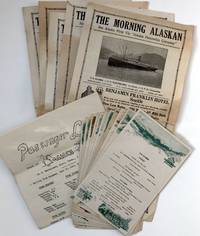
19341007At sea 1934. Very good. Five issues of The Morning Alaskan each 4pp. Also four leaves of manuscript four mimeo news sheets two passenger lists thirteen menus and related material. Light wear and chipping to edges of newsletters and news sheets heavier to news sheets. Light wear overall. A nice archive of ephemera collected during a voyage from Seattle to Alaska aboard the S.S. Alaska. Founded in 1894 the Alaska Steamship Company ran cargo and passenger service to Alaska from Seattle through the mid-1950s at which point it became a freight-only company until its demise in 1971. The materials here likely saved from a voyage in June 1934 provide a glimpse into Alaskan cruise tourism during the height of the Great Depression. There are four daily mimeo "news sheets" titled "Sense and Nonsense" which are filled with one-liner inside jokes about the goings-on about the ship: "Mr Sullivan his own is still holding against all comers and how!!" and "Who was the boyfriend in Ketchikan Rose The flowers at least were beautiful." Additionally thirteen menus for breakfast lunch and dinner meals. The shipboard newspaper The Morning Alaskan features ads and a vignette of the ship on the first page followed by a mixture of news and tidbits from locales across the globe. One issue includes news about the dock strike in San Francisco the reappearance of a missing Japanese Vice Consul in Shanghai and sports news. It was a fairly sophisticated production presumably with the first page pre-printed and then the interior mimeographed aboard ship. The manuscript leaves contain brief notes about the voyage. Upon leaving Seattle on June 13 the author made the following notes providing an insight into the other passengers on the ship: "Six mo. truce made. First boat in 6 mo. why Eng. boats no help to Alaskans. Heavy cargo interesting loading - autos personal Bride soldiers lecturer natives Alaskans going home prospectors old men going back missionaries teachers natives contractors for school projects "nails counted." Orchestra steward. News Daily - ship personals sight seeing paper. Food number of meals & type." He notes stops at Juneau and Hawkes Inlet: "Juneau again. Hawkes Inlet at 9:30 p.m. light. Beautiful. Private homes at most canneries Gov. visiting Hawkes Inlet came on board." Though brief his notes do provide interesting details about the voyage. Notably this archive also highlights possible Chinese migration to Alaska perhaps for the cannery industry based on the passenger lists. The northbound passenger list from Seattle to Skagway on June 14 lists eighty roundtrip passengers as well as 107 passengers with destinations at various ports along the way such as Ketchikan Wrangell Petersburg Juneau and Skagway. It also lists among the passengers sixty "Orientals" and forty-six passengers traveling "Oriental Steerage." At Hawk Inlet thirty-one "Orientals" disembarked -- no white passengers -- twenty-nine of them traveling steerage. An interesting group of ephemera made even more interesting by the addition of the Asian-American component in the passenger lists. unknown books
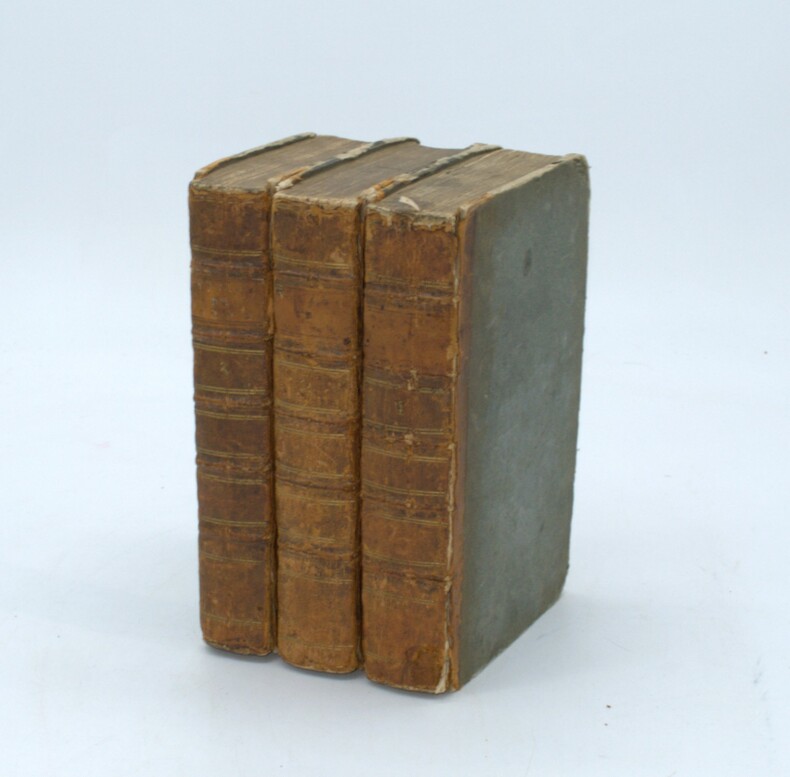
1785PHO-1570Paris, Moutard, 1785. 3 volumes in-8, demi veau époque, dos à nerfs, charnières fendues, coiffes absentes, coin et coupes usés, 3ff.-viii-519pp., 2ff.-591pp., 2ff.-477pp., quelques rousseurs.
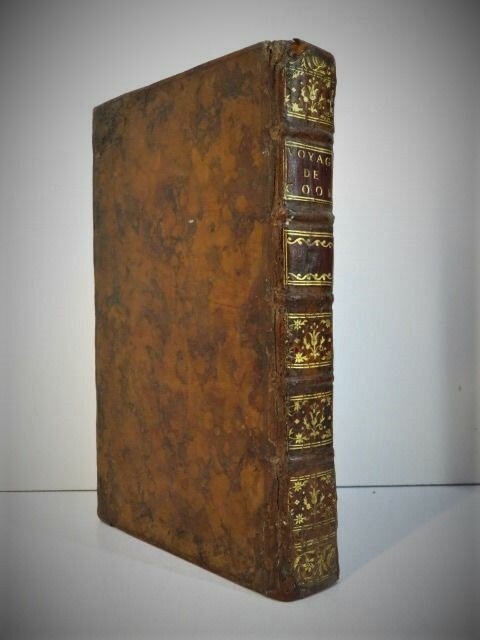
1782PHO-1839Paris, Chez Pissot père et fils, Chez Laporte, (1782) 1 volume in-octavo (20 x 12,7 cm) de X-508 pp., Reliure plein veau marbré d'époque, dos lisse orné avec pièce de titre, tranches rouges, illustré de la gravure de la mort de Cook, la carte est manquante, défauts à la reliure, mouillure en fin d’ouvrage.
1782PHO-717Paris ,Chez Pissot père et fils, Chez Laporte, (1782) 1 volume in-octavo (20 x 13 cm) de X-508 pp. Reliure plein veau marbré d'époque, dos à nerfs orné avec pièce de titre,la carte et le frontispice sont manquants.