California Imperial CourtBiblio.com
8 987 résultats
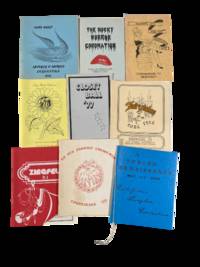
1977226851977. California Imperial Court System coronation program archive of drag performance and community-based organizing ephemera of LGBTQ activist and mutual aid networks during the late 1970s and early 1980s. Produced between 1976 and 1981 by regional courts in Long Beach Monterey and Stockton these materials record ceremonial and social functions central to the Imperial Court System founded in 1965 by José Sarria. The programs capture a period of expanding queer visibility and institution-building prior to the HIV/AIDS Crisis when drag pageantry was fundamental to fundraising political engagement and mutual aid. <br /> <br /> Archive of nine saddle-stapled coronation and event programs issued by California chapters of the Imperial Court System. Includes programs for events such as "Closet Ball '77" "The Rocky Horror Coronation" 1979 "A Spring Renaissance" 1980 and "Ziegfeld '81." Contents feature illustrated covers event schedules advertisements contestant listings and messages from reigning court figures including Empress Dorothy Big Mouth Empress IX Sophie and Emperor James Michael V. Several programs incorporate humor and personal commentary alongside dedications reflecting interpersonal and organizational bonds. The 1976 Long Beach program includes promotional material for Empress candidates notably a full-page image of Louella Mother in drag sponsored by "Queen Mother III of Los Angeles." References throughout the programs identify interconnected networks such as the San Francisco Tavern Guild Operation Concern and affiliated courts across California indicating coordinated regional activity and shared institutional culture.<br /> <br /> These materials document the Imperial Court System's dual function as a performance-based institution and a framework for charitable and social support within LGBTQ communities. Coronation events formalized hierarchies of emperors and empresses while generating funds for local causes embedding drag within broader systems of civic engagement. The programs also reflect the aesthetic and rhetorical strategies of queer communities navigating public visibility in the years following gay liberation movements of the late 1960s and 1970s. Minor toning rubbing and scattered staining to the 1978 "Old Fashion Christmas" program with occasional handling creases; otherwise well-preserved; overall very good condition. A cohesive archive illustrating the intersection of drag performance leadership and mutual aid in California's Imperial Court System. unknown
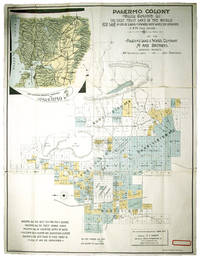
1890WRCAM40516San Francisco: H.S. Crocker & Co. 1890. Chromolithographic map 26 3/4 x 20 3/4 inches. Old folds. Worn along the edges. Long clean split along one fold but with no loss. A few other shorter closed tears along the edges with no loss. A few early pencil notes. Good. An attractive and rare map promoting lands in and around Palermo in Butte County California. Located about sixty miles north of Sacramento Palermo is touted as having "the best soil for fruit culture.the finest orange groves.an unlimited supply of water.a healthy and salubrious climate" all of which make it "the best place to make money in." The map is oriented with north to the left and a colored inset map shows the relative position of Palermo in northern California. The scale is four inches to the mile. The lots are numbered with size noted in acres on many of them and the owners often named. The routes of streets railroads creeks and rivers are also shown. About two-thirds of the lots are colored blue or gold indicating that they have been sold and those colored blue are designated as being planted in fruit trees. McAfee Brothers agent for the Palermo Land & Water Company was headquartered at 108 Montgomery Street in San Francisco. OCLC locates only a single copy of this map at the Bancroft Library at the University of California. Rare. OCLC 26431384. H.S. Crocker & Co. unknown books
1855WRCAM28879Sacramento: B.B. Redding 1855. 8pp. Dbd. Light tanning. Very good. An intriguing document submitting a proposal entitled "An Act to Create Three States Out of the Territory of California." The states are to be named California Colorado and Shasta. The state of California is to occupy the territory between the forty-second and thirty-fifth parallels; Colorado is to exist roughly between the mouth of the Pajaro River and the Sierra Nevadas extending south to Mexico; Shasta is to be comprised of the remaining territory. The purpose of the proposed division was twofold: it would be far easier to collect revenue from California's booming population if the territory had three separate administrative governments; and secondly California's tremendous coastline was represented in Congress by only two senators in contrast to the ten senators representing the eastern coastal states. The authors do raise the serious issue of whether or not slavery will be permitted in the new states. It is their contention that only the middle state would profit from the institution its economy most likely based entirely on agriculture and they reject the argument that the issue is critical to the balance between North and South. They maintain that balance is destroyed already and that the fabric of the Union is held together only by the failing patriotism of its citizens. Not in Greenwood. Quite scarce with OCLC locating only six copies. OCLC 11847469 21618433. B.B. Redding unknown books
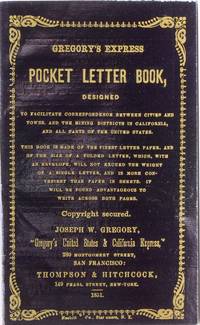
1851320912San Francisco: Joseph W. Gregory 1851. 20 blank leaves. 24mo. Original dark purple wrappers printed in gilt. Minor ink stains on inner wrappers otherwise a near fine copy with the original unused plain paper envelope. 20 blank leaves. 24mo. A lovely example of an unused Gold Rush letter book intended to advertise Joseph Gregory's California and New York Express Line by means of a convenient way for gold seekers in California to communicate with friends and family back home. According to the wrapper "this book is made of the finest letter paper and of the size of a folded letter which with an envelope will not exceed the weight of a single letter and is more convenient than paper in sheets." Gregory also published a pamphlet GREGORY'S GUIDE FOR CALIFORNIA TRAVELLERS; VIA THE ISTHMUS OF PANAMA 1850. This is a scarce California Gold Rush ephemeron. Joseph W. Gregory unknown books
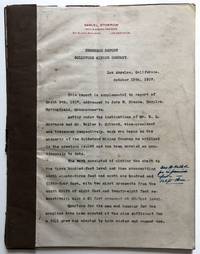
19171262Los Angeles 1917. About very good. 12pp. plus eleven silver gelatin photographs. Folio. Typescript with brown card spine and rear cover. Spine perished leaves loose. Manuscript notations light soiling. Typescript report by mining engineer Samuel Storrow supplemented with eleven original photographs. Storrow 1865-1939 was the manager of the Goldstone Mining Company of Delaware and he reports here on work conducted about thirty-five miles north of Barstow California describing the sinking of a mining shaft and other related operations as well as the quality of ore discovered. He also comments on some of the difficulties with the operation: "The unusual labor conditions brought about by shortage of labor and by serious labor disturbances in the nearby Arizona mines and then an additional shortage of labor due to war conditions rendered the work more expensive than had been anticipated; and the same causes have made it difficult at times to obtain the necessary materials promptly but on the whole the work has been prosecuted steadily and within the estimates previously prepared." Additionally there is mention of the assessment and exploration of the "Big Drum group the Lucky Find group and the Golden State group" which also operated in the area. The report concludes with Storrow's recommendation to continue with the mining program developed by the company and with a detailed financial report. The photographs all have typed captions and depict the area around the mine as well as its machinery and buildings.<br/><br/>Gold was reportedly discovered at Goldstone as early as the 1880s. With the discovery in 1915 of an especially productive claim at Redfield prospectors began to flood into the area. By February 1917 a boomtown had emerged and the Goldstone Mining Company had established a mill. Rather unexpectedly and inexplicably however prospecting declined precipitously in 1917 and by August 1918 the post office established for the town closed its doors. Today Goldstone is regarded as the last in a series of boomtown gold rushes that began around 1906 with the discoveries in Goldfield Nevada. unknown books
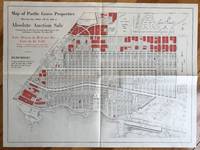
1919832San Francisco 1919. Very good. Folded map 21 x 28 inches. Promotional text printed on verso. Minor wear. Map highlighting lots in the city Pacific Grove on the Monterey peninsula owned by the Del Monte Properties Co. and to be sold by auctioneers Barry & Austin with no reserve. The text printed on panels on the verso highlights this as a brilliant investment opportunity particularly targeting the concept of the vacation rental: "The country today is on the eve of tremendous prosperity and every city large or small will naturally feel the effect. Keep in mind that real estate is the safest and soundest investment you can possibly make. . Buy a lot in Pacific Grove at this sacrifice sale build a small bungalow live in it when you want to and rent the bungalow the rest of the year at a rental which will give you the use of the house free." Interestingly the text notes that Liberty Bonds will be accepted at par value as forms of payment. The map shows lots for auction in red with a tidy block fronting Monterey Bay. An attractive map depicting the post-war real estate boom in California leading into the Roaring 20s. We locate four copies in OCLC -- at Yale California Historical UC Berkeley and UC Santa Cruz. unknown books
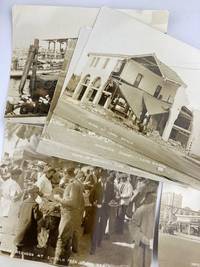
19331962Long Beach Ca 1933. Very good plus. Forty silver gelatin photographs. Twenty-six mounted on leaves with typed captions the remainder loose but captioned in negative. Images 3.5 x 5.75 inches and 3.5 x 4.5 inches. Images crisp and clean mounting leaves a bit rumpled with light wear. Small collection of images documenting the Long Beach Earthquake of May 10 1933. The images mounted to sheets are numbered and captioned in typescript with the heading "Earthquake Damage - Long Beach and Vicinity. March 14 1933". They provide a visual survey of the damage to major sites around Los Angeles and Compton such as the Masonic Temple the Dominguez Sub-station the Security First National Bank in Compton buildings along East Compton Boulevard and several of the local schools. The loose photos all show damage in Long Beach itself including the Seaside Hospital the Catholic Church the Imperial Theatre schools and an image captioned "Feeding refugees at Lincoln Park - Long Beach Cal."<br/><br/>The Long Beach Earthquake occurred just before 6 o'clock in the morning and was a magnitude 6.4 killing more than 100 people. The epicenter was offshore south of Los Angeles with much of the damage limited to Long Beach but also spreading north into southern L.A. It is notable that many of the images here document school buildings as more than 200 schools were damaged in the event. This highlighted a need for earthquake-proof construction in school buildings where the death toll would have been much higher had the earthquake struck during school hours and the legislature passed the Field Act on April 10th as a result. An altogether interesting set of images. unknown books
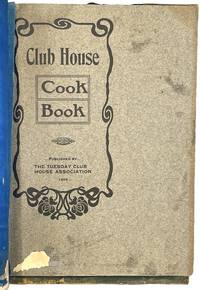
190410151Sacramento California: Press of A.J. Johnston Co 1904. First Edition. 8.5 x 6" grey printed wrappers encased in green suede wrappers 127 pp with pages 96-127 consisting of local advertisements. An early owner has crudely encased the original booklet in green suede wrappers with cloth reinforcements to hinges; occasional staining and creasing to pages mild staining and paper abrasions to covers staining and chipping to suede wrappers three of the advertisement pages have been covered with recipe clippings additional clipping to margin of one page few annotations to pages. An early Sacramento California community cookbook by a social club dedicated to the civic and community interests of the city. Includes recipes for "southern gumbo soup as made by our old Auntie Mary" navarro salad enchiladas olive patties frijioles la laurita nut cake rum punch and more. This copy contains six pages of manuscript recipes on blank pages or in the margins including oysters in chafing dish currant punch lady fingers and Easter cake. The contributor of each recipe is named. Four in OCLC. Press of A.J. Johnston Co hardcover
1956mon0000100710Berkeley 1956-01-01. Hardcover. Good. in x in x in. EX LIBRARY BOOK Berkeley hardcover
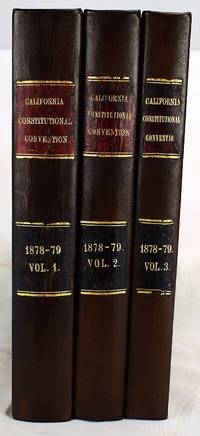
18801710240064Sacramento: E.B. Willis and P.K. Stockton 1880. Hardcover. Very Good. 3 volume set. Proceedings of the second Constitutional Convention of California. Bound in later 1/4 leather over marbled boards. Original spine labels laid on spines moderately chipped. Pages generally clean and unmarked with minimal foxing. Overall a clean set. 1578 p. ; 30 cm. Text in double columns. Convention adjourned March 3 1879. "Constitution of the State of California": p. 1510-1521. Rocq 6638. This is an oversized or heavy book which requires additional postage for international delivery outside the US. E.B. Willis and P.K. Stockton hardcover
Telephone Talk was the glossy bimonthly publication of the British Columbia Telephone Company. It was written by employees for employees to present information of interest to those engaged in the plant, traffic, commercial, operating, accounting and other departments of the service. Each issue is replete with black and white photos and information on topics such as: company, industry and technological news, traffic levels, expansion plans, personnel announcements, publicity and social events, deaths, weddings, lists of exchanges, and more. As such, these issues serve as a vital preserve of rare and fascinating British Columbia history. This volume covers topics including: Hundred Thousandth phone installed - lengthy article; Essentials of good maintenance; Statement of Development - number of phones per exchange in the province; B.C. Telephone Company takes over East Kootenay System; Prompt service aids with Sidney fire; The office boys dream; Telephone assists in Vancouver Stock Exchange (VSE) Rush - great photo; Automatic phone system installed at Hammond; Keeping the electrons on the proper path; Photo of J.P.D. Malkin takes part in first Vancouver-London phone call; Shell Oil operator; Health Tips; Greater Vancouver can now talk to the European continent; Cable damaged by anchor; Radio interference putting music on phone lines; Production of phone directories - 4 pages with photos; Laying cable through Stanley Park; Direct Route to West Vancouver completed - 5 pages of interesting text and photos; Langley Prairie phone service restored during the fire - article with photos; Phone given as wedding gift in Vancouver; F.C. Paterson; Vancouver Power House Fire; Mr. George H. Halse becomes Chairman of the Board; Close-up photos of splicing job; Transatlantic phone service still expanding; photo of horse-drawn 'drop wagon'; Photo on Cordova St. after fire 42 years ago; There's more to installation work than just placing a telephone - 4 pages with photos and text; Good-bye to operating when Dan Cupid comes along; Sending news stories to Vancouver from California over phone wires; We are linked with 80% of the world's phones; photo of conduit laying on forty-first ave; The Monophone - advertisement; B.C. Tel. acquires government lines in the Interior; New trans-atlantic long distance mark; Photo montage of vehicles used by the Plant Department; B.C. Box Factory Fire; Baby causes problem by teething on phone cord; Chilliwack phone system now affiliated with us; Regular fire drills; Photo of Premier Tolmie participating in first call from Vancouver to Calgary - with detailed related story; The longest circuit in the system of the B.C. Telephone Company; A new radiotelephone company will be organized; New Fraser River Cable serves South Westminster Subscribers; Eleven european countries with telephone reach of Vancouver; Now installing a new type of telephone typewriter; New faster system for handling telegrams; Benefits of new telephone ownership are evident in 500-mile circle; and more. Half-leather binding. Average wear. Ink stamp of company executive E.P. LaBelle upon top edge of text else unmarked. Binding intact. Significant wear to backstrip with some chips missing. Book
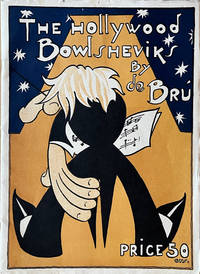
192762150Hollywood CA: Hollywood Bowl Assoc. 7046 Hollywood Blvd. 1927. 4to. 32 pp unpaginated. decorated title w/ tinted background borders 28 Xavier Cugat illustrated plates throughout. Colour-illustrated softcovers Art Deco cover art of caricature conductor by Cugat yapp fore-edges minor wear dustsoiling slight scuffing still VG copy. First edition of this surprisingly scarce and splendidly illustrated caricature rendering of the stars and performers at the Hollywood Bowl for the 1927 Season. Caricatured among the “Hollywood Bowlsheviks†are Alfred Hertz who inaugurated the first Hollywood Bowl season of music in 1922 Bruno Walter Vladimir Shavitch Cecil B. De Mille Louis B. Mayer Pola Negri Hestelle Heartt Dreyfuss Lloyd Wright Pierre Monteux Douglas Fairbank and Mary Pickford. De Bru 1900-1990 was a child prodigy taken to Cuba where he trained as a classical violinist played with the Orchestra of the Teatro Nacional in Havana and after New York was hired as musician and caricaturist in Hollywood at the Bowl. He also put together a tango band in 1927 which performed at the Cocoanut Grove at the Ambassador and later took up a long term residency at the Waldorf Astoria in New York for 15 years and one of the noted performers was Desi Arnaz. His famed caricature “Curtain of Stars†measuring 40 x 60 feet hunt at Grauman’s Chinese Theatre. Cugat’s brother Francis was a noted illustrator best remembered for his cover art of Fitzgerald’s The Great Gatsby. Worldcat locates 1 copy Cal. Hist. Soc. Lib.; Paul Spitzzeri Striking a Chord: A Program for Summer Concerts at the Hollywood Bowl 19-23 July 1927 Homtesead Museum July 20 2020. Hollywood Bowl Assoc., 7046 Hollywood Blvd., paperback
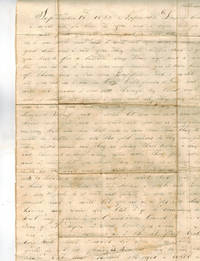
1855007164Sacramento California 1855. Two manuscript letters in ink both on ruled paper with folding creases the 1855 letter 8" x 12 1/2" with single spaced writing both sides approx. 500 words. The 1856 letter 15" x 10" folded in half to make 4 pp. approx. 300 words with small blindstamp top left corner depicting an eagle. The earlier letter is headed "September 18th 1855 Naperville Dupage County Illinois" and ends "Michael direct your letters Nevada County Nevada post office California". George writes to his brother Michael in Naperville that he has "seen a good dele sins i rote you they last letter" including a hundred "inshins" and some "Buffellow". He adds that "we had good luck all they way of may we left Council Bluff" and that he is not home sick yet. He then talks of the gold mines river mining what they are paying and the cost of things such as board "from five to ten dollars a week" "Beaf" "wors 15 to 20 cents" and "potato" "4 cent per pound". He adds that he intends to have some gold before he comes home and that "girls are not so plenty here as they are in state". He closes by asking his brother to write him and to remain at home in Illinois to care for their parents. The 1856 letter headed Sacramento august 3th 1856 informs his brother that he is well and "down to Sacramento now" working on a farm feeding a "schrasing" thrashing machine and that "they times is verry hard in California now". He adds that he had some money "stole" while he was in the mountains but since coming down into the valley he was making money and will send some home soon. The letter ends with George wishing to see them all soon and that he is not home sick. The third page of the letter bears a drawing of a wing or leaf eleven smaller versions of the same image interspersed on page 2. A fascinating testimonial on California during the gold rush written in a strong hand and in a wonderful vernacular style by a good observer. . HOLOGRAPH LETTER SIGNED. Manuscript. Very Good. books
MA05A-08741A.J. Johnston supt. State printing. Collectible - Acceptable. Mt. Hamilton CA: The Lick University 1891 printed by A.J. Johnston supt. State printing. Sm 4to pebbled cloth with gilt titling to the spine and paneled boards. Multiple paginations. Frontis "Silver print of the Total Solar Eclipse of December 1889" from negatives by S.W. Burnham. 10 additional plates and 1 figure. Near good book. A bit edge and shelfworn with a scuffed lower spine with the remnants of a paper label. Small gouge to the upper rear joint. Corners frayed with a few nicks and light soiling to the boards. An owner's name to the front free endpage. Title page and table of contents detached and laid in. Otherwise and internally very good copy with less than the usual age-toning. Solar System Sol Sun Ecslipse Total Eclipse Inquire if you need further information. A.J. Johnston, supt. State printing hardcover
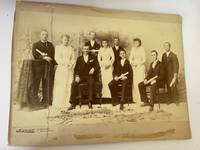
1880182831880. California college graduation photograph circa 1880s documents the presence of an Asian student within a formally posed graduating class at a time of legalized anti Chinese exclusion and widespread racial discrimination in the American West. The image shows ten graduates holding diplomas with men in formal evening dress and women in white gowns presenting a unified visual statement of academic achievement and social standing. At the edge of the group a young Asian man faces the camera his inclusion within the cohort providing rare visual evidence of Asian participation in higher education during a period when Chinese immigrants and their descendants faced systemic barriers to citizenship employment and social mobility. Produced in the years surrounding the Chinese Exclusion Act of 1882 the photograph intersects with federal immigration restriction and regional anti Chinese sentiment in California where exclusion laws and social hostility sharply limited opportunities for Asian communities. The image offers documentation of educational attainment that stands in contrast to dominant narratives of exclusion.<br /> <br /> Large format albumen photograph circa 1880s measuring approximately 22 x 17 inches and mounted to a photographer's board bearing the imprint of Elite Studio San Francisco with gilt lettering along the lower margin. The composition presents ten graduates arranged in a formal studio grouping each holding a rolled diploma with attire consistent with late nineteenth century graduation conventions. The Asian student is positioned at the edge of the formation fully integrated within the group portrait. The photograph retains strong clarity in facial detail and costume with the large scale format emphasizing the ceremonial nature of the occasion.<br /> <br /> Created during a period when Chinese immigrants contributed significantly to the economic development of the American West while facing escalating legal restrictions the photograph provides a point of entry into the study of race education and social hierarchy in nineteenth century California. The passage of the Chinese Exclusion Act marked the first federal law to broadly restrict immigration based on nationality reinforcing racialized boundaries that shaped access to institutions such as universities. Within this context the documented presence of an Asian graduate offers valuable evidence of participation and visibility within elite educational spaces despite systemic exclusion. Crease to one side of the photographer's board with minor glue staining along the lower edge not affecting the image. Some light sunning at the top of the photograph; figures remain sharp and legible. Overall good to very good. unknown
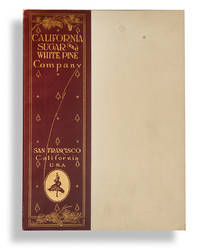
114788San Francisco The Union Lithograph Co. c. 1912. . Tall 4to; 56 photogravures contents toned; original stiff cloth wrappers cream with burgundy backstrip titles gilt wrappers a little rubbed and marked a very good copy.<br /> An uncommon marketing booklet for the California Sugar & White Pine Company which was headquartered in San Francisco from at least 1902 to 1919 based on the dates of correspondence held at the Arizona Historical Society. The contents comprise 56 photogravures documenting the entire lumbering process from stands of old-growth pine through felling milling and transportation. A fantastic record of the American timber industry from the period when it was becoming highly mechanised.<br /> San Francisco, The Union Lithograph Co., [c. 1912]. hardcover
189245920San Francisco: Published by H. W. Faust 1892. 12th Edition. Map mounted at some past juncture and then housed in a simple black wooden frame. Original printed buff wrappers attached to rear of framed map. Usual bit of age-toning. Modest wear & soiling. Very Good. Relief shown by hachures. Depicts drainage rancho and tract names block numbers radial distances from Ferry Building railroads and street railways selected public buildings etc. Adverts in margins. Printed in sepia. Map:. <br/><br/>OCLC records 5 holding instituions. Published by H. W. Faust unknown books
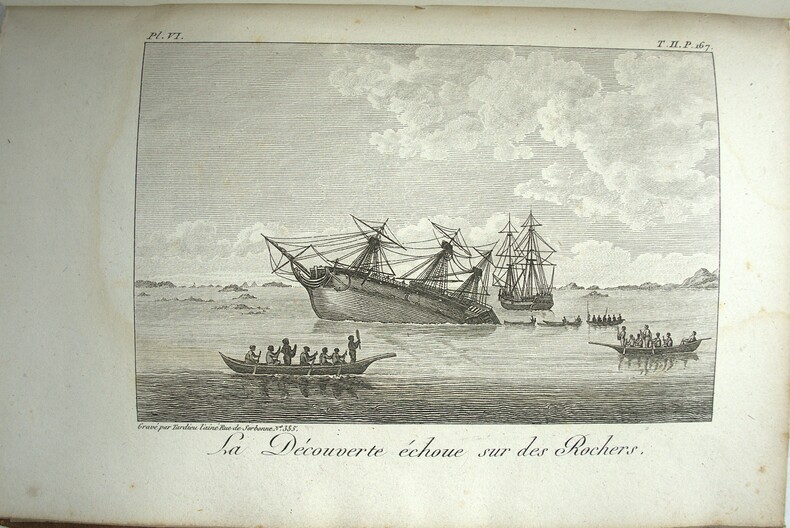
1802PHO-2092Paris, Didot jeune, an X (1802), ATLAS in-8(190x130mm), basane époque, dos lisse orné, manque au dos, brunissures en début et fin d’ouvrage, mouillure claire, légères rousseurs. ATLAS seul de l’édition in-8. Complet de ses 18 planches et 8 cartes dépliantes, De la bibliothèque de Joseph de Lazerme avec son ex-libris et timbre sec
2021BN126230Elsevier - Health Sciences Division 2021. 2021. Hardcover. Diagnostic Pathology: Neoplastic Dermatopathology <br/><br/>Diagnostic Pathology: Neoplastic Dermatopathology David S. Consultant Dermatopathologist and Staff Pathologist Southern California Permanente Medical Group Los Angeles California; Clinical Professor Department of Dermatology University of Calif Elsevier - Health Sciences Division hardcover
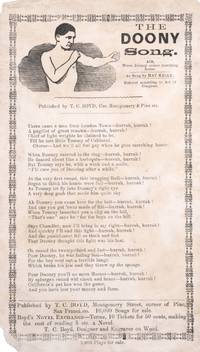
1870332661San Francisco: T.C. Boyd Montgomery Street 1870. Approx. 10x4 inches. Several with woodcut illustrations. Various conditions. Generally very good. Approx. 10x4 inches. Several with woodcut illustrations. Includes: The Doony Song re: the April 1867 victory of American Californian boxer Tom Chandler over British boxer Dooney Harris Great Prize Fight between Lazarus and Peter Daly "I do not Want to be drowned" re: Burning of the steamship Golden Gate near Manzanillo July 27 1862 Sally Come Up Yes I Would the War Were Over Or Any Other Man and more. T.C. Boyd, Montgomery Street unknown
189471028Washington: United States Geological Survey 1894-1900. First edition of all seven folios. 21 2/4 x 18 1/2 inches each. Folio 3 Placerville. 3 maps. 1894. Folio 5 Sacramento. 2 maps. 1894. Folio 29 Nevada City Special. 9 maps. 1896. Folio 41 Sonora. 4 maps. 14x4" portion of rear wrapper torn off affecting lettering on inside rear wrapper; plates and text fine. 1897. Folio 51 Big Trees. 3 maps & 1 plate reproducing 5 photographs. 1898. Folio 63 Mother Lode District. 8 maps. 1900. Folio 66 Colfax. 3 maps. 1900. All in original printed wrappers and cloth spines. Cursive stamp of Chas. S. Sawyer to each volume. Bit of soiling ad corner wear but altogether a very good collection of this attractive group of atlases. United States Geological Survey hardcover
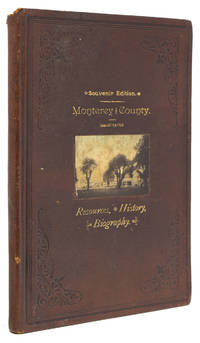
1889251925Salinas Ca: E.S. Harrison 1889. Profusely illustrated. Double-page map. 88 pp. printed in double columns. 4to. Original pigskin gilt with pictorial onlay on front board a.e.g. Chipped at head of spine binding a bit shelfworn. Small closed tear in upper margin of final leaf not affecting text. Contemporary ownership signature on front flyleaf. Very good. In a cloth chemise and half morocco and cloth slipcase spine gilt. Profusely illustrated. Double-page map. 88 pp. printed in double columns. 4to. Designated "souvenir edition" on the front board and without a titlepage apparently as issued. A scarce and early guide to Monterey County featuring a general profile of the region its history resources industries and agriculture as well as biographical sketches of prominent men. Several of the biographies are illustrated with portraits and there are dozens of illustrations of the sights in the county as well. The double-page map shows the entirety of Monterey County. This text was also issued in pamphlet format around the same time for the Salinas City Board of Trade. Rocq 5514 E.S. Harrison unknown
187976513Bodie: V.p. 1879-1882. Bodie Evening Miner. Two Issues; August 1st and September 19 1882. The first Bodie Evening Miner was published on May 9 1882.Bodie Morning News. June 5 1879.Each a bifolio 4 pp. and all three in very nice condition.The town of Bodie was the location of the first lucrative gold strike in Eastern California. Word spread quickly and by 1879 there was a boom town largely preserved today of around 10000 souls. In 1881 the Bodie and Benton Railway was built and used to haul lumber and other goods from the Bodie mines to the saw mill by Mono Lake. But the writing was on the wall by that time as wall and a mere decade later it was largely deserted. More than $38000000 in gild and silver was taken ut of Bodie and surrounds. It is probably the most visited ghost town in the American West. V.p. unknown
193649961N.P. California: Standard Oil of California Sept. 9 1936. Large panoramic photograph 36 x 8.5 in. w/ date noted in lower margin of image very slight creasing in a few spots from when the photo was originally rolled very slight lightening to image at ends still a very sharp crisp photo in contemporary frame old glass with new archival backing. This very scarce panoramic photo provides an excellent historical snapshot of the heyday of Standard Oil Company semi-pro baseball teams in California. Of particular note in this photograph is the presence of the RPM Motor Oil baseball team because 1936 was the year that Standard Oil introduced the brand. To offset the dramatic drop in earnings during the Great Depression Standard Oil pushed heavily researched new products including RPM Motor Oil Standard Gasoline DELO Diesel Engine Lubricating Oil and others. Standard Oil and other large oil companies promoted company-sponsored baseball teams as diversions for oil families to entertain themselves and to incorporate the values of aggressiveness and toughness symbolized by the oil roughnecks. In this photo the RPM team is fielding 15 players in uniform while the opponents Standard Oil are fielding 13 players including one in catcher’s gear. See: Chevron Corporation A History in War and Peace 1927-1946 2015; Standard Oil Bulletin. Standard Oil of California, unknown
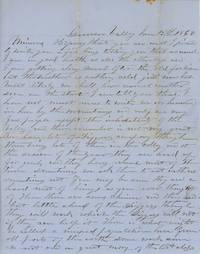
1860List3317Likely Plumas County California 1860. Single four-page letter measuring 7 ½ x 9 ½ inches. Folded with some small tears at folds; excellent. A letter from “Charly†to his wife or fiance written in January of 1860 from “Ganser possibly sic Valley†likely in Plumas County California. Located in the Sierra Nevada Plumas County contained a number of mining towns following the California gold rush; however Charly does not specify his line of work or discuss any particulars. Instead—besides inquiring after the health of family and friends and considering when he would return home—Charly discusses the other residents of the valley. He writes:<br /> <br /> “I can tell you that I have not much news to write we are hemmed in here by the mountains and only see very few people except the inhabitants of the valley and their number is not very great we have lots of Digger company though there being lots of them in the valley and at this season of the year they are hard up for grub and they hang round most of the time sometimes we ask them to eat with us sometimes not You may be sure they are a hard nest of beings as you ever thought of them there are sorry Chinese and they are but little ahead of the Diggers though they will work which the Diggers will not if they can help it There is what might be called a mixed population here from all parts of the earth some work some do not and there are a great many of the last classâ€.<br /> <br /> “Digger†is a derogatory term applied to several Indigenous peoples in the region referring to their diet of root vegetables. In this part of California they would likely have been Northern Paiute or Mono people. Following the US’s acquisition of California and especially after the discovery of gold these groups were decimated by murder enslavement and disease; an 1896 article notes that the Plumas area had proportionally more survivors of American depredations.1<br /> <br /> Of interest to historians of the late gold rush especially relations between Anglo-Americans and other races.<br /> <br /> 1 Mabel L. Miller “The So-Called California ‘Diggers’†Popular Science Monthly 50 December 1896 201–214. unknown