8 987 résultats
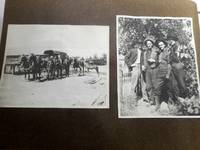
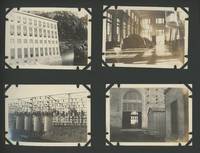
1921List3510California 1921. Photo album measuring 10 x 12 inches containing approximately 360 photographs. Photos are approximately 3 ½ x 4 ½ and smaller with very good to excellent contrast. Album with wear to covers and edges of pages; photos generally excellent to Near Fine. A photo album belonging to an unknown Southern California family; license plates date the album to about 1914 to 1921. Most of the photographs are of family life including farm work: piles of hay; cows pigs chickens turkeys and horse-drawn plows; gigantic watermelons; and family members posing outside vineyards and in cornfields. The family also documented their car and their recreational activities including swimming hiking and fishing picnics and carriage rides. It appears that they were quite proud of their car and were frequent “auto-campers.†They seem to have taken a trip to Mexico or the Southwest as some shots show wide desert landscapes Joshua trees and low Spanish colonial-era buildings.<br /> <br /> Identifiable subjects include the ferry boat Ramona; the Rose Parade in Pasadena showing Culver City Pasadena and Glendale floats; San Gorgonio Mountain Half Dome and the Wawona Tree a giant sequoia in Yosemite; and the Fairview Farm Club parade—a line of cars driving down a dirt road the first decorated with cornstalks—which is probably related to the ranching development located between Huntington Beach and Newport Beach.<br /> <br /> Someone in the family had an interest in hydroelectric power as many shots show ongoing or completed hydroelectric works projects in Southern California. Several show the Southern California Edison Big Creek plant. Located in the Sierra Nevada the Pacific Light & Power Corporation began the Big Creek project in 1910 to provide power to the growing metropolis of Los Angeles. The photographs in this album appear to include both exterior and interior shots. Another set of shots show a dam under construction; this may be Devil’s Gate Dam on the Arroyo Seco which was constructed in 1920.<br /> <br /> Of interest to historians of Southern California in the early twentieth century and some of its public works projects. unknown
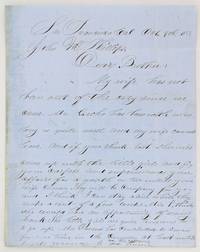
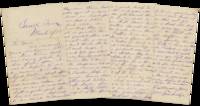
18522473San Francisco: October 4 1852. Very good. 2pp. with integral address leaf. Old folds mild staining and soiling three-inch closed tear to address leaf. An interesting letter documenting the family side of the California Gold Rush in which a San Francisco man writes to his brother offering to send his wife and daughters to Placerville as helpers. Interestingly at first Phillips addresses the letter to his brother in Ohio then scratches it out and writes in "Cal;" this most likely indicates the Phillipses hailed from Ohio and trekked to California along with scores of others in hopes of untold riches in the California gold fields. In his letter Phillips writes that his wife who has long been in San Francisco looking after a sick friend can now leave as he is better "And if you think best she will come up with the little girls and fix your carpets and superintend your affairs for a month or two untill your wife comes." The formerly sick friend Mr. Gardner could also accompany them apparently as "He is coming up to P. and he wants you to give him work for a short time. Mr. G. is a good sailsman sic having been in the dry goods business." While not overtly concerned with gold mining the correspondence is nevertheless interesting for providing details on family routines during the Gold Rush era when numerous families uprooted their lives and moved not only to places like San Francisco and Placerville but between such locations during the years of speculation. A nice example of history from below particularly notable for its domestic implications during the time of the great California Gold Rush. October 4 unknown
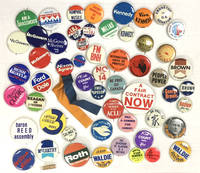
73242A collection of 1950s and ‘60s political buttons supporting causes and candidates ranging from the Vietnam anti-war movement to Ronald Reagan’s campaign for the California governorship. This group consists of 56 unique metal pinback buttons which are housed in a period cardboard box. Most of the buttons are coated paper with metal backing; some are union printed.<br/> <br/> Several of the political pins relate directly to Northern California. For example a button for the Free Speech F.S.M. is associated with the 1964-65 student protest at the University of California Berkeley the first mass act of civil disobedience on an American college campus in the 1960s.<br/> <br/> The orange and black Viva Kennedy button in this collection is representative of clubs formed by Latinx supporters of John F. Kennedy during his 1968 presidential campaign. The Viva Kennedy clubs began in Texas as a forum for Mexican American veterans to rally support for equal rights and eventually spread to swing states with large Latinx populations like Arizona and California. They also promoted increased voter registration and political organization for the Latinx community.<br/> <br/> Another button in this collection advocates “No on Prop 14â€. The Proposition 14 in question is the proposed amendment to the California Constitution which had it passed would have effectively allowed housing discrimination. The initiative was intended to counteract the effects of the Rumford Fair Housing Act which was passed by the California Legislature in 1963 to help end racial discrimination by property owners and landlords who refused to rent or sell their property to people based on ethnicity religion sex marital status physical handicap or familial status. It was drafted by William Byron Rumford the first African American from Northern California to serve in the state legislature.<br/> <br/> Overall the buttons are in very good condition. unknown
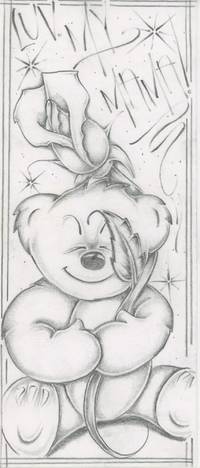
2015List3213California 2015. Eighty letters ten artworks and two photographs. Anonymized for writers’ and their families’ privacy with more information available on request. Overall excellent. Offered here is a collection of letters and art sent from people incarcerated in the California State Prison system primarily from a husband “P.†and wife “A.†to P’s mother and stepfather. <br /> <br /> A. who served a shorter sentence than P. worked as an inmate-firefighter. Currently about twenty to thirty percent of California’s firefighters are incarcerated people and about ten percent of those are women; they work cutting the fireline receiving little compensation and at a significantly higher risk of injury than both their non-incarcerated counterparts and other prison laborers. They also are not eligible to become firefighters upon release due to California’s laws about both employment and EMT certification following a felony conviction.1 A. writes of her training:<br /> <br /> “I’ve been training for camp. Its realy realy hard. This has got to be the hardest thing I’ve ever done in my life. Well Im gonna make this my last trip to prison well I hope so anyway.†January 12 2009<br /> <br /> She also writes from the field that “Its very hard and dangerouse but I guess Im used to it†June 6 2009 with later letters giving more detailed descriptions; for instance:<br /> <br /> “Im not in San Diego right now because my crew and my cousins crew got sent to all the fires that are up North = we left on the 4th and we’ve been on the road and to a couple of fires since I don’t know when we are going back but Im making money! yesterday I worked a 24 hour shift and we got back to have our down time to rest this morning. Its very tireing and hard I felt like I was hiking forever! Right know Im up in Shasta County its beautif up here and I’ve never been this far from home befor.†August 14 2009<br /> <br /> A. wanted to save up to buy a car. She wrote that firefighting is “hard work for a dollar a day†December 14 2009—in 2023 the inmate-firefighter pay rate was raised to an astounding 16 to 74 cents per hour with a maximum daily rate of $5.80 to $10.24.2<br /> <br /> P. on a longer sentence in various higher-security facilities grappled with boredom loneliness and the bureaucracy involved in trying to contact his wife and family. The prisons where he was incarcerated were frequently on lockdown for months at a time including the Corcoran Substance Abuse Treatment Facility which locked down in June of 2009 following a gang-related riot. He often describes being hungry and not allowed to go to the commissary either because of lockdowns or just because “there not letting Hispanics go†January 30 2011.<br /> <br /> One way he seemed to have dealt with his circumstances was through art. Over time his package requests—incarcerees can only be sent packages through approved third-party vendors which contract with prisons—included alongside toothpaste and deodorant art supplies and even a typewriter and books on “how to properly write a novel†January 30 2011. He mentions copying drawings and the reader can see him experiment with different handwriting styles in the letters and on envelopes. The art in the collection includes greeting cards with teddy bear clown—a common character in Chicano art—and nature motifs; a Las Vegas Raiders butterfly signed “E†most likely by P.’s cellmate Ernie for whom drawing is a “little hustle to make money for food and supplies†January 30; and a pair of beaded earrings that P. bought for $10 “to some Indian here†August 25 2010.<br /> <br /> Of interest to scholars of outsider art and incarceration in the California prison system.<br /> <br /> 1 Carly Tolin “Fighting More Than Fires: California’s Inmate Firefighting System Needs Reform†The Georgetown Environmental Law Review February 6 2025.<br /> 2 Doug Melville “Inmates Can Make Up Nearly A Third Of Those Fighting California Fires†Forbes January 9 2025. unknown
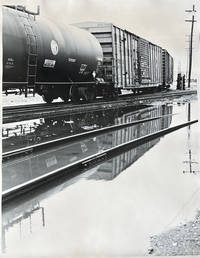
198863366Los Angeles & Westlake Village CA: Bill Bronstein 561 Hampshire Rd. ca. 1988-1989. Folio. 41 original silver gelatin photographs mostly on Ilford Multigrade IV RC Deluxe paper a few w/ photographer’s annotations on verso all sized 11 x 14 in. minor rippling to fore-edges of a couple images still a VG archive preserved in the original Ilford box w/ MS label on white tape affixed to box lid all retaining bright strong contrast from the collection of the photographer. This effective archive of 41 original photographs by Bronstein b. 1949 encompass a series of 34 images he began in the late 1980’s documenting the industrial arteries of Los Angeles Long Beach and San Pedro California transforming through black and white the visual contrast shadow and grit of areas seldom captured. Depicted are grain silos stark against the sun above the railyard; Southern Pacific oil cars with graffiti and rust; the vast Western Paper Mills Supplies Inc. recycling center established in 1983; refinery & cement factory tanks reflected in polluted pools of water; along with night and day shots of the vast railroad switching yards in Los Angeles. A few photos capture the Sunlaw Partners cogeneration power site in Los Angeles who were a pioneer in providing clean safe and efficient power from their plant; and mounds of oil tank floats piled alongside the tanks. Also included are photos of the Vincent Thomas Bridge crossing Los Angeles harbor in San Pedro CA; fishing boats in harbor and Long Beach CA railyards. This archive finishes with seven photos capturing Santa Clarita & Mojave desert along I-395 the Amargosa River and the surrounding landscape. Bill Bronstein, 561 Hampshire Rd., unknown
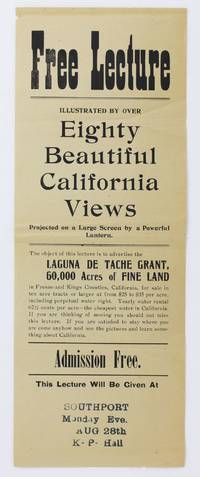
19054170N.p. possibly Fresno 1905. Very good. Broadside 13 x 5 inches. A few small nicks to edges minor even toning old horizontal folds. Lecture location stamp added in bottom margin reading "Southport Monday Eve. Aug 28th K.P. Hall." An apparently unrecorded broadside advertising a magic lantern presentation aimed at promoting land in Fresno and King counties "for sale in ten acre tracts or larger at from $25 to $35 per acre including perpetual water right. Yearly water rental 62 1/2 cents per acre -- the cheapest water in California. If you are thinking of moving you should not miss this lecture. If you are satisfied to stay where you are come anyhow and see the pictures and learn something about California." The Golden State was the site of not one but two Rancho Laguna de Tache land grants. One was granted by the Mexican governor Pio Pico in 1846 to Manuel Castro and included land along the north bank of Kings River for over twenty miles. The other Rancho Laguna de Tache was claimed to have been given to Joseph Yves Limantour by the Mexican governor Manuel Micheltorena in 1843. The latter grant which was along the south bank of Kings River was not honored by the Land Commission after the cession of California to the United States. The broadside then most likely relates to the sale of Castro's 48000-plus acre Rancho Laguna de Tache tract north of the Kings River. Castro sold his land grant to Jeremiah Clark in 1866. Clark's wife Charlotte had her husband declared mentally incompetent and eventually was allowed to sell the land to Charles A. Laton and Llewellyn A. Nares the namesakes of the present-day towns of Laton and Lanare.<br /> <br /> The location of the lecture was a Knights of Pythias Hall in Southport though the exact location of Southport is unclear. From the text of the broadside it is not out of the realm of possibility that the developers of the Laguna de Tache Grant tract were marketing their efforts outside California. We could locate no other copies of this informative broadside. However a map at the California Historical Society of the Laguna de Tache Grant showing a portion subdivided into lots surveyed and platted by order of Nares and Saunders managers that was drawn in 1904 by H.L. Ward of Laton California helps place the present broadside in its proper context. The involvement of Nares in subdividing the Laguna de Tache tract in 1904 jibes with our proposed date for the broadside as August 28 was a Monday in 1905. unknown
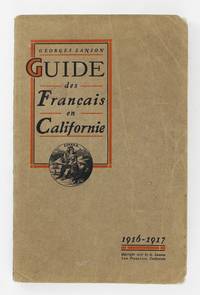
19165576San Francisco: George Lanson 1916. About very good. 272xxxi pp. Original printed wrappers. Chipping to corners and spine ends light wear. Front inner hinge reinforced. Minor wear and soiling internally. A brief history and directory for the French in California complete with illustrations advertisements and a wide array of information. The directory contents focus on northern California with listings for San Francisco Oakland and San Jose. The closing section is comprised of biographical sketches of local notable California Frenchmen. Scarce with three copies in OCLC located at California Historical Society the Autry Museum and the University of Utah. George Lanson unknown
1921List3316S.I.: Department of Public Works Division of Land Settlement 1921. Large broadsheet; 19 ½ x 16 ¾; pp. 2; illustrated with photographs drawings and a large map; a few penciled-in manuscript notes possibly originally belonging to a potential settler; some age-toning along fold lines; edges a bit unevenly trimmed; in about very good condition. Very good. An uncommon survivor of a failed California State project the broadsheet outlined all the relevant information to potential settlers of the Delhi State Land Settlement in Merced County California. It was initiated in 1917 with its main goal being to encourage improved land development and farming techniques through a cooperative model. A State Land Settlement Board was appointed led by engineer and educator Elwood Mead 1858—1936 which would be responsible for selecting approximately 230 settlers based on their capital experience and willingness to cooperate. Though well-intended by 1931 the project would fail spectacularly due to a myriad of problems including insufficient plot sizes unsuitable crops high financial burdens lax management social and cooperative disputes etc.<br /> <br /> The broadsheet included details on conditions under which farms were offered to purchasers various allotments with acreage and prices poultry farms farm laborers' lots schools and churches soil water supply taxes and so on. It also featured images of model homes a vineyard a large subdivisional map plan and a drawing of the Delhi Community Hall the latter called â€The Business and Social Center of the Delhi Colonists.†Quite scarce with only two copies recorded at UC Davis and the California State Library; none currently in the trade.<br /> <br /> Smith Roy J. â€PROBLEMS FOUND IN THE CALIFORNIA STATE LAND SETTLEMENTS AT DURHAM AND DELHI.†Applied Anthropology 3 no. 2 1944: 16–22. http://www.jstor.org/stable/44135106. Department of Public Works, Division of Land Settlement unknown
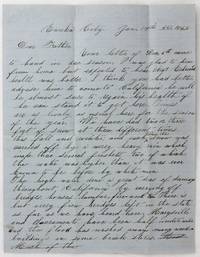
18624920Eureka City: January 14 1862. Very good. 2pp. on a folded sheet. Old folds minor wear. Manuscript letter to folks back home describing heavy rain and flooding around Eureka City. The author writes: "We have had two or three feet of snow at three different times this fall and winter and each time the snow was carried off by a verry heavy rain which made three several freshets two of which the water was higher than it was ever known to be before by white men." He goes on to discuss the difficulties caused by the flooding: "The high water done a great deal of damage throughout California by carrying off bridges houses lumber fire-wood &c. There is but verry few bridges left in the state as far as we have heard here. Marysville and Sacramento have been half under water and the flood has washed away many wooden buildings and some brick stores. A large portion of the farmers in the Sacramento Valley and also many other places were damaged considerable by having their land overflowed some crops washed off &c. The roads are almost impassable here we have had but three mails in as many weeks when we usually get one each day. January 14 unknown
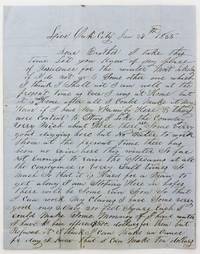
18555504Live Oak City Ca: January 27 1855. Still very good. 4pp. on a bifolium. Previously folded with manuscript docketing on lower half of second leaf verso. Minor wear along old folds with a couple of short separations. Minor soiling and dampstaining somewhat heavier to addressed area. A detailed mid-1850s California Gold Rush letter from Elias Hunt Jr. to his brother in the tiny of Poolville New York southeast of Hamilton. Hunt was camped in Live Oak north of Yuba City when he wrote this letter home on January 27th 1855. He tells his brother that he has good claims but that a lack of rain has not allowed him to work them:<br /> <br /> "It is hard for a man to get along. I am stopping here in hopes there will be some rain soon so that I can work my claims. I have some very good ones 2 only 200 feet square each. I could make some money if I had water. I have been offered $500 dollars for them but I refused it -- I think I can make an ounce per day; I know that I can make ten dollars for I have done that before."<br /> <br /> There is talk of irrigating the area but Hunt is not sure that it will be finished before he wants to return east:<br /> <br /> "There is a ditch coming in here to suply sic the place with water but it will not be completed until Spring some time in April & I should like to come home in June. I shall stay until there is water in the ditch then I can wash a part of my claims & sell the rest to a good advantage for they are situated immediately on the line of the ditch."<br /> <br /> Continuing upon his plans to return he writes:<br /> <br /> "I have had a very good offer to come home across the plains by a man in Sacramento. He is from Utica; his name is Hamilton. He is going to cross with four hundred Spanish horses or mares. He has offered me good money to come with him as I have been over to Carson Valley this last season. It will take some sixty days to do it if I should get through with my claims by the time time that he gets ready to start. I think I shall come with him if the Indians are not to hosstille sic. They were very bad this last season; they got possession of one of Uncle Sam's forts."<br /> <br /> Hunt continues writing about local hunting prospects and family in New York before delivering a Crockett-esque farewell -- "Please give my respects to all may inquire for me & let the rest go to Hell for all that I care." A good letter from one of the less trafficked areas of the California Gold Rush. January 27 unknown
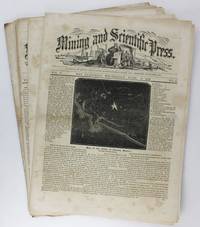
18633573San Francisco 1863. Very good. Six issues each 8pp. Folio on single folded sheets of newsprint. One issue separated along spine minor foxing creasing and edge wear. A small collection of early issues of a notable scientific journal published in San Francisco beginning in 1860; the present issues were all issued during the opening years of the Civil War. The issues present here include Vol. V No. 5 April 9 1862; Vol. V No. 13 June 9 1862; Vol. V No. 16 July 2 1862; Vol. V No. 21 August 8 1862; Vol. VI No. 4 November 8 1862; and Vol. VI No. 38 July 20 1863. The articles present a wide range of scientific subjects such as mining news new inventions lectures extracts from scientific publications metallurgy balloon ascensions patents and more. Illustrations in the present issues include a map of Sinaloa Heath's Spiral Spice Mill and various other machines the Coffey & Risdon Boiler Factory and sectional illustrations of the Colorado River among others. There are also articles related to encouraging emigration to Sinaloa Mexico and notices of local "theatricals;" along with a wealth of advertisements for scientific equipment services and local businesses. The June 9 1862 issue even prints a "Business Directory" of almost seventy commercial interests who have subscribed to the periodical. A nice batch of issues of Mining and Scientific Press from its early few years of publication. unknown
3971San Francisco:: News Letter. Not illustrated; 4 pp. Folio bifolium outer pages browned inner pages less so. The bulk of this Postscript pages 1-3 contains the transcript of a letter from Eugene N. Richardson 1847–1889 to Charles Bruce Porter 1817–1894 joint publisher of the weekly newspaper the "Contra Costa Gazette" and a keen supporter of narrow gauge rail. Porter born in Taunton Massachusetts went to California in 1849 and soon entered politics serving as both a state Congressman and Senator.The author of the letter Robinson was referred to in a California newspaper at the time of probating his will as “Cornelius Vanderbilt’s ‘pet broker.’†He was born in New York state and his main area of expertize was mining but he was also along with Vanderbilt a director of the Lake Shore and Michigan Southern Railway Company and both men at different times served as President of that line.In great detail Robinson outlines the advantages of a narrow gauge rail-bed of 36 inches as opposed to the more commonly used gauge of 48 inches for both freight and passenger use. The coast of the narrower is shown to be considerably less in building the line in the equipment needed to run it and its future maintenance. He proves that the narrow gauge can equal and in some instances out-perform the regular gauge. He is extremely enthusiastic and sends all good wishes for the line’s success. This proposed line was apparently not built Union Pacific built a line in the 1890s.Numbers of this newspaper are very sketchily held and there seems to be some confusion as to when it was published. It was a weekly and therefore one might assume that a volume would contain 52 issues. This present number was the fifth of Volume 5 and was published on March 1—it is apparent that the paper was first published on Saturday February 1 of some year. Working backwards the first issue was published on Saturday February 1 1851 and ceased on Saturday August 25 1928. The Library of Congress has a notation that this publication was the organ of the Aerial Steam Navigation Company Frederick Marriott founded in 1856 to promote his attempt to launch an early flying machine. We can find no evidence to support this. Marriott the publisher of The San Francisco News Letter was an English-born American publisher and early promoter of aviation who came to the United States when news of the 1849 gold rush reached Britain. He had been one of the founders of the London Illustrated News and had considerable financial success until his last British venture Chat failed and led to his near-bankruptcy. In 1850 he left England for California traveling by the isthmus route over Panama an experience that led him to try and find a faster and safer route to California. To this end he created the Avitor Hermes Jr. the first unmanned aircraft to fly by its own power in the United States. He is credited as the person to coin the word “aeroplaneâ€. Marriott intended his steam-powered aircraft to fly coast to coast over the United States. The vehicle was named after the Greek Messenger of the Gods who was also regarded as a protector of travelers. Initial tests were successful but he failed in his attempt to prove its viability before the completion of the last section of the Trans-Continental Railroad which happened in May 1869—Marriott’s company ceased to exist that same year. San Francisco:: [News Letter],. unknown
189461007San Francisco: H.S. Crocker Co. 215-219 Bush St. 1894. Fifteen parts in one vol. Oblong folio. 14.5 x 10.75 in. 240 pp unpaginated. 227 photo plates 13 double-page. Recent black cloth Portfolio No. 7 cover mounted on front cover as title endpapers renewed all fascicles were bound in adjustable slide post-binder as evidenced by discrete slits at gutter margin some occasional minor tears slight edgewear to textblock from thumbing still a VG copy from the library of Prof. Marvin Nathan. First edition of this exceptional and complete photographic souvenir series capturing the California Midwinter International Exposition which was the first World’s Fair in San Francisco’s Golden Gate Park prior to the Earthquake & Fire. Taber 1830-1912 was the official photographer of the Fair and he has captured with vividness the excitement and variety of the events in the Fair with night shots of the Electric Tower piercing the darkness the action in the Forty-Niner Mining Camp which featured “Monarch†the stuffed Grizzly Bear who was showcased in the venue along with logging scenes at Lake Tahoe Hopfields in Ukiah CA the bedraggled Apache confined to the “Arizona Indian Village†along with a portrait of a Chinese Opium Den in San Francisco’s Chinatown. H.S. Crocker Co., 215-219 Bush St., hardcover
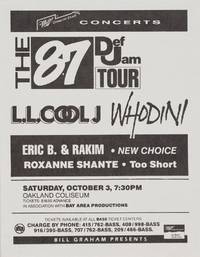
1987List2878Oakland California 1987. 14 x 22 inches. Rolled stored in a tube otherwise fine. Poster for the 87 Def Jam Tour date at the Oakland Coliseum with LL Cool J and Whodini headlining and featuring influential hip hop duo Eric B. & Rakim R&B singers New Choice Roxanne Shante—known for the “Roxanne Warsâ€â€”and rapper Too Short. unknown
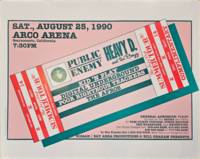
1990List2879Sacramento California 1990. 22 x 28 inch poster on heavy cardstock. Fine contrast near fine. Poster for the “Sizzling Summer†tour featuring Public Enemy Heavy D. and the Boyz Digital Underground and others. Heavy D. and Digital Underground had recently released Big Tyme and Sex Packets respectively both of which went Platinum in the US. Public Enemy was touring on Fear of a Black Planet which would go on to be recognized as one of the greatest hip-hop albums of all time. A well-designed piece advertising a stacked lineup. unknown
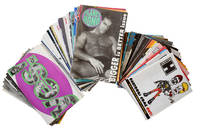
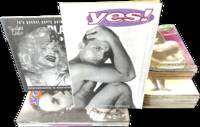
19923357<p>Stapled wrappers b&w illustrations. Minor wear to a few corners. Very Good or better overall.</p><p>A significant collection of Planet Homo an irreverent bi-monthly guide to L.A.'s underground LGBTQ entertainment scene together with a run of its successor publication Yes! The collection includes the following issues:</p><p>- Planet Homo L.A.: 024-025 034 037 040-58 060-081 12/4/1992 – 3/22/1995</p><p>- Yes!: 082-88 90-91</p><p>Devoted throughout these issues primarily to LGBTQ nightlife Planet Homo and later Yes! nevertheless developed noticeably over the course of its brief publication history becoming a source of important and often acidly funny LGBTQ cultural critique of the 1990s. In the earlier issues offered here it is a rather thin publication marketed as "L.A.'s Pocket Party Guide" and includes the expected short listings of LGBTQ dance clubs bars theatre performances music concerts movies etc. accompanied by classifieds a "letters to the editor" section a "resources" section and a section aptly titled "Dish" which provides a gossipy account of goings on about town. However by issue #030 the "pocket party guide" tagline was dropped from the cover and long feature interviews with musicians and actors vie with club listings for space; by issue #056 the magazine has quite literally grown from 8-3/4 inches tall to 11 inches tall. It also includes regular columns substantive articles and a horoscope section alongside the usual entertainment listings classifieds and plethora of phone sex ads.</p><p>Subjects of notable cultural critique include the introduction of LGBTQ themes into contemporary cartoons the LGBTQ advocacy of stand-up comedian Margaret Cho drug use in the LGBTQ community John Waters' films the OJ Simpson trial "Heterocide: The Tragic Straight Lifestyle" drag performances gay bashing and much much more. Covers range from offbeat and quirky to the provocative "Hey Fag Read This" #062.</p><p>All in all an important collection documenting not only L.A.'s LGBTQ nightlife but the way a certain segment of the LGBTQ community chose to confront celebrate and fight to change the cultural legacy of the 1990s.</p> Community Investment Corp.; Planet Homo Publishing Corp paperback
199577137Los Angeles and West Hollywood: Planet Home Publishing Corporation 1995. 52 issues: 8 3/4 x 7 inches or 11 x 7 inches. Various paginations. Stapled wrappers with black-and-white illustrations. Minor wear to a few corners; else very good or better overall.<br /> <br /> A significant collection of Planet Homo an irreverent bi-monthly guide to L.A.'s underground LGBTQ entertainment scene together with a near complete run of its successor publication Yes! The collection includes the following issues:<br /> <br /> Planet Homo L.A.: 024 030 033 040-058 060-081<br /> Yes!: 082-88 90-91.<br /> <br /> Devoted throughout these issues primarily to LGBTQ nightlife Planet Homo and later Yes! nevertheless developed noticeably over the course of its brief publication history becoming a source of important and often acidly funny LGBTQ cultural critique of the 1990s. In the earlier issues offered here it is a rather thin publication marketed as "L.A.'s Pocket Party Guide" and includes the expected short listings of LGBTQ dance clubs bars theatre performances music concerts movies etc. accompanied by classifieds a "letters to the editor" section a "resources" section and a section aptly titled "Dish" which provides a gossipy account of goings on about town. However by issue #030 the "pocket party guide" tagline was dropped from the cover and long feature interviews with musicians and actors vie with club listings for space; by issue #056 the magazine has quite literally grown from 8 3/4 inches tall to 11 inches tall. It also includes regular columns substantive articles and a horoscope section alongside the usual entertainment listings classifieds and plethora of phone sex ads.<br /> <br /> Subjects of notable cultural critique include the introduction of LGBTQ themes into contemporary cartoons the LGBTQ advocacy of stand-up comedian Margaret Cho drug use in the LGBTQ community John Waters' films the O.J. Simpson trial "Heterocide: The Tragic Straight Lifestyle" drag performances gay bashing and much much more. Covers range from offbeat and quirky to the provocative "Hey Fag Read This" #062.<br /> <br /> All in all an important collection documenting not only L.A.'s LGBTQ nightlife but the way a certain segment of the LGBTQ community chose to confront celebrate and fight to change the cultural legacy of the 1990s. Planet Home Publishing Corporation unknown
1889List3035California Oregon Iowa and New York 1889. Sixty-five items: sixty-two letters mainly dating from 1887 eleven letters 1888 nineteen letters and 1889 fourteen letters; and three playbills from the CMA Dramatic Club. Overall excellent. William H. Sharp 1863–deceased was born in Washington and lived in The Dalles Oregon. He attended the California Military Academy in Oakland from 1880 to 1883 and then returned to The Dalles. There he worked as a commission merchant and ran for county clerk. <br /> <br /> Offered here is a collection of letters mainly to with some from William Sharp. The letters are from friends and family—Sharp had many cousins with whom he corresponded regularly—and cover his time at the California Military Academy CMA and back in The Dalles.<br /> <br /> The CMA was founded in 1865 by Rev. David McClure and combined college preparatory education with military drills including firearm training with the aim to “give the youth of the remote West an opportunity to acquire an education such as could not otherwise be obtained.â€1 His attendance put a financial strain on the family; his mother Mary Sharp reminds him that “we have to scrach hard to keep you at school†as she scolds him for his poor performance April 8 1882. Mary Sharp also worried about conditions at the Academy:<br /> <br /> “Willie I hope you will be kind to all new comers & comfort them all you can I read of two boys being killed by ill treatment at boarding schools one they took out of a warm bed & pumped cold water on him in a cold night untill he died the other they tied a & triped him so he fell hurt his head & killed him I hope the boys do not play such tricks at your schoolâ€. November 12 1880<br /> <br /> The CMA promised not to admit any boys who were “morally bad as the institution is not designed to reform vicious boysâ€.1 However a letter from C.W. Chapman Sharp’s friend and former roommate suggests that the school’s rigorous drilling was not necessarily successful. Chapman writes from Nevada City a mining town in central California:<br /> <br /> “I’m working hard as usual; but I expect you don’t care anything about that. I’m having lots of fun too if that interests you. You don’t know one half as many girls as I go to see every evening. And they are the kind of girls that you can have fun with too. . I am making up for lost time. . I haven’t had my fingers in anybody else’s pie yet and maybe I haven’t had them in anybody’s anything else either. But that’s some more trash. . How do you fellows treat the little dears now I hope you don’t deal with them as harshly as you did when I was down there.†January 10 1883<br /> <br /> Later letters are mainly between Sharp and his wife-to-be Jennie Booth. He mentions attending a temperance meeting updates her on business which is “not overly brisk†but “good enough†October 6 1888 and describes hiring a “mongolian†cook who is “a very fair specimen of the celestial race†October 5 1887. Booth describes Oregon City on a visit there as “very picturesque†but primitive: “it has only one street that is passable the rest are so rocky that you can’t get over them with a conveyance.†August 17 1888.<br /> <br /> Around this time Sharp runs for county clerk as a Republican; a W.T. McPhire writes from Mosier:<br /> “I am glad to know you are in the field for the clerkship which as you state is a very desirable office. Now I can and will say this much although opposing you in politics that if you receive the nomination for this office against any one in my party that is not an honest sober and industrious man I will willingly do all in my power to help elect you to the office.†March 12 1888<br /> <br /> Despite this bipartisan support Sharp lost to a man named Thompson. Sharp and Booth married and lived together in The Dalles and Sharp remained in his career as a farmer and merchant.<br /> Of interest to scholars of Oregon history and of 19th-century military education.<br /> <br /> 1 “California Military Academy†Mariposa Gazette June 30 1887 4. unknown
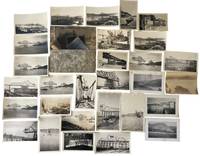
1927233011927. Carquinez Bridge construction photo archive documenting the industrial development of the 1927 cantilever crossing at the Carquinez Strait a transportation project driven by California's rapid automobile growth and the mounting inadequacy of the Vallejo ferry connection between the Bay Area and Sacramento. By the early 1920s California vehicle registrations had risen sharply ferry traffic across the strait had become a bottleneck and the new span created the first direct highway link between San Francisco and Sacramento when it opened in May 1927. Positioned between the first major wave of California highway investment in the 1910s and the later Freeway Era the archive records bridge construction as an industrial process showing how steel members cranes temporary decking marine equipment and high-angle labor were organized into a permanent transportation crossing. With two main spans of 1100' each the Carquinez Bridge at the time of its completion was the fourth largest cantilever truss bridge in the world and the second largest in the United States<br /> <br /> Photo archive of 31 silver gelatin photographs plus 12 photographic negatives ranging from roughly 3 x 5 to 3.5 x 6 inches Carquinez Strait California circa 1927. Most of the prints focus on the bridge construction process. The 1927 Carquinez Bridge was the first major auto bridge in the San Francisco Bay Area designed to resist seismic forces with piers extending 135 feet below water and notes its role as the first direct highway link between Sacramento and San Francisco. Exterior views show the cantilever arms extending out over open water from tall steel towers with large truss sections still incomplete the suspended span not yet joined and the full geometry of the crossing legible at successive phases of erection. Several photographs are taken from elevated ground above shoreline houses and industrial buildings locating the bridge within a worked waterfront rather than an isolated engineering view. Others are made from water level where the steel rises directly from the strait and barges work boats and temporary supports register the marine logistics required to build in the channel. One close construction view looks straight down a temporary work deck lined with rails or timbers toward cranes and hoisting apparatus embedded inside the growing steel frame. Another shows a group of workers seated and standing on a riveted member before placement making the relationship between labor and material explicit without shifting the archive away from its central subject the structure under assembly. Additional prints show falsework approach grading industrial shoreline staging and spectator vantage points from which the nearly completed trusses were watched from land. Versos carry Velox paper marks oval WEBBS processing stamps dated March 14 1927 on several prints and manuscript or stamped inventory numbers. The 12 negatives are secondary material and include unrelated vernacular subjects by the same photographer among them floodwater truss bridges a rifle-range scene and a few domestic snapshots. <br /> <br /> The archive belongs to the period when California road building and bridge construction accelerated to meet automobile traffic that older ferry systems could no longer absorb. In these photographs infrastructure is not presented as a finished monument but as an active building process with the visual emphasis placed on staged steel erection temporary supports shoreline preparation marine access and workers operating within narrow elevated material-heavy conditions. Light curling minor creasing and scattered discoloration on few with verso stamps or notations; overall good condition. Archive of photographs showing a necessary piece of California transportation infrastructure being built with the labor system and material processes documented. unknown
1920181251920. California photograph and postcard scrapbook 1920s-1950s documents the development of regional identity tourism and youth leisure culture during a period of rapid population growth and national attention to the American West. The album captures informal social life alongside curated views of California's built and natural environments including missions urban centers and recreational landscapes. Images of camping excursions bathing scenes and staged outdoor portraits present a visual record of mobility and leisure that accompanied the expansion of automobile travel and the increasing accessibility of California as a destination. The inclusion of postcards depicting historic sites such as mission architecture and Olvera Street situates the scrapbook within broader efforts to frame California's past for visitors while candid photographs of young men and women emphasize social bonding performance of identity and recreation within emerging twentieth century youth culture.<br /> <br /> Scrapbook containing approximately 200 photographs and postcards dating from the 1920s through the 1950s primarily depicting locations and activities across California. Photographs and cards range in size from approximately 2 x 1.5 inches to 9 x 6 inches and include both candid and posed images. Notable sequences include a group of four young men on a camping trip in the 1920s shown cooking washing dishes outdoors with tin buckets and a camp stove posing individually before a shared tent and engaging in playful staging including one image of a figure standing on a rock over a stream partially covered by a towel. Additional sequences depict groups of young women in bathing caps and swimwear posed in coordinated arrangements. Postcards interspersed throughout the album depict missions streetscapes and scenic landmarks reinforcing the connection between personal travel experience and widely circulated images of California.<br /> <br /> Produced across decades that saw the rise of the film industry expansion of tourism infrastructure and continued migration into California the scrapbook offers a layered record of how individuals encountered and documented the state. The juxtaposition of personal photographs with commercial postcards reflects the intersection of private memory and public imagery in shaping perceptions of place. Camping and outdoor leisure scenes align with broader trends in early twentieth century recreation while the repeated use of specific sites and poses suggests intentional documentation of shared experience. Brown cloth boards with gilt title "Photographs" on front cover; album measures approximately 7 x 11 inches. Minor wear to boards and edges with typical age toning to some images; contents remain stable and intact. Overall very good. unknown
73242A collection of 1950s and '60s political buttons supporting causes and candidates ranging from the Vietnam anti-war movement to Ronald Reagan's campaign for the California governorship. This group consists of 56 unique metal pinback buttons which are housed in a period cardboard box. Most of the buttons are coated paper with metal backing; some are union printed.<br/><br/>Several of the political pins relate directly to Northern California. For example a button for the Free Speech F.S.M. is associated with the 1964-65 student protest at the University of California Berkeley the first mass act of civil disobedience on an American college campus in the 1960s.<br/><br/>The orange and black Viva Kennedy button in this collection is representative of clubs formed by Latinx supporters of John F. Kennedy during his 1968 presidential campaign. The Viva Kennedy clubs began in Texas as a forum for Mexican American veterans to rally support for equal rights and eventually spread to swing states with large Latinx populations like Arizona and California. They also promoted increased voter registration and political organization for the Latinx community.<br/><br/>Another button in this collection advocates "No on Prop 14". The Proposition 14 in question is the proposed amendment to the California Constitution which had it passed would have effectively allowed housing discrimination. The initiative was intended to counteract the effects of the Rumford Fair Housing Act which was passed by the California Legislature in 1963 to help end racial discrimination by property owners and landlords who refused to rent or sell their property to people based on ethnicity religion sex marital status physical handicap or familial status. It was drafted by William Byron Rumford the first African American from Northern California to serve in the state legislature.<br/><br/>Overall the buttons are in very good condition. unknown books
188033712San Francisco: Alley Bowen and Co. 1880. First Edition. 676pp. Illus ports throughout. First several have an old stain on upper right corner. Original 4to calf.with red leather gold stamped label on spine Howes M515 b. Not in Graff. Cowan p.424. Rocq 5324. Not in Eberstadt Catalogs or Streeter Sale. Native Americans Mexican grants statistical history homicides townships biographical sketches many with a portrait etc. Alley Bowen and Co. hardcover books
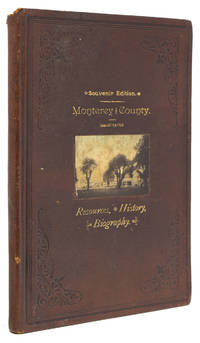
1889251925Salinas Ca: E.S. Harrison 1889. Profusely illustrated. Double-page map. 88 pp. printed in double columns. 4to. Original pigskin gilt with pictorial onlay on front board a.e.g. Chipped at head of spine binding a bit shelfworn. Small closed tear in upper margin of final leaf not affecting text. Contemporary ownership signature on front flyleaf. Very good. In a cloth chemise and half morocco and cloth slipcase spine gilt. Profusely illustrated. Double-page map. 88 pp. printed in double columns. 4to. Designated "souvenir edition" on the front board and without a titlepage apparently as issued. A scarce and early guide to Monterey County featuring a general profile of the region its history resources industries and agriculture as well as biographical sketches of prominent men. Several of the biographies are illustrated with portraits and there are dozens of illustrations of the sights in the county as well. The double-page map shows the entirety of Monterey County. This text was also issued in pamphlet format around the same time for the Salinas City Board of Trade. Rocq 5514 E.S. Harrison unknown books
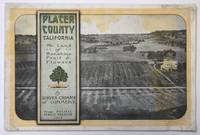
1913679Auburn: Auburn Chamber of Commerce 1913. About very good. 12pp. Original pictorial wrappers stapled. Covers lightly soiled previously damp; edges reinforced with tape. Contents reinforced with tape at lower corner minor soiling. Promotional work published by the Auburn Chamber of Commerce promoting the county as an ideal place for agriculture and profit with an article extracted from the Pacific Serves Magazine entitled "Enlarging the Bear River Canal: A Part of Our Development Work in the Sierras." This article which is illustrated describes work on the canal and the ways in which it will benefit the region's farmers with irrigation. We locate one copy in OCLC at the University of California at Davis. Auburn Chamber of Commerce unknown books
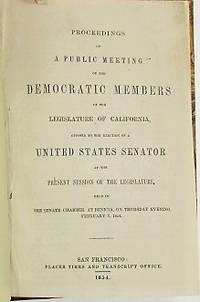
185433622San Francisco: Placer Times and Transcript Office 1854. 8pp bound in attractive modern quarter calf and marbled boards gilt spine lettering. Very Good. <br/><br/> A significant chapter in the epic Gwin-Broderick struggle which split the California Democratic Party on the Kansas-Nebraska issue and ended only with Broderick's death in a duel with Chief Justice David Terry of the California Supreme Court. At the time of this public meeting Broderick was President of the California Senate and sought to engineer his own election to the U.S. Senate to replace Senator Gwin whose term would expire on March 4 1855. These California Democrats resist the attempt to steamroll Broderick's election arguing that only "the Legislature next preceding a new senatorial term has the right to elect." <br/> Discussing this item Eberstadt says "The 'public meeting' was held in the Senate Chamber at Benicia and the proceedings give a clear insight into local politics just prior to vigilante days." <br/>Cowan 502. Greenwood 491 1- CU-B. 136 Eberstadt 157. OCLC 21658923 6- 4 in CA Yale KY Hist. Soc. as of January 2021. Placer Times and Transcript Office unknown books