66 935 résultats
H728St. Petersburg u. Leipzig Logan 1781-1796. Mit 6 wiederh. gest. Titelvign. 15 von 16 gefalt. teils kolorierten Kupfertafeln 1 gefalt. Tafel Folterszene 7 gefalt. Kupferkarten u. 1 gefalt. Tabelle. Dekorative Halblederb‰nde mit reicher R¸ckenvergoldung und R¸ckenschilder die ersten beiden B‰nde sind Einb‰nde aus der Zeit die anderen sind fachm‰nnisch den ersten nachgebunden eine sehr gute Buchbinderarbeit. Einige B‰nde mit St.a.T. ein Reihentitel lose sauberer guter Zustand. Es fehlt eine Mineralientafel w‰hrend die Tafel mit der H‰ngeszene die nur wenigen Exemplaren beigebunden wurde in s/w vorhanden ist. Insgesamt ein sehr schˆnes Set. Kirchner 3276; Lada-M. 31; Chavanne 163; Cordier BS 727; nicht bei Sabin. - Alle erschienenen B‰nde ab Bd. 5 mit Nebentitel "Neueste Nordische Beytr‰ge". Die Tafelanzahl variiert in den Bibliographien. Im vorliegenden Set fehlt eine Mineralientafel w‰hrend die Tafel mit der H‰ngeszene die nur wenigen Exemplaren beigebunden wurde in s/w vorhanden ist. "This serial work compiled by P. S. Pallas contains mostly articles edited by him. It is a rich mine of information on the early history of the discovery and settlement of Alaska" Lada-M. Wichtige Karten: Karte der Entdeckungen zwischen Sibirien und America bis auf das Jahr 1780. Band 1. Karte des Gebietes zwischen Sibirien und Alaska mit einer kleinen Nebenkarte: Vorstellung der S¸dlichsten Kurilischen Inseln. Band 4. Die B‰nde sind in sich vollst‰ndig und beinhalten eine wichtige Berichte zur Erforschung von Innerasien haupts‰chlich allerdings vom nordˆstlichen Teil Sibiriens der Berings-Strafle und Russisch-Amerikas. Einige Beitr‰ge: Band 1: Tagebuch einer von den Geodesisten Andrejef Leonteif und Lyssof nach den gegen die kowymische M¸ndung im Eismeer gelegenen B‰reninseln auf dem Eise geschehenen Entdeckungsreise; nebst einer Beschreibung dieser Inseln. Besondere Nachrichten ¸ber die tschuktschische Landspitze und benachbarte Inselns. Bericht von der in den Jahren 1768 und 1769 auf allerhˆchsten Befehl der russischen Monarchinn unter Anf¸hrung des Capitains Krenitzyn und Lieutenants Lewaschef von Kamtschatka nach den neuentdeckten Inseln und bis an Alaska oder das feste Land von America vollbrachten Seereise. Erl‰uterungen ¸ber die im ˆstlichen Ocean zwischen Sibirien und America geschehenen Entdeckungen. Band 2: Topographische und physikalische Beschreibung der Beringsinsel welche im ˆstlichen Weltmeer an der K¸ste von Kamtschatka liegt. Bericht von einer im Jahr 1772 angetretenen vierj‰hrigen Seereise zu den zwischen Kamtschatka und America gelegenen Inseln unter Anf¸hrung des Peredofschiks Dmitrei Bragin. Auszug aus dem Tagebuch einer Seereise welche Iwan Solowief in den Jahren 1770 bis 1775 bis an die zum festen Lande von America gehˆrige Landspitze Alaska verrichtet. Band 4: Auszug aus dem Tagebuche des Kosaken-Sotniks Iwan Kobelef ¸ber das Land der Tschuktschen und die demselben entgegenliegende Inseln und Landecke von Amerika. Neue Beschreibung der Kurilischen Inseln. Neueste Beschreibung der Nertschinskischen Berg- und H¸ttenwerke im ˆstlichen Sibirien. Band 7: Merkw¸rdige Nachrichten von denen im Eismeer dem sogenannten Swatoi-Nos gegen¸ber gelegnen L‰chofschen Inseln. Sievers Briefe aus Sibirien. unknown
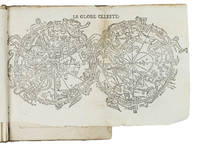
1592ABC_45768Langres 1592. 4to. Jean des Preyz 18th-century half brown sheepskin brown paper sides title in gold on spine with a printed text reversely used as front paste-down. With a woodcut on the title page showing an armillary sphere 3 woodcut folding plates of the solar system a celestial chart in two hemispheres and a terrestrial map of the world in two hemispheres 4 woodcut maps in the text including a map of Europe many astronomical and cosmographical woodcut figures and tables in the text and woodcut head- and tailpieces and initials. 92 ll. Rare French 16th-century astronomical cosmographical and geographical work by Simon Girault. This short treatise comprising three books presented in the form of a dialogue between two children named Charles and Marguerite discussing several aspects of heaven and earth. The first book discusses celestial movements and circles the second book treats the solar system more extensively the quality of different planets the size of the earth and its proportion and distance to the other celestial bodies. Girault also discusses why the sun appears to be larger in the winter than in the summer explains eclipses and tells more about the directions and retrograde movements of several planets. The third book is more on terrestrial topics. With manuscript inscriptions on the first free endleaf and on the title page. Binding worn corners bumped parts of the backstrip loose some water- staining slightly dust-soiled with some small tears mainly in the foot margin some repaired and a wormhole in the foot and one in the fore-edge margin. Otherwise in good condition. A rare astronomical work.l BM STC French p. 203; Brunet II col. 1614 note; Graesse III p. 89; Houzeau & Lancaster 4962; Pettegree French vernacular books 23076 & 23077 2 identical descriptions!; USTC 37546; not in Adams; Mortimer French. ABE CAT Alchemy ABE CAT Astronomy & Cosmography unknown
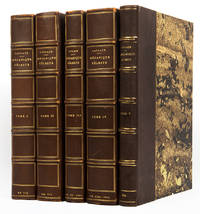
120389Paris Crapelet for J.B.M. Duprat AN VII 1799 - AN XI 1802; Courcier AN XIII 1805; Huzard-Courcier AN XIII 1805; Bachelier 1825. . First editions; 5 volumes 4to 25.5 x 20 cm; engraved folding plate in volume IV some light spotting and toning of the contents; volumes I-IV in recent brown quarter morocco marbled sides and matching endpapers spines gilt in compartments double gilt fillets top edges gilt and gauffered with floral roll blue silk bookmarks volume V in similar brown half morocco with marbled sides and endpapers spine gilt in compartments edges with old red sprinkling bindings very lightly rubbed at the extremities 368pp 382pp 303pp with 24pp supplement 347pp with supplements of 65 and 78pp 419pp.<br /> First edition and a close-to-complete set of this monumental work of celestial mechanics the most important after Newton's Principia. <br /><br />Traité de Mécanique Céleste is bibliographically complex and 'any or all of the supplements may be lacking in some sets' Hook & Norman 1277. This set conforms to the collation laid out by Hook & Norman save that the second errata statement in volume IV is on the list of tables rather than on 2K4v and volume V is lacking the supplement Avertissement and part-titles. All the other supplements are present. There are two issues of volumes I and II this being the issue with the imprint of Crapelet and Duprat and the French Republican date AN VII on the title pages.<br /><br />'Here Laplace applied his mathematical theories of probability to celestial bodies and concluded that the apparent changes in the motion of planets and their satellites are changes of long periods and that the solar system is in all probability very stable' Hook & Norman. This was a level of certainty absent from the work of Newton who 'like Euler was doubtful whether the variable forces acting in the solar system could be permanently maintained in an equilibrium' without the intervention of a creator Printing and the Mind of Man 252. <br /><br />'Laplace maintained that while all planets revolve around the sun their eccentricities and the inclinations of their orbits to each other will always remain small. He also showed that all these irregularities in movements and positions in the heavens were self-correcting so that the whole solar system appeared to be mechanically stable. The universe was really a great self-regulating machine and the whole solar system could continue on its existing plan for an immense period of time. Laplace also offered a brilliant explanation of the secular inequalities of the mean motion of the moon about the earth - a problem which Euler and Lagrange had failed to solve' and he 'investigated the theory of the tides and calculated from them the mass of the moon' PMM. <br /><br />Famously when asked by Napoleon why his book did not mention God Laplace replied 'I had no need of such a hypothesis'.<br /> Horblit One Hundred Books Famous in Science 63; Hook & Norman Norman Library of Science and Medicine 1277; PMM 252 Paris, Crapelet for J.B.M. Duprat, AN VII [1799] - AN XI 1802; Courcier, AN XIII, 1805; Huzard-Courcier, AN XIII 1805; Bachelier unknown
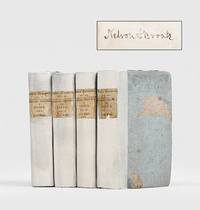
1803178761London: James Ridgway 1803. Nelson seeks intelligence on an ambivalent ally Horatio Nelson's set with his ink signature "Nelson & Bronte" on the front free endpaper of volumes VI VII and VIII and occasional marginal pencil marks. This is the first edition to be translated by Francis Blagdon being volumes V-VIII in the publisher's Modern Discoveries series. The review in the Monthly Mirror may have caught Nelson's eye which noted that "the abilities of Mr Blagdon are fully adequate to this important undertaking. We have no doubt that this publication will become extremely popular". Nelson has recently April-June 1801 concluded a term as second-in-command Baltic Fleet which naturally brought him into contact with Britain's Russian allies. In this theatre Russia "did not share the maritime commercial interests of her Scandinavian clients: she sought control of the theatre and a rapprochement or worse with France. The British had long recognised this strain in Russian policy. Consequently Denmark Prussia and Sweden were coerced into following a Russian programme which had at its heart the assertion of dominance over their countries and the establishment of the Baltic as a Russian mare clausum closed sea - a consistent aim of Russian policy since the days of Peter the Great" Lambert p. 189. For this journey through Russia the German naturalist and traveller Peter Simon Pallas 1741-1811 accompanied by his wife and daughter and the artist C. G. H. Geissler travelled down the Volga to Astrakhan and then through the Caucasus to the Crimea. His earlier gruelling six-year expedition through Siberia to the borders of China 1768-74 resulted in one of the most acclaimed contemporary accounts of those regions Travels into Siberia and Tartary. 4 vols duodecimo. With 22 engraved plates 2 folding. Uncut in original pale blue-grey boards sometime neatly rebacked preserving the original labels. Housed in a custom leather-entry pale green cloth slipcase. Some stripping of paper from boards of vols. II-IV pale tidemark to back cover of Vol. III inner hinges cracked but firm that of Vol. IV holding on one cord at front damp staining at beginning and end of Vol. II general toning and dust marking paper flaw to leaf H13 Vol. I without loss yet this remains a very good set. Cross D67 for the Longman edition; Troelstra p. 331. Andrew Lambert Nelson: Britannia's God of War 2005. hardcover
247Folding engraved plate in Vol. IV. Five vols. Large 4to handsome antique blue morocco-backed marbled boards flat spines nicely gilt. Paris: J.B.M. Duprat & others An VII 1798-1825. First edition and a complete set with all the supplements. In this monumental and fundamental astronomical work Laplace -- the "Newton of France" -- codified and developed the theories and achievements of Newton Euler d'Alembert and Lagrange. "Laplace maintained that while all planets revolve round the sun their eccentricities and the inclinations of their orbits to each other will always remain small. He also showed that all these irregularities in movements and positions in the heavens were self-correcting so that the whole solar system appeared to be mechanically stable. He showed that the universe was really a great self-regulating machine and the whole solar system could continue on its existing plan for an immense period of time. This was a long step forward from the Newtonian uncertainties in this respect.Laplace also offered a brilliant explanation of the secular inequalities of the mean motion of the moon about the earth -- a problem which Euler and Lagrange had failed to solve.He also investigated the theory of the tides and calculated from them the mass of the moon."Printing & the Mind of Man 252. A very nice set. Our set has the first state of the titles of Vols. I and II and all the supplements. It lacks the title leaf for the first supplement in Vol. IV. Dibner Heralds of Science 14. D.S.B. XV pp. 273-403. En Français dans le Texte 201. Horblit 63. Roberts & Trent Bibliotheca Mechanica pp. 197-98. hardcover books
18252471825. Folding engraved plate in Vol. IV. Five vols. Large 4to handsome antique blue morocco-backed marbled boards flat spines nicely gilt. Paris: J.B.M. Duprat & others An VII 1798-1825.<br/> <br/> First edition and a complete set with all the supplements. In this monumental and fundamental astronomical work Laplace -- the "Newton of France" -- codified and developed the theories and achievements of Newton Euler d'Alembert and Lagrange. "Laplace maintained that while all planets revolve round the sun their eccentricities and the inclinations of their orbits to each other will always remain small. He also showed that all these irregularities in movements and positions in the heavens were self-correcting so that the whole solar system appeared to be mechanically stable. He showed that the universe was really a great self-regulating machine and the whole solar system could continue on its existing plan for an immense period of time. This was a long step forward from the Newtonian uncertainties in this respect.Laplace also offered a brilliant explanation of the secular inequalities of the mean motion of the moon about the earth -- a problem which Euler and Lagrange had failed to solve.He also investigated the theory of the tides and calculated from them the mass of the moon."Printing & the Mind of Man 252. <br/> <br/> A very nice set. Our set has the first state of the titles of Vols. I and II and all the supplements. It lacks the title leaf for the first supplement in Vol. IV. <br/> <br/> Dibner Heralds of Science 14. D.S.B. XV pp. 273-403. En Français dans le Texte 201. Horblit 63. Roberts & Trent Bibliotheca Mechanica pp. 197-98. unknown
H801Berlin Voss 1791-93 I-IV und Prag Herrle 1795 V. 8vo. Mit gest. Front. Halblederb‰nde der Zeit mit R¸ckentitel etwas berieben aus der Bibliothek der Grafen von Schˆnborn-Buchheim mit den entsprechenden Bibl.-Schildern ein gutes komplettes Set. Sehr seltene deutsche Ausgabe komplett mit allen 5 B‰nden! - Diese Berichte stammen u®berwiegend aus dem 16. und 17.Jahrhundert. Die u®brigen B‰nde schildern Unglu®cksf.lle sowie Robinsonaden auf allen Weltmeeren auch aus dem 18.Jahrhundert. Enth‰lt f¸nfzig Berichte von Schiffbr¸chen ‹berwinterungen und Seefahrten von Walf‰ngern und Polarfahrten in nordischen Gew‰ssern sowie auch von schicksalstr‰chtigen Begebenheiten in den Meeren zu Brasilien Malediven Kap der guten Hoffnung von den Hottentotten usw. Am Schluss jeden Berichtes finden sich Erl‰uterungen L‰nderbeschreibungen etc. in den Anmerkungen. Bei der Zusammenstellung der Berichte wurde sorgsam ausgew‰hlt: "Man begreift leicht dafl wenn man alle Berichte dieser Art ohne weitere Auswahl in diese Sammlung aufnehmen wollte eine grofle Reihe von B‰nden heraus entstanden seyn w¸rde. Daher hat man alle diejenigen davon ausgeschlossen welche Unwahrscheinlichkeiten langweilige Unterrichtsleere und wenig unterhaltende Umst‰ndlichkeiten enthielten." a. d. Vorwort. - Wenige deutsche Bibliotheken besitzen nur Einzelb‰nde meist 1 und 2 Kriegsverlust der Berliner Staatsbibliothek Dresden nur Band 3. Die Berliner Staatsbibliothek gibt an dass Band 5 rechtm‰flig in Prag verlegt wurde und so wie hier zur Reihe gehˆrt. - Fromm II 6951; Engelmann 106 beide abweichend Ort und Jahr fu®r Band 5. Vgl. Polack 2521 Monglond I 1111 und Landwehr VOC 374 alle die franzˆsische Ausgaben. unknown
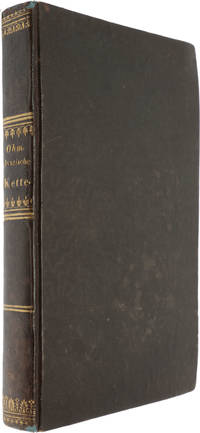
18275475Berlin: J.G.F. Kniestädt for T.H. Riemann 1827. First edition. <p>First edition of "Ohm's great work" DSB containing the fully-developed presentation of his theory of electricity including Ohm's Law. "Ohm's great contribution − 'The Galvanic Chain Mathematically Calculated' − was to measure the rate of current flow and the effects of resistance on the current. 'Ohm's law' − that the resistance of a given conductor is a constant independent of the voltage applied or the current flowing was arrived at theoretically by analogy with Fourier's heat measurements" PMM.</p>. PMM 289 - Measuring Electricity. First edition of "Ohm's great work" DSB containing the fully-developed presentation of his theory of electricity including Ohm's Law. "Ohm's great contribution − 'The Galvanic Chain Mathematically Calculated' − was to measure the rate of current flow and the effects of resistance on the current. 'Ohm's law' − that the resistance of a given conductor is a constant independent of the voltage applied or the current flowing that is C = E/R where C = current E = electromotive force and R = resistance − was arrived at theoretically by analogy with Fourier's heat measurements 1800-14" PMM.<br/> <br/> <br /> <br /> "The expression "investigated mathematically" in the title of Ohm's book described his objective: to deduce the properties of the galvanic circuit from a set of "fundamental laws." The first of these laws states that electricity passes only between adjacent particles of the conductor and that the quantity passed is proportional to the difference in electroscopic force at the two particles. Here Ohm drew on an analogy to Fourier's heat theory in which the quantity of caloric passed between two particles is proportional to the difference between their temperatures. Ohm's second law supported by Coulomb's experiments states that the loss of electricity in unit time from the conductor to the air is proportional to the electroscopic force of the electricity to the amount of surface exposed and to a coefficient that depends on the air; acknowledging that this second law has little bearing on the phenomena of galvanic currents Ohm included it to make the theory complete and parallel to Fourier's theory of heat. The third and last law states that two bodies in contact maintain the same difference of electroscopic force at their common surface which is the basic tenet of the contact theory of the battery. From these three laws Ohm derived differential equations for electric currents analogous to Fourier's and Poisson's for heat which indicated to him an "intimate connection" between the two phenomena. <br/> <br/> <br /> <br /> "The mathematical expression of Ohm's physical analogy between the conduction of electricity and the conduction of heat is an equation identical in form to Fourier's. The only difference is in the physical significance of the symbols entering the equation: in Fourier's the independent variable is the temperature; in Ohm's it is the electroscopic force which is the force with which an electroscope a body of constant electrical condition is attracted to or repelled from a body it is brought into contact with. Following an approach Fourier had made familiar Ohm mathematically divided the conductor into infinitely thin discs and calculated the quantity of electricity transferred per unit time across the parallel surfaces and outward through the edges of the discs. The result was the fundamental second-order partial differential equation of Ohm's theory . Having formulated the physical problem as a differential equation Ohm then solved it to obtain relations between directly measurable quantities. Manipulating the solution written as an infinite series of sine and cosine functions with damping coefficients Ohm arrived at . his law relating electric current resistance and tension. <br/> <br/> <br /> <br /> "The "torch of mathematics" Ohm wrote shines through physics illuminating its dark places. With his Galvanic Circuit he could claim that mathematics had "incontrovertibly" possessed a "new field of physics from which it had hitherto remained almost totally excluded." By means of mathematical deductions from a few experimental "principles" galvanic phenomena had been brought together in "closed connection" and presented as a "unity of thought." The deductions showed that the seemingly disparate phenomena of electric tension and current are really connected in nature partially realizing Ohm's goal of fashioning the theory of electricity as a "whole" .<br/> <br/> <br /> <br /> "When the Galvanic Circuit appeared few physicists in Germany knew mathematical physics sufficiently to understand it. Journal editors were afraid their readers could not understand papers containing the simplest mathematics as Ohm complained. For reviewing Ohm sent a copy of his book to Schweigger at Halle who did not see the point of a mathematical treatment. To have it evaluated the Prussian minister of culture sent a copy to Kämtz Schweigger's colleague at Halle who could not follow the mathematical derivation as is clear from his cautious review of it. In Berlin which desperately needed a "mathematical physicist" Ohm's work received its most famous and to Ohm irritating review from Pohl who was neither a mathematical nor a typical Berlin physicist . Pohl complained that Ohm had not paid attention to the "essence" of the circuit and had merely expressed some properties of electricity in formulas. This was no achievement but only a replication of Fourier's and Poisson's work in another part of physics . In general the response to Ohm's book reflected a paucity of physicists with good mathematical knowledge in Germany in the late 1820s. But one German review of Ohm's book showed complete comprehension. Ohm sent his book to Kastner in Erlangen to be reviewed in his journal. Kastner asked the mathematician Wilhelm Pfaff to write the review but Pfaff did not know the literature . The review that appeared under Pfaff's name was apparently written by Ohm himself after his brother had interceded. The review was of course favourable but a favourable review does not necessarily make a successful book. Sales of the Galvanic Circuit were unimpressive and Ohm paid friends to order the book from out of town to make a better impression on the publisher. The book was in print for eight years then not again for sixty years though in the meantime it had come out in several translations. Ohm sent free copies to everyone who might help him as he did not want to return to his teaching in Cologne" Jungnickel & McCormmach pp. 53-7. <br/> <br/> <br /> <br /> Georg Simon Ohm 1789-1854 was educated together with his brother Martin the mathematician principally by his father who gave his sons a solid education in mathematics physics chemistry and the philosophies of Kant and Fichte; their considerable mathematical ability was recognized in 1804 by the Erlangen professor Karl Christian von Langsdorf who enthusiastically likened them to the Bernoullis. Ohm received his Ph.D. from the University of Erlangen in 1811 but after teaching there for three semesters as a Privatdozent he was only able to find employment as a schoolteacher first at Bamberg and then from 1817 at the recently reformed Jesuit Gymnasium at Cologne. "The ideals of wissenschaftliche Bildung had infused the school with enthusiasm for learning and teaching; and this atmosphere which appears later to have waned coupled with the requirement that he teach physics and the existence of a well-equipped laboratory stimulated Ohm to concern himself for the first time avidly with physics. He studied the French classics − at first Lagrange Legendre Laplace Biot and Poisson later Fourier and Fresnel − and especially after Oersted's discovery of electro-magnetism in 1820 did experimental work in electricity and magnetism. It was not until early in 1825 however that he undertook research with an eye toward eventual publication" DSB.<br/> <br/> <br /> <br /> "Feeling increasingly burdened by his teaching at a secondary school in Cologne Ohm took his father's advice and asked the Prussian minister of culture for a year off. To the minister he explained that for a long time he had divided his attention between mathematics and physics though for practical reasons he had emphasized physics. By taking up physics he did not have to give up mathematics he said since the two were closely connected. His appeal to the minister contained an element of calculation: he regretted that the French had recently dominated physics and he had been studying the mathematical works by Laplace Fourier Poisson Fresnel and other French masters to see what they had left for him to do. He had been doing purely experimental work on the whole but he had in hand a mathematical theory of galvanic current; all he needed was time off to complete it and he added to work out a theory of light as well. On the recommendation of Ermann the minister approved Ohm's request. With half salary Ohm went off to Berlin in 1826 to live in his brother's house where he had a small apartment with space for doing experiments. With these improved working conditions he developed the mathematical theory of the galvanic current perhaps with his brother's help with the calculations. The result was the Galvanic Circuit .<br/> <br/> <br /> <br /> "After the Galvanic Circuit Ohm carried out important researches on tones and on crystal optics and he undertook a comprehensive theory of physics. In the year the Galvanic Circuit was published he began to speak of a greater work to come one that would treat the whole of molecular physics. Apparently he wanted to derive all physical phenomena from analytical mechanics and molecular hypotheses. Ohm published the first volume containing the mathematical preliminaries. In the second volume he intended to treat dynamics and in the third and fourth its application to physical phenomena. But Ohm's late call to Munich University interfered with his plan and the volumes never appeared. The existence of the plan however pointed to the confidence of the author of the Galvanic Circuit in the power of mathematical physics to complete the understanding of nature that Newton had begun" Jungnickel & McCormmach pp. 53-8. <br/> <br/> <br /> <br /> Widespread understanding and acknowledgement of the importance of the Galvanic Circuit did not come until the late 1830s and early 1840s when Ohm's work began to receive official recognition with corresponding memberships of the Berlin and Turin academies in 1839 and 1841 respectively the award of the Royal Society of London's Copley Medal in 1841 and finally just before his death the chair of physics at the University of Munich in 1852. In 1881 when the importance of Ohm's work was fully understood the standard unit of electrical resistance was named the ohm in his honour at the Paris Conference on international standards. <br/> <br/> <br /> <br /> Waller 11419; Wellcome IV p. 260; Wheeler Gift Cat. 835. Jungnickel & McCormmach Intellectual Mastery of Nature. Theoretical Physics from Ohm to Einstein Volume 1: The Torch of Mathematics 1800 to 1870 1990. <br /> <br/> <br/> 8vo 195 x 123 mm pp. iv 245 errata on p. 245 1 folding engraved plate. Contemporary patterned German cloth gilt spine lettering light wear to capitals and corners. Previous owner's signature removed from title. Custom half leather clamshell box. J.G.F. Kniestädt for T.H. Riemann unknown
1532WRCAM41962Basel 1532. 48584 i.e. 5862pp. Lacks the map. Folio. Antique-style gilt calf gilt spine gilt with raised bands. Slight worming to first hundred leaves mostly affecting margins. Contemporary annotations throughout volume. Very good. One of the most important collections of New World material issued up to the time. Grynaeus is often given credit for this volume somewhat unfairly since the majority of the work was compiled by John Huttich. Describes the voyages of Columbus and Vespucci and prints various accounts of Portuguese discoveries in Brazil and the East accounts of Marco Polo and much of the material gathered by Peter Martyr. There are extensive accounts of almost all of the European voyages to the larger world. EUROPEAN AMERICANA 532/17. SABIN 34100. HARRISSE 171. JCB 3I:104. STREIT I:28. MEDINA BHA 46n. hardcover books
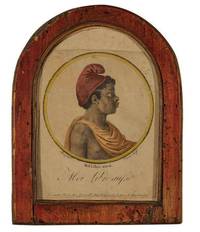
17943053Paris: : Se vend à Paris chez Depeuille Rue Franciade Section de Bon Conseil François Jules Gabriel Depeuille 1794. First edition. Hand-colored engraving. In contemporary or near contemporary frame. Engraved by Louis Darcis after Boizot Boizot del.t : Darcis Sculp.t. Showing a black man with a red Phrygian liberty cap in a circular medallion with the motto or title engraved beneath twice in different typefaces. Paper tanned trimmed the engraving mounted on paper to fill the arch-shaped frame. Wormholes to the frame. Otherwise in fine condition. First edition. Hand-colored engraving. In contemporary or near contemporary frame. Engraved by Louis Darcis after Boizot Boizot del.t : Darcis Sculp.t. Showing a black man with a red Phrygian liberty cap in a circular medallion with the motto or title engraved beneath twice in different typefaces. Diameter: ca. 75 mm. <p><br /> Important public propaganda image commemorating the abolition of slavery in France in 1794.<br /> <p><br /> The abolition of slavery in Saint Domingue in 1793 a major achievement of the slave revolt the Haitian Revolution the activity of the abolitionist societies in France and just as importantly the ideas of the French Enlightenment and the revolutionary ethos of Liberté égalité fraternité convinced the French National Convention to issue a decree in 1794 the so-called Law of 4 February 1794 which abolished slavery and the slave trade in all French colonies and gave the formerly enslaved equal rights.<br /> <br /> Commemorating the occasion promoting the idea of general emancipation and proclaiming equality in public propaganda various images featuring men and women of African descent with different printed slogans referring to freedom and equality started to circulate.<br /> <p><br /> A pair of these images depicting a freed woman and a man titled Moi libre aussi I Too Am Free was created by Louis Simon Boizot 1743–1809. Boizot's designs were probably intended to decorate porcelain box lids as the artist was the director of the Sèvres porcelain manufactory at the time and also created sculptures with the same title for the company. The freed black man the engraving presented here wears a red Phrygian liberty cap of emancipated enslaved people a symbol still featured in the centerpiece of the Haitian flag and the title Moi libre aussi appears twice beneath his image.<br /> <br /> <p><br /> Scarce. Except for the present one no other records on RBH.We could trace institutional copies only in France BnF - 4 copies in two versions with a slightly different arrangement of the text; Le musée Carnavalet the UK British Museum and the United States JCB. One of the BnF-copies a variant was exhibited at The Metropolitan Museum of Art in New York City as part of the exhibition Fictions of Emancipation: Carpeaux Recast March 10 2022–March 5 2023.<br /> <br /> <br /> <br /> <br /> <p>. : Se vend à Paris chez Depeuille, Rue Franciade, Section de Bon Conseil [François Jules Gabriel Depeuille] unknown
1892296808New York: COLTON G. W. and COLTON C. B. 1892. unbound. very good. Large folding map mounted on linen 29 1/2 x 37 1/2 inches in very good condition bound with 28 pp of text 10 blank pages. Manuscript notes in pencil. 8vo 3/4 polished calf. New York: G.W. Colton & C.B. Colton 1892. Scarce. Very good .<br/><br/> "Real estate speculators shippers and business interests could not agree on the best way to utilize the Harlem river debating whether public works should facilitate traffic across the river or shipping along the river. Coastal trade interests advocated for a Harlem River Canal but their opponents argued that transportation across the river was more important. This map of the river between the Hudson River top and the East River bottom accompanied an unsuccessful proposal to have the state legislature turn the Harlem into a subterranean river and connect Manhattan with the mainland between Third and Eighth Avenues section shaded red." Gotham Center for New York history. Small abrasions along folds. Includes notes for the proposed site for Columbia University.<br/><br/> COLTON, G. W. and COLTON, C. B. unknown books
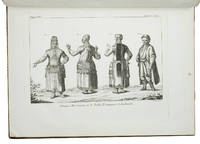
1788ABC_45571Paris: Lagrange vol. 1 Maradan vol. 2-5; colophon of vol. 5: De l'Imprimerie de Demonville 1788. Uniform gold-tooled tree calf with a border on each board richly gold-tooled spines a red morocco spine label with the title and a green morocco spine label with the volume number gilt edges marbled endpapers. 4to text and Imperial 4to atlas: 33.5 x 25 cm. With 123 engraved plates and maps 29 16 22 35 21 to accompany the 5 text volumes respectively printed on 108 leaves 27 folding including a large folding map of the Russian Empire and several other maps plans views and plates showing costumes plants birds etc. and some engraved head- and tailpieces in all text volumes. 5 text volumes and 1 atlas volume. First edition of the French translation of Peter Simon Pallas's 1741-1811 famous account of his first expedition to Russia and Siberia one of the "academic expeditions" undertaken by the Academy of Sciences in St Petersburg 1768-1774. One of Pallas's chief geological contributions from the expedition was "the recognition of temporal sequence of rocks from the centre to the flanks of a range" DSB mainly based on his study of the Ural and Altai Mountains. He describes numerous Russian plants many depicted in the 123 plates along with some birds and other animals living in the Russian areas he visited.Pallas also describes his journey through the less-visited regions of the Russian Empire depicted in 11 maps including a large folding map of the Russian Empire and he describes the population depicted with their costumes in several plates and the economy of each area. Although a large amount of the 5 text volumes are because of Pallas's background on geology geography climate and flora and fauna and were of great importance for the natural science of Russia the volumes are more than that: they contain a sketch of the Russian Empire in the years 1768-1774 and are a beautiful witness of the first "academic expedition".Bindings a little worn corners bumped heads and feet of the spines a little worn those of volume 1 and the atlas volumes a little cracked. The endpapers of some volumes are browned in vols. 2 and 5 also the half-title and the title-page. Only some very small stains and slight foxing not affecting the text or images. With a tear in the first endpaper of vol. 5 some larger stains on the endpapers of vol. 3 and on rare occasions the foot margin of a text page is cut a little bit short. The edges of the folding plates in the atlas volume are sometimes a little frayed. Otherwise a beautiful set uniformly bound and in good condition.l Brunet IV col. 325; Catalogue de la section des Russica P35; Howgego P9; Hunt 672 note; Nissen ZBI 3076; Stafleu & Cowan 7224; for the author: DSB X pp. 283-285. Lagrange (vol. 1), Maradan (vol. 2-5; colophon of vol. 5: De l'Imprimerie de Demonville), unknown
126964aafBerne, chez les Artistes Associés (imprimé à Basle, chez Guillaume Haas, fils), 1797, in-4to, 40 S. + 2 Bl. + 13 kolorierte Umriss-Radierungen in leuchtendem Kolorit d. Zeit + 1 Übersichtstafel mit 9 Umrissradierungen + (beigebunden:) 2 Bl. (remarques minéralogiques von Pfarrer Wyttenbach), Roter Marokko-Ledereinband d. Z., Goldprägung auf Buchrücken und Deckel. Original Buntpapier-Vorsätze.
156588London: 4AD 1989. Three early never-issued alternate artwork proof designs for the classic 1989 album. Developed by British graphic designer Vaughan Oliver with photography by Simon Larbalestier. Unique.<br /> <br /> In 1980 Oliver and photographer Nigel Grierson formed the graphic design partnership 23 Envelope. In 1982 the duo were invited to create sleeve art for the 4AD record label by co-founder Ivo Watts-Russell. Under 23 Envelope and v23 Oliver would give 4AD one of the most acclaimed and distinguished visual identities of any record label of the 1980s and 1990s designing album art for the Cocteau Twins This Mortal Coil Dead Can Dance Colourbox and the Pixies among many others. Oliver managed the graphic design for the Pixies' entire discography during his lifetime with "Doolittle" being the most celebrated.<br /> <br /> Photographer Simon Larbalestier is best known for his collaborative work with Oliver under 23 Envelope and v23 and provided photography for all the Pixies albums helping to give the band their distinctive and opulent visual style.<br /> <br /> "Doolittle" was the first Pixies album for which Oliver and Larbalestier had access to the lyrics which "made a fundamental difference" according to Larbalestier and helped determined the photography layout and graphic style.<br /> <br /> While each of the experimental proofs presented here retain the general overall layout of the released cover each contains both stark and subtle differences. The first proof the most dramatically divergent is printed in a sharp copper with the photograph a pale yellow and the rear cover text a deep blue. The other two proofs experimenting with metallic copper and gold are both notably lighter in tone than the final art but the photograph printed in a gray green is close to Oliver's final design with the rear cover text also in gray-green as opposed to the white of the final design. The layout of the typography is also notably different in all three proofs with the band name much smaller and its accompanying grid nearly indiscernible as is the title placed discreetly above the band's name. <br /> <br /> Three extraordinary experimental proofs documenting Oliver's process in creating the exceptional art of one of the most celebrated and influential rock albums of all time.<br /> <br /> 25.25 x 13.75 inches on heavy card stock. Near Fine overall. 4AD unknown
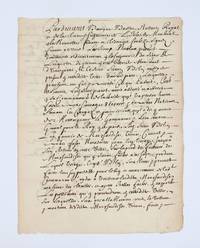
1688368775Montreal 1688. In French. 2pp. recto and verso on a single leaf. Signed by Perrot Bleinz and notary Benigne Basset. With an English transcription. Quarto. Old folds. Near fine. Provenance: Archibald de Léry MacDonald; Lawrence Lande. Exhibition: An Exhibition of Early Documents and Printed Material Relating to the Beginnings of Trade in North America from the Private Collection of Dr. Lawrence M. Lande McGill University May 30-July 15 1985 with an 8-page exhibition catalogue. In French. 2pp. recto and verso on a single leaf. Signed by Perrot Bleinz and notary Benigne Basset. With an English transcription. Quarto. Scarce seventeenth century voyageur fur trade contract for an expedition to the wilderness to trade with the Ottawa signed by one of the most important early traders and explorers of Canada and the upper midwest. "Partnership agreements such as this one of Nicholas Perrot are of great rarity" Lande.<br /> <br /> Perrot 1644-1717 was an explorer interpreter trader commandant diplomat and seigneur. He was one of the best-known figures in the early fur trade of New France particularly during the latter part of the 17th century and took possession of large tracts of land in the Great Lakes region in the name of King Louis XIV. His travels commonly took him deep into unexplored territory and he was the first Frenchman to explore the Upper Mississippi in what is now Wisconsin and Minnesota.<br /> <br /> Perrot arrived in New France about 1660 as a young donné or contracted assistant in the company of Jesuit Missionaries and travelled to the western Great Lakes region where he gained the friendship of the local First Nations people by trading guns for furs believing that they were entitled to defend themselves from their enemies. He also took the opportunity to learn several Native languages which served him well during his career. Perrot soon entered the fur trade full time and began forming business partnerships. He enlisted himself as a translator with government authorities and participated in peacekeeping missions to bring warriors of several First Nations together to sign peace treaties. By 1685 he was appointed Commandant-in-Chief at Bais des Puants present day Green Bay Wisconsin and surrounding regions and travelled to the upper reaches of the Mississippi River in the territory of the Sioux tribes where he built Fort St. Antoine in present-day Minnesota.<br /> <br /> During the spring of 1687 in preparation for taking part in raids on Indian villages in the Seneca country Perrot left his store of furs with the Jesuits at St. Francois-Xavier mission in present-day Wisconsin. While out with the raid party a fire at the mission destroyed his entire fur inventory valued at more than 40000 livres. Financially ruined Perrot returned to Montreal to deal with creditors and renew partnership agreements like the present.<br /> <br /> In the summer of 1688 Perrot partnered with Simon Bleinz to undertake an expedition to trade with the Ottawa Indians and other Nations. Perrot had always been a staunch ally of Governor Frontenac and had obtained a fur trade license from the governor for this venture to ensure that his activities were in keeping with the rules and regulations of the trade.<br /> <br /> The agreement states that Perrot would supply Bleinz with goods food provisions a canoe and other necessary supplies for the voyage and that Bleinz would convey the goods to the trading area and do all that he was able for the success of the partnership. Bleinz had the option of taking at his own expense six shirts two capots or hooded coats of blanket cloth moosehide or other material and one rifle to trade for his own personal profit. The pelts resulting from the venture were to be distributed evenly amongst Bleinz another unnamed associate of the partnership and Perrot. An "apichimon" or bonus of six beaver pelts was to be paid to Bleinz by the partnership upon the successful conclusion of the expedition. <br /> <br /> "Perrot who was often unappreciated even during his lifetime was France's best representative among the Indians of the west. His knowledge of the languages of the country his natural eloquence the happy blend of daring and coolness that were the essence of his character had made it possible for him to win the esteem confidence and even affection of the Indians. The Potawatomis the Menominees the Foxes the Miamis the Mascoutens and the Sioux granted him with the honours of the pipe of peace the rights and prerogatives enjoyed by their own chiefs. His credit was not less among the Ottawas and the Hurons. During the last four decades of the 17th century at a time when alliance with the nations of the west was indispensable in order to ward off the Iroquois peril and allow access to new territories Perrot thanks to the influence that he had acquired rendered valuable assistance to the colony" Dictionary of Canadian Biography.<br /> <br /> The present document is from the famed collection of Lawrence M. Lande 1906-1998 detailed as item 107 in his second bibliography of his collection The Founder of our Monetary System John Law Compagnie des Indes & the Early Economy of North America Montreal: 1984. Lande began collecting manuscript material relating John Law the Compagnie des Indes and the fur trade - North America's first economy - as early as the 1960s principally working with dealers Izzy Ehrlich and Alfred Van Peteghem purchasing material from the collections of Thomas Phillips Philip Sang and historian Archibald Lery MacDonald the assemblage of which Van Peteghem termed an "unparalleled feat." All of the printed material and many of the documents were donated by Lande in his lifetime; however a grouping of the manuscript items including the present document were sold by his heirs after his death. Lande Founder of our Monetary System 107 unknown
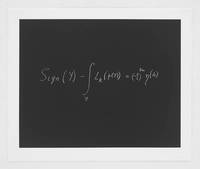
20149325Portland OR: Parasol Press 2014. Limited Edition. Loose Sheets. Fine in Fine Archival Boxes. Bright and unmarred. Black coated cloth archival boxes prints descriptions cards. 8 are 26 1/8 x 31 5/8 inches. 2 are 31 5/8 x 26 1/8 inches. Illus. b/w plates. Limited edition of 100. Signed by the mathematicians/physicists. <br/><br/>A collection of 10 aquatints on Rives Paper. Leon Battista Alberti renaissance scholar artist and architect coined the term Concinnitas to connote the beauty found in the confluence of perfect uses of number position and outline. <br />In 2012 Parasol commissioned ten mathematicians physicists and computer scientists including two Nobel Laureates and five Fields Medalists to create etchings of the mathematical expression most meaningful to them. These formulae were then printed by the fine-art print shop Harlan and Weaver as aquatints evoking the look of equations quickly and elegantly sketched in white chalk on a blackboard. Accompanied by an expository essay of each and description card signed by each. <br />Sir Michael Atiyah. Edinburgh University. Fields Medal <br />Enrico Bombieri. Institute of Advanced Study Princeton. Fields Medal <br />Simon Donaldson. Stony Brook University / Imperial College London. Fields Medal <br />Freeman Dyson. Institute of Advanced Study Princeton. Templeton Prize <br />Murray Gell-Mann. Santa Fe Institute. Nobel Prize <br />Richard Karp. UC Berkeley. Turing Medal <br />Peter Lax. Courant Institute NYU. Abel Wolf and Norbert Wiener Prize <br />David Mumford. Brown University. Fields Medal <br />Stephen Smale. City University of Hong Kong. Fields Meda <br />Steven Weinberg. University of Texas. Nobel Prize <br /> Parasol Press unknown books
9325Portland OR: Parasol Press 2014. Limited Edition. Loose Sheets. Fine in Fine Archival Boxes. Limited Edition. Loose Sheets. A collection of 10 aquatints on Rives Paper. Leon Battista Alberti renaissance scholar artist and architect coined the term Concinnitas to connote the beauty found in the confluence of perfect uses of number position and outline. <br /> In 2012 Parasol commissioned ten mathematicians physicists and computer scientists including two Nobel Laureates and five Fields Medalists to create etchings of the mathematical expression most meaningful to them. These formulae were then printed by the fine-art print shop Harlan and Weaver as aquatints evoking the look of equations quickly and elegantly sketched in white chalk on a blackboard. Accompanied by an expository essay of each and description card signed by each. <br /> Sir Michael Atiyah. Edinburgh University. Fields Medal<br /> Enrico Bombieri. Institute of Advanced Study Princeton. Fields Medal<br /> Simon Donaldson. Stony Brook University / Imperial College London. Fields Medal<br /> Freeman Dyson. Institute of Advanced Study Princeton. Templeton Prize<br /> Murray Gell-Mann. Santa Fe Institute. Nobel Prize<br /> Richard Karp. UC Berkeley. Turing Medal<br /> Peter Lax. Courant Institute NYU. Abel Wolf and Norbert Wiener Prize<br /> David Mumford. Brown University. Fields Medal<br /> Stephen Smale. City University of Hong Kong. Fields Meda<br /> Steven Weinberg. University of Texas. Nobel Prize. Bright and unmarred. Black coated cloth archival boxes prints descriptions cards. 8 are 26 1/8 x 31 5/8 inches. 2 are 31 5/8 x 26 1/8 inches. Illus. b/w plates. Limited edition of 100. Signed by the mathematicians/physicists. Parasol Press unknown
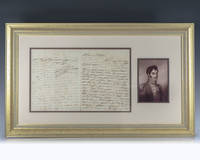
18291261831829. Rare autograph letter signed by ‘El Libertador’ Simón Bolívar as President of Gran Colombia. One page script in Spanish on both recto and verso. The letter is dated May 13 1828 and offers the recipient Colonel José Félix Blanco Bolívar's support in his struggle to maintain the security of Barinas of which was made Governor in 1827 in the midst of heavy criticism from several officers including General José Antonio Páez. Bolívar notes that the offending officers have been dismissed in order to prevent the possibility of partial influence on the resulting hearings and regrets that he will be unable to the proceedings in Orinoco but expects Blanco's reputation to be restored in four to six months. Signed by Bolívar at the conclusion of the letter. The recipient Colonel José Félix Blanco joined the war of independence in 1810 serving as chaplain and was appointed intendant Governor of Barinas in 1827. He was among the defenders of Valencia in the first siege of the city and participated in the first battle of Carabobo. Active in a variety of military government and religious capacities over the course of several decades he was later appointed commander of arms of the province of Maracaibo Secretary of War and Navy in 1837 and Secretary of the Treasury and Foreign Relations in 1847 after an unsuccessful run for the vice-presidency of the Republic in 1844 and for the presidency in 1846. In near fine condition. Double matted and framed with a portrait of Bolívar with a glass pane on the verso of the frame displaying the letter in full. A unique association. Venezuelan military and political leader Simón Bolívar also known as 'El Libertador' led what are currently the countries of Venezuela Bolivia Colombia Ecuador Peru and Panama to independence from the Spanish Empire in the campaign for the independence of New Granada which began in 1808 and was consolidated with the victory at the Battle of Boyacá on 7 August 1819. Despite a number of hindrances including the arrival of an unprecedentedly large Spanish expeditionary force the revolutionaries eventually prevailed culminating in the victory at the Battle of Carabobo in 1821 which effectively made Venezuela an independent country. Following this triumph over the Spanish monarchy Bolívar participated in the foundation of the first union of independent nations in Latin America Gran Colombia of which he was president from 1819 to 1830. Through further military campaigns he ousted Spanish rulers from Ecuador Peru and Bolivia the last of which was named after him. He was simultaneously president of Gran Colombia present-day Venezuela Colombia Panama and Ecuador Peru and Bolivia but soon after his second-in-command Antonio José de Sucre was appointed president of Bolivia. Bolívar aimed at a strong and united Spanish America able to cope not only with the threats emanating from Spain and the European Holy Alliance but also with the emerging power of the United States. At the peak of his power Bolívar ruled over a vast territory from the Argentine border to the Caribbean Sea. unknown
51642 p.l. 164 5 pp. 12mo cont. polished calf by Derome triple gilt fillet round sides with floral devices in each corner flat spine gilt in a fish-scale pattern black morocco lettering piece on spine a.e.g. Paris: de l'Imprimerie de Didot l'Ainé 1783. Limited to 25 copies only finely printed by Didot on Annonay paper and handsomely bound in contemporary polished calf by Derome; this is one of the rarest and oddest of all private library catalogues. It is also notable as the first bibliography or catalogue with a limitation statement and very probably the first catalogue to mention binders' names. Mérard 1749-1812 man of letters was born into a family of great wealth and for a number of years was in charge of the residence of the future Louis XVIII. After retiring from his public duties in 1782 he concentrated on his growing collection of books and on commissioning editions printed in severely limited numbers. Guigard wrote Vol. II p. 351: "Sans l'amour des livres Mérard de Saint-Just serait complètement oublié." There is much truth in this but the catalogue is a fascinating and rare document which keeps Mérard's name alive in the world of bibliophily. The catalogue is an odd combination of books which were present in his library books no longer in his library and books which he desired for his library including some books which could be imaginary; see below. His collection was not large but fine. Mérard did not have the taste for editio princeps except for Aldines but preferred the best editions with careful editing. The catalogue describes 513 items each with details regarding binding and prices paid. In the Preface which alone would justify reprinting for his extraordinary views on book collectors and in his concluding remarks on pp. 161-163 he sets out his main interests foremost among them fine bindings listing eight binders whose works he had acquired or himself commissioned: Padeloup Laferté Derome le Jeune Chamean Chaumont Roger Payne and Baumgarten. He enumerates sixteen sales at which he acquired books including those of the Pompadour Boze Gaignat Gouttard Mac Carthy Reagh and 'Mylord Keri' i.e. Ker Duke of Roxburghe collections. His catalogue is the first in which the binders of the books whenever known are mentioned. Mérard has been accused of including in his catalogue the description of books which never existed or which he never owned but Escoffier convincingly defends him against that charge though Barbier shows that six of his own works described as printed editions were in fact in MS. Mérard suffered two major losses from his library which he recounts in this catalogue. During an absence the pipes in the kitchen leaked causing serious water damage to the library room below irreparably destroying 200 of his most precious books. Then on the 12th of December 1782 the English navy seized a French boat which was carrying 1000 books of Mérard's - considered by Guigard to be the cream of his collection - which he had sent to a friend in America why he had sent them he never explained. These volumes were never recovered. A very fine copy. This copy has the five extra pages at end often missing which contain a description of one of the books in the catalogue the Des Pierres Précieuses of Dutens. This was the first book printed by Didot l'ainé. Unidentified armorial book label on inside front cover: with coat-of-arms monogrammed with initials "C.R.L." or "R.L.C." and motto "Vita sine litteris mors est." Bookplate of A.R.A. Hobson. ❧ Brunet III 1643. Guigard II pp. 351-52. Houghton Library Bibliotheca Chimaerica 1962 p. 7. Peignot p. 113-"assez recherché à cause de sa rareté." Taylor Book Catalogues p. 92. unknown books
1794006817London: Printed by W. Bulmer & Co. Shakspeare Printing-Office for John & Josiah Boydell and George Nicol. From the Types of W. Martin. 1794 1795 1797. First Edition. Full Gilt and Blindstamped Morocco. Near Fine. Folio 32 by 26 cm. cxxxiii 3 213 286 300 pp. 32 hand-colored mezzotint plates within the 3 volumes one plate folding. Among them are three reproductions of Milton portraits including Milton as an infant as a boy and the famous Romney painting of the blind Milton dictating to his daughters this plate being the folding one. To our knowledge this copy of the Boydell Milton is an uniquely hand-colored copy. All the plates other than the Milton portraits are the artwork of Westall. These have an unmistakable affinity to the heroic style of Blake his contemporary. The men and even the women can have exaggerated bulging muscles as found most famously in Michelangelo. As invited by Milton's epic light contends with dark and the illustrations serve up a phantasmagoria of imagery with swirling shadows and specters. The hand-coloring is of a very high caliber and we think greatly enriches the mezzotints. The three volumes contain all the major poetry of Milton -- "Paradise Lost" "Paradise Regained" "Samson Agonistes" "Comus" etc. etc. Note all half-titles are present. Binding of a rich russet/crimson straight-grained morocco with bands of blindstamping and gilt-stamping decoration on the boards and gilt decoration within and on the raised bands. Decoration consists of ruling Greek palmettos and more floral rinceaux bands. Conditiion: morocco binding with minor abrasions and wear. One leaf with repaired tear Vol. II pp. 103/4. Pages generally clean plates bright. All volumes tight. Printed by W. Bulmer & Co., Shakspeare Printing-Office, for John & Josiah Boydell, and George Nicol. From the Types of W. Marti books
1797006817London: Printed by W. Bulmer & Co. Shakespeare Printing-Office for John & Josiah Boydell and George Nicol. From the Types of W. Martin 1797. First Edition. Full Gilt and Blindstamped Morocco. Near Fine. Folio 32 by 26 cm. cxxxiii 3 213 286 300 pp. 32 hand-colored mezzotint plates within the 3 volumes one plate folding. Among them are three reproductions of Milton portraits including Milton as an infant as a boy and the famous Romney painting of the blind Milton dictating to his daughters this plate being the folding one. To our knowledge this copy of the Boydell Milton is an uniquely hand-colored copy. All the plates other than the Milton portraits are the artwork of Westall. These have an unmistakable affinity to the heroic style of Blake his contemporary. The men and even the women can have exaggerated bulging muscles as found most famously in Michelangelo. As invited by Milton's epic light contends with dark and the illustrations serve up a phantasmagoria of imagery with swirling shadows and specters. The hand-coloring is of a very high caliber and we think greatly enriches the mezzotints. The three volumes contain all the major poetry of Milton -- "Paradise Lost" "Paradise Regained" "Samson Agonistes" "Comus" etc. etc. Note all half-titles are present. Binding of a rich russet/crimson straight-grained morocco with bands of blindstamping and gilt-stamping decoration on the boards and gilt decoration within and on the raised bands. Decoration consists of ruling Greek palmettos and more floral rinceaux bands. Conditiion: morocco binding with minor abrasions and wear. One leaf with repaired tear Vol. II pp. 103/4. Pages generally clean plates bright. All volumes tight. Printed by W. Bulmer & Co., Shakespeare Printing-Office, for John & Josiah Boydell, and George Nicol. From the Types of W. Marti unknown
1605180091605 Leyde, Jan Paedts Jacobsz, 1605-1608, in-folio de (8)-360-132-85-(1)-21-(1)-58-(2)-108 pp., papier assez bruni, quelques mouillures claires et taches n'affectant pas le texte, bords des 2 derniers feuillets consolidés, rel. d'époque de pleine peau de daim jaune clair, frottée, taches claires), dos à nerfs avec titre anciennement doré, bon ex. dans sa reliure d'origine.
1892296808New York: COLTON G. W. and COLTON C. B. 1892. unbound. very good. Large folding map mounted on linen 29 1/2 x 37 1/2 inches in very good condition bound with 28 pp of text 10 blank pages. Manuscript notes in pencil. 8vo 3/4 polished calf. New York: G.W. Colton & C.B. Colton 1892. Scarce. Very good .<br/> <br/> "Real estate speculators shippers and business interests could not agree on the best way to utilize the Harlem river debating whether public works should facilitate traffic across the river or shipping along the river. Coastal trade interests advocated for a Harlem River Canal but their opponents argued that transportation across the river was more important. This map of the river between the Hudson River top and the East River bottom accompanied an unsuccessful proposal to have the state legislature turn the Harlem into a subterranean river and connect Manhattan with the mainland between Third and Eighth Avenues section shaded red." Gotham Center for New York history. Small abrasions along folds. Includes notes for the proposed site for Columbia University.<br/> <br/> COLTON, G. W. and COLTON, C. B. unknown
1533748286 126 leaves engraved title page and frontispiece full page plate title in red and black gothic text further 56 woodcuts throughout including diagrams decorated capitals. First published in Paris 1504 under title: Le Cuer de philozophie this is a new translation of an anonymous compilation of a treatise attributed to Jean Bonnet an abstract of "De sphera" by Johannes de Sacro Bosco and a translation of Anianus by S. de Compiègne. It follows the edition of 1530 Printed by Philippe le Noir, University Bookbinder hardcover
169189QBOS08WBVRAmsterdam 1691. 12mo. Abraham Wolfgang Contemporary slightly overlapping vellum manuscript title on spine blue edges. With the same woodcut printer's device on both title-pages 2 folding engraved maps 17 double-page engraved plates with printed music Siamese alphabets inhabitants etc. 21 full-page engraved plates engraved headpiece and several woodcut illustrations in text. 2 volumes bound as 1. 8 436 2; 4 324 1 1 blank pp. Second edition published in the same years as the first of a comprehensive work on the history of the kingdom of Siam "Universally regarded as the finest work on seventeenth-century Thailand" Wyatt. The French diplomat Simon de La Loubère 1642-1729 was appointed as Louis XIV's envoy extraordinary to the court of Siam and while he stayed in Siam for only three months he diligently and systemically asked questions "probably stimulated by the Jesuit scientists who accompanied the mission to take more than a passing interest in Siamese cosmology astronomy and mathematics" Lach & Van Kley. Loubère compensated his short stay with a thorough study of earlier writers referring to twenty-three European authors from Pinto to Gervaise in the first volume and collecting French translations of native works in the second. Besides presenting information on Siam itself Loubère also incorporates information on India and China and their influence on Siam's past.With the armorial bookplate of Anton Ernst Burckhard van Birckenstein active 1686-1744 on paste-down. Very good copy.l STCN 6 copies; Walravens 92; cf. Lach & Van Kley III pp. 1194-1196; Wyatt "Introduction" in: A new historical relation of the Kingdom of Siam 1966. ABE CAT Anthropology & Ethnography hardcover