Sammlung ausgeführter ConstructionenAntiquariat.de

10 874 résultats
18592792Nach den zur Verfügung gestellt gewesenen Materialien der Ingenieurschule des Grosh. bad. Polÿtechnikums zu Carlsruhe. Zusammengestellt, geordnet & gezeichnet durch Eleven der genannten Fachschule im Laufe des Studienjahres 1857/58. 120 doppelblattgr. lithogr. (7 mit Tonplatte) oder gestochenen Tafeln (inkl. Titel mit lithogr. Titelvign.). Karlsruhe, J. Veith, [1857-1859]. Folio (44,0 x 30,8 cm). Doppelblattgr. Inhaltsblatt. 4 Halbleinwandbände d. Zt. [8 Warenabbildungen]
19112092902138301906Not Available 1911. Soft Cover. Fine. Number of pages: 8242p Size: 23cm Not Available paperback
19352091502135500494Not Available 1935. Soft Cover. Fine. Number of pages: Photographic version 40p 19.5x27.5 cm Complete box Size: Uncollected materials of the National Diet Library Not Available paperback
1901166570Istanbul: 1901-07. An astounding feat of engineering Eight issues of this popular Ottoman magazine documenting the construction of the Hejaz Railway accompanied by a blank export declaration designed for the transportation of goods. The images focus on Tall al-Shahab on the Haifa branch Muzayrib near Dar'a' and the town of Ma'an. A view over the valley at Tall al-Shahab is followed by additional images showing the line snaking between the hills and a bridge in the same location with particular care taken to emphasize the technological achievement of blasting a route through the rock. Pictures from Muzayrib show workmen and locomotives on the track including a larger picture of a carriage with the railway's logo emblazoned. The photographs taken near Ma'an show the town's station and bridges. There are also two pictures of tunnels near Haifa each of which is an engineering achievement. The ultimate vision for the railway was to link Istanbul with the holy cities of Mecca and Medina and thereby consolidate Ottoman military control over the Arabian Peninsula. However only the section of the main line from Damascus to Medina was ever constructed becoming fully operational in 1909. Eight issues quarto each issue 4 pp. Photographic illustrations in the text. Two instalments in original wrappers as issued. Four issues with postal stamps some only partial. Two issues uncut some wear and toning as expected loss to a few characters of text expert repairs with Japanese tissue paper and archival tape. A very good collection of a fragile publication. unknown
19972080502106907340Not Available 1997. Soft Cover. Fine. The book is in fine condition. Not Available paperback
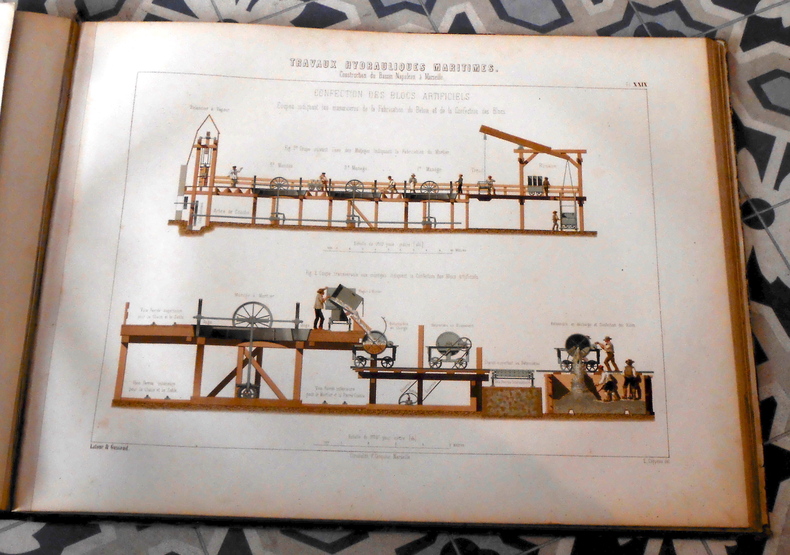
186122979Marseille, E. Cappeau del., 1861. Cartonné, 42 cm x 54,5 cm, LV planches en chromolithographies montées sur onglet par F. Canquoin. Ouvrage de Esprit Latour et Auguste Gassend. Couverture en état d’usage, planches en très bon état. Il manque les planches II et III et la page de garde, les planches XXVIII et XXXVI sont détachées. Rarissime
1900373823St. Louis 1900. 34 photographs mounted recto and verso on 17 cards with printed album title on each the images captioned in the negative on linen guards. Oblong small folio 10-1/8x12-1/2 inches. Contemporary half calf and cloth covered boards titled in gilt on the upper cover leather perished contents loose. The images generally dark printings in good condition. Provenance: Battery Park Hotel Asheville NC presentation in gilt on the upper cover from H. C. Townsend Gen'l Pass'r and Ticket Agent St. Louis. 34 photographs mounted recto and verso on 17 cards with printed album title on each the images captioned in the negative on linen guards. Oblong small folio 10-1/8x12-1/2 inches. The images by an unindentifed photographer comprise lovely compositions of buildings and scenes along the route in Missouri Kansas Nebraska and Arkansas. OCLC locates only a single example at University of Texas Austin. unknown
19902091202133206396Kuresushuppan 1990. Soft Cover. Fine. Number of books: 9 books in total Kuresushuppan paperback
1914164836Istanbul: May 1330 Rumi / 1914 CE. North Arabia and the First World War First and only printing of this rare decree by the Ottoman Chamber of Deputies written in the opening months of the First World War which outlines the state's commitment to constructing a 23-kilometre railway connection between the towns of Jenin and Nablus in what is today the West Bank as an extension of the Jerusalem branch of the Hejaz railway. The decree states that the government will spend 1200000 Kuru from the budget for 1329/1913-14 and 4800000 Kuru from the budget for 1330/1914-15 and that it will complete the track within a period of two years. It also lays out the assembly's assent and an analysis of how the budget for the project will be balanced. A list of the committee members who had signed off on the project is appended. The railroad was a key piece of infrastructure in supplying Ottoman troops in the Sinai hence the decision of the Ottoman government to spend large amounts of money on its expansion as the war began. The ultimate vision for the railway was to link Istanbul with the holy cities of Mecca and Medina and thereby consolidate Ottoman military control over the Arabian Peninsula. However only the section of the main line from Damascus to Medina was ever constructed becoming fully operational in 1909. Single bifolium with text in Osmanl Turkish printed across three pages. Light folds old pale stain at left edge a few light pencil annotations otherwise in good condition. unknown
191042977Paris, Imp. de G. Goury,, 1910. 2 vol. in-folio de 202-(1) pp. et (4)-64 planches, chagrin brun, dos orné à nerfs, titre et tomaison frappés or, filet doré sur les coupes et dentelles dorées sur les chasses, super libris frappé or en pied des plats, première de couverture illustrée conservée (reliure de l'époque).
19478964Osaka: Liason Office Osaka Railway Division Japanese Government Railways 1947. First Edition . Hardcover. Fine. Quarto 66pp. illustrated with 89 mounted photographs. A fresh clean example sharp and bright with the only visible flaw being some waviness throughout due to the mounting glue. The prints themselves are universally in excellent condition; overall fine. An absolutely extraordinary visual collection of the rolling stock locomotives and all sorts of freight cars used by the Japanese Government Railways in the immediate post-war period. The prints are each about 4" x 6" and the developer cropped the exposiure to jst the immediate area around the trains leaving large white borders which give the trains themselves a real "pop."<br/> <br/> Int he mid-19th century Japan was an extremely isolated society both from the rest of the world and also to some extent internally with different regions of the main island quite distinct culturally. The railway system which began construction in 1872 facilitated movement throughout Japan and helped to create a more interconnected society. The railways were nationalized in 1906 and they remained under direct imperial control until 1949 when the Japanese National Railways corporation took over management of the system.<br/> <br/> This extremely well-illustrated album complete with details and specifications for all pictured models is undoubtedly the most extensive record of Japanese trains for the period of World War II and at the dawn of the post-war period. In the decades since Japan has become an undisputed world leader in train technology particularly in terms of human rather than freight transportation.<br/> <br/> OCLC records a single holding at the Army Logistics University library. Liason Office, Osaka Railway Division, Japanese Government Railways hardcover
19322091502135500223Not Available 1932. Soft Cover. Fine. Number of pages: 204p Size: 13x18.5㎠Not Available paperback
1927172731Likely Beijing: Jinghan tielu guanli ju before 1927. From bustling Beijing to historic Hankow First edition first printing of this guide to the towns and counties traversed by the Peking-Hankow railroad China's first long-distance railway line and the lifeblood of the country's modernizing economy. Aimed at the armchair traveller and tourist alike the parts discuss scenery local customs important historical events and matters of cultural interest The Peking to Hankow railway was built as a co-operative venture between the Imperial Chinese Railway Company and the Belgian China Railway Survey Company. The German engineer Heinrich Hildebrand was engaged to survey the 1500-mile route and in June 1898 the contract was awarded to a Belgian syndicate. Bonds worth 112 million Francs were issued to French investors to raise the necessary finance. Construction began at both ends of the line and progressed at a rate of 500 metres per day. The first trains began to run on sections of the track in 1901 and in 1902 the Empress Dowager Cixi made her triumphant return to the capital using part of the line. Four years later construction was finally completed. An engineering triumph the project facilitated unprecedented levels of commercial and leisure travel between north and central China. The title evokes the long history of the Beijing and Hankow regions by referring to them as "Yan" and "Chu" the names of their equivalent Zhou dynasty states. This guide was issued the Peking-Hankow Railway Administration Chinese: Jinghan tielu guanli ju. In 1927 Chiang Kai-Shek's government established its capital at Nanjing and the name of the route was changed to "Beiping-Hankow Railway" providing a terminus ante quem for the date of publication. Copies are recorded at Berkeley Chicago Harvard Princeton Columbia Stanford the University of Hong Kong and Bukkyo. 20 parts in 8 vols octavo 253 x 149 mm. Original brown paper wrappers white thread xianzhuang stitching front covers lettered in black. With original blue cloth folding case contemporary manuscript title label bone toggles. Contemporary Beijing bookseller's ink stamp on final page of first volume contemporary red ink stamp on rear wrapper of same volume. Covers with a few small closed tears and chips rear wrapper of volume I soiled contents toned a few leaves browned. A near-fine copy in like case. hardcover
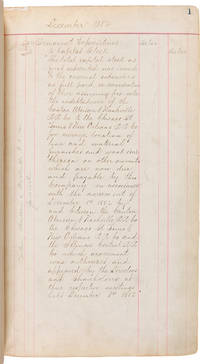
1944WRCAM55833N.p. likely Chicago 1944. 190pp. Folio. Contemporary black pebbled cloth boards with later red leather corners and backstrip gilt title on front board. Endpapers renewed. Minor rubbing and soiling to boards. Light thumb-soiling to text. Very good. An extensive and informative company ledger listing the assets properties profits losses and other business activities of the Canton Aberdeen & Nashville Railroad a subsidiary of the Illinois Central based in Chicago maintained over a period of more than sixty years. This ledger offers a rare glimpse into the economics of the railroad industry in the American South over a vast period of development from the immediate post-Reconstruction era to the requirements of the American war effort during World War II. <br> <br> The Canton Aberdeen & Nashville Railroad was incorporated on February 17 1882 as a subsidiary of the Illinois Central to acquire the branch already built in 1874 from Durant to Kosciusko Mississippi and extend it to Aberdeen and eventually to Nashville Tennessee. The line was completed as far as Aberdeen in 1888. A short disconnected section was also built from Winfield to Brilliant Alabama to serve several coal mines. The railway was officially dissolved and absorbed into the Illinois Central Railroad on August 21 1953. The current ledger records company activity for the great majority of the life of the Canton Aberdeen & Nashville Railroad. <br> <br> The ledger begins in December 1882 the year of incorporation of the railroad and is written in at least five distinct but highly readable hands. The early pages detail the "permanent expenditures" such as stock commitments construction costs equipment and interest; the construction costs are broken out into thirty-three line items including bridges cross ties grading iron rails right of way section houses stationery almost $50000 worth telegraph lines water stations and much more. This is followed by earnings statements profit and loss reports land costs mortgages additional permanent expenditures "sundries" to the Illinois Central and capital stock officers' and clerks' salaries bond payments advertising costs and other types of regularly-reported accounting through December 1944. Railroad accounting here is often reported as "Gross Receipts" balanced against "Operation Expenses" every quarter or six months and is later encapsulated as periodic "Additions and Betterments" and "Profit and Loss" statements in the latter two decades of the ledger. <br> <br> As the 20th century proceeds the ledger records business transactions between the Illinois Central and the Chicago St. Louis and New Orleans Railroad. The latter was based in Kentucky but was also working to build railroad lines in Mississippi and Tennessee during this time. The Illinois Central apparently made occasional "capital advances" to the Chicago St. Louis and New Orleans starting in 1913 which the latter then repaid in December 1919. The Illinois Central continued to make capital advances to the Chicago St. Louis and New Orleans throughout the time period recorded here. The Illinois Central would buy the Chicago St. Louis and New Orleans outright in 1951 absorbing its operations in Kentucky Tennessee and Mississippi. <br> <br> Other activities beyond the normal operations of the company include additional tracks and rail services provided to mining and manufacturing companies in the late 1930s and early 1940s. In December 1939 the Illinois Central agreed to construct "tracks to industry" located on property belonging to the American Colloid Company in Aberdeen Mississippi. The American Colloid Company appears to have been mining bentonite in Aberdeen and was in need of spur tracks to move their product to market or perhaps manufacturing plants. The Illinois Central also constructed further "tracks to industries" in December 1941 namely to the Nickles Lumber Company in Aberdeen and Moeller & Vandenboom also a lumber company in Ethel Mississippi. Depreciation "retirement or abandonment of nondepreciable property" "service value of nondepreciable" retired property and other "property retirements" occupy the latter few pages of the ledger. <br> <br> A dense and useful record of a southern railway's business activities for over half a century. Records for railroads operating in the American South are scarce especially for such a vast span of time. hardcover books
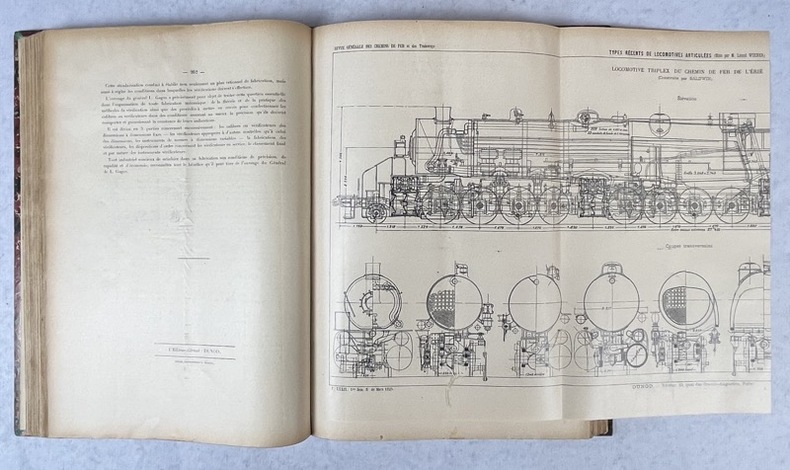
1939132636Paris, Dunod 1939 37 volumes. In-4 32 x 22 cm. Reliures demi-toile bordeau, environ 400 pp. par volume, nombreux plans, schémas, illustrations, tables, analyses des matières par ordre alphabétique.
18604490Dessins d'exécution du pont métallique construit sur la Garonne à Bordeaux par les compagnies d'Orléans et du Midi pour relier le chemin de Paris à Bordeaux au réseau du Midi. Ouvrage projeté et dirigé par les Ingénieurs de la Compagnie des Chemins de Fer du Midi, commencé sous les ordres de [Amédée Alexandre Hippolyte] Bommart ... et achevé sous les ordres de [Alexandre Charles] Surell ... Exécuté par la Compagnie de Matériels de Chemins de Fer, représentée par [Felix Charles Christophe] Pauwels ... [Charles] Nepveu et [Alexandre Gustave] Eiffel. Mit 27 (5 doppelblattgr.) lithogr. Tafeln. Ohne Ort, Drucker u. Jahr, (nicht vor dem 15. August 1860). Groß-Folio (69 x 55 cm). Titelblatt. Lose in neuer Halbleinwandmappe mit montiertem Orig.-Vorderumschlag. [4 Warenabbildungen]
18633809Nach den Materialien Grosh. Oberdirection des Wasser- und Strassenbaues geordnet, zusammengestellt & gezeichnet im Studienjahr 1862/63 durch die Eleven des II.ten Curses der Ingenieur-Schule am Grosh. Polytechnicum zu Carlsruhe. Mit gefalt. lithogr. Titel mit Titelvignette (Ansicht von Heidelberg) u. 64 (3 farbigen, 1 getönten) doppelblattgr. (1 zusätzl. gefaltet) lithogr. Tafeln. Karlsruhe, Druck & Verlag v. J. Veith, 1862-1863. Folio (43,5 x 30,3 cm). 2 gefalt. Bl. Text. Halblederband d. Zt. [6 Warenabbildungen]
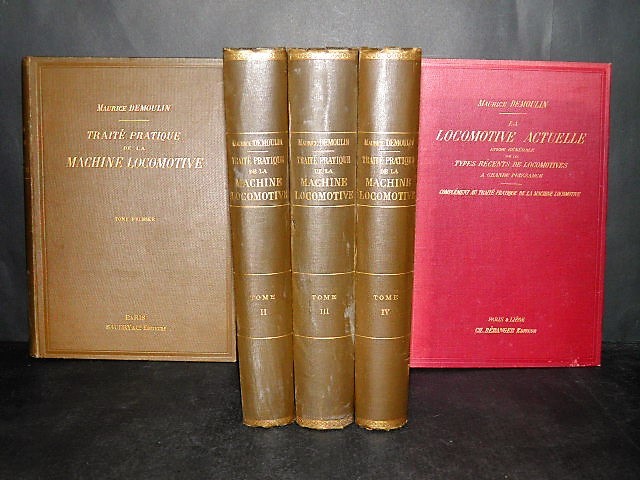
Ouvrage précédé d'une introduction par Edouard Sauvage, 973 figures et planches dans le texte, 6 planches hors texte, 4 vol. in-4 reliure pleine percaline éditeur marron, Librairie Polytechnique, Baudry & Cie, Paris, 1898, 2 ff., XII pp., 1 f., 457 pp. ; 2 ff., 510 pp. ; 2ff., 551 pp. et 5 pl. dépliantes ; 2 ff., 459 pp., 2 ff. avec 6 grandes planches dépliantes. Titre complet : Traité pratique de la Machine Locomotive. Contenant Les Principes généraux relatifs à l'étude et à la construction des locomotives, la description des types les plus répandus, l'étude de la combustion, de la production et de l'utilisation de la vapeur, du rendement, des conditions de fabrication et de réception des matériaux, des proportions et du mode de construction des organes. Edition originale. Très rare exemplaire bien complet de cet important traité. Bon ensemble(cartonnage lég. frotté avec petites fentes à qq. mors, bon état intérieur). Français
7376Chicago 1914-1920. Common Sense" binder 8.5" x 11" and 2" thick trade-mark patented in 1904 by Asa L. Shipman's Sons tan cloth over boards. 102 cyanotypes 23 silver prints 1 map 4.5" x 9" plus margins and 47 reproductions of drawings most on blue print-out paper some folding; 8 catalogs a total of 324 pp. as follows: two Electric Railway supply catalogs a total of 30 pp. Railway Line Material for Direct Suspension 92 pp. Line Material and Rail Bonds for Mine and Industrial Haulage 72 pp. Rail Bonds and Bonding Tools 54 pp. General Electric Company Supply Department-Shaft Couplings 12 pp. Railway Motor Gears and Pinions 24 pp. and Railway Substations 40 pp. The back-cover bears the following title "Electric Traction. Descriptions of Systems. Technical Papers on Electrification. Regenerative Braking. Chicago Milwaukee & St. Paul General Description & Data." CONDITION: Contents very good overall a handful of the cyanotypes faded; no losses to the text. <p>An impressive and apparently unique photographically-illustrated shop manual relating to the early phase of electrification of the Chicago Milwaukee & St. Paul Railroad supplemented with eight illustrated electric railway parts catalogs published by General Electric Co. between 1914 and 1920.</p> <p>This manual includes photos and illustrations of locomotives rail lines and railway electrification equipment and components in addition to a regional map of the Chicago Milwaukee & St. Paul Railroad line through parts of Idaho and Montana. Many photos bear an ink stamp stating they are the property of General Electric Co. and cannot be reproduced without permission indicating that the manual was assembled by someone working on the electrified Chicago Milwaukee & St. Paul line from materials supplied by General Electric Co. The line eventually connected St. Paul Minnesota and the Pacific Northwest passing through Wyoming Montana Idaho and into northern Washington during the early electrification period of the railroad from 1914 to 1920.</p> <p>Photos show many railroad and municipal railway systems supplied by General Electric Co. of Schenectady NY. Besides the Chicago Milwaukee & St. Paul R.R. these include the Butte Anaconda and Pacific Railroad; the Greenville Spartanburg and Anderson Railway; London and Port Stanley Railway Co.; Commonwealth Edison Co.; Ft. Dodge Des Moines and Southern Railroad; Wilkes Barre and Hazleton Railway Co.; Minneapolis St. Paul Rochester and Dubuque Electric Traction Co.; Chicago North Shore and Milwaukee Railroad; Portland Railway Light & Power Co.; Grafton & Upton Railroad Co.; University of Michigan; Nashville Interurban Railway; Claremont Railway & Lighting Co. and the Detroit River Tunnel.</p> <p>Incorporated in 1892 General Electric Co. was heavily involved in the electrification of America including its railroad and railway systems. The company designed and manufactured-along with the American Locomotive Co.-locomotives and their motors frames transmission lines generators and a host of equipment necessary to outfit and power trains and streetcars and maintain them. The company's plant in Schenectady NY had a short railroad built along the Erie Canal on which it tested new locomotives and railway equipment. The illustrated catalogs from General Electric included here consist of two Electric Railway supply catalogs Railway Line Material for Direct Suspension 1916 Line Material and Rail Bonds for Mine and Industrial Haulage 1918 Rail Bonds and Bonding Tools 1914 General Electric Company Supply Department-Shaft Couplings 1914 Railway Motor Gears and Pinions 1916 and Railway Substations 1915.</p> <p>A highly visual manual with extensive photo-documentation of railway electrification in the early twentieth century.</p> [Chicago?, 1914-1920.] unknown
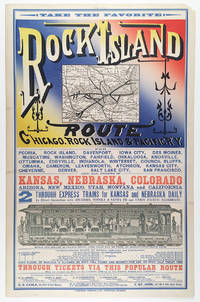
5510Chicago: Cameron Amberg & Co. Printers ca. 1880. Illustrated chromolithographic broadside with map 21.25†x 13.125†plus margins inset map measuring 4.5†x 5.875†illus. measuring 3.25†x 12.5â€. CONDITION: Very good margin chipped at upper right corner a few minor stains. <p>A rare and striking broadside issued by the Chicago Rock Island & Pacific Railway advertising the Rock Island through-express route and promoting the railroad’s numerous destinations connections and amenities.</p> <p>Featuring the eye-catching mix of typefaces and colors that characterized railroad advertising in this era this attractive broadside promotes the numerous midwestern stops and destinations accessible via the Chicago Rock Island & Pacific R’y. At this time two through-express trains for Kansas and Nebraska ran daily in connection with the Atchison Topeka & Santa Fe and Union Pacific railroads. As noted here meals were served in palace dining cars for seventy-five cents each and 150 pounds of baggage were allowed on each full ticket and seventy-five pounds on each half ticket free. The line’s various destinations included Iowa City Council Bluffs Denver Salt Lake City and San Francisco as well as “all points in Kansas Nebraska Colorado Arizona New Mexico Utah Montana and California.â€</p> <p>Showing the Rock Island R.R. in bold the inset map spans from Chicago and Lake Michigan in the east to Omaha and Council Bluffs in the west and reaches from St. Paul in the north to St. Louis and Kansas City in the south—with Lake Michigan lying in the upper-right corner. One axis of the line extends from Milwaukee and Racine Wisconsin to Leavenworth Kansas and another stretches from Chicago to Omaha. Various spurs connect to both.</p> <p>The lower section of the broadside features a marvelously detailed illustration of the interior of a palace dining car showing numerous fashionably dressed passengers seated and dining among African American waiters who are shown in the small kitchen and serving food. In the far-right end of the train men are depicted in drawing rooms—reading newspapers and smoking—and various railway operators and ticket-men appear at the ends of the car. Also included is a table of connections with various railroads that could be made in “Union depots.†Through-tickets via this route could be found on sale at all coupon offices in the U.S. and Canada. Those seeking additional information folders maps and times-tables are encouraged to contact any of the ten agents and managers of the Rock Island R.R. listed at the bottom who were based in New York Toronto Philadelphia Chicago etc.</p> <p>Established in 1847 as the Rock Island & LaSalle R.R. the company was reincorporated in 1851 as the Chicago & Rock Island R.R. Co.—its rails during this period reaching to Morris Illinois and later Ottawa. After acquiring the Mississippi & Missouri R.R. in 1866 the company was renamed Chicago Rock Island & Pacific R.R. Co. Expanding between 1873 and 1882 the company built more branch lines that reached into Iowa as well as Kansas City. In 1880 the firm was reorganized under the name Chicago Rock Island and Pacific R’y Co. and by 1883 extended nearly to the southern boundary of Kansas. After Congress granted passage across Indian Territory in 1887 the Rock Island R.R. began developing through Texas to Galveston as well as New Mexico Territory. During the 1920s the railroad enjoyed considerable success. In 1926 the company began constructing a freight line between Amarillo Texas and Liberal Kansas which was finished in 1929 and served to make accessible a country of rich grain. While the railroad industry continued fairly steadily through 1930 between 1931 and 1935 the Depression took a toll on the Rock Island R.R. and went into decline. The company ceased operation in 1980.</p> <p>OCLC records just one copy held at Yale.</p> <p>REFERENCES: “Chicago Rock Island and Pacific Railway Records†at Kansas Historical Society online.</p> Chicago: Cameron, Amberg & Co., Printers, [ca. 1880] unknown
18871408San Francisco 1887. About very good. 668pp. including numerous in-text or full page illustrations and eight photolithographed plates plus large folding map. Folio. Original pictorial wrappers. Wraps with some soiling wear at edges; front wrap with a few signs of biopredation; two small chips to rear wrapper; spine perishing at extremities. Minor worming at upper corner of a few interior leaves. Light tanning. A rare and extravagant promotional for the Pacific Cable Railway Company which manufactured installed and operated the famous streetcar system of San Francisco and in several other American cities. The present work also serves as a declaration of patent with a list of patents and patent holders at the rear and the text comprises a detailed technical description of the wire cable system with many illustrations of its mechanisms and operation as well as general accounts of the systems running in San Francisco Los Angeles Chicago and Kansas City. In addition to the technical diagrams are several attractive line illustrations and eight photolithographed plates reproduced by artotype of the cable cars of San Francisco in action all by Britton & Rey. The folding map at the rear provides a detailed delineation of the lines running across the city. Very scarce OCLC locates only five copies.<br /><br />Cowan II p.512. books
19332091502135500210Not Available 1933. Soft Cover. Fine. Number of pages: 250p Size: 11x17 cm Not Available paperback
1852Paris (& Liège pour le supplément), Librairie Polytechnique, Baudry & Cie – Béranger pour le supplément, 1898 – 1906 pour le supplément. 4 Tome + Supplément: 5 Volumes, COMPLET. In-4 – 20x28cm. Reliure éditeur en plein percaline marron (bordeaux pour le supplément), dos lisse orné de dentelle et filets dorés, filets à froid en encadrement des plats. 2 ff., XII pp., 1 f., 457 pp. ; 2 ff., 510 pp. ; 2ff., 551 pp. et 5 pl. dépliantes ; 2 ff., 459 pp., 2 ff. avec 6 grandes planches dépliantes. Volume de supplément: III, 334 pp. Edition originale. Envoi de l’auteur sur la page de garde du tome 1 à M. Salomon, Ingénieur en Chef du Matériel et de la Traction des Chemins de fer de l’Est. Ouvrage précédé d'une introduction par Edouard Sauvage, et illustré de 973 figures et planches dans le texte, 6 planches hors texte. Le supplément est orné de 132 figures dans le texte et 40 planches hors texte. Très rare exemplaire de cet important traité, bien complet de son supplément et de ses planches.
19372092902143300235South Manzhou Railway 1937. Soft Cover. Fine. Size: non-uniform South Manzhou Railway paperback
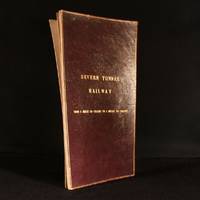
1890948F10London: Not Stated c1890 . Leather. Good. 17.5" by 9.5". Anonymous. An annotated and hand coloured lithograph map of the Severn Tunnel Railway belonging to the office of the Great Western Railway's Chief Engineer's Office. A vanishingly scarce lithograph map of the Severn Tunnel a tunnel linking South Gloucestershire to Monmouthshire built under the estuary of the River Severn and reaching a length of 4 miles 628 yards or 7012 m.Large portions of the map have been partially hand coloured with extensive annotations in both pencil and ink.With several stamps reading both 'Great Western Railway Chief Engineers Office Paddington' and 'To Be Returned to Chief Engineer's Plan Office G. W. R. Paddington' to both the recto and verso of the map.During the period of the tunnel railway's construction Chief Engineers of GWR included Joseph Armstrong William Dean and George Armstrong.The map is divided into fourteen plates mounted on linen and folding concertina style bound in morocco boards. The front board reads 'Severn Tunnel Railway: From 54 Miles 60 Chains to 7 Miles 50 Chains'.The majority of the pencil annotations detail the owner's and acreage of the pieces of land the railway runs through with the local Parishes of different sections of the railway also detailed. Further annotations include measurements and depths reference numbers for deeds and details of freeholds.A fascinating and very scarce map with a clear association to GWR the company responsible for constructing the tunnel offering insight into the land surrounding the tunnel. In the original limp morocco covered boards. Light rubbing to boards. Internally map mounted on linen and folding concertina style. Map significantly age toned with handling marks throughout. Large portion of map hand coloured with extensive pencil and ink annotations. Stamps throughout to both the recto and verso of the map. Good Not Stated hardcover