56 630 résultats
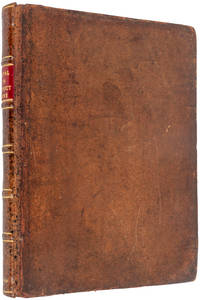
186153936Paris, Librairie de Challamel Ainé, 1861-1897. 8vo. 128 volumes, all except 7 volumes bound in uniform contemporary half calf with gilt lettering. Remaining 7 volumes in half cloth. Two volumes with detached spine. All volumes with gilt stamp to front board and a few volumes with paper label pasted on to pasted down front end-paper. Spines with a bit of wear, internally very fine and clean. With numerous folded maps and charts.
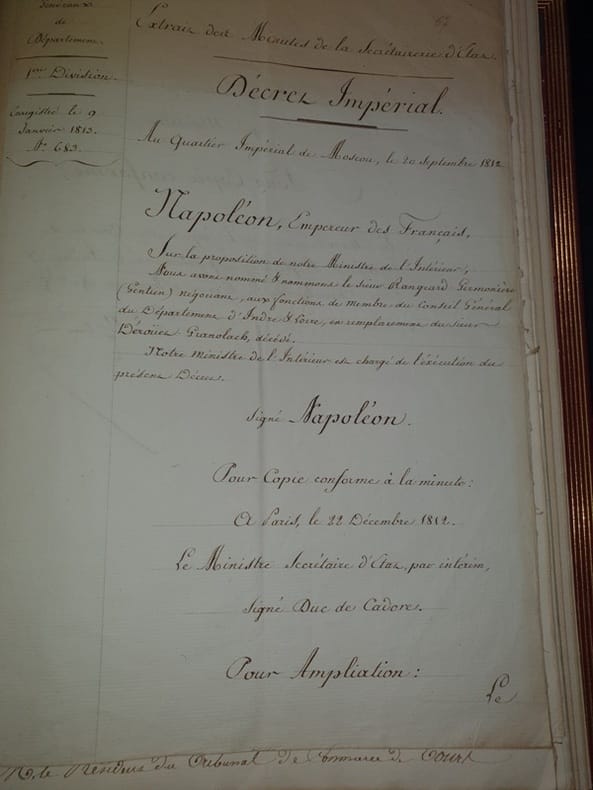
Arm2160 In4 - plein maroquin rouge , dos à nerfs , documents montés sur onglets ( sauf 6) - Le dossier , agréablement relié , comporte 83 documents , pour l'essentiel manuscrits : Nominations à divers postes ( notamment comme contrôleur de la Marine à l'Arsenal de Rochefort , signé de la main de Louis XVI ) , échanges de lettres avec divers ministres ( Sartine ) , passeports divers , certificats de non émigration , décret impérial concernant les élections du Département d'Indre et Loire et nombreux autres documents sur cette élection , nécrologie , photographie prise en 1920 d'une maison appartenant à la famille , 2 portraits de Gatien Rangeard de la Germonière , etc... Gatien Rangeard de la Germonière ( Blois 1753/ Tours 1820 ) fut l'époux de la fille du Maire de Tours , Etienne Benoist de la Grandière . Il fut successivement nommé , élève commissaire de la Marine ( 1774) ,Contrôleur de la Marine à Rochefort ( 1776) Contrôleur de la Marine à l'Ile de grenade ( 1779) , Contrôleur de la Marine à Brest ( 1781) , inspecteur des comptes des Divisions des Canonniers de la Marine ( 1790) , Membre du Conseil général d'Indre et Loire en 1814 , Commissaire honoraire de la Marine ( 1816) et Président du tribunal de commerce de Tours jusqu'à sa mort en 1820 . Rare ensemble retraçant le parcours d'un marin et notable qui réussit a passer entre les gouttes lors de la Révolution Française ; Précieusement conservé par la famille dont une branche s'établit dans la Manche .
15161Paris Au Dépôt Général de la Marine 1822 petit in folio (38x29) 1 volume reliure cartonnée de l'époque (dos absent). Titre gravé et 91 planches gravées hors-texte, toutes sur double page, non rognées, et montées sur onglets. Rédigé par Beautemps-Beaupré, ingénieur Hydrographe en Chef de la Marine, Membre de l'Académie Royale des Sciences de l'Institut de France et de la Société Royale des Sciences de Goettingen. Bel exemplaire complet, tel que paru
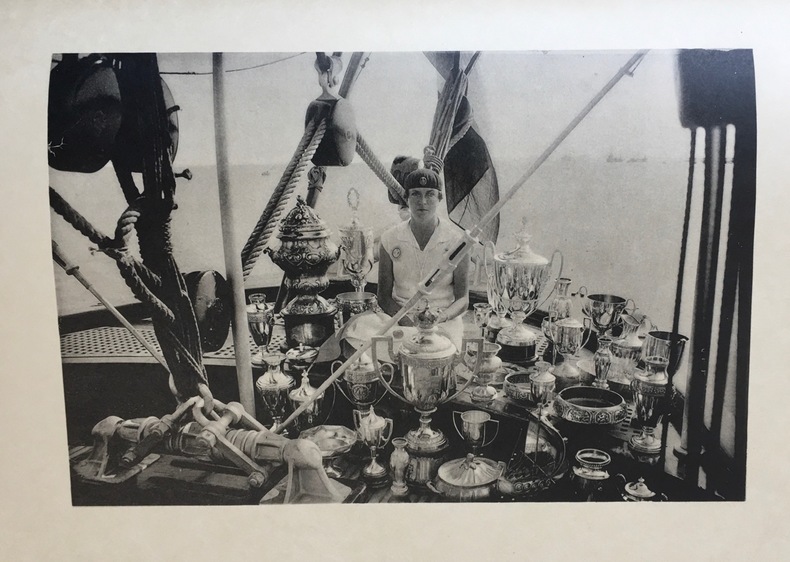
19343975Paris, Edilux, 1934. 1934 1 vol. in-fol° (390 x 290 mm.) de : LXXVII, [1], 122 pp. ; 72 + 12 planches hors-texte dont de nombreuses reproductions photographiques de yachts ; préface du Docteur J. Charcot ; illustrations de Léon Haffner, André Galland et A. Theunissen. Un des 40 exemplaires sur japon (tirage total à 200 exemplaires + 120 de propagande). Plein vélin à décors aquarellé reprenant le motif de la couverture brochée (laquelle est reliée en début d'ouvrage).
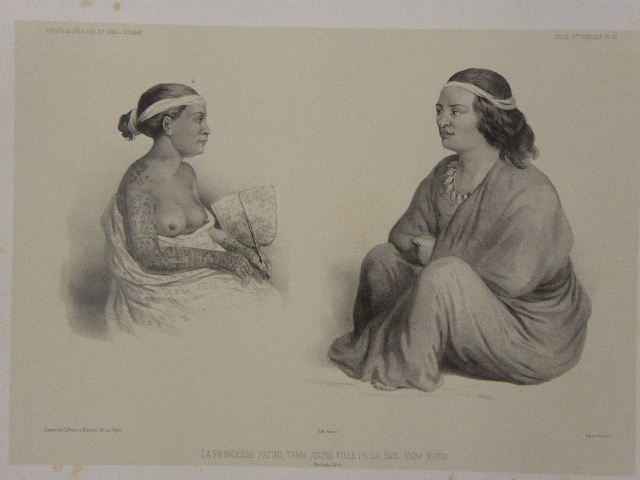
434178Gide Paris 1846 56 planches + 2 cartes à double page de l'"Atlas Pittoresque" reliées en 1 volume in-folio ( 525 X 355 mm ), demi-basane noisette, dos lisse orné de filets et fleurons dorés ( Reliure moderne exécutée dans les ateliers Yves RAMEAU à Marseille ). 56 planches essentiellement au sujet de Tahiti, finement gravées, certaines sur Chine monté ou en sépia, toutes munies du timbre sec de l'éditeur "GIDE" dans les marges. Cet atlas comprend les planches 39 à 96 ( sans la planche 58 ) et 2 cartes à double-page: - Carte du groupe de Iles MANGA-REVA ( Iles Gambier ) - Carte de L'Archipel VITI. Certaines planches sont roussies, parfois des rousseurs, ancienne mouillure marginale claire en marge des derniers feuillets. Agréable exemplaire malgré les défauts annoncés, bien relié.
albffcdbe960db90c5dTsvetaeva M.I. The Magic Lantern. The Second Book of Poems. In Russian /Tsvetaeva M. I. Volshebnyy fonar. Vtoraya kniga stikhov. Moscow, Ole-Lukoe (Levensons T-print), 1912, 148s, Reduced 9x12 sm. We have thousands of titles and often several copies of each title may be available. Please feel free to contact us for a detailed description of the copies available. SKUalbffcdbe960db90c5d.
194444499Okinawa Japan; Camp Pendleton CA.; Kinston NC: Photographed and compiled by an American Marine 1944-1946. 1944 - 1946. WORLD WAR II JAPAN. First edition. Oblong octavo black leatherette string-tied photograph album 101 silver gelatin photographs with most being 4 1/4" x 5 1/4" some smaller. An interesting collection of vernacular images from World War II Okinawa documenting an American Marine Corps reservist's time on the Japanese island after the successful U.S. invasion in the spring and summer of 1945. He is identified simply as "Ronnie" in several photographs. The album was likely assembled by Ronnie's wife or girlfriend as the first item is annotated "A Christmas card from my honey" and includes a greeting in manuscript from the soldier on the verso. Eighty-nine photos emanate from Okinawa four from Camp Pendleton and eight from Camp Lejeune in Kinston N.C. and on the soldier's furlough at home likely Florida. The photographs of Okinawa feature a wide variety of interesting subjects including island views abandoned Japanese bunkers tombs Shinto shrines damaged Japanese armaments "Korean teahouse girls . the type used by the Japanese armies for entertainment purposes" Japanese natives washing clothes in the river views of villages "A native barber and his victim in the village of Ishikawa in northern Okinawa" "Native family of three enroute to a detention camp" "Jap dugout in the ‘Suicide Cliff' area" "Japanese school children and teachers" "Native women bathing" "Remains of Japanese 'Betty' pilot Yontan Airstrip" marine and army cemeteries "Ernie Pyle's grave" "Spot where Lt. Gen. Simon Bolivar Buckner was killed . June 18 1945" and many more. The U.S. invasion of Okinawa began in April 1945 and lasted eighty-two days ending on June 22. Immediately the island became an important staging area for the planning of the U.S. invasion of mainland Japan. Ultimately the invasion was not necessary after the atomic bombings of Hiroshima and Nagasaki in early August. Also taped-in are two Japanese yen bills and eight magazine excerpts featuring Okinawa scenes. Laid-in are three Florida newspapers detailing the U.S. Navy's invasion of Japan. A rare view of occupied Okinawa from an American Marine . itself a rare thing as most albums of this type come from Army boys. Minor wear to the covers else a very good copy. Photographed and compiled by an American Marine, 1944-1946. hardcover
4222962Short description: In Russian. Tsvetaeva Marina Ivanovna. Magic Lantern. Moscow: Ole Lukoye 1912. The image is provided for reference only. It may reflect condition of one of the available copies or only help in identifying the edition. Please feel free to contact us for a detailed description of the copies available. SKU4222962 unknown
4222962Short description: In Russian. Tsvetaeva, Marina Ivanovna. Magic Lantern. Moscow: Ole Lukoye, 1912. You are welcome to reach out to us for a detailed description of the copies currently available. Delivery of this book may take longer than usual including extended processing and pre-shipping time, no expedited shipping is available. Please advise us if you have a set date or a deadline to receive your order.SKU4222962
18522202020008Philadelphia: P.S. Duval & Co. Philadelphia: Lippincott Granbo and New York: Horstmann Bros. & Allen 1852. First Edition. Paperback. Good. Rare American Military Costume Plate Book Bound in contemporary wraps. Held in modern cloth folder. Folio 14 x 11 1/2 inches. Moderate wear to wraps spine cloth. 14 of 15 plates 12 of which are chromolithographs. 15 1 pages. Marginal tears along bottom margin. Moderate foxing and soiling. A seminal work on naval uniforms including the full set of regulations in effect at that time and finely executed plates. Lithographed by C. Schuessele after drawings by J. Goldsborough Bruff and printed by the Philadelphia firm of P.S. Duval & Co. Sabin 68960. P.S. Duval & Co. (Philadelphia: Lippincott, Granbo and New York: Horstmann Bros. & Allen) paperback
120811778 - 1779. 1 vol. in-4. Cartonnage moderne à la Bradel, pièce de titre de maroquin vert.
LX-590 pages, [1] feuillet blanc, 27 planches dépliantes basane havane de l'époque, dos à nerfs et fleuronné, pièce de titre rouge, tranches rouges 1773, 1773, in-4, LX-590 pages, [1] feuillet blanc, 27 planches dépliantes, basane havane de l'époque, dos à nerfs et fleuronné, pièce de titre rouge, tranches rouges, Rare édition originale de cet ouvrage remarquable sur les chronomètres, fruit de la longue expérience de l'auteur ; exemplaire bien complet des 27 belles planches dépliantes gravées sur cuivre par Choffard, d'après Goussier, représentant les mécanismes des instruments décrits ou construits par Berthoud. Le Traité constitue une suite à l'Essai sur l'horlogerie, paru dix années auparavant. Ferdinand Berthoud (1727-1807), horloger originaire de Plancemont en Suisse, se rendit à Paris en 1745 à l'âge de 17 ans et y devint maître horloger en 1754. Dès 1762, il se spécialisa dans la confection des chronomètres de marine et, à partir de 1773, il devint horloger mécanicien de la Marine et, en 1786, horloger pensionnaire du roi et Inspecteur général des machines pour la Marine. Berthoud lança toute une gamme d'idées nouvelles et fut l'auteur d'un grand nombre d'ouvrages. On lui attribue l'invention de la détente à ressort, dont il équipa son dernier chronomètre de marine. Bien qu'il parvint à construire des horloges marines d'une très grande précision, ses pendules s'avérèrent fragiles et non adaptées au service en mer. Il fut l'un des principaux rivaux de l'horloger Le Roy. Reliure restaurée avec soin. Petites taches de moisissures anciennes angulaires aux feuillets de texte et aux planches, mouillure pâle en tête de la seconde moitié de l'ouvrage. Polak, 701. Lalande, 535
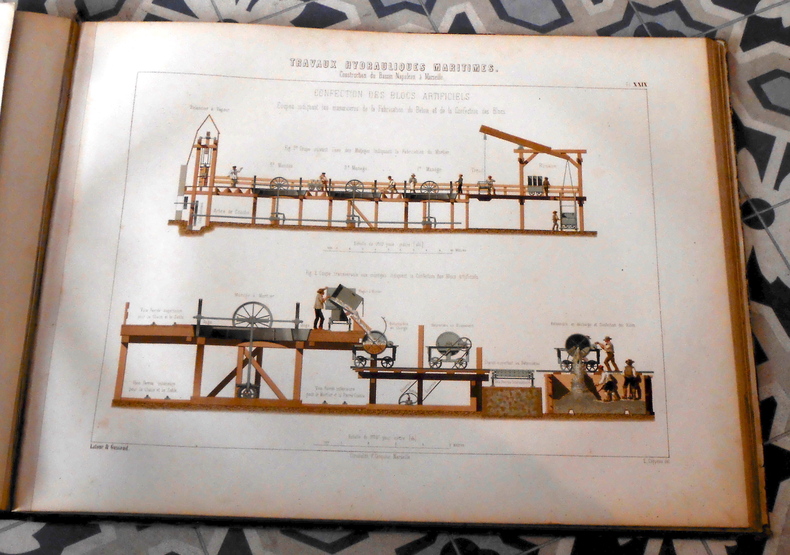
186122979Marseille, E. Cappeau del., 1861. Cartonné, 42 cm x 54,5 cm, LV planches en chromolithographies montées sur onglet par F. Canquoin. Ouvrage de Esprit Latour et Auguste Gassend. Couverture en état d’usage, planches en très bon état. Il manque les planches II et III et la page de garde, les planches XXVIII et XXXVI sont détachées. Rarissime
In-4°;cc. (8), pp. 407(1), cc. (28),varie e grandi iniziali silografiche istoriate, nelle 28 carte finali pagine finali sono presenti un vasto indice delle materie ed il vocabolario nautico. Trattazioni di argomenti marinaresci e militari Con molti avvertimenti necessari alla navigazione ed alla battaglia. Presenza di fori di tarlo, pagine leggeremente brunite.
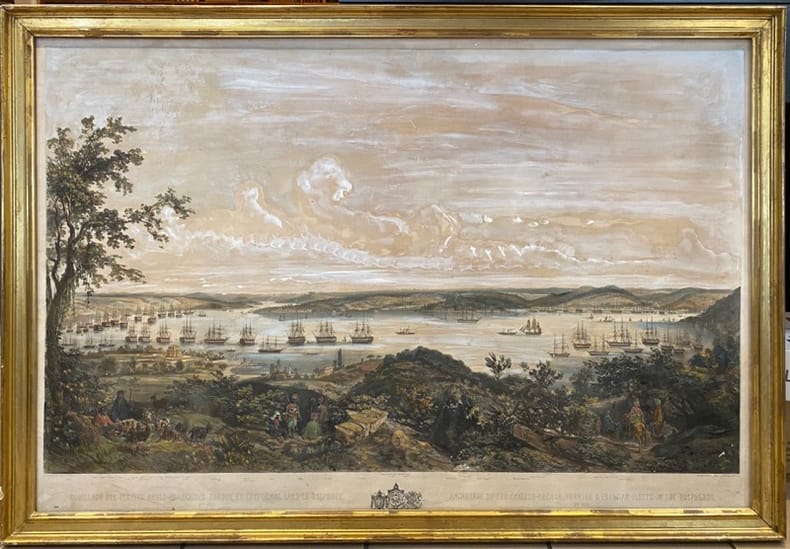
210664A Constantinople, A. Percheron et J. Schranz, Paris, Imp. de Jacomme & Cie, (1854) 89 x 129 cm, lithographie en deux tons, mise en coloris de l'époque, en feuille, sous cadre doré ancien. Sans verre.
190731197N.p. Japan ca 1907. Pair of large trapunto banners both removed from original frames. First 82cm x 60cm ca 32" x 24"; embroidered in silk with trapunto elements on a black silk ground; photographic portrait on cabinet card inserted in embroidered pocket at center inscribed "Mellie McKeever" on verso. Silk ground fragile with a few thin tears but no significant losses; light soil; embroidered portions generally well-preserved and colors bright. Very Good. Second banner 65cm x 50cm ca 25" x 20"; photo-transfer on silk with embroidered ornaments. Slight fading to embroidered portions but generally well-preserved and sound; Very Good. Both banners with firm provenance purchased from the descendants of Mellie McKeever of Richwood West Virginia. Two exceptional and well-preserved examples of the ornamental trapunto banners that were popular souvenirs among U.S. sailors and marines during the late 19th and early 20th century. Yokohama was the principal point of production for these naval souvenirs but we have also seen examples from the Philippines and mainland China; Japanese examples such as these are generally distinguished by a higher quality of embroidery and more sophisticated composition. The banners became popular among British and American sailors beginning as early as the Boxer Rebellion and the Spanish-American War but seem to have reached their peak of popularity with the arrival in the Far East of Teddy Roosevelt's Great White Fleet in 1908. Some 14000 sailors and marines made land at various Japanese ports-of-call in that year and given the regularity with which these textiles still appear one imagines that every sailor must have brought at least one of these souvenirs home with him. <br /> <br /> The first example though of an unusually impressive size is of a type frequently seen displaying typical naval iconography right down to the hand-painted battleship portrait of a two-stack battleship of the Kearsarge class its hull painted white reflecting its peace-time mission at bottom center. The embroidered frame to hold a cabinet portrait of the sailor or perhaps a loved one is a typical feature found on more elaborate examples. The American Eagle in full battle stance is a nearly universal element of these banners. <br /> <br /> The second banner is of a style we have not previously seen and for which we can find no analogues in the extensive literature of naval souvenirs. It is clearly a family portrait probably a composite made from cartes-des-visites carried by McKeever; the portraits are printed by silkscreen using a photo-transfer process with applied trapunto decorations. The likenesses are clearly enlarged -- it is highly unlikely that a common sailor would have had room aboard a battleship to carry full-size portraits -- and it strikes us that this must have seemed an almost magical process at the time of creation especially to a young man from a tiny lumber-and-coal town in central West Virginia. <br /> <br /> Aside from their obvious virtues as objects of art and handicraft we regard these banners as compelling pieces of material culture from a period of tremendous social transformation in the United States. According to the Naval Historical Center U.S. naval rolls expanded by nearly 400% between the beginning of the Spanish-American War and the launching of the Great White Fleet. To meet this demand for the first time in its history the Navy began recruiting from the American heartland rather than solely from the Eastern Seaboard states. The generation of inland farmers and mechanics to follow was thus the first in American history to experience first-hand cultures as diverse and divergent from their own as those of Europe Asia and the Pacific Islands; they represented not only the beginning of the American imperialist enterprise but also the first stirrings of America's global consciousness. That so many of these banners have survived in good condition is evidence of the degree to which they were treasured by their owners for whom they represented an experience that must have been transformative and definitive. unknown
190731197N.p. Japan ca 1907. Pair of large trapunto banners both removed from original frames. First 82cm x 60cm ca 32" x 24"; embroidered in silk with trapunto elements on a black silk ground; photographic portrait on cabinet card inserted in embroidered pocket at center inscribed "Mellie McKeever" on verso. Silk ground fragile with a few thin tears but no significant losses; light soil; embroidered portions generally well-preserved and colors bright. Very Good. Second banner 65cm x 50cm ca 25" x 20"; photo-transfer on silk with embroidered ornaments. Slight fading to embroidered portions but generally well-preserved and sound; Very Good. Both banners with firm provenance purchased from the descendants of Mellie McKeever of Richwood West Virginia. Two exceptional and well-preserved examples of the ornamental trapunto banners that were popular souvenirs among U.S. sailors and marines during the late 19th and early 20th century. Yokohama was the principal point of production for these naval souvenirs but we have also seen examples from the Philippines and mainland China; Japanese examples such as these are generally distinguished by a higher quality of embroidery and more sophisticated composition. The banners became popular among British and American sailors beginning as early as the Boxer Rebellion and the Spanish-American War but seem to have reached their peak of popularity with the arrival in the Far East of Teddy Roosevelt's Great White Fleet in 1908. Some 14000 sailors and marines made land at various Japanese ports-of-call in that year and given the regularity with which these textiles still appear one imagines that every sailor must have brought at least one of these souvenirs home with him. <br/><br/>The first example though of an unusually impressive size is of a type frequently seen displaying typical naval iconography right down to the hand-painted battleship portrait of a two-stack battleship of the Kearsarge class its hull painted white reflecting its peace-time mission at bottom center. The embroidered frame to hold a cabinet portrait of the sailor or perhaps a loved one is a typical feature found on more elaborate examples. The American Eagle in full battle stance is a nearly universal element of these banners. <br/><br/>The second banner is of a style we have not previously seen and for which we can find no analogues in the extensive literature of naval souvenirs. It is clearly a family portrait probably a composite made from cartes-des-visites carried by McKeever; the portraits are printed by silkscreen using a photo-transfer process with applied trapunto decorations. The likenesses are clearly enlarged -- it is highly unlikely that a common sailor would have had room aboard a battleship to carry full-size portraits -- and it strikes us that this must have seemed an almost magical process at the time of creation especially to a young man from a tiny lumber-and-coal town in central West Virginia. <br/><br/>Aside from their obvious virtues as objects of art and handicraft we regard these banners as compelling pieces of material culture from a period of tremendous social transformation in the United States. According to the Naval Historical Center U.S. naval rolls expanded by nearly 400% between the beginning of the Spanish-American War and the launching of the Great White Fleet. To meet this demand for the first time in its history the Navy began recruiting from the American heartland rather than solely from the Eastern Seaboard states. The generation of inland farmers and mechanics to follow was thus the first in American history to experience first-hand cultures as diverse and divergent from their own as those of Europe Asia and the Pacific Islands; they represented not only the beginning of the American imperialist enterprise but also the first stirrings of America's global consciousness. That so many of these banners have survived in good condition is evidence of the degree to which they were treasured by their owners for whom they represented an experience that must have been transformative and definitive. unknown books
18750001913ASEA ABOARD THE HMS ROYAL YACHT SERAPIS TO INDIA. Good. 1875. On offer is a superb manuscript relic of Victorian Era travel detailing a well documented trip by H R H Prince Edward and various dignitaries to India traveling by way of HMS Royal Yacht Serapis. The journal of the trip begins with the author we believe to be M. Harwell Royal Marine as was marked the chest from which this manuscript was rescued though we note a later childish hand circa 1900s wrote the name of Kenneth Ellicott among other scribbles and drawings a later relative we suspect being based on a hulk in Portsmouth awaiting the ship being prepared for the 9 month voyage. Researchers and historians of Victorian travel or the global politics and commerce behind this trip will relish the large folio sized 12½ x 8½ inch 86 well filled pages with super detail by this crew man giving good account of movements of crew HRH visitors deaths accidents in harbor receiving gifts such as ostriches. Binding still complete spine cover gone some blank pages removed but the journal is complete and overall G. ; Manuscript; Folio - over 12" - 15" tall; KEYWORDS: HISTORY OF ROYAL YACHT SERAPIS NAVAL M HARWELL ROYAL MARINE ROYAL NAVY VICTORIAN ERA 19TH CENTURY MARINE NAUTICAL OCEAN TRAVEL ASIAN SUBCONTINENT INDIA STEAM SHIPS SAILING SHIPS BRITANNIA BRITANNICA HANDWRITTEN MANUSCRIPT AUTOGRAPHED AUTHORS MANUSCRIPT DOCUMENT LETTER AUTOGRAPH KEEPSAKE WRITER HAND WRITTEN DOCUMENTS SIGNED LETTERS MANUSCRIPTS HISTORICAL HOLOGRAPH WRITERS AUTOGRAPHS PERSONAL MEMOIR MEMORIAL PERSONAL HISTORY ARCHIVE DIARY DIARIES ANTIQUITÉ CONTRAT VÉLIN DOCUMENT MANUSCRIT PAPIER ANTIKE BRIEF PERGAMENT DOKUMENT MANUSKRIPT PAPIER OGGETTO D'ANTIQUARIATO ATTO VELINA DOCUMENTO MANOSCRITTO CARTA ANTIGÜEDAD HECHO VITELA DOCUMENTO MANUSCRITO PAPEL . unknown
1862blb05571<p>Washington D.C.: Government Printing Office 1862. 1st. Hardcover. Very Good. Signed by the Secretary of the U.S. Navy during the Civil War Gideon Welles and inscribed to the Vice President under Abraham Lincoln's first term Hannibal Hamlin - ""Honorable Hannibal Hamlin from his friend Gideon Welles"" on the FFEP. Fantastic and ultimate association copy updating the Vice President during the Civil War of the current status on the naval engagements. Two striking color plates in front one on ""the Ram Louisiana as she appeared prior to the explosion"" and the other ""the Ram Manassas as she appeared in passing the Harriet Lane after receiving a broadside from the ship the Mississippi."" Reddish brown heavy textured cloth on boards with blind stamped decorations to front and gilt titling in center. Rear has eagle and shields blind stamped with decorative borders. Multiple fold-out maps throughout all in Very Good condition. The maps include a detailed view of the water and railroad approaches to New Orleans from the south; the Mississippi River below forts Jackson and St. Philip before Farragut's victory; and a plan of Fort Jackson. The well-executed maps and illustrations are all by the Bowen firm of Philadelphia. INSCRIBED</p> Government Printing Office hardcover
1913241781913 4 Aquarelle signée du cachet d'atelier en bas à droite, 1913, 50 X 35 cm., encadrée.
2011102364Edizioni Dei Soncino. New. 2011. Hardcover. 889049025X . FREE UPGRADE to Courier/Priority Shipping Upon Request - IN STOCK AND IMMEDIATELY AVAILABLE FOR SHIPMENT - FLAWLESS COPY BRAND NEW PRISTINE NEVER OPENED -- Text in Italian. 348 pages; illustrated in color and in black and white. Catalogue Raisonne Catalog Raisonné Complete Works Catalogo Ragionato Catalogo delle Opere L'Opera Completa Raisonnee Edizioni Dei Soncino hardcover
198894121Neri Pozza Editore. New. 1988. Paperback. FREE UPGRADE to Courier/Priority Shipping Upon Request - IN STOCK AND IMMEDIATELY AVAILABLE FOR SHIPMENT - FLAWLESS COPY BRAND NEW PRISTINE NEVER OPENED -- Text in Italian. 314 pages; 199 illustrations in black and white; 8 in color. Catalogue Raisonne Catalog Raisonné Complete Works Catalogo Ragionato Catalogo delle Opere L'Opera Completa Raisonnee Neri Pozza Editore paperback
200094054Gallimard. New. 2000. Hardcover. FREE UPGRADE to Courier/Priority Shipping Upon Request - IN STOCK AND IMMEDIATELY AVAILABLE FOR SHIPMENT - Flawless copy brand new pristine never opened -- Text in French. 430 pages; over 600 illustrations including a number in color. Catalogue Raisonne Catalog Raisonné Complete Works La Vie et L'uvre Oeuvre Raisonnee -- with a bonus offer . Gallimard hardcover
2111005London: no printer. 1757. 4to. Contemporary calf sympathetically rebacked with raised bands and red morocco lettering-piece; pp. 2 231 folding table at the end paginated 232; title with engraved vignettes a few finely engraved head- and tailpieces; rebacked light wear to extremities title-page with old expert repair occasional very light toning or spotting a very good copy of a beautiful and rare work.In 1731 the King's Regulations and Admiralty Instructions were first issued. Before that Captains devised their own rules and regulations for the vessels they were in command of. All early edition are very rare. This enlarged and revised edition was issued the year after the outbreak of the Seven Years' War which was the first global military conflict with much naval activity in the Americas.ESTC T206853 locating copies in the British Library the National Library of Ireland and at RUSI Library of Military History; WorldCat adds copies in the National Library of Scotland in the Wellcome and at St. Andrews. hardcover