ALBERT GUILLAUMELivre Rare Book

24 759 résultats
1897AMO-4214Madame est servie. Album en couleurs (colorié au pochoir - ateliers Greningaire). Par Albert Guillaume. Préface de Willy. H. Simonis Empis, éditeur, s. d. (1897). Format 35,5 x 28 cm. Couverture illustrée en couleurs (premier plat) et 20 planches imprimées en couleurs (coloriage au pochoir par Greningaire) (avec 1 feuillet de faux-titre, 1 feuillet de titre et 2 feuillets de préface). Superbe et très rare tirage de luxe sur papier du Japon à 25 exemplaires seulement. Exemplaire dérelié. Tête dorée. Très bon état de fraicheur des couvertures (les deux plats sont conservés en très bon état). Petite ombre rousse dans la marge supérieure du premier plat de couverture. A relier (un cartonnage papier serait le bienvenu). Voir photos de l'annonce. Très rare dans ce tirage.
1956015760Liège Editions Dynamo - [Pierre Aelberts] 1956 In-12 à l'italienne Broché
1971267Tokyo, 1971. Petit in-4 (220 x 233 mm) relié sous cartonnage éditeur toilé noir, jaquette de papier couché blanc imprimé en noir. Edition originale du premier livre de Shigeo Gocho. 48 photographies en noir, dont la moitié est dûe au photographe Masao Sekiguchi.
198018592Bln/...., Springer, 1980. Hrsg. v. d. deutschen Gesellschaft für Natur- und Völkerkunde Ostasiens (OAG), Tokyo. 2 Textbände (Faksimile der Ausgabe Lemgo 1777/79) mit 45 z.T. mehrfach gefalteten Tafeln, 1 Tafelband: Icones selectae plantarum, quas in Japonia collegit et delineavit Engelbertus Kaempfer (Faks. d. Ausgabe London 1791) mit 59 Abbildungen und 1 Band: Beiträge und Kommentar. Zus. 4 Bände in OKassette (alles). 8°. und 4°. LXVIII,310,2/VIII, 478,2 S. / 3 Bl.,3 S. + 59 Tafeln / 167,1 S. OHalblederbände mit Lederecken, Rücken z.T. mit reicher Blindprägung und goldgeprägten Rückenschildchen sowie mit Marmorpapier bezogene Deckel. Zus. in Kassette mit Schnürverschluss. 1 Riemen gerissen, sonst sehr schön.
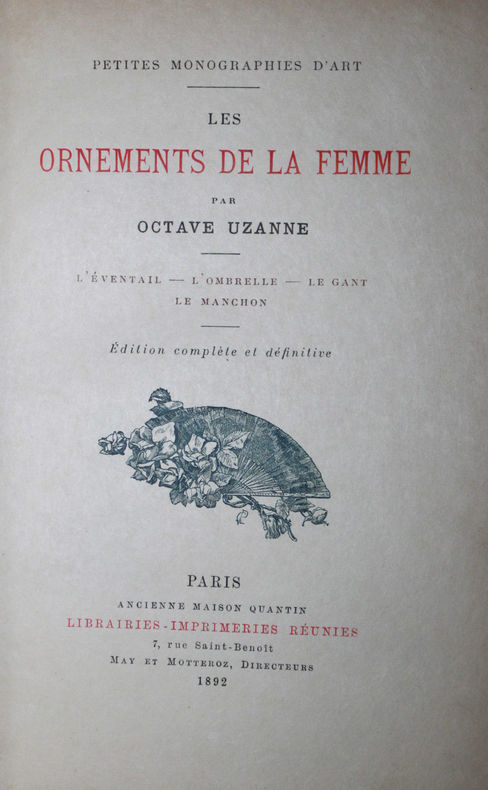
1892AMO-2425Paris, Ancienne Maison Quantin, May et Motteroz, 1892 1 volume in-12 (19 x 13 cm), de 270-(4) pages. Quelques ornements. Reliure de l'époque demi-chagrin olive, dos lisse orné en long, tête dorée, relié sur brochure, couvertures imprimées conservées. Quelques légers frottements à la reliure, dos légèrement insolé. Excellent état. ÉDITION ORIGINALE. TIRAGE DE LUXE A 10 EXEMPLAIRES SUR JAPON IMPÉRIAL. Les exemplaires ordinaires sont sur papier vélin teinté de médiocre qualité (devenu cassant). L'exemplaire que nous proposons ici est un des très rares exemplaires de tête sur Japon (10 ex. seulement), seuls exemplaires a être imprimés sur papier de luxe. Référence : Vicaire, Manuel de l'amateur de livres du XIXe siècle, VII, 923-924. Ouvrage publié à 5 francs seulement, les exemplaires de luxe sur Japon étaient vendus 20 francs (4 fois le prix des exemplaires ordinaires). L’Éventail et L'Ombrelle, parus respectivement en 1882 et 1883, très illustrés par de nouvelles techniques et imprimés à petit nombre pour un public choisi d'amateurs bibliophiles et esthètes, sont, contrairement à l'image qui en a souvent été donnée de légèreté et de fanfreluche pour dilettante, deux belles et intéressantes études sur ces indispensables ornements de la mode de ces dames à travers le temps. Néanmoins Octave Uzanne très déçu voire marqué à vie d'avoir été considéré par trop de monde comme "le Monsieur de ces dames à l'éventail, à l'ombrelle, etc" (dixit Antoine Laporte, bouquiniste et auteur d'un violent pamphlet contre Uzanne publié en 1893). Il décide donc de donner en 1892 une édition bon marché, de format in-12, et sans illustrations, dans laquelle il expliquera en préambule souhaiter donner à un public de lecteurs, et non plus à un public d'esthètes bibliophiles, ces textes pour pouvoir les apprécier à leur juste valeur : "cette fois-ci, écrit-il, ce n'est plus aux iconophiles que je m'adresse, mais à ces lettrés qui prétendent lire, apprendre et connaître...". BEL EXEMPLAIRE DU TRÈS RARE TIRAGE DE LUXE A 10 EXEMPLAIRES SEULEMENT.
197564688ABWuppertal., Museumsverein., 1975. 1 Blatt., 64688AB Sehr gutes Exemplar.
1951010547Genève Cailler, collection "Peintres et Sculpteurs d'hier et d'aujourd'hui" 1951 Broché, couverture illustrée rempliée, étui
1907278656Kobe Tamamura, Photographer 1907. 20 teilw. farb. Taf. mit Fotos, englische Untertitel. Quer 8° Kart. Kordelbindung. *schönes Expl. *Notiz auf Vorsatz* Vorsatzbl. teils leimschattig resp. leicht fleckig*.
191958916ABBando (Japan), Lagerdruckerei, 1919. 4to. 261 S. Mit Textabbildungen. Orig.-Leinwand.
197630703ABKyoto (Japan), Otani University, 1976 - 1996. Gr. 8° (23,5 x 16,5 cm). Je Heft ca. 130 - 170 S. und je 1 Frontispiz (teils farbig), einige Abbildungen. Original-Kartoniert.
20062110502151001839Yuhikaku 2006. Soft Cover. Fine. Number of books: 33 Yuhikaku paperback
19822111902160200439morning education chart 1982. Soft Cover. Fine. Number of books: 36 morning education chart paperback
20002111902160200517Seishodoshoten 2000. Soft Cover. Fine. Volume: 1 Seishodoshoten paperback
194346330ABBerlin und Leipzig, de Gruyter, 1929-1943. 4to. Mit zahlreichen Abbildungen. Leinwandbände der Zeit mit Rückenschild und Orig.-Broschuren (1938).
185663919Washington D.C.: Beverley Tucker Senate Printer 1856. Thick 4to. xvii 1 537 1 pp. With 88 lithographs some colour others colour-tinted 2 large folding colour lithograph reproductions of colour Japanese woodblocks numerous woodcut-engraved text illustrations & plates numerous maps 2 large folding. Contemporary full sheep rebacked w/ red & gilt morocco spine label minor scuffing edgewear slight bumping to corners still VG bright copy w/ admonishment on front cover in MS advising “Do not touch the plates.†First edition of Volume I of this account published for the U.S. Senate and without the suppressed bath house plate. This fascinating historical and travel document chronicles Perry’s voyage to St. Helena Cape Town Mauritius Ceylon Singapore Hong Kong Shanghai Japan for half a year where he opened the isolated country to commerce with the Western World by sailing into Edo Bay. Beverley Tucker, Senate Printer, unknown
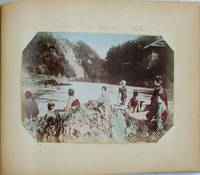
1893228031893. Hardcover. A collection of 74 hand-tinted albumen post card sized photographs on paper loosely tipped into album pages. The original owners name on the inside front cover reads "E. M. Griffill or Griffin Yokohama March 12th 1902." The photographers are not identified but these are stock images measuring approx. 5 1/8 x 3 1/2". Subjects include landscapes in many towns predominantly Nikko Kyoto Nara and Osaka tea cultivation and river tea house geishas shrines etc. A sample of some titles - 746 Imaichi Road; 714 Tomb Eayasu Shogun at Nikko; Tea Garden along Tokaido Railway; P 79 Fuji from Taconoura Tokaido; Yaami Hotel Kyoto. Most of the photos are from Kyoto; 2 of tea fields 1 of afternoon tea. The M K & G Museum in Hamburg holds some of the images in a larger format and dates them as 1893. The photos have penciled captions above the images and penciled captions on the verso of the prints. <br /> <br /> Small album 8 1/4 x 6" bound with fiber covered boards tied with turquoise string. Board corners a trifle rubbed. Some images a little faint. Overall a very pleasant little album. hardcover
190959761Kobe Japan: Kanegafuchi Spinning Co. S. Ichida Photographer Photo-printer 1909. Oblong folio. 14 x 10.75 ins. 4 6 pp. 17 collotype photographic plates 1 large folding double-page nearly all retaining original tissue guards. Lavender-coloured-cloth post-binder elaborate art nouveau lettering and illust. of cotton plants & flowers on front cover in gilt dark purple lilac and gilt punch-sewn purple silk ties at spine a.e.g. very slight shelfwear couple tissue guards w/ minor tears at corners still NF copy. First edition of this scarce and wonderfully illustrated work apparently prepared by the Kanegafuchi Spinning Company in 1909 for the Alaska-Yukon-Pacific Exposition in Seattle extolling the labor welfare system established by the firm. Japan and Canada were the only foreign countries to have pavilions at the Exposition and Japan’s was exceptional with extensive and elaborate exhibits of their companies and products for export including silks finished textiles clothing lacquer and more. Soichi Ichida the Kobe photographer was noted for his souvenir albums for export and travelers to Japan his postcards as well as his fine photo-engraving work. Kanegafuchi was originally established in 1887 as the Tokyo Trading Company and by 1889 opened its first spinning factory. In 1890 after suffering financial setbacks Mitsui Bank bailed them out and injected capital and modern well-trained managerial talent with Sanji Muto becoming the firm’s managing director and changing the name to Kanegafuchi Spinning Co. Muto was inspired by the company welfare system of the Krupp company in Germany and established a truly innovative welfare work system for their 1000s of employees. The photographs in this work illustrate that the company maintained an excellent hospital boarding house dining room kindergarten for young children laundry facilities bath houses as well as offering recreational facilities. They employed men as well as women and established a pension and insurance system for their workers. In addition the Kanegafuchi Company established an innovative 6-day work week for their 17 factories at the time. In 1908 the company began silk spinning and weaving. See: Singleton World Textile Industry p. 136; Clarence Poe Where half the world is waking up. The old and new in Japan 1911 pp. 30-32; History & Background of Kanebo Textile Ltd. Kanegafuchi Spinning Co., S. Ichida, Photographer, Photo-printer], hardcover
20062110502151101287Not Available 2006. Soft Cover. Fine. Volume: 19 Not Available paperback
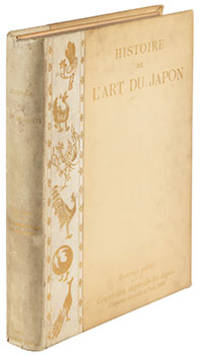
51-6797Paris: Maurice de Brunoff 1900. Folio. 40x30 cm 15¾x11¾" gilt-stamped vellum-backed boards lettered in gilt on cover and spine top edge gilt printed tissue guards.Text in French. Illustrated with photogravure plates and other illustrations in text. 280pp. 68 hors texte plates with tissue guards.Publication of the official Japanese delegation to the 1900 Exposition Universelle in Paris.OCLC Number / Unique Identifier:1269015847.Contents:PremieÌ€re partie. Depuis les origines jusqu'aux anneÌes TeÌmbyau Shyaumou TeÌ€nnau XLV;DeuxieÌ€me partie. De Kwammou Ier au de Kamakoura;TroisieÌ€me partie. Le Bakoufou de Kamakoura;QuatrieÌ€me partie. Depuis les Shyaugouns ;Ashikaga jusqu'au Shyaugoun Tokougawa;CinquieÌ€me partie. Kwampakou des ToyotomiSixieÌ€me partie. Tokougawa Paris: Maurice de Brunoff, 1900 hardcover
189827983London: Edward Stanford 1898. Colored map. 1 vols. 22 x 26 1/2 inches. Bound in green cloth paper label folding paper over linen backing. Fine. Colored map. 1 vols. 22 x 26 1/2 inches. Edward Stanford unknown books
194143024Japan 1941. Loose in a black clamshell box. Very good copies with slight curl; some with small edge or corner tears; 23 have the name of the film or featured actors/actresses rubber-stamped on the back in Japanese. 47 b/w photos. Approximately 6 x 4 inches. One duplicate. Most are group scenes from dramas a few portraits a few without characters; subject matter ranges from early historical dramas to contemporary scenes to the war and its effects. The dates have been verified on a few and all fall during the years of the Pacific War including Tadashi Imai's Tanjiko-mura 1940 "Hanagoyomi hasshojin" 1940 based on the 19th century novel "Josei hongan" 1940 made in the same year as the novel by Kan Kikuchi Yasuki Chiba's "Kuso buraku" 1939. The balance of the stills appear to date within approximately the same period. unknown books
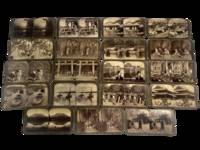
1900226421900. Underwood & Underwood stereoview archive documents Japanese religious practice labor systems and urban environments during the Meiji period when Japan underwent rapid industrialization and imperial expansion following the First Sino-Japanese War and the Russo-Japanese War. Produced in the early 1900s these images were designed for Western educational and commercial audiences forming part of a stereographic program that presented Japan as both modernizing and culturally distinct. The archive spans multiple regions including Osaka Harima Kyoto Tokyo Kawasaki Mount Fuji Nikko and Omori offering a geographically broad record of religious institutions agricultural labor and urban infrastructure. It supports research in early photography transnational visual culture and the representation of East Asia in Western media.<br /> <br /> Collection of 19 black-and-white stereoviews by Underwood & Underwood albumen prints mounted on original gray card stock with printed captions along the margins and extended descriptive text on the verso. Each stereoview measures approximately 3.5 x 7 inches. The series includes pilgrims ascending the slopes of Mount Fuji in ceremonial dress and an interior view of monks assembled at Ikegami Temple in Omori surrounded by ritual objects. Views of Nikko depict cedar-lined approaches shrine architecture and visitors gathered at temple precincts. Urban scenes include Osaka waterways with merchant boats and a view of Osaka Castle's stone fortifications and moat. Additional images show a weaver at work groups of women in kimono posed for the camera vendors and performers near Kyoto shrines and children assembled in public activity. Religious imagery includes Shinto elements such as shrine statuary torii gates and ritual spaces alongside landscapes featuring Mount Fuji and coastal environments. The selection reflects a deliberate balance of sacred rural and urban subjects.<br /> <br /> These stereoviews circulated during a period of expanding international engagement as Japan promoted itself to foreign audiences while consolidating its status as a modern imperial state. Visual materials of this kind contributed to a transpacific exchange in which Japan was framed through dual narratives of continuity and transformation aligning with Western expectations of cultural difference while documenting infrastructural and social change. Increasing contact between Japan and the United States during this period combined commercial exchange and tourism with emerging political tensions that would shape immigration and foreign policy debates. Light edge wear and occasional fading primarily to printed text; images remain clear; overall very good condition. A cohesive stereographic archive illustrating the construction and circulation of Japanese visual identity in the early 20th century. unknown
19695ca. 1920-1931 Kyushu Japan. Very good . Oblong 4to. String-tied commecial album; black boards. Contains 57 gelatin-silver prints of various sizes including 8" by 10" 7.5" by 5" and smaller most of which are adhesive-mounted with several loose plus 11 postcards depicting Kyushu Lutheran churches and one bookmark. One photograph apparently perished; several others loosening from pages. Else apparently complete.Album edges moderately worn; one photo missing a chunk at edge. Most are lightly toned but overall clean. Very good or better. <br/><br/>Well-assembled photo album compiled by an American Lutheran missionary to Japan whose face appears consistently in the majority of the photographs. The island of Kyushu is home to several Lutheran schools and churches including the Kyushu Gakuin Kyushu Lutheran College and the Janice James School both of which are pictured here having recently been built in the early 1900's. The Kyushu Lutheran mission was founded in 1893 by American missionaries; within several years they began building churches under the supervision of one Charles Lafayette Brown 1874-1921 and presumably the subjects pictured here with members of that particualr mission. The album features posed group photographs of large congregations — as large as roughly 150 — captioned with date and location in cities including Kurume Kamamoto and Saga; additionally included are many images of church services in progress plus several family portraits of church members. While Christianity began to spread when Japan phased out its isolationist policies in the 1850s Protestant evangilization in particular slowed under the military government of the Showa period the early years of which are covered by this album.These anti-Western trends were closely tied to the patriotic fervor that culminated in WWII. An absorbing visual archive of a prospering Protestant community and of American missionary activity in Imperial Japan. hardcover books
19450088251945. Very good. Envelope only no letter. <br /><br />The envelope was addressed to Private First Class Walter Mikucki at the Osaka Yodogawa Bunsho POW Camp in Japan. It has a typed "Prisoner of War Postage Free" free frank in the upper right corner and has received a Chicago "War Savings machine postmark dated Jan 13 1944. The envelope was opened by a U.S. censor and resealed using censor tape annotated "Examined by 6587." The address was subsequently obliterated with a red cross and black bands using grease pencil or crayon. It has a circular handstamp in the lower right corner dated Nov 20 1945 with text that appears to read "LIBERATED HQ. USMC. WASH. D.C." There is a USMC "pointing finger" return-to-sender hand stamp that point to the return address. <br /><br />Pfc. Mikucki was a member of the 4th Marine Regiment when as war clouds rumbled in the Pacific it was sent from China to Corregidor to defend Manila Bay in the Philippines. Shortly after its arrival Japan launched its infamous sneak attack on Pearl Harbor and allied bases throughout the Pacific. Corregidor was bombed continuously from late December 1941 until May 5 1942 when an overwhelming force of Japanese soldiers landed on the island. After tanks were brought ashore the following day Lt. Gen. Jonathan Wainwright realized defeat was imminent and surrendered fearing the thousand or so wounded men and bedraggled defenders would be annihilated. <br /><br />Although most of the 4th Marine Regiment had been killed the remaining men were transported to prison camps in Japan. The Yodogawa Bunsho Camp near Osaka was one of the smallest Japanese prisoner of war camps and records in the National Archives identify only 12 prisoners that were known to have been held there. Pfc. Mikucki's name is not on that list. <br /><br />Other records show that Mikucki may also have been imprisoned at various times at the Itchioke Chikko and Umeda Bunsho camps. He died from unknown causes on March 11 1943. <br /><br />Clearly this information was not provided by the Japanese to the Red Cross as Mikucki's parents sent this letter ten months later. <br /><br />Examples of mail sent to American prisoners held in Japan are very scarce and this example may be unique for at the time of this listing I find no mention in philatelic or ephemera auction records in sale listings or institutional holdings of other returned mail for Corregidor Marines who died in Japanese prisoner of war camps . Also there is no mention of anything similar in Gruenzner's <i>Postal History of pf American POWs</i>. <br /><br />
19450088251945. Very good. Envelope only no letter. <br /><br />The envelope was addressed to Private First Class Walter Mikucki at the Osaka Yodogawa Bunsho POW Camp in Japan. It has a typed "Prisoner of War Postage Free" free frank in the upper right corner and has received a Chicago "War Savings machine postmark dated Jan 13 1944. The envelope was opened by a U.S. censor and resealed using censor tape annotated "Examined by 6587." The address was subsequently obliterated with a red cross and black bands using grease pencil or crayon. It has a circular handstamp in the lower right corner dated Nov 20 1945 with text that appears to read "LIBERATED HQ. USMC. WASH. D.C." There is a USMC "pointing finger" return-to-sender hand stamp that point to the return address. <br /><br />Pfc. Mikucki was a member of the 4th Marine Regiment when as war clouds rumbled in the Pacific it was sent from China to Corregidor to defend Manila Bay in the Philippines. Shortly after its arrival Japan launched its infamous sneak attack on Pearl Harbor and allied bases throughout the Pacific. Corregidor was bombed continuously from late December 1941 until May 5 1942 when an overwhelming force of Japanese soldiers landed on the island. After tanks were brought ashore the following day Lt. Gen. Jonathan Wainwright realized defeat was imminent and surrendered fearing the thousand or so wounded men and bedraggled defenders would be annihilated. <br /><br />Although most of the 4th Marine Regiment had been killed the remaining men were transported to prison camps in Japan. The Yodogawa Bunsho Camp near Osaka was one of the smallest Japanese prisoner of war camps and records in the National Archives identify only 12 prisoners that were known to have been held there. Pfc. Mikucki's name is not on that list. <br /><br />Other records show that Mikucki may also have been imprisoned at various times at the Itchioke Chikko and Umeda Bunsho camps. He died from unknown causes on March 11 1943. <br /><br />Clearly this information was not provided by the Japanese to the Red Cross as Mikucki's parents sent this letter ten months later. <br /><br />Examples of mail sent to American prisoners held in Japan are very scarce and this example may be unique for at the time of this listing I find no mention in philatelic or ephemera auction records in sale listings or institutional holdings of other returned mail for Corregidor Marines who died in Japanese prisoner of war camps . Also there is no mention of anything similar in Gruenzner's <i>Postal History of pf American POWs</i>. <br /><br /> books