199 résultats
1928053485Istanbul: Servet-i Fünûn - Ahmed Ihsan Matbaasi i.e. Printing House" Letterhad 1928. No Binding. Very Good. 8vo - over 7¾ - 9¾" tall. Original manuscript autograph letter/document signed by Muhtar Halid sent to the presidency of the Republican Party of Turkey in Ankara. 205x135 cm. In Ottoman script. Dated September 23 1928. Six lines. Two punching holes out of text on the paper. The document says that 26.000 alphabets 57.000 brochures and pamphlets and 100.000 are printed and will be sent to the 'Cumhuriyet Halk Firkasi' i.e. Republican Party CHF - CHP in Ankara city. This rare autograph documents how widespread and comprehensive work was done to switch from Arabic letters to Latin letters during the Letter Revolution in 1928. "Muhtar Halid Kitabhanesi i.e. Printing House of Muhtar Halid was located on Bâb-i Alî i.e. The Sublime Port main street number 17; a place where is located old Izmir Terzihanesi i.e. Old Smyrna Taylor Shop. Muhtar Halid was the Late period Ottoman / Turkish typographer the elder brother of the famous Turkish typographer and translator of Ahmed Ihsan Tokgöz 1868-1942 and the owner of 'Muhtar Halid Kitabhanesi'. He worked together with his brother's printing and publishing house especially when he was publishing 'Servet-i Fün'un' periodicals. Servet-i Fünûn i.e. The Wealth of Knowledge was a long-running and an avant-garde literary and sometimes political periodical and journal or magazine. It's published to support the Ittihat ve Terakki Cemiyeti i.e. The Union and Progress Society later Party initially by Ahmed Ihsan Tokgöz. Source: Tanzimat'tan Cumhuriyet'e Tarihi Kentsel Çevrede Mekânlar Üzerinden Bir Semt Okumasi: Cagaloglu Semti Örnegi by Melek Yalvaç Ph.D. Thesis. <br/> <br/> Servet-i Fünûn - Ahmed Ihsan Matbaasi [i.e. Printing House]" Letterhad unknown
1910052639Istanbul: TBMM: Türkiye Büyük Millet Meclisi i.e. The Ottoman Grand National Assembly. AH 1326 1910. Soft cover. Very Good. Folio - over 12 - 15" tall. Paperback. Wrapper is repaired. Tape on spine. Chipped on last page. Other wise a good copy. Folio. 40 x 28 cm. In Ottoman script. 72 p. 14 cedvels schemes and 14 p. color statistics. Meclis-i Mebûsân Birinci devre 1325-1326 içtimai. 326 senesi muâzene-i umûmîsi hakkinda . kaleme alinan esbâb-i mûcibe mazbata-yi umûmîsi. Meclis-i Mebûsân The Chamber of Deputies of the Ottoman Empire was the lower house of the General Assembly the Ottoman Parliament. Unlike to the upper house the Senate the members of the Chamber of Deputies were elected by the general Ottoman populace although suffrage was limited to males of a certain financial standing among other restrictions that varied over the Chamber's lifetime. The Second Constitutional Era of the Ottoman Empire began shortly after Abdul Hamid II was forced to restore the constitutional monarchy after the 1908 Young Turk Revolution. The period established many political groups and parties. Ahmet Riza became the first President of the Chamber in 1908. An amendment in 1909 to the original 1876 constitution resulted in the Chamber gaining more true political power at the expense of the non-democratically elected Senate and the Sultan. A series of elections during this period resulted in the gradual ascendance of the Committee of Union and Progress's CUP domination in politics. The second largest party Liberal Unionist Party LU Turkish: Hürriyet ve Itilâf was in fact a coalition of parties led by Prince Sabahaddin. This is a rare protocol register book of Meclis-i Mebûsân. First and Only Edition. Not in Özege.; Not in OCLC. <br/> <br/> TBMM: Türkiye Büyük Millet Meclisi [i.e. The Ottoman Grand National Assembly]., [AH 1326] paperback
24124Without date or place but apparently written in Mesopotamia in late 1916. This poem is said to be an earlier work by ‘A Tommy’ the pseudonymous author of the collection ‘If I Goes West’ published in London by Harrap in 1918. WorldCat has no entries to support a second claim: that the present poem was published in 1917 with the subtitle ‘Verses written by a “Tommy†who has fought suffered and triumphed in Mesopotamia and is still on active service there’. While there is no indication that the poem has ever been published in its entirety extracts from it appeared in ‘The Bystander’ 27 November 1916; and ‘The Near East’ 6 July 1917; the latter headed ‘An Alphabet from Mesopotamia’ being preceded by the following: ‘A member of our Fighting Forces in Mesopotamia has composed some verses which he entitles “ The Alphabet of Mesopotamia.†Through the kindness of a correspondent we are allowed to reproduce here some specimens’. There may also be a reference in Catherine W. Reilly’s 1978 bibliography ‘English Poetry of the First World War’. Duplicated typescript titled ‘ALPHABET OF MESOPOTAMIA.’ 2pp foolscap 8vo. Text complete on two leaves of air mail paper glued together. Apparently contemporary and with the look of an item that has been handed around the mess room. Twenty-six four-line stanzas: one for each letter of the alphabet apart from a joint stanza for S and T and ending with an ‘ENVOI’. The first stanza reads: ‘ “A†Was an apple that grew so they say In the Garden of Eden down Qurnah way Till Eve came along and ate it one day And got thrown out of Mesopotamia.’ The poem includes the following stanzas: ‘ “F†Stands for Fritz who flies in the sky To bring down the brute we’ve many a try But the shells that we shoot seem to all pass him by And fall --- on Mesopotamia.’ ‘ “J†Is the jam with the label that lies And states that in Paris it won the first prize But out here we use it for catching the flies That swarm in Mesopotamia.’ ‘ “U†Is the Lake we call Umm-el-Brahm And guards our flanks from all possible karm sic And waters Gorringe’s Barley Farm In the middle of Mesopotamia.’ ‘ “V†Is the Victory we won at Dujailah I heard of it first from a friend who’s a sailor Who read it in Reuter’s on board a mahela On the Tigris in Mesopotamia.’ ‘ “W†Stands for the wonder and pain With which we regard the infirm and insane Old Indian Generals who guide the campaign Which we’re waging in Mesopotamia.’ ‘ “Y†Is the yearning we feel every day For a passage to Basra and thence to Bombay If we get there we’ll see that we stay right away From this wilderness - Mesopotamia.’ Without date or place, but apparently written in Mesopotamia in late 1916. unknown
22474'Wedesday' no date. On monogram letterhead combining the letters C and A. 1p 12mo. In good condition lightly aged. Folded twice. Reads: 'Dear Mr Blacket I should wish to know in the course of the day how many pages of print are in the first volume.' Despite the spelling of the name the recipient is presumably either Henry Blackett 1825-1871 of the publishers Hurst and Blackett or one of the four of his sons to become publishers. There is no record of a book by Vámbéry being published by a Blacket or Blackett but he may be referring to an essay or article published in a periodical or compilation or an anonymous or pseudonymous work. 'Wedesday' [no date]. On monogram letterhead combining the letters C and A. unknown
1915055604Istanbul: Kitabhane-i Islâm ve Askerî Çigiraçan Ibrahim Hilmi - Balkan Harbi Külliyati Aded: 4. AH 1331 1915. 1st Edition . Soft cover. Very Good. 8vo - over 7¾ - 9¾" tall. Original wrappers. Foolscap 8vo. 18 x 12 cm. In Ottoman script Turkish with Arabic letters. 158 p. 4 plans. Occasionally stains on cover pages and edges; chipped on extremities of front cover and spine. Overall a good copy. Some uncut pages. First and only edition of this rare first-hand account of the failures and deficiencies of the Ottoman army in the Balkan War 1912-1913 and the conflicts between Turkish commanders during the war. Bekir Sitki or Sidki participated in the war with the rank of lieutenant. The wars and struggles fought by the Vardar army a branch of the Western army called Câvîd Pasha branch affiliated with it are explained day by day with four plans in this work in plain language and information is given about the situation of the Ottoman army its deficiencies the difficulties experienced during the war. As of 2023 September only one paper copy could be traced in the OCLC: 283477138 Universitatsbibliothek der Eberhard Karls Universitat.; Özege 6039.; TBTK 5822.; Not in ATYB. <br/> <br/> Kitabhane-i Islâm ve Askerî Çigiraçan, Ibrahim Hilmi - Balkan Harbi Külliyati, Aded: 4., [AH 1331] paperback
1925053174Istanbul: Erkân-i Harbiye Mektebi Matbaasi. AR 1341 1925. 1st Edition . Soft cover. Very Good. Folio - over 12 - 15" tall. Paperback. Oblong folio. 24 x 32 cm. In Ottoman script Turkish with Arabic letters. 22 p. 22 b/w plates. Some autograph notes with a pencil on several pages. Chipped extremities faded on pages and cover spine is damaged. Otherwise a good copy. TBTK 10129.; Not in Özege.; Not in OCLC. <br/> <br/> Erkân-i Harbiye Mektebi Matbaasi., [AR 1341] paperback
1910055042Istanbul: Agob Matyosyan Printing House. AH 1327 1910. 1st Edition . Leather. Very Good. 8vo - over 7¾ - 9¾" tall. In modern aesthetic full leather bdg. in Ottoman style. Roy. 8vo. 24 x 17 cm. In Ottoman script Old Turkish with Arabic letters. 184 p. numerous b/w plates. First and only edition of this scarce travelogue which was planned for fifteen days on January 19 1909 but took about forty days containing a first-hand travel account of Egypt in 1909 an Islamic country that began to modernize at the beginning of the 20th century written by an Ottoman intellectual one year after the Second Constitutional Regime. This rare book contains early descriptions of the Egyptian municipality the Red Crescent gardens and parks urbanism zoo and botanic gardens tramps bridges social life folkloric customs Mahmil Alays cemeteries music and history of art hotels Nile and many historical heritages architecture etc. Agop or Agob Matyosyan was one of the first Armenian printers to apply during the inspections of printing houses that were done in accordance with the Nizam-name-i Cedid Jareeda-i Mahakim No. 429 13 Jamazia al-awwal 1305 in the late Imperial Ottoman period. Hegira: 1327 = Gregorian: 1910. Özege: 14459. OCLC: 476243661 / 16347814. <br/> <br/> Agob Matyosyan Printing House., [AH 1327] hardcover
1928052325Istanbul: N.d. ca. 1928-1930 1928. Soft cover. Very Good. Original TLS signed 'Ihsan Schükrü-Aksel' sent to 'Herrn Prof. Dr. Hecht' Budapest to Psychiatrische Klinik Budapest VIII Balassa Utca 6.". 28x21 cm. In German. 1 p. 'Bank Extra Strong' watermarked paper and 'Sinir ve Beyin Hekimi Dr. Ihsan Sükrü Aksel - Bakirköy ve Haydarpasa Nümune Hastaneleri Mütehassisi' letterhead. Text: "Sehr geeheter Herr Kollege! Ich erlaube mir Ihren eine Patientin von mir Frl. Nihat zu empfehlen die zurzeit in Budapest ist und möchte ich Sie bitten Ihre gütige Anempfehlungen nicht fehlen zulassen. Für Ihre Bemühungen danke ich Ihnen im voraus und zeichne und sehr ergebener.". Aksel was a Turkish / Ottoman specialist phsycian-psychiatrist. He was born in Istanbul in 1889. He graduated from Istanbul Darülfünun Medical Faculty in 1919 and started working as an assistant at "Emraz-i Akliye and Asabiye Hospital". He went to Germany for education in 1922. In Munich and Hamburg he worked with Prof. Kraeplin Prof. Spielmayer Prof. Weygand and Prof. Jakob. He returned to Turkey in 1925 I was appointed as the chief of Emraz- i Akliye ve Asabiye Hospital i.e. Mental and Nervous Diseases Hospital and established the neuropathology laboratory. He became 'ordinarius' in 1951. In 1953 he became the dean of Istanbul University Faculty of Medicine; he prioritized the establishment of a psychiatry clinic in Çapa and established the Institute of Child Psychiatry in 1958. <br/> <br/> N.d., [ca. 1928-1930] paperback
1945049571Istanbul 1945. Soft cover. Very Good. Original autograph letter. 2 p. No letterhead on paper. In Ottoman script. Sent to Hayri Bey Efendi. Dated February 25 1945. A fine script. Sent from abroad to Turkey before one year of his return. Damat Mehmet Serif was a Turkish statesman Ottoman Minister of Interior author translator and the groom of Sultan Abdulaziz. He graduated Mulkiye School and worked in various government services. In 1901 he married Emine Sultan who was the daughter of Sultan Abdülaziz. Therefore he was groom Damat of Ottoman Court in the last period of the Ottoman Empire. He was translator of 'Voyages of Ibn-i Battuta' into Turkish from Arabic language and 'The Prince' by Machiavelli. from French. Source: Türk meshurlari -1946- Ibrahim Alaettin Gövsa. He's known with his a negative attitude towards the Turkish War of Independence. After that he became one of the people disrupting the national unity in the Speech by Mustafa Kemal Atatürk. When the War of Independence was successful he was fled and banished. He returned from exile to Turkey in 1946. <br/> <br/> paperback
1916052092Istanbul: AH 1332 1916. Soft cover. Very Good. Original manuscript 'berat' in diwanî Ottoman Turkish script for promoted rank of Ottoman berat for promoted rank of Musa Rifki Efendi son of Hasan of Düzce who was deputy reserve officer to the rank 'lieutenant' durin WW 1 in 1916. 41x195 cm. 1 p. Four lines with elqab and sealed by Enver Pasha when he was Minister of War during the first World War in 1916. Written in very calligraphic diwanî style. Sealed in Dersaadet Ministry of War as 'Harbiye Nâziri Enver' i.e. Enver Minister of War. Enver Pasha was an important Ottoman general and commander in chief a hero of the Young Turk Revolution of 1908 and a leading member of the Ottoman government from 1913 to 1918. He played a key role in the Ottoman entry into World War I on the side of Germany and after the Ottoman defeat in 1918 he attempted to organize the Turkic peoples of Central Asia against the Soviets. Manuscript notes on verso. <br/> <br/> AH 1332 paperback
1916052091Istanbul: AH 1332 1916. Soft cover. Very Good. Original manuscript 'berat' in diwanî Ottoman Turkish script for promoted rank of Mehmed Emin Efendi son of Ahmed Nuri of Istanbul who was deputy reserve officer in the wireless telegraph to the rank 'lieutenant' durin WW 1 in 1916. 41x195 cm. 1 p. Four lines with elqab and sealed by Enver Pasha when he was Minister of War during the first World War in 1916. Written in very calligraphic diwanî style. Sealed in Dersaadet Ministry of War as 'Harbiye Nâziri Enver' i.e. Enver Minister of War. Enver Pasha was an important Ottoman general and commander in chief a hero of the Young Turk Revolution of 1908 and a leading member of the Ottoman government from 1913 to 1918. He played a key role in the Ottoman entry into World War I on the side of Germany and after the Ottoman defeat in 1918 he attempted to organize the Turkic peoples of Central Asia against the Soviets. Manuscript notes on verso. <br/> <br/> AH 1332 paperback
1941050291Istanbul: Foto Turan Çarsikapi 1941. Soft cover. Very Good. 8vo - over 7¾ - 9¾" tall. Original b/w portrait photograph of Cemal Karabekir. 24x22 cm. With card-board. Autograph signed and inscribed by Karabekir as 'Sekizinci Kolordu Askerî Mintika Kumandani' in May 30 1941. Inscribed as '. aziz ve muhterem arkadasim kardesim Enver Nâci Bey' takdîm kilinmisdir; Sekizinci Kolordu Askerî Mintika Kumandani Cemal Karabekir."'. Karabekir also was author of his memoirs 'Maçka Silahhanesi hatiralari' Memoirs from Maçka Arsenal. During the Turkish War of Independence he was manager of Arsenal or; Armory / Armoury in Maçka Besiktas and he supplied and sent armament to Anatolia especially in the course of Occupation period of Istanbul. <br/> <br/> Foto Turan, Çarsikapi paperback
1911373896Istanbul: Bab ʻAli Cadeh Sindh Matbaʻah Sindh Ṭabaʻ ul-Mas̲edar 1911. Second printing of vols. 1-3. 152; 109; 112; 124 1 pp. 1 vols. 8vo. Green cloth. Toning to paper some minor marginal flaws. Very good. Second printing of vols. 1-3. 152; 109; 112; 124 1 pp. 1 vols. 8vo. Bab ʻAli Cadeh Sindh, Matbaʻah Sindh Ṭabaʻ ul-Mas̲edar unknown
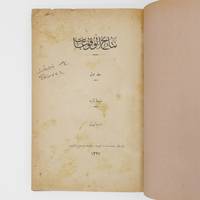
191463974New York NY: American Art Galleries American Art Association 1914. Five parts in one vol. Thick 8vo. 486 pp unpaginated - duplication of 110 pp. Day 3. Titles in red & black photo illustrations and plates throughout many double-page annotated w/ realized prices in ink manuscript throughout for every item placeholder slips also present. Contemporary flexible dark brown calf rebacked inner hinges repaired still a VG- copy from the library of Tom Atiyeh w/ Atiyeh Bros. Inc. 604 SW 10th Ave. Portland Oregon ownership stamp on ffep. First edition of this lavishly illustrated catalogue of the historic liquidation of the collection of Persian Oriental and Chinese rugs held and brokered by the Constantinople-based Armenian firm of O. Agopian & Son who appear to have sold out just after the forced emigration and anti-Armenian campaign by the Ottoman Committee of Union and Progress following the 1912-1913 Balkan Wars. The rugs offered from sale ranged from Beluchistan weave Turkoman rugs to Antique Caucasian prayer rugs with Kazak weaves; giant 18th-Century Turkoman carpets to Persian Khorassan Triclinium rugs realizing $ 1300.00 over $ 43000 today Many of the rugs textiles and antiquities from this sale found their way not only to the hands of collectors but also to such museum collections as the Detroit Institute of Arts the Frick Collection and others. American Art Galleries, American Art Association, unknown
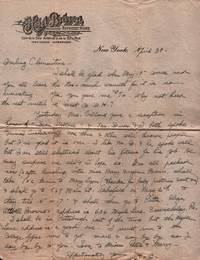
1922List3039Constantinople New York City and others 1922. Four letters totaling seven pages. Folded else fine. A small collection of letters from “H.C.†who seems to have been an American university professor in Constantinople to his “Darling Clementine†back home. H.C. may have taught at Robert College a Christian college founded in 1863 now a prestigious private highschool.<br /> <br /> It is not clear when H.C. first arrived in Constantinople but he had been there for several years already by the time the letters begin and was certainly there at a critical point in its history. He writes in 1918 shortly after the arrival of occupying forces:<br /> <br /> “conditions are still very bad in town I long to see the suffering diminished. Some say it will be months yet. Sometimes now there is no coal no electric light no bread no water. Can you imagine the state of an Oriental city under such conditions We have had are still having trouble about light water-supply but we have steam heat plenty of food of a plain kind. We all keep well. . I hear that an American Red Cross boat will arrive next week I am eager to see its passengers. We may have a chance to leave on it but I can not see my way clear to skip because our faculty is depleted ever since the exodus at the time of the panic long ago when Miss Lyon left. . We have a good college now – boarders about 90 in the College-department – and many day scholars but lately the Spanish fever the lack of tram-car service has kept many students away. As soon as our cousins supply coal we hope for improvement. The Ententists are spreading over the city thoroughly quietly – like oil. It is a delight to see so many manly looking officers after the ones we have had here for years. There is a spiritual look in the eyes of the present occupants a look of bull-dog determination.†December 6 1918<br /> <br /> H.C. enjoys a “real yachting cruise†on his way back to Constantinople from the States in 1921 tells Clementine about his plans for his commencement speech in 1922 and describes a college reception in New York City which “General Custer’s wife†Elizabeth Bacon Custer attended undated letter. Meanwhile Turkey was engaged in its brutal war for independence. At some point H.C. befriended Electra—probably a Greek woman—whom he sent along to visit Clementine in part to help Electra cope with her traumatic experiences during the war:<br /> <br /> “As you will recall my young friend’s father was executed – tho innocent – with about 70 others. At first E. bore this with wonderful fortitude but after Xmas a reaction set in naturally enough. She developed morbidness a hyper sensitive attitude toward all of my looks words – probably a condition due to shock. I am confident that travel new scenes interests will bring her back to her old self your wholesome household will chase all gloom away. A doctor told her lately that she has hysteria that she must think of cheerful things only. I tell you this thinking that you might keep her from talking about the nation that does cruel things. The truth is that cruelty is pretty generally distributed a judicial mind finds it difficult to pick choose. Some nations get the public ear so the pot can call the kettle black!†June 6 1922<br /> <br /> Indeed both sides of the Greco-Turkish war—part of the larger Turkish campaign for independence—massacred each other. However only the Turkish contingent’s actions have been argued by historians to constitute ethnic cleansing or genocide.<br /> <br /> Of interest to historians of the Ottoman Empire and Turkey post-World War I especially Americans’ experience thereof. unknown
052108Istanbul : Manuscript. 19th century. 2nd Edition . Soft cover. Very Good. 16mo - over 5¾ - 6¾" tall. Original ketebe page and last page of a manuscript written by Ottoman / Turkish calligrapher Hasan Hüsni Efendi 1840-1914. 16x8 cm. In Arabic. 2 p. Written on a watermarked paper. Well-trained in the educational and instructional curricula of the day anda member of the class of religious scholars Hasan Hüsnü Effendi attended dasses in calligraphy under the Üsküdar Mawlawi sheikh Zeki Mehmed Dede from whom he received his diploma and became one of the best representatives of this art. Hasan Hüsnü Effendi who taught the Persian style of calligraphy nasta'lik or naskh-i ta'lik in the law school Medresetü'l Kuzat trained a number of artists like Hulusi Yazgan and Kemal Batanay and attained da place of importance in the history of the Turkish art of calligraphy. A Neglected Cultural Treasure: Calligrapher Karînâbatli Hasan Hüsnü Effendi MUHITIN SERIN. <br/> <br/> Manuscript., [19th century] paperback
1922052114Istanbul: Manuscript - Autograph letter / Letterhead 'Sura-yi Devlet'. H.: 1338 1922. Soft cover. Very Good. 4to - over 9¾ - 12" tall. Original manuscript autograph document signed by Mehmed Tevfik Biren. 335x20 cm. Folded. 1 p. In Ottoman script. Dated 25 Saban 1338 AH. Letterhead of 'Sûrâ-yi Devlet' addressed to 'Bâb-i Âlî Teshilât Sandigi Komisyonu'. Biren served as a high-ranking statesman such as the Minister and the Governor in the last period of the Ottoman Empire. Also he was last chief of the council of the state i.e. Shûrâ al-Devlet. Mehmet Tevfik Bey was born in 1867 in Istanbul. His father was a high-ranking statesman in the Ministry of Education. After graduating from Mekteb-i Mulkiye in 1885 at the age of 18 he started his first duty as the clerk of Abdulhamid II at Yildiz Palace. From 1897 to 1901 he served as the Governor of Jerusalem. After that he was appointed as the Governor of Thessaloniki. He was the governor of Yemen between 1904-1905. He became the Minister of Finance in the last years of the Ottoman Empire. He participated in the negotiations of the Treaty of Sevres signed in 1920. He was last appointed on 19 August 1921 as the 'Sûrâ re'isi'. He continued this duty until the abolition of the Sultanate on 4 November 1922. Thus he was the last 'al-Shura' of the Ottoman Empire. After the proclamation of the Republic he left the state. Wikipedia. <br/> <br/> Manuscript - Autograph letter / Letterhead 'Sura-yi Devlet'., [H.: 1338] paperback
1981053241Istanbul: TC Istanbul Üniversitesi Edebiyat Fakültesi Bizans Sanati Tarihi Kürsüsü Letterhead 1981. No Binding. Fine. Original typescript letter signed by Semavi Eyice. Some autograph corrections as well by Eyice. 31x225 cm. In Turkish. Twenty lines. 7.5.1981 dated. He mentions Fatih Mosque in Silivri which transformed from an old Byzantine church. The letter includes very interesting information Silivri and Selimbria with its ancient name. For instance in the 1960s the district governor of Silivri sold the land of this church/mosque for five Turkish Lira per square meter. In addition to this he says that Silivri is a Turkish district were always destroyed its own historical artifacts. In the continuation of the letter he indicates that he adds to this sending an off-print including his article related to the Byzantine monuments in Thrace and containing mentioned church in Silivri. <br/> <br/> TC Istanbul Üniversitesi Edebiyat Fakültesi Bizans Sanati Tarihi Kürsüsü Letterhead unknown
1955051571Istanbul 1955. Soft cover. Very Good. Original autograph letter and one original press photography of Damad Mehmed Serif Pasha Çavdarlioglu; two items together. Photograph taken in 1914 according to the seal on verso. Sealed and photo by French photographer Dupuy & Cie. of Paris. This photo used by 'Meurisse' for a reportage there is another seal by 'Meurisse' of Paris. 14x9 cm. Text in French. Autograph letter by Mehmed Serif written a fine in Ottoman script addressed to an unnamed person. He mentions on this letter 'Nizamülmülk's Siyasetnama i.e. Book of politics he wanted to translate it however he wrote in his letter that he's afraid of translation. Damat Mehmet Serif was a Turkish statesman Ottoman Minister of Interior author translator and the groom of Sultan Abdulaziz. He graduated Mulkiye School and worked in various government services. In 1901 he married Emine Sultan who was the daughter of Sultan Abdülaziz. Therefore he was groom Damat of Ottoman Court in the last period of the Ottoman Empire. He was translator of 'Voyages of Ibn-i Battuta' into Turkish from Arabic language and 'The Prince' by Machiavelli. from French. Source: Türk meshurlari -1946- Ibrahim Alaettin Gövsa. He's known with his a negative attitude towards the Turkish War of Independence. After that he became one of the people disrupting the national unity in the Speech by Mustafa Kemal Atatürk. When the War of Independence was successful he was fled and banished. He returned from exile to Turkey in 1946. Dated 1955 after nine years of his return from exile. Extremely rare. <br/> <br/> paperback
1934052617Ankara: T. B. M. M. Özel 1934. Soft cover. Very Good. Original autograph letter ALS signed 'Bilecik Saylavi Salih Bozok' with its original envelope. 21x15 cm. In Ottoman script. 2 p. Full. Letter includes 27 lines. Dated December 22 1934. Letterhead 'TBMM Özel' i.e. Turkish Grand National Assembly. Recipient is Salih Bey Sener who was lived in Kadiköy and Commandant Gendarme. Bozok was an officer of the Ottoman Army later the Turkish Army and a politician of the Republic of Turkey. He was the chief aide-de-camp of Mustafa Kemal Atatürk the founder of modern Turkey. Bozok was a close childhood and lifelong friend of Atatürk both having been born in 1881 in Salonica and having attended the Monastir Military High School together. On November 10 1938 upon witnessing the dead body of Atatürk in the latter's bedroom of Dolmabahçe Palace a distraught and stunned Bozok stepped outside and shot himself through the chest with a pistol. However the bullet narrowly missed his heart and Bozok did not succumb to his fatal wound until April 1941. Wikipedia. <br/> <br/> T. B. M. M. Özel paperback
1918053722Berlin: TLS - Letterhead 'Ambassade Imperiale Ottomane' 1918. Soft cover. Very Good. 8vo - over 7¾ - 9¾" tall. Original TLS by Ibrahim Hakki Pasha in French sent to the Minister of Switzerland etc. etc. in French sent to the Minister of Switzerland etc. etc. 26x19 cm. In French. 1 p. 16 lines. Foxing on paper minimal stains. A good paper. Text: "Monsieur le Ministre Naim Bey directeur d'une societe coommerciale a Constantinople et son epouse Mevhibe Hanem ainsi que le medecin Ibrahim Bey directeur et medecin en chef de l'hôpital militaire Chehid Mouhtar desirant se rendre en Suisse pour une dizaine de jours en vue de regler certaines affaires particulieres qui les concernent. Je prie Votre Excellence de vouloir bien donner a qui de droit les ordres necessaires pour que leur passeport soit vise. Veuillez agreer Monsieur le Ministre l'assurance de ma haute cconsideration. Son Excellence Monsieur Mercier Minisre de Suisse etc. etc. etc.". Dated 'Berlin le 13 Juillet 1918'. i.e. Naim Bey director of a trading company in Constantinople and his wife Mevhibe Hanem as well as the doctor Ibrahim Bey director and chief doctor of the military hospital Chehid Mouhtar wishing to go to Switzerland for ten days in order to settle certain specific cases which concern them. I beg Your Excellency to be good enough to give to whom it may concern the necessary orders for their passport to be stamped. Please accept Mr. Minister the assurance of my high consideration. His Excellency Monsieur Mercier Minister of Switzerland etc. etc. etc. ". Dated 'Berlin July 13 1918'. Ibrahim Hakki Pasha 1862-1918 was an Ottoman statesman who served as Grand Vizier of the Ottoman Empire between 1910-1911. He served as Ottoman ambassador to Germany and to the Kingdom of Italy. Hakki Pasha also spent considerable amounts of time in London between February 1913 and the outbreak of World War I working on negotiations concerning the Berlin-Baghdad Railway and a settlement for the Second Balkan War. During that visit Hakki Pasha met with King George VI. He was awarded the Order of Karadorde's Star. <br/> <br/> TLS - Letterhead 'Ambassade Imperiale Ottomane' paperback
1909052756Trablussam: Original Manuscript ALS. Ah 1325 1909. No Binding. Very Good. Original autograph letter sealed by Mahmud Naci Balkis. 21x15 cm. In Ottoman script Turkish with Arabic letters. 1 p. To his unnamed respectable friend. Congratulations to Abdussaid Bey a kind appeal for a payment behalf of himself and sending the receipt to his mother "Islahat Komisyonu" etc. Dated fî sene 1 Subat February 1325 AH = 1909 AD. Mahmud Naci Bey was a Turkish politician soldier deputy of the Ottoman Parliament Assembly Tripoli 17 December 1908 founder of Besiktas Gymnastics Club 1903. Mahmut Naci Bey who was one of the founders of the Ottoman Besiktas Terbiye-i Bedeniye School also became a member of the Ottoman Deputy Council and served as the Deputy of Tripoli. He wrote a book titled "Trablusgarp - Hedefteki Ülke Libya'nin Tarihi" i.e. "Tripoli - The History of the Destination Country Libya" which also wrote the situation in Libya with his memories here. Mahmut Naci Bey who was of Caucasian origin was against the policy of Sultan Abdülhamid II. He joined Mustafa Kemal Pasha during his occupation years. He took part in the National Struggle in secret weapon shipments from Anatolia to Istanbul. The Independence Medal was awarded for his active role in the War of Independence. <br/> <br/> Original Manuscript ALS., [Ah 1325] unknown
1885051539Istanbul: Bâb-i Fetva Daire-i Seyhülislâm. H.: 1301 1885. No Binding. Very Good. 8vo - over 7¾ - 9¾" tall. Original manuscript handwritten letter ALS signed 'Ahmed Es'ad'. Oblong: 19x24 cm. In Ottoman script. Letterhead of 'Bâb-i Fetva Daire-i Seyhülislâm'. AH: 1301 = AD: 1885. With elqab includes three lines. Written on salary increase of 'Imam-i Sânî Rasid Efendi hazretleri'. Folded. In elqab it starts with 'Faziletlü efendim hazretleri' after 'Hüve'. Uryânîzâde Ahmed Esad Efendi was 117th sheikh al-islam of the Ottoman Empire in the period of Sultan Abdulhamid 2. He was son of Mehmed Said who was one of qadis judge of Sultan Mahmud II. He was descend from Osman el-Uryânî who was a Kilis city-born. <br/> <br/> Bâb-i Fetva Daire-i Seyhülislâm., [H.: 1301] unknown
193863875New York NY: Fleming H. Revell Co. 1938. 12mo. 202 pp. Photo frontisp. photo plates map printed letter facsimile. Dark green publisher’s cloth yellow lettering on spine minor shelfwear w/ d.j. photo cover art of captured artillery minor scuffing couple very minor closed tears slight tear upper right corner still VG/VG- copy. First edition of this very uncommon World War account of an Armenian-American who was forced into the Ottoman Empire’s Army participated in the 10-month Gallipoli campaign at Aru Burnu against the Anzacs and as a medical orderly burying the 3000 Turkish dead during a nine-hour truce. Following the withdrawal of the British from the Dardanelles his 16th Division was transferred to Syria fights General Allenby at the capture of Jerusalem and was taken prisoner and interned in Egypt. Subsequently he served with the British as an interpreter for British Intelligence and then returned as a POW at Belbeis until July 12 1920 when discharged eventually immigrating to the U.S. attending and earning degrees before opening businesses in Georgia. Very scarce in original dustjacket. Fleming H. Revell Co., hardcover
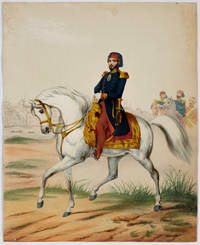
1840177838circa 1840-1850s. Pair of hand-coloured lithographs highlighted with gum arabic 32.2 x 25.1 cm trimmed spotting to the upper corners affecting the sky only paper adhesions on the verso but the images in very good bright condition. Two finely coloured lithographs one of a Turkish Sultan in military costume with the skyline of Constantinople in the background and another of lower rank perhaps issued in the period of the Crimean War. Trimmed and possibly from an album or scrapbook. . unknown