71 408 résultats
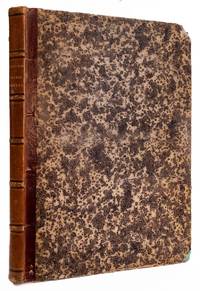
62026Paris: Girard 1830. FIRST EDITION. Imperial folio 58.5 x 40.5 cm. Half-titleengraved calligraphic title with large lithographed vignette2 prefacepp.871 list of plates. Contemporary half russet morocco over marbled boards spine with 5 raised bands and title gilt to second compartment from top marbled endpapers. 69 lithographed plates maps and plans after drawings made on the spot by Laborde and Linant de Bellefonds et al. 3 of which folding or double-page including the large map of Arabia Petraea many mounted on India paper one of which fully coloured plus numerous woodcut illustrations within the text. Ex libris G.B. Bountas with his collector's stamp four times to title page along with oval bookseller's sticker of the Librairie Orientale H. Samuelian to front pastedoen. Corners bruised with one corner piece missing binding rubbed upper rear joint starting spine faded significant spotting throughout. First edition of "an important work" Blackmer complete with all the magnificent views in large folio format. All subsequent editions including the English one were published in octavo and retained only a few plates of the original edition all in considerably reduced format. Laborde made the journey to Petra with the engineer Linant de Bellefonds in 1828 travelling from Suez via St. Catherine's and through Wadi al-Araba to Akabah. Although Burckhardt Irby and Mangles had explored Petra before Laborde he was the first to make detailed drawings of the area. Dedicated to the Elector Wilhelm II of Hesse 1777-1847. "Both Burckhardt and Irby and Mangles had Explored Petra before Laborde but Laborde was the first to be able to make plans views and maps of the area" Blackmer. The son of an archaeologist and diplomat Léon-Emmanuel-Simon-Joseph 1807-1869 count of Laborde was educated at the University of Göttingen. In 1826 he embarked on a transformative journey with his father to Greece Asia Minor Syria and Egypt honing his artistic talents and linguistic skills along the way. In Cairo he encountered Louis Maurice Adolphe Linant de Bellefonds known as Linant Bey then Linant Pacha a seasoned explorer seeking a companion to traverse the Sinai to Petra. Their partnership led to a historic expedition in February 1828 during which they meticulously documented their journey through sketches and detailed maps. Arriving in Petra they became the first Europeans to conduct an extensive survey of the Nabataean capital a milestone in archaeological exploration. Upon returning to Europe in May 1828 Laborde dedicated himself to publishing his travel notes culminating in the richly illustrated Voyage de l'Arabie Pétrée in 1830. This publication introduced the Nabataeans to the Western world influencing subsequent explorers like the Scottish painter David Roberts. Laborde's contributions extended beyond exploration; he served as the Curator of the Department of Antiquities at the Louvre in 1847 later becoming Director General of the Archives in 1857. His decade-long tenure saw the creation of the Musée des Archives laying the groundwork for the future Museum of the History of France. Laborde's legacy endures as a testament to his pioneering spirit and profound impact on the fields of archaeology and cultural preservation. Blackmer 929 Paris: Girard, 1830. hardcover
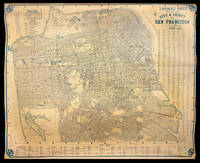
192614395San Francisco Oakland and Los Angeles: Compiled & Published by Thomas Bros. Map Publishers & General Draftsmen 1926. 1676 by 2083mm. 66 by 82 inches; 5.5 by 7 feet. Lithographed wall map printed in blue over-printed in red blue and green wash in outline to coastline and the park areas respectively laid down on linen as issued A monumental map of San Francisco at the height of its post-fire pre-depression era development the vision of the chief engineer Michael Maurice O'Shaughnessy 1864-1934 who modernised the infrastructure of San Francisco and who is revered as one of the most important civil engineers in American history. After the devastating earthquake and fire of 1906 San Francisco underwent an intense period of reconstruction and development which culminated in the city as the Thomas Brothers' map shows it. A year later in 1927 construction began on San Francisco airport on Mills Fields 13 miles south in San Mateo County making it a truly international city. The city is limited by its natural boundaries with the Pacific Ocean and San Francisco Bay on three sides and the border with San Mateo County to the south. Included on the map are a 'Street index' 'Tract Index' 'Legend' 'San Francisco Street Car Lines' including all stops for the 'Market Street Railway' 'California St. Cable RY.' 'Municipal Railway' and a list of the 'New Streets' in the newly developed southwest portion of the City adjacent to California and San Francisco Golf Clubs at Laguna de la Merced. In 1912 the then mayor of San Francisco James Rolph persuaded O'Shaughnessy to take the post of chief engineer for the city a position which he held for the next twenty years. "The tasks he faced were challenging the more so as he could have made much more money in the private sector. O'Shaughnessy whose long-term view of the city's infrastructure included much more than its water supply which had been his previous concern felt that San Francisco's public transportation network should be a single system providing uniform service at a reasonable price throughout the city. The transportation system could be used to encourage growth in given areas through construction of new lines ahead of residential development. Careful design of the system would produce cost-effectiveness. O'Shaughnessy thus supervised the expansion of the city's streetcar system by building new lines into areas with no previous service using funds derived from operating income and by assessing properties along the right-of-way. Between 1915 and 1927 O'Shaughnessy created the municipal streetcar system that formed the basis of San Francisco's future public transportation network. In addition to modernizing the railway system O'Shaughnessy supervised a new fire system sewers streets highways bridges and tunnels. Much of this construction was done over the areas destroyed by the 1906 earthquake and fire. Under his leadership the city built a main sewer line under Golden Gate Park to the Pacific Ocean. All of these accomplishments however paled before the challenge of the construction of the city's water-supply system from the Hetch Hetchy Valley" Abraham Hoffman for ANB. The Thomas Bros. publishing firm was founded by cartographer George Coupland Thomas and his two brothers in Oakland California in 1915. They published the popular 'Thomas Guide' which was not only useful for tourists but indispensable to the government and emergency services who would refer to the 'Thomas Guide' page number and map grid in dispatches. They published many other maps and atlases until 1999 when they were acquired by Rand McNally. Rare: not in Rumsey; while OCLC records other maps with this title published by the Thomas Bros. company from 1922 to 1946 all are much smaller folding maps. List of 'New Streets': Aerial Way Agnon Ave. Aloho Ave. Benton Ave. Brentwood Ave. Cascade Way Colonial Way Cecilia Ave Cragmount Way Delmote St. El Verano Way Fanning Way Genebern Av. sic Grant Way Harding Blvd. Justin Dr. Lurline St. Lomita Av. Loyola Terrace Mandaly Lane Manor Drive Mantucket Ave. Miroloma Drive Mount Lane Mt. Davidson Way Murray Av. North Gave Dr. Oriole Way Ortega Way Pilgrim Ave. Pinehurst Way Radio Terrace Rock Ridge Drive Roosevelt Way Rudden Av San Andres Way San Jacinto Way St. Elmo Ave. Southern Heights Av. Upland Drive Westgate Drive Wilson fmly Bismark. Compiled & Published by Thomas Bros. Map Publishers & General Draftsmen, unknown
1946003794Floury 1946. 1st Edition 1st Printing. Soft cover. Very Good. About the book: Softcover. First Printing. Signed by Delavier on half title page. Half title page is uncut at the top. Still attach to title page. 60 loose plates with one fold out table of contents. All are in very good condition. Cover is also in very good condition. Onion skin protecting the cover. Not sure if this was part of the production or added on afterwards. Published by hand in a print run of 500 copies. Extremely rare. Additional photos available upon request. Additional shipping charges may apply. <br/> <br/> Floury paperback
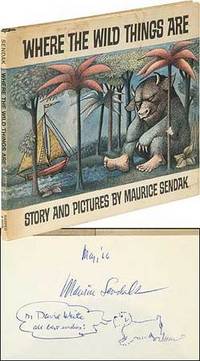
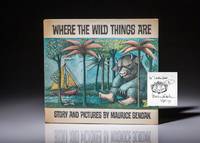
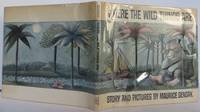
1963325185New York: Harper & Row 1963. Hardcover. Near Fine/Very Good. First edition with the publisher's price and the correct first issue code on the front flap. Cloth and papercovered illustrated boards. A bit of foxing to the boards near fine in a modestly toned very good dust jacket with a couple of faint splash marks. Nicely Inscribed by Sendak in 1966 with a small drawing of a dog. Harper & Row hardcover
EXE-286Paris, Le Livre de Bibliophile, 1921. Grand in-4°, maroquin bleu nuit, jeux de filets dorés sur le dos et les plats; doublures de maroquin citron décorées; tranches dorées; couverture, étui ( Weckesser). 12 eaux-fortes originales, en couleurs, hors-texte, et 21 compositions dans le texte, gravées sur bois. Tiré à 555 exemplaires, celui-ci l'un des 55 exemplaires réimposés au format in-4°, EXEMPLAIRE UNIQUE SUR JAPON ANCIEN, avec 4 états des eaux-fortes et 3 états des bois. Il contient un important DESSIN AU PASTEL (245 x 320 mm) ainsi que 27 DESSINS ORIGINAUX dont 20 à pleine page, le tout signé par l'artiste.
194774125Editions Pétridès | Paris 1947 | 28 x 38 cm | relié
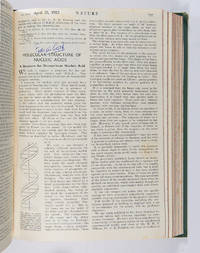
123125London Macmillan and Co. Ltd. 1953. . First edition complete volume signed by Crick on the first paper; 8vo 24.5 x 17 cm; illustrations throughout the text 1982 ownership inscription of J.D. Mollon to front pastedown spotting to early and late leaves; contemporary green library cloth titles to spine gilt red speckled edges corners bumped and worn a little wear at the ends of the spine lower joint just starting very good condition; 1168pp 64 page index.<br /> First edition the complete journal volume containing the first four papers on the structure of DNA signed by Crick on the 'Molecular Structure of Nucleic Acids' paper. From the library of John D. Mollon eminent professor of visual neuroscience at Cambridge.<br /> London, Macmillan and Co., Ltd., 1953. hardcover
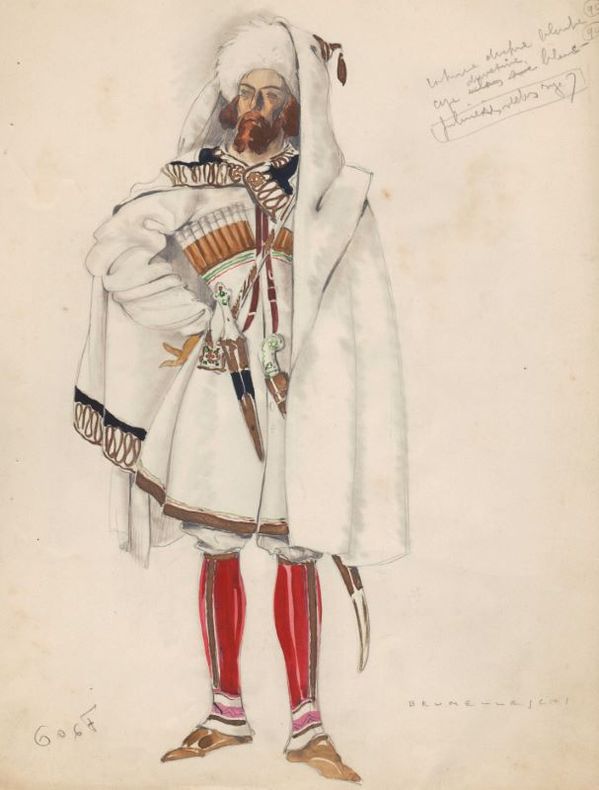
1938193831938 22 aquarelles pour le spectacle-opérette de Mogador, sur papier cartonné beige, 21 signées en bas à droite, 4 datées (1938), rehauts d'or et de blanc, mine de plomb, feuilles de 32 x 25 environ, dessins de 30 x 15 cm. environ.
1963874New York: Harper & Row Publishers 1963. First Edition. Hardcover. Near fine/near fine. First edition of Where The Wild Things Are signed by Maurice Sendak in first state dust jacket. Oblong quarto 38pp. Illustrated boards olive green cloth spine. Light shelf wear to edges of boards. Housed in custom cloth clamshell title on spine on red morocco label. On title page contains Library of Congress number 63-21253. Pictorial endpapers bright boards and clean illustrated text. In a first issue dust jacket near fine with $3.50 price on front flap code "40-80 / 1163" on bottom of front flap three paragraph blurb on front flap and no mention of the Caldecott Award. Light wear to dust jacket on spine with 1 mm chip at top corner of spine. Signed by author and illustrator Maurice Sendak on half title with illustration of "Wild Thing" drawn in his hand dated September 1971. Hanrahan A58 An exceptional signed copy. Harper & Row, Publishers hardcover books
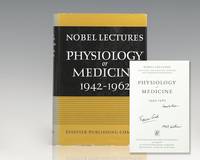
196495688Amsterdam: Elsevier Publishing Company 1964. First edition of this collection of Nobel Lectures in physiology or medicine from the years 1942-1962. Thick Octavo original yellow cloth. Signed by all three Nobel Prize-winning scientists Francis Crick James D. Watson and Maurice Wilkins on the title page. They were awarded the Nobel Prize in Medicine in 1962 "for their discoveries concerning the molecular structure of nucleic acids and its significance for information transfer in living material."Fine in a very good dust jacket with some closed tears and toning to the spine. An exceptional piece signed by these Nobel Prize-winning scientists. In the early 1950s the race to discover DNA was on. At Cambridge University graduate student Francis Crick and research fellow James Watson had become interested impressed especially by Pauling's work. Meanwhile at King's College in London Maurice Wilkins b. 1916 and Rosalind Franklin were also studying DNA. The Cambridge team's approach was to make physical models to narrow down the possibilities and eventually create an accurate picture of the molecule. The King's team took an experimental approach looking particularly at x-ray diffraction images of DNA. Watson and Crick took a crucial conceptual step suggesting the molecule was made of two chains of nucleotides each in a helix as Franklin had found but one going up and the other going down. Crick had just learned of Chargaff's findings about base pairs in the summer of 1952. He added that to the model so that matching base pairs interlocked in the middle of the double helix to keep the distance between the chains constant. Watson and Crick showed that each strand of the DNA molecule was a template for the other. During cell division the two strands separate and on each strand a new "other half" is built just like the one before. This way DNA can reproduce itself without changing its structure -- except for occasional errors or mutations. The structure so perfectly fit the experimental data that it was almost immediately accepted. DNA's discovery has been called the most important biological work of the last 100 years and the field it opened may be the scientific frontier for the next 100. Elsevier Publishing Company hardcover books
196495688Amsterdam: Elsevier Publishing Company 1964. First edition of this collection of Nobel Lectures in physiology or medicine from the years 1942-1962. Thick Octavo original yellow cloth. Signed by all three Nobel Prize-winning scientists Francis Crick James D. Watson and Maurice Wilkins on the title page. They were awarded the Nobel Prize in Medicine in 1962 "for their discoveries concerning the molecular structure of nucleic acids and its significance for information transfer in living material."Fine in a very good dust jacket with some closed tears and toning to the spine. An exceptional piece signed by these Nobel Prize-winning scientists. In the early 1950s the race to discover DNA was on. At Cambridge University graduate student Francis Crick and research fellow James Watson had become interested impressed especially by Pauling's work. Meanwhile at King's College in London Maurice Wilkins b. 1916 and Rosalind Franklin were also studying DNA. The Cambridge team's approach was to make physical models to narrow down the possibilities and eventually create an accurate picture of the molecule. The King's team took an experimental approach looking particularly at x-ray diffraction images of DNA. Watson and Crick took a crucial conceptual step suggesting the molecule was made of two chains of nucleotides each in a helix as Franklin had found but one going up and the other going down. Crick had just learned of Chargaff's findings about base pairs in the summer of 1952. He added that to the model so that matching base pairs interlocked in the middle of the double helix to keep the distance between the chains constant. Watson and Crick showed that each strand of the DNA molecule was a template for the other. During cell division the two strands separate and on each strand a new "other half" is built just like the one before. This way DNA can reproduce itself without changing its structure -- except for occasional errors or mutations. The structure so perfectly fit the experimental data that it was almost immediately accepted. DNA's discovery has been called the most important biological work of the last 100 years and the field it opened may be the scientific frontier for the next 100. Elsevier Publishing Company hardcover
1959Sendak234<p>SENDAK Maurice:</p><p><em><strong>The Acrobat. </strong></em></p><p>New York: Capricorn Press 1959.</p><p>With 14 small illustrations hand-colored by the artist.</p><p>Oblong 64mo 8 leaves folded self-wrappers sewn measuring 1-1/8 x 5 inches. A Fine copy.</p><p>First and only edition of the rarest of Sendak's books only 30 copies printed unnumbered SIGNED from fourteen blocks issued as a Christmas greeting divided between the printer Robert Brooks and the artist. The narrative is of an ambidextrous tumbler who folds himself into a ball; along comes a dog who eats the ball.</p><p>Hanrahan A37 illustrated p48</p> Capricorn Press paperback
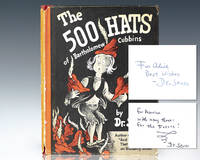
1938135672New York: The Vanguard Press 1938. First edition early printing of Seuss's unique book of prose. Association copy inscribed by the author on the pastedown "For Maurice with many thanks for the Future! Dr. Seuss." The recipient Maurice Sendak is best known for his immensely popular illustrated children’s book Where the Wild Things Are which was awarded the Caldecott Medal in 1964 and gained him international fame. Sendak acquired the present volume which had been previously signed by Seuss on the verso of the front free endpaper "For Alice Best Wishes - Dr. Seuss" and brought it to the July 1 1980 American Library Association Conference in New York where Seuss inscribed it personally to him as is notated in Sendak's small ownership inscription above Seuss's. At that time Sendak and Seuss would have been two of the most popular and perhaps even controversial best-selling children's author in attendance. Sendak's career was launched in 1952 with the publication of Ruth Krauss's A Hole Is to Dig. Their author-illustrator collaboration facilitated by Harper & Row publisher and editor-in-chief of juvenile books Ursula Nordstrom became something of a cultural phenomenon spawning a host of imitators of their “unruly†and “rebellious†child protagonists. Now one of the scarcest and most desirable books in modern children’s literature Sendak’s Where the Wild Things Are faced many opponents and was banned in several libraries upon publication in 1963. Its challengers accused the work as being “too dark†and “traumatizing†to young children due to its often frightening imagery." It would become one of many “good books for bad children†edited and published by Nordstrom who disliked the genteel sentimental tone of earlier American children’s literature and sought to change its purpose to appeal to children’s imaginations and emotions rather than serve as adult-approved morality tales. American children’s author and illustrator Theodore Seuss Geisel produced some of the most popular children’s books of all time under the pen name Dr. Seuss. Although most recognized for his vivid and original drawing style Geisel’s works also carried a complexity that went beyond the function of entertaining children; many of his works had an autobiographical undertone and were written to be intentionally divergent from traditional children’s books. Rather than write stories to convey morals to children many of Geisel’s stories expressed strong views on current social and political issues. Near fine in a very good dust jacket. An exceptional association. Unlike the majority of Geisel's books The 500 Hats of Bartholomew Cubbins was written in prose rather than rhyming and metered verse. Geisel who collected hats got the idea for the story on a commuter train from New York to New England while he was sitting behind a businessman wearing a hat; the passenger was so stiff and formal that Geisel idly wondered what would happen if he took the man's hat and threw it out the window. Geisel concluded that the man was so "stuffy" that he would just grow a new one. The book received positive reviews from critics. The New York Times reviewer called the book "a lovely bit of tomfoolery which keeps up the suspense and surprise until the end." Booklist which had criticized Geisel's previous book And to Think That I Saw It on Mulberry Street for containing only enough material for one comic strip praised The 500 Hats as "a brand-new idea developed into a complete tale not too long not too short just right. Somewhere between the Sunday supplements and the Brothers Grimm Dr. Seuss has produced a picture book combining features of both." The Vanguard Press unknown
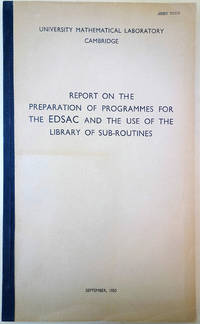
195044861Cambridge: University Mathematical Laboratory 1950. <p>Wilkes Maurice 1913-2010 et al. Report on the preparation of programmes for the EDSAC and the use of the library of subroutines. Dittoed document in two colors. 3 40 2 26 39 xi ff. 323 x 201 mm. N.p. September 1950. Original tan printed wrappers cloth spine. Fine. Stamp of John Todd 1911-2007 on the front wrapper.</p> <p> First Edition One of No More Than 100 Copies Issued. The first report on how to program an operational stored-program computer—Cambridge University's EDSAC the world's second stored-program computer and the first to be truly usable for large-scale operations. The machine was constructed at the University's Mathematical Laboratory now the Computer Laboratory by Maurice Wilkes who was inspired by John von Neumann's account of the EDVAC; it ran its first program on 6 May 1949. The Report on the Preparation of Programmes for the EDSAC was prepared by Wilkes and a fifteen-man team of researchers at the Mathematical Laboratory and distributed to no more than one hundred people—"everyone we thought would be interested both in the United Kingdom and abroad" Wilkes Memoirs of a Computer Pioneer p. 149. The material in this dittoed report was published with very few changes in Wilkes Wheeler and Gill's Preparation of Programs for an Electronic Digital Computer 1951.</p> <p> This copy bears the ownership stamp of mathematician John Todd professor of mathematics at Caltech and pioneer of numerical analysis and high-speed computer programming. Origins of Cyberspace 1027. </p> . University Mathematical Laboratory unknown books
192137643Paris Editions de la Galer 1921 In-4, box havane orn sur chaque plat de deux encadrements mosaqus en lige teint havane et bords de larges listels irrguliers en box rouge fonc souligns d'un filet dor zigzaguant, titre de l'ouvrage pouss or en grandes capitales sur le dos sans nerfs; doublures serties d'un filet or et gardes de daim havane fonc, tranches dores sur brochure, couverture illustre. Chemise, tui (Georges Leroux).Edition originale, illustre de 19 bois originaux de Maurice Vlaminck, dont un frontispice. Tirage limit 112 exemplaires numrots, signs par l'artiste. Un des 90 exemplaires sur papier de Hollande. Trs belle reliure dcore de Georges Leroux.
196433488Paris Scripta et Picta 1964 Grand in-4, maroquin jansniste ocre, dos sans nerfs orn du nom de l'auteur et du titre de l'ouvrage en grandes capitales pousses verticalement, celles du titre tant disposes sur de petites pices rectangulaires en maroquin rose; doublures de daim vert bouteille, gardes de daim aubergine, tte dore, non rogn, couverture illustre. Etui.Edition originale, illustre par l'auteur de 48 lithographies originales en couleurs qui ont ncessit prs de dix ans de travail pour Maurice de Vlaminck. L'ouvrage comporte en outre 40 lettrines dessines par le relieur Paul Bonet. Tirage limit 260 exemplaires numrots sur vlin de Rives. Un des quelques exemplaires nominatifs sur japon nacr (celui-ci imprim au nom du relieur Georges Crett), accompagns d'une double suite des 48 lithographies originales en noir sur chine et en couleurs sur vlin. La reliure, non signe, peut tre attribue Georges Crett.
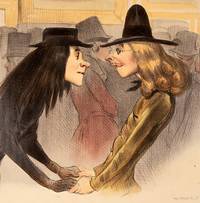
05964Paris: Chez Aubert 1839. With 150 Hand-Colored Lithographs<br /> including Forty-Five by Honoré Daumier and Forty-Two by Gavarni<br /> <br /> DAUMIER Honoré Gavarni and others illustrators. ALHOY Maurice Louis Huart and Charles Philipon editors. Le Musée pour rire. Dessins par tous les caricaturistes de Paris; Texte par MM. Maurice Alhoy Louis Huart et Ch. Philipon. Paris: Chez Aubert Editeur des Cent-et-Un Robert-Macaire 1839-1840.<br /> <br /> Three quarto volumes 10 3/16 x 7 15/16 inches; 259 x 202 mm. 2 half-title 2 title 200 2 "Table" 4 publisher's advertisements; 2 half-title 2 title 200 2 "Table; 2 half-title 2 title 200 2 "Table 4 publisher's advertisements pp. With 150 numbered hand-colored lithographs heightened with gum arabic by Honoré Daumier forty-five Gavarni forty-two Frédéric Bouchot twenty-two Victor Adam ten Platier seven Benjamin i.e. Benjamin Roubaud four Bourdet three Pruche three Platel two Grandville two Edme-Jean Pigal two Alophe Menut two Charles Vernier two Charles-Joseph Traviès one and others.<br /> <br /> Early twentieth-century half red scored calf ruled in gilt over marbled boards by Adolphe Cuzin stamp-signed in gilt at foot of spine. Smooth spines decoratively tooled and lettered in gilt all edges gilt marbled endpapers. Expert and almost invisible minor restoration to corners and spine extremities. Occasional light foxing and/or browning. A wonderful copy.<br /> <br /> "The house of Aubert was ingenious in marketing its products. Its lithographs.were published one by one in periodicals like Le charivari and together in suites by the same artist without letterpress. Still a third form of publication was in albums made up of lithographs by several artists with accompanying texts. These collections most commonly took the form of volumes with the generic title Paris comique which consisted of twenty colored lithographs accompanied by quite unrelated texts. Aubert remarked that the resulting hodgepodge had 'a plan that is easy to follow for it consists in not having any' and in fact this was indeed a frugal procedure for reusing old texts and already published plates. The interest of the various volumes of Paris comique resides entirely in the lithographs they happen to contain. It can be considerable however since Daumier and Gavarni are the predominant artists. Le musée pour rire represents a more considerable effort on the part of Aubert. To accompany 150 lithographs including forty-five by Daumier among them twenty-seven from Croquis d'expressions and eight from La galerie physionomique and forty-two by Gavarni new commentaries were commissioned on each plate all except two by Alhoy and Huart. Daumier's lithographs were trimmed slightly and their captions were relettered. The designs of the other artists were provided with decorative frames. The whole was then published in three handsome volumes and in copies with expert contemporary coloring like this one Le musée pour rire is among the freshest and most attractive of romantic illustrated books" Ray The Art of the French Illustrated Book.<br /> <br /> Le Musée pour Rire "contained 150 lithographs by Daumier Gavarni Bouchot Traviès etc. These are re-impressions some of them in mirror image which had previously already been used for publication in Le Charivari. Most prints of the series 'Croquis d'expressions' are contained in the book. The name of the series is missing and the texts were printed in a different type than in the original Charivari version. We do not consider these prints original lithographies but rather prints 'after Daumier'" The Daumier Register at http://www.daumier-register.org.<br /> <br /> Ray The Art of the French Illustrated Book 164. Paris: Chez Aubert, 1839 unknown
189741462Sous étui bordé. Reliure plein maroquin cerise. Dos à nerfs orné de filets dorés et date dorée au talon. Quadruple filet doré en encadrement sur les plats. Toutes tranches dorées. Contreplats de soie bleue encadrés d'une bande de maroquin rouge ornée de filets dorés. Couverture et dos conservés. Reliure signée Ch. SEPETIER.Orné de 12 planches hors texte, 12 en-têtes et 12 culs-de-lampe reproduits en couleurs par H. Reymond d'après les aquarelles de J. LE BLANT. Couverture d'après une aquarelle de Giraldon.Avec une préface par George Duruy et un tableau historique des régiments français.
19221280741922. First Edition. DE BRUNOFF Maurice and DE BRUNOFF Jacques editors. Collection des plus beaux numéros de Comoedia Illustré et des Programmes consacrés aux Ballets & Galas Russes depuis le début a paris 1909-1921. Paris: M. de Brunoff 1922. Small folio period-style full green morocco gilt decorated spine and boards original patterned endpapers original color pictorial cover illustration laid down internally uncut. $13500.First edition of this homage to the Ballets Russes by French publisher de Brunoff consisting of covers and pages from the French magazine Comoedia Illustré and from Ballets Russes programs and featuring 42 full-page color plates 12 two-page color spreads and hundreds of black-and-white photographs and illustrations depicting sets costumes dancers composers and artists and covering the years 1909 through 1921. Beautifully bound preserving the original pictorial cover illustration and patterned endpapers.""The programmes for the Diaghilev Ballet seasons in Paris and London were published by Maurice de Brunoff. He was the French editor of Comoedia Illustré probably the greatest of all theatrical magazines. De Brunoff devoted many pages to the early Diaghilev seasons in his magazine. Eventually he began to publish the equally lavish souvenir programmes which contained articles photographs and reproductions of the designs for the new ballets all reproduced to the highest quality They are now highly prized collector's items"" Victoria & Albert Museum Theatre Collections. Includes illustrations and designs by Bakst Picasso and Derain and photographs of Nijinsky Pavlova Rubinstein Karsavina and Fokine. ""This deluxe volume is an indispensable source for the best in graphic stage and costume design of the period; early photographs of performers attired for their roles; and commentaries on the ballet by Maurice Ravel Jean Cocteau Guillaume Apollinaire M.D. Calvocoressi and Michel Georges-Michel. Among the elegant drawings and pastels are those by Georges Lepape Jean Dulac Georges Tribout Andre Marty Jean Cocteau and Valentine Gross The drawings and pastels by Valine Gross are especially interesting because the document in a charming style Nijinsky's dance interpretations during actual performances before photographs in the theatre became commonplace"" Roadcap The Book of Dance in the 20th Century 28. No articles appear for the years 1916 or 1918 when performances were halted during WWI. An introductory note by dance critic Valérien Svetlov appears before each season's articles. Text in French. Front cover illustration by painter and ballet designer Natalia Gontcharova preserved on the front free endpaper. Just a few programs with a hint of marginal dampstaining to bottom edge. Color plates spreads photographs and illustrations bright and beautiful. hardcover
C91590Editeur Petrides. As New. N.D. Paperback. FREE UPGRADE to Courier/Priority Shipping Upon Request - IN STOCK AND IMMEDIATELY AVAILABLE FOR SHIPMENT - AS NEW THE TEXT BLOCK IS PRISTINE CLEAN UNMARKED AND IN EXCELLENT CONDITION - - Text in French. FIVE 5 VOLUME SET published between 1959 and 1974 inclusive. Catalogue Raisonne Catalog Raisonné Complete Works La Vie et L'uvre Oeuvre Raisonnee -- with a bonus offer-- - May be EITHER: out of print OOP and extremely rare in this pristine condition; signed by author or contributor; or a first or special edition; inquire for details . Editeur Petrides paperback
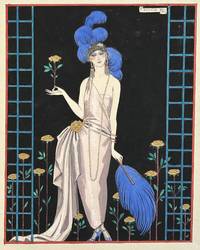
19279184<p>Limited to 150 copies this being number 141 but with an additional original 14 x 17 cm Barbier watercolor bound in before the half title. This original work had served as the model for Charles Frederick Worth's "Robe du Soir" as plate 21 in La Gazette du Bon Ton 1922 no. 3. Sumptous full Morocco by Georges Crette with gilt particulars to spine. All edges heavily gilt. Polished calf doublures and decorated endpapers with the original wraps bound in. Decorative slipcase with Morocco fore edges. Minor wear to corners of case see image. Pochoir frontispiece by Barbier as well as pochoir initials headpieces tail pieces.</p><p>8.25 x 10.25 in or 21 x 26 cm</p> A. Blaizot hardcover
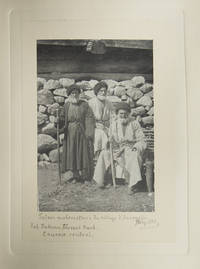
1898307181Caucasus mountains 1898. 38 vintage platinum print photographs printed circa 1900 mounted on card captioned in pencil and signed and dated beneath the image by the photographer. Sizes vary all approximately 7 x 5 inches. Generally fine images not faded heavy spotting to one mount slight warping to mounts. In a custom black half morocco slipcase and chemise. 38 vintage platinum print photographs printed circa 1900 mounted on card captioned in pencil and signed and dated beneath the image by the photographer. Sizes vary all approximately 7 x 5 inches. A fine group of ethnographic and mountaineering scenes from the Causasus Mountains by the Hungarian photographer and mountaineer Maurice de Déchy 1851-1917. A wide-ranging selection of views encompasing scenes from Chechnya Dagastan Georgia and the breadth of the Caucasus Mountains. Images include Mount Elbrus several views Mount Adyr Mount Chikhildi Mount Kasbek and numerous passes valleys glaciers and gorges; ethnographic scenes including Tatar Digor Karachai Daghestani and Khevsuri people and villages; mountaineering scenes including camping beneath Katchou pass with a note that the guide Maser of Tyrol died in 1900 and "en route pour la découverte du col Djiper 1885" with de Déchy identified as one of the mountaineers.<br/><br/>Douglas Freshfield in his classic Exploration of the Caucasus 1896 summarizes de Déchy's activities in the Caucasus: <br/><br/>". M. de Déchy a Hungarian gentleman took up the task of exploration. In 1884 1885 and 1886 he made three extensive journeys in the range. In 1884 . he climbed Elbruz and a fine peak near the Mamison Pass. In the course of his wanderings he made the first passage by travellers of several native glacier passes and collected a considerable amount of scientific information with regard to the glaciers and the snow region. He also took a very large number of most valuable photographs of the scenery and people thus making himself the pioneer in Caucasian photography. I am indebted to him for some of the most interesting illustrations in these volumes" Freshfield p. 19. <br/><br/>De Déchy returned to the Caucasus again in 1887 this time with Freshfield. Fourteen of De Déchy's photographs were reproduced in Freshfield's Exploration of the Caucasus including "Ice-Lake at Klukhor Pass" one of the images in the present group. He also contributed an entire chapter "The Sources of the Kuban" vol. II chapter XXI. <br/><br/>These beautifully printed platinum prints are in a fine state of preservation and exhibit the wide tonal range and delicate shading characteristic of the process. unknown books
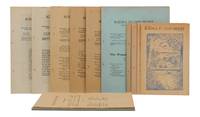
1933140948109Brooklyn NY; South Ozone Park NY; Jamaica NY: Science Fiction Digest Company 1933. First Edition. Near Fine. September 1932 volume 1 number 1 through December 1933 volume 2 number 4 whole number 16. A complete run of the amateur magazine published as Science Fiction Digest prior to its name change to Fantasy Magazine with issue number 17. The Cosmos supplement is not present. Sixteen issues bound in side-stapled wraps and side-stapled self-wraps. Ranging from Very Good to Near Fine with general wear light pencil notations soiling some wear to spines and staples. Several small mends and chips several rear covers detached. A very early science fiction fanzine which absorbed The Time Traveller which is considered by many to be the first true science fiction fanzine. The two publications shared several overlapping founders and editors. Complete runs are scarce. Science Fiction Digest Company unknown
19632306058New York: Harper Row 1963. First. hardcover. Near fine/Near fine. A near fine first edition in a near fine first issue dust jacket. Harper Row unknown
192846845Paris Pierre Fnis 1928 In-8, maroquin vert fonc orn sur le premier plat du titre de l'ouvrage mosaqu en capitales de maroquin bleu nuit serties de filets pousss or, dispos cheval sur une importante composition Art dco voquant un paysage, constitue de listels et rectangles mosaqus en peaux argentes lisses ou granites assembls en une large bande verticale occupant la moiti extrieure de la surface, le tout accompagn d'une range de trois larges bandes horizontales de diffrentes longueurs mosaques en maroquin bleu canard se poursuivant sur le second plat, de cinq points mosaqus en maroquin bleu nuit et d'un grand cercle en maroquin vert serti or; dos sans nerfs portant le nom de l'auteur et le titre de l'ouvrage en petites capitales pousses or, filets dors sur les coupes; encadrements intrieurs orns de filets et roulettes dors, doublures et gardes de papier fantaisie dans des tons gris argent, tte dore, non rogn, couverture illustre. Etui (Guide, Bruxelles).42 bois originaux de Louis-Joseph Soulas, dont 4 hors-texte en couleurs et 38 vignettes en deux couleurs (2 sur la couverture, 18 in-texte et 18 lettres ornes). Premier ouvrage de la Collection de la Revue du Centre. Tirage limit 1.060 exemplaires numrots.. Un des 950 exemplaires sur vlin teint pur fil Lafuma. Trs bel exemplaire reli l'poque par Antoine Guide dont l'atelier a t situ boulevard de l'abattoir Bruxelles jusqu'en en 1936, avant de dmnager au 44 rue Vanderkindere Uccle, commune de Bruxelles et tre repris par A. Rong. Eugne Guide, frre d'Antoine tait architecte et ralisait galement certains projets de reliures.