SENDAK, MauriceBiblio.com

71 408 résultats
109057New York Harper & Row 1963. . First edition first printing with Library of Congress number 63-21253 and 1963 copyright on title; oblong 4to; illustrated in colour throughout; publisher's cloth-backed pictorial paper boards front board with one small smudge with the correct first state of the dust-jacket with no mention of the Caldecott award and a $3.50 price at top of front flap this flap with three paragraphs of text lower corner trimmed slight dust-soiling short closed tear to lower edge of front panel a few trifling nicks else a near-fine example.<br /> The true first edition with the correct first state dustjacket. <br /><br />A fine well-preserved copy of what is perhaps the best-loved and most distinguished illustrated children's book of the 20th century one that the American Institute of Graphic Arts called 'the perfect book.' With the Library of Congress catalogue number 63-21253 and 1963 copyright on title and first state jacket with price $3.50 in upper right corner of inner flap and no mention of the Caldecott Medal.<br /> Hanrahan A58. New York, Harper & Row, 1963. hardcover
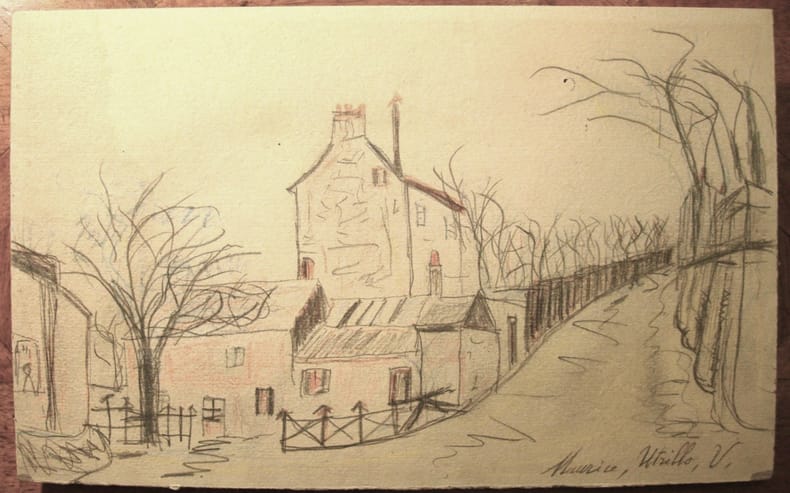
8507Très beau dessin signé. Crayon et crayons de couleurs. Sur papier contrecollé sur carton. Ce beua dessin représente le Lapin Agile, lieu emblématique de Montmartre, à l'angle de la rue des Saules et de la rue saint-Vincent; Il semble qu'il s'y trouve deux personages : l'un dans la rue Saint-Vincent, l'autre à une fenêtre rue des Saules. Très bon 23 x 37,3 cm
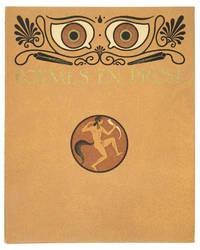
94761Paris A. Blaizot 1928. . First edition number 101 of 150 copies; 4to 26 x 21 cm; 27 text illustrations wood-engraved by Pierre Bouchet and printed in colour after designs by Barbier; presentation copy signed by Barbier on front blank; loose as issued in original pictorial wrappers after Barbier publisher's burgundy cloth chemise and slipcase.<br /> A French Romantic poet Maurice de Guérin 1810-39 achieved cult status in his lifetime as one of the first writers of 'prose poems.' The present work is illustrated by George Barbier who provides beautiful illustrations of the mythological Centaur and the Bacchante a follower of Bacchus Dionysus.<br /><br />The charming presentation inscription reads: 'À Mademoiselle Violette Gath / ces petites divinités d'autrefois déjà touchées par la mélancolie d'aujourd'hui / avec les respectueux compliments de l'artiste / George Barbier / juin 1928.' To Miss Violette Garth / These small deities of days past already touched by the melancholy of today / With respectful compliments of the artist George Barbier / June 1928.<br /> Carteret IV 195; Méhé II 309-310; Ritchie 25. Paris, A. Blaizot, 1928. hardcover
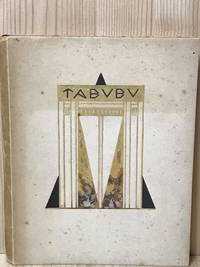
19323247Paris 1932. Egyptian novel Paris Jules Meynial 1932 In-12 square in sheets illustrated cover full black morocco case by Loutrel first Plexiglas plate showing the cover ONE OF THE MOST BEAUTIFUL ""ART DECO"" BOOKS FIRST ILLUSTRATED EDITION of this ""Egyptian novel"" first published in 1894 Illustrations by Maurice Lalau: 71 Art Deco geometrical compositions printed in gold silver and shades of grey including 10 full-page Unique edition of 110 copies on vellum from Madagascar n° 65 hardcover
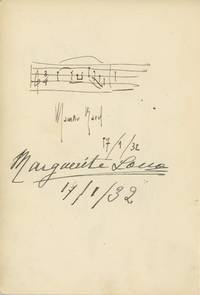
13580Used; Like New/Used; Like New. Rare autograph musical quotation on an album page two measures the instantly recognizable tune from Boléro signed "Maurice Ravel" and dated 17/1/32 and signed additionally beneath on the same date by the important pianist so closely associated with the composer Marguerite Long.  In fine condition also signed on the verso by the pianist Alexander Borovsky. 5.2 x 7.5 inches 13 x 19 cm. <br style="">The premiere of the G major Concerto by Ravel conducted by the composer and featuring the pianist Marguerite Long had taken place just three days prior on January 14 1932 at the Salle Pleyel after which the two musicians had immediately embarked together on a European tour that would last until April. At the premiere in a program largely repeated on the tour the Concerto had appeared in a program of Ravel works exclusively including Pavane pour une infante défunte and Boléro. Long herself reported that Ravel grew so tired of Boléro that when she would hum the tune in his presence he would snap: "Quit singing that" to which she would retort "Oh! my friend you shouldn't have composed it then!" As quoted in Cecilia Dunoyer "Marguerite Long: A Life in French Music 1874-1966" p. 95<br style="">Originally composed as a ballet commissioned by Russian actress and dancer Ida Rubinstein the one-movement orchestral piece Boléro was premiered in 1928 and is Ravel's most famous musical composition.  Nevertheless it is surprisingly uncommon in musical quotations from the composer perhaps as Long reports because he himself grew to find the tune tiresome!<br style=""> unknown books
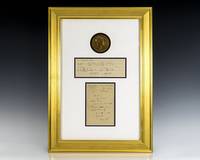
72755Autograph musical quotation signed and an autograph letter signed by Maurice Ravel. The quotation 3 bars from his Chansons madecasses notated on a two-stave system with holograph title lyrics tempo directive and instrument labels. The letter in French is addressed to "My friend" in French stating that he received his note when leaving Geneva and mentioning two places he might be when he returns at Christmastime dated Paris 15 December 1928 With Hotel D'Athenes" stationery. Both matted and framed together with a commemorative medallion. The entire piece measures 19 inches by 27 inches. A striking piece rare and desirable. Maurice Ravel was a French composer pianist and conductor. He is often associated with impressionism along with his elder contemporary Claude Debussy. In the 1920s and 1930s Ravel was internationally regarded as France's greatest living composer. The Chansons madecasses Madagascan Songs is a collection of three art songs by Maurice Ravel written between 1925 and 1926 for voice mezzo-soprano or baritone flute cello and piano with words from the poetry collection Chansons madecasses fr by Evariste de Parny. The song cycle consists of the three titles "Nahandove" "Aoua" and "Il est doux". They are dedicated to the American musician and philanthropist Elizabeth Sprague Coolidge. unknown books
72755Autograph musical quotation signed and an autograph letter signed by Maurice Ravel. The quotation 3 bars from his Chansons madécasses notated on a two-stave system with holograph title lyrics tempo directive and instrument labels. The letter in French is addressed to "My friend" in French stating that he received his note when leaving Geneva and mentioning two places he might be when he returns at Christmastime dated Paris 15 December 1928 With Hotel D'Athènes" stationery. Both matted and framed together with a commemorative medallion. The entire piece measures 19 inches by 27 inches. A striking piece rare and desirable. Maurice Ravel was a French composer pianist and conductor. He is often associated with impressionism along with his elder contemporary Claude Debussy. In the 1920s and 1930s Ravel was internationally regarded as France's greatest living composer. The Chansons madécasses Madagascan Songs is a collection of three art songs by Maurice Ravel written between 1925 and 1926 for voice mezzo-soprano or baritone flute cello and piano with words from the poetry collection Chansons madécasses fr by Évariste de Parny. The song cycle consists of the three titles "Nahandove" "Aoua" and "Il est doux". They are dedicated to the American musician and philanthropist Elizabeth Sprague Coolidge. unknown
02253Paris: Chez Aubert 1839. With 150 Hand-Colored Lithographs<br/>including Forty-Five by Honoré Daumier and Forty-Two by Gavarni<br/><br/>DAUMIER Honoré Gavarni and others illustrators. ALHOY Maurice Louis Huart and Charles Philipon editors. Le Musée pour rire. Dessins par tous les caricaturistes de Paris; Texte par MM. Maurice Alhoy Louis Huart et Ch. Philipon. Paris: Chez Aubert Editeur des Cent-et-Un Robert-Macaire 1839-1840.<br/><br/>First edition. Three quarto volumes bound in one 10 x 7 5/8 in; 251 x 193 mm. 1 half-title 2 title 600 pp. With 150 numbered hand-colored lithographs heightened with gum arabic by Honoré Daumier forty-five Gavarni forty-two Frédéric Bouchot twenty-two Victor Adam ten Platier seven Benjamin i.e. Benjamin Roubaud four Bourdet three Pruche three Platel two Grandville two Edme-Jean Pigal two Alophe Menut two Charles Vernier two Charles-Joseph Traviès one and others.<br/><br/>Bound ca. 1886-1890 by James Screeton of Hull with label to rear pastedown half black pebbled morocco over gray-brown cloth. Elaborately gilt tooled compartments gilt-rolled raised bands. All edges gilt. Some foxing and toning throughout but still a very good copy.<br/><br/>"The house of Aubert was ingenious in marketing its products. Its lithographs.were published one by one in periodicals like Le charivari and together in suites by the same artist without letterpress. Still a third form of publication was in albums made up of lithographs by several artists with accompanying texts. These collections most commonly took the form of volumes with the generic title Paris comique which consisted of twenty colored lithographs accompanied by quite unrelated texts. Aubert remarked that the resulting hodgepodge had ‘a plan that is easy to follow for it consists in not having any' and in fact this was indeed a frugal procedure for reusing old texts and already published plates. The interest of the various volumes of Paris comique resides entirely in the lithographs they happen to contain. It can be considerable however since Daumier and Gavarni are the predominant artists. Le musée pour rire represents a more considerable effort on the part of Aubert. To accompany 150 lithographs including forty-five by Daumier among them twenty-seven from Croquis d'expressions and eight from La galerie physionomique and forty-two by Gavarni new commentaries were commissioned on each plate all except two by Alhoy and Huart. Daumier's lithographs were trimmed slightly and their captions were relettered. The designs of the other artists were provided with decorative frames. The whole was then published in three handsome volumes and in copies with expert contemporary coloring like this one Le musée pour rire is among the freshest and most attractive of romantic illustrated books" Ray The Art of the French Illustrated Book.<br/><br/>Le Musée pour Rire "contained 150 lithographs by Daumier Gavarni Bouchot Traviès etc. These are re-impressions some of them in mirror image which had previously already been used for publication in Le Charivari. Most prints of the series ‘Croquis d'expressions' are contained in the book. The name of the series is missing and the texts were printed in a different type than in the original Charivari version. We do not consider these prints original lithographies but rather prints ‘after Daumier'". <br/><br/>James Screeton was the son of bookbinder William Screeton of Hull. It appears that he was partner of binder William Wardell until opened his own shop in 1886. <br/><br/>Ray The Art of the French Illustrated Book 164. Paris: Chez Aubert, 1839 unknown books
02253Paris: Chez Aubert 1839. With 150 Hand-Colored Lithographs<br /> including Forty-Five by Honoré Daumier and Forty-Two by Gavarni<br /> <br /> DAUMIER Honoré Gavarni and others illustrators. ALHOY Maurice Louis Huart and Charles Philipon editors. Le Musée pour rire. Dessins par tous les caricaturistes de Paris; Texte par MM. Maurice Alhoy Louis Huart et Ch. Philipon. Paris: Chez Aubert Editeur des Cent-et-Un Robert-Macaire 1839-1840.<br /> <br /> First edition. Three quarto volumes bound in one 10 x 7 5/8 in; 251 x 193 mm. 1 half-title 2 title 600 pp. With 150 numbered hand-colored lithographs heightened with gum arabic by Honoré Daumier forty-five Gavarni forty-two Frédéric Bouchot twenty-two Victor Adam ten Platier seven Benjamin i.e. Benjamin Roubaud four Bourdet three Pruche three Platel two Grandville two Edme-Jean Pigal two Alophe Menut two Charles Vernier two Charles-Joseph Traviès one and others.<br /> <br /> Bound ca. 1886-1890 by James Screeton of Hull with label to rear pastedown half black pebbled morocco over gray-brown cloth. Elaborately gilt tooled compartments gilt-rolled raised bands. All edges gilt. Some foxing and toning throughout but still a very good copy.<br /> <br /> "The house of Aubert was ingenious in marketing its products. Its lithographs.were published one by one in periodicals like Le charivari and together in suites by the same artist without letterpress. Still a third form of publication was in albums made up of lithographs by several artists with accompanying texts. These collections most commonly took the form of volumes with the generic title Paris comique which consisted of twenty colored lithographs accompanied by quite unrelated texts. Aubert remarked that the resulting hodgepodge had 'a plan that is easy to follow for it consists in not having any' and in fact this was indeed a frugal procedure for reusing old texts and already published plates. The interest of the various volumes of Paris comique resides entirely in the lithographs they happen to contain. It can be considerable however since Daumier and Gavarni are the predominant artists. Le musée pour rire represents a more considerable effort on the part of Aubert. To accompany 150 lithographs including forty-five by Daumier among them twenty-seven from Croquis d'expressions and eight from La galerie physionomique and forty-two by Gavarni new commentaries were commissioned on each plate all except two by Alhoy and Huart. Daumier's lithographs were trimmed slightly and their captions were relettered. The designs of the other artists were provided with decorative frames. The whole was then published in three handsome volumes and in copies with expert contemporary coloring like this one Le musée pour rire is among the freshest and most attractive of romantic illustrated books" Ray The Art of the French Illustrated Book.<br /> <br /> Le Musée pour Rire "contained 150 lithographs by Daumier Gavarni Bouchot Traviès etc. These are re-impressions some of them in mirror image which had previously already been used for publication in Le Charivari. Most prints of the series 'Croquis d'expressions' are contained in the book. The name of the series is missing and the texts were printed in a different type than in the original Charivari version. We do not consider these prints original lithographies but rather prints 'after Daumier'". <br /> <br /> James Screeton was the son of bookbinder William Screeton of Hull. It appears that he was partner of binder William Wardell until opened his own shop in 1886. <br /> <br /> Ray The Art of the French Illustrated Book 164. Paris: Chez Aubert, 1839 unknown
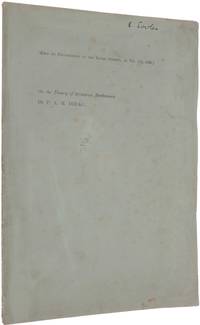
19265980London: Harrison & Sons for the Royal Society 1926. First edition. <p>First edition extremely rare offprint of Dirac's paper which "is justly seen as a major contribution to quantum theory" Kragh. It introduced his quantum mechanical derivation of what is now called Fermi-Dirac statistics and also contained Dirac's first steps towards quantum electrodynamics. The paper "will be remembered as the first in which quantum mechanics is brought to bear on statistical mechanics" Pais.</p>. FERMI-DIRAC STATISTICS AND THE FIRST STEPS TOWARDS QUANTUM ELECTRODYNAMICS. <p>First edition extremely rare offprint of Dirac's paper which "is justly seen as a major contribution to quantum theory" Kragh p. 36. It introduced his quantum mechanical derivation of what is now called Fermi-Dirac statistics which describes a distribution of particles now known as fermions a name coined by Dirac in 1945 in certain systems containing many identical particles that obey the Pauli exclusion principle-meaning that no two of the particles can occupy the same quantum state simultaneously. It also contains Dirac's first steps towards quantum electrodynamics. The paper "will be remembered as the first in which quantum mechanics is brought to bear on statistical mechanics. Recall that the earliest work on quantum statistics by Bose and by Einstein predates quantum mechanics. Also Fermi's introduction of the exclusion principle in statistical problems though published after the arrival of quantum mechanics is still executed in the context of the 'old' quantum theory. All these contributions were given their quantum mechanical underpinnings by Dirac who was in fact the first to give the correct justification of Planck's law which started it all: 'Symmetrical eigenfunctions . give just the Einstein-Bose statistical mechanics . . . which leads to Planck's law of black-body radiation'" Pais p. 6. Dirac's paper is credited "for having laid the foundations of the integration of quantum mechanics and quantum statistics because they introduced the quantum-mechanical expression of the symmetry of a system under exchanges of equal particles. The quantum formalism of exchange symmetry is regarded as having solved at once long-standing difficulties regarding the statistical properties of both equal particles and light quanta by clarifying and legitimizing the previously foggy notion of indistinguishable particles" Monaldi p. 125. The second part of the present paper contained the seed of Dirac's invention of quantum electrodynamics which was brought to fruition a few months later in 'The Quantum Theory of the Emission and Absorption of Radiation'. In the present paper "Dirac considered a system of atoms subjected to an external perturbation that could vary arbitrarily with the time . Dirac obtained results 'in agreement with the ordinary Einstein theory' that is with the quantum mechanical derivation of the B coefficients that occurred in Einstein's theory of 1917 that gave the probability of absorption and stimulated emission of radiation. Since he made use of a classical description of the electromagnetic field Dirac was not at the time able to proceed further and he noted 'One cannot take spontaneous emission i.e. the A coefficients into account without a more elaborate theory.' This more elaborate theory was ready less than half a year later" Kragh pp. 120-121. OCLC lists University of Florida only where Dirac spent his last years. No copy in auction records.</p> <br /> <p>Provenance: Bertha Swirles 1903-99 signature on front wrapper extensive annotations to lower margins of last two pages of text including several equations. As an undergraduate at Cambridge Swirles attended lectures by J. J. Thomson and Rutherford. She remained at Cambridge in 1925 to undertake research in mathematical astronomy under the supervision of Ralph Fowler; another of Fowler's research students a couple of years ahead of Swirles was Paul Dirac. After periods at Bristol Imperial College London and Manchester Swirles took up a lectureship in mathematics at Girton College Cambridge in 1938 where she remained for the rest of her career.</p> <br /> <p>The present paper was "Dirac's first published response to Schrödinger's theory i.e. wave mechanics. He had corresponded with Heisenberg while completing his PhD thesis in Cambridge in the spring of 1926. Many years later he wrote in his recollections that he did the present work on many-particle systems after Heisenberg convinced him of the usefulness of wave mechanics. Dirac felt 'at first a bit hostile' to this theory because it seemed to him that it represented a regress to 'the pre-Heisenberg stage.' In a non-extant letter to Heisenberg he criticized Schrödinger because 'the wave theory of matter must be inconsistent just like the wave theory of light'. Heisenberg agreed with this criticism but nonetheless saw Schrödinger's theory as progress. Thanks to Heisenberg's detailed explanation of the relation between the two formal schemes Dirac could see that wave mechanics 'would not require us to unlearn anything that we had learned from matrix mechanics' but rather 'supplemented the matrix mechanics and provided very powerful mathematical developments which fitted perfectly with the ideas of matrix mechanics'.</p> <br /> <p>"In Dirac's retrospective account it was the study of Schrödinger's formalism that suggested to him the possibility of symmetric and antisymmetric wave functions for a system of similar particles. These 'symmetry questions' in turn 'brought in the possibility of new laws of Nature' .</p> <br /> <p>"Instead of confronting Schrödinger's undulatory interpretation Dirac set out to reformulate Schrödinger's formal apparatus in general terms according to his own mathematical approach. He deduced the expression of the general solution of a quantum-mechanical problem as a linear expansion with arbitrary constants in 'a set of independent solutions' which he called eigenfunctions p. 664. This formal milestone enabled him to develop a quantum-mechanical treatment of multiparticle systems and to reach three lasting results. He arrived at the symmetry and antisymmetry of the wave functions formulated the statistics that we now know as Fermi-Dirac statistics and derived a calculation of Einstein's coefficients of absorption and stimulated emission .</p> <br /> <p>"Dirac adopted 'an atom with two electrons' as the simplest multiparticle system. In his atom however all interactions between electrons could be neglected. He did not resort to the analogy with the classical phenomenon of resonance as a theoretical tool but used only the symmetry of the two-electron system supplemented by the methodological principle for which he credited Heisenberg:</p> <br /> <p>'Heisenberg's matrix mechanics enables one to calculate just those quantities that are of physical importance and gives no information about quantities such as orbital frequencies that one can never hope to measure experimentally. We should expect this very satisfactory characteristic to persist in all future developments of the theory' p. 667.</p> <br /> <p>"Dirac indicated with 'the state of the atom in which one electron is in an orbit labelled and the other in the orbit .' He then asked: Were the 'physically indistinguishable' states and to be counted as distinct or as identical This question was inconsequential in classical mechanics but in the matrix formalism it implied a choice between two different matrix representations. In one the matrix elements corresponding to the transitions → m'n' and → n'm' would be represented by two separate matrix elements in the other they would be represented by the same element . Dirac asserted that the two transitions → m'n' and → n'm' were 'physically indistinguishable' and that 'only the sum of the intensities for the two together could be determined experimentally' p. 667. From this proposition he drew the answer:</p> <br /> <p>'Hence in order to keep the essential characteristic of the theory that it shall enable one to calculate only observable quantities one must adopt the second alternative that and count as only one state' p. 667.</p> <br /> <p>"Having so fixed the matrix formalism Dirac applied his formula for the general solution of the two-particle model. He formed the eigenfunctions of the whole system as linear combinations of products of the eigenfunctions of the single electrons; then he imposed the condition that they correspond to the matrices. This condition could be satisfied only by combinations that were symmetrical or antisymmetrical under exchange of the electrons. Either one of these two possibilities gave 'a complete solution of the problem' and quantum mechanics did not dictate which was the correct one p. 669. The choice Dirac stated was to be made by appealing to Pauli's exclusion principle:</p> <br /> <p>'An antisymmetrical eigenfunction vanishes identically when two of the electrons are in the same orbit. This means that in the solution of the problem with antisymmetrical eigenfunctions there can be no stationary states with two or more electrons in the same orbit which is just Pauli's exclusion principle' pp. 669-670.</p> <br /> <p>"The symmetrical solution however could not be correct for 'the problem of electrons in an atom' because it allowed any number of electrons in the same orbit p. 670. These results could be straightforwardly extended to any system composed of similar particles in particular to an assembly of molecules. Dirac thus applied them to the ideal gas. He obtained the eigenfunction of the assembly by multiplying the single-molecule eigenfunctions and choosing either the symmetrical or the antisymmetrical linear combinations. At this point he turned to statistical considerations. He implicitly made the assumption that the new states represented by symmetrical and antisymmetrical wavefunctions represented the energy distributions or macrostates of statistics. Then he explicitly adopted as a 'new assumption' the simplest extension of Bohr's rule namely that 'all the stationary states of the assembly each represented by one eigenfunction have the same a priori probability' p. 671. In the case of symmetrical eigenfunctions this rule corresponded to the Bose-Einstein statistics. In the case of the antisymmetrical eigenfunctions whereby the number of molecules associated with each single-particle eigenfunction could only be 0 or 1 it led to the new statistics that is now known as the Fermi-Dirac statistics. Dirac concluded:</p> <br /> <p>'The solution with symmetrical eigenfunctions must be the correct one when applied to light quanta since it is known that the Einstein- Bose statistical mechanics leads to Planck's law of black-body radiation. The solution with antisymmetrical eigenfunctions though is probably the correct one for gas molecules since it is known to be the correct one for electrons in an atom and one would expect molecules to resemble electrons more closely than light quanta' p. 672</p> <br /> <p>"Despite having just derived the two quantum statistics from the same set of assumptions with the difference of the Pauli principle Dirac separated them starkly in their applicability. His integration of quantum statistics and quantum mechanics was thus sealed with an uncompromising rejection of Einstein's analogy between light quanta and material corpuscles .</p> <br /> <p>"The fact that Dirac disregarded the undulatory interpretation of the wave function and the consequences of antisymmetry for the independence of material particles does not mean that he refrained completely from any interpretation of the general solution of the wave equation. He did put forward an interpretation in the last section of the paper in which he outlined a perturbation theory and fruitfully put it to use. He wrote the wave equation of 'an atomic system subjected to a perturbation from outside e.g. an incident electromagnetic field' and showed that the general solution could be written as Ψ = Σn anΨn where the Ψn were the wave functions associated with the stationary states of the unperturbed atom and the an coefficients depending on time. He thus deftly switched interpretive models. He proceeded to consider the general solution as no longer representing an atom but an assembly of atoms and to assume that the square modulus of the coefficient an represented 'the number of atoms in the th state' pp. 646-647. The general solution now was a new theoretical representation of a multiparticle system that avoided any representation of individual particles and therefore bypassed for the time being the question of whether two states differing only by particle exchange should be counted as a distinct or identical. Determining the time evolution of the an under the effect of the perturbation Dirac was then able to derive the coefficients of absorption and stimulated emission of Einstein's theory of radiation .</p> <br /> <p>"Dirac returned to the difference between electrons and light quanta and the emission and absorption of radiation half a year later after having spent several months at Bohr's institute in Copenhagen formulating the general transformation theory and a general statistical interpretation of it. As a result of that work he was able to forge a link between his two representations of multiparticle systems for the case of light quanta and thereby launched quantum electrodynamics" Monaldi pp. 137-143.</p> <br /> <p>"'On the Theory of Quantum Mechanics' became the most cited of Dirac's early papers and was studied with interest by both matrix and wave theorists. Although the paper was recognized as an important work many physicists felt that it was difficult to understand and even cryptic. Schrödinger may be representative in this respect. In October 1927 when Dirac was in Copenhagen Schrödinger told Bohr about his troubles in reading Dirac:</p> <br /> <p>'I found Dirac's work extremely valuable because it translates his interesting set of ideas at least partly into a language one can understand. To be sure there is still a lot in this paper which I find obscure . Dirac has a completely original and unique method of thinking which - precisely for this reason - will yield the most valuable results hidden to the rest of us. But he has no idea how difficult his papers are for the normal human being'" Kragh p. 37.</p> <br /> <p>"Following the publication of Dirac's paper the new statistics was eagerly taken up and applied to a variety of problems. The first application was made by Dirac's former teacher Fowler; as an expert in statistical physics he was greatly interested in the Fermi-Dirac result. Fowler studied a Fermi-Dirac gas under very high pressure thus beginning a chapter in astrophysics that a few years later would be developed into the celebrated theory of white dwarfs by his student Chandrasekhar. In Germany Pauli and Sommerfeld made other important applications of the new quantum statistics with which they laid the foundation for the quantum theory of metals in 1927" ibid. p. 36.</p> <br /> <p>Kragh Dirac: A Scientific Biography 1990; Monaldi 'Early interactions of quantum statistics and quantum mechanics' pp. 125-147 in: Traditions and Transformations in the History of Quantum Physics. HQ-3: Third International Conference on the History of Quantum Physics Berlin June 28 - July 2 2010 Katzir Lehner & Renn eds. 2017. Pais 'Paul Dirac: Aspects of his life and work' in Paul Dirac: The Man and his Work ed. P. Goddard 1998 pp. 1-45.</p> <br/> <br/> 8vo 254 x 179 mm pp. 661 662-677 3 blank. Original printed wrappers lightly soiled and foxed. Harrison & Sons for the Royal Society unknown
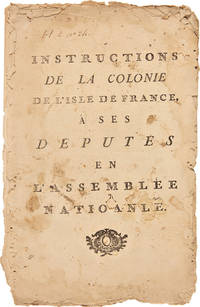
1791284301791. Folio. 24pp. Stitched as issued. Top corner of first leaf torn away affecting several lines of text. Lightly dampstained and worn throughout. Still very good. Early and unrecorded imprint from the colonial press at the French colony of Mauritius also known as the Ile de France. Issued at a critical moment at the beginning of the French Revolution the lengthy text concerns the government and judiciary of the island together with a proclamation by the King dated August 24 1790. The text nominally recognizes the authority of the King while taking measures to establish major autonomy of local government. The Dutch were the first Europeans to become interested in the island taking possession in 1598. After exploiting the island's dense forests for a century and introducing the cultivation of sugar cane and cotton in 1710 the Dutch abandoned the colony. The French soon claimed it as "Ile de France" and the island remained under the control of the French East India Company until 1767. During the long war between France and England at the beginning of the 19th century Mauritius proved to be an important strategic naval base and as a result the British took charge of the island in 1810 and the Treaty of Paris confirmed official British possession in 1814. It remained an important sugar producing colony and in the 20th century agricultural production was expanded to include tea rice and other produce. Printing began on Mauritius in 1768. During the French period until 1810 only about 400 imprints were produced mostly in the form of official documents and newspapers though there are also almanacs and a few other items. All are quite rare. No copies located in OCLC and not recorded by Toussaint in his bibliography of Mauritius imprints. unknown books
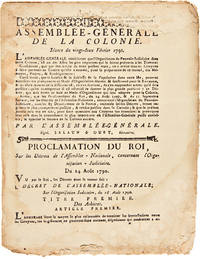
1791WRCAM48597Isle de France: Chez F.N. Bolle 1791. 24pp. Folio. Stitched as issued. Top corner of first leaf torn away affecting several lines of text. Lightly dampstained and worn throughout. Still nearly very good. Early and unrecorded imprint from the colonial press at the French colony of Mauritius also known as the Ile de France. Issued at a critical moment at the beginning of the French Revolution the lengthy text concerns the government and judiciary of the island together with a proclamation by the King dated Aug. 24 1790. The text nominally recognizes the authority of the King while taking measures to establish major autonomy of local government. <br> <br> The Dutch were the first Europeans to become interested in the island taking possession in 1598. After exploiting the island's dense forests for a century and introducing the cultivation of sugar cane and cotton in 1710 the Dutch abandoned the colony. The French soon claimed it as "Ile de France" and the island remained under the control of the French East India Company until 1767. During the long war between France and England at the beginning of the 19th century Mauritius proved to be an important strategic naval base. The British took charge of the island in 1810 and the Treaty of Paris confirmed official British possession in 1814. It remained an important sugar producing colony and in the 20th century agricultural production was expanded to include tea rice and other produce. <br> <br> Printing began on Mauritius in 1768. During the French period until 1810 only about 400 imprints were produced mostly in the form of official documents and newspapers although there are also almanacs and a few other items. All are quite rare. No copies located in OCLC and not recorded by Toussaint in his bibliography of Mauritius imprints. Chez F.N. Bolle unknown books
1790WRCAM48602Isle de France: Imprimerie Royale 1790. 29pp. Folio. Printed self-wrappers. Folded sheets several leaves loose. Moderate wear and soiling heavier to wrapper. Wrapper with some minor loss not affecting text. Good. Early and unrecorded imprint from the colonial press at the French colony of Mauritius also known as the Ile de France. An extract from the journals of the "Délibérations & Arretés de L'Assemblée- Générale de la Colonie de l'Isle de France" dated Sept. 25 1790 this document records the steps made to establish what was largely self-government at the outset of the French Revolution. <br> <br> The Dutch were the first Europeans to become interested in the island taking possession in 1598. After exploiting the island's dense forests for a century and introducing the cultivation of sugar cane and cotton in 1710 the Dutch abandoned the colony. The French soon claimed it as "Ile de France" and the island remained under the control of the French East India Company until 1767. During the long war between France and England at the beginning of the 19th century Mauritius proved to be an important strategic naval base. The British took charge of the island in 1810 and the Treaty of Paris confirmed official British possession in 1814. It remained an important sugar producing colony and in the 20th century agricultural production was expanded to include tea rice and other produce. <br> <br> Printing began on Mauritius in 1768. During the French period until 1810 only about 400 imprints were produced mostly in the form of official documents and newspapers although there are also almanacs and a few other items. All are quite rare. No copies located in OCLC and not recorded by Toussaint in his bibliography of Mauritius imprints. Imprimerie Royale unknown books
1790284331790. Folio. 2 9pp. Printed self-wrappers. Folded sheets several leaves loose. Moderate wear and soiling heavier to wrapper. Wrapper with some minor loss not affecting text. Early and unrecorded imprint from the colonial press at the French colony of Mauritius also known as the Ile de France. An extract from the journals of the "Délibérations & Arretés de L'Assemblée-Générale de la Colonie de l'Isle de France" dated Sept. 25 1790 this document records the steps made to establish what was largely self-government at the outset of the French Revolution. The Dutch were the first Europeans to become interested in the island taking possession in 1598. After exploiting the island's dense forests for a century and introducing the cultivation of sugar cane and cotton in 1710 the Dutch abandoned the colony. The French soon claimed it as "Ile de France" and the island remained under the control of the French East India Company until 1767. During the long war between France and England at the beginning of the 19th century Mauritius proved to be an important strategic naval base and as a result the British took charge of the island in 1810 and the Treaty of Paris confirmed official British possession in 1814. It remained an important sugar producing colony and in the 20th century agricultural production was expanded to include tea rice and other produce. Printing began on Mauritius in 1768. During the French period until 1810 only about 400 imprints were produced mostly in the form of official documents and newspapers though there are also almanacs and a few other items. All are quite rare. No copies located in OCLC and not recorded by Toussaint in his bibliography of Mauritius imprints. unknown books
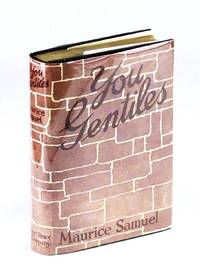
1924458H4766New York: Harcourt Brace and Company. Good. 1924. Third Printing. Hardcover. A modern Jew perhaps for the first time analyzes western civilization as an expression of the Gentile way of life and shows where this clashes with the nature and spiritual impulses of the Jew. - paraphrased from front flap of replica dust jacket included with this copy. "We Jews we the destroyers will remain the destroyers for ever. Nothing that you will do will meet our needs and demands - The wretched fate which scattered us through your midst has thrust this unwelcome role upon us." - p. 155. "I console myself with the thought that if this book offends by its assertiveness God knows that the infinite tactfulness of thousands of other Jews seems to have offended no less. Whatever we do we are damned - and I would rather be damned standing up than lying down." - p. 221. "Born in Romania Maurice Samuel 1895-1972 moved to the United States in 1914. A Jewish intellectual and writer he is best known for You Gentiles." - Wikipedia. 6-221pp. 7.75" x 5.5". Tight and unmarked with average wear and soiling. Includes new replica dust jacket in glossy new archival-grade protection.; 8vo - over 7¾" - 9¾" tall; western civilization its religion morality art and science as an expression of the gentile way of life and shows where this clashes with the nature and spiritual impulses of the Jew Comparison Contrast Christian . Harcourt, Brace and Company hardcover
196327514New York: Harper & Row 1963. First printing. Near fine in very good plus jacket. Lovely first edition of the subversive Caldecott-award winner in the rare original first-issue dust jacket. After illustrating nearly 50 other books WILD THINGS was Sendak's first full-color picture book with his own text and illustrations. He took full advantage of that control to push the boundaries of the children's picture book genre. The story of a boy who gets in a fight with his mother and lets out his pent up feelings in a fantastical Wild Rumpus WILD THINGS focused on the complex inner experience of little Max acknowledging the reality that children deal with anger frustration and fear just as adults do. For this reason the book was initially not well received: before the rise of New Realism in children's literature many critics felt children's books ought to model ideal behavior rather than accurately reflect children's emotional experiences. The book made a splash from the very beginning as Sendak expected it would: many critics advised against buying the book and some libraries banned it. Readers largely didn't know how to react to its unconventional approach - until it won the Caldecott. WILD THINGS is now one of the best-selling children's books of all time paving the way for commercial picture books that explore our darker sides and encourage us to make friends with monsters. 9'' x 10''. Original quarter grey cloth color pictorial paper boards. In original price-clipped color pictorial dust jacket without Caldecott medal and with 3-paragraph blurb on front flap blurbs are issue point not price; ref. Hanrahan. Color pictorial endpapers. Illustrated by Sendak in color throughout. 40 pages. Jacket with some soiling and toning a few short closed tears minutely reinforced on verso. Book with a bit of bumping to extremities else clean and bright. Harper & Row unknown
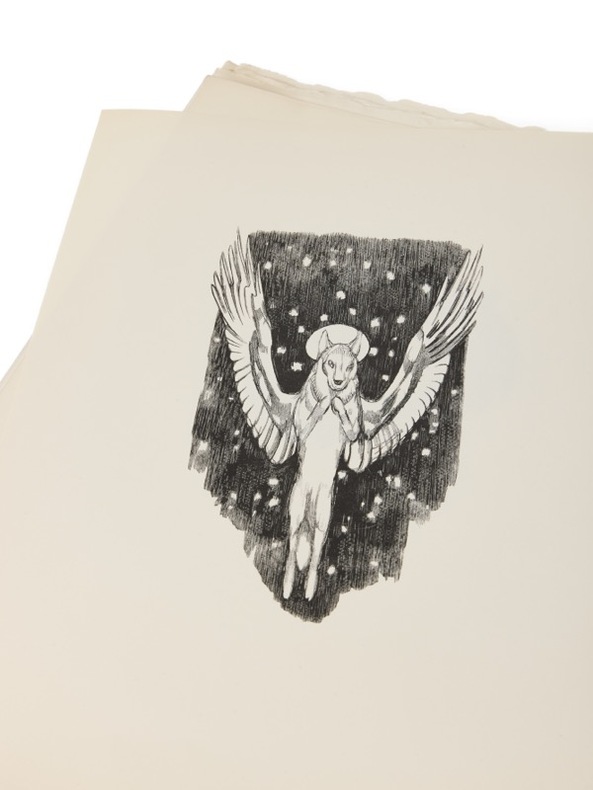
31556Paris Editions Vialetay 24 mars 1958 pour le texte 9 février 1959 pour les gravures. Édition originale illustrée des bois de Paul Jouve gravés par Jacques Beltrand d’après les dessins de l'artiste. Un des 25 exemplaires réservés aux collaborateurs celui-ci marqué « exemplaire d'artiste » sur papier du Moulin Richard de Bas signé par Genevoix Jouve et Beltrand et enrichi de deux suites. . De ces exemplaires réservés aux collaborateurs nous connaissons celui de Paul Jouve relié par Georges Cretté pour le collectionneur Francis Kettaneh qui l'a acquis auprès de l'artiste en 1962. Ce précieux exemplaire enrichi des dessins originaux est passé en vente en 2009 chez Christie's 27 novembre 2009 n° 141 et n'est plus réapparu depuis. Notre exemplaire est donc probablement destiné à Jacques Beltrand conservé par Maurice Genevoix qui l'a détenu depuis lors dans sa bibliothèque de la maison des Vernelles dans le Loiret. Il est enrichi de la suite en noir de la suite en couleurs et de la suite de décomposition des planches doubles ; il est signé par Genevoix Jouve et Beltrand. L'édition du Roman de Renard illustrée par Paul Jouve et adaptée par Maurice Genevoix constitue une oeuvre à la croisée de la tradition littéraire médiévale de l'art animalier moderne et du grand livre illustré bibliophilique français du XXe siècle. Genevoix écrivain de la nature et des êtres vivants a toujours porté un regard empathique et poétique sur le monde animal comme en témoignent Raboliot La Dernière harde ou L'Hirondelle qui fit le printemps. Le choix de revisiter Le Roman de Renart - chef-d'oeuvre de la satire médiévale - s'inscrit dans cette continuité : Renart rusé libre et irrévérencieux incarne une figure de résistance à l'ordre imposé que Genevoix admire. Le texte est adapté en français moderne comme un prélude à La Forêt perdue qui sera publiée dix ans plus tard et qui aura également pour scène le Moyen Âge : ce roman initiatique constitue un ouvrage-clé de son oeuvre où la mort apparaît comme un thème de plus en plus présent. Il s'en est expliqué peu de temps avant sa mort évoquant l'expérience de la mort durant la Première Guerre mondiale : « J'ai eu l'instinct de la chasse très fort très vif . mais je sais depuis . que l'ombre de la mort dans l'oeil d'une perdrix tuée c'est exactement la même chose ». Le choix de Paul Jouve comme illustrateur n'est pas un hasard mais une évidence esthétique et morale : le peintre est alors le plus grand artiste animalier de son temps connu pour ses représentations vibrantes de fauves singes chevaux. Il livre ici une riche illustration de 53 compositions en couleurs gravées sur bois par Jacques Camille et Georges Beltrand et de 33 grandes initiales gravées sur bois fruit d'un travail de plus de dix ans entrepris dès 1941 et alors qu'il n'a aucun éditeur pour le suivre dans ce monumental projet. Ce sont le bibliophile Jules Exbrayat et l'éditeur Jacques Vialetay qui seront à l'origine de cette édition et de sa commercialisation et qui feront appel à Maurice Genevoix pour l'établissement du texte. Jules Exbrayat président de la Société des Bibliophiles franco-suisses n'aura malheureusement pas le bonheur de voir l'édition réalisée : il décède en 1958 quelques semaines avant l'impression du livre qui lui sera dédié. Ce sera l'un des derniers ouvrages de Paul Jouve et l'un de ses chefs-d'oeuvre. De la bibliothèque de Maurice Genevoix aux « Vernelles » ex-libris. Paris, Editions Vialetay, (24 mars) 1958, pour le texte, (9 février) 1959, pour les gravures. unknown
195931556Exemplaire de tête, hors commerce : l'un des trois réservés à l'auteur et aux artistes. Paris, Editions Vialetay, (24 mars) 1958, pour le texte, (9 février) 1959, pour les gravures. Édition originale illustrée des bois de Paul Jouve, gravés par Jacques Beltrand d’après les dessins de l'artiste. Un des 25 exemplaires réservés aux collaborateurs, celui-ci marqué «exemplaire d'artiste» sur papier du Moulin Richard de Bas, signé par Genevoix, Jouve et Beltrand et enrichi de deux suites.
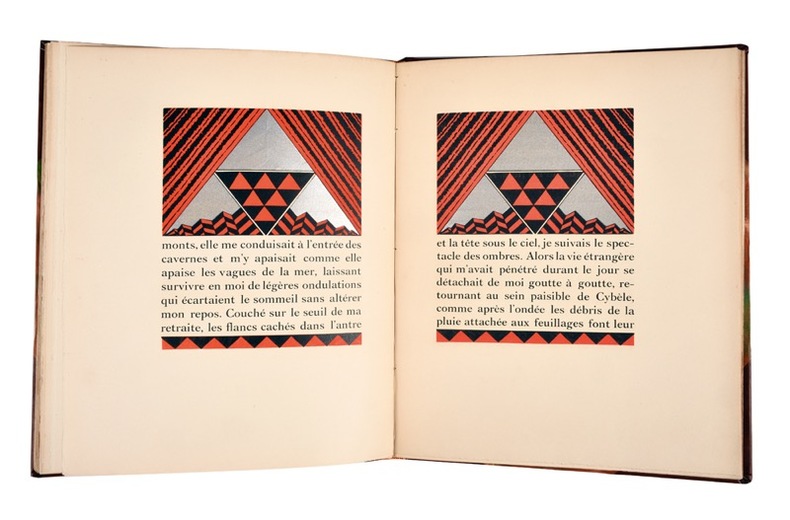
193138857Paris Le Livre Contemporai 1931 In-4, maroquin grenat orn au centre des plats d'un mdaillon estamp or reprsentant le Centaure sur le premier, une bacchante sur le second, et bord en haut et en bas de chaque plat en passant par le dos d'une grecque stylise suggre par deux filets dors et orne d'un semis de points dors; dos sans nerfs; larges encadrements intrieurs orns d'un filet pouss or, doublures de soie peinte, gardes de tabis vieux rouge, doubles gardes de papier marbr, tranches dores sur tmoins, couverture illustre d'un motif estamp froid. Etui (G. Crett, successeur de Marius Michel).50 gravures sur bois en couleurs dont 13 pleine page par Jules Chadel, tires la main suivant les mthodes japonaises par Y. Urushibara, avec le concours de Germaine de Coster et Savinienne Tourette. Tirage unique limit 120 exemplaires numrots sur japon. Exemplaire enrichi de 4 lavis originaux par Jules Chadel, dont 2 peints sur soie et monts sur les doublures et 2 sur papier monts en tte du livre.
192921587Lyon, (Aux dépens du Cercle Gryphe, Marius Audin imprimeur), 1929. In-quarto, demi-basane à coins fauve, dos décoré de 20 nerfs épais, titre doré à la japonaise, couverture illustrée du logo du Cercle Gryphe gravé sur bois par Philippe Burnot et tiré en rouge (Missol relieur-Lyon) ; [38] ff., le premier blanc; illustré de 73 compositions géométriques de Claudius Linossier gravées sur bois par Philippe Burnot et tirées en rouge, noir, gris, beige et argent (palladium).
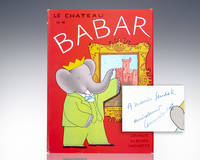
1961147137Paris: Hachette 1961. First edition of this winsome children's story in the original French from the library of Maurice Sendak. Folio original pictorial boards pictorial endpapers illustrated. Association copy inscribed by the author on the title page "A Maurice Sendak amicoleures Laurent de Brunhoff" with a drawing of one of Babar's children peeking out from behind a gardener elephant. Maurice Sendak author of Where the Wild Things Are is often hailed as “the Picasso of children’s books.†He has produced more than 85 books which have populated children’s imaginations for years. For his contributions to children’s literature Sendak received the third biennial Hans Christian Andersen Award for Illustration in 1970 one of two inaugural Astrid Lindgren Memorial Awards in 2003 and the Laura Ingalls Wilder Medal from the professional children’s librarians in 1983. In very good condition. An exceptional association. Jean de Brunhoff wrote The Story of Babar based on a story his wife created for their children. The book enjoyed immediate success upon publication and de Brunhoff went on to publish six more stories in the series before his death in 1937. In Le Chateau de Babar King and Queen of the Elephant Kingdom Babar and Celeste move to Bonnetrompe Castle and have a house-warming party. Hachette hardcover
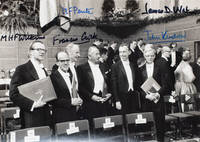
19621389371962. Original photograph from the 1962 Nobel Prize Ceremony signed by Francis Crick James Watson and Maurice Wilkins jointly awarded the 1962 Nobel Prize in Physiology and Medicine as well as Max Ferdinand Perutz and John Kendrew jointly awarded the 1962 Nobel Prize in Chemistry. Also captured in the photograph is John Steinbeck who was awarded the 1962 Nobel Prize in Literature. In fine condition. The Nobel Prize in Physiology or Medicine 1962 was awarded jointly to Francis Harry Compton Crick James Dewey Watson and Maurice Hugh Frederick Wilkins "for their discoveries concerning the molecular structure of nucleic acids and its significance for information transfer in living material." In 1968 Watson published The Double Helix: A Personal Account of the Discovery of the Structure of DNA his account of his codiscovery along with Francis Crick of the structure of DNA. To preserve the "real" story for the world James Watson attempted to record his first impressions as soon after the events of 1951-1953 as possible with all their unpleasant realities and "spirit of adventure" intact. "He has described admirably how it feels to have that frightening and beautiful experience of making a great scientific discovery" Richard Feynman winner of the 1965 Nobel Prize for Physics. unknown
104095Paris Librairie de l'Art Indépendant 1893. . First edition number 133 of 300 copies on Holland paper; 4to 195 x 185 mm; 30 lithographed tonal illustrations; contemporary morocco backed marbled boards ruled in gilt with the original wrappers bound in the upper with a further plain woodcut illustration by Denis.<br /> A splendid example of this important illustrated work claimed by numerous artistic movements over the years including Symbolism and Art Nouveau although the artist himself preferred the term 'neo-traditionalist'. Denis intentionally set out to decorate a book without direct servitude to the accompanying text instead embroidering the pages with arabesques of expressive lines. The lithographs are printed on a tinted background the background colour changing for each of the three parts of the book their size and layout complemented by the typefaces aspiring to create a uniquely immersive experience for the reader.<br /><br />Nobel Prize-winning André Gide requested that Denis be his collaborator for this work via the director of the Librairie de l'Art Indépendant. Gide's imaginative text is generally considered to be an allegory for his own voyage toward self realisation sailing to unknown and mysterious places.<br /><br />Particularly uncommon with the original wrappers present.<br /> Paris, Librairie de l'Art Indépendant, 1893. hardcover
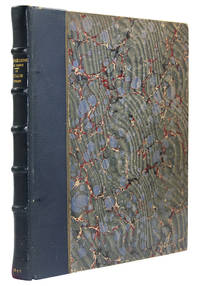
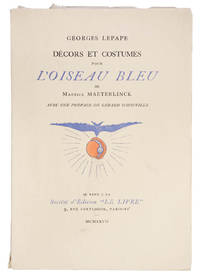
97689Paris Le Livre 1925-1927. . 2 vols; 8vo; libretto one of 10 examples on Japon imperial nominative hors commerce example this for the publisher Henri Barthlémy 8vo 14 original Pochoirs by Saude after Georges Lepape original wrappers. Décors et costumes: one of of 10 copies on Japon Imperial hors commerce this for the publisher Henri Barthlémy 61 colour plates seven double page folding loose in the original wrappers both volumes protected by a chemise and slipcase slight wear.<br /> 03 Illustrated libretto with separate edition of 61 costume designs for L'Oiseau Bleu which was written in 1908 by the Belgian playwright Maurice Maeterlinck and premiered at Konstantin Stanislavski's Moscow Art Theatre. These illustrations are based on the 1923 production of the play for which Lepape was the designer.<br /><br />An Art Deco artist Georges Lepape 1887-1971 began his career as an illustrator for the fashion designer Paul Poiret before becoming one of the world's most famous fashion illustrators in the world working primarily for Vogue.<br /> Paris, Le Livre, 1925-1927. unknown
18931704391893. DENIS Maurice. Le Voyage d'Urien. By André Gide. 110 pp. illustrated with 29 lithographs in 2 colors by Maurice Denis. 4to 200 x 192 mm. original wrappers in a new cloth folding box. Paris: Librairie de l'Art Indépendant 1893. A fine copy of one of the few Nabis illustrated books preserved in the original wrappers as issued and not rebound as is almost always the case. It is also free from the foxing that plagues many copies. It is interesting that Denis illustrated this book at the express invitation of Gide who had seen his drawings for Sagesse. One of 300 copies. The Artist and the Book No.76. Freches-Thory. The Nabis pp. 216 - 217. Cailler Maurice Denis: Catalogue Raisonné de l'Oeuvre Gravé et Lithographié Nos. 37 - 67. hardcover