289 résultats
1390332136.Gpaperback. Good. Access codes and supplements are not guaranteed with used items. May be an ex-library book. paperback
183248329Paris Crochard 1832. No wrappers. In: "Annales de Chimie et de Physique" 2e Series vol. 51 Cahier 4. Pp. 337-444 Entire issue offered. Faraday's letter: pp. 404-434 a. 1 engraved plate. Some brownspots. <br/><br/><em>First printing of Faraday's famous letter to Gay-Lussac in which he claim to be the discoverer of electro-magnetic induction analysed the results of the Italian philosophers pointing out their errors and defending himself from what he regarded as imputations on his character. The style of this letter is unexceptionable for Faraday could not write otherwise than as a gentleman; but the letter shows that had he willed it he could have hit hard. The letter was later translated into English and published in "Philosophical Magazine" in 1840 under the title "On Magneto-electric Induction"."In 1831 seemingly out of nowhere came the discovery of electromagnetic induction and the beginning of the experimental researches in electricity which were to lead Faraday to the discovery of the laws of electrochemistry specific inductive capacity the Faraday effect and the foundations of classical field theory." DSB. </em> unknown
183247933Paris Crochard 1832. Contemp. hcalf. Spine gilt. Light wear along edges. Stamps to verso of titlepage. In: "Annales de Chimie et de Physique" 2e Series vol. 51. Entire volume offered. 448 pp. a. 1 folded engraved plate. Faraday's letter: pp. 404-434. Internally clean and fine. <br/><br/><em>First printing of Faraday's famous letter to Gay-Lussac in which he claim to be the discoverer of electro-magnetic induction analysed the results of the Italian philosophers pointing out their errors and defending himself from what he regarded as imputations on his character. The style of this letter is unexceptionable for Faraday could not write otherwise than as a gentleman; but the letter shows that had he willed it he could have hit hard. The letter was later translated into English and published in "Philosophical Magazine" in 1840 under the title "On Magneto-electric Induction"."In 1831 seemingly out of nowhere came the discovery of electromagnetic induction and the beginning of the experimental researches in electricity which were to lead Faraday to the discovery of the laws of electrochemistry specific inductive capacity the Faraday effect and the foundations of classical field theory." DSB. The volume contains further importent papers by AMPÈRE "Note sur une Experience de Hippolyte Pixii relative au Courant produit par la Rotation d'un aimant à l'aide dün appareil imagine par M. Hippolyte Pixii" WÖHLER et LIEBIG "recherches sur le Radical de l'Acide benzoique" and "Lettre de M. Berzelius sur le Benzoyle et l'Acide benzoique" papers by Strohmeyer Gay-Lussac Dutrochet Boussingault BERZELIUS "Sur le Bleu de Prusse et le Cyanoferrure de plomb" etc. etc. </em> unknown
1999Q-0912299762Stoneydale Pr Pub Co 1999-03-01. Hardcover. New. In shrink wrap. Looks like an interesting title! Stoneydale Pr Pub Co hardcover
1999Q-0912299851Stoneydale Pr Pub Co 1999. Hardcover. New. In shrink wrap. Looks like an interesting title! Stoneydale Pr Pub Co hardcover
188247024Paris Gauthier-Villars 1882. 4to. No wrappers. In: "Comptes Rendus Hebdomadaires des Séances de L'Academie des Sciences" Tome 95 No 22 a. Tome 104 No 21 entire issues offered. Pp. 1017-1076 and pp. 1387-1462. Raoult's papers: pp. 1030-33 tome 95 and pp. 1430-1433 tome 104. <br/><br/><em>First appearance of Raoult's two importent papers in which described a method for finding the molecular weight of an organic compound by the determination of the lowering of the freezing point of water that resulted from dissolving that compound in water and the law governing the relation between solutes and vapor pressure."Then in 1882 F.-M. Raoult published his results on the effects of nondissociating organic solutes from which he deduced a general law controlling the lowering of freezing points the first paper offered. Four years later he extended this work to show the effect of solutes on vapor pressure the second paper offered. Having established the effect of nondissociating compounds he was in position to show that salts produced an eeffect which though anomalous could nevertheless be explained by the supposition that a dissolved molecule broke up into other molecules. This work was of great value in supplying a new method for determining molecular weights since the depression of freezing point and vapor pressure as well a the related rise in boiling point later discovered are proportional to the moleculat concentrations ofthe solutions; it was of equal value in supporting the ideas of van't Hoff on osmotic pressure. With the announcement of the dissociation theory of Arrhenius the anomalies were explained and the full significance of the generalizations of Raoult was recognized. Raoult published the formulations of his laws in the "Comptes Rendus" for 1882 and 1887 the papers offered" Leicester a. Klickstein "A Source Book in Chemistry" pp. 471 ff. </em> unknown
0525464743.Gpaperback. Good. Access codes and supplements are not guaranteed with used items. May be an ex-library book. paperback
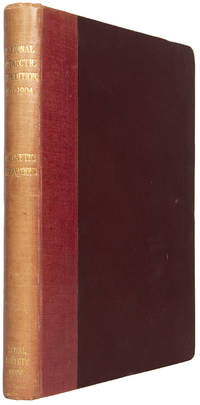
115667London Royal Society 1909. . First edition; 4to; 43 plates original red buckram-backed boards spine fade small stamps to foot of title a very good copy; vii 274 pp.<br /> From the library of Professor Otto Nordenskjöld 1869-1928 the distinguished Swedish Antarctic explorer and scientist. Nordenskjöld was on the Swedish scientific expedition to the Antarctic 1901-1903 and would have had a particular interest in the results of the Discovery expedition. The volume includes an appendix comparing magnetic observations in the Antarctic and the Arctic.<br /> Rosove 288-11.A1; Spence 841; Taurus 48. London, Royal Society, 1909. hardcover
180645517Paris Chez Bernard 1806. No wrappers. Ectracts from "Annales de Chimie ou Recueil de Mémoires." Vol. 57. Pp. 131-174 a. pp. 225-272. With the titlepage to volume 57. <br/><br/><em>First appearance of a classic paper in which Proust describes his discovery of Grape.Sugar and the identificationof this with glucose. He investigated the varieties of sugar that occur in sweet vegetable juices distinguishing three kinds and he showed that the sugar in grapes of which he announced the existence to his classes at Madrid is identical with that obtained from honey by the Russian chemist J. T. Lowitz.Proust is famous for his work on the steadiness of composition of chemical compounds."In chemistry the law of definite proportions sometimes called Proust's Law states that a chemical compound always contains exactly the same proportion of elements by mass. An equivalent statement is the law of constant composition which states that all samples of a given chemical compound have the same elemental composition. For example oxygen makes up 8/9 of the mass of any sample of pure water while hydrogen makes up the remaining 1/9 of the mass. Along with the law of multiple proportions the law of definite proportions forms the basis of stoichiometry."Wikipedia. </em> unknown
1334216037.Gpaperback. Good. Access codes and supplements are not guaranteed with used items. May be an ex-library book. paperback
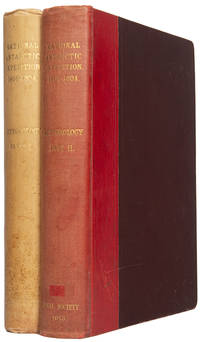
115669London Royal Society 1908-1913. . First edition; 2 vols 4to; vol. I: frontispiece 14 plate leaves large folding coloured map 1 very large chart dissected into 4 parts with title sheet; vol. II: 261 leaves of weather maps printed on one side only vol. I in red buckram backed boards vol. II in bright carmine red cloth backed boards spines faded lightly soiled a very good set; xiv 544; 26 pp.<br /> From the library of Professor Otto Nordenskjöld 1869-1928 the distinguished Swedish Antarctic explorer and scientist. Nordenskjöld was on the Swedish scientific expedition to the Antarctic 1901-1903 and would have had a particular interest in the results of the Discovery expedition.<br /><br />Meteorology is an important work providing a compendium of over a thousand synoptic charts concerning the Antarctic drawn not only from Scott's expedition but also from the Scottish Swedish and German expeditions. This was the first attempt to give an idea of the general principles underlying atmospheric circulation in the southern hemisphere.<br /> Rosove 288-9.A1 288-210.A1 binding b; Taurus 50; Spence 840. London, Royal Society, 1908-1913. hardcover
182843318Leipzig Johann Ambrosius Barth 1828. Without wrappers as issued in "Annalen der Physik und Chemie. Hrsg.von Poggendorff" Bd. 14 Zweites Stück. =Jahrgang 1828 zehntes Stück. Pp. 191-306 a. 3 engraved plates. the entire issue offered Heft 2 together with the titlepage to 14. Band. Brown's paper: pp. 294-313. Clean and fine. Small stamp on verso of titlepage. <br/><br/><em>First appearance in German of this monumental paper in atomic theory and kinematics as it was the first evidence for atomism that was an observation rather than a deduction from abstract principles."In 1827 as he was viewing a suspension of pollen in Water under the microscope he noted that the individual grains were moving about irregularly. This he thought was the result of the life hidden within the pollen grains. However when he studied dye particles indubitably nin-livin suspended in water he found the same erratic motion. This has been called "Brownian motion" ever since and Brown could merely report on the observation. He had no explanation for it. Nor had anyone else until the development of the kinetic theory of gases by men such as Maxwell a generation later. It seemed plain. after Maxwell and especially after the work of Einstein and Perrin a half century after Maxwell that the Brownian Motion was actually a visible effect of the fact that water was composed of particles. It was the first evidence for atomism that was an observation rather than a deduction." Asimov.The issue contains other importent papers by C. Naumann G. Magnus Th. Saussure "Kohlensäuregas in der Atmosphäre" andothers.PMM: 290 the English paper from 1828 - Sparrow Milestones of Science No 31. - Magie "A Source Book in Physics p. 251-255. - Dibner Heralds of Science No 156. </em> unknown
2005Q-0760321949Motorbooks 2005-12-02. Paperback. New. In shrink wrap. Looks like an interesting title! Motorbooks paperback
198174493Marquette University. Good. 1981. Award Booklet Celebrating Mother Teresa. Soft Cover. rb-1 . Marquette University paperback
19946946Sao Paulo: Fundacao Quadrilátero do Descobrimento 1994. 1st ed. Paperback. Used; Like New. Small Folio bds 239 pp.dust jacket semi glossy stock maps color plates facsimiles bibl. Fundacao Quadrilátero do Descobrimento paperback
2009Q-1572933240Discovery House Publishers 2009-07-31. Paperback. New. New. In shrink wrap. Looks like an interesting title! Discovery House Publishers paperback
184447225Paris Bachelier 1844. 4to. No wrappers. In "Comptes rendus hebdomadaires des séances de l’Académie des sciences" Vol. 19 No 14. Pp. 621- 686. Entire issue offered. Balard's paper: pp. 634-641. <br/><br/><em>First appearance of an importent paper in pharmacology as Balard here described his discovery of amyl nitrite and its preparation.Sir Thomas Lauder Brunton a Scottish physician later famously pioneered the use of amyl nitrite to treat angina pectoris. Brunton reasoned that the pain and discomfort of angina could be reduced by administering amyl nitrite to dilate the coronary arteries of patients thus improving blood flow to the heart muscle.Garrison & Morton No 1859. </em> unknown
182659047Paris Crochard 1826. Contemp. hcloth. Gilt lettering on spine. In: "Annales de Chimie et de Physique par Gay-Lussac et Arago" tome 32. 448 pp. 3 folded engraved plates. Balard's paper: pp. 337-84. Entire volume offered with original memoirs by Savart Berzelius Humboldt Arago Poisson Liebig Dumas et al. <br/><br/><em>First printing of Balard's famous memoire in which he records his discovery of the new element Bromine le brôme. While he was studying the flora of a salt marsh he notized a deposit of sodium saulfate which had crystallized out in a pan containing mother liquer from common salts. "In an attempt to find a use for the waste liquers he performed a number of experiments and notized that when certain reagents were added the mother liquer bacame brown. His investigation of this phenomenon.ked to the remarkable discovery.Weeks p. 264. "The discovery of a new chemical element by a young and obscure provincial pharmacist caused a sensation in Paris. Balard's achievemnt was recognized by the Academie des Sciences and he was awarded a medal by the Royal Society of London."DSB I p. 416. "The discovery of bromine is a very importent acquisition to chemistry and gives M. Balrad honorable rank inthe career of the sciences. We are of the opinion that this young chemist is every way worthy of the encouragement of the Academy and we have the honour to propose that his memoir shall be printed in the "Recueil des Savants Étrangers" The report from the French Academy signed by Vaugelin Thenard and Gay-Lussac. </em> hardcover
182643853Paris Crochard 1826. Without wrappers. In: "Annales de Chimie et de Physique par Gay-Lussac et Arago" tome 32 Sec. Series Cahier 4. Pp. 337-443 a. 1 fodled engraved plate. The entire issue offerd. Balard's paper: pp. 337-84. <br/><br/><em>First printing of Balard's famous memoire in which he records his discovery of the new element Bromine le brôme. While he was studying the flora of a salt marsh he notized a deposit of sodium saulfate which had crystallized out in a pan containing mother liquer from common salts. "In an attempt to find a use for the waste liquers he performed a number of experiments and notized that when certain reagents were added the mother liquer bacame brown. His investigation of this phenomenon.ked to the remarkable discovery.Weeks p. 264."The discovery of a new chemical element by a young and obscure provincial pharmacist caused a sensation in Paris. Balard's achievemnt was recognized by the Academie des Sciences and he was awarded a medal by the Royal Society of London."DSB I p. 416."The discovery of bromine is a very importent acquisition to chemistry and gives M. Balrad honorable rank inthe career of the sciences. We are of the opinion that this young chemist is every way worthy of the encouragement of the Academy and we have the honour to propose that his memoir shall be printed in the "Recueil des Savants Étrangers" The report from the French Academy signed by Vaugelin Thenard and Gay-Lussac. </em> unknown
184849456Paris Bachelier 1848. 4to. No wrappers. In: "Comptes Rendus Hebdomadaires des Séances de L'Academie des Sciences" Tome 26 No 21. Pp. 529- 548. Entire issue offered. Pasteur's paper: pp. 535-538. Clean and fine. <br/><br/><em>First appearance of the announcement of Pasteur's momentous and revolutionary discovery of "molecular assymetry" and founding the science of Polarimetry.The discovery was first announced by Pasteur in may 1848 by the printing of the preliminary report of only 4 short pages in order to establish priority the paper offered. A more full exposition was published the same year in "Annales de Chimie et de Physique" 3me Series - Tome XXIV."In 1848.Pasteur studied the crystals of tartrates one of the substances that exhibited the now-clockwise now-counterclockwise effect under the microscope and found that the xcrystasls were mirror images of the others. The two crystals resemmbled each other as a right-hand glove resembles a left-hand glove.This was a revolutionary discovery and it took some courage to announce it. A few years before the well-known chemist Mitscherlich had studies the same tartrate crystals and declared them all to be identical. Pasteur was only a twenty-sic-year-old unknown. neverthelless he announced his findings and went before Biot to repeat the separation ofthe crystals before the eyes of the aged authority in the field. Biot was convinced and Pasteur received the Rumford medal of the Royal Society for his work.Pasteur had thus founded the science of polarimetry in which the measurements of the manner in which the plane of polarized light was twisted could be used to help to determine the structure of organic substance to follow various chemical reactions and so on."Asimov. Leicester & Klickstein "A Source Book of Chemistry" p. 374-379. </em> unknown
184847149Paris Bachelier 1848. 4to. No wrappers. In: "Comptes Rendus Hebdomadaires des Séances de L'Academie des Sciences" Tome 26 No 21. Pp. 529- 548. Entire issue offered. Pasteur's paper: pp. 535-538. <br/><br/><em>First appearance of the announcement of Pasteur's momentous and revolutionary discovery of "molecular assymetry" and founding the science of Polarimetry.The discovery was first announced by Pasteur in may 1848 by the printing of the preliminary report of only 4 short pages in order to establish priority the paper offered. A more full exposition was published the same year in "Annales de Chimie et de Physique" 3me Series - Tome XXIV."In 1848.Pasteur studied the crystals of tartrates one of the substances that exhibited the now-clockwise now-counterclockwise effect under the microscope and found that the xcrystasls were mirror images of the others. The two crystals resemmbled each other as a right-hand glove resembles a left-hand glove.This was a revolutionary discovery and it took some courage to announce it. A few years before the well-known chemist Mitscherlich had studies the same tartrate crystals and declared them all to be identical. Pasteur was only a twenty-sic-year-old unknown. neverthelless he announced his findings and went before Biot to repeat the separation ofthe crystals before the eyes of the aged authority in the field. Biot was convinced and Pasteur received the Rumford medal of the Royal Society for his work.Pasteur had thus founded the science of polarimetry in which the measurements of the manner in which the plane of polarized light was twisted could be used to help to determine the structure of organic substance to follow various chemical reactions and so on."Asimov. Leicester & Klickstein "A Source Book of Chemistry" p. 374-379. </em> unknown
183351493Paris Crochard 1833. Contemp. hcalf. Raised bands gilt spine with gilt lettering. A few scratches to spine. Stamps to verso of titlepage. In: "Annales de Chimie et de Physique Par MM. Gay-Lussac et Arago." Series 2 tome 53. Entire volume offered. 448 pp. Payen & Persoz's paper: pp. 73-92. Clean and fine. <br/><br/><em>First printing of a pioneering paper in industrial chemistry and microbiology being the discovery of the first Enzyme Diastase. It catalyses the breakdown of starch into maltose. </em> hardcover
185545031Paris Victor Masson 1855. 8vo. Without wrappers. In 'Annales de Chimie et de Physique' Series 3 tome 30 December-issue. With halftitle to vol. 30. Pp. 385-508 a. 1 plate. Entire issue offered. Wurtz's paper: pp. 443-506. <br/><br/><em>First appearance of the entire memoir in which Wurtz describes his outstanding discovery of Liebig’s prediction that there might be organic compounds analogous to ammonia and derivable from it by the replacement of hydrogen - the amines. The discovery was announced in 1849 and a small extract was printed in "Comptes rendu" 4 pp. The offered paper is the memoir in full.Wurtz is most noted for his investigation of glycols and for his discovery of the amines. The latter discovery in 1849 the paper offered was very significant at the time for ot suggested the possibility of a new type the ammonia type which helped to explain the behaviour of nitrogenous compounds. Leicester & Klickstein "A Source Book." pp. 362-63. - Parkinson "Breakthroughs" 1849 C.Charles Adolphe Wurtz was born at Strasbourg 1817. For many years he was Professor of Chemistry at the Ecole de Médicine and at Sorbonne in Paris. He was known not only for his researches in organic chemistry but also for his many literary works. He was editor of a Dictionnaire de Chemie Pure et Appliquée and after 1868 one of the editors of the Annalen der Chemie et de Physique. He died in Paris in 1884. </em> unknown
1997x-1563084554Teacher Ideas Pr 1997. Paperback. New. 161 pages. 11.25x8.50x0.75 inches. Teacher Ideas Pr paperback
184147143Paris Bachelier 1841. 4to. No wrappers. In: "Comptes Rendus Hebdomadaires des Séances de L'Academie des Sciences" Tome XIII No. 10. Pp. 487- 558. Entire issue offered. Matteucci's paper: pp. 540-41. <br/><br/><em>First appearance of a main paper in the history of electro-physiology."The discovery by Volta of means for producing galvanic currents led to the construction of a galvanometer for measuring currents and later to its refinement. In 1841 Matteucci presented. a paper which showed that a galvanometer indicates a curring flowing whenh it is connected from the surface of a muscle to a wound in the muscle a current that was later called the "current of injury" and also the "current of rest" since it flowed without observable muscular contraction. Johannes Müller showed tis paper to his brilliant pupil du Bois-reymond. Du Bois interest was caught at once. He published his first paper on "thierische Electricität" in 1843 and his two-volumes on the subject - soon to become the classic - in 1848-49."Boring "History of Experimental Psychology" p. 40. </em> unknown