289 résultats
2009Q-1572933666RBC Ministries 2009-01-01. Paperback. New. New. In shrink wrap. Looks like an interesting title! RBC Ministries paperback
B9781017994421Hardback. New. hardcover
A9781017994421Hardback. New. hardcover
1333019912.Gpaperback. Good. Access codes and supplements are not guaranteed with used items. May be an ex-library book. paperback
19973486Alexandria VA : Time-Life Books; Tehabi Books 1997. 1997. Hardcover. Very Good/Very Good. 205 pp. : illustrated some in color color maps ; 26 cm. ; ISBN: 0783552610 LCCN: 97-16404 ; OCLC: 36727998 ; LC: G530.T6; Dewey: 910/.91634 ; "Unlike any other book ever published on the Titanic these pages magnificently present the combined efforts of hundreds of individuals through years of historical and scientific research study exploration and preservation."--dustjacket ; color photographic boards in printed glassine dustjacket ; a few tiny spots on dustjacket wear points on bottom of boards else VG/VG <br/> <br/> [Alexandria, VA] : Time-Life Books; Tehabi Books, 1997. hardcover
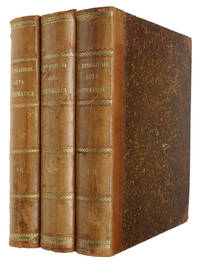
188460243Berlin Stockholm Paris F. & G. Beijer 1882-84. Large4to 272 x 230 mm. Three volumes uniformly bound in contemporary half calf with gilt lettering to spine. In "Acta Mathematica" volume 1-5. Light wear to extremities boards and spines with scratches. Stamp to verso of front board in all volumes. First three leaves in first volume detached otherwise internally fine and clean. Vol. I pp. 1-62; Pp. 193-294; Vol. II pp. 97-113; Vol. III. pp. 49-92; Vol. IV pp. 201-312; Vol. V pp. 209-278. <br/><br/><em>First publication of these groundbreaking papers which together constitute the discovery of Automorphic Functions. "Before he was thirty years of age Poincaré became world famous with his epoch-making discovery of the "automorphic functions" of one complex variable or as he called them the "fuchsian" and "kleinean" functions." DSB.These manuscripts written between 28 June and 20 December 1880 show in detail how Poincaré exploited a series of insights to arrive at his first major contribution to mathematics: the discovery of the automorphic functions. In particular the manuscripts corroborate Poincaré's introspective account of this discovery 1908 in which the real key to his discovery is given to be the recognition that the transformations he had used to define Fuchsian functions are identical with those of non-Euclidean geometry. See Walter Poincaré Jules Henri French mathematician and scientist.The idea was to come in an indirect way from the work of his doctoral thesis on differential equations. His results applied only to restricted classes of functions and Poincaré wanted to generalize these results but as a route towards this he looked for a class functions where solutions did not exist. This led him to functions he named Fuchsian functions after Lazarus Fuchs but were later named automorphic functions. First editions and first publications of these epochmaking papers representing the discovery of "automorphic functions" or as Poincaré himself called them the "Fuchsian" and "Kleinian" functions."By 1884 Poincaré published five major papers on automorphic functions in the first five volumes of the new Acta Mathematica. When the first of these was published in the first volume of the new Acta Mathematica Kronecker warned the editor Mittag-Leffler that this immature and obscure article would kill the journal. Guided by the theory of elliptic functions Poincarë invented a new class of automorphic functions. This class was obtained by considering the inverse function of the ratio of two linear independent solutions of an equation. Thus this entire class of linear diffrential equations is solved by the use of these new transcendental functions of Poincaré." Morris Kline.Poincaré explains how he discovered the Automorphic Functions: "For fifteen days I strove to prove that there could not be any functions like those I have since called Fuchsian functions I was then very ignorant; every day I seated myself at my work table stayed an hour or two tried a great number of combinations and reached no results. One evening contrary to my custom I drank black coffee and could not sleep. Ideas rose in crowds; I felt them collide until pairs interlocked so to speak making a stable combination. By the next morning I had established the existence of a Class of Fuchsian functions those which come from hypergeometric series; i had only to write out the results which took but a few hours.the transformations that I had used to define the Fuchsian functions were identical with those of Non-Euclidean geometry." </em> hardcover
1587380161.Gpaperback. Good. Access codes and supplements are not guaranteed with used items. May be an ex-library book. paperback
0260105244.Gpaperback. Good. Access codes and supplements are not guaranteed with used items. May be an ex-library book. paperback
191441545London 1914. No wrappers but stiched. All three papers contained in: "Philosophical Magazine" Sixth Series Vol. 27. No. 159. March 1914. The whole issue issue offered =no. 159: pp. 397-540 and 2 plates.Rutherford's paper.pp. 488-498. - Darwin's paper: pp. 499-506. - Bohr's paper: pp. 506-523. All clean and fine. <br/><br/><em>First edition and first printing of all three papers. Rutherford in this paper for the first time identifies the hydrogen nucleus and called it the 'positive electron'. He later called it 'the proton' . In his definitive paper of 1911 he estimated the radius of the nucleus a hundred thousand times smaller than that of an atom. Darwin in his paper offered here gave a more precise measure.In the first lines of the paper Rutherford outlines the content "The present paper and and the accompanying paper by Mr. C. Darwin the second paper offered here deal with certain points in connection with the "nucleus" theory of the atom which were purposely omitted in my first communication on that subject Phil. Mag. May 1911. A brief account is given of the later investigations which have been made to test the theory and of the deductions which can be drawn from them. At the same time a brief statement is given of recent observations on the passage of alpha particles through hydrogen which throw importent light on the dimensions of the nucleus." - Rutherford had studies alpha-particles intensely in the years before 1914 and proved quite conclusively that the individual particle was a helium atom with its electrons removed. The alpha particles were like the positive rays that had been discovered by Goldstein 1886 and now in 1914 the paper offered Rutherford suggested that the simplest positive rays must be those obtained from the hydrogen and that these must be the fundamentall positively-charged particle. He names it a 'positive electron'.Darwin in the paper offered "concluded from the known data:"No force proportional to some power of the distance other than the inverse square can give the dependence the Rutherford scattering cross section on the initial velocity" and he then calculated the distance of closest alpha-particle-nucleus approach.The paper by Niels Bohr relates to "The Stark effect". In 1913 appeared "an importent new discovery: when atomic hydrogen is exposed to a static electrical field its spectral lines split the amount of splitting being proportional to thefield strenght the linear Stark effect. After Rutherford read this news in "Nature" he at once wrote to Bohr:'I think it is rather up to you at the present time to write something on.electric effects.'" A. Pais. Bohrs paper on The Stark effect appeared in 1914 the paper offered here. - Rosenfeld. Niels Bohr' publications No. 10. </em> unknown
1965332Beamsville Ontario: Discovery Women's Institute Printed by Rannie Publications 1965. First edition. Stapled Wraps. Unpaginated. pp. 64. 4to. Illustrated card covers. Profusely illustrated with maps black and white photographs portraits and illustrations. Lightest rubbing to the extremities contents clean and unmarked with tight sound binding; very good. Rare. A comprehensive local history of Discovery N.W.T. formerly a mining town with details on the Indigenous peoples of the region religious affiliations of the community and the institutions serving them schools libraries newspapers fraternal organizations etc. <br/><br/> [Discovery Women's Institute], Printed by Rannie Publications paperback
0260052701.Gpaperback. Good. Access codes and supplements are not guaranteed with used items. May be an ex-library book. paperback
1331911052.Gpaperback. Good. Access codes and supplements are not guaranteed with used items. May be an ex-library book. paperback
1682206521-NDiscovery. hardcover. New. 0x0x0. BOOK IS IN NEW CONDITION. Discovery hardcover
2019mon0003456527Discovery 2019T. hardcover. Very Good. 0.8268 11.2992 8.7402. Discovery hardcover
2004Q-0803280394BISON BOOKS 2004-11-01. Paperback. New. In shrink wrap. Looks like an interesting title! BISON BOOKS paperback
1996USD_9780070160613MGH 1996. 1st. Hardcover. UsedLikeNew/UsedLikeNew. MGH hardcover
1996AME_9780070160613MGH 1996. 1st. Hardcover. New/New. MGH hardcover
1332558380.Gpaperback. Good. Access codes and supplements are not guaranteed with used items. May be an ex-library book. paperback
1856mon0000018903George Virtue and Co c. 1856. HardcoverLeatherSpineCorners. Like New. in x in x in. No DJ. Volume II only. Few pages with light foxing. No other marks in lightly read book. 36 b/w plates no foxing. Binding intact. Three-quarter leather over marbled boards with wear of leather. No publication date. George Virtue and Co hardcover
2014x-0309285968National Academies Press 2014. Paperback. New. 1st edition. 195 pages. 9.00x6.00x0.75 inches. National Academies Press paperback
1990029556AUSTIN TEXAS: STATE HOUSE PRESS. small closed tear to the p/c dj. author's signature affixed to title page. . VG. Hardcover. STATED FIRST EDITION. 1990. STATE HOUSE PRESS hardcover
2006260417008Teacher's Discovery 2006. hardcover. Used: Very Good. 11x8x2. Includes sealed CDROM. Clean and unmarked. Some minor cosmetic shelf wear. From a private collection. Very good condition. Comes from non smoking home. Teacher's Discovery hardcover
146275Teacher's Discovery. hardcover. Very Good. 11x8x2. Teacher's Discovery hardcover
0243413114.Gpaperback. Good. Access codes and supplements are not guaranteed with used items. May be an ex-library book. paperback
192146992London Taylor and Francis 1921. Blank wrapper. In: "The London Edinburgh and Dublin Philosophical Magazine and Journal of Science" Sixth Series Vol.42 No. 252 December 1921. Pp. 873-1024 textillustr. a. 1 plate. Entire issue offered. Chadwick & Bieler's paper: pp. 923-940 textillustr. <br/><br/><em>First printingof this milestone paper in which the strong nuclear forces are mentioned for the first time."It was only in 1921 that Chadwick had first shown that at very small distances the interactions of alpha particles with the atomic nucleus did not follow exactly the inverse square law predicted from the repulsion of their positive electrical scharges. Chadwick concluded that his experiments showed that these nuclear forces are of "very great intensity". According to Pais this is THE FIRST PUBLISHED STATEMENT ABOUT THE EXISTENCE OF A STRONG NUCLEAR FORCE. This 'new force' interpretation was disputed untill well into 1920s."Hey & Walters."In any event Chadwick and Bieler's final conclusion avoid all reference to a possible electromagnetic cause for the deviations from the simple theory: "The present experiments do not seem to throw any light on the nature of the law of variation of the forces at the seat of an electric charge but merely show that the forces are of very great intensity. It is our task to find some field of force which will reproduce these effects." I consider this statement made in 1921 as marking the birth of the strong interaction."Pais in "Inward Bound" p. 240. </em> unknown