289 résultats
181042219London W. Bulmer and Co. 1810. 4to. No wrappers as extracted from "Philosophical Transactions" 1810 - Part I. Pp. 16-74 and 2 engraved plates showing Davy's electrochemical apparatus for decomposing substances. The plates dampstained. Text fine and clean. <br/><br/><em>First appearence of this historical chemical paper Davy' fifth Bakerian Lecture in which he announced his discovery of hydrogen telluride."Mr. Davy having from the commencement of his electro-chemical researches communicated the several steps of his progress to the Society The Royal Society takes the present opportunity of reporting the results of his further inquiries under four principal heads. First on the nature of the metals of the fixed alkalis. Second on the nature of Hydrogen and composition of ammonia. Thirdly on the metals of the earth; and Fourthly he makes a comparison between the antiphlogistic doctrine and a modified phlogistic hypothesis."Abstract. He further gives arguments for considering potassium and sodium which he discovered in 1808 as a element."Humphry Davy was one of the most brilliant chemists of the early nineteenth century. His early study of nitrous oxide brought him his first reputation but his later and most importent investigations were devoted to electrochemistry. Following Galvani's experiments and the discovery of the voltaic pile interest in galvanic electricity had become widespread. The first electrolysis by means of the pile was carried out in 1800 by Nicholson and Carisle who obtained oxygen and hydrogen from water. Davy began to examine the chemical effects of electricity in 1800 and his numerous discoveries were presented in his Bakerian lectures." - Wheeler Gift: 2518. </em> unknown
180842218London W. Bulmer and Co. 1808. 4to. No wrappers as extracted from "Philosophical Transactions" 1808 - Part I. Pp. 1-44. <br/><br/><em>First printing of this importent historical paper in chemistry in which Davy shows that electricity is capable of decomposing some alkalies isolating two new substances and discovering potassium and sodium. Neville in his Historical Chemical Library vol. I p.340 writes about this paper "ONE OF THE GREAT CLASSIC RESEARCHES IN CHEMISTRY in which Davy announced in this his second Bakterian lecture the isloation of metallic potassium and sodium by the electrolytic decomposition of their fused oxides.""He Davy began his own electrical experiments.The results were spectacular. On October 6 1807 the current passing through molten potash liberated a metal which Davy called potassium. The little globules of shining metal tore the water molecule apart as it eagerly recombined with oxygen and the liberated hydrogen burst into lavender flame. Davy danced about in a delirium of joy. A week later he isolated sodium from soda."Asimow. The paper offered here describes these discoveries."Humphry Davy was one of the most brilliant chemists of the early nineteenth century. His early study of nitrous oxide brought him his first reputation but his later and most importent investigations were devoted to electrochemistry. Following Galvani's experiments and the discovery of the voltaic pile interest in galvanic electricity had become widespread. The first electrolysis by means of the pile was carried out in 1800 by Nicholson and Carisle who obtained oxygen and hydrogen from water. Davy began to examine the chemical effects of electricity in 1800 and his numerous discoveries were presented in his Bakerian lecture to the Royal Society on November 20 1806.A Source Book in Chemistry p. 243. - Wheeler Gift: 2514. </em> unknown
180845884London W. Bulmer and Co. 1808. 4to. No wrappers as extracted from "Philosophical Transactions" 1808 - Part I. Pp. 1-44. Clean and fine wide-margined. <br/><br/><em>First printing of this importent historical paper in chemistry in which Davy shows that electricity is capable of decomposing some alkalies isolating two new substances and discovering potassium and sodium. Neville in his Historical Chemical Library vol. I p.340 writes about this paper "ONE OF THE GREAT CLASSIC RESEARCHES IN CHEMISTRY in which Davy announced in this his second Bakterian lecture the isloation of metallic potassium and sodium by the electrolytic decomposition of their fused oxides.""He Davy began his own electrical experiments.The results were spectacular. On October 6 1807 the current passing through molten potash liberated a metal which Davy called potassium. The little globules of shining metal tore the water molecule apart as it eagerly recombined with oxygen and the liberated hydrogen burst into lavender flame. Davy danced about in a delirium of joy. A week later he isolated sodium from soda."Asimow. The paper offered here describes these discoveries."Humphry Davy was one of the most brilliant chemists of the early nineteenth century. His early study of nitrous oxide brought him his first reputation but his later and most importent investigations were devoted to electrochemistry. Following Galvani's experiments and the discovery of the voltaic pile interest in galvanic electricity had become widespread. The first electrolysis by means of the pile was carried out in 1800 by Nicholson and Carisle who obtained oxygen and hydrogen from water. Davy began to examine the chemical effects of electricity in 1800 and his numerous discoveries were presented in his Bakerian lecture to the Royal Society on November 20 1806.A Source Book in Chemistry p. 243. - Wheeler Gift: 2514. </em> unknown
181045887London W. Bulmer and Co. 1810. 4to. No wrappers as extracted from "Philosophical Transactions" 1810 - Part I. Pp. 16-74 and 2 engraved plates showing Davy's electrochemical apparatus for decomposing substances Davy's versions of the Voltaic-pile. Plates a bit brownspotted otherwise clean and fine wide-margined. <br/><br/><em>First appearence of this historical chemical paper Davy' fifth Bakerian Lecture in which he announced his discovery of hydrogen telluride."Mr. Davy having from the commencement of his electro-chemical researches communicated the several steps of his progress to the Society The Royal Society takes the present opportunity of reporting the results of his further inquiries under four principal heads. First on the nature of the metals of the fixed alkalis. Second on the nature of Hydrogen and composition of ammonia. Thirdly on the metals of the earth; and Fourthly he makes a comparison between the antiphlogistic doctrine and a modified phlogistic hypothesis."Abstract. He further gives arguments for considering potassium and sodium which he discovered in 1808 as a element."Humphry Davy was one of the most brilliant chemists of the early nineteenth century. His early study of nitrous oxide brought him his first reputation but his later and most importent investigations were devoted to electrochemistry. Following Galvani's experiments and the discovery of the voltaic pile interest in galvanic electricity had become widespread. The first electrolysis by means of the pile was carried out in 1800 by Nicholson and Carisle who obtained oxygen and hydrogen from water. Davy began to examine the chemical effects of electricity in 1800 and his numerous discoveries were presented in his Bakerian lectures." - Wheeler Gift: 2518.Also with William Hyde Wollaston "The Croonian Lecture. Read November 16 1809.On Muscular Action - On Sea-Sickness - On the salutary Effects of Riding and other Modes of Gestation. Pp. 1-15. </em> unknown
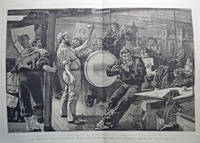
42294London. The Graphic. Sept 1875. overall 40x 58cm 15.3/4" x 23" engraved plate illustration fine condition. Ar. see Holland p279-280. [London]. The Graphic. Sept, 1875 unknown
189359360Copenhagen 1893. Folio. 51 x 45 cm. Orig. printed clothbacked boards. Stamp on title-page. 28 pp. "In the present reproduction only those few pages are printed which concerns the discovery of America by the Northmen in the first years of the 11th century.". Lower right corners damaged by insect-bites no loss of text. Old Norse text English and Danish translation. hardcover
6331264like new. unknown
0578011735.Gpaperback. Good. Access codes and supplements are not guaranteed with used items. May be an ex-library book. paperback
20001560723947Prentice Hall Upper Saddle River NJ 2000. 9th Edition. Hardcover. New . Brand new in shrink wrap. Quantity Available: 1. ISBN: 0130212849. ISBN/EAN: 9780130212849. Pictures of this item not already displayed here available upon request. Inventory No: 1560723947. . 9780130212849 Prentice Hall hardcover
1563319780.Gpaperback. Good. Access codes and supplements are not guaranteed with used items. May be an ex-library book. paperback
184947031Paris Bachelier 1849. 4to. No wrappers. In: "Comptes Rendus Hebdomadaires des Séances de L'Academie des Sciences" Tome 28 No 7. Pp. 189-240 entire issue offered. Wurtz's paper: pp. 223-226. <br/><br/><em>First appearance of the announcement of Wurtz's outstanding discovery of Liebig’s prediction that there might be organic compounds analogous to ammonia and derivable from it by the replacement of hydrogen - the amines. The entire memoir was not published in full until 1855 in 'Annales de Chimie et de Physique'.Wurtz is most noted for his investigation of glycols and for his discovery of the amines. The latter discovery in 1849 the paper offered was very significant at the time for ot suggested the possibility of a new type the ammonia type which helped to explain the behaviour of nitrogenous compounds. Leicester & Klickstein "A Source Book." pp. 362-63. - Parkinson "Breakthroughs" 1849 C. </em> unknown
185048830Paris Bachelier1850. 4to. No wrappers. In: "Comptes Rendus Hebdomadaires des Séances de L'Academie des Sciences" Tome XXXI No. 17. With titlepage to vol. 31. Pp. 561- 592. Entire issue offered. Bernard's paper: pp. 571-574. Titlepage with a faint stamp to top and a stamp in lower margin. <br/><br/><em>First appearance of the first exposition of the glycogenic function of the liver - one of the greatest physiological discoveries of the 19th century. Bernard showed that the liver builds up complex substances including glycogen from the nutriment brought to it by the blood and that these are subsequently modified for distribution to the body.Dibner "Heralds of Science" No 131 - Horblit "One Hundred Books famous in Science" No. 11a here listing "Nouvelle Fonction du Foie" from 1853 but with the remark "The work appeared earlier in abbreviated form in the "Comptes rendus" the paper offered. - Exhibition of First Editions of Epochal Achievements in the History of Science Berkeley 1934. No 107. </em> unknown
189847409Paris Gauthier-Villars 1898. 4to. No wrappers. In: "Comptes Rendus Hebdomadaires des Séances de L'Academie des Sciences" Tome 129 No 16. Pp. 567- 626. Entire issue offered. Debierne's paper: pp. 593-595. Paperquality rather poor a bit fragile. <br/><br/><em>First appearance of the paper in which Debierne announced his discovery of a new radioactive element found in uranium residues."In 1906 Professor Hahn discovered radioactinium between actinium an actinium X. Actinium emanation or "action" like radon is an inert gas was discovered independently by F. Giesel and André Debierne." Weeks "Discovery of the Elements" p. 307.Parkinson "Breakthroughs" 1899 C. </em> unknown
179843089Paris Fuchs et Guillaume An VIe. 1798. Contemp. hcalf. Spine gilt. Very slightly rubbed. Small stamps on verso of titlepage. In: "Annales de Chimie ou Recueil de Mémoires concernant la Chemie" Tome 25. - 3353 pp. 2 engraved folded plates and 1 folded table.the entire volume offered. Vauquelin's papers: pp. 21-32 a. pp. 194-204. Some brownspots to the first and last leaves otherwise fine and clean. <br/><br/><em>First printing of the papers in which Vauquelin describes and announces his discovery of Chromium. The first paper was simultaneously printed in Mem.de l'Institut. Because of its many coloured compounds Fourcroy and Haüy suggested the name 'chromium' for the new metal. Greek chroma-colour.In 1797 Vauquelin began his own studies of Siberian red lead. He was convinced that the mineral contained a new element. None of the elements then known could account for his results. He reported "a new metal possessing properties entirely unlike those of any other metal." A year later Vauquelin was able to isolate a small sample of the metal itself. He heated charcoal nearly pure carbon with a compound of chromium chromium trioxide Cr 2 O 3 . When the reaction was complete he found tiny metallic needles of chromium metal. DSB XIII p. 597 - Parkinson "Breakthrough" 1798 C.The volume contains other importent papers in the history of chemistry Guyton "Examen de quelques propriétés du Platine" a. "Examen de quelques critiques de la nomenclature de chimistes francais" Chaptal "Observations sur la fabrication de l'acétite de cuivre verd-de-gris etc. </em> unknown
190047268Paris Gauthier-Villars 1900. 4to. No wrappers. In: "Comptes Rendus Hebdomadaires des Séances de L'Academie des Sciences" Tome 130 No 20. Pp. 1285- 1344. Entire issue offered. Grignard's paper: pp. 1322-24. One leaf repaired in upper margin affecting the text on verso but without loss of letters. Light browning poor paperquality. <br/><br/><em>First apperance of an importent paper in which Grignard revealed the "Grignard Reagent" an important means of preparing organic compounds from smaller precursor molecules. For this work Grignard was awarded the Nobel Prize in Chemistry in 1912 jointly with fellow Frenchman Paul Sabatier."A large number of general synthetic methods had been developed by the end of the nineteenth century. However one of the most versatile and importent was first described as the new century opened. This was the Grignard synthesis." Leicester "A Source book in Chemistry 1900-1950" where this paper is translated "Some New Organometallic Compounds of Magnesium and Their Application to the Synthesis ofAlchohols and Hydrocarbons"."Grignard treated magnesium turnings in anhydrous ether with methyl iodide at room temperature preparing what came to be known as the Grignard reagent which could be used for reaction with a ketone or an aldehyde without first being isolated. On hydrolyzing with dilute acid the corresponding tertiary or secondary alcohol was produced in much better yield than Barbier had been able to obtain. Grignard’s discovery was reported in a short paper at a meeting of the Académie des Sciences in May 1900 the paper offered." DSB. </em> unknown
184748815Paris Bachelier1847. 4to. No wrappers. In: "Comptes Rendus Hebdomadaires des Séances de L'Academie des Sciences" Tome XXIV No. 7. Pp. 209- 252. Entire issue offered. Sobrero's paper: pp. 247-248. Clean and fine. <br/><br/><em>First appearance of the paper in which Sobrero announced his discovery of nitroglycerin."When I think of all the victims killed during nitroglycerine explosions and the terrible havoc that has been wreaked which in all probability will continue to occur in the future I am almost ashamed to admit to be its discoverer." Sobrero"Nitroglycerin was synthesized by the chemist Ascagne Sobrero in the middle of the nineteenth century. When he tasted it as all good nineteenth century chemists did when they discovered a new compound it gave him what he called a migraine because of its vasodilatory effect which was later harnessed in the treatment of angina by William Murrell 1879 following the experience of a distinguished British clinician Lauder Brunton using amyl nitrite 1867 Later in the nineteenth century Alfred Nobel discovered how to stabilize nitroglycerin using kieselguhr diatomite clay; this led to highly successful industrial applications of dynamite and created the fortune that eventually funded the eponymous prizes. For medical purposes nitroglycerin was subsequently renamed glyceryl trinitrate to hide the fact that it was literally dynamite as well as metaphorically." </em> unknown
189646854Paris Gauthier-Villars 1896. 4to. Near contemp. full cloth. Spine gilt and with gilt lettering. Bookmark "The Chemists Club" in gold on lower part of spine. Light wear along edges. In: "Comptes Rendus Hebdomadaires des Séances de L'Academie des Sciences" Tome 122 Entire volume offered.1633 pp. The papers: 420-421 pp. 501-502 pp. 559-564 pp. 689-694 pp. 762-767 and pp. 1086-1088. <br/><br/><em>First appearance of the six landmark papers in which Becquerel documents his discovery of Radio-activity PROMPTING THE NUCLEAR AGE.Becquerel was an expert in fluorescence and phosphorescence continuing the work of his father and grandfather. Follwing the discovery of X-rays by Röntgen Bexquerel investigated fluorescent materials to see if they also emitted X-rays. He exposed a fluorescent uranium salt pechblende to light and then placed it on a wrapped photographic plate.He found that a faint image was left on the plate which he believed was due to the pichblende emitting the light it had absorbed as a more penetrating radiation. However by chace he left a sample that had not been exposed to light on top of a photographic plate in a drawer. he noticed that the photographic plate also had a a faint image of the pechblende. After several chemical tests he concluded that these "Becquerel rays" were a property of atoms. He had by chace discovered radio-activity and prompted thee beginning of the nuclear age. He shared the Nobel Prize for Physics in 1903 with Marie and Pierre Curie. The "Becquerel Rays" were later discovered to be a composite of three forms of emanation distinguished by Rutherford as alpha beta and gamma rays.Dibner: 163 the later Mémoire from 1903 - PMM: 393 1903- Mémoire - Garrison & Morton: 2001 only the first paper. - Magie "A Sourve Book in Physics" p. 610 ff. - Norman:157. </em> hardcover
188249173Paris: Gauthier-Villars 1882. 4to. No wrappers. In: "Comptes Rendus Hebdomadaires des Seances de l'Academie des Sciences" Vol 94 No 4 15 17. Pp. 149- 184 pp. 997-- 1068 a. pp. 1139- 1214. 3 entire issues offered. Poincare's papers: pp. 163-168 1038-1042 a. 1166-67. <br/><br/><em>First appearance in print of the discovery of the automorphic forms which Poincaré named Fuchsian functions."One of Poincaré's first discoveries in mathematics dating to the 1880s was automorphic forms. He named them Fuchsian functions after the mathematician Lazarus Fuchs because Fuchs was known for being a good teacher and had researched on differential equations and the theory of functions. Poincaré actually developed the concept of these functions as part of his doctoral thesis. Under Poincaré's definition an automorphic function is one which is analytic in its domain and is invariant under a discrete infinite group of linear fractional transformations. Automorphic functions then generalize both trigonometric and elliptic functions." Wikipedia. </em> unknown
183149631Paris Crochard 1831. No wrappers. In: "Annales de Chimie et de Physique Par MM. Gay-Lussac et Arago." tome 46 Cahier 1. Pp. 5-112. Entire issue offered. Sefström's paper: pp. 105-111. <br/><br/><em>First printing of the paper in which Sefström announced his discovery of a new element in iron from the Taberg mine in Småland. He named it Vanadium from the goddess Vanadis.Parkinson "Breakthroughs" 1831 C.The discovery and isolation of Vanadium has a long story to tell. In reality it was found by del Rio in 1801 he named it Erythronium but upon further study he decided that he was mistaken as his further studies showed that it was made up of a basic lead chromate. </em> unknown
185547110Paris Mallet-Bachelier 1855 a. 1857. 4to. No wrappers. In: "Comptes Rendus Hebdomadaires des Séances de L'Academie des Sciences" Tome 41 No 13 and Tome 44 No 12 a. No. 26. Pp. 461-500 pp. 578-640 a. pp. 1293-1363 3 entire issues offered. Bernard's papers: pp. 461-469 pp. 578-586 a. pp. 1325-1331. Some scattered brownspots to the first paper. <br/><br/><em>First printing of these two milestone-papers in physiology in which Bernard discovers and isolates glycogen from the liver shows that it is converted into blood glucose and discovers the process of gluconeogenesis. He further creates the concepts "experimental determination" and "local interieur"Bernard undertook the task of tracing out the various transformations of food stuffs within the animal organism beginning with the carbohydrates; and he not only found contrary to the accepted view that sugar was formed in the liver but he was also able to isolate a substance from the hepatic tissue which though not sugar was converted by fermentation into dextrose. He made a special study of its properties and called it "glycogen"."The culmination of Bernard's work on the glycogenic function of the liver. He invented the term "internal secretion" and can be said to have started the scientific investigation of the internal secretions although for 30 years the significance of his work was not generally realized. By his research on glycogene Bernard showed that the body not only can break down but can also build up complex chemical substances."Garrison & Morton .Claude Bernard 1813-78 was a key figure in French nineteenth-century science and one of the world's great physiologists. With good reason he has been called the ‘father of experimental medicine’.Garrison & Morton No. 1000 a. 999.1 </em> unknown
190051313Paris Gauthier-Villars 1900. 4to. No wrappers. In: "Comptes Rendus Hebdomadaires des Séances de L'Academie des Sciences" Tome 130 No 15 a. No 18. Pp. 962- 1044 a. pp. 1145- 1220. Entire issues offered. Villard's papers: pp. 1010-1012 a. 1178-1182 textillustrations. Clean and fine. <br/><br/><em>First apperance of Villard's two papers in which he announced and described the discovery of a new type of radiation more powerfull and penetrating than alpha-and beta rays. The new type of rays was named by Rutherford as gammarays. </em> unknown
190048207Paris Gauthier-Villars 1900. 4to. No wrappers. In: "Comptes Rendus Hebdomadaires des Séances de L'Academie des Sciences" Tome 130 No 15 a. No 18. Pp. 962- 1044 a. pp. 1145- 1220. Entire issues offered. Stamp on first pages. A few tears to margins. Poor paperquality fragile. Villard's papers: pp. 1010-1012 a. 1178-1182 textillustrations. <br/><br/><em>First apperance of Villard's two papers in which he announced and described the discovery of a new type of radiation more powerfull and penetrating than alpha-and beta rays. The new type of rays was named by Rutherford as gammarays."His Villardexperiments in radioactivity led to the unexpected discovery of gamma rays in 1900. Villard recognized them as being different from x rays because the gamma rays had a much greater penetrating depth. He had discovered they were emitted from radioactive substances and were not affected by electric or magnetic fields. These came to be called gamma rays by another scientist Ernest Rutherford. It wasn't until 1914 that Rutherford showed that they were a form of electromagnetic EM like light only with a much shorter wavelength than x rays. Now we know that gamma rays are a form of EM radiation similar to x rays. Gamma rays tend to have a higher energy and a shorter wavelength than x rays do. However the dividing line between these two forms of radiation is not clearly defined. Scientists typically apply the term gamma ray to EM radiation with energies above several hundred thousand electron volts." Hps - Healt Physics Society. - See Sigmund Brandt "The Harevst of a Century" Episode 6 p. 24 ff.The issues contains other importent papers HENRI BECQUEREL "Note sur la transmission du rayonnement du radium au travers des corps" pp. 979-984 and "Sur la transparance de l'aluminium pour le rayonnement du radium" pp. 1154-57. P. CURIE et G. SAGNAC "Électrisation négative des rayons secondaires produits au moyen des rayons de Röntgen" pp. 1013-1016. </em> unknown
183748086Paris Crochard et Comp. 1837. Orig. printed wrappers. No backstrip. In: "Annales de Chimie et de Physique Par MM. Gay-Lussac et Arago." tome 64 Cahier 2 Fevrier 1837. Pp. 113-224. Entire issue offered with printed wrappers. Wöhler a. Liebig's papers: pp. 185-209 a. pp. 209-217. <br/><br/><em>First appearance of this classic paper in organic chemistry in which Wöhler and Liebig showed how Amygdalin could be decomposed by a vegetable emulsion the first example of a glycoside. The papers were issued at the same time in "Annalen der Physik und Chemie"."The conclusions which you have drawn from the investigation of bitter-almond oil" wrote Berzelius to Liebig and Wöhler "are certainly the most importent which have so far been reached in the domain of vegetable chemistry and give promise of shedding an unexpected light over this part of the science.The facts which you have set forth inspire such reflections that they may be regarded as the dawn of a new day in vegetable chemistry."Berzelius-Wöhler Briefwechsel."During the years that Liebig was preoccupied with the ether theory and with organic acids he also carried out two importent investigations with Wöhler. In october 1836 Wöhler wrote that he had discovered a way to transform amygdalin to oil of bitter almonds and hydrocyanid acis by distilling it with manganese and sulfuric acid and he invited Liebig to join in pursuing the topic. Two days later he made a more remarkable discovery. It had occurred to him that perhaps thetransformation of amygdalin could be effected by the albumin in the almonds in a manner similar to the action of yeast in sugar.Wöhler suspected that the decomposition was an example of what Berzelius had recently defined as catalysis. Liebig and Wöhler then divided up the detailed examination of the properties and composition of amygdalin. They precipitated from the emulsion of almonds a substance which when dissolved retain its action. They named the active substance "emulsion". Its effectiveness in very small quantities confirmed that it acted like yeast."DSB VIII p. 342. </em> unknown
180843299Paris Chez Mad. Ve. Bernard 1808 Contemp. hcalf. gilt spine. Some scratches to binding. Verso of titlepage and plates with small stamps.In: "Annales de Chimie" Vol. 68. - 358 pp. a. 3 engraved plates. The entire volume offered. Gay-Lussac's a. Thenard's paper: pp. 169-174. <br/><br/><em>First announcement of the results that they had obtaines by treating boric acid with potassium showing that acid is composed of a combustible substance and oxygen. "Before regarding their proof of the existance of a new element as complete Gay-Lussac and Thenard wished not only to decomposed boric acid but to recompose it. On November 30 of the same year they were able to state in the 'Annales de Chemie et de Physique" the paper offered that "the composition of boracid s no longer problematical. In fact said they "we decompose and we recompose this acid at will" Weeks "Discovery of the Elements" p. 160. - Parkinson "Breakthroughs" 1808 C. - Bunch 1808.The volume contains other importent paper Davy's famous paper on electrolysis in first French translations Gayton-Morveau"Description d'un hygrometre pour le gaz." d¨'Arcet "Observations sur la potasse et sur la soude préparées à l'alcool" etc. </em> unknown
187848210Paris Gauthier-Villars 1878. 4to. No wrappers. In: "Comptes Rendus Hebdomadaires des Séances de L'Academie des Sciences" Tome 87 No 17. Pp. 570- 616. Entire issue offered. Marignac's paper: pp. 578-581. <br/><br/><em>First apperance of the paper relating Marignac's discovery of the rare earth Ytterbium Ytterbia."He began his study of the rare earths in 1840 when he was barely twenty-three years old. According to P.T. Cleve "Marignac's work on the rare earths is undoubtedly the most importent in this particular department of chemistry". In 1878 marignac heated some erbium nitrate obtained from gadolinite until it decomposed. When he extracted the resulting mass with water he obtained two oxides: a red one for which he retained the name Erbia and a colorless one which he named Ytterbia." Weeks "The Discovery of the Elements".Parkinson "Breakthroughs" 1878 C </em> unknown