Discovery CommitteeBiblio.com
Station List 1935-1937: Discovery Reports V24
125864780X.Gpaperback. Good. Access codes and supplements are not guaranteed with used items. May be an ex-library book. paperback
Bonita · États-Unis54,63 $US≈ 46,22 €
289 résultats
187947273Paris Gauthier-Villars 1879. 4to. No wrappers. In: "Comptes Rendus Hebdomadaires des Séances de L'Academie des Sciences" Tome 88 No 12. Pp. 625- 676. Entire issue offered. Nilson's papers: pp. 642-645 a. 645-648. First leaf with a tear to right margin no loss of paper. <br/><br/><em>First apperance of the papers in which Nilson describes his discovery of a new element and its properties and naming it Scandium. It was the second new element found after Mendeleev's prediction of its existence as "Eka-Boron"."Mendeléeff had predicted that another element which he called eka-boron and which he said would have an atomic weight between 40 calcium and 48 titanium would some day be revealed. It was discovered in 1879 by Lars Fredrik Nilson. Nilson extracted 63 grams of the rare earth erbia from gadolinite and euxenite and converted it into the nitrate. Upon decomposing this salt by heat as Marignac had done he obtained some very pure ytterbia and to his great surprise an earth that was unknown to him.Upon thoroughly investigating this new earth he found that it contained an element whose properties concided almost exactly with those Mendeléef had predicted for ekaboron. Nilson called it scandium in honour of his fatherland."Weeks "Discovery of the Elements" pp. 219-20.Parkinson "Breakthroughs" 1879 C. </em> unknown
125864780X.Gpaperback. Good. Access codes and supplements are not guaranteed with used items. May be an ex-library book. paperback
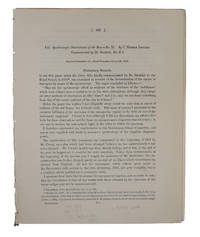
187042423London Taylor and Sons 1870. 4to. No wrappers as extracted from "Philosophical Transactions" 1869 Vol. 159 - Part I. Pp. 425-444 and 2 lithographed plates 1 with the spectrum of helium 1 with his spectroscope not requiring eclipses to function. Clean and fine. <br/><br/><em>First appearance of this milestone paper in chemistry physics and astronomy announcing the discovery of helium in the sun and naming it 'helium' for Helios the Greek God of the Sun. In the same paper he demonstrates his invention of the spectroscope by which the prominences of the sun could be observed and studied without an eclipse by leading the light from the very edge of the sun through a prism. - Helium was not discovered on the earth before 1895 by William Ramsay and it was Crookes who established its identity with the helium Lockyer observed in the spectrum of the sun."This the last discovery was announced on the same day by the French astronomer Janssen who was in India observing a total eclipse. As a result the French government some ten years later struck a medallion showing the heads of both scientists.By that time the two men had made a much more dramatic discovery at the same time this time in cooperation. Janssen studying the spectrum ofthe sun during the eclipse had noted a fine line he did not recognize. he send a report on this to Lockyer an acknowledges expert on solar spectra. Lockyer compared the reported position of the line with lines of known elements concluding that it must belong to a yeat unknown element possibly not even existing on the earth. He named the element from the Greek word for the sun."Asimov. </em> unknown
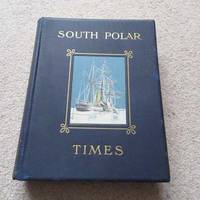
191439Smith Elder London 1914. First Edition. Hardcover Original Cloth. Very Good Condition/No Dust Jacket. 1st Limited Edition: This is copy 43 of a limited edition of 250. Original covers no dust jacket all page edges gilt. Copiously illustrated drawings in the text and full-page plates from sketches and paintings by E. Wilson and others. Gutta-percha binding very delicate with leaves just loosening. Gutta Percha was used as the binding glue in many early books it is not a difficult job to remove and reback using modern glues Ex Library with various library stamps on some pages. The South Polar Times was a magazine written and printed by the members of Antarctic Expeditions during the various voyages they undertook. The South Polar Times form what is perhaps the most personal of the printed documents to have come out of that most remarkable of periods of Antarctic adventures revealing so many often contradictory aspects of these men's various personalities. 'During the Antarctic winter of 1902 and 1903 the officers of the National Antarctic Expedition on board the Discovery among other diversions wherewith to lighten the long and dreary darkness brought out at monthly intervals a periodical to which they gave the name of "The South Polar Times" the contents of which range over a wide field grave and gay scientific and humorous prose and poetry. It contains a diary of the events of each month a record of the proceedings of the local Debating Society a monthly acrostic humorous notes besides articles of a more solid nature as well as stories sketches of various kinds and poems of a standard considerably above average.' One of the corner stones of an Antarctic collection. Volume 1 & 2 were Scott's 1st "Discovery Expedition" Special Limited Edition first issue in this format. Quantity Available: 1. Shipped Weight: Under 5 kilogram. Category: Arctic & Antarctic; Exploration. Pictures of this item not already displayed here available upon request. Inventory No: 39. . This book is extra heavy and may involve extra shipping charges to some countries. Smith Elder hardcover
1839977531.Gpaperback. Good. Access codes and supplements are not guaranteed with used items. May be an ex-library book. paperback
2023__1839977531Jessica Kingsley Pub 2023. Trade Paperback. New. 112 pages. 10.98x8.50x0.50 inches. Jessica Kingsley Pub paperback
2003157790Discovery Communications 2003. DVD. Very Good. Includes 6 clean DVDs and artwork in the 6 original plastic cases and slipcase. In Vietnamese with English subtitles Discovery Communications unknown
181545715London W. Bulmer and Co. 1815. 4to. No wrappers as extracted from "Philosophical Transactions" 1815 - Part II. Pp. 203-213 a. pp. 214-219. <br/><br/><em>First appearance of two importent papers by davy. In the second paper offered he relates his discovery of chlorine dioxyd."By explosion over mercury he found that 2 vols. give from 2.7 to 2.9 of gas and this would probably be 3 vols. if no chlorine had been absorbed by the mercury. This gas contains 2 vols. of oxygen and the remainder chlorine hence the compound consists of 'two in volume of oxygen and one of chlorine condensed into the space of two volumes' ClO2. He found it to explode at about 100 deg. with more viollence than euchlorine."Partington III p. 57.Together with ROBERT PORRETT "Further analytical experiments relative to the constitution of the prussic; of the ferruretted chyazic and of the sulphuretted chyazic acids; and of their salts; together with the application of the atomic theory to the analysis of these bodies." pp. 220-230 a. 2 tables one folding. </em> unknown
2000DADAX0525464050Brand: Dutton Juvenile 2000-07-10. paperback. New. 8.50x0.12x11.00. Buy with confidence. Excellent Customer Service & Return policy. Brand: Dutton Juvenile paperback
0525462937.Gpaperback. Good. Access codes and supplements are not guaranteed with used items. May be an ex-library book. paperback
DADAX1250097770Feiwel & Friends 2016-05-17. Media tie-in. hardcover. New. 9.25x0.75x11.50. Buy with confidence. Excellent Customer Service & Return policy. Feiwel & Friends hardcover
025937248X.Gpaperback. Good. Access codes and supplements are not guaranteed with used items. May be an ex-library book. paperback
1995Q-0833118021The Discovery Channel 1995-06-01. Plastic Comb. New. New. In shrink wrap. Looks like an interesting title! The Discovery Channel unknown
2019mon0003456552Discovery Education 2019T. paperback. Very Good. 0.6693 10.9055 8.5039. Discovery Education paperback
0785337547.Gspiral_bound. Good. Access codes and supplements are not guaranteed with used items. May be an ex-library book. unknown
0428510825.Ghardcover. Good. Access codes and supplements are not guaranteed with used items. May be an ex-library book. hardcover
195044583Washington: Government Printing Office. 1950. First Edition; First Printing. Original Printed Wrappers. Very Good. US Congress Serial Set No. 11401 81st Congress No. 152; 8vo; v 1 99 pages; Contents clean and secure in original printed stapled wrappers; dime-size chip at lower edge of rear wrapper otherwise in very good condition. An examination of the interactions between the Russians and the native populations of Alaska Territory from the late 18th century through the 19th century . From the Russian discovery of Alaska to the establishment of the Russian American Company 1749-1799. Baranov's Rule 1799-1818. Alaska under the Second and Third Charters of the Russian American Company 1821-1867. Period of Transition 1862-1867. Tribal Property Rights. Vladimir Gsovski was Chief of the Foreign Law Section and later Chief of the European Law Division in the Law Library of the U.S. Library of Congress from 1942 until 1960. He was born in Moscow and graduated from the Law School of Moscow University after studying at Law Schools in university of Heidelberg and Leipzig. He left Russia in 1920 after havig fought on the Anti-Communist side during the war. In 1927 he came to the U.S. He was an internationally recognized authority of the law of the U.S.S.R. and other Communist countries as well as an expert on Roman law. . Government Printing Office unknown
200017001405110162000-01-01. Paperback. Very Good. Nice looking book has minor edge wear. paperback
2007AME_9781588296726Humana Press 2007. 1st. Hardcover. New/New. Humana Press hardcover
180950198Paris Mad. Ve Barnard 1809. Contemp. hcalf. Spine gilt. Wear to top of spine. A few scratches to binding. Small stamps on verso of titlepage.In: "Annales de Chimie ou Recueil de Mémoires concernant la Chemie" Tome 70. 336 pp. Entire volume offered. Davy's paper: pp. 189-254. <br/><br/><em>First edition in French the first English 1808 of this importent historical paper in chemistry in which Davy shows that electricity is capable of decomposing some alkalies isolating two new substances and discovering potassium and sodium. Neville in his Historical Chemical Library vol. I p.340 writes about this paper "ONE OF THE GREAT CLASSIC RESEARCHES IN CHEMISTRY in which Davy announced in this his second Bakterian lecture the isloation of metallic potassium and sodium by the electrolytic decomposition of their fused oxides.""He Davy began his own electrical experiments.The results were spectacular. On October 6 1807 the current passing through molten potash liberated a metal which Davy called potassium. The little globules of shining metal tore the water molecule apart as it eagerly recombined with oxygen and the liberated hydrogen burst into lavender flame. Davy danced about in a delirium of joy. A week later he isolated sodium from soda."Asimow. The paper offered here describes these discoveries."Humphry Davy was one of the most brilliant chemists of the early nineteenth century. His early study of nitrous oxide brought him his first reputation but his later and most importent investigations were devoted to electrochemistry. Following Galvani's experiments and the discovery of the voltaic pile interest in galvanic electricity had become widespread. The first electrolysis by means of the pile was carried out in 1800 by Nicholson and Carisle who obtained oxygen and hydrogen from water. Davy began to examine the chemical effects of electricity in 1800 and his numerous discoveries were presented in his Bakerian lecture to the Royal Society on November 20 1806. A Source Book in Chemistry p. 243. </em> unknown
183244145Paris Crochard 1832. Contemp. hcalf. gilt spine light wear along edges. In: "Annales de Chimie et de Physique Par MM. Gay-Lussac et Arago." tome 50 Series 2. Entire volume offered. 448 pp. 2 folded engraved plates. Faraday's papers: pp. 5-67 a. pp. 113-162. <br/><br/><em>First French editions of the 2 first memoirs of Faradays groundbreaking researches on electricity constituting the first 2 papers of his "Experimental Researches in Electricity" and containing his fundamental discovery of electromagnetic induction THE FOUNDATION OF NEARLY ALL THE ELECTRICITY IN USE TODAY. In 1820 Oersted had generated magnetism from electricity Faraday here finds the opposite effect generating electricity by magnetism. He also described the first electrical generator second paper. THESE PAPERS ARE SOME OF THE GREAT CLASSICS OF CHEMISTRY AND PHYSICS."Faraday demonstrated this theory involving the lines of force.by inserting a magnet into a coil of wire attached to a galvanometer. While the magnet was being inserted or removd current flowed through the wire. If the magnet was held stationary and the coil moved over it one way or the other there was current in the wire. In either case the magnetic lines of force about the magnet were cut by the wire.If the magnet and coil were both held motionless whether the magnet was within the coil or not there was no current.Faraday hd thus discovered electricalinduction.It was to lead to great things but this was not apparent."Asimov."Although his discovery of the electric motor and the dynamo was almost entirely identical to his theoretical discoveries it laid the foundation of the modern electrical industry - electric light and power teælephony wireless telegraphy televison etc. - by providing for the production of continous mechanical motion from an electrical source and vice versa." PMM 308.Horblit 29 - Milestones 62. - Dibner 64. - PMM 308. </em> unknown
183248987Paris Crochard 1832. Contemp. hcloth gilt lettering to spine. In: "Annales de Chimie et de Physique Par MM. Gay-Lussac et Arago." tome 50 Series 2. Entire volume offered. 448 pp. 2 folded engraved plates. Faraday's papers: pp. 5-67 a. pp. 113-162. Some scattered brownspots. <br/><br/><em>First French editions of the 2 first memoirs of Faradays groundbreaking researches on electricity constituting the first 2 papers of his "Experimental Researches in Electricity" and containing his fundamental discovery of electromagnetic induction THE FOUNDATION OF NEARLY ALL THE ELECTRICITY IN USE TODAY. In 1820 Oersted had generated magnetism from electricity Faraday here finds the opposite effect generating electricity by magnetism. He also described the first electrical generator second paper. THESE PAPERS ARE SOME OF THE GREAT CLASSICS OF CHEMISTRY AND PHYSICS."Faraday demonstrated this theory involving the lines of force.by inserting a magnet into a coil of wire attached to a galvanometer. While the magnet was being inserted or removd current flowed through the wire. If the magnet was held stationary and the coil moved over it one way or the other there was current in the wire. In either case the magnetic lines of force about the magnet were cut by the wire.If the magnet and coil were both held motionless whether the magnet was within the coil or not there was no current.Faraday hd thus discovered electricalinduction.It was to lead to great things but this was not apparent."Asimov."Although his discovery of the electric motor and the dynamo was almost entirely identical to his theoretical discoveries it laid the foundation of the modern electrical industry - electric light and power teælephony wireless telegraphy televison etc. - by providing for the production of continous mechanical motion from an electrical source and vice versa." PMM 308.Horblit 29 - Milestones 62. - Dibner 64. - PMM 308.The volume contains further notable papers. Elie de Beaumont "Zweiter geologischer Brief.an A.v. Humboldt über die relative Alter der Gebirgszüge" pp. 1-58 a. 2 plates one handcoloured papers by Döbereiner E. Lenz Moser Mitscherlich de Saussure J. Dumas F.E. Neumann Gay-Lussac Johannes Müller "Beobachtungen zur Analyse der Lymphe des Bluts und des Chylus" pp. 513-590. </em> hardcover
184849336Paris Victor Masson 1848 a. 1851. 8vo. 2 contemp. hcalf raised bands gilt spine. Light wear along edges. Small stamps on verso of titlepages and on verso of 1 plate. In "Annales de Chimie et de Physique" 3me Series - Tome XXIV and XXXI. 6512 pp. and 2 plates 512 pp. a. 4 plates.2 entire volumes offered. Pasteur's papers: pp. 442-459 a. pp. 459-460 1 double-page folded engraved plate pp. 67-102 a. 1 plate. Some scattered brownspots to first part of the first volume not affecting P's papers. <br/><br/><em>First full exposition of Pasteur's momentous and revolutionary discovery of "molecular assymetry" and founding the science of Polarimetry.The discovery was first announced by Pasteur in may 1848 by the printing of the preliminary report of only 4 short pages in order to establish priority. The announcement - 4 pages - was published in Comptes rendus hebdomadaires de l’Académie des Sciences Paris Seance of May 15 1848 26 21 535-538 Published on May 1848."In 1848.Pasteur studied the crystals of tartrates one of the substances that exhibited the now-clockwise now-counterclockwise effect under the microscope and found that the crystals were mirror images of the others. The two crystals resembled each other as a right-hand glove resembles a left-hand glove.This was a revolutionary discovery and it took some courage to announce it. A few years before the well-known chemist Mitscherlich had studies the same tartrate crystals and declared them all to be identical. Pasteur was only a twenty-sic-year-old unknown. neverthelless he announced his findings and went before Biot to repeat the separation ofthe crystals before the eyes of the aged authority in the field. Biot was convinced and Pasteur received the Rumford medal of the Royal Society for his work.Pasteur had thus founded the science of polarimetry in which the measurements of the manner in which the plane of polarized light was twisted could be used to help to determine the structure of organic substance to follow various chemical reactions and so on."Asimov. Leicester & Klickstein "A Source Book of Chemistry" p. 374-379. </em> hardcover
183947232Paris Bachelier 1839. 4to. No wrappers. In: "Comptes Rendus Hebdomadaires des Séances de L'Academie des Sciences" Tome VIII No 13. Pp. 459- 504. Entire issue offered. Piria's paper: pp. 479-485. <br/><br/><em>First apperance of a main paper in pharmacology describing the discovery of Salicylic acid compound giving it the empirical formula C7H6O3. It is the most successful drug in history. A trillion tablets are consumed every year. Used to treat everything from headaches to heart disease from rheumatism to cancer - scientists are still struggling to understand all its qualities. But aspirin can truly claim the title of wonder drug.Raffaele Piria 20 August 1814 - 18 July 1865 an Italian chemist from Scilla who converted the substance Salicin into a sugar and a second component which on oxidation becomes salicylic acid a major component of an analgesic drug Aspirin acetylsalicylic acid.Garrison & Morton No 1857. </em> unknown
183149604Paris Crochard 1831. Contemp. hcloth. Some scattered brownspots. "Annales de Chimie et de Physique" 2. Series Tome 48. 448 pp. 1 engraved plate. Entire volume offered. Soubeiran's paper: pp. 113-157. Scattered brownspots. <br/><br/><em>First appearance of an importent paper in chemistry and medicine as it for the first time relates the finding of Chloroform which some years later was proved to have anaesthetic effects and was introduced in chirurgy in 1848 by Simpson.Justus von Liebig Souberain and Guthrie independently discovered Chloroform in 1831 but Souberain was the first to publish his results. Garrison & Morton No. 1851. - Gedeon "Science and Technology in Medicine" 36.7.The volume contains other notable papers by LIEBIG DUMAS DUTROCHET WÖHLER LECANU BECQUEREL etc. </em> hardcover