Simon NANQUIERBiblio.com
173 résultats
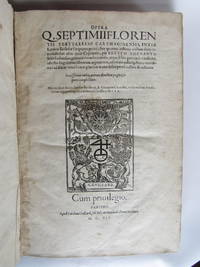
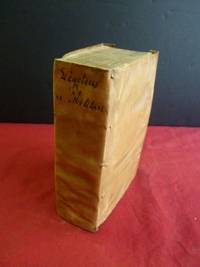
157066372Lugduni Leiden: Apud Benedictum rigaudum Rigaud 1570. Fine. Apud Benedictum rigaudum Rigaud Lugduni Leiden 1570 10.50 x 17 cm relié New edition. The earliest edition is found at the British Library 1498; this is likely the first edition as Charles VIII died that same year. The work was reprinted several times during the 16th century. Bound in rigid half vellum late 19th century. Smooth Jansenist spine. Red shagreen title-label. Some light rubbing. Handsome copy with wide margins. Some pale marginal dampstains. The De Lubrico is a poem on human misery and deception composed in the manner of numerous works of the period with first the poem itself followed by its explanation and the circumstances that produced it scholia. Modern bookplate of the library of F. Renard pasted on front pastedown. Apud Benedictum rigaudum (Rigaud) hardcover
157053001Antverpiae Antwerp Anvers Antwerp: Joannes Stelcius 1570. Fine. Joannes Stelcius Antverpiae Antwerp Anvers Antwerp 1570 6.50 x 11 cm relié New edition of this bible bearing the privilege on the verso of the title page dated January 20 1558. Preface by Johannes Hentenius and probably establishment of the text. Printer's device on title page. Decorated initials. Colophon on verso of last leaf: Excudebat Antverpiae Amatus Tavernerius anno M.D. LXIX. The text is found in the Vulgate version of the very famous Louvain edition of 1547; Charles V had indeed expressly requested a new more accurate version of the Bible and this was made from Greek Aramaic and Hebrew texts. This Old Testament comprises the Pentateuch: Genesis Exodus Leviticus Book of Numbers Deuteronomy and Joshua as well as the Book of Judges and Ruth. All other texts have been excluded from this edition: namely Book of Job Psalms Proverbs Ecclesiastes Song of Songs Wisdom of Solomon Ecclesiasticus but also the prophets: Isaiah Jeremiah. Full red morocco binding of the 17th century. Smooth spine decorated with 4 fleurons with frame of small dot tools. Gilt titles. Boards richly decorated with a central rectangle with medallion and leafy designs in the corners; corner tools and multiple framing fillets. Gilt edges. Tail headcap blackened with 2 small wormholes. Rubbing. Copy slightly warped. Missing the second marbled endpaper. Slight lack to upper joint at head. Handsome copy in decorated 17th-century red morocco. While references for this Antwerp bible can be found in libraries one notes that the collations of these bibles are not the same nor the format; thus the library of the Catholic University of the West at Angers shows Joannes Stelcius hardcover
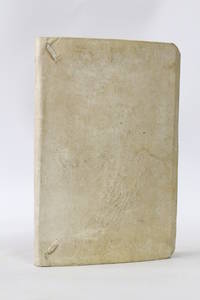
158310458Venetiis Venice Venise Venice: Apud Felicem Valgrisium 1583. Fine. Apud Felicem Valgrisium Venetiis Venice Venise Venice 1583 16 x 11.50 cm relié First edition. Not in Brunet or other French catalogues. Not in French National Library's Italian catalogue either. Modern vellum flaps. 8vo 16 76 ll. A treatise on different types of fever hectic erratic plague-like and what's more unusual on the circulation of the blood. William Harvey gave a full description of the circulation of blood in 1628; this treatise thus comes in the wake of and at the time of the great discoveries on the blood. Galen placed the origin of blood in the liver and this view was not challenged before the 16th century. Apud Felicem Valgrisium hardcover
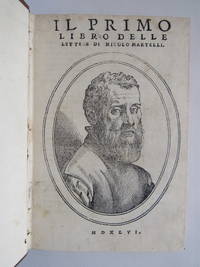
154666243Fiorenza Florence: Nicolo Martelli 1546. Fine. Nicolo Martelli Fiorenza Florence 1546 13.50 x 19.50 cm relié First edition very rare. Portrait of Nicolo Martelli on title page woodcut in a medallion. Address and place in colophon: In Fiorenza a instanza dell'auttore l'anno MDXLVI adi xviij del mese di giugno. Printed by Antonio Francesco Doni. Printed in italics. Edition dedicated to Maddalena Buonaiuta wife of Luigi Alamanni. Only one copy at Cambridge University nothing in the electronic catalogues of the British Library or the Bibliothèque Nationale de France. One copy at the Paul Getty Museum. Listed in Italian sixteen century books Harvard College Library p. 426 427. Vellum copy gift of Philip Hofer. Ca. 1820 binding in half brown sheep. Spine with false raised bands decorated with 5 blind tooled ornaments and blind and gilt fillets. Head worn. Lower joint split at head. Generally rubbed. The 2 lower corners turned and stripped of marbled paper. Yellow stains on final leaves. Label on pastedown: Harvard College Library. From the bequest of Mary P. C. Nash in memory of her husband Benett Hubbard Nash instructor and professor of italian and spanish. 1866-1894. Stamp below label: Harvard College Library Released. On verso of title page stamp: Harvard College Library Nah Fund. In grey pencil below: July 22 1926. Mary Nash was responsible for several foundations following her husband's death including one bearing the name of Benett Hubbard Nash intended for the purchase of books for Harvard. Collection of letters addressed to various personalities including the Queen of Navarre Pietro Aretino Benvenuto Cellini Cardinal Bembo Benedetto Varchi Fiammetta Strozza Michele Angelo Buonaroti and several Lettera d'amore. These letters missives and messages were written from 1539 to 1546. Poet and important literary personality of his time Nicolo Martelli was especially known as a master in the art of love hence the numerous love letters in this collection and the letters to the Queen of Navarre to courtesans. The collection also contains Michelangelo Buonarroti's response to poems sent to the painter celebrating the paintings of the Sistine Chapel. Nicolo Martelli hardcover
154561711Lutetiae Parisiorum Paris Parisiis Paris: Apud Carolam Guillard 1545. Fine. Apud Carolam Guillard Lutetiae Parisiorum Paris Parisiis Paris 1545 22 x 32.50 cm relié Edition of the works of Tertullian produced by Jean de Gagny and Martin Mesnart according to 2 notes on the verso of the title. Fine printer's device on title page. This edition contains 11 more treatises than previous editions of Tertullian's works two of which entitled ""De Trinitate"" and ""De cibis judaicis"" are actually by Novatian. Edition whose privilege was shared with Jean de Roigny. Adams T408. Notes and life of Tertullian by Beatus Rhenanus. This edition is based on that produced by Beatus Rhenanus in 1539 in Basel. Contemporary full brown calf binding. Smooth spine with raised bands. Head worn with cracks to joints. Damage to first raised band. Corners slightly bumped. Dampstains in central and top margins throughout the work quite light then fading then returning. On the last 50 pages dampstain on half the leaves rather light and not troublesome more pronounced on the last index leaves. Leaves 3 to 7 restored with a strip of paper mending a tear. Some manuscript notes in the margins. He who was considered the greatest theologian of his time came from a Berber family and was moreover the first theologian from North Africa. He died around 220 in Carthage but was never canonized by the church since he joined a heretical movement the Montanists at the end of his life. His work is remarkable; it is with him truly that Latin theology begins and the thought of the Trinity of which he employs the term for the first time. He thus affirms the unity of God in three persons and that Christ is both God and man composed of 2 substances. This theological thought as we know would have an immense future. His treatises address different subjects: On Patience On the Flesh of Christ On the Resurrection On the Soul Against the Jews On the Trinity. Among them are found a certain number of polemical works. Apud Carolam Guillard hardcover
1574GT1274London: Henri Binneman for Lucas Harison and George Bishop 1574. 1st Edition . Hardback. Vg. Folio. English edition translated by Arthur Golding. Woodcut decorative initials throughout and final leaf with woodcut device to the foot. Lacking the illus. title-page. Original full calf panelled binding incomplete with worn covers. A rare copy in the original state. Sadly the illus. title-page lacking as often with early books. Spine missing and gatherings loose. Fine illus. rear page with 'Imprinted at London by Henri Binneman for Lucas Harison and Geoge Bishop Anno 1574 followed by complete 24pp index. Engraved illus. initials throughout the volume. ORIGINAL BINDING <br/> <br/> [Henri Binneman] for Lucas Harison and George Bishop hardcover
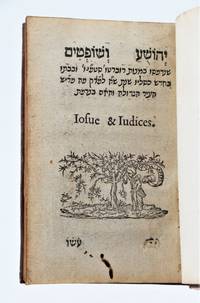
154482811Paris: Robert Estienne 1544. Fine. Robert Estienne Paris 1544 7 x 11.50 cm relié Iosue & Iudices BIBLE IN HEBREW ESTIENNE Robert Estienne Paris 1544 16mo 7x115cm a volume bound in brown morocco. First 16mo edition in Hebrew by Robert Estienne. This pocket edition was printed in 17 volumes between 1544 and 1546 after the success of the four-volume quarto edition printed from 1539 to 1544. Each individual volume unnumbered on the title-page could be acquired separately and considered complete in itself. Elaborate printer's woodcut device on each title page with book titles set within woodcut cartouche head-pieces. Only the title page is in Latin-Hebrew. ""This little edition said to be very accurate is a true typographical jewel and perhaps the most beautiful one ever printed in the Hebrew language. Cette petite édition que l'on dit fort exacte est vraiment un bijou typographique et peut-être ce qui a jamais été imprimé de plus beau en langue hébraïque"" A. A. Renouard Annales de l'imprimerie des Estienne Brown morocco later binding 1590-1615 smooth spine with gilt fillets double gilt borders on covers all edges gilt. Marginal wormhole on the lower part of the leaves not affecting the text. Upper part of joint slightly cracked some rubbing. This edition is based on the Hebrew Soncino princeps published in 1488 and was established by Humanist François Vatable early scholar of Hebrew studies during the Renaissance and royal lecturer of Hebrew under Francis I. The text in Hebrew follows the Masoretic tradition and presents diacritics that facilitate its vocalization. Talented scholar François Vatable 1495-1547 was a member of the Cénacle de Meaux' founded by Jacques Lefèvre d'Étaples and published with him in 1530 the first complete French translation of the Bible known as the Bible of Antwerp. After founding the Collège de France in 1530 King Francis I appointed him chair of Hebrew studies. As a Royal lecturer he actively participated ten years later in a Hebrew edition the Bible with Robert Estienne 1503-1559 printer to the King in Latin and Hebrew. This edition is undoubtedly a real typographical feat for a small format text in Hebrew lettering. It was certainly intended for scholarly use by Sorbonne and Collège Royal students given its pocket size sold in separate individual volumes. The presence of numerous contemporary marginal notes further indicates its educational purpose as is the numbering of lines of several pages in some of our volumes. A very beautiful and scarce collaborative work by two of the greatest figures of Parisian humanist scholarship a fine example of the renewed interest in classical texts and their study in the original language. Provenance: library of Charles John Dimsdale 1801-1872 fifth baron of the Russian Empire with his bookplate on each pastedown endpaper. Robert Estienne unknown
156410452Parisii Paris Paris: apud aegidium Gilliumin vico Ioan Lateran 1564. Fine. apud aegidium Gillium in vico Ioan Lateran Parisii Paris Paris 1564 16 x 10.40 cm relié Rare first edition. Not held by the Bibliothèque Nationale de France. Brunet II 1236. Title vignette. Modern full vellum binding with overlapping flaps. Plain spine ties. Light marginal dampstaining to first few pages. Some foxing. Auger Ferrier 1513-1588 of Toulouse was simultaneously a renowned astronomer physician and physicist he was one of Catherine de Medici's private physicians. The work is a treatise on the Spanish plague or Spanish pox otherwise called the Neapolitan disease which is none other than syphilis and which had been wreaking havoc in France for some time depending on the country it was also called the French disease. Description of the illness and remedies. There follows a chapter intended for barbers and the remedies they could employ not being physicians falling nails alopecia; this treatise is followed by its translation as barbers were not learned and did not speak Latin yet they often practiced various surgical operations. apud aegidium Gilliumin vico Ioan Lateran hardcover
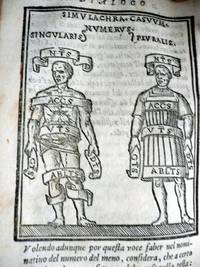
158613002In Venetia Venice Venise Venice: apresso Giambattista Sessa & fratelli 1586. Fine. apresso Giambattista Sessa & fratelli In Venetia Venice Venise Venice 1586 15.30 x 10 cm relié New edition after the 1562 original. Rare. Brunet II 789. Italic typeface edition illustrated with about twenty curious figures in and outside the text notably associating objects with letters. One copy at Manchester library we found nothing in France and Germany. Contemporary full vellum binding smooth spine with handwritten title lengthwise in pen. One tear on the spine 1 cm. Endpapers restored the title page has been reinforced with two small pieces of paper on the verso. Lodovico Dolce 1508-1568 Venetian man of letters and humanist worked on editions of Italian classical texts Dante Petrarch. in collaboration with the publisher Ferrari and renewed the genre which bears his mark. He translated the Metamorphoses into Italian and wrote several dialogues including one on painting featuring Vasari and Aretino and another on the properties of colors. He wrote notably theatrical pieces. The general theme of the present dialogue is occultism astrology. apresso Giambattista Sessa & fratelli hardcover
158787613A Paris: Chez Mamert Patisson 1587. Fine. Chez Mamert Patisson A Paris 1587 8.50 x 15 cm relié New edition following the original of 1573. A handsome edition well printed in italics. It contains the Christian poetry absent from the 1600 edition. Copy enhanced with a portrait of the author from around 1820. Full glazed blonde calf Restoration binding signed at foot F. Bozérian jeune. Spine with raised bands decorated with 5 fleurons fillets and roulettes on the bands. Date at foot in blind. Boards ruled in blind with frame roulette composed of interlaced circles. Interior Greek key border. Edges gilt. A small fragment missing from head. Some traces of rubbing. Paper very fresh the engraving has caused slight uniform foxing on the title page. A handsome copy. The volume contains: Les amours de Diane; Les amours d'Hippolyte; Les dernières amours de Cléonice; Les Elégies; Les imitations de l'Arioste; Les meslanges contenant Les diverses amours les bergeries et masquarades les épitaphes les prières et oeuvres chrétiennes. Desportes' poetry was durably influenced and shaped by Italian literature. The author indeed returns to France after a journey to Italy where he underwent the influence of Petrarch - his first poems are moreover criticized as neo-Petrarchan. His first book appeared in a collective collection and gathered his poetry imitated from Ariosto. His clear frank mannerist and refined poetry court poetry eclipsed that of Ronsard at the court of Henri III. It was in turn criticized and replaced by that of Malherbe. Desportes' literature nonetheless constitutes an important aspect of Renaissance poetry. Chez Mamert Patisson hardcover
157543955Genève Geneva: Chez Eustache Vignon 1575. Fine. Chez Eustache Vignon Genève Geneva 1575 11 x 18 cm relié New edition reproducing that originally published by the same publisher in 1573. 84 letters text on 36 lines. Contemporary full vellum binding with overlapping edges. Smooth spine. Lower compartment clumsily restored as well as an angular lack to the lower corner of the second board. Light worming to the first endpaper and the first three leaves not touching the text. A pale dampstain to the lower margin of half the volume. Manuscript annotation on title page ""ExLB MMagdal Rochesse 1713"". Theodore de Bèze alone embodies and personifies Christian humanism; above all a churchman he was the undisputed leader of Protestantism from 1575 and directed the Church of Geneva for fifty years after Calvin. He was also a Latinist and Hellenist playwright poet and artist statesman and diplomat in the service of the cause of the Reformation as his correspondence amply testifies. Through his immense correspondence which surpasses in scope the already prodigious ones of Heinrich Bullinger and Calvin he organized and encouraged the defense of the reformed faith throughout the European continent. This edition brings together the letters of Bèze as theologian and polemicist concerned with political reflection. Chez Eustache Vignon hardcover
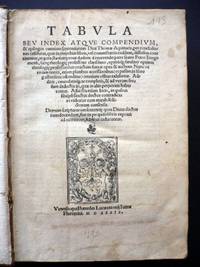
153926396Venetiis Venice Venise Venice: Apud Haeredes Lucaeantonij Iuntae Florentini 1539. Fine. Apud Haeredes Lucaeantonij Iuntae Florentini Venetiis Venice Venise Venice 1539 17 x 24 cm In-4 relié New edition following the princeps of 1473 in Bologna under a different title. Very rare. Printers device of the Junta on the title page and the final leaf. Dedication to Hercules Gonzaga of Mantua. Not in Brunet. One copy in Oxford and one in the Italian catalogues but none in the French catalogues nor in the Bibliothèque nationale de France. Half calf binding c. 1800. Spine with raised bands and gilt fillets. Brown morocco title-piece. Headcap trimmed. Rubbing to edges. NB: This volume is available at the bookshop on request within 48 hours. Pietro da Bergamo died 1482 whose real name was Almaldura authored this work known as the tabula aurea the golden table as it became the unique and essential instrument for the reading and consultation of the works of Saint Thomas see La tabula Aurea di Pietro da Bergamo by T. Sterli Trento published in 2003. The tabula is a universal index to the entire work of Thomas Aquinas. A second part with separate pagination comprises another index: Concordantiae dictorum et conclusionum divi Thomae de aquino. Finally a last part lists entries by biblical term Psalms Daniel Deuteronomy etc. This new edition is the work of Vincenzo Giaccari. Having been revered as a saint during his studious life as a Dominican friar Fra Pietro da Bergamo was laid to rest in the crypt of the chapel of Saint Thomas Aquinas. Apud Haeredes Lucaeantonij Iuntae Florentini hardcover
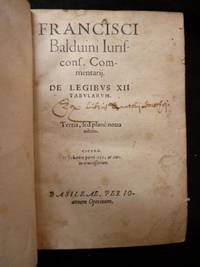
155741235Basileae Basel Bâle Basel: Per Ioannem Oporinum 1557. Fine. Per Ioannem Oporinum Basileae Basel Bâle Basel 1557 12.50 x 18.50 cm relié Third edition first octavo published in Basel after two folios published in Paris in 1550 and 1554 for the first text. The two following texts are in first edition. Text in single column 33 lines per column. Not in Brunet. Full speckled brown calf binding 18th century. Spine with five raised bands decorated with red morocco title label gilt compartments and fleurons. All edges red. Upper board joint cracked along its entire length. Minor wormholes on first board and at foot of lower board headcap. Three corners bumped. Pale dampstains. Minimal wormhole damage on first endpaper. Both an eminent jurist and no less renowned Renaissance theologian François Baudouin animated his studies with a very particular thesis at the junction of both disciplines; he therefore set out to find the historical and true sources of law and particularly of Roman law. His work and reflections on the 12 tables of the law are placed in this perspective. In his other works Baudouin remains attached to his thesis seeking in historical and religious origins the foundations of laws and law. Per Ioannem Oporinum hardcover
15546951Bâle Basel: Chez Nicolas Bryling 1554. Fine. Chez Nicolas Bryling Bâle Basel 1554 11 x 17.5 cm relié New edition. Although we have found no trace of this Basel edition the first edition was published in Venice by Aldus in 1527 with a different collation. Not held by the Bibliothèque nationale de France and absent from French catalogues. Oxford holds an edition with the same date. English catalogues mention several copies at different dates. Printed in italic type. Fine contemporary German binding on pigskin with clasps in perfect working order. Spine with 3 raised bands unlettered with handwritten paper lettering piece boards stamped in blind with decorative rolls in frames leafy designs with medallions representing Erasmus of Rotterdam and Philip of Milan Martin of Paris John of . Central rectangle with interlacing foliate mirror patterns. 2 dampstains on the upper board one 2cm in diameter and the other 4cm extending outward. Fresh paper. Priscian was a Roman grammarian of the 6th century AD whose Latin name was Priscianus Caesariensis named after his native city of Caesarea in Mauritania. Little is ultimately known of his existence except that he taught in Constantinople and above all that his major work to which he owes his fame the Institutiones Grammaticae in 18 books became the reference for Latin grammar until the end of the Middle Ages. The present work is a collection that brings together different works by Priscian linguistic studies or translations of Hermogenes and Dionysius Periegetes. Chez Nicolas Bryling hardcover
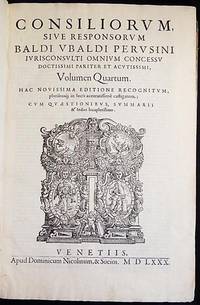
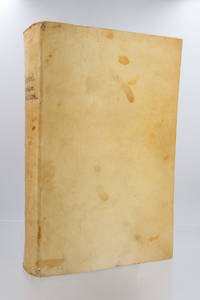
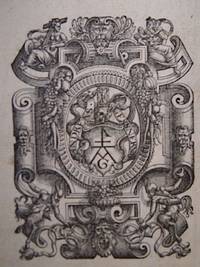
1580003503Venice: apud Dominicum Nicolinum & Socios Domenico Nicolino 1580. Hardcover. Very Good . Vols. 4 & 5 of 5 only. 2 volumes in 1. "Hac novissima editione recognitum pluribusq; in locis accuratissime castigatum; cum quaestionibus summarii & indice locupletissimo." 117 leaves 234 p. 139 leaves 278 p.; 37 cm. Signatures: A-P8 -P7 -P8 A-R8 S4 last leaf blank folio. Original parchment over boards. Five spine compartments between raised bands; hand-written title in first compartment. Handwritten identification also on lower page edges. Large and elaborate printer's device on title pages which combines the earlier printer's device of Domenico Nicolino a woman holding a wreath with three others presumably of the partners Socios referred to in the imprint. In Very Good Condition: original parchment over boards rubbed and soiled with loss of parchment at ends of spine and over raised bands; loss at lower corner of front board; small stain along lower edge of 5:2-22 not impacting text; minor soiling along lower edge of 5:42 verso and 5:43 recto; marginal worming in vol. 5; otherwise clean and bright. apud Dominicum Nicolinum, & Socios [Domenico Nicolino] hardcover
160082166Francofurti Francfort Frankfurt am Main: Apud haeredes Andreae Wecheli Andreas Wechel 1600. Fine. Apud haeredes Andreae Wecheli Andreas Wechel Francofurti Francfort Frankfurt am Main 1600 21.50 x 34 cm relié Rare first edition. Text in two columns. Very fine printer's device on the title page and at the colophon. Contemporary full vellum binding smooth spine with pen-and-ink title some stains on boards. Some worming without touching the text as well as scattered dampstains. Originally from Hesse Calvin was professor of jurisprudence at the University of Heidelberg as well as a compiler and author of manuals on politics Roman law and Mosaic law. Apud haeredes Andreae Wecheli [Andreas Wechel] hardcover
1571015795Venetiis Venice: In Officina Valgrisiana 1571. Illustrated with many hundreds of half-page woodcuts. pp 14 922 13 the title page is laid down and has slight losses the next leaf is restored at the corner with no loss of text the preliminary index is a bit thumbed and marked a little marginal staining to the last hundred pages a little marginal staining and marking on occasional pages but overall very firm and tight and in better condition than many copies. There are very neat early manuscript notes on many pages mainly limited to the common English names. Contemporary simple lined calf rebacked and with new endpapers in the early twentieth century with the original spine laid down. An inked paper title label on the spine. The Hartland Library copy with labels and manuscript notes attached to the front endpapers. RARE. The Library was formed by Edwin Sydney Hartland and was a diverse but major collection of herbals archaeology and anthropology. It was donated to Gloucestershire County Council in 1936 and was eventually dispersed around 2010. This the first edition of a digest of Mattioli's commentaries on Dioscorides expressed in the form of an encyclopedia of plants giving synonyms classification description locale and medicinal qualities and uses. A careful student of botany he described 100 new plants and coordinated the medical botany of his time in his Discorsi "Commentaries" on the Materia Medica of Dioscorides. The first edition of Mattioli's work appeared in 1544 in Italian. In addition to identifying the plants originally described by Dioscorides Mattioli added descriptions of some plants not in Dioscorides and not of any known medical use thus marking a transition from the study of plants as a field of medicine to a study of interest in its own right. In addition the woodcuts in Mattioli's work were of a high standard allowing recognition of the plant even when the text was obscure. A noteworthy inclusion is an early variety of tomato the first documented example of the vegetable being grown and eaten in Europe. There is also an early illustration of a coconut. First Edition. Full-Leather. Good. In Officina Valgrisiana Hardcover
155646906Tiguri Zurich Zurich Zurich: Apud Gesneros fratres Gessner 1556. Fine. Apud Gesneros fratres Gessner Tiguri Zurich Zurich Zurich 1556 20 x 31.50 cm relié First edition from this publisher. Printer's device of Andreas Gesner on title page and on verso of final leaf; this device also appearing on verso of the leaf preceding the index. Bilingual edition with double-column printing Greek on one side Latin translation on the other; the two Greek columns form the middle of the book. Edition produced by Conrad Gesner celebrated Swiss naturalist printed by Andreas Gesner and published by Hans Jakob Gesner. At colophon: Tiguri per Andream Gesnerum f. et Iacobum Gesnerum fratres. The translations from Greek are by Theodore Gaza 1400-1475 Sebastian Guldenbeck died 1565 and Pierre Gilles 1490-1555. The De militaribus text is illustrated with several in-text figures including a large double-page plate military camp. Note also the fine historiated initials. Armorial copy with the arms of the University of Paris on upper cover: three fleur-de-lys on lower cover two crossed quills. Full brown sheep binding of the 17th century. Raised band spine richly decorated gilding partly faded. One title-label in red morocco a second in brown morocco. Cracked joints with various lacks. Headcaps worn. Corners bumped. Title page reinforced on verso at margin. An old paper strip in the middle on first leaves. Leaf 605 restored at margin. Edition that gathers the works of Claudius Aelianus Roman orator and historian writing in Greek died 235. Only two of Aelian's works survive On the Nature of Animals De natura animalium in 17 books which is a natural history book the author citing 70 species of mammals 109 species of birds about fifty reptiles and approximately 130 fish Pierre Gilles and Conrad Gesner are the commentators. Aelian's second work is entitled Miscellaneous History Variae historiae a collection of anecdotes on highly varied subjects Commentator: Justus Vultejus. The edition also provides a third text by Aelian De Militaribus but Claudius Aelianus is not actually the author; it is by Aelian the Tactician a Greek writer who lived a century earlier but who was only identified in the 19th century; his treatise on tactics is most valuable being an exposition on the Macedonian army in the Hellenistic period. This treatise would enjoy great success during the Renaissance from its first Latin translation in 1487 by Theodore Gaza which Gesner's edition adopts in a presentation by Robortello dating from 1552. The works of Claudius Aelianus are actually compilations of curious anecdotes extracted from ancient authors but have the merit of informing us about many rare authors who have disappeared. This type of work would furthermore be abundantly copied and plagiarized during the Renaissance notably by Polydore Vergil The Book of the Inventors of Things which also gathers knowledge in all fields in the anecdotal style. Finally the work eager to be absolutely exhaustive on the Roman author also assembles Aelian's correspondence that has come down to us: Epistolæ rusticæ in a translation by Guldenbeck. Apud Gesneros fratres( Gessner) unknown
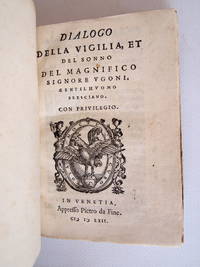
156255314In Venetia Venice Venise Venice: Apresso Pietro da Fine 1562. Fine. Apresso Pietro da Fine In Venetia Venice Venise Venice 1562 10 x 14.50 cm relié First edition rare of these three editions functioning as 3 distinct parts of a single work the signature of the gatherings indeed links the parts together; it happens however that one finds certain texts in isolation. 3 title pages with the printer's device of the cockerel. Early 20th century full vellum binding. Smooth spine with title in pen in red and black. Stains and soiling. Good copy very fresh. The philosophical dialogue of waking and sleep bears witness to a relatively pessimistic and skeptical vision typical of the Reformed vision. Ugoni was indeed Protestant and his perception of man and the world are unquestionably its reflection. The impossibility of distinguishing between the waking state and that of sleep reflects the indetermination of our knowledge necessarily destined for illusion man wandering in a world of shadows. The dialogue reprimands man for having been too audacious in trying to understand what has been forbidden by God; man would waste his time trying to uncover what is by definition beyond his understanding and his reach. God allows man to understand what is necessary for the preservation of his body and his soul the rest belongs to God. However man must not therefore abandon himself to his senses quite to the contrary is it imperative for him to cultivate the qualities of his mind in accordance with God's designs God having given man the gift of reason. The weakness of human knowledge is constantly repeated in the dialogue as is the existence of a metaphysics. The author was condemned for heresy by the tribunal of Venice in 1565 and it is thought that his nobility spared him a death sentence. The discourse on Venice would be an attempt to soften too severe a judgment. Bookplate Eug. D. Forgues. Parisiis. 1921. Apresso Pietro da Fine hardcover
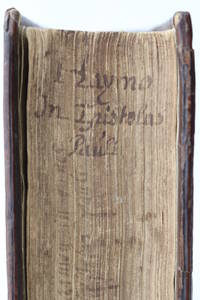
153910444Coloniae Cologne Cologne: Ex officina Eucharii Ceruicozni. Impensis Magistri Godefridi Hitorpii 1539. Fine. Ex officina Eucharii Ceruicozni. Impensis Magistri Godefridi Hitorpii Coloniae Cologne Cologne 1539 16.20 x 11 cm relié Rare edition unknown to the Bibliothèque Nationale de France and to numerous libraries. Handsome Renaissance binding in full glazed brown calf with spine in four compartments boards formed of a central rectangle divided at its center and decorated with leafy designs rich frieze framing the rectangle composed of musical angels a flutist a drummer and decorative elements. Slits for the placement of ties now missing. Upper headcap restored and minor various restorations edges corners and endpapers. One volume small octavo unpaginated and unfoliated. Haymo was a Benedictine priest of the 9th century he died in 853 after having traveled notably to Tours and exercised different functions particularly teaching at the monastery of Fulda he was appointed abbot of the monastery of Halberstadt. He was a prolific writer and most of his works are commentaries on the holy scriptures as with the book we present which concerns the epistles of St. Paul. Following in this the exegetical tradition of his time Haymo was not an original commentator and his ideas are drawn from the church fathers but his position tends to accentuate the profoundly moral and mystical character of the texts he comments upon and his works have the interest of reflecting the century in which he lived. Ex officina Eucharii Ceruicozni. Impensis Magistri Godefridi Hitorpii hardcover
158323286Anvers Antwerp: Par Guillaume Niergue 1583. Fine. Par Guillaume Niergue Anvers Antwerp 1583 8 x 12.50 cm relié The first edition was published in 1578 in Geneva. Brunet II 1076: 'Cet ouvrage piquant a été édité à Genève en 1578 et non à Paris ; selon plusieurs bibliographes. L'auteur y a prodigué son immense érudition mais en même temps s'y est permis certaines plaisanteries un peu hardies qui lui attirèrent une verte semonse du conseil de Genève par suite de laquelle il jugea prudent de s'absenter. Il en existe deux autres d'Anvers 1579 et 1583 in 16 qui ne sont guère moins rares que la première et dont le prix est assez élevé.' ""This piquant work was published in Geneva in 1578 and not in Paris; according to several bibliographers. The author lavished his immense erudition upon it but at the same time permitted himself certain rather bold jokes which brought him a sharp rebuke from the Geneva council as a result of which he judged it prudent to absent himself. There exist two others from Antwerp 1579 and 1583 in 16mo which are hardly less rare than the first and whose price is quite high."" Full calf binding mid-19th century. Ornate spine with raised bands in the style of a 17th-century binding. Rubbing. Missing the lower right corner of leaf 97 with loss of a few letters from the last word. Satirical dialogues mocking court behaviors fashion in dress and language the fashion of pronouncing French words in the Italian manner for example or linguistic conventions about titles. Henri Estienne conceals himself under the name of Jean Franchet. The drollery and mockery are often pushed quite far and the whole reads with the greatest delight. The two dialogues are preceded by poems addressed to courtiers no less droll and satirical. Par Guillaume Niergue hardcover
150860047Haguenau: Pallas Spangelimpensis Johann Rynmannin officina industrii Henrici Gran 1508. Fine. Pallas Spangel impensis Johann Rynmann in officina industrii Henrici Gran Haguenau 1508 20 x 29 cm relié First edition very rare. Colophon f. m7: Impressarum in impiali opido Hagenau finit feliciter anno salutis nostre millesimo quingentesimo octavo Xij die mensis julii. Epistle on the verso of the title page addressed to the bookseller Andreas Grindelhart by Pallas Spangel responsible for the edition. Not in Brunet. One copy at the Bibliothèque Nationale de France one at the Mazarine Library. Half vellum binding from the late 19th century. Smooth spine. Red morocco title label. Marbled paper boards. 2 brown stains on title page affecting the last 4 lines of text 2 perforations in margin. French Dominican friar of the 13th century 1190-1277 Humbert de Romans or sometimes de Bourgogne made his mark through his writings teaching and preaching he was appointed head of the Dominicans in France and worked to unify the liturgy. Besides classical sermons one will find sermons addressed to students of medicine grammar to the poor to the infirm in hospitals to the sick. The sermons are followed by selected correspondence from Humbert. Pallas Spangelimpensis Johann Rynmannin officina industrii Henrici Gran hardcover
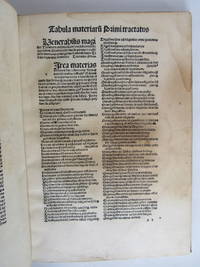
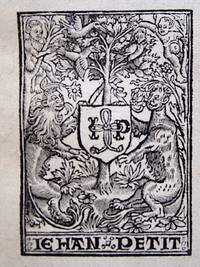
150847403Paris: Jehan Petit 1508. Fine. Jehan Petit Paris 1508 10 x 16.50 cm relié New post-incunabula edition in Petit Jehan. Gothic print in two columns to 45 lines. Thumbnail of the printer on the title page. The first edition was published in 1498. Jehan Petit reprinted several times in sermons 1506-1522 Brunet. Many white initials on black full of stars or others. Colophon transcribed: ""Opera Johannis Barbier impensis vero honesti viri Johannis Small Bibliopole parisiensis impressorum. Anno. M.CCCCC. VIII quarto nonas maii. » Full burgundy morocco binding late nineteenth or early twentieth century. Back with nerves decorated with jewels box section 5. Golden tail date basis. Cold coaching nets on the dishes. Gilt edges. Wetting the top right corner of folios 65-73 and 153-175. Beautiful specimen rare in this condition. Olivier Maillard 1430-1502 Vicar General of the Franciscan observant of France in 1502 is one of the greatest figures of the Franciscan order at the end of the XV. From Brittany and died in Toulouse he was a preacher of Louis XI and the Duke of Burgundy. His reputation is mainly based on the preaching he did during the years 1494 and 1508 in the church of Saint-Jean en Greve in Paris and strange liberties he gave it. He seemed never find the word hard enough nor sufficiently vivid expression to his sermons. ""Nobody had ever attacked all classes and all social professions more boldly virulence and tasteless. Each of his sermons is a bitter and outrageous satire covered with foul language trivial and words borrowed from bad places of the lowest ""Hoefer. The style of Olivier Maillard was rated ""Macaronic"" by Sainte-Beuve in his historical and critical Table of poetry and the French theater in the eighteenth century. See Moreau chronological inventory Parisian editions of XVIII century. ""Brother Olivier Maillard was a preacher of the fifteenth century who acquired much fame pronouncing several Latin sermons mixed with French in which he declaimed against the vices of the great the church people and lawyers. ""Brunet III 1318 Jehan Petit unknown
159221979Lugduni Batavorum Leiden Leyde Leiden: Ex officina Plantinianaapud Franciscum Raphelengium 1592. Fine. Ex officina Plantiniana apud Franciscum Raphelengium Lugduni Batavorum Leiden Leyde Leiden 1592 12 x 17 cm relié Second Plantin edition with Steewech's commentaries after that of 1585. A printer's device on both title pages. Fine and esteemed edition. Illustrated with 51 woodcuts in and outside the text military machines military manoeuvres. and with a folding plate showing the organization of a Roman camp. The commentaries by Stewachius 1557-1588 have a particular title page: Godescalci Stewechii Commentarius ad Flavi Vegeti Renati De re militari libros. Accesserunt eiusdem G. Stewechii & Francisci Modii. The text of Polybius book VI of his History was translated into Latin by Janus Lascaris 1445-1535. The military dictionary Modesti libellus De vocabulis rei militaris was compiled by Pomponius Laetus 1425-1497 or Leto and his students based on Vegetius's work. Contemporary limp vellum binding with overlapping edges. Traces of ties. Black title in pen. Handsome copy. Binder's error: pages 49-64 have been placed after page 32 so that after page 48 comes page 65. Vegetius was a Roman military writer of the second half of the 4th century and apart from the fact that he was a civil servant of the Empire little is known about his life. We have from this author a treatise in five parts: the first deals with recruits and recruitment the second with the organization of the Legion and ancient Roman armies the third with military manoeuvres in the field the fourth with the attack and defense of fortified places the fifth concerns naval tactics. Steewech commentator of this edition was professor at Pont-à-Mousson. Engraved armorial bookplate of Jean-Baptiste Peyer lord of Fontenelle. Ex officina Plantinianaapud Franciscum Raphelengium hardcover
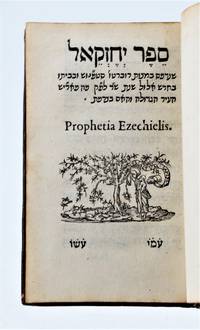
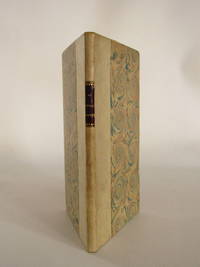
154382820Paris: Robert Estienne 1543. Fine. Robert Estienne Paris 1543 7 x 11.50 cm relié Prophetia Ezechielis BIBLE IN HEBREW ESTIENNE Robert Estienne Paris 1543 16°7x115cm a volume bound in brown morocco. First 16mo edition in Hebrew by Robert Estienne. This pocket edition was printed in 17 volumes between 1544 and 1546 after the success of the four-volume quarto edition printed from 1539 to 1544. Each individual volume unnumbered on the title-page could be acquired separately and considered complete in itself. Elaborate printer's woodcut device on each title page with book titles set within woodcut cartouche head-pieces. Only the title page is in Latin-Hebrew. Numerous contemporary Latin annotations certainly by a scholar. ""This little edition said to be very accurate is a true typographical jewel and perhaps the most beautiful one ever printed in the Hebrew language. Cette petite édition que l'on dit fort exacte est vraiment un bijou typographique et peut-être ce qui a jamais été imprimé de plus beau en langue hébraïque"" A. A. Renouard Annales de l'imprimerie des Estienne Brown morocco later binding 1590-1615 smooth spine with gilt fillets double gilt borders on covers all edges gilt. Binding slightly rubbed. This edition is based on the Hebrew Soncino princeps published in 1488 and was established by Humanist François Vatable early scholar of Hebrew studies during the Renaissance and royal lecturer of Hebrew under Francis I. The text in Hebrew follows the Masoretic tradition and presents diacritics that facilitate its vocalization. Talented scholar François Vatable 1495-1547 was a member of the Cénacle de Meaux' founded by Jacques Lefèvre d'Étaples and published with him in 1530 the first complete French translation of the Bible known as the Bible of Antwerp. After founding the Collège de France in 1530 King Francis I appointed him chair of Hebrew studies. As a Royal lecturer he actively participated ten years later in a Hebrew edition the Bible with Robert Estienne 1503-1559 printer to the King in Latin and Hebrew. This edition is undoubtedly a real typographical feat for a small format text in Hebrew lettering. It was certainly intended for scholarly use by Sorbonne and Collège Royal students given its pocket size sold in separate individual volumes. The presence of numerous contemporary marginal notes further indicates its educational purpose as is the numbering of lines of several pages in some of our volumes. A very beautiful and scarce collaborative work by two of the greatest figures of Parisian humanist scholarship a fine example of the renewed interest in classical texts and their study in the original language. Provenance: library of Charles John Dimsdale 1801-1872 fifth baron of the Russian Empire with his bookplate on each pastedown endpaper. Robert Estienne unknown