Guido PAPEBiblio.com
173 résultats
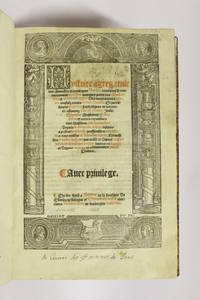
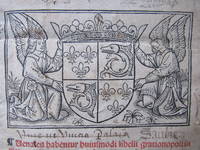
150868717Grationopoli Grenoble Grenoble: Franciscum Pichatum et Bartholomeum Bertoletum François Pichon et Bartholomé Bertholet 1508. Fine. Franciscum Pichatum et Bartholomeum Bertoletum François Pichon et Bartholomé Bertholet Grationopoli Grenoble Grenoble 1508 S.d. 17 x 24 cm relié First edition. Title page in red and black. Title vignette with the arms of Dauphiné flanked by 2 angels. Manuscript inscriptions from the 16th century in the margins of the title page the one at the bottom of the page recalling the history of Humbert bequeathing Dauphiné to the eldest son of the King of France. On the last leaf manuscript ex libris as well as on the verso of the first blank leaf: Je suis l'abbé de Pinet et de Cours ""I am the abbot of Pinet and Cours"". Title inside the volume in the upper margin: Statuta Delphinatus. Gothic printing in 2 columns of 45 lines. Brunet J.-C. Manuel du libraire et de l'amateur de livres 5th ed. II 1812. As Brunet specifies 2 blank leaves at the end one separating the 2 parts. 2 copies in the Harvard Hollis catalog Harvard Law School Library and Brown University nothing in the catalogs of the Bibliothèque Nationale de France one copy located at the Caen library. Full chamois binding 17th century. Jansenist spine with raised bands. Red morocco title label. Holes and worm damage on the spine. Extensive worm damage on the boards. Visible stitching along the inner hinge. Title page browned some stains. A dampstain on the verso of the title page and various traces of brown dampstains throughout the volume. From leaf XVI of the second part wormholes affecting some letters. In 1349 the Dauphin Humbert II without heir bequeathed Dauphiné to the eldest son of the King of France who would henceforth bear the title of Dauphin as sovereign of this province. Louis XII son of Charles VII would be the first Dauphin. Going to Dauphiné would be the first responsibility of the future King of France. From 1447 the Dauphin Louis went to his lands where he resided for 10 years. Louis decided to govern this province and modernized it by having a register of the rights privileges and freedoms of Dauphiné compiled the delphinal register. This register would be the basis of the statutes of Dauphiné found in this customary. In 1461 Louis the Dauphin became Louis XI upon the death of his father. All the customs of Dauphiné were compiled in 1482 in Grenoble. The first part of the work reflects this. The second part largely in French is the result of the meeting of the three estates forming Dauphiné and which met in Tours where Louis XII resided. The text is a response to their requests and grievances establishing new edicts for Dauphiné. There is found at the end as Brunet stipulates a piece dated March 1508 so the publication cannot be earlier: ""Actum quarta martij. Anno domini M. cccccviij"". Franciscum Pichatum et Bartholomeum Bertoletum( François Pichon et Bartholomé Bertholet) hardcover
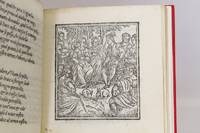
152956658à Paris: Chez Galliot du Pré 1529. Fine. Chez Galliot du Pré à Paris 1529 21 x 31.50 cm relié Extremely rare first edition featuring a full-page engraving on the verso of leaf aiiii showing a scene where the author kneeling offers his work to Louise de Savoie mother of François Ier in the presence of an important assembly. Title page in red and black text entirely ruled and set in 49 lines. Half brown sheep binding spine with six raised bands set with gilt fillets compartments underlined with cold-stamped fillets gilt roulette and double gilt fillet at foot brown paste-paper boards all edges speckled red. Very small wormhole on the final gatherings affecting the text in places without concern dampstain in the upper right corner throughout the work small yellow stains not affecting the text on verso of leaf vii. Manuscript ink ownership inscription in the lower portion of the title page reading ""du couvent des ff. Minimes de Paris"". Several manuscript annotations of the period as well as several marginal manicules. The first recorded history of the duchy of Anjou this work is placed under the patronage of Louise de Savoie who was its duchess. The frontispiece essentially centered on female figures shows them as veritable icons allegories of Knowledge and Wisdom. Alongside Louise de Savoie two other women dominate the crowd: Judith on the left and Esther on the right. Together they form a new trinity united under the motto from the Book of Proverbs ""the wise woman builds a house"". By furthermore nicknameing Louise de Savoie ""Pallas"" after the Greek goddess of Knowledge Jehan de Bourdigné inaugurates a history of Anjou constructed along two axes: the importance of historians' work and the place of this work in a historiography oscillating between medieval and Renaissance material. Bourdigné thus establishes himself as a true defender of historians and their work and presents them as the ""valiant and warlike knights who for renown battle continually against death and accomplish so much through their prowess that renown obtains victory"". At a time when history was part of belles-lettres and was not truly recognized as an independent discipline it is remarkable that historians should be thus considered. Bourdigné's work is rich in detail and apt to awaken the reader's interest. It is notable to observe that he borrows from the medieval historical manner by proposing a narrative in the form of chronicles: rich in novelistic details with historical precision sometimes neglected but nevertheless demonstrating true erudition. Indeed he explains in the prologue that his decision to write annals and chronicles is not insignificant this approach allowing him according to his view to ""have experience of cases that occurred in times past as if we had been present when they had produced their effect"". This book thus plays a pivotal role in Angevin and more broadly Gallican historiography by linking two historical manners: the medieval one represented by chronicles and that which was born in the Renaissance stemming from a humanist logic advocating a more linear narrative less inclined to subjectivity. A work on Angevin history but also more generally on Gallican history this work is celebrated by Bertoldi in his Angevins célèbres for its ""many precious details"" of which Bourdigné becomes the ""eyewitness"". Very rare first edition of the very first history of the duchy of Anjou. Chez Galliot du Pré hardcover
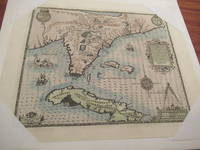
1592026339Frankfurt am Main 1591 1592. Original Antique Map . Single Sheet. Near Fine. Laid Paper. Size: Image And Border Approximately 17 7/8 Inches X 1M.5 Inches 45.2 Cm X 36.75 Cm. Debry Printed His Voyage To Virginia In 1590 As Part I Of His Works But Burden Mapping Of North America Provides No Record That A 1592 Printing Exists. This Map Has No Center Fold But Contemporary Engravings Exist Of The Offices Of The Great 17Th Century Cartographic Publishers With Row Upon Row Of Flat Drawers For Storage Of Single Maps; It Would Be Unreasonable To Believe That None Of These Unbound Maps Survived. This Appears To Be One Of Them Although The Consensus Of Modern Dealers Is That No Unfolded Large Map First Published In A Book Can Exist. Although We Have Been Unable To Locate A 1592 German Edition Of Debry We Believe This Is A Map As Issued In The 1592 German Edition Of De Bry Which Was First Published In 1591 And Subsequently Reprinted In 1592 And 1594 And In The Seventeenth Century. Small Cartouche At Lower Left Monogram With Text "Caesavece Matis. Privilegio Mdxcii" In The Plate Added After Original 1591 Printing. This Is An Unfolded Sheet Which Was Never Bound In A Book; A Strong Impression Without Damage And With Old Light Partial Coloring. Once Quite Aged Then Professionally Cleaned De-Acidified And Mounted Loosely With Archival Materials By A Museum-Experienced Conservator In About 2000. Scarce. And Now 430 Years Later It's Depicting A Hangout For Orangutans. <br/> <br/> unknown
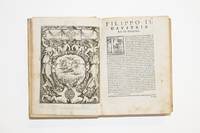
157264242Venezia Venice: Comin da Trino di Monteferrato 1572. Fine. Comin da Trino di Monteferrato Venezia Venice 1572 16.50 x 22.50 cm 3 parties reliées en un volume Le Imprese Illustri : con Espositioni et Discorsi del S.or Ieronimo Ruscelli Comin da Trino di Monteferrato Venezia 1572 in-4 165 x 225 cm 8 191 pp. 20 193-288 pp. 3 parts bound in one volume later full parchment Second edition the first one was published in Venice in 1566. The work is illustrated with a portrait of the author and 128 engravings of which 17 plates engraved by Nicolò Nelli et Gaspare Oselli in addition to a double page engraving by Domenico Zenoi representing the battle of Mühlberg. Each of the three parts contents an engraved title page representing a sophisticated structure the first bearing the coat of arms of Philip II of Spain. Later binding in full parchment gilt title in a triple gilt frame a little label from the library pasted on the top left-hand side of the first board sprinkled edges. The leaf HH2 was mistakenly numbered HH3. Scattered foxing. The book is a foundation in the research of heraldry Le Imprese Illustri represents an exceptional encounter between an uncommon field of study impresa heraldic badge and the amour lifted by a boom of printing techniques of illustrated books. Divided in several books the work opens with a theoretical approach for the study of impresa with the aim of demarcating this form of heraldry very close to emblem which is characterized by the combination of figure the body and motto the soul. Ruscelli here refines his work in Le Discours which he had written in 1556 upon the new edition of the first work which traits exclusively the impresa la Ragionamento di Mons. Paolo Giovio sopra I motti e I disegni d'arme e amore che comunemente chiamiamo Impresse Guide by the intrinsic visual dimension of the subject of study the author nevertheless distinguishes himself from his predecessor by an abundance of illustrations notably of plates engravings. They are exceptional for their quality which support the analytic approach of his study. The central double page featuring the battle of Mühlberg is a work by Domenico Zenoni then one of the most active engravers in Venice who was particularly known for his representation of contemporary events. Through the impresa of the princes of whom a majority were still alive at the time of the composition of the work Ruscelli's book draws up a real political map of Europe in the middle of 16th century. Moreover the representations of the two most powerful royal families of the time the Habsburg and the Valois the remarkable presence of the impresa of the ottoman sultan Suleiman the Magnificent reflects the influence of the princes and the capacity of the impresa to overcome borders. The first author to highlight this connection Ruscelli gives an important place to feminine imprese revealing the influence women leaders acquired in the second half of the 16th century like Catherine de' Medici. An art situated between literature and pictorial work l'impresa is according to Ruscelli a know how in which women excel shown by their status and their engagement in the literary activities of the period si vede che tuttavia le Donne vengono facendo cosi gloriasa concorrenza a gli uomini che per quasi commune consentimento di loro stessi esse se ne trovino di gran lunga superiori. Each impresa being the mirror of its prince they become the demonstration of the inseparable link between the social rank and the intellectual culture during the Renaissance. They highlight the qualities and the noble values which the prince wishes to show to the world the present becoming the future. In the same way Ruscelli places his volume in posterity with dedicated epistle so that he lives eternally in the eyes the ears on the lips in the soul and the memoirs of all the men and women of high spirit and true nobles whether they be wise or ignorant but above all the princes. The work pioneered b Comin da Trino di Monteferrato unknown
156582337Genevae Genève Geneva: Ex officina Francisci Perrini 1565. Fine. Ex officina Francisci Perrini Genevae Genève Geneva 1565 12 x 19.50 cm relié CALVIN Jean & BèZE Théodore de Ioannis Caluini in viginti prima Ezechielis Prophetae capita Praelectiones Ioannis Budaei & Caroli Ionuillaei labore & industria exceptae. Com Praefatione Theodori Bazae ad generosis. Gasparem Colignio Gallia Amiralium. Ex officina Francisci Perrini Genevae Geneva 1565 in-8 12 x 195 cm 10 f. 412 ff 20 f. Sig: 10 a-z8 A-Z8 Aa-Hh8 mid-19th-century half morocco The very rare posthumous first edition first printing known as type a with all the typographical characteristics capitals in the fifth line of the title in Roman letter ii instead of ij and identical initials on ii and p.1. This edition contains a preface by Théodore de Bèze Calvin's successor in the form of an exhortation to the head of the Protestants in France Admiral Gaspard de Coligny. Another edition by the same printer appeared a few months later in French translation. Thirty-four lines per page woodcut initials printer's device. Mid-19th century half navy blue morocco by Galette spine in six compartments with richly decorated frames marbled pastedowns and endpapers all edges red. Two corners slightly rubbed small repair to upper inside margin of title a few leaves repaired in margins occasional marginal dampstaining. Contemporary inscription to title. Calvin began his lessons on Ezekiel on the 20th January 1562. Very soon however his state of health compelled him to call upon Théodore de Bèze's help. In a letter to the Daniel family François Perrot notes this double teaching: Our good tutor and common father has got into the habit of commenting on Ezekiel still in hand which is to say on the first three days every second week this year while our Théodore in his turn is commenting on the Catechism in Greek the first three days of the week.Because of his illness Calvin can often hardly finish his bit. Calvin interrupted his unfinished lessons once and for all on the 2nd February 1564. These lessons on the first twenty chapters of the revelations of the Prophet Ezekiel are the last preached by Calvin before his death on the 27th May 1564. Like the previous lessons these too were collected in Latin by Jean Budé and Calvin's secretary Charles de Jonviller who on the 9th October 1564 asked the Council for permission to have printed the lessons of Monseigneur Calvin on the first 20 chapters of Ezekiel reviewed by the deceased. Agreed that he has permission for as many as Monseigneur de Bèze has witnessed. In his dedicatory epistle to Admiral de Coligny de Bèze who succeeded Calvin to the Chair of Theology at the Academy pays elegant homage to his friend and spiritual guide: In him we find the only person in our time who has left behind so many works which contain so whole and so pure a doctrine. But that it had pleased God to leave us the benefit of this shining light for another year or two; it seems to me in truth that one could not demand a more perfect knowledge of the Old and New Testaments.His death of which he was forewarned prevented his finishing Ezekiel which is all the greater a loss to the Church since he was the most obscure of the Prophets as we know.and who knows when we will find someone to complete this painting begun by our Apelles. Only 16 copies in various libraries of the first printing cf. Bibliotheca Calviniana. A handsome and very rare copy of the first printing with good margins. Ex officina Francisci Perrini unknown
1505000423bGENOA ITALY. Good with no dust jacket. 1505. Original Vellum. One hundred and eighty four hand numbered pages in this remarkable 500 year old handwritten manuscript ledger journal and diary : " 1505 Gendenze di Saviz - gnano" as stated on the cover. The first page begins: "Libro de tuto _____ quale so tato asan__giano ala venuta mia. To Alexandro salueto schrise e soto schrise de mia gnovia mar." Not written by a scribe this is a working journal and ledger containing hundreds of business entries purchases loans and repayments. There are long lists of foods and prices for what is assuredly shopping lists for parties and feasts. There are also what appears to be observations and business maxims and poetry in a number of entries. Certainly this fascinating book requires more research. The original vellum cover is in somewhat rough shape with tears rubbing and bumping and is barely attached to the text block though still held by the rear binding cords. Interior is in excellent shape save for the odd and to be expected ink blot age-toning and light soiling. Please email for pictures of this rare manuscript.; Italian Spanish Latin; 4to - over 9¾" - 12" tall; KEYWORDS: HISTORY OF ANCIENT ITALIAN GENOA VENICE MANUSCRIPT COMMERCE HANDWRITTEN HAND WRITTEN JOURNAL LEDGER MEMOIR PERSONAL LOG HOLOGRAPH AUTOGRAPH SPAIN SPANISH DIARY DIARIES ANCIENT ANTIQUE MEDIEVEL RENAISSANCE antiquité contrat vélin document manuscrit papier Antike Brief Pergament Dokument Manuskript Papier oggetto d'antiquariato atto velina documento manoscritto carta antigüedad hecho vitela documento manuscrito papel. . hardcover
1555000865Dégagnac France Lot. Very Good. 1555. On offer is a fascinating handwritten medieval French manuscript book earliest date 1555 with entries through 1597 in original blindstamped calf with small Fleur-de-lis. This stunning book has approximately 300 pages of handwritten entries being a register of acts properties transactions loans personal notes and journal entries the majority concerning Marc-Antoine Hébrart a noted merchant in the village of Dégagnac in Lot in south-western France. Most certainly Jewish it is evident that the Hebrart family was one of the largest land-holding families in the area. "In 1504 and 1505 the two "headmen" of the village Antoine Hebrart and Pierre Peysson together accounted for 15 percent of the land of the village" Ref: By Le Roy Emmanuel and Ladurie John Day The Peasants of Languedoc . A pencil annotation indicates that Marc Hébrard was of Jewish origin. A fairly cursory examination of the manuscript lends no additional support to this assertion but it is possible given the history of the Jews of neighboring Languedoc and the fact that some Jews remained in France under Christian-like assumed names after their expulsion in 1306. The generic 'Marc-Antoine' is cited as a Jewish name in Sara Uckelman's "Jewish Given Names Found in "Les Noms Des Israélites en France." Handsome blindstamped 16th century calf legible bâtarde script some old and minor restoration but otherwise VG.; French; 4to - over 9¾" - 12" tall; KEYWORDS: HISTORY OF FRANCE MERCHANT TRADE COMMERCE ECONOMICS JUDAICA JUDAISM FRENCH REAL ESTATE MANUSCRIPT HANDWRITTEN HAND WRITTEN JOURNAL LEDGER MEMOIR PERSONAL LOG HOLOGRAPH AUTOGRAPH DIARY DIARIES ANCIENT ANTIQUE MEDIEVEL RENAISSANCE antiquité contrat vélin document manuscrit papier Antike Brief Pergament Dokument Manuskript Papier oggetto d'antiquariato atto velina documento manoscritto carta antigüedad hecho vitela documento manuscrito papel. . unknown
1575000429bLUGDUNI. Very Good with no dust jacket. 1575. Half-Leather. ROYAL FOLIO. PRINTED 1575. ONE OF THE MOST IMPORTANT HEBREW GRAMMARS EVER COMPILED AND AT THE DISPOSAL OF THE TRANSLATORS OF THE KING JAMES BIBLEFrom the esteemed 18th century library of Thomas Peckitt himself the author of Hebrew Grammar and other theological works with his fine bookplate and signature. It should be noted that this is a very important volume in the Biblical Studies; The Trinitarian Bible Society in their April - June 1979 Quarterly Record cites this volume as being at the disposal of the translators for the KING JAMES BIBLE. The Book: Pagninus "Thesaurus Linguæ Sanctæ" Lugduni 1575. Large Folio Orginal soft calf with blindstamping sympathetically rebacked internally clean. From the famed library of Henry Peckitt well known 18th century scriptural scholar with his siganture and handsome bookplate. Pagninus was perhaps the greatest of Christian Lexicographers and whose work was fundamental as an aid to 16th-century scriptural translators. A highly important work only one copy of this 1575 edition in 30 years of auction records and that copy was a very poor one lacking a leaf. A Finer 1548 Edition of this work Christies June 26 1996 lot 113 $9240.00 As a measure if Pagninus' importance it should be noted that that the first printed Bible divided into verses was an Old Testament Latin edition by Pagninus. ; Latin Hebrew; Elephant Folio - over 15" - 23" tall; JUDAISM HEBREW LANGUAGE GRAMMAR CHRISTIANITY BIBLE STUDIES THESAURUS DICTIONARYREFERENCE JUDAICA JUDAISM HEBREW ETHNIC CHOSEN PEOPLE PEOPLE OF THE BOOK JEW HEBRAIC JUDEO-CHRISTIAN . LUGDUNI hardcover
15990001479SEGOVIA SALAMANCA SPAIN ESPANA. Very Good. 1599. On offer is a superb late 16th early 17th Century manuscript book in two volumes being the transcribed works of John of Segovia the influential Catholic Theologian who was a professor at the Spanish University of Salamanca represented Castille at the Council of Basel and represented the council in the 1439 Diet of Mainz. He played a large role in the removal of Pope Eugene IV and the placement of Antipope Felix V. Volume One: "Tractatus de Deo" a 333 page work in a fine hand though not necessarily the work of a scrivener the endpapers featuring heraldic and maybe royal watermarks each is topped with a crown very similar to a Spanish heraldic crown of higher nobility. There seems to be the use of quartering and a pallet like central division. Pictured within the escutcheon are castles lions fleur de lis like symbols likely eagles a cross three horizontal circles with the use of borders and orles without the use of supporters or mottoes with other watermarks specifically a star over anchor on interior pages. Volume Two: "Tractatus de Sacramentis" 303 pages both 4to 26.5cm x 20cm. Tucked in the volume is one sheet of paper of identical type which we conclude is a leaf missed in binding or perhaps and erratum paage. Bound in period sheep vellum. There is some general mostly light soiling to the covers one worm hole to the vellum the odd interior fault but overall these volumes are VG. NOTA BENE: John of Segovia - His most important literary work is an extensive history of the Council of Basle "Historia generalis concilii Basiliensis. Libri XVIII" edited by Birk and Beer in "Monumenta conciliorum generalium saeculi decimi quinti: Scriptor." II-IV Vienna 1873-96. His other works are a treatise in favour of the Immaculate Conception of our Lady printed at Brussels in 1664; a refutation of the Koran entitled "De mittendo gladio in Saracenos"; a defense of the "Filioque" against the Greeks entitled "De processu Spiritus Sancti" Basle 1476; a Biblical concordance "Concordantiae biblicae vocum indeclinabilium" Basle 1476; and a few works defending the superiority of a general council over the Pope.; Latin; 4to - over 9¾" - 12" tall; KEYWORDS: RELIGION SPECULATIVE RELIGION JUAN DE SEGOVIA JOHN OF SEGOVIA JOHANNES VON SEGOVIA UNIVERSITY OF SALAMANCA ROMAN CATHOLIC CATHOLIC CATHOLICISM THEOLOGY THEOLOGIANS TRACTATUS DE DEO TRACTATUS DE SACRAMENTIS CASTILE JESUIT WATERMARKS SACREMENT SACREMENTAL COUNCIL OF BASLE UNIVERSITY OF SALAMANCA CHRISTIAN CHRISTIANITY CATHOLIC CHURCH HANDWRITTEN MANUSCRIPT AUTOGRAPHED AUTHORS AMERICANA MANUSCRIPT DOCUMENT LETTER AUTOGRAPH KEEPSAKE WRITER HAND WRITTEN DOCUMENTS SIGNED LETTERS MANUSCRIPTS HISTORICAL HOLOGRAPH WRITERS AUTOGRAPHS PERSONAL MEMOIR MEMORIAL PERSONAL HISTORY ARCHIVE DIARY DIARIES antiquité contrat vélin document manuscrit papier Antike Brief Pergament Dokument Manuskript Papier oggetto d'antiquariato atto velina documento manoscritto carta antigüedad hecho vitela documento manuscrito Papel . hardcover
154748296In Vinegia Venice Venise Venice: appresso Gabriel Giolito de Ferrari 1547. Fine. appresso Gabriel Giolito de Ferrari In Vinegia Venice Venise Venice 1547 10.50 x 16 cm relié A handsome illustrated edition and one of the first printed by Gabriele Giolito de Ferrari dedicated to the Dauphin of France. It has a superb engraved title with Giolito's printer's device a phoenix being reborn from its ashes on a globe marked with the printer's initials 56 attractive woodcuts and numerous large ornate capitals as well as a portrait of Ariosto after Titian in a medallion at the end of the poem and two states of the printer's device. The end of the work is made up of a vocabulary of obscure words and an explanation of the difficult passages in the work compiled by Lodovico Dolce with a separate title and not included in the pagination. Giolito published more than twenty books in thirteen years of printing this is the third edition of this work the first appearing in 1542 and the second in 1543. Printed in round Roman type double column. Late 17th or early 18th century red morocco spine richly gilt in six compartments one compartment marked with lettres rondes round Roman type. Covers with a frame of triple gilt fillets gilt roulette frame to insides of covers all edges gilt. Binding a little rubbed faint dampstaining to end of volume. A handsome copy in a lovely red morocco binding. appresso Gabriel Giolito de Ferrari unknown
15250001371LOMBARDY ITALY. Good. 1525. Original Vellum. On offer is an ancient very charming and even beautiful manuscript relic of early civil law and legal procedure bound in vellum being the "Corpus Iuris Civilis of Justinian" the Digesta Digests or Pandects Books 1 through 38 in condensed form. All titular headings from 1.1.0 through 38.17.0 with each followed by an abbreviated explanation of the premise. In some instances may also have portions of subsections such as 1.5.6. The text does not contain the elaborations of Ulpianus Pomponius Florentinus or their like. Justinian the Great "Justice is the constant and perpetual wish to render to everyone his due" was the Roman Emperor of Byzantine Constantinople from 527 to 565. He was the last Roman Emperor to speak Latin as his first language. He tried to revive the greatness of the empire by reconquering the lost western half of the classical Roman Empire achieving only partial success in this although he did retake the city of Rome. But probably his most enduring legacy was the uniform rewriting of Roman law the Corpus Iuris Civilis which is still the basis for much civil law in many modern states and with which this volume is concerned. Dated October 30 1525 handwritten in one humanist hand this version appears to be a synopsis of the first 38 books of the Digesta and may have been used as a primer for a law student or as is more likely in this case given the marginalia a reference by a civil authority such as a lawyer or civil magistrate. On the spine is the word "Castaldus". Castaldus Gastaldo in Italian was also a term for a Lombardy official in charge of some portion of a demesne a gastaldia or castaldia with civil martial and juridical powers. When Lombardy submitted to a codified Roman law the term came to be used as a reference for civil magisterial matters. Another possiblility is this was owned by a Restaurus Castaldus an Italian civil lawyer d. 1564 and known to be the author of published book: "De imperatore in Tractatus universi iuris" or this book may possibly be a redaction or some other volume of the same Castaldus by another hand. This book offers a wonderful research opportunity for the right researcher! Description: CASTALDUS 1525 Italy. Cover of limp vellum 148x 119x 20mm Held by two leather straps through the spine to under the covers. Small section of cover on spine is missing. 124 leaves of linen rag paper 140 x105mm the first and last blank. 122 paginated folios; 1-109 CX-CXXII. Collation; i I 1313 a singleton II16 III15 39 a singleton IV15 51 a singleton V16 VI15 90 a singleton VII16 i. COMPLETE. 243 pages of text. Dated on recto of f.CXXII October 30 1525 verso blank. The pages have 15 lines in brown ink written in an elegant Humanist Bookhand with italic traits a few initials with minor flourishes near the beginning and marginal notations. Folios 73-79 some ink smear from damp stain f.74-75 stuck together in center toward spine. Folios 107-CXXII with spill stain over one half of page. In all instances the text is legible. The book is in unusually good condition for it's nearly five hundred years of life although it naturally shows appropriate signs of age and use and there is some brittleness to the cover. Overall G. ; Latin; 16mo - over 5¾" - 6¾" tall; KEYWORDS: LOMBARDY CIVIL LAW LEGAL JURISPRUDENCE CIVIL PROCEDURE JUSTINIAN LATIN PANDECTS ROMAN LAW MANUSCRIPT HANDWRITTEN HAND WRITTEN JOURNAL HOLOGRAPH AUTOGRAPH ANTIQUE MEDIEVEL RENAISSANCE antiquité contrat vélin document manuscrit papier Antike Brief Pergament Dokument Manuskript Papier oggetto d'antiquariato atto velina documento manoscritto carta antigüedad hecho vitela documento manuscrito papel. . hardcover
1569GT027Lugduni: apud Guliel. Rouillium sub scuto Veneto 1569. Hardback. Very Good. Folio. 37x23cms. BIBLIA SACRA ad vetustissima exemplaria castigata nécnon figuris & chorographicis descriptionibus illustrata : Quid autem in horum Bibliorum castigatione præstitum sit subsequens præfatio latius indicabit. Accesserunt prætereà Hebraicorum Chaldæorum & Græcorum nominum interpretationes cum indicibus copiosissmis LUDUNI Lyons. 1569 Title-page with fine large engraved dec. printer's device block 6 leaves plus 2 map leaves 39465 leaves. Full page maps facing p315 and p316 and full page plates of tabernacles. Woodcut blocks richly found throughout. Bound in the original full raised band vellum binding loss of the upper and lower sections ot the spine vellum. Some damp staining to the fore-edges but a sound and complete copy of a very rare book. A very early reprint of the 1547 'Louvain Bible' a Vulgate edition created by imperial edict and the authorised bible until 1590. Illustrateur Pierre Eskrich Paris c 1530-apres 1590. A RARE AND COMPLETE VOLUME IN THE ORIGINAL FULL VELLUM BINDING. <br/> <br/> apud Guliel. Rouillium sub scuto Veneto hardcover
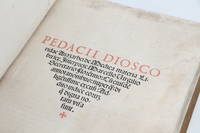
151866812Florence: Filippo Giunta 1518. Fine. Filippo Giunta Florence 1518 21 x 32.50 cm relié First edition of the Marcello Virgilio translation in Latin dedicated to Leo X. The princeps edition was based on an old translation by Petrus de Abano ca. 1250-1316 and published in 1478 in Colle di Val d'Elsa. The original text was written in Greek around 60 AD. Title page in red and black. 45 lines per page. Colophon : ""Florentiæ per hæredes Philippi Iuntæ Florentini. Anno ab incarnatione Domini.1518. Idibus Octobris. Leone decimo Christianam Rempub. gerente."" Superb Filippo Giunta printer's mark on verso of last leaf. Bibliographical note in French opposite the title page. Full modern limp vellum binding all edges faintly bluish. A lack of a small piece of paper skillfully filled on the title page and the margins of the first endpapers have been restored. A few pages at the end of the volume show the discreet work of a few worms - without affecting the text. The copy has been thoroughly cleaned. We have not been able to find any copy of this important edition for sale except in the catalogue of a nineteenth-century German bookshop Ernest Heinemann Offenbach sur le Mein 1840. Provenance: Crowned monogram H.O. and library stamp of Prince Nicolas Petrovitch of Oldenburg 1840-1886 on the title page. He was the great-grandson of Emperor Paul I through his daughter Catherine Pavlovna 1788-1819 who married George of Oldenburg. His sister Alexandra married Grand Duke Nicholas son of Emperor Nicholas I. His nephew Peter of Oldenburg married Grand Duchess Olga daughter of Emperor Alexander III. The Traité de matière médicale made up of six books describes more than 800 substances of natural origin mostly plant-based but also animal and mineral giving their description how to harvest them and their medicinal properties. This veritable encyclopedia originally written by Dioscorides in the second half of the 1st century AD was from the first years of its diffusion praised by the greatest minds of the Roman Empire: Galen himself considered that Dioscorides' descriptions were unsurpassable and that it was no longer necessary to set about writing pharmacopoeial works. The text circulated throughout Antiquity and the Middle Ages through copies of the Greek text on papyrus parchment and paper and through translations into Latin Syriac Arabic Persian and European languages. However this massive transmission led to significant misinterpretations which were highlighted by the humanists of the Renaissance. « Humanism is another feature of the Renaissance that gave to the history of the biological sciences a very special aspect. Stricly speaking humanism is a voluntary and unreserved return to ancient science. The intellectual culture that prevailed in the 16th century was one of respect for tradition and the authority of the Elders. The literary and artistic movement which developed alongside the scientific movement was even more obvious in this respect. At the beginning of the Natural Sciences we find this tradition and authority firmer than anywhere else. Thus the work of scholars bears fruit that they had not always foreseen. Thanks to them editions and translations of the old works of Natural History began to flow in. Marcellus Vergilius again translated Dioscorides. The entire host of Italian German French and English humanists works to make ancient works better known which were in the middle of the 16th century as well understood as today. » Émile Callot La Renaissance des sciences de la vie au XVIe siècle A rare copy of this important pharmacological work emblematic of the determination of Renaissance humanists to rediscover the sources of the Ancients and ensure the survival of their texts. Filippo Giunta hardcover
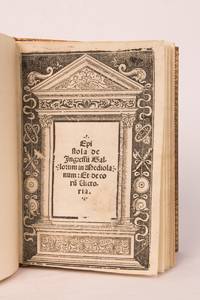
151562607Rome Rome: Jacopo Mazzochi 1515. Fine. Jacopo Mazzochi Rome Rome 15 novembre 1515 14 x 20 cm relié VITALI Giano Epistola de ingressu Gallorum in Mediolanum Jacopo Mazzochi Rome November 15 1515 small in-4 14 x 20 cm 6f. full red polished morocco First edition embellished with an architectural title frontispiece. The title is in gothic font and the text is in Roman and Greek fonts. The last two pages of the book contains a poem by Giano Vitali dedicated to Francesco Santilio called ne petat ubi belle excercentur. Binding in full red polished morocco spine uniformly sunned Jansenist binding with the title gilt date and place gilt roll-stamp framing the endpapers and pastedowns in marbled paper. A very tiny scratch on the spine head. An old stamp erased on the page of the frontispiece. Provenance: the library of Gianni de Marco with his book plate and his seal. The work was published by Jacopo Mazzochi one of the most prolific publishers in Rome in the beginning of the 16th century. From 1510 he started the trend of the architectural frontispiece an entry gate in the book E.P. Goldschmidt. In this open letter addressed to his friend Ottavio Silvio the humanist poet Giano Vitali relates an eyewitness account of the triumphant entrance of Francis I of France in Milan and siege the of the imperial city. The monarch inspired by the Italian war undertaken by Charles VII twenty years earlier claimed possession of the duchy of Milan. In the spring of 1515 after having assembled 30000 men he marched on Italy succeeding in thwarting the Swiss blockade on the route of Mont-Cenis. The victory of Marignan occurred several months later the 16th of October 1515 in Milan. Giano recounts in the book the fervor of the battle with the Swiss the dissent prevailing in the entourage of Maximilien Sforza and the magnanimity of the latter who had surrendered without exercising reprisals. We have found four copies referenced in the European catalogues. One at the Bayerische Staatsbibliothek in Munich in the National Library of Italy one in the Royal Dutch Library and finally a copy in the Columbus Library of Seville. The latter has a note by Fernando Colomb the most illustrious son of the famous discoverer of the Indies who explained that he acquired the book in Rome in November 1515. Such a rare change is explained by the fact that the pamphlets were produced at the time at the periodical office and thus only had a short life expectancy. It is important to highlight that French pamphlets were a true news bulletin flourished actually up to the moment of the Italians wars 1494-1559. Rare and maybe the last copy privately owned of this pamphlet recounting the entrance of François I of France in Milan. $ 10 000 Jacopo Mazzochi unknown
153762983s. l. Venise Venice 1537. Fine. s. l. Venise Venice 1537 14.60 x 9.20 cm 2 textes reliés en 1 volume Rare edition of this bawdy tale complete in two parts published separately. It is illustrated with four wood-engraved vignettes borrowed from Decameron of Boccace Venice 1531 and ingeniously twisted to suit their context. This edition is the first text of the author and is unique in that it has not been corrected. The book will be translated in French only in 1792. Modern binding in full red morocco the spine in five compartments gilt date and title golden fillets surround the cover the endpaper and pastedown of vellum. Provenance: Library of Gianni de Marco with its book plate and itsseal. No copies in an American Library one in the British Library and some others in European Libraries. No copy has been sold in the past 20 years. Ode to the harvest in which Luigi Tansillo 1510-1568 poet and soldier of the Renaissance recounts the carnival-like celebration of the country side of Nola Campanie. During this celebration inspired by those of the antiquity the drunk peasants give all sorts of bawdy speeches about Neapolitan women with a licentiousness that was still tolerated without distinction of age or sex or social class. The allegory of Tansillo a truly priapic creation alarmed the modesty. The Inquisition placed the work on the index and the poet was forced to beg forgiveness from Pope Paul IV by composing the Lagrime de san Pietro: the supreme Pontiff accorded his mercy to the sinner and removed the ban on all his works except for this one. hardcover
154682797Paris: Robert Estienne 1546. Fine. Robert Estienne Paris 1546 7 x 11.50 cm 5 volumes reliés TORAH Quinque libri legis BIBLE IN HEBREW ESTIENNE Robert Estienne Paris 1546 16mo 7x115cm 5 bound volumes. First 16mo edition of the Torah in Hebrew by Robert Estienne. Printer's woodcut device on each title page with book titles set within woodcut cartouche head-pieces. Only the title page is in Latin-Hebrew. Slightly later brown morocco bindings 1590-1615 two of the volumes with a smooth spine the three others with gilt raised bands gilt tooled boards all edges gilt. Some wormholes on the fifth volume not affecting the text. Numerous contemporary Latin marginalia mainly in the first two volumes. This five-volume Torah includes Genesis Exodus Leviticus Numbers and Deuteronomy. ""This little edition said to be very accurate is a true typographical jewel and perhaps the most beautiful one ever printed in the Hebrew language. Cette petite édition que l'on dit fort exacte est vraiment un bijou typographique et peut-être ce qui a jamais été imprimé de plus beau en langue hébraïque"" A. A. Renouard Annales de l'imprimerie des Estienne Brown morocco later binding 1590-1615 smooth spine with gilt fillets double gilt borders on covers all edges gilt. Some wormholes to the fifth volume not affecting the text. Joints corners and spine-ends expertly restored. Numerous contemporary marginal annotations in Latin manly in the first two volumes. This little edition said to be very accurate is a true typographical jewel and perhaps the most beautiful one ever printed in the Hebrew language.A. A. Renouard Annales de l'imprimerie des Estienne Exceptional copies of the Books of the Bible in Hebrew in first 16mo edition published by Robert Estienne. This pocket edition was printed in 17 volumes between 1544 and 1546 after the success of the four-volume quarto edition printed from 1539 to 1544. Based on the Hebrew Soncino princeps published in 1488 it was established by Humanist François Vatable. The text in Hebrew follows the Masoretic tradition and presents diacritics that facilitate its vocalization. Talented exegete François Vatable 1495-1547 early scholar of Hebrew studies during the French Renaissance was a member of the 'Cénacle de Meaux' founded by Jacques Lefèvre d'Étaples and translated for him in 1509 the Hebraicum one of the five psalters of the Quincuplex Psalterium published by Henri Estienne. After founding the Collège de France in 1530 King Francis I appointed him chair of Hebrew studies. As a Royal lecturer he actively participated ten years later in a Hebrew edition of the Bible with Robert Estienne 1503-1559 printer to the King in Latin and Hebrew. This edition is undoubtedly a real typographical feat for a small format text in Hebrew lettering. It was certainly intended for scholarly use by Sorbonne and Collège Royal students given its pocket size sold in separate individual volumes. The presence of numerous contemporary marginal notes further indicates its educational purpose as is the numbering of lines of several pages in some of our volumes. A very beautiful and scarce collaborative work by two of the greatest figures of Parisian humanist scholarship a fine example of the renewed interest in classical texts and their study in the original language. Provenance: library of Charles John Dimsdale 1801-1872 fifth baron of the Russian Empire with his bookplate on each pastedown endpaper. Robert Estienne hardcover
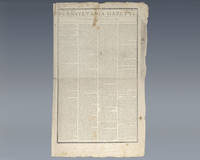
1518126803Philadelphia: Hall & Sellers January 15 1800. Exceedingly rare first appearance in print of Washington's Funeral Oration featured on the front page of the Wednesday January 15 1800 issue of the Pennsylvania Gazette. Folio four pages the headline reads "A Funeral Oration in Honor of the Memory of George Washington. Late General of the Armies of the United States. Prepared and Delivered at the Request of Congress at the German Lutheran Church on Thursday the 26th of December By Major-General Henry Lee One of the Representatives from the State of Virginia." Washington's eulogy was delivered by Major-General Henry Lee to both Houses of Congress and a crowd of 4000 at the first President's funeral on December 26 1799. This printing of the eulogy in the Pennsylvania Gazette precedes the first official Congressional printing Evans 37797 Sabin 39744. In very good condition. Exceedingly rare being one of two copies to have appeared in existing auction records the other in 1889. The father of his country" and the first president of the United States General George Washington died on December 14th 1799 and was buried at Mount Vernon in Virginia. In his Last Will and Testament written only months before his death Washington left explicit directions for the emancipation of each of his 123 slaves to be carried out after the death of his wife Martha. Legislature was passed in Virginia toward the end of the American Revolution in 1782 making it legal for slave holders to emancipate their slaves without an special action by the government. In his will Washington left a detailed slave census as well as stipulations regarding the treatment of the emancipated slaves who were sick and elderly orphaned children and the binding of children to masters and mistresses who would provide them with an education. Upon his death memorial processions were held in every major city and thousands wore mourning clothes for months; Martha Washington was known to have worn a mourning cloak for over a year. Hall & Sellers hardcover
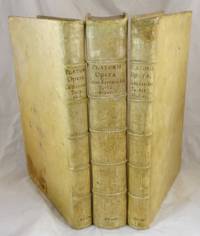
1578620Geneva: Henr. Stephani 1578. First Edition. vellum. Very good. The STEPHANUS Plato <br />The Book That Established the UNIVERSAL REFERENCE System for Platos Writings <br /><br />PLATO. Platonis opera quae extant omnia. The Complete Works of Plato Title also in Greek Henr. Stephani Geneva 1578. First Greek/Latin Edition. <br />Volume 1: TP 16 unnumbered leaves handwritten replacement preliminaries circa 18th c = Dedication to Queen Elizabeth Studioso Lectori Platone Epigrammata Catalogus Dialogorum half title with first page of text - unnumbered - on the verso 1 469 471 471 542. <br /><br />Volume 2: Half-title blank leaf lettered AA.i. 3 unnumbered leaves printed replacement preliminaries circa 18th c. = Dedication to King James the Sixth of Scotland later James the First of England Two Poems 3-701 672 673 704 992. <br /><br />Volume 3: Half-title 3 unnumbered leaves handwritten replacement preliminaries circa 18th c. = Dedication to the Republic of Bern Poem AAAA.i. = Contents Page 3-374 375 368 377-416 1-139; Folio. <br /><br />Three vols. 10.25 x 15.5 in. text block sheets are 10 x 15 in. Folio. <br /><br />"A great Renaissance author and scholar as well as a member of one of Europe's most illustrious families of printers Henri Estienne II himself edited his grand Plato for which he commissioned a new Latin translation by Jean de Serres. Together with his monumental 1572 Thesaurus graecae linguae the lavish Plato was responsible according to Schreiber for securing both Estienne's scholarly reputation and his financial ruin" Garden Ltd. #40. <br />First Greek/Latin edition printed in parallel text with translation and commentary by Jean de Serres noted French historian and advisor to King Henry IV during the reformation. The famous Stephanus edition which has served as the universal reference system for all other editions of Plato's writing since its publication. In every translation of Plato there are small numbers in the margin which refer to the pagination in this edition affording scholars the opportunity to cross-reference each other's work in any language - they are called the "Stephanus numbers." For example Socrates major speech in the Symposium completes at 212c. <br /><br />Some preliminary pages dedication poems etc. are not original but rather were printed and inserted sometime in the 18th century. Because the preliminary pages included dedications to Queen Elizabeth copies of the Stephanus Plato circulating in countries hostile to the throne at the time of publication 1578 often had these pages removed. Some copies of the Stephanus Plato have appeared at auction lacking preliminaries altogether. In 2008 Sokol Books Ltd. catalogued the missing prelims: their absence is the works most common defect. Others like this copy had the preliminaries replacedsometimes by hand other times by a local printeronce relations with England had improved. This is one of those rare copies with replacements. Thus not only is this an important and rare antiquarian book The Stephanus Plato! but also an important historical artifact given its unique history and provenance. <br /><br />CONDITION: Very Good in uniformly bound contemporary possibly early 17th c. vellum with manuscript lettering to spines. Minor repairs to vellum on head and heel of spine mostly on volume 3. Expert old paper repairs to title page of volume I and half-titles of vols. II & III with bookplates on all three pastedowns: Inter Libros Josephi Mariae Parascandolo Antecessoris Regii A.L.N. of Naples. Woodcut-engraved printers vignette on title woodcut-engraved decorated initials head-pieces & tail-pieces. Large paper 15 x 10. Handwritten and printed preliminaries replaced sometime in the 18th c. A tightly bound historically important copy of one of the most important books in the history of philosophy. Henr. Stephani hardcover
151165641Strasbourg: Matthias Schurerius 1511. Fine. Matthias Schurerius Strasbourg 1511 14 x 20 cm relié Syntagma de Musis Matthias Schurerius Strasbourg 1511 4to 14 x 20 cm 16 f. A4 B8 C4 modern full morocco Rare editio princeps illustrated with a large title vignette 86 x 95 mm featuring the Muses playing their instruments under the water of a fountain overlooking the Hippocrene spring surmounted by a verse from Hesiod's Theogony: Ennea thugateres megalou Dios / £ Nine daughters engendered by the almighty Zeus. This was the very first collective representation of the Muses bathing in the fountain of youth. Nine magnificent in-text woodcuts 63 x 50 mm also showing these same Muses elegantly dressed and holding their distinctive symbols. 30 lines per page in rounded characters a full-margined copy not rubricated. The leaf a2 does not have a signature c2 is incorrectly labelled b2. First publication of the Strasbourg printer Matthias Schürer to contain Greek letters as the latter points out in the colophon: Finis libelli de Musis compositi a Lilio Graegorio Ziraldo Ferrariensi quem Matthias Schurerius artium doctor summa cum diligentia impressit non omissis accentibus in eisque Gareca sunt. Argentorat. Ann. salutis. M.D.XI. Idibus August. Modern binding 20th century in brown morocco Jansenist spine in five compartments gilt date at the foot gilt fillet in a silver frame all gilt edges. Binding signed Honegger. Ex-libris from the Guelfo Sitta and Gianni de Marco libraries glued to the inside of the first board dry stamp of the latter at the right-hand bottom of the first white endpaper. Several very discreet wormholes without loss of text on the last leaves. Verified complete by a bibliographer of the Bernard Quaritch Ltd bookshop on 8 May 1925 cf. note on the verso of the last leaf. Rare and important treatise the very first on the topic marking a significant advance in the humanist and philological knowledge of the ancient deities. It is preceded by several lines addressed to the reader as well as a inscription entitled Andreae Reginio Romarici monti Sonrario by Philesius Vogesigena Matthias Ringmann humanist and scientific publisher of the work. Then follows a dedicatory epistle to Luca Ripa one of Giglio Gregorio Giraldi's old Ferrarese teachers dated 1507 in Milan. The author claims to have composed his Syntagma de Musis when he was still only an adolescent. The dissertation closes with several verses by ancient or contemporary poets to Giraldi Virgil Pico della Mirandola and Fausto Adrelini who have before him praised the graces of the Muses. This treatise emblematic of Medici-neoplatonism will have a significant influence on pictorial cycles and mythographers of the 16th century. The superb wood engravings illustrating the work do not conform to the ancient or Italian tradition but rather represent Germanic virgins. These woodcuts close in style to those of Dürer are very clearly inspired by the artist without being able to be formally attributed to him. Very beautiful full-margined copy of this rarity representing higher German education. Matthias Schurerius unknown
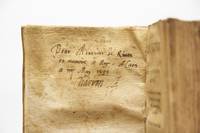
159571963à Bourdeaus Bordeaux: Par S. Millanges 1595. Fine. Par S. Millanges à Bourdeaus Bordeaux 1595 10.50 x 16 cm relié Third edition after the original published in Bordeaux in 1593 and a second Parisian edition in 1594. The copy mentions the second edition because it is the second to be published in Bordeaux. Extremely rare handwritten presentation signed by the author on the page of the endpaper: Pour Monsieur de Rives en memoire de moy. A Caors ce iiij 4 may 1595. Charron. For Monseiur de Rives in memory of me. In Caors this iiij 4 May 1595. Charron. It is without doubt about Jean III de Rieu Lord of Rives who belonged to the family of Antoine Hébrard de Saint-Sulpice bishop of Cahors. Pierre Charron had been called theological by this same bishop of Cahors and became his curate for six years. Bound in calf vellum with contemporary yapp edges blank spine. Extensive yellowing of the endpaper page until page 30 then lessening in the middle of the page throughout the first part and until page 120 of the second part. This yellowing resumes from page 760 until the end. Pierre Charron's first writing who in this controversial work regarding Protestantism develops three great vérités truths: religion is necessary Christianity is revealed and only the Roman Church is the true Church. It is this last point in particular that the author tries to demonstrate. This third part is so important that it has its own title page and takes up two-thirds of the book. In Bordeaux Pierre Charron met Montaigne whose ideas spread through his works and his thoughts. They bonded with such a deep friendship that Montaigne designated Charron as heir to his house coat of arms. The handwritten ex-donos or presentations of the great humanists of the 16th century are an exceptional rarity. Par S. Millanges hardcover
155165642Lyon: Guillaume Rouillé 1551. Fine. Guillaume Rouillé Lyon 1551 10.50 x 17.50 cm relié Juda ABRAVANEL or Leo the Hebrew Philosophie d'amour de M. Léon Hébreu The Dialogues of LoveGuillaume Rouillé Lyon 1551 small 8vo 10.5 x 17.5 cm 675 pp. 44 p. contemporary full calf First edition of the French translation of Dialoghi d'Amore by Denis Sauvage Sieur du Parc. The title page is decorated with a handsome border wood-engraved based on a composition by Pierre Vase. A very beautiful Lyon print in italic characters with ornamental initial letters and decorations. Copy entirely red ruled 28 lines per page. Contemporary binding from the city of Lyon spine repaired richly decorated with arabesques and gilt stippling the centre of the boards decorated with a large typographic gilt motif against a background of gilt stippling large arabesques and interlacing in the corner pieces all edges gilt and gauffered with vegetal arabesques. James Toovey's library ex-libris glued on the inside of the first board that of Samuel Putnam Avery produced by the English painter and engraver Charles William Sherborn glued on the first endpaper Gianni de Marco library's dry stamp on the following endpaper. Two old handwritten ex-libris on the title page. Librarian and publisher James Toovey 1813-1893 was also an influential bibliophile. He acquired the Gosford Castle library in Northern Ireland in 1878. After his death his books were sold in part at auction in 1894 while his son kept the other part which was then sold in 1899 to Mr J. Pierpont Morgan founder of the Morgan Library in New York. Samuel Putnam Avery 1822-1904 art dealer and expert was named commissioner in charge of the American art department at the Exposition Universelle in Paris. Founder and long-standing director of the Metropolitan Museum of Art in New York he was also a great collector of prints and rare books with superb bindings. This high-quality work one of the most beautiful productions from the Lyon printing works then at its peak is emblematic of a transitional period in the history of the re-emerging French language two years after the publication of the Défense et illustration de la langue française by Joachim du Bellay. Denis Sauvage's translation dedicated to Catherine de' Medici is an historical milestone in the history of the French language. Sauvage for a time proofreader for the publisher Guillaume Rouillé converted to La Réforme and was like Froissart and Commines historiographer to King Henri II. Particularly sensitive to the reform of the French language he did not hesitate in this work to invent numerous neologisms. In total there are more than one hundred words that are indexed in the glossary which he writes for the attention of the reader at the end of the volume. Many of these terms have today been adopted through use: astuce bénévole dimension immédiatement contrary to médiatement moteur etc. The publisher Guillaume Rouillé trained at the Venice print works was one of the first in France to conform to the modernised spelling rules that Ronsard had just advised some months earlier. Juda Abravanel or Leo the Hebrew 1460-1521 a Cabalist Jew refusing to convert to Christianity was forced in 1492 to leave Castille for Genoa where he practised medicine. His dialogues contributed along with those of Marsilio Ficino to the diffusion of a Neoplatonism closely linked to the humanist movement in France. The poets in the Lyon art circle then those from La Pléiade welcomed the Philosophie d'amour with enthusiasm. Furthermore we find a copy amongst the 105 volumes listed in Montaigne's library that will be amused by the text's great success: My valet made love read Leo the Hebrew and Ficino. His influence will however carry through time a century later Spinoza will borrow his concept of God's intellectual love. Beautiful and rare copy in a luxurious Lyon Renaissance binding and notably having belonged to Samuel Putnam A Guillaume Rouillé hardcover
153266816Norimbergae Nürimberg Nuremberg: In aedib. viduae Durerianae Hieronymus Andreae 1532. Fine. In aedib. viduae Durerianae Hieronymus Andreae Norimbergae Nürimberg Nuremberg 1532 20.50 x 32 cm relié Alberti Dureri clarissimi pictoris et geometræ. De symmetria partium in rectis formis humanorum corporum In aedibviduae Durerianae Hieronymus Andreae Norimbergae Nuremberg 1532 folio 20.5 x 32 cm 80 f. A-E6 F4 G-N6 O4 full parchment First edition of the Latin translation created by Joachim Camerarius the work appeared in German in 1528 under the title Vier Bücher von menschlicher Proportion. Our edition contains the first two books the following two will be published in 1534 under the title De varietate figurarum et flexuris partium ac gestibus imaginum. We will have to wait until 1557 for Louis Meigret's French translation to be published. Our edition is illustrated with 85 large wooden insert illustrations and many other smaller in-text illustrations the same as those used in the original German edition. The title page shows Dürer's well-known monogram. Gothic text. The last white leaf missing in most copies is present here. Large greatly fresh margined copy. Full parchment with preserved laces. Very beautiful copy of the most sought-after of Albrecht Dürer's technical works. The illustrations required the examination of several hundred male and female models and something rarer for the time children. These extremely precise analyses resulted in anthropometrical impressionist drawings showing the human body as a whole and also in detail hands feet heads etc. Each drawing squared or scaled in the margin allows the models to be easily reproduced the book being intended to avoid errors of proportion for young artists. Joachim Camerarius' Latin translation humanist and close friend of the author had at the time an essential role: it gave Dürer's work until then written in archaic German a significant audience; without Camerarius Michelangelo would never for example have known of Dürer's theory of proportions. Dürer whose godfather Anton Koberger published La Chronique de Nuremberg in 1493 frequented the world of printing and engraving very early on and unlike his contemporary Florentine Leonardo da Vinci who published nothing he produced several theoretical treatises. It was during a trip to Italy in 1494 that he met Jacopo de' Barbri 1445-1516 who introduced him to the role of mathematics in perspective and the study of the proportions of the human body. On returning to Germany he opened a workshop became the painter of Maximillian I of Habsbourg and joined the Great Council of the City of Nuremberg. Recognition is complete and Dürer becomes an internationally known artist with the knowledge and ability for well-received thought. In the last years of his life not abandoning the pictorial arts Dürer encouraged by his humanist friends spends most of his time writing. Determined to leave the results of his long theoretical thoughts for posterity he publishes several treatises: Instruction sur la manière de mesurer 1525 Instruction relative aux fortifications des bourgs villes et châteaux 1527 and finally Traité des proportions du corps humain 1528. In keeping with the artistic considerations of the Renaissance the intention of this last treaty is to establish a scientific basis geometrical and arithmetical applied to aesthetics and thus to provide practical guidelines aimed at achieving anatomical perfection. A true artistic testament this emblematic work will have a considerable influence on the history of Western art. In aedib. viduae Durerianae[ Hieronymus Andreae] unknown
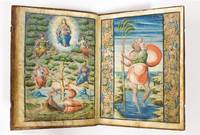
156957498s. l. Grenade Granada: S. n. 1569. Fine. S. n. s. l. Grenade Granada 1569 21.50 x 30.50 cm relié ILLUMINATED MANUSCRIPT ANONYMOUS Regla y Constitutiones de la Cofradia del Sanctissimo Sacramento de la Yglesia de San Christoval de Granada Autograph manuscript with three miniatures no publisher Granada 1569 folio 21.5 x 30.5 cm upper margin: 35 mm bottom margin: 50 mm interior margin: 30 mm exterior margin: 40 mm 31 ff. 16th-century full calf gilt Manuscript on vellum comprising 31 leaves: 50 pages of text ruled and lined and 3 full-page miniatures in colours heightened in gold. The four final leaves were numbered and partly ruled but left empty. Contemporary manuscript ex-libris on front endpaper. In Spanish throughout written in Caroline minuscule on 24 lines the text is very readable and very regular. The manuscript begins with a three-page summary covering the 24 chapters that comprise the Regla y constitutiones de la cofradia del Sanctissimo sacramento de la yglesia de San Christoval de Granada. One illuminated capital in red and blue indents and pagination in red small sketch in black ink to the inner margin. The verso of the final page of the summary has been ruled and lined in red but left blank. There follow the three full-page miniatures. The first shows a Communion scene on the recto of one leaf the second the Tree of Jesse verso of the same leaf and the third Saint Christopher bearing the baby Jesus recto of the following leaf. The verso of the miniature bears a short manuscript text explaining that these rules are those of the confraternity and brotherhood of the Holy Sacrament established in the Church of Saint Christopher of Granada on the 1st of May 1568. This is followed by the prohemio a prologue of two and a half pages in which the confraternity takes an oath; this starts with an imposing illuminated capital in red and blue. The chapters then follow on directly each with a tidy initial. The important terms are heightened in red allowing for quick navigation in the text. A long manuscript annotation to the outer margin of leaf 24. The aforementioned rules take up 23 ruled leaves ruled and lined in red. Leaf 27 bears two manuscript privileges. We have not been able to read the signature on the first dated May 1569 though quite elaborate. The second later one May 1596 is signed by Justino Antolinez de Burgos 1557-1637 at the time the Chaplain Royal charged with the inspection of ecclesiastical lodges. Long contemporary manuscript note to reverse of leaf 24. Contemporary light-brown calf spine in five compartments with gilt fillets and fleurons gilt fillet frame to boards small gilt fleurons to corner and a larger gilt fleuron to centre of covers. One clasp preserved. A few very skilful repairs and regilding practically invisible. This manuscript has three spectacular full-page miniatures in gouache heightened in gold. The first shows the Holy Communion with Christ himself establishing the Eucharist with the words This is my body this is my blood. The Apostles and Jesus with a halo blessing them are seated around a table set with bread and fish. This motif became a major theme of Christian art in the Renaissance as this miniature also shows. The second miniature shows the Tree of Jesse which symbolises the genealogy of Christ traced from Jesse Xese shown as an old man reclining. In keeping with the iconographic tradition a tree protrudes from his side the main branches of which bear some of Jesus's ancestors. Here they are: Zachary Jeremiah David an unidentified king and at the pinnacle Mary holding the Christ child within a mandorla. The third miniature presents a scene with Saint Christopher the patron of the Church in Granada to which the Confraternity of the Holy Sacrament was attached with a child on his shoulders as he was commonly represented. The iconography derives from a passage in the Golden Legend in which St Christopher helps a small b S. n. hardcover