48 402 résultats
19100012373Ottawa Ontario Canada. Good with no dust jacket. 1910. Non-Book. On offer is a newsy letter with excellent Canadian content written and signed by notable Canadian William Saunders 1836-1914 and written to one H. A. Kennedy. Dated April 24 1910 on letterhead of Central Experimental Farm Ottawa. The letter deals with Kennedy's recent visit to Saunders and talks about Kennedy's family in particular Kennedy's son. Saunders is suggesting the son attend the Forestry Program at University of Toronto and Saunders has already talked to them. BIO NOTES: William Saunders was a Canadian pharmacist scientist civil servant and author. Saunders emigrated to Upper Canada in 1848 settling in London. He apprenticed to a local druggist and opened his own pharmacy in 1855. In 1862 he helped found the Entomological Society of Canada. He was a founding member of the Canadian Pharmaceutical Society and served as its president. He also helped establish the Ontario College of Pharmacy. He served as president of the American Pharmaceutical Association the Entomological Society 18751886 and the Fruit Growers Association of Ontario 18821886. In 1876 he was made a director of the Huron and Erie Savings and Loan Society and served as its president from 1879 to 1887. In 1886 he was made the founding director of the Dominion Experimental Farms system. He retired in 1911. He was created a Companion of the Order of St Michael and St George in 1905. He was a charter-member of the Royal Society of Canada in 1882 and served as its president from 1906 to 1907. Wikipedia2pp. Autograph letter signed small 8vo. Overall Good. ; Manuscripts; 8vo 8" - 9" tall; 1 pages; Signed by Author . unknown
19420008187UNITED STATES BATON ROUGE LOUISIANA. Good. 1942. On offer is a fascinating collection of letters from an American soldier in WWII. The collection consists of 69 letters written between this soldier and a young woman in North Carolina. The letters were written from April 1942 through March 1944. The letters are in generally good condition and the handwriting is legible. William Sain is a soldier in the United States army Quartermasters Corp. He serves in a number of locations around the United States as evidenced by his return addresses or imprinted letterheads. He entered the army as a private but progresses and by late 1943 has attained the rank of Staff Sergeant. The letters mostly detail his growing affection for Mary Mitchell: ". I don't know whether you will want to hear this or not but i'm goin to say it anyway really life is different since I met you. You are the first girl that I met in several years that I cared anything about " Apr 27 1942. By 1944 they were talking about marriage: ". I have really regretted that we didn't get married while I was at home . " Feb 21 1944. Included in the collection is a letter to Mary dated in 1943 from a Sergeant Glenn Thomas who was serving in North Africa. Apparently he too was a suitor for Mary's hand! However it is evident that Sain and Mitchell have built a relationship over the years of correspondence. Their letters are full of the minutia of daily life chatty gossip and growing affection for each other. "Dearest Darling Here I am behind on my writing I owe you about 4 so I will write them all in one I got a letter from Vada and Christine yesterday And Christine said she would like for us to get married there. Listen darling I don't know how far Baton Rouge is from Miss. I expect it's a pretty good ways I bet you can't hardly make it on a weekend pass. . Frank is still in Tenn. He has a deferment for six months but I expect he will have to go before then ." Apr 3 1944. The letters give a wonderful look into the lives of very ordinary American youth as they cope with the unknowns of a global war. For a social historian they provide a terrific window into the world of the home front. Despite the momentous events happening throughout the world these letters show the complete focus these people have on their immediate lives and their desires for a better future.; Manuscript; KEYWORDS: HISTORY OF; 20TH CENTURY; 1940S; WW2; SECOND WORLD WAR; WILLIAM R SAIN; MARY MITCHELL; UNITED STATES QUARTERMASTERS CORP; AMERICAN SOLDIERS IN WW2; WARTIME CORRESPONDENCE; SOLDIER'S LETTERS; WARTIME LOVE LETTERS; GLENN THOMAS; U.S. ARMY; UNITED STATES HOME FRONT; WARTIME LOVE STORIES; LOVE IN WARTIME; AMERICAN HOMEFRONT IN WW2; AMERICANA HANDWRITTEN MANUSCRIPT DOCUMENT LETTER AUTOGRAPH WRITER HAND WRITTEN DOCUMENTS SIGNED LETTERS MANUSCRIPTS DIARY DIARIES JOURNALS PERSONAL HISTORY SOCIAL HISTORY HISTORICAL HOLOGRAPH WRITERS AUTOGRAPHS PERSONAL MEMOIR MEMORIAL ANTIQUITÉ CONTRAT VÉLIN DOCUMENT MANUSCRIT PAPIER ANTIKE BRIEF PERGAMENT DOKUMENT MANUSKRIPT PAPIER OGGETTO D'ANTIQUARIATO ATTO VELINA DOCUMENTO MANOSCRITTO CARTA ANTIGÜEDAD HECHO VITELA DOCUMENTO MANUSCRITO PAPEL . unknown
194872161Paris: Editions du Sagittaire 1948. Fine. Editions du Sagittaire Paris 1948 12 x 19 cm broché First edition in French one of 30 numbered copies on alfa paper the only deluxe copies. Handsome copy. Editions du Sagittaire unknown
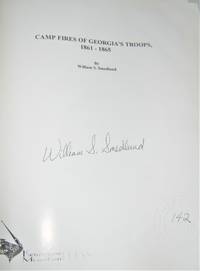
19940022955Kennesaw Georgia: Kennesaw Mountain Press 1994. First Edition . Hardcover. Near Fine/None as Issued. NF/0/Limited Signed First Edition. This copy is part of a limited first edtion of 150 copies this copy being number 142 The author's signature is on the title page along with a stamp and the number of the book. A great copy; the cover is maroon buckram with the title in gold gilt across the front panel and along the spine. No writing or marking to interiro or exterior. Small skinned place at the bottom of the front cover. This book records the camps of Georgia troopsin Georgia and other states that were names in honor of fallen soldiers prominent citizens past and present leaders and those who gave of their time and resources to assistt the men and boys in camp. the book also provides information on how a company was formed and outfitted. Many maps are included some draqn by the soldiers themselves. Information about the three training camps were the companies from each Georgia Counties. A wealth of information for serious research about the Civil War Troops or genealogical Studies. Comes to you in an archival document bag for storage and I can pop it in the mail for you tomorrow. <br/> <br/> Kennesaw Mountain Press hardcover
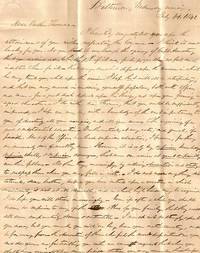
18410002370BALTIMORE MD to NORFOLK VA c/o U.S. SLOOP CYANE 1841. On offer is a super fascinating stampless manuscript letter dated 'Baltimore Wednesday Evening July 14 1841 Dear Brother Thomas' Rousy Midshipman on U.S. Sloop Cyane handwritten by older brother William to his brother who appears to be a newly minted midshipman aboard the noted sloop of war Cyane. Beginning with congratulations the three 3 page and a bit well filled letter written over a couple of days brother William provides wisdom and advice as a good brother would along with admonitions of care regarding 'intercourse'. It is likely that the author William was himself a naval officer or at least a soldier within a command structure as his advice of hard work in attaining the highest levels of seafaring education are classic: 'Most of the Officers have had superior education I presume for they are commonly the sons of wealthy men. However it is only by superior knowledge superior skills and superior courage that men can arrive at great superiority of his fellows.' He goes on hoping Thomas will be interested in rising above mediocrity. Family news is interspersed but mostly the content deals with the ship future travels and Thomas' role. The folded stampless letter has some splits in the folds and some very small loss where the seal opened but overall G. HISTORICAL NOTES online sources: The second USS Cyane was a sloop-of-war in the United States Navy during the Mexican-American War. Cyane was launched 2 December 1837 by Boston Navy Yard. She was commissioned in May 1838 Commander John Percival in command. She sailed 24 June 1838 for duty in the Mediterranean returning to Norfolk Virginia 16 May 1841. She cleared 1 November 1841 for the Pacific Squadron returning 1 October 1844. Sailing again for the Pacific 10 August 1845 Cyane served on the west coast during the Mexican War. On 7 July 1846 her commanding officer Captain William Mervine led a detachment of Marines and sailors from Commodore John D. Sloat's squadron ashore at Monterey California hoisting the American flag at the Customs House and claiming possession of the city and all of present day California. On 26 July 1846 Lieutenant Colonel John C. Frémont's California Battalion boarded Cyane now under the command of Commander Samuel Francis Du Pont and the ship sailed for San Diego California on 29 July 1846. She landed Marines at nearby La Playa where they were warmly welcomed by the largely pro-American civilian population. The Marines took abandoned guns from Fort Guijarros and used them to lay siege to Old Town San Diego. A detachment of Marines and sailors from Cyane took possession of the town raising the American flag. They were followed shortly by the Fremont volunteers and Cyane's detachment returned aboard to sail for San Blas where a landing party destroyed a Mexican battery 2 September. Entering the Gulf of California Cyane seized La Paz and burned the small fleet at Guaymas. Within a month she cleared the Gulf of hostile ships destroying or capturing 30 vessels. In company with Independence and Congress she captured the town of Mazatlán Mexico 11 November 1847. On 22 January 1848 she arrived off San José del Cabo to relieve the besieged garrison there. She landed a force of about 100 men who fought the final engagement and broke the Mexican siege. She returned to Norfolk 9 October 1848 to receive the congratulations of the Secretary of the Navy for her significant contributions to American victory in Mexico. Between 9 October 1851 and 24 June 1852 Cyane sailed in the Home Squadron rejoining it 10 October 1852 to cruise constantly on the Atlantic coast and in the Caribbean from Nova Scotia to Aspinwall for the protection of the lives and property of American citizens. She bombarded and destroyed Greytown Mosquito Coast 13 July 1854 in retaliation for actions against American citizens there. On June 3 1857 the Cyane retrieved from Greytown more than 150 filibusters who surrendered with William Walker at Rivas Nicaragua on May 1 some of whom had their families with them. The ship afterward protected the disputed fisheries along the coast of Nova Scotia from 2 September to 30 October 1857. She sailed for Haiti 19 November 1857 and joined a special expedition surveying the Isthmus of Darien as a possible canal site. Bombardment 1854 In August 1858 Cyane stood out for the Pacific joining the Pacific Squadron. In 1863 during the Civil War the Cyane prevented the sloop J. M. Chapman from being used as a Confederate privateer when their boarding parties took control of the ship as it was preparing to leave San Francisco. Good. 8vo - over 7¾" - 9¾" tall. Manuscript. unknown
19090008177MISSOURI ; ILLINOIS; TENNESSEE. Good. 1909. On offer is a collection of 8 diaries the earliest is of 1909 7 diaries are for the period from 1916 to 1921 and the last one is of 1949. Diaries of 1909 1921 and 1949 have 60 pages each diaries for 1916 through 1919 are 91 pages each diary of 1920 is 365 pages and the record book is 152 pages. All diaries are in good condition and 100% complete except the record book which is 90% complete. The author of 7 of these diaries was William Robert King Jr. of St. Louis MO. He was the son of William Robert King a Presbyterian minister and founder of Henry Kendall College now the University of Tulsa. King Sr. was married and he and his wife had one child - a son also named William Robert King. A reference in the second diary notes King Sr.'s birthday which coincides with other records. A second reference Sept 1 1919 records his 24th birthday indicating he was born in 1895. This accords with his and his family's history. William Robert King Jr. was a graduate of Monmouth College and post-graduate in chemistry from the University of Illinois. He worked at the university for a while as an instructor of chemistry then as a chemical engineer and was connected with the National Carbide and Chemical Company in Cleveland. The first diary in the collection is written in 1909. It does not appear to have been written by King Jr. The age and experiences of the writer do not match up. The unknown author appears to be teaching in a high school as well as working as a minister: ". Second election for high school . Disqualified election and serious mistake in the counting ." Feb 19 1909. He probably writes about elections of school students for a trip to Washington as guests of Post-Dispatch a major St. Louis newspaper to see inauguration of President Taft that were held in February of that year. "Preached this morning on John 1:46 ." Feb 28 1909. A great many entries referred to him studying but the specifics are not mentioned: ". Studying in A.M. Teachers meeting at College" May 31 1909. This could in fact belong to King's father Rev. William Rober King Sr. For part of his career King served as superintendent of the American Sunday School Union's southwestern office in St. Louis Missouri. The second diary definitely belongs to King Jr. as he has entered his name in the ID page. Written in 1916 he is attending high school in St. Louis. His entries are filled with references to classes assignments and family: "Assigned to make up Physics and French exams in March. English Class: 9 - 10' French Class: 10 - 11' Economics Class: 12 - 1" Feb 5 1916; "History lecture. Took French make-up exam - complete failure suppose it means I quit school as I cannot get credit on anything unless I have French . " Mar 31 1916. In fact he does graduate and attends in Monmouth College in Monmouth Ill. He was involved with his church and often participated in activities there: ". Taught class communion services. Led C.E. consecration services subject: consecration of time Ps 90: 1-17 Illustrated lecture on Philippines ." Apr 2 1916. He mentions a number of landmark buildings in St. Louis including the New Central Theatre and the Jefferson Hotel. He also references the 1916 presidential elections: ". race of Wilson and Hughes doubtful ." Nov 6 1916; " . Election Wilson vs Hughes at 2 A.M. looks like Hughes Republicans carried Ill" Nov 7 1916; "Election still doubtful looks like Wilson" Nov 8 1916 ". election still doubtful . claiming fraud" Nov 9 1916; "Wilson seems elected Hurrah! ." Nov 10 1916. Amongst the many people he references is a girl referred to only as "M". The third diary 1917 continues with his college life. "M" is still very much a part of it. "M" in fact is 'Marjorie' Marjorie Scott who becomes frequently referred to in later years. Eventually they become engaged and married. WWI is indirectly referenced as well: ". company organized in college to drill every night . " Apr 11 1917; ". Situation getting critical quickly . college presidents considering disbanding schools and giving whole time to military training" Apr 14 1917. Throughout the year he keeps track of his classes and comments on assignments and marks. He is in frequent communication with his father and mother. The fourth diary in 1918 sees him still at Monmouth College. He references the sensational Dawson trial in which John Wesley Knight a 35-year-old black man was sentenced to 19 years in Joliet penitentiary for the slaying of William E. Dawson; his wife Charity and their daughter 13-year-old Georgia: "Dawson trial most of A.M. State vs John Knight ." Jan 29 1918; "Down at trial in A.M. ." Jan 31 1918; ". Dawson trial went to jury ." Feb 1 1918; ". jury convicted Knight - 19 years ." Feb 2 1918. Extensive contemporary research suggests that the Dawson murder was the work of a German serial killer named Paul Mueller who travelled the country by rail killing perhaps as many as 100 Americans before returning to Europe where he may have continued his spree. For those killings the authors contend that four innocent people were executed seven were killed by lynch mobs and four - including John Knight-served prison sentences. In August he notes a very special date: ". Red Letter Day. M promised to be my wife" Aug 28 1918. The fifth diary 1919 sees him continue his education at Monmouth. He also becomes a member of Tau Delta Phi and mentions their activities frequently. He notes president Wilson's visit to St. Louis: "President Wilson in city today speaking tour for League of Nations ." Sept 5 1919. The sixth diary 1920 sees him continuing his education at the University of Illinois at Champaign. Most of his entries revolve around university classes activities with friends and family and his relationship with Marjorie. In December he takes a major step: "Marjorie and I married by Dad at 10 A.M in church ." Dec 28 1920. The seventh 1921 continues with his university education and his married life with Marjory. He is working at least part time and Marjory is working full-time: "M is teaching class often girls for Mrs. Camp this summer ." July 10 1921; ". notice of appointment as graduate associate in chemistry from Board of Trustees ." Aug 8 1921; He finishes the year working as an associate at the university in the field of Chemistry. The eighth diary 1949 is part of the collection but was not authored by William Robert King. Records suggest that King died in 1939 at the age of 44. It might have been authored by William Robert King Sr. who after retirement and until his death in 1951 lived on his farm Church Hill near Kingsport. There are references to Kingsport TN where both King Sr. & King Jr. are buried: "Good day in old Kingsport " Dec 18 1949. A number of references are agricultural: "Repairing barn." Feb 2 1949; "Sell pigs." Apr 15 1949. There is a fascinating brief reference to international affairs in January: "Pan Asian Conference Chiang Kai Shek decided to give up presidency of China. President Truman " Jan 28 1949. There is a reference to Washington College in Tennessee where William R. King Sr. received his degree in divinity in 1890: "Board Meeting Washington College 12:15 " Feb 28 1949. The author ends the year on a somewhat dispirited note: "This has been an eventful year. . Dirty politics financial greed infidelity of men and women & break up of homes aftermath of war ." Dec 31 1949. The last volume is a loose-leaf binder compiled by William Robert King. It is really a collection of lists and data that matter to him. Although undated the 'Christmas Card' lists begin in 1923 and continue annually until 1941. As noted above King passed away in 1939 and it appears that most likely his wife Marjorie maintained this particular list for another two years. She later remarried. Other lists include names and birth dates of many other family members lists of possessions particularly coins and silver plate courses studies in university along with marks and more. It is interesting that his son William Robert King III was educated as an architect at the University of Illinois served in WWII and was present during the D-Day invasion and then later became a Presbyterian minister and missionary. Overall this is a superb collection of daily notes covering an extensive period of time in early 20th century America. For a genealogist it is a veritable goldmine. The last volume alone recounts dozens and dozens of names many associated with Monmouth College. It gives a very clear picture of university education during WWI.; Manuscript; KEYWORDS: HISTORY OF; 20TH CENTURY; PROGRESSIVE ERA; 1900s; 1910s; 1940s; WW1; UNITED STATES; ST. LOUIS; MISSOURI; ILLINOIS; KINGSPORT TN; TENNESSEE; HAWKINGS COUNTY; AMERICAN EDUCATION OF THE EARLY 20TH CENTURY; PRESBYTERIAN CHURCH; PRESBYTERIAN MINISTERS IN AMERICA; WILLIAM ROBERT KING JR.; WILLIAM ROBERT KING SR.; MONMOUTH COLLEGE; UNIVERSITY OF ILLINOIS; TAU DELTA PHI ; DAWSON TRIAL 1918; JOHN WESLEY KNIGHT; SERIAL KILLER PAUL MUELLER; CHIANG KAI SHEK; WOODROW WILSON LEAGUE OF NATIONS; D-DAY; MONMOUTH COLLEGE ALUMNI; EDUCATION IN EARLY 20TH CENTURY AMERICA; COLLEGE LIFE IN 1910s AMERICA; MURDER TRIALS IN EARLY 20TH CENTURY AMERICA; WOODROW WILSON VISITS ST. LOUIS; AMERICANA HANDWRITTEN MANUSCRIPT DOCUMENT LETTER AUTOGRAPH WRITER HAND WRITTEN DOCUMENTS SIGNED LETTERS MANUSCRIPTS DIARY DIARIES JOURNALS PERSONAL HISTORY SOCIAL HISTORY HISTORICAL HOLOGRAPH WRITERS AUTOGRAPHS PERSONAL MEMOIR MEMORIAL ANTIQUITÉ CONTRAT VÉLIN DOCUMENT MANUSCRIT PAPIER ANTIKE BRIEF PERGAMENT DOKUMENT MANUSKRIPT PAPIER OGGETTO D'ANTIQUARIATO ATTO VELINA DOCUMENTO MANOSCRITTO CARTA ANTIGÜEDAD HECHO VITELA DOCUMENTO MANUSCRITO PAPEL . unknown
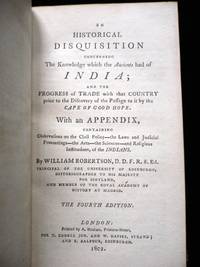
18029992London edinburgh: T. Cadell Jun and W. Davis StrandE. Balfour 1802. Fine. T. Cadell Jun and W. Davis Strand E. Balfour London edinburgh 1802 14.80 x 9.50 cm relié Fourth edition after the first edition published in 1791. Contemporary full sheep binding. Smooth spine richly decorated a repeated tool in 4 compartments featuring arms a shield and a helmet. Double fillet border on the boards. One black and one red title label. This is the last historical work by the celebrated Scottish historian William Robertson pastor of the Presbyterian church and dean of Edinburgh University. The author examines closely Indian civilization and its current functioning as well as its entry into the colonial empire. There is an interesting chapter on silk production and trade. 2 corners slightly bumped. T. Cadell Jun and W. Davis StrandE. Balfour hardcover
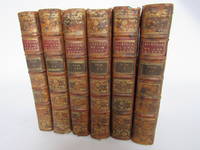
177143812A Amsterdam et se trouve à Paris: Chez Saillant & Nyon 1771. Fine. Chez Saillant & Nyon A Amsterdam et se trouve à Paris 1771 9 x 17 cm 6 volumes reliés New edition after the original published in 1769. Contemporary full blonde sheep binding. Raised spine decorated. Red morocco title-label. Head of all 6 volumes worn. Headcaps of volumes III and IV split. Rubbing. Corners very bumped. The Histoire de Charles-Quint is undoubtedly one of the great historical classics of the 18th century whose model would inspire many imitators the author seeking to grasp beyond simple factual history the historical march of a civilization and its singular spirit. A tableau of the progress of society in Europe from the destruction of the Roman empire to the beginning of the sixteenth century. The introduction is a précis of the history of the early Christian centuries. Chez Saillant & Nyon unknown
184527085Paris: Didier 1845. Fine. Didier Paris 1845 11 x 18 cm 2 volumes reliés Fifth edition of the French translation by J.B. Suard and Morellet. Half black sheep binding spine with four raised bands decorated with blind fillets showing slight rubbing of no consequence marbled paper boards marbled endpapers and pastedowns. Notes by Humboldt Bulloch Warden Clavigero Jefferson. collected by De La Roquette. Some minor foxing of no consequence. Didier hardcover
177158175à Paris: Chez Saillant & Nyon 1771. Fine. Chez Saillant & Nyon à Paris 1771 10 x 17 cm 6 volumes reliés First French edition translated from English by Suard after the first English edition published in 1769. This edition was printed at the same time in quarto format in 2 volumes. Contemporary full marbled sheep binding. Spine with raised bands decorated. Red morocco title label and volume label. Head of volume VI torn off. Loss at head of volume III with joints cracked at head. Tail of volume VI partly worn. Loss at tail of volume II. Lower joint of volume III cracked at head. Overall rubbed. Corners slightly bumped. The History of Charles V is undoubtedly one of the great historical classics of the 18th century whose model would inspire many imitators the author seeking to grasp beyond simple factual history the historical march of a civilization and its singular spirit. A tableau of the progress of society in Europe from the destruction of the Roman empire to the beginning of the sixteenth century. The introduction is a précis of the history of the early Christian centuries. Chez Saillant & Nyon hardcover
188218270Paris: O. Doin 1882. Fine. O. Doin Paris 1882 12 x 19 cm broché First edition. Occasional small foxing. Rare. O. Doin unknown
193012014Bruxelles Brussels: Imprimerie J. Perebooms 1930. Fine. Imprimerie J. Perebooms Bruxelles Brussels 1930 17 x 25.50 cm broché First edition of this lecture given to the Belgian Society of Philosophy on May 11 1929. Autograph inscription from the author on the front cover. Imprimerie J. Perebooms unknown
18380001527Good. 1838. On offer is an important and significant unique set of published works on Cornish fauna notable for numerous manuscript additions and drawings by the noted surgeon and naturalist William Pennington Cocks 1791-1878. BOOK SPECIFICS FOLLOW DESCRIPTION. This complete three-volume 1838 set lists the fauna of Cornwall in a systematic way: Parts I and II "Vertebrate crustacean and a portion of the radiate animals" and "The testaceous mollusks" are by Jonathan Couch; part III "The zoophytes and calcareous corallines" is by Richard Couch his son. The first volume contains bats mice the 'whale tribe' including grampus porpoise highfinned blower and dolphin birds reptiles including the viper and red viper fishes including 9 pages of Yarrell's observations on the lancelet crustaceans and radiated animals mostly starfish. The second volume contains molluscs together with an appendix taken from a report on the zoology of Cornwall containing additions to various species not just molluscs. The third volume contains radiated zoophytes orders Hydroida Asteroida Helianthoida molluscan zoophytes Ascidioda and a supplement to the first two volumes adding additional species. There are also 23 lithographic plates at the rear entirely related to species in this volume. Of particular importance to collectors historians and researchers of the topic are the numerous manuscript drawings and annotations contained in the third volume by noted Cornish naturalist William Pennington Cocks. He has annotated in the margins including some underlining in the text of numerous pages in the main text noting specimens found and signing next to each one with his initials. Some are also dated e.g. 1846. Cocks has done his own drawings alongside the lithographic plates in ink presumably illustrating specific specimens that he found on the coast together with Latin names at the bottom of each plate. The illustrations - done either beside the printed material or on the blank facing or rear pages - are actually very impressive and complement the existing lithographs nicely. Further manuscript illustrations have been done by Cocks in the margins of several text pages. Cocks has also written his name at the head of the preface page. Approx. 40 text pages are annotated to some degree and most lithograph pages and several blanks have Cocks' further annotations and/or drawings on them. Historians will know that Cocks donated a small collection to the British Museum in 1849. This included specimens of Balanus tintinnabulum an extremely variable species and this probably explains why Charles Darwin wished to examine the collection. In a letter to curator John Edward Gray in January 1851 Darwin wrote: "I will be here tomorrow morning at 10 oclock & as I have very much to do will you kindly oblige me by having Spengler on Cirripedia which you once showed me ready for me.- Also I want to look at the rest of the sessile Cirripedia in the Collection for praise be to Heaven I have finished Balanus. And Lastly could I see Mr. Cocks' collection" THE BOOK: A Cornish Fauna; being a compendium of the Natural History of the County intended to form a companion to the Collection in the Museum of the Royal Institution of Cornwall 3 volume set by Jonathan and Richard Q. Couch. DETAILS: Truro: Printed for the Royal Institution of Cornwall by L.E. Gillet 1838-1844. First editions. Volumes 1 and 2 in original paper wraps; Volume 3 in original cloth-backed papered boards. vi 84; viii 76; xvii 164pp. Illustrated with 23 lithographic plates many with additional ink drawings and annotations in contemporary hand. 8vo standard sized books. CONDITION: Very Good see table below for details. Volume 1: Sunning and edge-wear to wraps split down edge of rear wrap wrap coming loose but still attached. Signature to front wrap. Small nick to fore edge of some front pages minimal to margin only. Small bumps to page corners. Volume 2: Signature to front wrap. Some sunning and creasing to wraps. Light foxing to bottom of front wrap and a few pages. Volume 3: Ex-library with stickers to spine and bookplate to front endpaper. Sunning and edge-wear to boards and spine. Foxing to boards and endpapers scattered spots elsewhere minimum to a few plates. Some annotations to margins including several ink drawings plus annotations and additional ink drawings nicely done to most plates. Further notes to one laid-in leaf and rear fly leaf. Spine starting between a number of text pages and binding a little fragile but still intact. Overall G. ; 8vo - over 7¾" - 9¾" tall; KEYWORDS: CONCHOLOGICAL SOCIETY WILLIAM PENNINGTON COCKS JONATHAN AND RICHARD Q. COUCH CHARLES DARWIN JOHN EDWARD GRAY BRITISH MUSEUM CORNISH FAUNA COUCH CORALLINES CORNWALL HANDWRITTEN MANUSCRIPT DOCUMENT LETTER AUTOGRAPH DIARY JOURNAL LOG KEEPSAKE WRITER HAND WRITTEN DOCUMENTS SIGNED LETTERS MANUSCRIPTS HISTORICAL HOLOGRAPH WRITERS DIARIES JOURNALS LOGS AUTOGRAPHS PERSONAL MEMOIR MEMORIAL PERSONAL HISTORYantiquité contrat vélin document manuscrit papier Antike Brief Pergament Dokument Manuskript Papier oggetto d'antiquariato atto velina documento manoscritto carta antigüedad hecho vitela documento manuscrito papel. . hardcover
181018583<p>Good hard cover. Full leather over boards black spine panel with gilt stamped title. Clean scuffed covers and spine; some edge wear - boards just exposed at front cover fore corners; spine title gilt mostly effaced; slight cracking at front cover upper joint but all remains tightly bound; faint pencil markings on front free end paper; owner name and date 1814 on front fly leaf; clean interior with some foxing and general age darkening; leaves remain supple; 1 inch chip at top fore corner of pp 477/478 with some text loss. 2nd title page at p. 457 for Appendix with names of places and people of the bible. 14 x 13 cm. xi 1 14 - 491. See OCLC #64408394; Shaw and Shoemaker #21048.</p> Boston: Thomas & Andrews, West & Blake, Eben, Larkin, and John West & Co; no date (1810) hardcover
1927287889New York: William Helburn Inc. 1927 Black Cloth With Pink Paste -On Title Plate. Map End Pages. 162 Pgs Index Of Old Houses Mentioned In Text Or Illustrated. Clean Tight. 4to - over 9¾ - 12" tall. Owner's Name. First Edition Ex-Library. Hardcover. Very Good. William Helburn Inc. hardcover
1904036619London: G. P. Putnam's Sons 1904. Book. Very Good. Hardcover. First Edition. 8vo. pp. 398 numerous illustrations foldout colour maps of India Spain and Portugal portrait frontispiece plate with tissue guard. Privately bound polished calf prize binding for Malvern Collegel gilt vignette to the front board gilt decoration to the spine and boards some cracking to leather on the front hinge secure. Contents clean and tight marbled endpapers and matching marbled fore-edges all plates clean. A very good attractive copy. G. P. Putnam's Sons Hardcover
19170001868CHAMPAGNE MARNE FRANCE. Good. 1917. On offer is a sensational archive of World War I manuscript diaries 2 and ephemera handwritten or accumulated by William O. Swenson a 23 year old soldier who was part of the 117th Ammunition Train 42nd Rainbow Division occupied as a driver. The first diary 2.5 x 4 inches has 42 well filled handwritten pages starts in Sept. 1917 to Oct. 31 1917 mostly the trip to overseas arriving in N.J. getting on boat go to London Paris Parade Day etc. The second diary that is 2.5 x 4.25 inches has 138 well filled pages starting Jan. 1918 to Dec. 27 1918. This diary details much more intense war content. Here are some snippets: 'May 1 1918 We landed at New Port New VA and at 6:30 we pulled into the Chesapeake Bay and there was a tug boat pulled up beside us with women and 3 men in it. They were the welcoming committee from Kansas. We got off the boat at 10 am the Red Cross gave us chocolate a package of Camels and cookies. We lined up and marched up there turned and passed in review of Gen. March. The shute was all decorated and had a banner from every state where the rainbow was from. We loaded our packs in trucks and started for camp. May 18 1918 I wanted to go home so we finally started. There stood mama she was surprised I'll say she was glad. How good everything looked and so quiet and peaceful and to think I was free and oh so happy and home with mother. June 21 1918 We went to Baccarat and got Inf. men and took them to Rheims and got home at 6 am. July 5 1918. Drove to Bursy Fe Chataen. Sunday morning: we went to the front with flying pigs for the 117th French Mortar Bat. July 14 1918 The night of 14th at midnight the hell started. We got up and went back up a hill a manuvaled And stayed until daylight. The shells were lightning all around and the sky was as light as day. It was awful. They stopped shelling for a while just as I got there breakfast and went to the And tried to get some sleep. I laid down for 15 min. And they started again. They started to shell the hospital and the shells were coming straight over our head and I decided to go to the hill again and just then a shell 12 yards from the and blew up a dug out and threw the breakfast food full of dirt. Watch them shell the hospital and I went over there after they let up and it sure was a sight. Two men were killed and men laying and bed and it made me feel bad the rest of the day. Left for the front 175s Inf. 149. I hauled 400 rounds and worked all night. The airplane men dropped bombs and it was quite interesting. July 18 1918 We went to the front with flying pigs for the 117th French Mortar Bat. We had an awful trip. Shell holes and muddy roads. July 31 1918 When Suneanger was coming home on one of the trucks an airplane dropped a bomb and killed him. Aug. 1 1918 An airplane came over at dust and flew over us twice he sure was low. We could see him but the machine gun drove him away. Oct. 10 1918 Just got to bed when the huns started shelling the place. We got up and went down the road and we came back at 5 am. Archer was killed and dorms got his leg shot off. Oct 29 1918 Met a French Lt. and a girl who could speak English and also an ex-soldier from Austria who was in Eng. Army. Jan. 25 1918 Went back abut 10 miles after 4 loads of French mortar bombs or flying pigs and we stayed all night. Jan. 30 1918 I went on the rifle range and beat the record for the day 37. March 25 1918 Went to 168 Inf. and got Lut. Stunley and Col. Bear of 167 and took them to Ahnuerler. Nov. 20 1918 Went to Montrimeby The French had flags out and gave us a warm welcome. Got a room and had electric light in it. A fine room. This town is not shot up and it is a treat to get in a place and see civilization.' Last entry is Dec. 27 1918. And still overseas. Ephemera includes: 30 X 34 inch blueprint map of the Motor Battalion 117th Ammunition Train 42nd Rainbow Division through France bBelgium Luxembourg and Germany. few pin holes on creases this is folded up so it has creases; 19 x 25 black and white map of Nouvelle Carte Nord-Est folded and has some tears along some of the creases; 5 real photo postcards: 1. a soldier perhaps William Swenson. 2. Soldiers Altenahr 1918-19 On the back he wrote "I am not in here as I was with Div. Hdg. at the time"; 3. a group of soldiers; 4. R.M.S. Arabic and 5. Paris. Additionally pay records clippings autograph album telegrams French money travel documents tickets . Overall G. HISTORICAL NOTES: THE Rainbow Division sailed from Hoboken New Jersey on Oct. 18 1917 and was the fourth American combat unit to arrive in France and they became the first American troops to be entrusted with a whole sector of the western front on their own as they moved into the Baccarat Sector. In late June they moved into the Champagne a desolated battleground east of Rheims. On midnight July 14-15 the greatest artillery barrage of the war opened the battle guns every 10 meters along 42 kilometers of front on both sides roared for 4 hours then 200000 German infantrymen assaulted the French and American position. The battle of Champagne went on through the 15-17th most of the fighting was hand to hand with grenades clubbed rifles bayonets and trench knives. During the 3 days the furious artillery barrage continued to rake all areas within 10 miles of the battle line. These three days of horror were subsequently labelled the "Champagne-Marne Defensive". ; Manuscript; 32mo - over 4" - 5" tall; KEYWORDS: HISTORY OF CHAMPAGNE MARNE DEFENSIVE RAINBOW DIVISION AMMO TRAIN AMMUNITION TRAINS EXPLOSIVES DANGEROUS DUTIES WORLD WAR I WW1 WWI THE WAR TO END ALL WARS WILLIAM O. SWENSON WAR WITH GERMANY HUNS HANDWRITTEN MANUSCRIPT AUTOGRAPHED AUTHORS AMERICANA MANUSCRIPT DOCUMENT LETTER AUTOGRAPH KEEPSAKE WRITER HAND WRITTEN DOCUMENTS SIGNED LETTERS MANUSCRIPTS HISTORICAL HOLOGRAPH WRITERS AUTOGRAPHS PERSONAL MEMOIR MEMORIAL PERSONAL HISTORY ARCHIVE DIARY DIARIES antiquité contrat vélin document manuscrit papier Antike Brief Pergament Dokument Manuskript Papier oggetto d'antiquariato atto velina documento manoscritto carta antigüedad hecho vitela documento manuscrito Papel . unknown
1829000522New York NY Virginia VA. Good with no dust jacket. 1829. On offer is a letter written by a cashier at the Farmers Bank of Virginia to a well-off client regarding the debt consolidation of a former business associate who declared bankruptcy. The letter dated April 10 1829 is written and signed by William Nekervis cashier for the Farmers Bank of Virginia. Nekervis was born in Philadelphia Pennsylvania date unknown and prior to becoming a bookkeeper and then cashier in Virginia it is believed that he is the same William Nekervis who was a co-founder of the Philadelphia Society for the Instruction of Indigent Boys which became the Philadelphia Society for the Establishment and Support of Charity Schools. Nekervis died in Virginia in August 1837. In this letter Nekervis writes in his role as cashier of the Farmers Bank of Virginia to Tobias Isaac Tobias 1786-1861 a merchant based in New York City. He writes: .Since I last wrote to you two of Mr. Judah's notes have been consolidated and reduced to $240. The debt is now $455 in two notes $240 and $215 both due 27/30 April. We believe that Nekervis is writing about Mr. David Judah 1789-1866. On June 23 1823 Virginia newspapers reported that David Judah Tobias Isaac Tobias and Edward Pollock had become business partners in David Judah & Company a Virginia-based dry goods company. Less than five years later New York newspapers reported that on February 4 1828 T. I. Tobias & Co. Of New York legally separated from Virginias David Judah & Co by "mutual consent". It is clear that following the dissolution of his company Judah was in financial distress. In March of 1829 Judah sold off all of his possessions including his home and its contents his four female slaves one of whom was a nine-year-old and over 184 acres of land. The Kaplan Collection which holds some of Tobias' and Judah's correspondence reports that following his financial collapse Judah moved to Maryland. The letter offered here was written only months after a January 1829 letter held in the Kaplan Collection in which Nekervis responded to Tobias' question about Judahs outstanding debts owed to the bank. This letter adds to the knowledge of 19th century Jewish-American merchants and the burgeoning banking industry that funded their business ventures in the Jeffersonian-era. This letter is one page integral stampless address leaf and measures 8 x 10 inches. Horizontal and vertical folds; light soil; some weakness at folds; large docketing note on address leaf; Good condition overall. ; Manuscript; 4to - over 9¾" - 12" tall; 1 pages; KEYWORDS: HISTORY OF HANDWRITTEN MANUSCRIPT DOCUMENT LETTER AUTOGRAPH WRITER HAND WRITTEN DOCUMENTS SIGNED LETTERS MANUSCRIPTS HISTORICAL HOLOGRAPH WRITERS AUTOGRAPHS PERSONAL PERSONAL HISTORY MEMOIR MEMORIAL DIARY JOURNAL DIARIES JOURNALS jüdisch jüdische Torah Tora sefer talmud Judaic Hebraica scarce book signed Judaica ANTIQUE Banking Money Moneylending VIRGINIA NEW YORK COLONIAL JUDAISM AMERICANA BANKING ECONOMY ECONOMICS THEATER THEATRE ; Signed by Author . unknown
1903009096Cincinnati: Byway Press 1903. First Edition Limited. Hardcover. Very Good. Goetting A. E. decorations. Limited edition this #63 of 350 copies. Short 8vo. Paper-backed covers over cloth spine. Covers soiled and edges worn. Internals near fine. Nice period pasted down bookplate designed by E H Ball. Byway Press hardcover books
1984056105Carmel / San Grancisco: Scenic Road Press / Sanford L. Berger 1984. 1st Edition . No Binding. Fine. Single Card Printing A William Morris Letter One Of 200 Copies. One Of 150 Copies. Issued As A Keepsake For The Biennial Meeting Of The Roxburghe And Zamorano Clubs In 1984. The Huntington Library Holds The Correspondence And Research Files Reflecting The Activities Of California Architect Sanford L. Berger 1919-2000 In The Mid-To-Late 20Th Century As A Collector Student And Enthusiast Of Objects And Knowledge Related To 19Th Century English Artist Decorator Poet And Printer William Morris 1834-1896 His Circle And His Involvement With The Pre-Raphaelites And English Arts And Crafts Movement. <br/> <br/> Scenic Road Press / Sanford L. Berger unknown
190528167Paris: Vers et Prose 1905. Fine. Vers et Prose Paris juin-juillet-août 1905 17 x 25.50 cm broché First edition. Substantial issue gathering contributions from: Paul Claudel Francis Vielé-Griffin Maurice Barrès Francis Jammes Paul Adam Albert Mockel Stefan George Stuart Merrill Jean Moréas Saint-Pol-Roux Mécislas Golberg André Salmon Tancrède de Visan Tristan Klingsor Henri Ghéon William Morris Robert de Souza Eugenio de Castro Paul Fort . Spine creased with some small tears and slight lacks traces of pencil annotations on rear cover otherwise a handsome copy with fine interior. Vers et Prose unknown
1989002342Atlanta Georgia: Peachtree Publishers 1989. First Edition. . Hardcover. Very Good/Near Fine. Photography By Richard Moore. VG/NF/1st ed. 1st prntng/Signed by Both. Writer William Mitchell and photographer Richard Moore have portrayed the wonders of gardens historic and comtemporary public and private and urban and rural from each of the three regions of Georgia: North Georgia Piedmont Plateau and South Georgia. Whether illustrating overall "gradenscapes" or capturing intimate vignettes and individual blossoms Richard Moore's photgraphs have a depth of color and clarity of detail that immerse the reader into a world of delightful splendor. The text by William Mitchell not only describes the setting as they are today but also spins a rich background of history in the context of the botanical "Eden" observed by the early explorers. Book Condition is Fine; beige cloth over boards with white lettering to spine and front. 214pp. First Edition first printing. Beautiful full color photos on nearly every page. A large index of gardens in the back of book. Clean with a few subtle spot on the half title page. Otherwise tight and square with some very light foxing on the first 3 pages no other markings or soiling. Signed by both the author and photographer on the half title page. Dust Jacket Condition is Near Fine; glossy clean jacket with a couple of small closed nicks at the bottom of the front panel. Covered with a removable mylar jacket. Book showcases the best Georgia has to offer. <br/> <br/> Peachtree Publishers hardcover
18980022152Washington DC: Government Printing Office 1898. First Edition. . Hardcover. Very Good/None Issued. VG/1st ed. Excellent copy of this elusive government publication. Clean with very little wear cover firmly in place all pages present. 281 pages of text and testimony 3 page index of testimony index of exhibits exhibit A through M which includes a chart of ship several b&w photos of the Maine's wreckage illustrationssketches of various areas of ship and a map. Publication has some very lightly upturned pages at the very tips and is missing a very small chip at rear bottom of spine. All pages are firmly attached. Truly a piece of US history. Comes to you in an acid free document bag. BASN <br/> <br/> Government Printing Office hardcover
18620009003New York NY San Francisco CA Melbourne AUS. Good. 1862. On offer is an archive of exemplary archive of letters telegrams and ephemera by and related to Captain William Augustine Macgill. This archive contains two letters from the early 1860s and the rest of the documents are from the late 1940s having been put together by R. R. Macgill obviously a descendent of Captain Macgill. These later documents are testaments to the historical significance of William Macgill captain of the clipper ship "Sweepstakes." This ship was one of the fastest sailing ships in the world at the time and made the fastest voyage from New York to San Francisco in the entire year of 1856. The letters from the 1940s are responses from various historical societies and museums that Mr. Robert R. Macgill has contacted about his great grandfather. A letter from the Smithsonian United States National Museums states "My dear Mr. Macgill.Mr. Taylor was pleased to have this information to add to his data card on Captain Macgill. In regard to the record of the 'Sweepstakes' Mr. Taylor cites 'The Clipper Ship Era' by Arthur H. Clark.as authority for the statement that the 'Sweepstakes' made the fastest run of the year from New York to San Francisco in 94 days in 1856." Interestingly enough another letter from the New York Historical Society received just three days later by Robert Macgill seems to contradict this. "The SWEEPSTAKES is not included among clipper ships which made record passages to or from California." However the book they use for this information is different Carl C. Cutler's "Greyhounds of the Sea." In this book they state that Captain Macgill made a voyage of 106 days from New York to San Francisco in 1859 but does not talk about 1856. This journey is 1859 is the subject of a statement received from The Mariner's Museum in Newport News Virginia. "Under command of Captain Macgill she left New York Jan. 23 1859 and arrived at San Francisco May 8th in 105 days. Had a succession of heavy gales the first 12 days until she sighted Fayal. Crossed the line 23 days out; was 57 days to the Horn and crossed the equator on the 86th day. On May 1st 12 days later and 98 days out was in 30 degrees North 137 degrees West after which had light and baffling winds from the north." The letter than describes the rest of the "Sweepstakes" journey. First to Hong Kong then to Manila. It leaves Manila on March 6 1860 and arrives in New York 98 days later. Then to Anjer Java Head Algoa Bay and Melbourne. It tours Australia and the East Indies for much of the next two years until it runs ashore in the Straits of Sunda. The estimated cost of repairs being too high Captain Macgill decides to sell the ship for 15000 florins in Batavia. There are two handwritten letters from the early 1860s included as well. One is by a "L. Maguire" to Capt. Macgill. It is dated "New York Sept. 24 1862". It begins "The Neptune has met with a sad mishap -" and details the strong winds and dangerous conditions that a fellow friend's ship has encountered on his clipper ship. It ends by telling Macgill that "Spinola's Brigade" a unit of the Union Army during the American Civil War has been stationed in East New York "where they will all the week and all the help I have is our Boy Williams." The other letter is four pages long and was written by Captain Macgill to his brother Richard. It is dated "Melbourne Sept 11th 1863." "We had a great deal of very heavy weather gale after gale across the Southern Ocean and the seas are frightfully high I never saw anything to equal it in all my going to sea but my little Brig proved herself a splendid sea boat and the gales like a bird." This new ship Macgill captains remains unnamed but he states that she can go "300 miles per day". "We are now loading for New Zealand and will sail in a week or two my vessel is just suitable for that trade carries a large cargo." He also speaks of what he has heard of the civil war back in America. " seems to have shook the whole yankee nation in marching I am sorry they have Vicksburg I much fear now they will have Charleston they are having a train in N. York just now I hope it will not reach Brooklyn and disrupt my family if they go on in this way I shall become naturalized before I leave her if I find they will make me join the army when I come home against my will." In the rest of the letter Macgill describes what he does in his spare time in Melbourne. It seems also that Macgill forgot to send the letter on the 11th because there is another part of the letter dated "Sept 23" which begins "I have been so long writing this letter that I forgot what I have written down." He writes that the mail in Melbourne goes out rather infrequently and that he missed the last mail leaving 4 days before his arrival. He finishes the letter with his well wishes and asks his brother to send his kind regards to his family and wife. Finally included in the archive is a photograph of Capt. Macgill. The back of the photograph reads "Capt. Wm. A. Macgill. Born Nov 12 1822. Died Jan 14 1867. This picture taken in Melbourne Australia." The photograph was printed in the "Julius Gulman & Co. Photograph Studio" in Baltimore Maryland. Two "Public School Reward of Merit" certificates are included as well. One is from the sixth grade and one from the seventh. These certificates belonged to Capt. Macgill's son whom he named William Macgill as well. These are beautiful and interesting in their own right. Overall G.; Manuscript; KEYWORDS: HISTORY OF WILLIAM MACGILL SHIP CAPTAIN CLIPPER SHIP UNITED STATES NAVAL HISTORY FASTEST SHIP WORLD RECORD SPEED NEW YORK TO SAN FRANCISCO SEAFARING OCEAN VOYAGE RACING BOATS PRE-CIVIL WAR ERA POST-CIVIL WAR SMITHSONIAN UNITED STATES NAUTICAL MARINE SAILING SAIL BOATS AMERICANA HANDWRITTEN MANUSCRIPT DOCUMENT LETTER AUTOGRAPH WRITER HAND WRITTEN DOCUMENTS SIGNED LETTERS MANUSCRIPTS HISTORICAL HOLOGRAPH WRITERS AUTOGRAPHS PERSONAL MEMOIR MEMORIAL AMERICANA ANTIQUITÉ CONTRAT VÉLIN DOCUMENT MANUSCRIT PAPIER ANTIKE BRIEF PERGAMENT DOKUMENT MANUSKRIPT PAPIER OGGETTO D'ANTIQUARIATO ATTO VELINA DOCUMENTO MANOSCRITTO CARTA ANTIGÜEDAD HECHO VITELA DOCUMENTO MANUSCRITO PAPEL . unknown
18930012237South Dakota. Good with no dust jacket. 1893. Non-Book. On offer is an interesting letter written by the internationally-recognized American historian William Maxwell Blackburn 1828-1898. Blackburn served as president of Pierre University from 1885 to 1898. He was an ecclesiastical historian internationally known through his authorship of numerous books and articles. He wrote on various topics of local and national interest such as the philosophy of education geology and South Dakota history. Blackburn published more than 30 books on topics ranging from young adult fiction to religious histories. He also was a founding member of the South Dakota Historical Society. SEE BIO NOTES AFTER LISTING FOR INFO ON THE UNIVERSITY. Blackburn wrote this letter to Prof Hitchcock apparently a friend and confidant. In his letter Blackburn writes for 3-and-a-half pages commenting on many events both local and national in scope. One reference is to labour problems at the Pullman Company that were the dominant railway coach manufacturer in the United States. The following year Pullman would be engaged in a bitter national strike that paralyzed U. S. Rail transport and was a turning point in American labour relations. An excerpt: . Since the brake up at Pullman an event so common to state institutions especially in new states that I was not overwhelmed with astonishment tho most very sorry that you felt it best to resign p1. The letter also references and important event in the state and city history notably an effort to have the state capital moved from Pierre to Huron. In the end Pierre prevailed: Just now we are somewhat concerned over a House bill to submit to the People a Change in the Constitution so as to give the Capital to Huron p2. He makes passing reference as well to the political divisions in the electorate of the time specifically mentioning the Populist Party which played a large role in 1892 elections as a significant left-wing force in American politics: The Legislature has few populists in it but about 30-40 farmers so-called p4. He touches on many other topics throughout. For a historian this letter is a direct connection to a widespread significant economic upheaval in America showing how it can touch even small communities far away from the major centres of economic and political power. On a more local level it is a direct link to an aspect of local history in the Sate of South Dakota. ABOUT PIERRE UNIVERSITY: The Presbyterian Church opened Pierre University in 1883 and built a wood-frame building called Pioneer Hall that year. In a bid for the university the city of Pierre South Dakota offered twenty acres of land and $13000 for the construction of the educational institution Religious and educational institutions were looked to as a civilizing influence over the rough Western town. Pierre Universitys focus was on training ministers and teachers and it awarded the first higher education degree in Dakota Territory in May 1887. The depression of the 1890s hit the area hard and the college was merged with Scotland Academy and relocated to Huron in 1898 where it became Huron College. Passing through several private hands and operating under various names the university continued until 2005 when it finally closed. The University was never large and in his letter Blackburn notes that they have 33 class students and 35-40 specials possibly part-time students. The letter is a two-page double-sided document that measures approximately 10.5 inches by 8.0 inches. It is about 2/3 complete. The paper is in good condition. There is an approximately 1.5 inch tear along one fold. The handwriting is clear and legible. ; Manuscripts; 8vo 8" - 9" tall; 3 pages; Signed by Author . unknown