Louis ARAGONBiblio.com
48 402 résultats
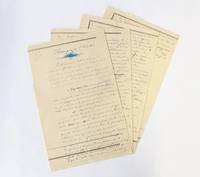
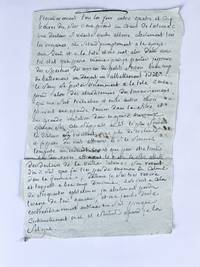
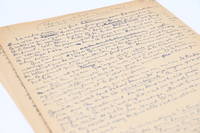
1948871601948. Fine. ""Pour moi l'amitié des assasins n'est pas l'amitié . tant pis si l'on me juge esclave et qu'on me juge sans coeur !"" For me the friendship of assassins is not friendship . too bad if I am judged a slave and judged heartless! s. d. 1948 21 x 30 cm 8 pages et demi sur 9 feuillets Exceptional autograph manuscript by Louis Aragon entitled ""Chronique de la pluie et du beau temps pour Europe mai"". 8 and a half pages in blue ink on 9 uniformly browned leaves. Numerous deletions and rewritings. Published in Europe no 29 May 1948 and does not appear in the book collecting these chronicles E.F.R. 1979. Superb nine-page militant profession of faith published in the anti-fascist literary review Europe. Aragon finds himself courted after the war in the name of ""friendship"" and ""freedom"" by various reviews but categorically refuses to publish alongside writers with Pétainist tendencies. The writer delivers his impressions after a radio interview in Belgium and meditates on ""two abstract monsters: freedom and friendship"" perverted at will in this early Cold War period when Sovietism becomes - to his great dismay - the new fascism. Very attached to the unified discourse advocated by communism which he calls ""national truth"" this notion serves as the guiding thread of his chronicle. Aragon writes in the midst of the Kravchenko affair and remains convinced by Sovietism which remains for him the great victor over Nazism. As a great literary witness to the suffering endured during the Occupation he is alarmed by the editorial choices of reviews seeking to obtain contributions from him: one shamelessly publishes a text by Montherlant totally oblivious to the Parisian martyrs during the war while the other affectionately justifies the allegiances of many French people to Marshal Pétain. It is also the occasion for a long and beautiful analysis of the idea of nation by Aragon who is unquestionably the national poet of this century. We find there in his inspired tirades the Aragonian ideal of healthy emulation among nations turned toward progress. Beautiful pages by Aragon in the midst of the crystallization of the Eastern and Western blocs. Aragon's ambition is to honor the memory of the Resistance by choosing to ""trust words when they are used for peace"". ""La Nation qui me paraît aujourd'hui encore être le groupe le plus étendu qui puisse se porter garant d'une vérité . la radio peut et doit transmettre à son public la vérité nationale . 'Qu'entendez-vous concrètement par vérité nationale ' Me demande-t-il comme il m'aurait sûrement demandé : qu'entendez-vous en disant qu'il fait grand jour en plein midi si je l'avais dit. C'est là le mécanisme des interviews. J'ai donc pris deux exemples concrets pour expliquer à quoi sert le maniement des abstractions. Deux cas récents où j'ai eu à me mesurer avec deux monstres abstraits : la liberté et l'amitié. La liberté d'abord. On sait comment les pires ennemis de la liberté font usage d'un livre qui s'appelle : J'ai choisi la liberté donnant le bénéfice d'un préjugé favorable de ce mot à tous ceux qui trahissent leur pays quand c'est pour choisir le système capitaliste . . Une revue qui s'édite à Montréal m'avait récemment écrit pour me demander ma collaboration. Son directeur littéraire faisait appel à l'homme libre l'italique est sienne que je suis. Cette façon de distinguer par la typographie en moi la possibilité d'être parfois un homme libre parfois non m'avait un peu inquiété. J'ai voulu voir sa revue . Mon Dieu le fait que ce numéro s'ouvre par un texte de M. de Montherlant me laisse libre de ne pas parler du contexte. On sait et j'imagine que M. Victor Barbeau de Montréal n'ignore pas que M. de Montherlant est sur la liste des écrivains avec lesquels les membres du Comité National des Ecrivains se refusent à collaborer. Ce qui doit sans doute m'expliquer pourquoi M. Barbeau s'adresse en moi à l'homme libre : c'est- unknown
189060481Paris 1890. Fine. Paris s. d. 1890 21.30 x 14 cm 3 pages in-8 au verso de 4 feuillets de l'Assistance publique de Paris VERLAINE Paul Complete autograph manuscript signed by Paul Verlaine of one of his Hospital Chronicles: We poets as well as they the workers our companions in misery Paris n. d. 1890 213 x 140 mm 8 3/8 x 5 1/2 3 pages in-8 at the back of 4 leaves of the Assistance publique de Paris Complete autograph manuscript signed by Paul Verlaine of one of his Hospital Chronicles 90 close lines in black ink on the verso of paper from the Assistance publique de Paris. The chronicle of one of Verlaines stays in hospital between September 1889 and February 1890. The note III has been crossed out in blue printers pencil. In the definitive collection this text is in fact second. In the version published by Le Chat noir on 5 July 1890 there appear to be no variations with the text of this manuscript. This is thus the final state of the text the one sent to the printer. Jacques Borel dates the writing of this chronicle to a hospital stay in Cochin in June 1890. Verlaine spent many days in hospital during his life especially in this period. During these stays he wrote Hospital Chronicles prose poems in eight parts. Here he mixed anecdotes observations of the lives of the patients and a delicate poetical analysis of the world of the hospital. Verlaine starts off with a troubling and tired observation: But certainly all the same the Hospital darkens despite the fine June weather.Yes the Hospital is dark despite philosophy insouciance and pride. Despite the fine weather the inflexibility of the system the misery and the sickness give the poet a gloomy take on things: let us punish all objections under pain of expulsion still severe even in this month of flowers and hay of warming days and clement nights if you have the devil at your back and debt and hunger at home. Discharge whether by way of being thrown out or getting cured and life outside did not offer more comfort than the stay itself: Clearly well all get out sooner or later more or less well more or less happy more or less sure of the future at any rate more or less alive. So we will think sadly.of our suffering emotional and otherwise of the doctors good or inhuman. This was a feeling he had already experienced during what he called my intervals the times when he was out of hospital. Life outside hospital was a miserable prospect despite his established fame. Verlaine compares his misery to that of the working classes who share his stays in various hospitals. The poet calls for resignation from his brothers artisans of one sort or another workers without a lifes-work and poets.and publishers too let us accept our fate let us drink up the cup of tea with barely any sugar or this little hot chocolate and let us be brave whether it be with our medicine or an enema or chewing tobacco. Let us follow their prescriptions closely let us obey all injunctions so that injections and colonics will seem sweet to us and let us reprimand all objections.. And along with them the poet wanted to take advantage of the beauties of June in quoting two verses from the Chanson sentimentale of Xavier Privas: We are pleased with ourselves in the strong sun. And under the green branches of the oaks we poets as well as they the workers our companions in misery.. Equal in the face of misfortune whether active or passive they might feel nostalgia once they were out: And perhaps some day we will miss these good times where you workers you could rest and where we we poets worked and where you artists earned your wine and your cups . Despite this reverie Verlaine was: tired of so much poverty provisionally believe me because I have been so used to it these last five years! and concludes bitterly with the observation of the lack of humanity in modern medicine: Hospital with a capital H an awful idea unknown
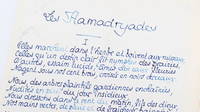
189686812Paris 1896. Fine. Paris s. d. ca 1896 21.50 x 26 cm trois pages sur trois feuillets Autograph manuscript signed by Pierre Louÿs entitled ""Les Hamadryades"" composed of sonnets on three sheets pasted onto more rigid leaves. The first two sonnets are written in blue ink the third in black ink. This poem was published in September 1896 in Volume II of the famous symbolist review ""Le Centaure"" to which notably contributed André Gide Paul Valéry Henri de Régnier Jean de Tinan and Pierre Louÿs. ""Elles marchent dans l'herbe et boivent aux ruisseaux Celles q'un destin clair fit nymphes des prairies. D'autres essaim lucide âmes des eaux fleuries Nagent sous nos cent bras croisés en noirs arceaux. . Maîtres des foudres Dzeus sauveur le verrons nous Frapper l'arbre mortel qui ferme nos genoux Et livrer la terre ivre à nos jambes écloses Connaîtrons-nous les grands horizons nébuleux L'eau du fleuve le lac de lumière les roses Et l'humide sommeil les champs profonds et bleus."" A fine poem by Pierre Louÿs one of the two with Byblis that was published in the luxurious and ephemeral review ""Le Centaure"". unknown
191480879Alger Algiers 1914. Fine. Alger Algiers s. d. ca 1914 13.70 x 18 cm 6 pages sur un double feuillet et un feuillet simple Autograph letter signed by Judith Gautier addressed to Céleste Chrétien her maid. Four pages written in black ink on a double sheet. Transverse folds inherent to mailing. Judith Gautier here evokes the visit of her friend the musician Chalmers Clifton - whom she liked to nickname Charmeur - to Dinard: ""Mr Clifton received yesterday Sunday a telegram which told him to book Villa Mitsou for August and September in the name of Ni Liao."" She also asks Celeste for additional information about a maid she recommended to her: ""Tell me again about the cleaning woman. Is she . a good cook how much does she ask for Is it only for the season"" A lover of animals she then gives some advice on how to pamper them: ""For the blackbirds you must crush the hemp seed very fine and crush in the same manner bread crust. This is the foundation of their diet but they eat almost everything bread in milk minced meat cooked or raw cherries strawberries grapes a little bit of young snail cut in pieces flies and especially mealworms and ant eggs fresh they adore them plenty of water always something to bathe in."" She also mentions one of her pets: ""My bat is still doing well. I am searching in vain for a little female for it."" ""A poor bat found itself one summer day stuck in a ""fly-catcher"" . The poor creature was struggling desperately. Judith unstuck it with cologne water put it in a small pantry and it lived there eighteen months. It lost its bat habits slept at night awake during the day it drank water from a shell lapping it like a little horse."" Anne Danclos La Vie de Judith Gautier : égérie de Victor Hugo et de Richard Wagner unknown
190885175Toulon 1908. Fine. Toulon 4 Août1908 13.50 x 21.50 cm 16 pages sur quatre doubles feuillets une enveloppe Very long autograph letter signed by Claude Farrère approximately 260 lines in blue ink 16 pages on four double sheets to his friend Pierre Louÿs. Fold marks inherent to postal dispatch envelope included. Claude Farrère mentions the letter he received from his friend and the one he has just sent him: ""I was writing to you on that same Friday a blood-colored letter. a glowing letter devoid of all composure."" He returns with humor to the quarrel between Pierre Louÿs and a certain Augusto probably Auguste Babut de Rosan for which he thought himself responsible: ""Note well dear friend that I was persuaded deep down despite your mutual denials of my personal influence in your quarrel. Human vanity never misses such opportunities. And it is with some shame that I confess to having believed myself for two good days to be the pivot of the world."" Claude Farrère castigates his own candor and lack of discernment: ""Although I am as prudent as you know me to be I am constantly caught red-handed. . the young divorced woman I once showed you at the cinema had the imprudence to arrange to meet me in deserted streets. the child's father a senior officer as befits encountered us there."" sensing that this naivety will eventually play tricks on him: "". it will end badly. I practice fencing every time I think about it."" Since he has just received his friend Pierre Louÿs's missive he continues writing his letter to respond to him and is astonished by what he has just read: ""So when four or five days later I find your first telegram 'am quarreling' with - for a reason you can guess."" I remain stupefied and rack my brain in vain. Having not guessed I suppose. I suppose wrongly. Bewilderment. I received last week seventy-five letters of which about twenty concerned you closely or distantly."" In this tangle of bruised and torn friendships Claude Farrère also describes the great dismay of another of their mutual friends a certain V who finally enlightens the writer about the misunderstanding opposing Louÿs and Babut de Rosan: ""Thereupon sudden change in V. He was more than struck. I saw him on the verge of suicide. He immediately pulls himself together regains his composure jumps on a train. And while waiting for departure time he resumes his account. and I understand."" Here Claude Farrère is almost relieved and reassured: ""Now I believe I have understood. Not quite everything. That I meddled in what did not concern me. I ask your pardon for it my friend and beg you to forget it. Your affection is so dear to me that I would be abominably unhappy to feel it cooled even by a single degree! Tell me if I must fear this and tell me so in earnest."" but still as sad for Augusto: ""Augusto is at this moment almost mad with grief because he believes your friendship lost to him. I deeply pity this poor child."" A very fine letter symbolizing the torments of the tumultuous friendships in Pierre Louÿs and Claude Farrère's circle. unknown
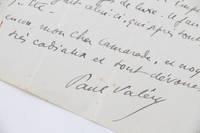
193384559Paris 1933. Fine. Paris 17 Juillet 1933 20 x 25.50 cm une page une enveloppe Autograph letter signed and dated by Paul Valéry 21 lines in black ink addressed to Adrien Raisin Dadre vice-president of the Seine tribunal concerning publishing rights and print run control. Fold marks inherent to the envelope a tear in the left margin of the letter at the fold level paper clip marks in the lower margin of the letter envelope included. Paul Valéry thanks his correspondent for his precious help: "". c'est là une question vitale pour les écrivains.dans cette question comme dans quelques autres la loi ni la jurisprudence n'étaient équitables ni même sensées."" "".this is a vital question for writers.in this question as in some others neither the law nor jurisprudence were equitable or even sensible."" He is also concerned about print run problems with publishers that border on illegality: ""La question du contrôle des tirages demeure toujours épineuse. J'avais proposé il y a 10 ans un timbrage d'état. Tout exemplaire non timbré serait réputé contrefait. Notez que les fraudes sont parfois le fait de l'imprimeur. Ce que j'ai vu arriver pour des ouvrages de luxe."" ""The question of print run control remains always thorny. I had proposed 10 years ago a state stamping system. Any unstamped copy would be deemed counterfeit. Note that fraud is sometimes the printer's doing. Which I have seen happen with luxury books."" unknown
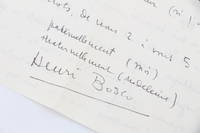
196684486Nice: S. n. 1966. Fine. S. n. Nice 26 Mai 1966 21 x 27 cm un feuillet recto-verso une enveloppe Autograph letter signed by Henri Bosco addressed to his friend and summer neighbor Georges Raillard 40 lines in blue ink on a recto-verso sheet from his home in Nice. Fold mark inherent to envelope insertion envelope included. The author of Mas Théotime is leaving for two summer months at his property in Lourmarin and is concerned about not having been entirely reimbursed for his expenses generated by the lectures he gave in Cadiz Georges Raillard being mandated to inquire about this pecuniary problem. Henri Bosco reproaches himself for having accepted too many requests: "". j'ai accepté trop d'obligations et comme le dit le mot cela me lie et m'agace"" "". I have accepted too many obligations and as the word says this binds me and annoys me"" and this is why he now imposes a complete refusal: "". je refuse donc colloques préfaces postfaces articulets - à quoi je suis inégalissime. J'attends quelques assauts à Lourmarin."" "". I therefore refuse symposiums prefaces postfaces brief articles - at which I am most unequal. I expect some assaults at Lourmarin."" When he stays at Lourmarin he will watch over the health and physical integrity of the beloved donkeys of his Luberon: ""Autre affaire on reprend T.V. Âne. Réapparition du jeune Goldenberg qui avait malmené ce petit quadrupède. Il jure de réparer tout cela cet été. J'ai été sévère. J'attends. Je me méfie."" ""Another matter we resume T.V. Donkey. Reappearance of young Goldenberg who had mistreated this little quadruped. He swears to repair all this this summer. I have been severe. I wait. I am wary."" Henri Bosco finally evokes the ancillary births surrounding him: ""Nous laissons à Maison Rose une servante qui vient d'accoucher - et allons trouver à Lourmarin une autre servante Geneviève qui se prépare à en faire autant. La France se repeuple. Il n'y a rien au monde que je craigne tant."" ""We leave at Maison Rose a servant who has just given birth - and are going to find at Lourmarin another servant Geneviève who is preparing to do likewise. France is repopulating itself. There is nothing in the world I fear so much."" S. n. unknown
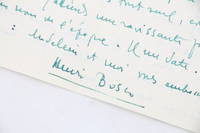
196587843Nice: S. n. 1965. Fine. S. n. Nice 10 Février 1965 21 x 27 cm un feuillet recto-verso une enveloppe Autograph letter signed by Henri Bosco addressed to his friend and summer neighbor Georges Raillard 53 lines in green ink on a recto-verso sheet on letterhead from his Nice residence ""La maison rose"" Fold marks inherent to mailing envelope included. A discoloration stain in the right margin of the verso of the sheet affecting a few words. Henri Bosco congratulates his friend on emerging unharmed from his recent car accident and invites him to be more cautious: ""Il y a sûrement des grâces pour les usagers de l'imprudence. et aussi pour ceux du verglas. Si vous n'êtes pas imprudent - et j'en suis sûr - peut-être cependant ne pensez-vous pas au verglas. Il faut y penser. Faites-nous ce plaisir à nous qui vous aimons vous Alice Henri Edmond Florence. Cela fait cinq têtes."" There are surely graces for those who are imprudent and also for those dealing with ice. If you are not imprudent - and I am sure you are not - perhaps however you do not think about ice. One must think about it. Do us this favor we who love you - you Alice Henri Edmond Florence. That makes five heads. The author of Mas Théotime then recalls his troubles as a clumsy driver: ""Quant à moi qui en 1931 me fracassai et fracassai ma femme au sud de Burgos je me garderai bien de vous faire part de mes expériences routières. Après 36 ans e volant je ne pars jamais sans trembler un peu. Partir est un acte de foi. Rapide ou lent lucide ou somnolent orgueilleux ou modeste on n'est sûr de rien. Arriver est toujours un miracle."" As for me who in 1931 crashed and crashed my wife south of Burgos I will be careful not to share my road experiences with you. After 36 years at the wheel I never leave without trembling a little. Leaving is an act of faith. Fast or slow lucid or drowsy proud or modest one is sure of nothing. Arriving is always a miracle. Henri Bosco prefers to postpone the visit he had promised to make to his correspondent: ""Au lieu d'aller à Barcelone nous irons en Sicile. J'ai des droits à toucher en Italie pour mon ""Don Bosco"". Je les dissiperai dans ce pays."" Instead of going to Barcelona we will go to Sicily. I have rights to collect in Italy for my ""Don Bosco"". I will squander them in that country. and marvels at nature already reborn in this month of February: ""Les amandiers commencent à fleurir et chats et chiens s'exaltent. Il en résultera encore des chats et des chiens. Le nôtre qui reste à la chaîne il vaut mieux est tenu à l'écart de ces débauches. Cela n'améliore pas son caractère."" The almond trees are beginning to bloom and cats and dogs are getting excited. It will result in more cats and dogs. Ours who remains on a chain it's better is kept away from these debaucheries. This does not improve his character. He evokes his work as a writer: the publication of the new version of his Don Bosco: ""Mais moi je travaille ! Mon ""Don Bosco II"" est paru avec 100 très belles photos et un texte mine très édulcoré.Il m'a néanmoins coûté des sueurs et suis souvent dans de répréhensibles états de colère. Que Dieu me pardonne ! Je n'en avais pas à Don Bosco le pauvre ! mais à l'éditeur à la fois suisse germanique photographe et coupeur de cheveux en quatre. Il était hanté par le poil sur l'oeuf."" But me I work! My ""Don Bosco II"" has appeared with 100 very beautiful photos and a very watered-down text. It nonetheless cost me sweat and I am often in reprehensible states of anger. May God forgive me! I had none against Don Bosco the poor man! but against the publisher who is at once Swiss Germanic photographer and hair-splitter. He was haunted by finding fault with everything. and the writing of his memoirs: "". j'ai pu me remettre à la rédaction de mes souvenirs III que j'intitule ""Le jardin des Trinitaires"" Mais la mise en train parès tant de Suisse a été treès pénible d'autant que dès le début j'ai rencontré le diable et je m'en sui S. n. unknown
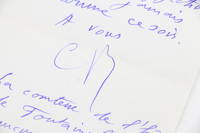
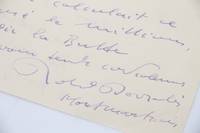
193085078Paris 1930. Fine. Paris s. d. 1930 21.50 x 27.50 cm une double page Fine autograph letter signed by Roland Dorgelès addressed to a writer also enamored of Montmartre in which he recalls with nostalgia the Butte of yesteryear and its famous ghosts 40 lines in blue ink from his Parisian home on rue Jean Goujon. Fold marks inherent to being placed in an envelope. ""Mon cher confrère Bien cordialement je vous remercie. Votre article de la Liberté m'a fait le plus grand plaisir. Vous aimez mon roman : pour un auteur c'est toujours agréable ; mais vous aimez aussi la Butte et cela nous rapproche. Nos chemins ne se sont-ils jamais croisés entre la place du Tertre et le Lapin Agile Savez-vous qu'un soir oh ! il y a longtemps j'ai rencontré boulevard de Clichy Léon Bloy que j'admirais ! vêtu d'un gros complet de velours et la canne son gourdin plutôt à la main. Et un après-midi j'avais 18 ans j'ai écouté les souvenirs de Bruant attablé avec moi rue des Saules - les deux visages sont accrochés dans ma mémoire comme les photos encadrées dans un salon petit-bourgeois. Dire qu""on va combler en partie cette délicieuse rue de l'Abreuvoir. Pourquoi seigneur Et si l'on calculait ce qu'on a dépensé de millions pour enlaidir la Butte. Je vous tends cordialement les mains. Roland Dorgelès Montmartrois."" My dear colleague Most cordially I thank you. Your article in La Liberté gave me the greatest pleasure. You love my novel: for an author this is always pleasant; but you also love the Butte and this brings us together. Have our paths never crossed between the place du Tertre and the Lapin Agile Do you know that one evening oh! it was long ago I encountered Léon Bloy on the boulevard de Clichy whom I admired! dressed in a heavy velvet suit and his cane rather his cudgel in his hand. And one afternoon I was 18 years old I listened to Bruant's reminiscences as he sat at table with me on rue des Saules - both faces are hung in my memory like framed photographs in a petit-bourgeois parlor. To think that they are going to partially fill in that delightful rue de l'Abreuvoir. Why Lord And if one calculated how many millions have been spent to make the Butte ugly. I cordially extend my hands to you. Roland Dorgelès Montmartrois. unknown
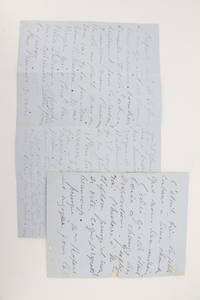
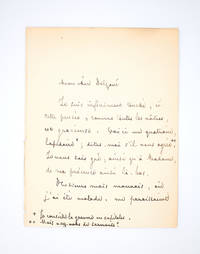
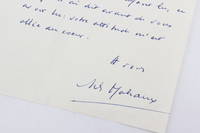
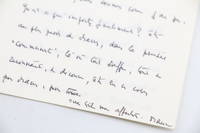
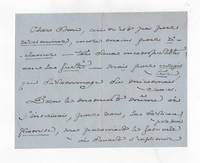
1892759251892. Fine. s. d. 15 avril 1892 12.60 x 16.40 cm 2 pages sur un double feuillet une carte et un calque Autograph letter signed by Stéphane Mallarmé to Alidor Delzant. Two pages written in black ink on a bifolium. Envelope enclosed. Also included is a signed autograph quatrain by Mallarmé on a card the one later inscribed on the mantelpiece: « Ici le feu pour renaître Tantôt durable ou charmant Comme l'amitié du maître Mêle du chêne au sarment. » Alidor Delzant was a lawyer collector and bibliophile. A friend of the Goncourt brothers he devoted a work to them and served as Edmonds secretary and executor. A fine letter in which Mallarmé evokes the composition of a quatrain to adorn Delzants mantelpiece: « Je suis infiniment touché et cette pensée comme toutes les vôtres est gracieuse. Voici un quatrain lapidaire je conseille la gravure en capitales; dites-moi s'il vous agrée. Mais usez-vous de sarments » Also included is the original tracing probably made by Mallarmé himself of the quatrain intended to decorate the lintel of Alidor Delzants library fireplace in his house at Paraÿs. Delzants reply to this letter is known: « Mon cher ami / Ces vers sont très beaux juste ce qui convenait pour glorifier la Cheminée de Paraÿs où les sarments pétillent autour des bûches des chênes. / Je demeure touché et reconnaissant. / Alidor Delzant. » unknown
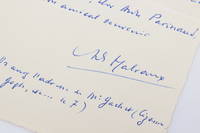
195484014Boulogne-sur-Seine Boulogne-Billancourt: S. n. 1954. Fine. S. n. Boulogne-sur-Seine Boulogne-Billancourt 17 Mars 1954 13 x 21 cm une feuille une enveloppe Autograph letter dated and signed by André Malraux 14 lines in blue ballpoint pen from his Boulogne home on avenue Victor Hugo confirming a scheduled appointment. He thanks him for his ever-benevolent friendship: ""J'ai trouvé la Parisienne à mon retour. Je vous écris vous ayant lu ce que je vous ai dit avant de vous avoir lu : votre attitude m'est allée au coeur."" ""I found la Parisienne upon my return. I am writing to you having read you what I told you before having read you: your attitude touched my heart."" Fold mark from mailing envelope included. Resistance fighter participating in Combat André Parinaud is a journalist columnist art critic and writer. From 1959 to 1967 he held the position of editor-in-chief of the important weekly Arts bringing together the elite of French creation in all artistic fields: literature painting theater cinema. He would then conduct more than 1000 radio interviews with the greatest writers and artists including Salvador Dali Louis-Ferdinand Céline Colette Paul Léautaud André Breton Georges Simenon and André Malraux. While continuing to work at O.R.T.F. and radio he founded several festivals or artistic events such as Le Festival international du film d'art l'Académie nationale des arts de la rue. S. n. unknown
196987858s. l.: S. n. 1969. Fine. S. n. s. l. 11 Décembre 1969 10 x 7.50 cm une feuille une enveloppe Autograph card dated and signed by Maurice Blanchot to his sister Marguerite 12 lines in black ink. Manuscript envelope included. ""Cher marg voici donc des paroles comme testamentaires accueille-les non comme venant de moi mais d'une recherche qui a par hasard et sans mérite ni démérite passée par moi qui m'y suis soumis comme j'ai pu qu'est-ce qui importe finalement être au plus près de chacun dans la pensée ""communiste"" là où tout souffre tout se reconnait se découvre être en ce coeur pour chacun pour tous. Avec toute mon affection. Maurice."" Dear Marg here then are words like testamentary ones receive them not as coming from me but from a search which has by chance and without merit or demerit passed through me who submitted to it as I could what matters finally to be as close as possible to each one in ""communist"" thought where everything suffers everything recognizes itself discovers itself to be in this heart for each one for all. With all my affection. Maurice. S. n. unknown
191174273s. l.: S. n. 1911. Fine. S. n. s. l. 9 Juin 1911 13.50 x 21 cm quatre pages sur deux feuilles Remarkable autograph letter dated and signed by the dandy count four pages on two large sheets 16 lines written in black ink to his ""dear friend"" Henri Lapauze denouncing his failure to keep his word and provoking the poet's epistolary ire. Henry Lapauze was to celebrate Robert de Montesquiou in a tribute book regarding the latter and to his great chagrin he forgot him thus stinging his impulsive pride: "". it is not to recriminate even less to complain - both incompatible with pride - but to record what compensates for misunderstandings."" and additional affront to the dandy-poet's pride : "". you spoke. only of Lavedan !"" while double and supreme betrayal Robert de Montesquiou honored his promise by dedicating his latest work to him: ""At the very moment when I was inscribing for you the dedication promised by me I received the fascicle where the comments promised by you were to be expressed for the book that pays tribute to me."" The poet and writer Robert de Montesquiou would be very grateful to him: "". the poet and friend who both in one thank you affectionately in advance."" Henry Lapauze 1867-1925 was a journalist art critic then in 1905 curator of the Petit Palais converted four years earlier into a museum whose collections he considerably enriched by acquiring notably the Courbet Henner Falguière collections with at the twilight of his life a marked predilection for the Decorative Arts of which he was one of the ardent promoters. S. n. unknown
180185841Charenton 1801. Fine. ""I experience spasms a sort of shivering a lot of yawning disgust total despondency the blood rushes violently to my head then I feel dizzy spinning which makes me stumble and a thousand other things proving a great tension in the body and a great irritation in the nervous system."" Charenton 1801 15 x 22.80 cm un feuillet composé deux papiers encollés Original autograph letter by the Marquis de Sade consists of 27 lines of relatively tight handwriting. Most likely written to his wife as evidenced by the letter's origin from Sade's family. The letter is physically composed of two glued pieces of paper. On the verso the Marquis wrote 19 lines and scrupulously crossed them out - a few words and letters are still quite visible. Cited in Maurice Lever's biography 'Donatien Alphonse François marquis de Sade' Paris Fayard 1991 p. 631. On March 7 1801 Armand de Sade the Marquis's son received a letter from the Minister of Police Joseph Fouché notifying him that his father had been arrested yesterday and that handwritten pages from the novel 'La nouvelle Justine' Justine or the Misfortunes of Virtue had been found on his person: Nevertheless sensitive to your request for leniency and concerned to preserve the honor of your name I have decided to have your father transferred to the Charenton nursing home.. It should be noted that for Fouché Charenton an insane asylum was nothing more than a nursing home a prison. It should not be forgotten that a large proportion of the population of these asylums did not fit into the social and moral field and psychiatry has long had no other aim than to normalize to make them fit for social life. Contrary to what has been said Sade fits in perfectly. However as soon as he entered Charenton Sade's attitude led to his expulsion to Bicêtre the Bastille of scoundrels but his family succeeded in getting him back into the Charenton asylum. Charenton was not only the Marquis de Sade's last incarceration but also the last place he lived in where he died in 1814. The 19 lines scrupulously crossed out on the back of the leaf reveal a few words or letters; in this respect we can conjecture that it's a coded message which Sade was quite fond of for if censorship had been behind these erasures absolutely everything would have been yet the message clearly shows that almost everything has been conscientiously crossed out apart from a few words or letters. We can still make out a few of them: 'Nécessaire' 'à tous' 'ger' 'ue' 'quel' 'je trouve' 'de'. As for the letter itself it is remarkable for the homogeneity of its message. It is a lengthy complaint describing the physical ailments Sade has suffered. It is an account of the sum total of the symptoms that overwhelm the writer. In a hyperbolic style using among other figures of speech adverbs of intensity si tel très. Sade methodically spells out the violent pains his body is suffering with the whole of this violence constituting a system a structure in which all the parts are linked. In the writer's correspondence it can be said that each time he found himself incarcerated his letters mention uncontrollable physical attacks although we know of no other letter so uniform and systematic.The pain originates in the pit of the stomach radiating out to the periphery: head eyes legs all converging on vertigo loss of balance. .because that's what it's all about: Sade isn't suffering from any illness he's besieged by anguish whose ultimate meaning is vertigo the wavering of a reality from which his freedom to live as he pleases his freedom of movement and his name have been taken away. The loss of these fundamental elements of his existence sends Sade in turmoil. In addition and as regards the formation of these particular symtoms if we consider that the fulfillment of a certain sexual sadism is necessary to him the deprivation of this satisfaction turns this sadistic driv unknown
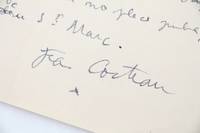
1946871451946. Fine. ""Ainsi les dieux grecs nous visitent encore et nous sentons autour de nous une tempête d'ailes un remous de merveilleux païen cette foule turbulente qui va de Zeus à Mercure et s'abat sur nos places publiques comme à Venise les pigeons de Saint-Marc"" Thus the Greek gods still visit us and we feel around us a storm of wings a stirring of pagan marvels this turbulent crowd that goes from Zeus to Mercury and swoops down on our public squares like the pigeons of Saint Mark's in Venice 1946 20.60 x 26.80 cm trois pages et une paperolle tapuscrite Autograph manuscript signed by Jean Cocteau entitled ""Le merveilleux païen"" 3 pages in black and blue ink on three leaves multiple rewritings and crossed-out passages. Accompanied by a typewritten bibliographical reference on paper. Pencil note by a previous bibliographer on the outer margin of the first leaf. Published in Plaisir de France no. 122 13th year December 1946 p. 18. Superb praise of ancient Greek culture and its theatrical pantheon of idols. Cocteau draws from his symbols to understand the modern world and compares Hollywood to the Olympus of old. Cocteau collaborates here in the issue of Plaisir de France devoted to ""Le Merveilleux dans l'Art et dans la Vie"" alongside Supervielle and Marcel Aymé. Fascinated from his beginnings by ancient mythology which floods his theatrical works Antigone Orphée La Machine Infernale. he writes a declaration of love to this blessed time when ""there existed a perpetual contact between human acts and their symbols"" when the marvellous was part of daily life. Numerous corrections mark the manuscript including the very title of the article which Cocteau had originally baptized ""L'Olympe"". Faithful to his mythological alter ego Orpheus who charms with his lyre and verses he will choose the shimmering tapestry ""Orphée et les Muses"" by Lucien Coutaud to illustrate this article. ""A cause du mécanisme moderne qui permet de reproduire le rare à d'innombrables exemplaires le rare se meurt et entre autres on fait du mot merveilleux un emploi abusif mot biffé. Le merveilleux cesse de l'être s'il se désingularise et l'on a une tendance à le confondre avec tout ce qui nous étonne encore : la radio la vitesse la bombe atomique. Or le merveilleux se trouve beaucoup plus en nous que dans les objets qui nous surprennent. Le véritable merveilleux c'est la faculté d'émerveillement qui s'émousse si vite chez l'homme. L'enfance le quitte. Il se blinde contre elle. Il juge il préjuge. Il repousse l'inconnu phrase biffée. S'il laisse agir en lui cette faculté atrophiée c'est pour fuir les fatigues qu'il s'impose. Il en use comme d'une drogue et se plonge pour quelques heures dans un livre ou dans un film. L'antiquité c'est l'enfance du monde. L'âge où l'enfance interroge et se meut dans un univers peuplé d'énigmes mot biffé. Les dieux grecs sont des oiseaux qui se posent sur leurs propres statues. Il y vivent à la mode des pigeons de nos squares. Il y observent les hommes qu'ils imitent ou qui agissent à leur exemple. Il existait donc un perpétuel contact entre les actes humains et leurs symboles qui se formaient tout de suite et devenaient des réalités. Deux mondes se superposent et se compénètrent. Phrase biffée Rien ne frappe en arrivant à Athènes comme cette familiarité d'une religion toujours pareille de siècle en siècle de peuple en peuple qui cette fois prenait un style de théâtre. Il fallait un décor où puissent jouer leurs drames et leurs comédies les acteurs aimés du public véritables vedettes de l'Olympe espèce d'Hollywood peuplé d'emplois divers de tragédiens de mimes de comiques et de belles filles plus ou moins mariées ensemble que la foule adore et auxquels on envoie des lettres et des cadeaux. Le moindre signe ""merveilleux"" du miracle grec relève d'un réalisme et c'est ce qui lui vaut un contact rapide. Et de même que passage biffé les yeux morts de la tête de Méduse unknown
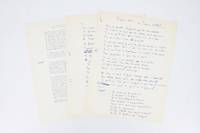
195482203s. l.: S. n. 1954. Fine. S. n. s. l. s. d. entre 1954 et 1959 21.20 x 27 cm trois feuilles perforées Complete set of Boris Vian's working manuscript and typescript genesis of the song ""Piano-bar ou Piano cocktail"". - two perforated white sheets handwritten in blue ballpoint pen by Boris Vian with numerous crossings-out and corrections - one perforated sheet typed on machine clean copy of the manuscript. This song whose title recalls the famous ""Pianocktail"" from L'Ecume des jours was not performed during the author's lifetime. The hip hop fanfare NMB Brass Band only gave a version of it in 2012. Dans un quartier fréquenté par des gens argentés Où le client ne boit que du whisky cent pour cent Y'a un p'tit bar genre acajou ciré et le soir Y'a un piano avec un pianiste Provenance: Boris Vian Foundation. S. n. unknown
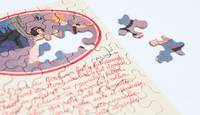
192587657Paris: Galeries Lafayette 1925. Fine. Galeries Lafayette Paris s.d. ca 1925 12 x 17 cm environ 45 pièces cartonnées sous enveloppe de papier cristal First edition of this rare and fragile promotional item for the Galeries Lafayette consisting of 47 cardboard pieces with an illustration in medallion drawn by Jack Roberts and a children's song of eight verses. A handsome copy complete with its original printed crystal paper envelope.  Galeries Lafayette unknown
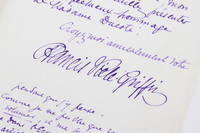
190383993Paris: S. n. 1903. Fine. S. n. Paris Janvier 1903 14 x 17.50 cm une page et demie Autograph letter dated and signed by Francis Viélé-Griffin addressed 31 lines in violet ink from his Parisian residence to Edouard Ducoté poet bibliophile and director of the review l'Ermitage since 1895 in which he requests a little patience before he sends the promised verses to the review he also assures him that he will send his forthcoming works: "". however small the print run of my next volume may be I naturally intended to reserve a copy for you. For are you not one of those for whom I wrote it. I will enclose the offprint of sainte Julie - of which I have three copies left - but are you not a bibliophile"" Finally Francis Viélé-Griffin demands in return more than a brief mention concerning him in the new issue of l'Ermitage: ""As I rarely publish volumes it would be pleasant for me to read not a note but an article a study. what do you say"" Close friend of Stéphane Mallarmé friend of André Gide Paul Valéry Francis Jammes Emile Verhaeren Francis Viélé-Griffin is an American symbolist poet writing in French. He becomes with Gustave Kahn one of the principal theorists of free verse. Fold mark inherent to postal mailing. S. n. unknown
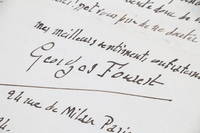
192485171Paris: S. n. 1924. Fine. S. n. Paris 14 Mai 1924 13 x 18 cm deux pages sur un double feuillet Autograph letter signed by Georges Fourest 31 lines in black ink addressed to a fellow writer. Fold mark inherent to envelope insertion marginal stains affecting some word beginnings. Georges Fourest praises the quality of his correspondent's work: ""Que les superstitieux viennent encore nous représenter le 13 comme un jour néfaste ! Pour moi je sais bien que je marque d'un caillou blanc le 13 Mai 1924 puisque le matin de ce jour-là je reçus votre exquis volume. . je pus consacrer mon après-midi à vous lire bien installé au Parc Monceaux."" Let the superstitious still tell us that the 13th is an unlucky day! For my part I know well that I mark May 13 1924 with a white stone since on the morning of that day I received your exquisite volume. . I was able to devote my afternoon to reading you comfortably installed in Parc Monceau. and compares the quality of his verse to his illustrious predecessor Clément Marot: "". quant à vos acrostiches je ne connaissais qu'un chef-d'oeuvre en ce genre celui de Clément Marot par Glatignyet voilà que vous nous en donnez sept et qui laissent de loin l'autre derrière eux."" . as for your acrostics I knew only one masterpiece in this genre that of Clément Marot by Glatigny and here you give us seven which leave the other far behind. at the risk of being considered a base flatterer: "". je ne me doutais guère qu'un poëte venait de m'exaucer et avec quelle maîtrise ! Mais si je vous disais tout ce que je pense vous me prendriez pour un flagorneur."" . I hardly suspected that a poet had just answered my prayers and with what mastery! But if I told you everything I think you would take me for a flatterer. S. n. unknown
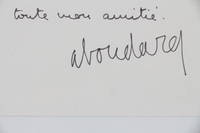
198079435Paris: S. n. 1980. Fine. S. n. Paris 27 Mars 1980 21 x 29.50 cm une feuille une enveloppe Handwritten letter dated and signed 20 lines by Alphonse Boudard to his great friend and companion of boozy lunches Brussels journalist André Tillieu who was like Alphonse Boudard a great friend of Georges Brassens as well as Louis Nucéra. Two fold marks inherent to placing the letter in its envelope envelope included. ""Old friend yes indeed I'm working. screenplays. television. and I no longer have time for friends. alas! finally I'm releasing ""La lanterne magique"" in September under the title ""Vulcanos"" name of the main character for ""Le gala"" it's Balland who republished it. Without success. so he remaindered it. I must have a few copies. If you're in a hurry I'll send you one otherwise I'll give it to you in person at our next meeting. which shouldn't be long! at least I hope so. around a table with Aline Giono Louis Nucéra and Georges Brassens the last square of the brave. all my friendship. Aboudard."" André Tillieu from Brussels very close friend and biographer of Georges Brassens maintained an epistolary correspondence with Alphonse Boudard for almost thirty years from 1972 until the latter's death in 2000. The witty Parisian writer very quickly showed him friendship considering him one of the rare critics to understand him perfectly to the point of clearly explaining in his reviews what he himself expressed only incompletely and sometimes confusedly in his books. André Tillieu thus became part of the small circle of Alphonse Boudard's true friends on the same level as le Gros Georges Georges Brassens le Niçois Louis Nucéra and René Fallet with whom he loved to share hearty well-watered meals and cycling trips. As death gradually took away his best friends one by one André Tillieu would remain one of Alphonse's very last pals. S. n. unknown
194784003Boulogne-sur-Seine Boulogne-Billancourt: S. n. 1947. Fine. S. n. Boulogne-sur-Seine Boulogne-Billancourt s. d. circa 1947 11.50 x 18 cm une feuille Autograph letter signed by André Malraux 20 lines in blue ballpoint pen from his Boulogne home on avenue Victor Hugo making witty reference to the release of his work probably Le musée imaginaire published in 1947 and to the article devoted to him by André Parinaud in Arts. André Malraux mocks the massive aspect of his work: "". avec le retard qu'implique le poids du livre poids qui affirme aux esprits non prévenus le sérieux de l'auteur. Un des premiers ""voix du silence"" paru en même temps que votre article"" "". with the delay implied by the weight of the book weight which affirms to unprejudiced minds the seriousness of the author. One of the first 'voices of silence' published at the same time as your article"" while praising the friendship of his benevolent correspondent: "" . je serais étonné de n'avoir à ""Arts"" que des amis ; vous avez pris parti. Ce que je ne tiens pas pour sans importance - et n'oublie pas."" "". I would be surprised to have only friends at 'Arts'; you have taken sides. Which I do not consider unimportant - and do not forget."" Fold mark inherent to posting. Resistance member and participant in Combat André Parinaud was a journalist columnist art critic and writer. From 1959 to 1967 he held the position of editor-in-chief of the important weekly Arts gathering the elite of French creation in all artistic fields: literature painting theatre cinema. He then conducted more than 1000 radio interviews with the greatest writers and artists including Salvador Dali Louis-Ferdinand Céline Colette Paul Léautaud André Breton Georges Simenon and André Malraux. While continuing to work for O.R.T.F. and radio he founded several festivals or artistic events such as The International Festival of Art Film the National Academy of Street Arts. S. n. unknown
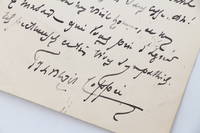
190584155s. l. Paris: S. n. 1905. Fine. S. n. s. l. Paris s. d. circa 1905 11.50 x 18 cm une page Autograph letter dated and signed by François Coppée 17 lines in black ink to Marthe Daudet wife of his young friend Léon. Fold marks inherent to the mailing. François Coppée apologizes for not being able to see his correspondent who had come to visit him and gladly accepts her invitation to dine soon: "". I have great desire to accept although I spend my time declining invitations for I continue to be in poor health."" S. n. unknown
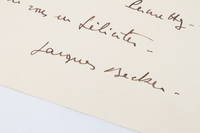
195183039Paris 1951. Fine. Paris 30 novembre 1951 20.50 x 26.50 cm une feuille Autograph letter signed by Jacques Becker addressed to Carlo Rim 8 lines in black ink congratulating him for his latest film ""La maison Bonnadieu"" : ""Carlo j'ai vu hier soir ""La maison Bonnadieu"". C'est un film épatant et merveilleusement mis en scène - Permettez-moi de vous féliciter. Jacques Becker."" ""Carlo I saw ""La maison Bonnadieu"" last night. It's a wonderful film and marvelously directed - Allow me to congratulate you. Jacques Becker."" Central folds inherent to postal handling. Carlo Rim was a Provençal writer author notably of ""Ma belle Marseille"" a caricaturist a filmmaker: ""Justin de Marseille"" ""L'armoire volante"" ""La maison Bonnadieu"" and was notably the friend of Fernandel Raimu and Marcel Pagnol but also of Max Jacob and André Salmon whom he met in Sanary. unknown
190383457s. l.: S. n. 1903. Fine. S. n. s. l. 19 juillet 1903 17.50 x 22.50 cm une feuille Autograph letter signed by Joséphin Peladan addressed to Marius Richard Carlo Rim's father 29 lines in blue ink asking him to publicize Paul Mounet the Sâr's favorite actor whom he feels is not sufficiently recognized at his true worth. Fold marks inherent to mailing small marginal foxing. S. n. unknown
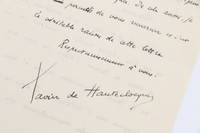
193484116Berlin: S. n. 1934. Fine. S. n. Berlin s. d. circa 1934 13 x 18 cm trois pages Autograph letter signed by Xavier de Hauteclocque 39 lines in black ink on Continental Hotel Berlin letterhead written from Berlin and addressed to Léon Daudet thanking him for: "". l'éloge que vous avez eu la bonté de consacrer encore à mon bouquin sur l'hitlérisme."" ""the praise you were kind enough to devote once again to my book on Hitlerism"" which he had published in the monarchist and Germanophobic daily Action Française. Although having sounded the alarm concerning the grave dangers posed to Europe by the Nazi party's rise to power Xavier de Hauteclocque despairs of being heard even by supposedly nationalist or patriotic circles: "". hélas ! monsieur ces crétins chamarrés de tricolore non seulement ne m'ont pas cru mais j'avais l'impression terrible qu'ils ne m'entendaient même pas."" ""alas! sir these cretins bedecked in tricolor not only did not believe me but I had the terrible impression that they did not even hear me."" ""les rebuffades désespérantes que j'ai essuyées de la part de gens en qui trop de nos malheureux concitoyens vient des 'remparts de la Patrie'."" ""the despairing rebuffs I suffered from people in whom too many of our unfortunate fellow citizens see the 'ramparts of the Fatherland'."" It is for this reason that he praises the clairvoyance of the Action Française newspaper and more particularly Léon Daudet's articles regarding the question of Nazi Germany: "". c'est vous qui nous ragaillardissez nous les journalistes qui allons chercher des renseignements authentiques dans le camp d'en face."" ""it is you who reinvigorate us we journalists who go to seek authentic information in the opposing camp."" Fold marks inherent to postal dispatch. Decorated with the Croix de Guerre in 1914-1918 at 18 he had volunteered early on July 15 1915 to join the 3rd Hussar Regiment at Saumur his father and brother having fallen in battle in 1914 first cousin of Marshal Philippe Leclerc de Hauteclocque Xavier de Hauteclocque was a military man journalist and writer who ceaselessly denounced vigorously through his writings and reportage the dangers of Adolf Hitler and his party's seizure of power in Germany. In 1935 in Paris he died poisoned by the Nazi regime whose works such as La Tragédie brune À l'Ombre de la Croix Gammée or Nuit sur l'Allemagne disturbed them. S. n. unknown