41 775 résultats
Folio (ca. 380 x 547 mm). 3 vols., including atlas. (22), CLI, (3), 279, (1) pp. (8), 339, (1) pp. Atlas has chromolithographed pictorial title, 48 engraved and 41 chromolithographed plates (numbered I-LXXXVI), 5 engraved plans, and 2 folding engraved maps. Contemporary marbled boards; modern spines with giltstamped labels. The rare first edition of this monumental work on the antiquities housed at the Hermitage Museum in St Petersburg, published at the personal expense of Emperor Nicolas I. The Tsar took a deep interest in Russian archaeological finds following the discovery of a Scythian burial mound near Kerch in 1830, and many of these discoveries are featured here. - A large number of the plates are magnificently lithographed in vivid colour after the drawings of Piccard and Solntzev. "Ouvrage imprimé avec une grande luxe. Le texte, en russe et en francais, est précédé d'une préface, signée du nom de M. Gilles, conservateur de l'Ermitage [...] Le nombre des exemplaires tirés n'est, dit-on, que de 200. Leur prix à Paris est de 400 fr." (Brunet). - The Swiss painter and engraver Piccard (1807-88) had studied in Paris and was active in Lausanne until the end of the 1830s. Long in Russia, he would return to Lausanne in 1869. Solntsev (1801-92) had already completed the massive six-volume album series "Antiquities of the Russian State" (1849-1853) and was one of the principal interior decorators of the Kremlin Palace. - Some foxing throughout, mainly concerning the margins and the first and last quires of the text volumes, but to some extent also the margins of the plates. Bindings professionally repaired. Removed from the Library of the Birmingham Assay Office, one of the four assay offices in the United Kingdom, with their inconspicuous library stamp to the flyleaves. Extremely rare: we can trace only one other copy at auction (2013, Sotheby's Paris, sale 1333, lot 532: EUR 59,100 - the duc de Luynes copy). Brunet I, 321. Graesse I, 149f. Thieme/Becker XXVI, 579. OCLC 82476426.
Large folio (570 x 320 mm). 4 vols. With 4 engr. title vignettes, 8 engravings in the text, and 344 engr. plates. (And:) Laurent, H., Musée Royal. Paris, Didot, 1816-1818. 2 vols. With engr. title vignette, 4 engravings in the text, and 161 engr. plates. (4), 28 pp. 113; 85 ff. A total of 6 vols. in contemp. dark-green morocco, sumptuously gilt, with giltstamped coat of arms on covers. First edition; the best documentation of the famous Louvre's holdings and collections, here complete with all illustrations. A splendid copy including all the supplements, uniformly bound in gilt green period morocco for Charles Ferdinand d'Artois, duc de Berry (1778-1820) and his wife Marie-Caroline of Naples and Sicily (1798-1870), with their marriage arms (1816); their "Bibliothèque de Rosny" bookplate is on the pastedown. - A few plates misbound; occasional staining. Published in only 600 copies, "Musée Français" was dedicated to Napoleon Bonaparte. The supplement, published after the Emperor's abdication, was dedicated to the King. - A magnificent set of this great work in perfect state of preservation and from a noble library. Cohen/R. 743. Vicaire V, 1229.
Oblong folio (485 x 405 mm). Title-page and 62 engraved, hand-coloured etchings by A. Sanquirico (all on velin paper with watermark "J. Whatman, Turkey Mill"); tissue guards (watermark "FB") preserved throughout. Contemporary green boards with elaborate gilt neo-classical decoration. In same-coloured original slipcase. First edition of Sanquirico's synoptic collection of his work, complete in 62 plates, never sold in the regular book trade and presented by the artist only to the highest dignitaries. "La grandiosa collezione del Sanquirico, in fogli di grande formato, stampati e colorati con estrema cura, era evidentemente destinata a clienti 'facoltosi'" (Ferrero). In 1818 Sanquirico set out to publish all the theatre decorations he had executed. The inked and coloured series of etchings was completed in 1829. - Sanquirico is considered the best stage designer of his time. From 1817 to 1832 he was "scenografico unico" at the Milano "Scala", where he was much admired for his inexhaustible production of new creations. "He is a master of perspective, and a painter of the finest taste; capable of creating magical effects through colour and light. Every one of his decorations is possessed of a unique magic and rich versatility of invention. There was not an opera in which Sanquirico, apart from the celebrated singers, did not also celebrate his own triumph" (Nagler). "La sua attività coincise con uno dei periodi più interessante della lirica italiana, quando ai nomi ormai famosi di Mayr, Mozart e Meyerbeer si alternavano quelli di Rossini, Bellini, Donizetti e Pacini, e il balletto italiano trovava la sua nova espressione nelle pantomime eroiche" (Enc. dello Spettacolo). For this present album, Sanquirico used the best paper available, the strong velin made by the Turkey Mill on which James Audubon also printed his 'Birds of America' (cf. Bannon/Clark, Handbook of Audubon Prints, 35). The colouring is masterfully executed, showing exceptional brilliance. Hundreds of fine hues - in the tropical flora, in the precious costumes of the exotic peoples, in the luminescent pink clouds over the evening landscapes - lend these scenes a unique beauty and atmospheric splendour. - Immaculate, entirely spotless copy in the original boards as issued. Merely the matching slipcase shows traces of restoration, otherwise entirely untouched. - Removed from the library of the Dukes of Bavaria at Tegernsee castle. Wurzbach XXVIII, 196. Nagler XVI, 135. Enc. dello Spettacolo VIII, 1483. M. V. Ferrero, La Scenografia della Scala nell'età neoclassica, Milan 1983, 91-140.
1 text volume and 2 portfolios with lithographed plates. Oblong folio (plates and their portfolio, ca. 64 x 40 cm) and folio (text volume, ca. 41 x 32 cm). Text volume: 30, [1], [1 blank] pp.; plus 100 lithographed plates. Text volume with the title printed in gold. With a total of 100 lithographed plates over 2 portfolios: 72 plates numbered I-LXIV, printed on gray or white paper and mostly printed in brown, some in gray, gray & white or brown & white, one in gold (plate I), one in colour (plate LXIV) and one plate is folding (plate LX), and 28 overlays, printed in brown on tissue paper. Each plate is embossed with Wright's blindstamp. Kept loose, as issued, in the original two portfolios (64 x 41.5 cm), both dark blue half cloth with the original publisher's printed grey wrappers over boards with all white ties present. Both portfolios and text leaves are kept in a larger, later beige half cloth portfolio (ca. 65 x 43 cm) with brown paper sides, three protective flaps and white ties. Extremely rare first edition, of the complete collection of plates prepared from drawings made by master architect Frank Lloyd Wright (1867-1959) at his Oak Park Studio, illustrating seventy buildings and projects completed between 1893 and 1909. It is the first major publication by one of the true innovators of modern architecture. The work boosted Wright's fame in European architectural circles and influenced key figures in contemporary architecture such as Ludwig Mies van der Rohe, Peter Behrens and Le Corbusier. The plates show perspective views, plans, sections and interior and exterior details. Plate LVI, with an interior view of the living room of the Coonley House, is one of the most important and desirable of the series. Other works represented are the Frederic Robie House, Susan Lawrence Dana House, Ward Willets House, Darwin Martin House, Avery Coonley House, the Larkin Building, and Unity Temple, showing the variety of his buildings. - Although each plate is embossed with Wright's blindstamp, Sweeney notes that he completed the work alongside assistants and collaborators, including Marion Mahony Griffin and Wright's son, Lloyd. A massive undertaking, the work was printed by Ernest Wasmuth. The original plans and presentation drawings had to be lithographed on large stones. The text volume, written by Wright, was printed both in German and in English, containing an essay on his architectural style and a list of the plates. The text part starts with the introduction by Wright, translated into German by Wasmuth, and is dated ''Florenz, Italien, 15. Mai 1910'', followed by an annotated list of plates (pp. 21-30). An English version of the introduction was printed in Chicago by Ralph Fletcher Seymour, dated "Florence, Italy, June 1910". - The edition is scarce due to the fire at Wright's home and studio, Taliesin, in August 1914. The fire destroyed the bulk of the American copies of this portfolio, in addition to much of Wright's other work. Many of the copies intended for the American market were destroyed, for which reason the work was far better known in Europe than in the United States. - Large half beige portfolio worn: a little stained, edges a little worn, head and outer protective flap half loose, bottom protective flap loose but present, linen ties somewhat frayed. Two ties of the second plate portfolio are torn and frayed. Text volume: some plates and the wrappers of both portfolios somewhat foxed, some plates with some occasional marginal tears (never affecting them), overlays a little toned. Overall a complete set with the plates, booklet and the two original publisher's portfolios still in good condition, being Wright's extremely rare magnum opus which secures his status in Europe and being one of the most influential architectural publications of the century. Kruft 210. Robert L. Sweeney, Frank Lloyd Wright: An Annotated Bibliography, Los Angeles, 1978, 87. Thieme-Becker XXXVI, 279.
199 Gelatinesilberabzüge auf Barytpapier, auf leichten Karton aufgezogen. Je ca. 265:179 mm, Papier ca. 293:208 mm. Lose in Original-Holzkassette. 1 von 25 numerierten Exemplaren, durchgehend von den Portraitierten signiert und vom Photographen bezeichnet. Bedeutende Sammlung von annähernd 200 Künstlerportraits von u. a. Joseph Beuys, Fernando Botero, Arno Breker (2 x), Paul Flora, Ernst Fuchs, Karl Otto Götz, Keith Haring, Jörg Immendorff, Loriot, Heinz Mack, Georg Muche, Meret Oppenheim, Gerhard Richter (2 x), HA Schult, Roland Topor, Günther Uecker, Tomi Ungerer, Wolf Vostell, Dondi White, Shizuko Yoshikawa u. v. m. - Heinz-Günter Mebusch, ein Schüler von Otto Steinert, einem der bedeutendsten deutschen Photographen der Nachkriegszeit, war in mehr als 40 Ländern Europas, Afrikas und Amerikas tätig. Sein zeitlich längstes Projekt und zugleich die umfangreichste Werkreihe sind die zwischen 1978 und 2000 entstandenen Portraits von über 200 Künstlern, die in enger Zusammenarbeit mit den Portraitierten entstanden sind. Eine etwas geringere Zahl von Arbeitsabzügen, meist mit zusätzlichen Signaturen (und einmal auch mit einer Übermalung des portraitierten Künstlers Ford Beckman) versehen, entstand in den Jahren von 1979 bis 1992 unter dem Arbeitstitel "Reise zum Planeten ARS" in einer Auflage von 25 Stück. Die hier vorliegenden Abzüge sind größtenteils (185 von 199) eh. von den Portraitierten signiert, tragen die Nummer 22 (von insgesamt 25) und werden in einer aufwendig gestalteten Holzkassette präsentiert; weiters sind alle Abzüge verso handschriftlich bezeichnet und mit dem Fingerabdruck des Photographen versehen; einige wenige sind irrtümlich mit 22/24 oder 22/23 numeriert. - Heute weitgehend in Vergessenheit geraten, war Mebusch mit allen bedeutenden Künstlern seiner Zeit bekannt, bespielte zahlreiche Ausstellungen (u. a. Costa Rica, Luxemburg, "Was ist Kunst" in der Fotogalerie Wien, "Polytoxicomania" in Hollywood, "Schatzsuche" im Kunstmuseum Düsseldorf, Goetheinstitute San Francisco 1998, Biennale di Venezia 1999), war Lehrbeauftragter an der Folkwangschule in Essen und organisierte und kuratierte Kunst- und Foto-Projekte (darunter das Beuys-Festival 1991 in Düsseldorf). Im documenta Archiv - das, wie auf dessen Homepage zu lesen ist, "seit den 1990er Jahren ein bedeutendes Konvolut von über 200 hochqualitativen fotografischen Künstlerportraits" von Mebusch besitzt - war zuletzt im Sommer 2018 eine kleine Auswahl davon zu sehen: "In starker Nahsicht bestechen die Kopf- bzw. Brustportraits durch den intensiven, direkten Blick der Künstlerinnen und Künstler". Vollständig in der Originalkassette wie vorliegend selten, das einzige im Auktionshandel der letzten Jahrzehnte nachgewiesene Vergleichsexemplar umfasste um 20 Portraits weniger. - Detaillierte Verlistung auf Anfrage.
Elephant folio (351 x 497 mm). 3 vols. 3 hand-coloured title-pages; 491 pp.; 16 engraved, mostly hand-coloured, and a few tinted headpieces; 12 engraved tailpieces (mostly hand-coloured, a few tinted); 101 engraved plates (two double-sized) with 145 hand-coloured illustrations; 18 maps, of which 12 double-sized, 16 hand-coloured, and one with an additional folding insert; two double-sized lithographed tables. Uniform contemporary straight-grain green quarter calf over marbled boards; spines with ornamental gilt lines and red morocco labels with gilt title. Very rare complete set, in fine contemporary colour, of a monumental and richly illustrated work on the state of Austria, with far more information than one would expect from a "voyage pittoresque". Louis Joseph Alexandre de Laborde (1773-1842) was a French writer, archaeologist, military officer and politician. Young Laborde had been dispatched to Vienna by his father at the outbreak of the French Revolution; there he joined the Austrian army, in which he was named an officer at the age of 17, by personal intervention of the Emperor Joseph II. In 1800 he was an attaché of Lucien Bonaparte’s embassy in Madrid. Laborde's Austrian experience and his perfect command of German suited him for a place as secretary of the delegation under Marshal Berthier to ask on behalf of Napoleon for the hand of the archduchess Marie Louise. - The first and second volume have no sub-title; the first deals largely with the history and archaeology of Austria, and in particular with its rulers, while the second volume deals largely with the topography, with detailed maps and fine views, including many of Vienna and other towns. The third volume has the sub-title "Précis historique de la Guerre", that is, the Franco-Austrian War of 1809 (War of the 5th Coalition, between Napoleon and Bavaria on one side and the Austrian Empire and Great Britain on the other). It contains many fine (battle) maps, views and scenes. In the few descriptions of this work, sometimes a map is listed as a plate, but the combined total of plates and maps should be 119 as in this set. In addition to plates and maps, this work is embellished with fine, large head- and tailpieces, illustrating towns, buildings, and antiquities. - Inscribed on the first front free endpaper, "de la part de l'auteur". Boards rubbed at edges, a few skilful repairs; scattered, mostly light and marginal foxing; one partly coloured map in Part 3 toned; short, marginal tear in one plate; otherwise in very good condition, with the printing strong and the hand-colouring detailed and accurate. Only five complete copies in auction records since WWII. Nebehay/Wagner II, 348 & 349. Brunet III, 713f. Graesse IV, 58. Querard IV, 344. Vicaire IV, 752. UCBA II, 1065. Mayer coll. 271 (only the normal edition).
4to. (5) ff., 1 blank, 61, (7) ff. With armorial title woodcut (Medici arms), printer's device at the end, and 35 large woodcut initials, showing views of cities. Contemp. vellum. All edges sprinkled in red. First edition of the only work of Cellini's published during the author's lifetime, and indeed in the entire 16th century. This treatise on the art of goldsmiths and sculptors offers a wealth of technical instructions drawn from immediate practical experience (on enamelling, gilding, embossing, moulding, bronze casting, etc.), providing insight not only into Cellini’s own methods, but also in those of Michelangelo and other Renaissance artists. - The misnumbered final leaf no. "47" has been corrected to "61" by a contemporary owner. Some occasional browning; slight waterstain near end. Binding somewhat rubbed and bumped at extremeties, with minor worming to upper cover. Letterpress bookplate of the musician and bibliophile Louis Thompson Rowe (1855-1927) and steel-engraved bookplate of John Addington Symonds (1840-93), a poet, literary critic and Renaissance scholar best known as an early advocate of male homosexuality. In 1887 he published an English translation of Cellini's autobiography. - Uncommon; ABPC lists the last copy at an international auction in 2003. Edit 16, CNCE 10737. BM-STC 164. Adams C 1240. IA 135.063. Cicognara 273. Gamba 335. Parenti 151. Steinmann/W. (Michelangelo) 439.
Folio (500 x 670 mm). Engraved title, engraved dedication, letterpress table of subscribers; 1) 16 pp. of letterpress text, 10 plates (2 coloured aquatints); 2) 24 pp. of letterpress text, 11 plates (2 coloured aquatints); 3) 12 pp. of letterpress text, 10 plates; 4) letterpress table of subscribers, 13 pp. of letterpress text, 10 plates (2 coloured aquatints); 5) 11 pp. of letterpress text, 10 plates (2 aquatints); 6) 12 pp. of letterpress text, 10 plates (2 aquatints); 7) 13 pp. of letterpress text, 10 plates (2 aquatints); 8) 14 pp. of letterpress text, 10 plates (2 coloured aquatints); 9) 14 pp. of letterpress text, 10 plates (2 coloured aquatints); 10) 6 pp. of letterpress text, 6 (instead of 10) plates (2 aquatints); 11) 10 pp. of letterpress text, 10 plates. A total of 107 (of 111) plates including 18 (of 22) aquatints, of which 10 are in original hand colour. Bound with 5 of the original wrappers in a calf portfolio with giltstamped spine and cover borders; marbled pastedowns. Very rare near-complete set of this beautiful collection of plates showing famous churches in Europe. The plates show 1) St. Peter's Basilica in Rome, 2) the Milan Cathedral, 3) the Pantheon in Rome, 4) St. Stephen's Cathedral in Vienna, 5) the Florence Cathedral, 6) the Pisa Cathedral, 7) St John in the Lateran, 8) the Siena Cathedral, 9) St. Mark's Basilica in Venice, 10) the cathedrals of Antwerp and Ghent, and 11) the Basilica of Superga. The aquatints show interior and exterior views, the uncoloured line-engraved plates are plans, cross-sections, interiors, monuments, among others. - A wide-margined set showing occasional browning and foxing, mainly confined to margins, and a few insignificant edge flaws. Wrappers slightly stained with repairs, all bound in an impressive full leather portfolio. Brunet I, 1843. Graesse II, 133. OCLC 21782995. Cf. Thieme/Becker XXIX, 214. Not in Fowler or in Kat. der Ornamentstichslg. Berlin.
160560109Mainz, Balthazar Lipp, 1605. 4to. Bound in a beautiful 18th century full mottled calf binding with double gilt line-borders to boards. Edges of boards gilt. Expertly rebacked perfectly matching the boards and the gilding. With gilt leather title-label and gilt ornamentations. End-papers renewed. B2 and B3 defective in lower blank margins, not affecting text. A nice and clean copy. 53, (1) pp. + 1 folded plate and numerous illustrations in text.
Mainz, Balthazar Lipp, 1605. 4to. Bound in a beautiful 18th century full mottled calf binding with double gilt line-borders to boards. Edges of boards gilt. Expertly rebacked perfectly matching the boards and the gilding. With gilt leather title-label and gilt ornamentations. End-papers renewed. B2 and B3 defective in lower blank margins, not affecting text. A nice and clean copy. 53, (1) pp. + 1 folded plate and numerous illustrations in text.
188048292[London, Eyre and Spottiswoode], 1880, 27th November + 1882 + 1885 (1): 8vo. Unbound. With a recent, discreete paper spine. A few smaller tears to extremities. 4 pp. + 1 plate (showing electric light bulbs].(2): 8vo. Original self-wrappers. Stitched at spine. Near mint.(3): 4 pages 8vo.
[London, Eyre and Spottiswoode], 1880, 27th November + 1882 + 1885 (1): 8vo. Unbound. With a recent, discreete paper spine. A few smaller tears to extremities. 4 pp. + 1 plate (showing electric light bulbs].(2): 8vo. Original self-wrappers. Stitched at spine. Near mint.(3): 4 pages 8vo.
Venice, Aloysius Pavinus, 1709. 4to. Completely uncut in the original stitched blank boards. Some brownspotting. Untouched and unrestored in completely original condition. A magnificent copy. Engraved title-vignette. (8), 56 pp. + 9 folded engraved plates.
180463104Kiöbenhavn, N. Möller og Sön, 1804. 4to. Near contemporary brown half calf with cloth-covered boards gilt title to spine (UREMAKER KUNST), with Australian bookbinder's etiquette: ""W. Detmold, Melbourne"" to inside of front board. Pencil name and doodles to front end-papers and traces of the same kind of pencil-names and doodling to the first leaves, removed. Front free end-paper with a portrait inserted (possibly of Urban Jürgensen, possibly of his brother Jøregen Jørgensen - see below under Provenance). Hinges and capitals worn. Hinges professionally re-enforced from verso and restorations to capitals. Text overall nice and clean, with the occasinal browning or dampstaining. Plates have some overall toning/even soiling and staining and some occasional offsetting or spotting. They have been lightly, and very professionally, cleaned, and a few of them have edge restorations (far from affecting image) or a small re-enfircement from verso, barely noticeable. Bothe text and plates printed on thick, heavy paper. XXVI,242 pp. and 18 double-page folded engraved plates.
Leipzig, Christoph Zunkel und (Bernhard Christoph Breitkopf), 1724-74. Folio. Bound in 8 nice hcalf, raised bands, gilt spine. Gilt lettering to spines. Pastiche-bindings, late19th century. Volume VII a. VIII in second edition (Neu aufgelegt, 1774). Some browning to textleaves in volume I. Minor scattered brownspots. Tear to lower right corner of halftitle in Vol. I, (repaired, no loss of text). With all 485 engraved plates.
1900519DG1900. Verschiedene Formate (gerollt). + Wichtig: Für unsere Kunden in der EU erfolgt der Versand alle 14 Tage verzollt ab Deutschland / Postbank-Konto in Deutschland vorhanden +
1900519DG1900. Verschiedene Formate (gerollt).
15015San Jose CA: Gist and Erdmann / Panoramic Productions 1990. 730 by 740mm. 28.75 by 29.25 inches. Colour printed poster. Pin holes in upper corners water stain to upper left corner trimmed along bottom edge. An entertaining pictorial map poster showing silicon valley in 1991 at the dawn of the internet age. This poster was created as a marketing tool for Seagate Technology a company based in Cupertino that specialises in data storage hardware. Seagate was founded in 1978 by Al Shugart and partners. In 1980 they released their first hard disc drive the ST-506. Their product was a hit and they soon secured the contract to produce disc drives for IBM's newest microcomputer the IBM XT the first personal computer with a built in hard disk. 1991 was a seminal year for the company marking the return of Al Shugart as CEO and the release of their most popular product line the Barracuda HDD the first drive with a 7200 rpm speed. Since then Seagate has remained at the forefront of the hard drive market by continuing to adapt their products to an ever improving and changing market as well as through the acquisition of competitors. We have been unable to find any additional information about this poster's artist P. Bach Phi Art Studio besides noting that they have included their studio's location and telephone number in the map. However Gist and Erdmann and Panoramic Productions whose names are in the imprint are both still in business. Gist and Erdmann provides advertising and marketing across all media for technology companies while Panoramic Productions produces film and video content for corporate communications. This copy has been trimmed along its lower edge and is therefore lacking Seagate's logo the imprint and a calendar for 1991. This is due to the ephemeral nature of promotional posters such as this. Apparently once 1992 came around and the calendar was obsolete the owner decided to cut the calendar off rather than throwing the entire poster out. They must have really like the map! Gist and Erdmann / Panoramic Productions, unknown
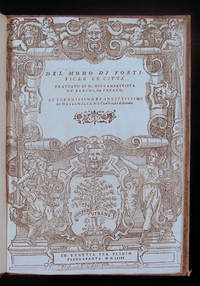
155413800Venice: Pinio Pietrasanta 1554. FIRST EDITION. Title within elaborate architectural border separate leaf with portrait of the author 17 decorative woodcut initials and 8 woodcut text illustrations 5 full-page. Bound in decorative modern boards. Other than a couple of very small and mild damp stains a lovely large copy. First edition of the first Italian book devoted exclusively to fortification of cities. It was preceded only by Durer’s Etliche underricht zur befestigung der Stett 1527. Italian works by Valle 1521 and Cataneo and Tartaglia both 1554 contained only chapters on the subject.<br /> <br /> Zanchi 1515-1586 a military engineer in the Venitian service under Marcantonio Colonna took part in several campaigns including the long siege of Siena where he became acquainted with Belluzzi and was a friend of Girolamo Maggi. He remarks that “the invention of artillery had necessitated a new system of fortifying cities and that those who might have been qualified by experience to write on the subject were not sufficiently versed in its theory to do so†Cockle 767. The system he describes herein is the favoured Italian bastion trace limited to the square with acute-angled bastions but already with an attempt to reinforce the curtains and the octagon again strengthening the curtains. This design improved the defense of the fortress as covering fire had to be provided often from multiple angles. The woodcuts are among the earliest showing the new pentagonal form of bastion.<br /> <br /> Zanchi left the manuscript of his work with Girolamo Ruscelli when he had to leave Venice; on his return Ruscelli sought and obtained permission to edit and publish the work which he recognized as a pioneering effort. Pinio Pietrasanta unknown
In-8 p. (mm. 212x151), p. pergamena antica, titolo oro su tassello al dorso, 20 cc.nn. (di Indici), 291 cc.num., 1 c.b., marca tipografica al frontespizio, ornato da testatine, grandi capilettera figurati a vignetta e finalini, inc. su legno. Questa edizione contiene 4 opere di Andrea Cesalpino e precisamente: i 5 libri della “Quaestionum peripateticarum”, dedicata al Sereniss. Franciscum Medicem // “Daemonum investigatio Peripatetica”, dedicata al Rev.iss Archiepiscopum Pisanum Petrum Iacobum Borbonium” // “Quaestionum Medicarum Libri II” e “De Medicament. facultatibus Lib. II”, entrambe dedicate al Sereniss. Ferdinandum Medicem”. Rara "seconda edizione" delle prime due opere, molto importante perchè aumentata di altre due (qui in "prima edizione"). L’Autore “medico, nato ad Arezzo (1519-1603), fu professore di medicina a Pisa dove aveva compiuto i suoi studi. Nel 1555 divenne Direttore dell’Orto Botanico; nel 1592 fu chiamato a Roma da Clemente VIII e tenne cattedra di medicina alla Sapienza. Fu medico e filosofo insigne; aristotelico per i suoi studi, appassionatissimo della botanica come della mineralogia, sostenitore fervente dell’indirizzo biologico, creatore di un sistema filosofico che, precorrendo i tempi, s’avvicina a quello di Spinoza. Nel campo della fisiologia della circolazione del sangue, attaccò la concezione galenica dell’inclusione del fegato nella grande circolazione. Dimostrò l’esistenza della circolazione polmonare, affermando che il sangue giunge nel polmone dal cuore e viene a contatto con l’aria che arriva all’estremità dei bronchi e che l’aria diminuisce il calore del sangue e lo tempera. La sua scoperta fu pubblicata nel 1571 nel suo libro "Quaestionum peripateticorum libri V", quindi mezzo secolo prima di quella di Harvey (1628). Essa sta strettamente in nesso con la sua concezione filosofica, secondo la quale egli ammette l’esistenza di un unico principio, chiamato "anima" una e indivisibile che regge tutte le funzioni del corpo, e ha sede nel cuore, dal quale mediante il sangue si diffonde per tutto il corpo. Cesalpino fu il primo a pronunciare, nel 1559, la parola "circolazione" e a osservare ciò che avviene nelle vene dopo la legatura del braccio. Quantunque la discussione intorno alla priorità della scoperta della circolazione sia tuttora vivace, gli storici moderni riconoscono a Cesalpino il merito di averne concepito con geniale acutezza di mente l’idea.. I libri di Cesalpino furono molto letti e discussi anche fuori Italia, soprattutto in Germania. Egli fu uno degli scienziati italiani che ebbero la maggior fama oltre i confini della patria e fu detto dai contemporanei il “papa dei filosofi”. Così “Enciclopedia Italiana”, Treccani, vol.IX, p. 866. Cfr. anche Castiglioni “Storia della medicina”, pp. 436-440 - Wellcome Library,1182 - Durling,925 - Garrison and Morton,756 - Camerini “Annali dei Giunti”,II,991. Leggerm. corto del marg. super.; con qualche fioritura, arross. e lievi aloni ma complessivamente un più che discreto esemplare.
183 x 33 cm. Large Jain cosmogram alternating text and geometric figures, representing the Universe. Jain cosmology considers the world as an uncreated entity that has existed since infinity with neither beginning nor end. - Provenance: French art trade; bought by Pierre Bergé (1930-2017) in Paris in 2010 and acquired from the sale of his estate.
Royal folio. 2 vols. in one (only the plate volumes) with 75 plates. Vol. 1: Half-title in red, main title in red and black, 1 f. index of plates, engr. portrait, 35 plates (numbered 1-40; 5 counted twice). Vol. 2: Half-title in red, main title in red and black, 1 f. index of plates, 40 plates (numbered 1-60; 20 chromolithographs counted twice). Includes: Half title of the text volume. Stored loosely in contemporary red half cloth portfolio with giltstamped cover title "Le Nouvel Opera de Paris | Bronzes" and four ties. First edition. - Plate volumes of the rare luxury work on the "Opéra Garnier", the neo-Baroque Parisian opera house completed in 1875, one of the most admired buildings of its time. The plates depict plans, cross-sections and elevations of the building, engraved in great detail after drawings by Duchamp, Jasson, Riquois and others. The beautiful chromolithographs (including the famous staircase) convey a vivid impression of the luxury and splendor of the interior decoration. Garnier's name became instantly famous when in 1861 he was unanimously awarded the first prize for his competition design for the new opera. His opera house, which cost the then unheard-of sum of 50 million francs, still constitutes the unsurpassed centerpiece of modern Parisian architecture (cf. Thieme/B.). To the plates were added four volumes of photographs by Durandelle and Garnier's monographic text volume (not present here). - Occasionally slightly rubbed; some 10 plates with insignificant defects to edges. Old library stamp ("Malmö Stadts Yrkesskolas Bibliotek") on front pastedown. Thieme/Becker 13, 205. Not in Ornamentstichslg. Berlin.
1 text volume & 1 portfolio with plates. 8vo (text volume) and 1mo (plates portfolio 53 x 43 cm). With 20 large numbered plates showing Pompeii wall paintings in situ, mounted on card stock, loose in a separate portfolio with letterpress title-leaf and contents leaf: 9 sepia collotypes (21 x 16 to 26.5 x 24.5 cm) and 11 chromolithographs (21.5 x 19 to 37 x 36 cm), no. 18 actually comprising 7 small chromolithographs on 1 card, each plate with a letterpress label on the back; and 7 black and white floor plans in the text. Set in roman type. XII, 462 pp. Contemporary half sheepskin parchment, sewn on 3 recessed cords, "Gustav" marbled sides (text); contemporary blue half cloth portfolio, blue-grey paper sides, letterpress title on the front board (plates). First and only edition of a detailed and beautifully colour-illustrated study of Pompeii wall paintings by Augustus Mau, who "knew as much about Pompeii as any other scholar at the time and seems always to have been willing to share the latest information from new excavations with visiting scholars" (Pedley, p. 23). In the present book he established the classification scheme still often used today, distinguishing four different styles that he believed represented chronological phases, though this remains a point of dispute among archaeologists. Most importantly his stunning and richly-coloured chromolithographs and detailed collotypes show the wall paintings in situ and in the state they were found during the archaeological excavations. Besides their extraordinary beauty and their interest as examples of the scientific use of these reproduction techniques, they therefore also provide an extremely important record of the material, before attempts at restoration, the removal of items from their original context, and the loss or destruction of some items. The eruption of Mount Vesuvius in AD 79 preserved an unparalleled historical time capsule for modern society: a window into a nearly 2000-year-old society. While serious excavations began at Pompeii already in 1748 and continued on and off into the early 19th-century, Giuseppe Fiorelli carried out a new round of excavations using new techniques in the years 1863 to 1875, inaugurating the modern stage in the study of the city. Mau (1840-1909), who studied classical philology in his native Kiel and in Bonn, moved to Rome for his health in 1872 and worked at the Deutsches Archäeologisches Institut. When he visited Pompeii, Fiorelli encouraged him to spend his summers there studying the inscriptions that were emerging during the new excavations, which he did with help from the historian and archaeologist Theodor Mommsen. In the winters he returned to the Institut in Rome. Fiorelli was one of the first archaeologists to recognise the importance of studying the wall paintings in their original context, rather than removing the painted panels or other "important" items and taking them off to museums, where they would then be studied as "works of art". Mau therefore studied and reproduced them in their archaeological and architectural context. Eighteen of the twenty plates were drawn by A. Sikkard, a German artist at the Rome Institut. The collotypes were executed by J. B. Obernetter in München and the chromolithographs by several lithographers in Berlin, mostly W. Loeillet, his successor Carl Müller, and F. Schwabe. The portfolio with a contemporary owner's inscription by the Italian architect Vigilio Giuseppe Oberziner, and the paste-down and title-page of the text volume with library stamps of the American School of Classical Studies in Rome (established 1895) and the American Academy there (the two merged in 1916) with the librarian's note that the book was sold in 1921 and the later stamp of the Philadelphia architect Harry Sternfeld (1888-1976). With tears along the gutter fold of the final leaf and a couple others, but otherwise in very good condition, with only an occasional minor spot in the text and probably lacking a final blank leaf. In quire 14, bifolium 2.7 (pp. 211, 212, 221, 222) is misbound between pp. 216 and 217. The front board of the portfolio somewhat spotted. A stunning display of Pompeii wall paintings in situ, soon after their excavation. Estelle Lazer, Resurrecting Pompeii (2009), p. 9; John G. Pedley, Life and work of Francis Willey Kelsey (2012), pp. 23-24, 53-55; not in BAL.
15604483DBFrankfurt., W. Han., um 1560. 8°. (4) Blatt, 490 S., (9) Blatt. Mit Titelholzschnitt, 79 Textholzschnitten. Geprägter Schweinslederband der Zeit und zwei Messingschliessen. + Wichtig: Für unsere Kunden in der EU erfolgt der Versand alle 14 Tage verzollt ab Deutschland / Postbank-Konto in Deutschland vorhanden +
177156289Neuchatel, L'Imprimerie de la Société Typographique), 1771-83. 4to. Bound in 19 contemp. uniform full mottled calf. Raised bands. Gilt spines. Title-and tomelabels with gilt lettering. Spine-ends on nearly all volumes strenghtened. Stamp on title-pages. Each volume around 650 pp. With 508 fine engraved plates.