PRONY, (CASPARD CLAIR de).Livre Rare Book
41 775 résultats
179056426Paris, Firmin Didot, 1790-96. Large 4to. 2 contemp. hcalf. Gilt spines. Titlelabes with gilt lettering. Wear to top of spines. A paperlabel pasted on spines. stamps on title-pages. XII,621,(3),71(tables)(2),203,(1) pp., 53 large folded engraved plates (numb. 1-52, no. 42 omitted (lacks ?), 16 + 47 bis). Occassional light browning to margins.
Paris, Firmin Didot, 1790-96. Large 4to. 2 contemp. hcalf. Gilt spines. Titlelabes with gilt lettering. Wear to top of spines. A paperlabel pasted on spines. stamps on title-pages. XII,621,(3),71(tables) (2),203,(1) pp., 53 large folded engraved plates (numb. 1-52, no. 42 omitted (lacks ?), 16 + 47 bis). Occassional light browning to margins.
Vintage lithographed poster backed on linen. 1050 x 690 mm. A rare Air France poster, showing an illustration by Guy Georget. - In good condition.
12mo. 4 parts in one volume. 141, (3); 232, (6); 173, (3); (2) 116, (2) pp. Wants half-title and frontispiece. With 37 (instead of 44) engraved plates, 4 of which folded. 5 engraved illustrations within the text. All edges sprinkled red. Contemporary half vellum over boards. Volume 1 of a practical three-volume manual composed for young aristocrats, introducing them to science and the applied arts. The present edition consists of four parts which were also published separately and have separate title-pages. Apart from the description of an army and its organization, featured topics include the building of fortresses, bridges and ships, as well as issues of architecture more generally, garden architecture, sculpture, art, cartography and ships' flags. The plates illustrate these themes, in particular visualizing the chapters on construction and the ensigns presented. The illustrations within the text relate to navigation and exhibit, among other things, constellations and a compass. - Frontispiece, half-title and seven additional plates are supplied in photocopy. Paper somewhat browned. All title-pages show slight edge defects from missing page markers; three modern markers have been added. From the library of the Viennese collector Werner Habel, with his stamped and signed ownership, dated 1979, to front pastedown. Graesse VI, 132.
Folio (270 x 360 mm). (2), XLIX, (1), 161, (1) pp. Contemporary giltstamped vellum with gilt borders, inner dentelle, and spine labels; leading edges gilt; Italian royal arms on the upper cover; crowned "M" on lower cover. Moirée flyleaves. All edges gilt. Second printing of this architectural work; without the separately published plates by Angelo Corsi. With a printed tughra and two-page printed dedication (dated January 1, 1863) to the Ottoman Sultan Abdülaziz (1830-76), who had begun his reign in 1861. - Some foxing near beginning and end. 20th-century ballpoint inscription on flyleaf. Possibly bound for Maria Clotilde, princess of Savoy, daughter of King Vittorio Emanuele of Italy, with the Savoy arms and "M" monogram on the elaborately decorated covers. ICCU UFI\0331336.
In folio (mm. 387 x 236), 2 parti in 1 vol., p. pergamena coeva, pp. (14),125,(5); (12),206,49,(5) (errori nella numeraz. delle pagine - manca l’occhietto); frontespizio della prima parte stampato in rosso e nero, ornato da belle testate, grandi capilettera e finali inc. su legno, con pregevole ritratto in medaglione di Francesco Stefano Duca di Lorena, alla dedica. Il volume è molto ben illustrato f.t. da 43 interessantissime tavole sull’arte molitoria, raffiguranti macchinari, macine, ingranaggi, piante e sezioni relative alla costruzione di mulini e loro locazione, inc. in rame e ripieg. Nella prima parte: “Von Untersuchung des Gefälles, der Quantität des Wassers, so ein Fluss in gewisser Zeit schüttet .. ”. Nella seconda: “Schau-Platz der Mühlen-Bau-Kunst, oder Kern des Mühlen-Rechts, bestehet in allerhand im heiligen römischen Reich und andern Ländern eingeführten Mühl-Ordnungen und Befehligen, zusamt demjenigen, was bey Mühlen-Sachen, sonderlich in Chur-Sächsischen Landen und sonsten Rechtens ist “. "Prima e rara edizione" di questa importante opera dedicata ai vari tipi di molini. Cfr. Berlin Katalog,I,1791 - Pggendorff,I,1438 - Brunet,III,1033 che del “Theatrum machinarum generale” precisa: “le plus considérable ouvrage qu’on eut alors sur la mécanique” - Graesse,IV,188. “Jacob Leupold, ingegnere meccanico (Planitz 1674 - Lipsia 1727), fin da giovane dimostrò un gusto appassionato per il disegno delle macchine; aprì a Lipsia (1699) una officina meccanica e costruì una pompa d’aria, della quale fornì molti esemplari ai laboratori dell’epoca; ideò una macchina a vapore più semplice di quella di Papin, e perfezionò molti strumenti di fisica. Fu nominato dall’elettore di Sassonia commissario per le miniere e fu corrispondente dell’Accademia delle Scienze di Berlino. Pubblicò a Lipsia il "Theatrum machinarum generale" (1723-27) che contiene una completa esposizione di tutta la tecnica meccanica e idraulica del suo tempo, in 7 volumi + un volume di supplemento che uscì nel 1739 per conto di J.E. Scheffler. Nel 1735 Johann Matthias Beyer dette alle stampe il “Teatro dell’architettura dei mulini”, in 2 parti, pubblicato dopo la morte di Leupold, che costituisce il nono volume dell’enciclopedico “Theatrum Machinarum””. Così Diz. Treccani,VI, p. 840. Solo una tav. con manc. margin., altrimenti fresco e bell’esemplare. Importante è la provenienza di questo volume: al risguardo figura l’ex libris di Carl Friedrich Gebhard Graf von der Schulenburg (1763 - 1818). Durante l' Ancien Régime fu alto funzionario di corte nel Principato di Brunswick-Wolfenbüttel; nel Regno di Westfalia fu Presidente degli Stati Imperiali e nel Ducato di Brunswick fu un politico di primo piano. Al frontesp. timbro di Gotthard Sachsenberg.
Folio (226 x 360 mm). (4) pp., 16 engraved plates. Papered spine. Later German edition of this finely engraved instruction book for drawing the human body and anatomy, translated from the popular work of Carlo Cesio (1626-86), "based on Vesalian drawings" (Choulant, p. 37). "His anatomy for artists, 'Cognizione de muscoli del corpo umano per uso del disegno', appeared at Rome in 1697 and in German at Nuremberg in 1706, 1759, and 1780" (Thieme/B.). Cesio, a pupil of Pietro Berettini, lived in Rome, where he "maintained in his own house an academy for artists [... His book] contains sixteen pages of illustrations with explanations, among them five complete muscle-manikins [...] Johann Daniel Preissler published these plates in a German edition at Nuremberg, 1706" (Choulant). Preißler (1666-1737), a member of a Nuremberg artists' dynasty of Bohemian origin, published several such pattern books and is also known for his series of ornamental, Biblical and allegorical engravings. The preface of the later German editions, which were was probably released by Johann Daniel Preissler's son Johann Justin, is dated 1743. - Light waterstain to letterpress introduction, otherwise very well preserved. Rare. Thieme/Becker VI, 316. OCLC 311529078. Cf. Choulant 256. Cicognara 309. Not in Kat. Ornamentstichslg. Berlin.
18764483Ouvrage suivi d'un appendice sur les travaux d'art. 3 Text- u. 3 Tafelbände. Mit 165 doppelblattgr. (11 zusätzlich gefalt.) gest. Tafeln u. 1 gefalt. Tabelle in Bd. 3. Paris, Dunod, 1867-1876. Gr.-8vo. (23,4 x 15,0 bzw. 26,3 x 28,7 cm). Einheitliche auberginfarbene Halblederbände d. Zt. mit Rückenvergoldung u. Buntpapiervorsätzen.
18073733Ouvrage dans lequel on enseigne les moyens de fabriquer en pierre factice, des conduites d'eau, des pompes, des auges, des bassins, aquéducs, réservoirs, terrasses, grands carreaux pour construire des murailles, tablettes pour couvrir les murs, et où l'on donne la manière d'exécuter des pavés en compartimens ou mosaïques avec des mortiers colorés, imitant le marbre; de mouler des bas-reliefs, et autres constructions dans l'eau et en plein air. Mit 32 (28 doppelblattgr., 4 gefalt.; 2 von Adam nach Fleuret) gest. Tafeln. Pont à Mousson, chez l'Auteur, Nancy, De La Haye-Haener, Paris, Magimel, 1807. 4to. (28,0 x 21,3 cm). Titel, 298 S., 1 l. Bl. Marmorierter grüner Halblederband d. Zt. mit Rückenvergoldung.
In-8 p. (mm. 220x150), cartonato muto antico, tit. ms. su tassello al dorso, pp. XII,484, con 12 tavole f.t., inc. in rame e ripieg., che raffigurano olive, parassiti delle medesime, mulini, frantoi, torchi e strumenti utili alla spremitura. "Edizione originale" di questo importante trattato di economia olearia, scritto dal Gandolfi, pubblico Professore di Fisica Sperimentale nell’Archiginnasio Romano della Sapienza. Diviso in 5 sezioni tratta della storia naturale e della coltivazione degli ulivi (con diretti riferimenti alla riviera ligure del Ponente), delle diverse varietà, del clima e dei terreni, della raccolta e trasporto dei frutti, dei procedimenti di oleificazione e della costruzione dei mulini per la spremitura. Al fine la sezione dedicata ai saponi, loro componenti, loro usi e maniera di fare il sapone e sue proprietà. Tracce d’uso al frontesp., due tavv. con lievi aloni solo margin., altrimenti esemplare con barbe ben conservato.
18496213Bevattende de beschrijving en afbeelding der meest in gebruik zijnde molens, met derzelver platte gronden, opstanden, onderdeelen, enz. Onder medewerking van eenige ervaren manne in het vak. Mit 63 gefalt. lithogr. Tafeln. Gorinchem, A. van der Mast, 1849. Folio (32,7 x 20,0 cm). 156 S., 1 Erratablatt. Halbleinwandband d. Zt. mit montiertem Titelschild.
17246195Schau-Platz der Wasser-Bau-Kunst, Oder: Deutlicher Unterricht und Anweisung desjenigen, was bey dem Wasser-Bau, und absonderlich der Dam(m)-Kunst, zu wissen nötig ... Mit 51 ausfaltbaren gest. Tafeln. Leipzig, Zufinden bey dem Autore u. J. F. Gleditsch Sohn, gedruckt von Chr. Zunkel, 1724. Folio (36,0 x 23,0 cm). (10; statt 12), 184, (4) S. Neuer Lederband im Stil d. Zt.
Folio (ca. 23 x 36 cm). 4 parts, separately bound, each comprising (8) pp. and 18 engraved plates, the first part with an additional frontispiece. 72 plates in all. Papered spines. Later edition, first published in 1728-31 (the fourth part was contributed by the author's son Johann Justin). A finely engraved instruction book for drawing human figures of all ages, their basic construction, proportions, facial details, draped clothes, etc. Johann Daniel Preißler (1666-1737), a member of a Nuremberg artists' dynasty of Bohemian origin, published several such pattern books and is also known for his series of ornamental, Biblical and allegorical engravings. Parts 1 and 4 of this issue were printed in 1789, part 2 in 1783, part 3 in 1781. - Light browning and brownstaining throughout; occasional edge flaws (title and first leaf of part I remargined), but well preserved. Cf. Kat. Ornamentstichslg. Berlin 4628. Thieme/Becker XXVII, 374.
Small 4to. 45, (1) pp. With (6) pp. of publisher's advertisements. Original printed and illustrated boards. Only edition, rare. Decorative booklet on the life and work of Gustav Klimt, prepared by the Viennese writer Felix Salten (1869-1945), author of "Bambi". Adorned with delicate ornaments in green, black and gold, carried out by Berthold Löffler (1874-1960), a Viennese artist of the Vienna Secession and the Wiener Werkstätte. The work describes Klimt's wide-ranging talents, addresses the fierce criticism levelled against the artist for his non-conventional style, then deemed pornographic, and includes a description of the author's personal favourite painting, "Judith" (1901). - Extremities very slightly bumped.
18613382Bayer. Eisengiesserei Weiherhammer. Mit Titel mit Vignette, 3 S. Inhalt u. 38 nummerierten Tafeln, alles lithogr. von Gg. Kölbl. München, o. Dr., 1861. 8vo. (20,7 x 13,4 cm). Marmorierter Pappband d. Zt. mit blauem Rückenschild.
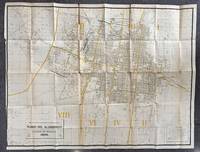
19046209Mexico 1904. Good. Map 31 x 41 inches. Old folds; slight loss and wear at some folds wear and chipping at edges. Lightly toned at folds minor soiling. A large and wonderful map depicting the streetlight illumination of Mexico City. The map puts the Alameda Central at the center of the sheet with eight outlined districts divided around it. A key provides a series of varying red dots which denote streetlights at various bulb levels as well as those planned for an increase. Green lines show electric lines both planned and in place. Various railroads snake throughout the city with the central train yard featured in the upper left center. The area with the most illumination left to do is the eighth district centered on the Paseo de la Reforma. Though the Paseo does have a series of lamps in place most of the rest of the area around it does not as it is still under development. We find no copies of this map in OCLC though with maps that is not uncommon. A fascinating look at the modernization and electrification of Mexico City at the turn of the 20th century. unknown
1885023087New York: D. Appleton and Company 1885. SEE PHOTOS. From the library of Thomas Alva Edison genius of technology who held over 1000 patents including the electric light phonograph and motion picture projector. This book bears his "Library of Thomas A. Edison" engraved bookplate believed to be the earliest of several Edison bookplates and found only in volumes he acquired in the 19th century for personal use. SEE PHOTOS. Because so many important scientific journals were published in German in those days a German language dictionary was an essential reference tool in the laboratory. Laid in loose is a printed authentication slip from Edison's youngest son Theodore M. Edison. Bound in contemporary brown cloth with a dark brown leather spine stamped in shiny gold. SEE PHOTOS. First Edition. Oversize Hardcover. Fine condition. xvi 852pp. ii 522pp. Great Packaging Fast Shipping. D. Appleton and Company Hardcover
First edition, 8vo (200 x 122 mm), iv, 290, [2]pp., with final errata leaf, 19 folding engraved plates, some light offsetting, minor browning from turn-ins, contemporary tree calf, smooth spine ruled in gilt, black leather lettering piece, joints slightly cracked otherwise a fine copy. The work was published anonymously and was long attributed to the English clergyman, the Rev. Francis Kelly Maxwell (1729-1782). However, it has recently been attributed to John Maxwell who was a property manager in Scotland for Sir William Pulteney and an amateur violinist. "In the 'Essay upon Tune' Maxwell presented his discovery to the public, namely, a division of the octave into forty-four distant pitches with the mechanism to enable an organ to produce these pitches."?Kassler. Provenance: Ownership inscription and bookplate of Sir Michael R. Shaw-Stewart, 7th Baronet (1826-1903). Kassler, The Science of Music, pp.760-1.
In-8 p. (mm. 215x132), mz. pelle coeva, fregi e tit. oro al dorso, conserv. bross. orig., pp. 61,(3), con 33 figure nel t., 2 tavole litografate f.t., di cui 1 più volte ripieg., con tre ill. di un apparecchio che vola. “Le premier ouvrage connu sur le vol à voile appliqué à l'homme. Après avoir longuement étudié le vol des oiseaux, Esterno (1805-1883) donne ses instructions pour construire un appareil volant. Un chapitre enthousiaste prophétise les "résultats utiles de la navigation aérienne", et particulièrement comme arme de guerre”. "Prima rara edizione". Cfr. Brockett “Bibliography of aeronautics”, p. 289 - Tissandier “Bibliographie Aeronautique”, p. 20. Esempl. molto ben conservato.
1985EG-210Boston MA.: A.A.Balkema 1985. Comprehensive Five-Volume reference set contains over 440 technical papers presented by internationally respected field experts from 47 countries. Contents include: Vol.I- Theme Lectures; Volumes II-IV- Technical Papers including Geotechnical aspects of Environmental Control Piles and Other Deep Foundations Evaluating Seismic Risk in Engineering Practice Soil Mechanics etc. Vol.V- Post Conference Proceedings including general reports and late papers. 3061 pp. collectively in five volumes. Text in English with a few contributed papers in French. Illustrated. Very minimal shelfwear. Gilt spines. Prior owner's name on the front endpaper in Vol.I only. Heavy Item. First Edition. Hard Cover. Fine/ . 4to - over 9¾" - 12" tall. A.A.Balkema Hardcover
198458040BBMilano, Automobilia, 1984-1996. 29x25,5 cm. Originalleinwandbànde mit Schutzumschlägen. Band 7, 8, 11-13, 16-19, 21-25 mit Bauchbinde.
198458040BBMilano, Automobilia, 1984-1996. 29x25,5 cm. Originalleinwandbànde mit Schutzumschlägen. Band 7, 8, 11-13, 16-19, 21-25 mit Bauchbinde.
In-8 (mm. 236x162), 61 volumi di testo + Atlante di tavole. L’opera, suddivisa in 186 fascicoli (come pubblicata editorialmente), con le sue bross. orig. (con manc., per lo più ai dorsi), è così composta: il “Dizionario” vero e proprio, dal vol. I al XIV - il “Supplemento” dal vol. XV al LVI - l’Appendice al Supplemento vol. LVII - Indice alfabetico dal vol. LVII al LXI. <br> L’Atlante (mm. 336x240), in mz. tela mod. con ang., contiene, come da Indici, una imponente documentazione iconografica di complessive 282 interessantissime tavole, inc. in rame, suddivise in 2 tomi (datati 1836) e così composte: 1° "Arti chimiche" con 100 tavole (di cui 65 ripieg.) - 2° "Arti fisiche" con 19 tavole (di cui 9 ripieg.) - 3° "Arti del calcolo" con 17 tavole (di cui 9 ripieg.) /// 1° "Arti meccaniche" con 87 tavole (di cui 51 ripieg.) - 2° "Tecnologia" con 59 tavole (di cui 27 ripieg.).<br> “"Prima traduzione italiana" fatta da una società di dotti ed artisti, con l’aggiunta della spiegazione di tutte le voci proprie delle arti e dei mestieri italiani, di molte correzioni, scoperte e invenzioni estratte dalle migliori opere pubblicate recentemente su queste materie; con in fine un nuovo Vocabolario francese dei termini di arti e mestieri corrispondenti con la lingua italiana e coi principali dialetti d’Italia. Opera interessante ogni classe di persone e corredata di un copioso numero di tavole in rame dei diversi utensili, apparati, stromenti, macchine ed officine”.<br> Manca il vol. 54, qui in fotocopia. Con qualche fiorit. ma complessivam. un buon esemplare con barbe.
In-8 p. (mm. 228x153), 5 volumi di testo + un Atlante in folio, mz. pelle coeva, fregi e titolo oro al dorso (lievi abras.), pp. XXI,593; 723; 614; 809; 781. Dizionario “utile ai veterinari, agli Ufficiali di Cavalleria, ai possidenti, ai fittajuoli, ai coltivatori, ed a quanti hanno cura del governo degli animali domestici”. L’Atlante (mm. 500x368): "Anatomia chirurgica dei principali animali domestici", opera di Leblanc e Trousseau, pp.nn. 6 (frontesp., introduz. e indice), contiene una importante ed interessantissima raccolta di 30 + 6 tavole in cui sono figurate: 1°. L’anatomia delle regioni del cavallo, del bue, dell’ariete, del majale, sulle quali si fannno le più alte operazioni chirurgiche. 2°. I diversi stati dei denti del cavallo, del bue, dell’ariete, del cane, dimostranti la età loro. 3°. Gli strumenti di chirurgia veterinaria”. Le sei addizionali sono dedicate ai vermi e alla dentatura degli animali domestici e ad altri strumenti chirurgici. Le tavole, litografate a colori e in bianco e nero, ciascuna con numerose figure, sono tutte descritte a fronte. Testo con qualche fioritura o lieve arross.; atlante ben conservato.
In-16 gr. (mm. 196x125), 2 voll., cartonato muto mod., tit. ms. al dorso, pp. LXXXIII,394; (4),435; molto ben illustrato da “41 planches dessinées par l’Auteur, comprenant 182 sujets, gravés au trait par MM. Normand Fils, Hibon et Thierry”: sono tavole ripieg. e f.t., tutte descritte. La prima è l’antiporta figur. dove l’A. rende omaggio ai più famosi pasticceri dei regni di Louis XV, Louis XVI e suoi contemporanei (come precisato a p. XLIV del “Discours préliminaire”). Dedica a M. Boucher, controleur de la maison du prince de Talleyrand-Périgord. L’opera è divisa in 7 parti: “Des détrempes en général - Des entrées chaudes de patisserie - Des grosses pièces de fonds - Des grosses pièces et des entremets montés - Des entremets de patisserie détachés et non détachés - Le petit four et les confitures - Revue critique des grands bals de 1810 et 1811”. "Seconda rara edizione". Cfr. Vicaire, p. 144-145 che cita le varie ediz. di questo celebre testo, pubblicato per la prima volta nel 1815 - Bitting, p. 74. Con aloni e fiorit. interc. nel t., ma complessivam. buon esemplare, con tavole ben conservate. "Il grande chef francese Marie Antoine Careme (1784-1833), fu cuoco di Talleyrand e poi degli imperatori di Russia e d’Austria. Il suo nome è divenuto quasi proverbiale per indicare l’ideale del cuoco perfetto. Scrisse varie opere fra cui “Il cuoco parigino o L’arte della cucina nel secolo XIX”". Così Diz. Larousse,III, p. 405.