Einstein, AlbertBiblio.com

1 506 résultats
191150424Leipzig: Johann Ambrosius Barth 1911. The Genesis of General Relativity<p>Einstein Albert 1879-1955. 1 Elementare betrachtungen über die thermische molekularbewengung in festen Körpern. In Annalen der Physik 35 9: 679-94 pp. Weil 42. 2 Über den Einfluß der Schwerkraft auf die Ausbreitung des lichtes. In Annalen der Physik 35 10: 898-908 pp. Weil 43. Red cloth gilt spine lettering. Figs. Text-illust. 214 x 140 mm. Whole volume: viii 1040 pp. 6 plates 3 b/w silver photos 1 colorized 2 folding. Very good. </p> <p>Approximate English translations of titles: 1 "Elementary considerations about thermal molecular motion in solid bodies" and 2 "On the influence of gravity on the propagation of light." </p> <br /> <br /> <p>"Einstein returns to his thoughts on gravitation and discusses his ideas on the static gravitational field no. 1 above advancing the "half-shift" prediction of the deflection of light by a massive body such as the Sun. In his early papers on the subject . . . he used two important features: the principle of equivalence and the role of the speed of light. In this paper he takes a broader perspective saying that if a light beam is bent in an accelerating frame of reference then if the theory is correct it must also be besnt by gravity by exactly the equivalent amount." Calaprice An Einstein Encyclopedia.</p> <p>"An important conclusion of this paper is that the velocity of light in a gravitational field is a function of the place. The equation: </p> <p> c = c01 / c2</p> <p> signifies that there exists a relationship between the velocity of light and the gravitational potential; the latter influences the first." Weinstein Einstein's 1912-1913 struggles with Gravitation Theory: Importance of Static Gravitational Fields Theory. </p> <br /> <br /> <p>"Here no. 2 above Einstein continues the work he had begun in 1907 on the specific heat of solids where the heat agitation of solids was reduced to a monochromatic oscillation of the atom and the specific heat was determined based on the quantum treatment of an oscillator in a radiation field. He explains the discrepencies between his formula and the measurements at low temperatures" Calaprice An Einstein Encyclopedia. </p> <br /> <br /> <p>Weil's Einstein Bibliography nos. 42 and 43. Boni's Einstein Checklist nos. 38 39. </p> . Johann Ambrosius Barth unknown
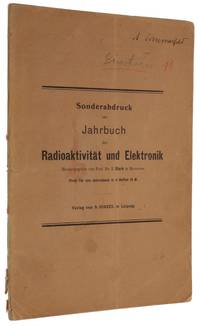
19076410Leipzig: S. Hirzel 1907. First edition. <p>First edition an extremely rare offprint from the library of the renowned German physicist Arnold Sommerfeld of one of the most important transitional papers in Einstein's scientific career. In this landmark work Einstein first articulated the equivalence principle - the insight that uniform acceleration and gravitation are physically indistinguishable</p> <p>- a profound realization he later described as "the happiest thought of my life." This concept became the foundation of general relativity marking a pivotal departure from special relativity and setting Einstein on the path toward a relativistic theory of gravitation.</p>. <p>THE EQUIVALENCE PRINCIPLE 'THE HAPPIEST THOUGHT OF MY LIFE'</p> . <p>First edition extremely rare author's presentation offprint with 'Überreicht vom Verfasser' Presented by the Author stamped on front wrapper from the library of the great German physicist Arnold Sommerfeld of this crucially important transitional paper in which Einstein introduced the equivalence principle that uniform acceleration and gravitation are equivalent in their physical effects which launched him on his path to general relativity. "Einstein's efforts to incorporate gravitation into the theory of relativity led him in 1907 to formulate a new formal principle later named the principle of equivalence. He stressed that when gravitational effects are taken into account it is impossible to maintain the privileged role that inertial frames of reference still have in the original relativity theory. He concluded that if gravitation is to be included it is necessary to extend the relativity principle. The search for a group of transformations wider than the Lorentz group under which the laws of physics remain invariant when gravitation is included lasted from 1907 until the end of 1915 leading finally to what Einstein considered his greatest achievement the general theory of relativity" Collected Papers 2 p. xxix. "On p. 443 are probably the first explicit statements both of the equivalence of inertial and gravitational mass and of the equation for mass in terms of energy E = mc2 now regarded as the theoretical basis for the release of atomic energy" Weil. In 1905 "Einstein said that all energy of whatever sort has mass. It took even him two years more to come to the stupendous realization that the reverse must also hold: that all mass of whatever sort must have energy. . With mass and energy thus wholly equivalent Einstein was able in 1907 in a long and mainly expository paper published in the Jahrbuch der Radioactivität the offered paper to write his famous equation E = mc2 . In presenting his equation in 1907 Einstein spoke of it as the most important consequence of his theory of relativity" Hoffmann Albert Einstein p. 81. "Of greatest importance is the last part of the paper which generalizes the principle of relativity from uniformly moving systems to uniformly 'accelerated' systems. . He introduces the principle of equivalence which claims that the problem of a uniform and stationary gravitational field on the one hand and the system moving with a constant acceleration without any gravitation on the other hand are physically indistinguishable situations. This principle put him in a position to find out what effect gravitation has on an arbitrary physical phenomenon because all he had to do was to observe that phenomenon from an accelerated reference system. He thus obtains the speeding up of clocks in a field of increased gravitational potential which must lead to a universal red shift of the spectral lines coming from the Sun and likewise to a bending of light rays near to the limb of the Sun. Furthermore this hypothesis at once makes it clear why inertial mass and gravitational mass must be under all circumstances strictly proportional to one another. . Hence the principle of the energy value of inertial mass must be extended to the gravitational mass" Lanczos The Einstein Decade p. 153. Later Einstein wrote that when he was working on this paper "There occurred to me the happiest thought of my life in the following form. The gravitational field has only a relative existence in a way similar to the electric field generated by magnetoelectric induction. Because for an observer falling freely from the roof of a house there exists - at least in his immediate surroundings - no gravitational field" Einstein's emphasis Pais Subtle is the Lord p. 178. Although Einstein submitted the paper on 4 December 1907; it was published in the January 22 issue of the Jahrbuch. This is one of Einstein's rarest major papers in offprint form. RBH lists three copies: Plotnick Christie's 2002; Einstein's own collection of his offprints Christie's 2008; and Richard Green Christie's 2008. OCLC lists 6 copies worldwide Morgan; Princeton; Stanford; Trinity College Cambridge; Queen's University Kingston ON; Thomas Fisher. This copy was presented by Einstein to one of the leading physicists of the time surely hoping to make himself known in the scientific world when he was still a technical expert in the Swiss Patent Office.</p> <br /> <p>Provenance: Arnold Sommerfeld 1868-1951 his signature and characteristic numbering in red pencil '11' on front cover. "The son of a physician Sommerfeld was educated at the University of Königsberg. After teaching briefly at the universities of Göttingen Clausthal and Aachen he was appointed professor of physics at the University of Münich in 1906. Sommerfeld should have retired in 1936 in favour of his pupil Werner Heisenberg. Opposition from the Nazi party to Heisenberg's appointment prolonged Sommerfeld's tenure and it was not in fact until late 1939 that he finally retired to be succeeded not by Heisenberg but by Wilhelm Müller a Nazi aerodynamicist without a single publication in physics to his credit. Although Sommerfeld and Heisenberg were not Jewish they were regarded by the Nazis as Jewish sympathizers. Sommerfeld however survived the war and returned to his Münich chair in 1945 continuing to work at physics until he died in a car accident in 1951" Oxford Reference. "Arnold Sommerfeld was one of the most distinguished representatives of the transition period between classical and modern theoretical physics. The work of his youth was still firmly anchored in the conceptions of the nineteenth century; but when in the first decennium of the century the flood of new discoveries experimental and theoretical broke the dams of tradition he became a leader of the new movement and in combining the two ways of thinking he exerted a powerful influence on the younger generation. This combination of a classical mind to whom clarity of conception and mathematical rigour are essential with the adventurous spirit of a pioneer are the roots of his scientific success while his exceptional gift of communicating his ideas by spoken and written word made him a great teacher" Max Born p. 275. </p> <br /> <p>"His first important paper on relativity theory after 1905 is the 1907 review. This article was written at the request of Johannes Stark the editor of the Jahrbuch. On September 25 1907 Einstein had accepted this invitation. On November 1 Einstein further wrote to Stark: 'I am now ready with the first part of the work for your Jahrbuch. I am working zealously on the second part in my unfortunately scarce spare time.' Since this second part contains the remarks on gravitation it seems probable that Einstein's 'happiest thought' came to him sometime in November 1907. We certainly know where he was when he had this idea. In his Kyoto lecture he told the story: 'I was sitting in a chair in the patent office at Bern when all of a sudden a thought occurred to me. 'If a person falls freely he will not feel his own weight!' I was startled. This simple thought made a deep impression on me. It impelled me toward a theory of gravitation' .</p> <br /> <p>"Three main issues are raised in Section V of the Jahrbuch article. </p> <br /> <p>The Equivalence Principle. 'Is it conceivable that the principle of relativity also holds for systems which are accelerated relative to each other' That is Einstein's starting question. Then he gives the standard argument. A reference frame Σ1 is accelerated in the x direction with a constant acceleration γ. A second frame Σ2 is at rest in a homogeneous gravitational field which imparts an acceleration -γ in the x direction to all objects. 'In the present state of experience we have no reason to assume that . Σ1 and Σ2 are distinct in any respect and in what follows we shall therefore assume the complete physical equivalence of a gravitational field and the corresponding acceleration of the reference frame. This assumption extends the principle of relativity to the case of uniformly accelerated motion of the reference frame . he began by applying his new postulate to the Maxwell equations always for uniform acceleration. He did not raise the question of the further extension to nonuniform acceleration until 1912 the year he first referred to his hypothesis as the 'equivalence principle.'</p> <br /> <p>The Gravitational Red Shift. Many textbooks on relativity ascribe to Einstein the method of calculating the red shift by means of the Doppler effect of light falling from the top to the bottom of an upwardly accelerating elevator. That is indeed the derivation he gave in 1911. However he was already aware of the red shift in 1907. The derivation he gave at that time is less general more tortured and yet oddly more sophisticated. It deserves particular mention because it contains the germ of two ideas that were to become cornerstones of his final theory: the existence of local Lorenz frames and the constancy of the velocity of light for infinitesimally small paths .</p> <br /> <p>Maxwell's Equations; Bending of Light; Gravitational Energy = mc2. Indomitably Einstein goes on. He tackles the Maxwell equations next. He concludes that Maxwell's equations have the same form in a uniformly accelerated reference frame as in a non-accelerated frame but with a modified velocity of light. 'It follows that the light rays . are bent by the gravitational field.' Second he examines the energy conservation law in the accelerated frame and finds 'a very notable result . In a gravitational field one must associate with every energy E an additional position-dependent energy which equals the position-dependent energy of a 'ponderable' mass of magnitude E/mc2. The law E = mc2 therefore holds not only for inertial but also for gravitational mass' .</p> <br /> <p>"This review does not have the perfection of the 1905 paper on special relativity. The approximations are clumsy and mask the generality of the conclusions. Einstein was the first to say so in 1911. The conclusion about the bending of light is qualitatively correct quantitatively wrong - though in 1907 not yet logically wrong. Einstein was the first to realize this in 1915. Despite all this I admire this article at least as much as the perfect relativity paper on 1905 not as much for its details as for its courage" Pais pp. 179-182.</p> <br /> <p>"In 1920 Einstein recalled how he first arrived at the ideas behind the equivalence principle: </p> <br /> <p>'While I was occupied in 1907 with a comprehensive survey of the special theory for the 'Yearbook for Radioactivity and Electronics' I also had to attempt to modify Newton's theory of gravitation in such a way that its laws fitted into the theory. Attempts along these lines showed the feasibility of this enterprise but did not satisfy me because they had to be based on physical hypotheses that were not well-founded. Then there came to me the most fortunate thought of my life in the following form: </p> <br /> <p>'Like the electric field generated by electromagnetic induction . the gravitational field only has a relative existence. Because for an observer freely falling from the roof of a house during his fall there exists-at least in his immediate neighborhood-no gravitation field. Indeed if the observer lets go of any objects relative to him they remain in a state of rest or uniform motion independently of their particular chemical or physical composition note by AE: air resistance is naturally ignored in this argument. The observer is thus justified in interpreting his state as being at rest. </p> <br /> <p>'Through these considerations the unusually extraordinary experimental law that all bodies fall with equal acceleration in the same gravitational field immediately obtains a deep physical significance. For if there were just one single thing that fell differently from the others in the gravitational field then with its help the observer could recognize that he was falling in a gravitational field. If such a thing does not exist-which experiment has shown with great precision-then there is no objective basis for the observer to regard himself as falling in a gravitational field. Rather he has the right to regard his state as one of rest and with respect to a gravitational field his neighborhood as field free. The experimental fact of the material-independence of the acceleration due to gravity is thus a powerful argument for the extension of the relativity postulate to coordinate systems in non-uniform relative motion with respect to each other . The generalization of the relativity principle thus indicates a speculative path towards the investigation of the properties of the gravitational field.' </p> <br /> <p>"Einstein alludes here to his initial attempts to set up a special-relativistic theory of gravitation but gives no details. In 1933 he gave the fullest account of how he 'arrived at the equivalence principle by a detour Umweg' through such attempts. After mentioning his doubts after 1905 about the privileged dynamical role of inertial systems and his early fascination by Mach's idea that the acceleration of a body is not absolute but relative to the rest of the bodies in the universe he turns to the events of 1907:</p> <br /> <p>'I first came a step closer to the solution of the problem when I attempted to treat the law of gravitation within the framework of special relativity. Like most authors at the time I attempted to establish a field law for gravitation since the introduction of an unmediated action at a distance was no longer possible at least in any sort of natural way on account of the abolition of the concept of absolute simultaneity. </p> <br /> <p>'The simplest thing naturally was to preserve the Laplacian scalar gravitational potential and to supplement Poisson's equation in the obvious way by a term involving time derivatives so that the special theory of relativity was satisfactorily taken into account. The equation of motion of a particle also had to be modified to accord with the special theory. The way to do so was less uniquely prescribed since the inertial mass of a body might well depend on its gravitational potential. This was even to be expected on the basis of the law of the inertia of energy. </p> <br /> <p>'However such investigations led to a result that made me highly suspicious. For according to classical mechanics the vertical acceleration of a body in a vertical gravitational field is independent of the horizontal component of its velocity. This is connected with the fact that the vertical acceleration of a mechanical system or rather of its center of mass in such a gravitational field turns out to be independent of its internal kinetic energy. According to the theory I was pursuing however such an independence of the gravitational acceleration from the horizontal velocity or from the internal energy of a system did not occur.</p> <br /> <p>'This did not accord with an old fact of experience that all bodies experience the same acceleration in a gravitational field. This law which can also be formulated as the law of equality of inertial and gravitational mass now appeared to me in its deep significance. I was most highly amazed by it and guessed that in it must lie the key to the deeper under- standing of inertia and gravitation.' </p> <br /> <p>"Turning from later reminiscences let us see how Einstein presented his approach to gravitation in 1907:</p> <br /> <p>'Up to now we have only applied the principle of relativity i.e. the presupposition that the laws of nature are independent of the state of motion of the reference system to acceleration-free reference systems. Is it conceivable that the principle of relativity also holds for systems that are accelerated relative to each other </p> <br /> <p>'This is not the place for an exhaustive treatment of this question. Since however it is bound to occur to anyone who has followed the previous applications of the relativity principle I shall not avoid taking a position on the question here. Consider two systems in motion Σ1 and Σ2. Let Σ1 be accelerated in the direction of its X -axis and let γ be the magnitude constant in time of this acceleration. Let Σ2 be at rest but in a homogeneous gravitational field that imparts an acceleration -γ in the direction of the X -axis to all objects. As far as we know the laws of physics with respect to Σ1do not differ from those with respect to Σ2; this is due to the circumstance that all bodies in a gravitational field are equally accelerated. So we have no basis in the current state of our experience for the assumption that the systems Σ1and Σ2differ from each other in any respect; and therefore in what follows shall assume the complete physical equivalence of a gravitational field and the corresponding acceleration of a reference system. </p> <br /> <p>'This assumption extends the principle of relativity to the case of uniformly-accelerated translational motion of the reference system. The heuristic value of this assumption lies in the circumstance that it allows the replacement of a homogeneous gravitational field by a uniformly accelerated reference system which to a certain extent is amenable to theoretical treatment.' </p> <br /> <p>"Some further comments on this equivalence in his next paper on gravitation in 1911 are illuminating. He notes that in both systems objects subject to no other forces fall with constant acceleration:</p> <br /> <p>'For the accelerated system K′ corresponding to the 1907 Σ1 this follows directly from the Galileian principle of inertia; for the system K at rest in a homogeneous gravitational field corresponding to the 1907 Σ2 however it follows from the experimental fact that in such a field all bodies are equally strongly uniformly accelerated. This experience of the equal falling of all bodies in a gravitational field is the most universal with which the observation of nature has provided us; in spite of that this law has not found any place in the foundations of our physical picture of the world . From this standpoint one can as little speak of the absolute acceleration of a reference system as one can of the absolute velocity of a system according to the usual special theory of relativity. Naturally one cannot replace an arbitrary gravitational field by a state of motion of the system without a gravitational field; just as little as one can trans- form all points of an arbitrarily moving medium to rest by a relativity transformation. From this standpoint the equal falling of all bodies in a gravitational field is obvious. </p> <br /> <p>'As long as we confine ourselves to purely mechanical processes within the realm of validity of Newtonian mechanics we are certain of the equivalence of the systems K and K′. Our point of view will only have a deeper significance however if the systems K and K′ are equivalent with respect to all physical processes i.e. if the laws of nature with respect to K agree completely with those with respect to K′. By assuming this we obtain a principle that if it really is correct possesses a great heuristic significance. For by means of theoretical consideration of processes that take place relative to a uniformly accelerated reference system we obtain conclusions about the course of processes in a homogeneous gravitational field.'</p> <br /> <p>"With hindsight one can see that Einstein's attempt to find the best way to implement mathematically the physical insights about gravitation incorporated in the equivalence principle was hampered significantly by the absence of the appropriate mathematical concepts. His insight as he put is a few years later that gravitation and inertia are "essentially the same" wesensgleich cries out for implementation by their incorporation into a single inertio-gravitational field represented mathematically by a non-flat affine connection on a four-dimensional manifold. But the concept of such a connection was only developed after and largely in response to the formulation of the general theory. So Einstein had to make do with what was available: Riemannian geometry and the tensor calculus as developed by the turn of the century i.e. based on the concept of the metric tensor without a geometrical interpretation of the covariant derivative" Stachel pp. 83-86.</p> <br /> <p>BRL 20; Stanitz 94; Weil 21. Born 'Arnold Johannes Wilhelm Sommerfeld 1868-1951' Obituary Notices of Fellows of the Royal Society 8 1952 pp. 275-296. Stachel 'The first two acts' pp. 81-112 in: Gravitation in the Twilight of Classical Physics. The Promise of Mathematics Renn & Schemmel eds. 2007.</p> <br/> <br/> 8vo 231 x 157 mm pp. 411-462. Original printed wrappers upper cover a bit soiled lower part of spine worn light vertical crease for posting faint ink stain to page 418 spine strip with wear and tear. S. Hirzel unknown
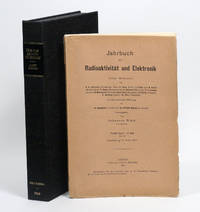
19082507Leipzig: S. Hirzel 1908. First edition. original wrappers. Very Good. THE BIRTH OF GENERAL RELATIVITY: FIRST PRINTING IN RARE ORIGINAL WRAPPERS OF ONE ONE EINSTEIN'S MOST IMPORTANT PAPERS; containing the beginning of general relativity the derivations of the equivalence principle gravitational redshift and the gravitational bending of light. "Einstein's road to general relativity began in November 1907 when he was struggling against a deadline to finish an article for a science yearbook explaining his special theory of relativity. Two limitations of that theory still bothered him: it applied only to uniform constant-velocity motion. and it did not incorporate Newton's theory of gravity. <br /> <br /> "'I was sitting in a chair in the patent office at Bern when all of a sudden a thought occurred to me' he recalled. 'If a person falls freely he will not feel his own weight.' That realization which 'startled' him launched him on an arduous eight-year effort to generalize his special theory of relativity and 'impelled me toward a theory of gravitation.' Later he would call it 'the happiest though in my life.'<br /> <br /> "The tale of the falling man has become an iconic one and in some accounts it actually involves a painter who fell from the roof of an apartment building near the patent office. Einstein refined his thought experiment so that the falling man was in an enclosed chamber such as an elevator in free fall above the earth. In this falling chamber at least until it crashed the man would feel weightless. Any objects he emptied from his pocket and let loose would float alongside him.<br /> <br /> "Looking at it another way Einstein imagined a man in an enclosed chamber floating in deep space 'far removed from stars and other appreciable masses.' He would experience the same perceptions of weightlessness. 'Gravitation naturally does not exist for this observer. He must fasten himself with strings to the floor otherwise the slightest impact against the floor will cause him to rise slowly towards the ceiling.'<br /> <br /> "Then Einstein imagined that a rope was hooked onto the roof of the chamber and pulled up with a constant force. 'The chamber together with the observer then begin to move "upwards" with a uniformly accelerated motion.' The man inside will feel himself pressed to the floor. 'He is then standing in the chest in exactly the same way as anyone stands in a room of a house on our earth. The man in the chamber will come to the conclusion that he and the chest are in a gravitational field. Just then however he discovers the hook in the middle of the lid of the chest and the rope which is attached to it and he consequently comes to the conclusion that the chamber is suspended at rest in the gravitational field.'<br /> <br /> Einstein observed that inertial mass always equals gravitational mass and through his thought experiments concluded that "From this correspondence it follows that it is impossible to discover by experiment whether a given system of coordinates is accelerated or whether. the observed effects are due to a gravitational field."<br /> <br /> "Einstein called this 'the equivalence principle.' The local effects of gravity and of acceleration are equivalent. <br /> <br /> "In 1907 working against the deadline imposed by the Yearbook of Radioactivity and Electronics Einstein tacked on a fifth section to his article on relativity that sketched out his new ideas. He also came up with many predictions that could be tested including that light should be bent by gravity and that the wavelength of light emitted from a source with a large mass such as the sun should increase slightly in what has become known as the gravitational redshift. <br /> <br /> "It would take Einstein another eight years until November 1915 to work out the fundamentals of this theory and find the math to express it. Then it would take another four years before the most vivid of his predictions the extent to which gravity would bend light was verified by dramatic observations. But at least Einstein now had a vision one that started him on the road toward one of the most elegant and impressive achievements in the history of physics: the general theory of relativity" Isaacson Einstein 145-49. <br /> <br /> Weil in his bibliography also notes that "On p.443 are probably the first explicit statements both of the equivalence of inertial and gravitational mass and of the equation for mass in terms of energy now regarded as the theoretical basis for the release of atomic energy." Weil 21. <br /> <br /> Although Einstein submitted the paper on 4 December 1907 it wasn't published until the January 22 issue of the Jarbuch. Note: There was a very short "Correction" in a subsequent issue not included here.<br /> <br /> IN: Jahrbuch der Radioactivität under Electronik Vierter Band - 4. Heft No. 16 pp. 411-462. Leipzig: S. Hirzel 1908. Octavo original wrappers; handsome custom box. Light wear to wrappers and split to spine; text fine with Einstein paper largely unopened. <br /> <br /> AN EXTREMELY RARE COPY IN ORIGINAL WRAPPERS OF ONE OF EINSTEIN'S MOST IMPORTANT PAPERS. S. Hirzel unknown
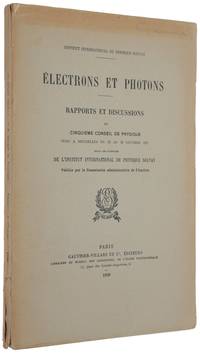
19286594Paris: Gauthier Villars 1928. First edition. <p>First edition rare in the original printed wrappers of the proceedings of the Fifth Solvay Congress 1927-the most celebrated of the Solvay conferences and the setting in which the Bohr-Einstein debate over the consistency and completeness of quantum mechanics first took public programmatic form. Convened under the banner "Electrons and Photons" the meeting brought together nearly all the principal architects of the old and the new quantum theory; seventeen of the twenty-nine participants were or became Nobel Prize laureates.</p>. The Bohr-Einstein Debate Begins. <p>First edition rare in the original printed wrappers of the proceedings of the fifth Solvay Congress where the debate between Bohr and Einstein on the consistency and completeness of quantum mechanics began. It was at this the most famous of the Solvay conferences that Einstein disenchanted with Heisenberg's uncertainly principle made his famous remark that "God does not play dice" to which Niels Bohr replied "Einstein stop telling God what to do!" Seventeen of the twenty-nine attendees which included nearly all the principal architects of the old and the new quantum theory were or became Nobel Prize winners. "The three and a half years since the fourth Solvay Conference . were marked by enormous progress in quantum physics. Partly based on discoveries and ideas that had been available already before 1924 − such as the Compton effect and matter waves − the new atomic theory had arisen which did more than throw new light on the difficulties discussed at the 1924 conference: quantum or wave mechanics went right to the heart of the problems posed by atomic phenomena. The two subjects put programmatically into the title of the fifth Solvay Conference − electrons and photons − designated the crucial points of interest because 'electrons' also stood for the smallest massive constituents of matter and they now became associated with waves and 'photons' a name given only recently in October 1926 by the physical chemist Gilbert N. Lewis to Einstein's light-quanta characterized the quantum-theoretical aspect of electromagnetic radiation. It was the declared intention of the Scientific Committee of the Institut International dePhysique Solvay to contribute by scientific reports and discussions about them to the clarification of the scientific concepts in the physics of the day. In retrospect one may indeed attribute an important success to the 1927 Solvay Conference in marking the completion of the ideas that had first been discussed in the international physics community sixteen years previously at the first Solvay Conference of 1911" Mehra & Rechenberg pp. 233-4. Following a 'Notice nécrologique' by Lorentz the present volume contains the following reports and discussions about them by the participants all articles in French: 'The Intensity of the Reflection of X-rays' by Bragg; 'Disagreement between Experience and the Electromagnetic Theory of Radiation' by Compton; 'The New Dynamics of Quanta' by de Broglie;<br /> 'The Mechanics of Quanta' by Born and Heisenberg; 'The Mechanics of Waves' by Schrödinger;<br /> 'The Quantum Postulate and the New Development of Atomic Theory' by Bohr. No copies located in auction records.</p> <br /> <p>In 1911 the Belgian industrialist Ernest Solvay invited a group of the world's most prominent physicists including Einstein Planck Lorentz Sommerfeld Rutherford and Marie Curie to participate in a scientific conference on the difficulties of reconciling classical physics with quantum theory. The conference "set the style for a new type of scientific meetings in which a select group of the most well informed experts in a given field would meet to discuss the problems at its frontiers and would seek to define the steps for their solution" Mehra Solvay Conferences p. xv. The first Solvay Conference-widely considered a turning point in the history of modern physics-was so successful that in the following year Solvay established a foundation now known as the International Solvay Institutes for Physics and Chemistry "to encourage the researches which would extend and deepen the knowledge of natural phenomena" ibid. and to sponsor further conferences. The next two Solvay Conferences met in 1913 and 1921; subsequent conferences have been held every three years except during wartime.</p> <br /> <p>"From amongst the members of the Scientific Committee of the 1927 Congress two had already played a leading role in 1911: the Chairman Hendrik Lorentz and Albert Einstein; the latter had presented then the most revolutionary report on the light quantum. In spring 1926 in the early stage of preparing for the new conference Lorentz again requested Einstein to write a report. The latter answered promptly: 'If you wish that I take over the report on quantum statistics I shall do so with pleasure; because without being in great difficulty I shall never say "no" to you' Einstein to Lorentz 1 May 1926 . On 17 June 1927 Einstein wrote to Lorentz: 'I recall having committed myself to you to give a report on quantum statistics at the Solvay Conference. After much reflection back and forth I came to the conclusion that I am not competent for giving such a report in a way which really corresponds to the state of the thing. The reason is that I have not been able to participate as intensively in the modern development of quantum theory as would be necessary for that purpose. This is in part because I have on the whole too little receptive talent for fully following the stormy developments in part also because I do not approve of the purely statistical way of thinking on which the new theory is founded .' As a substitute speaker for the topic assigned to him he proposed either Enrico Fermi from Italy or Paul Langevin from France. Ultimately however neither of them gave the report on Einstein's subject. Instead Niels Bohr agreed to contribute a report on a different topic: namely on his latest considerations on the problem of the interpretation of quantum mechanics.</p> <br /> <p>"The rapporteurs at the fifth Solvay Conference fell into three groups: the experimentalists Bragg and Compton; the theoreticians advocating the Gottingen-Cambridge-Copenhagen versions of quantum mechanics − Bohr Born and Heisenberg; and those of the wave-mechanical camp − de Broglie and Schrodinger.</p> <br /> <p>"The selection of Arthur Holly Compton seemed to be most appropriate because the Compton effect − discovered in late 1922 − had been one of the crucial results triggering the entire development which ended with the new atomic theory by providing Einstein's light-quantum hypothesis of 1905 a firm experimental foundation. Since its discovery and even more so after the refutation of the Bohr-Kramers-Slater theory of radiation . Einstein's fundamental light-quantum conception . became a physical reality. Compton's report dwelt on the conceptual consequences rather than on experimental details. In particular he addressed the questions of the aether and of electromagnetic waves on the one hand and the phenomena contradicting the classical wave concepts such as the photoelectric effect X-ray diffraction certain electron-recoil effects observed by C. T. R. Wilson and W. Bothe in 1923 and the individual interaction between radiation-quanta and electrons i.e. the Compton effect. Compton showed also in some detail how the Bohr-Kramers-Slater theory failed to account for these observations.</p> <br /> <p>"The report of William Lawrence Bragg a regular participant in the Solvay Conferences since 1913 appeared to address on first inspection less central points. However from his presentation of the material on reflection of X-rays one easily recognizes the strategy of the Scientific Committee of the Conference: Bragg had to take over the task of stressing those radiation phenomena that could be described by the wave theory namely the diffraction of X-rays by crystal lattices. Consequently he gave the story from Laue's discovery in 1912 over the subsequent work of his father William Henry Bragg and himself to the later investigations of Paul Ewald William Duane and others. Bragg demonstrated in detail how the old and the new wave theories worked to describe the phenomena of diffraction and refraction of X-rays. In the discussion of Bragg's report Hendrik Kramers presented at some length the recent development of the dispersion theory by himself and Ralph Kronig.</p> <br /> <p>"Both experimental reports served as a firm basis for the discussion of the theoretical concepts which provided the central theme of the conference. This significance was shown by the discussions immediately following them. Compton's talk especially gave rise to a lively exchange of ideas and arguments in which besides the experimentalists e.g. Bragg Madame Curie O. W. Richardson and C. T. R. Wilson almost all of the theoretical experts present participated i.e. Bohr Born Debye Dirac Ehrenfest Lorentz Pauli and Schrödinger − with one important exception: according to the published proceedings of the fifth Solvay Conference offered here Einstein remained silent after the presentations of Compton and Bragg .</p> <br /> <p>"The presentation of the theoretical reports at the Solvay Conference proceeded by following the historical order in which the ideas had been published between 1923 and 1926: thus de Broglie's talk came first then Born and Heisenberg's followed by Schrödinger's and finally Bohr's .</p> <br /> <p>"In the course of the year 1927 the Copenhagen physicists Heisenberg among them clarified their ideas on the interpretation of atomic phenomena. Although they admitted the existence and persistence of statistical relations in quantum mechanics they searched for − and succeeded in − formulating principles that in their opinion at least provided the deeper reason for these statistical features: the uncertainty relations and the complementarity principle. In spite of this difference in attitude toward what they regarded as truly fundamental and actually derived Heisenberg felt no difficulty in preparing a joint Solvay report together with his former teacher Max Born. Their report provided a view of the work performed in Göttingen and Cambridge in establishing quantum mechanics with chapters on matrix mechanics and its transformation into wave mechanics I the physical interpretation of the theory II and the uncertainty principle III. The balance in representing the main interests of the two authors was achieved insofar as Section II dealt with Born's statistical interpretation and Section III with Heisenberg's limitation on measurements in quantum mechanics. Moreover the Born-Heisenberg report also signaled the agreement reached by Heisenberg and Niels Bohr during the summer of 1927 .</p> <br /> <p>"Louis de Broglie entitled his report 'The new dynamics of quanta'; he covered the story from his first ideas on matter waves in 1923-24 to the advent of Schrödinger's equation in 1926 and on to the new pilot-wave theory in 1927. He further applied the pilot-wave theory to the problem of the hydrogen atom and claimed that the treatment yielded an easier understanding of the actual situation; finally he spoke about the experimental verification of matter waves obtained recently in the experiments of Clinton Joseph Davisson and Lester Halbert Germer and George Paget Thomson and Alexander Reid . Erwin Schrödinger on the other hand concentrated on the mathematical aspects of his wave-mechanical scheme the time-independent as well as the time-dependent equations the formal equivalence of wave mechanics to the Born-Heisenberg-Jordan matrix scheme and the relativistic wave equation. At the end of the conference Niels Bohr presented a modified version of his Como lecture under the title 'The Quantum Postulate and the New Development of Atomic Theory' .</p> <br /> <p>"Although the Born-Heisenberg and Schrödinger reports provoked only technical questions that of de Broglie and especially the one of Bohr stimulated some conceptual discussion. Thus Lorentz asked de Broglie how the old Sommerfeld quantum conditions could be obtained from the new matter-wave ideas and Pauli provided an appropriate calculation using the conservation law for the relativistic electric current; also Leon Brillouin illustrated some 'optical' applications of matter waves. Finally Bohr's report at the end provided the proper start for a very excited 'General Discussion of the New Ideas Put Forward.'</p> <br /> <p>"Upon an opening reflection of Hendrik Lorentz − who expressed some reservation with respect to the new pictures of electrons in quantum and wave-mechanics − and a technical illustration of Max Born for dealing with many-electron systems in the probability scheme Einstein addressed an elementary problem in the physical interpretation of the theory. He suggested in particular to consider an electron passing through a slit in a screen and to discuss the diffraction phenomena obtained. He claimed that 'with respect to quantum mechanics one can take two standpoints regarding its validity' namely:</p> <br /> <p>Interpretation I: The de Broglie-Schrodinger waves do not correspond to a single electron but to an electron cloud extended in space. The theory does not give then any information about an ensemble of an infinity of elementary processes.</p> <br /> <p>Interpretation II: The theory claims to be a complete theory of individual processes. Each particle which moves towards the screen as far as one can determine from its position and velocity is described by a de Broglie-Schrödinger wave packet of small length and small aperture. This wave packet is diffracted and after diffraction arrives partly at the film where it is registered in a resolved state Einstein in the present work pp. 254-5.</p> <br /> <p>"Evidently Interpretation II went beyond I and even included the latter; it also implied that the conservation laws especially for momentum were valid for individual atomic processes thus explaining the Bothe-Geiger experiment as well as other experiments. Still Einstein also objected to this interpretation because: 'If Ψ2 where Ψ is the wave function were simply considered as the probability for a particle to be at a place at the definite instant it might happen that one and the same elementary process would cause an action at two or more places on the screen' which would imply an action-at-a-distance hence a violation of the relativity postulate. The only way out of this difficulty had to be sought with de Broglie in further attempts to localize the microscopic particle. Einstein claimed further that the multidimensional phase space assumed for many-particle systems in quantum or wave mechanics and the corresponding permutation properties contradicted the new statistical results.</p> <br /> <p>"Although Lorentz tried to illuminate the statistical argument further Wolfgang Pauli contradicted Einstein by referring to the recent work of Paul Dirac Pascual Jordan and Oskar Klein on field quantization. He also refuted another argument of Einstein's that the range of forces in quantum mechanics might create problems by pointing to the work of Walter Heitler and Fritz London on molecular binding. Dirac at first supported Pauli's plea; then he stated his 'opinion about determinism and the significance of numbers which occur in the calculus of quantum theory' notably: 'In the classical theory one starts from certain numbers which completely specify the initial state of the system and one deduces certain numbers which specify the final state. This determination applies only to an isolated system' Dirac in the present work p. 261.</p> <br /> <p>"Now according to Bohr isolated systems are by definition unobservable because any observation must disturb the system; as a result already 'the classical deterministic theory cannot be defended.' Furthermore: 'In the quantum theory one starts from certain numbers from which one deduces certain other numbers . The perturbations which an observer inflicts on a system in order to observe it are directly subject to his control and are acts of his free will. It is exclusively the numbers which describe these acts of free choice that can be taken as initial numbers for a calculation in the quantum theory. Other numbers specifying the initial state of the system are fundamentally unobservable and do not appear in the quantum-theoretical treatment' Dirac loc. cit. .</p> <br /> <p>"After Dirac had illustrated his interpretation of the quantum-mechanical process and its observation in the case of a sample collision experiment Heisenberg remarked that he did 'not agree' with Dirac saying 'that in the experiment described nature makes a choice' because: 'Even if you place yourself very far from your scattering material and if you measure after a very long time you can obtain interference by taking two mirrors. If nature were to make a choice it would be difficult to imagine how the interference can be produced. Evidently we can say that nature's choice can never be known until the decisive experiment has been done; for this reason we cannot make any real objection to this choice because the expression "nature makes a choice" does not have any physical consequences. I would say as I have done in my latest paper that the observer himself makes the choice because it is not until the moment when the observation is made that the "choice" becomes a physical reality and that the phase relation in the waves i.e. the ability to interfere is destroyed' Heisenberg in the present work pp. 264-5 .</p> <br /> <p>"The differences in interpretation among the main pioneers of quantum mechanics that showed in this exchange notably between Bohr and Heisenberg and Dirac would become more pronounced in the future .</p> <br /> <p>"In the recollections of some participants of the fifth Solvay Conference the exchange between Bohr and Einstein on fundamental questions concerning the interpretation of quantum mechanics stands out vividly. Thus Bohr after more than twenty years wrote a detailed account of his 'Discussions with Einstein on Epistemological Problems in Atomic Theory' where he introduced the important part dealing with the 1927 exchange by saying: 'At the general discussions in Como we all missed the presence of Einstein but soon after in October 1927 I had the opportunity to meet him in Brussels at the Fifth Physical Conference of the Solvay Institute . At the Solvay meetings Einstein had from their beginning been a most prominent figure and several of us came to the Conference with great anticipations to learn his reaction to the latest stage of the development which to our view went far in clarifying the problems which he had himself from the outset elicited so ingeniously. During the discussions where the whole subject was reviewed by contributions from many sides Einstein expressed however a deep concern over the extent to which causal account in space and time was abandoned in quantum mechanics.'</p> <br /> <p>"The official discussions referred to above throw light on some of the exchanges on the questions that did interest Einstein although Bohr's participation in them does not seem to have been so active. For example no answer from Bohr to Einstein's analysis of the electron's passage through a slit or screen was recorded. Bohr just made some notes which are to be found in his files and as Louis de Broglie recalled: 'Also Einstein said hardly anything beyond presenting a very simple objection to the probability interpretation. Then he fell silent'. However Heisenberg took away quite a different impression from the conference and decades later he wrote enthusiastically: 'The discussions were soon focused upon a duel between Einstein and Bohr on the question as to what extent atomic theory in its present form could be considered to be the final solution of the difficulties which had been discussed for several decades. We generally met already at breakfast in the hotel and Einstein began to describe an ideal Gedanken experiment in which he thought the inner contradictions of the Copenhagen interpretation were especially clearly visible. Einstein Bohr and I walked together from the hotel to the conference building and I listened to the lively discussion between those two people whose philosophical attitudes were so different and from time to time I added a remark on the structure of the mathematical formalism. During the meeting and particularly in the pauses we younger people mostly Pauli and I tried to analyze Einstein's experiment and at lunch time the discussions continued between Bohr and the others from Copenhagen. Bohr had usually finished the complete analysis of the ideal experiment by late afternoon and would show it to Einstein at the supper table. Einstein had no good objection to this analysis but in his heart he was not convinced. Bohr's friend Ehrenfest who was also a close friend of Einstein said to him 'I am ashamed of you Einstein! You put yourself here just in the same position as your opponents in their futile attempts to refute your relativity theory."</p> <br /> <p>"Thus by piecing together the contemporary documents of 1927 with the later recollections of the participants a fairly consistent historical picture of the great epistemological debate between Bohr and Einstein has arisen. The fifth Solvay Conference would not end this debate however. Both participants returned to the problems involved again and again especially at the sixth Solvay Conference in 1930 and a few years later in 1935. Still quantum mechanics had already scored the main points in its favour. 'The most important success of the Brussels meeting was that we could see that against any objections against any attempts to disprove the theory we could get along with it' Heisenberg summarized the result in an interview in 1963 and added: 'At that time in 1927 it was practically Bohr Pauli and myself perhaps just the three of us. That very soon spread out'" Mehra & Rechenberg The Historical Development of Quantum Theory vol. 6 pp. 232-256.</p> <br /> <p>For an English translation and detailed analysis of the conference reports see Bacciagaluppi & Valentini Quantum Theory at the Crossroads. Reconsidering the 1927 Solvay Conference Cambridge 2009.</p> <br/> <br/> 8vo 255 x 165 mm pp. viii 289 with frontispiece portrait of Lorentz. Original printed wrappers spine ends slightly chipped upper margin of front wrapper sunned. Gauthier Villars unknown
192029309Berlin, Julius Springer, 1920. Clothbacked boards. Bound with orig. printed wrappers. Small inkspots in inner margins of wrappers. 15 pp.
192029310Berlin, Julius Springer, 1920. Uncut in orig. printed wrappers. 15 pp.
192088490Berlin, Julius Springer, 1920, in-8, 15 pp, Broché, couverture agrafée de l'éditeur, Édition originale de ce discours prononcé par Einstein (1879-1955) le 5 mai 1920 à la Reichsuniversität de Leyde, à l'occasion de son entrée en fonction en tant que professeur invité. Le savant y expose comment la conception ancienne de l'éther a laissé la place à la notion de gravitation. Cachet ex-libris du révolutionnaire Russe et bibliophile Marcel Bekus (1888-1939). Bon exemplaire. Couverture insolée, agrafes oxydées. Hans-Josef Küpper, Verzeichnis Der Wissenschaftlichen Publikationen Albert Einsteins von 1901-1922 [en ligne]. Weil, 111. Couverture rigide
192038643Berlin, Julius Springer, 1920. Uncut in orig. printed wrappers. 15, (1) pp. Clean and fine, near mint condition.
19207913FB1920. Berlin Springer 1920. 8°. 15 1 S. Unbeschnittene Original-Broschur gebräunt leicht fleckig. Durchgehend mäßig braunfleckig. Sonst gut. unknown
192029309Berlin Julius Springer 1920. Clothbacked boards. Bound with orig. printed wrappers. Small inkspots in inner margins of wrappers. 15 pp. <br/><br/><em>First edition. - Weil No. 111. </em> hardcover
192029310Berlin Julius Springer 1920. Uncut in orig. printed wrappers. 15 pp. <br/><br/><em>First edition. - Weil No. 111. </em> unknown
192038643Berlin Julius Springer 1920. Uncut in orig. printed wrappers. 15 1 pp. Clean and fine near mint condition. <br/><br/><em>First edition. - Weil: 111. </em> unknown
1906432891906. <p>Einstein Albert 1879-1955. Über eine Methode zur Bestimmung des Verhältnisses der transversalen und longitudinalen Masse des Elektrons. Offprint from Annalen der Physik 21 1906. 583-586pp. 223 x 145 mm. Original printed wrappers chipped spine splitting minor spotting. Light toning but very good.</p> <p>First Edition Rare Offprint Issue. In his landmark 1905 paper on special relativity Einstein used the velocity-dependent concepts of transverse and longitudinal mass for the moving electron these terms have now been replaced with the concept of relativistic mass first defined by Lewis and Tolman in 1909. In the present paper Einstein proposed an experimental method for determining the ratio of the transverse to the longitudinal mass and invited experimentalists to verify his special theory of relativity. Einstein later abandoned velocity-dependent mass concepts stating in 1948 that "it is better to introduce no other mass concept than the ‘rest mass' m" quoted in L. B. Okun "The concept of mass" Physics Today 1989: 31-36. Lavenda A New Perspective on Relativity pp. 7-8. Weil Albert Einstein Bibliography 14. </p> . unknown books
1921433161921. Offprint from Sitzungsberichte der preussischen Akademie der Wissenschaften 1921. Single sheet pp. 882-883. 256 x 184 mm. Minor marginal tears one corner chipped but very good. First ediiton offprint issue. "Since after 1917 Einstein firmly believed that light-quanta were here to stay it is not surprising that he would look for new ways in which the existence of photons might lead to observable devations from the classical picture. In this he did not succeed. At one point in 1921 he thought he had found a new quantum criterion published in the present paper but it soon turned out to be a false lead" Pais Subtle is the Lord pp. 412-413. Weil Albert Einstein Bibliography 118. unknown books
1908432171908. <p>Einstein Albert 1879-1955 and Jakob Johann Laub 1884-1962. Über die elektromagnetischen Grundgleichungen für bewegter Körper. Offprint from Annalen der Physik 4th series 26 1908. 532-540pp. 225 x 146 mm. Original printed wrappers. Fine.</p> <p>First Edition Offprint Issue. Einstein's first paper written jointly with a collaborator on the relativistic electrodynamics of ponderable media. "In 1908 Laub wrote works together with Einstein on the basic electromagnetic equations which was aimed to replace the four-dimensional formulation of the electrodynamics by Minkowski by a simpler classical formulation. Both Laub and Einstein discounted the spacetime formalism as too complicated. However it turned out that Minkowski's spacetime formalism was fundamental for the further development of special relativity" Wikipedia. Pais Subtle is the Lord pp. 151 154. Shields 23. Weil 23.</p> . unknown books
190519259Leipzig: Johann Ambrosius Barth 1905. FIRST EDITION. Line-block and halftone text illustrations one folding table 3 halftone plates 1 collotype plate. Contemporary cloth-backed marbled boards title and date in gilt on spine; an excellent copy with the small stamp of the University of Basel on the fly-leaf preserved in a clamshell box. First edition journal issues of three important early papers by Einstein. In the first paper “Einstein suggested that light be considered a collection of independent particles of energy which he called ‘light quanta.’ Such a hypothesis he argued would provide an answer to the problem of black-body radiation where classical theories had failed and would also explain several puzzling properties of fluorescence photoionization and the photoelectric effect†Norman. It was for this paper together with one of the photoelectric effect “Zur theorie der Lichterzeugung und Lichtabsorption†published in 1906 that Einstein was awarded the Nobel Prize in Physics in 1921.<br /> <br /> The second paper proved according to Einstein himself that “according to the molecular theory of heat bodies of dimensions of the order of 1/1000 mm. suspended in liquid experience apparent random movement due to the thermal Brownian molecular movement quoted by R.W. Clark Einstein New York 1984 p. 87. Experimental verification of the predictions made in this paper contributed to proving the physical reality of molecules.<br /> <br /> The third paper on the electodynamics of moving bodies was Einstein’s first statement of the special theory of relativity. In it he argued that all motion is relative to the inertial system in which it is measured and that matter and energy are equivalent. As he himself remarked “it modifies the theory of space and time.â€<br /> <br /> I: Weil 6; Norman 689; II: Weil 8 Norman 690; III: Weil 9 Dibner Heralds of Science 167; Grolier/Horblit 26b Norman 691A. Johann Ambrosius Barth unknown
191719286Leipzig: S. Hirzel 1917. FIRST EDITION. Contemporary half cloth and marbled boards preserved in a morocco slipcase. An excellent clean copy. First edition of this classic work on the quantum theory of radiation by Einstein in which he predicts the existence of the phenomenon of stimulated emission of radiation. He here analyzes the properties of photons and demonsrtrtes that Planck’s law is directly deducible from quantum theory and the concept of transition probabilities. Four decades later MASER and LASER devices are operated to prove him right.<br /> <br /> Boni 95; Weil 91. S. Hirzel unknown
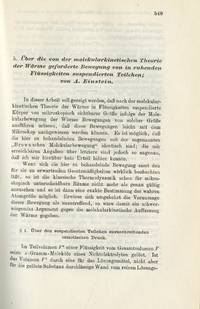
190532820546<p>FIRST EDITION. "On the Movement of Small Particles Suspended in a Stationary Liquid Demanded by the Molecular Kinetic Theory of Heat" appears here on pp. 549-560. This landmark paper on Brownian motion is one of the three great papers from 1905 Einstein <i>annus mirabilis</i>.</p><p>Although most physicists and chemists accepted the idea of atoms as a useful concept in 1905 many still questioned whether they actually existed. Einstein later claimed that "my major aim in this research was to find facts which would guarantee as much as possible the existence of atoms of finite size."</p><p>In 1827 botanist Robert Brown had used a microscope to look at dust grains floating in water. He found that the floating grains were moving about erratically a phenomenon that became known as "Brownian motion." In this paper Einstein proved the reality of these molecules and their motions by producing the first statistical physics analysis of Brownian motion. French physicist Jean Perrin used Einstein's results to experimentally determine the mass and the dimensions of atoms thereby conclusively verifying Dalton's atomic theory first proposed in 1808.</p><p>"Eventually the experimental evidence supporting Einstein's theory of Brownian motion became so compelling that the naysayers were forced to accept the existence of material atoms. His fundamental work on applying statistical methods to the random motions of Newtonian atoms also led to his insights into the photo electric effect through the discovery of a critical connection between his statistical theory of heat and the behavior of electromagnetic radiation. This was the first step in his goal to unify the two fields" APS.</p><br /><p>Complete issue removed from bound volume. Very good.</p>
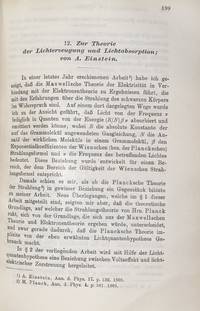
190632820369<p>Contemporary half dark green roan. Rubbed some chipping separation at upper joint. Library markings.</p><p>FIRST EDITION of "On the Theory of Light Production and Light Absorption" pp. 199-206. This classic in the history of physics is Einstein's second paper on the photoelectric effect. Einstein reconciles his and Planck's independent derivations of the blackbody formula E=hν. Planck's derivation of this formula ascribed it to a restriction on the energy changes possible when radiation is produced or absorbed by matter which implied no restriction on the energies of either matter or radiation. Einstein's 1905 derivation ascribed it to a restriction on the energy of radiation alone but in this paper he proposes the modern idea that the energies of both matter and radiation are quantized which led to his work on quantum specific heats.</p><p>and</p><p>FIRST EDITION of "The Principle of Conservation of Motion of the Center of Gravity and the Inertia of Energy" pp. 627-633. In this "ingenious thought experiment involving energy transport in a hollow cylinder Einstein returned to the relationship between inertial mass and energy giving more general arguments for their complete equivalence" Calaprice The Einstein Almanac. This is the first statement that the conservation of mass is a special case of the conservation of energy.</p><br /> Annalen der Physik
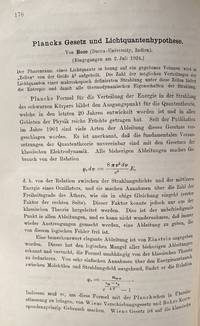
192432820524<p>FIRST EDITION of this classic in the history of quantum mechanics "Planck's Law and Light Quantum Hypothesis" pp. 178-181 in vol. 26.</p><p>Bose sent this paper to Einstein who translated it into German for this initial publication with the comment "In my opinion Bose's derivation of the Planck formula signifies an important advance." In this paper he "succeeded in deriving the Planck blackbody radiation law without reference to classical electrodynamics. Einstein's generalization of Bose's method led to the first of two systems of quantum statistical mechanics known as the Bose-Einstein statistics. Paul Dirac later coined the term 'boson' for particles that obey these statistics" DSB. </p><p>"With their work Bose and Einstein established the field of quantum statistics one year before the appearance of quantum mechanics" Brandt <i>The Harvest of a Century</i></p><p>This volume also contains three papers by Werner Heisenberg.</p>Complete vols. 25-26. Contemporary half calf. Near fine without any library markings.
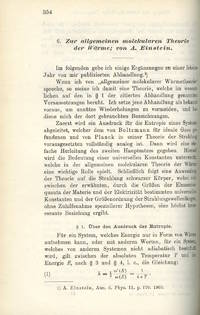
190432820371<p>Brown buckram. Library markings.</p><p>FIRST EDITION of Einstein's fifth published paper "On the General Molecular Theory of Heat" pp. 354-362.</p><br /> Annalen der Physik
193028376Berlin, Gruyter & Co., 1930. 4to. Orig. printed orange wrappers. Offprint/Sonderausgabe aus Sitzungsberichten...pp. (1)-13. Fine fresh copy.
193037422Berlin: Akad. Wiss 1930. Weil 170. Offprint from S. preuss. Akad. Wiss. Akad. Wiss unknown books
193038646Berlin, Akademie der Wissenschaften, 1930. 4to. Orig. printed green wrapper. No VI, 1930 of Sitzungsberichte der Preussische Akademie der Wissenschaften. Wrappers with very small nicks atspine. Small part of one corner gone. pp. 110-120. A small stamp at foot of frontwrapper.
1930270851930. S.Ber. Akad. Wiss. Berl. 1930/ 6. - Berlin Verlag der Akademie der Wissenschaften 1930 8° 13 S. orig. Broschur. First Edtion; the rare off-print from the "Sitzungsberichte". Weil No. 170; Schilpp-Shields No.240; Alicke No. 144 unknown