1 506 résultats
193028376Berlin Gruyter & Co. 1930. 4to. Orig. printed orange wrappers. Offprint/Sonderausgabe aus Sitzungsberichten.pp. 1-13. Fine fresh copy. <br/><br/><em>First edition in the rare Offprint with its separate printed title and separate pagination. Se Weil No. 170 not mentioning this.The early Offprints from "Sitzungsberichten." are called "Sonderabdruck" up to Weil No.165 including this. From Weil 166 they are called "Sonderausgabe.". - Before 161 up to 160 the Offprints do not have separate title and pagination the pagination follows the numbering in the periodical. From 166 the Offprint has both separate printed title and pagination. - So Weil Nos 161-165 is still "Abdruck" but with separate title and pagination. These facts are not mentioned in the bibliographies. </em> unknown
193038646Berlin Akademie der Wissenschaften 1930. 4to. Orig. printed green wrapper. No VI 1930 of Sitzungsberichte der Preussische Akademie der Wissenschaften. Wrappers with very small nicks atspine. Small part of one corner gone. pp. 110-120. A small stamp at foot of frontwrapper. <br/><br/><em>First edition in the periodical form. - Weil No. 170 </em> unknown
193037422Berlin: Akad. Wiss 1930. Weil 170. Offprint from S. preuss. Akad. Wiss. Akad. Wiss unknown
1930433141930. Offprint from Sitzungsberichte der preussischen Akademie der Wissenschaften 1930. Single sheet pp. 1-2. 256 x 184 mm. Upper edge a bit creased light toning but very good. First edition offprint issue. One of Einstein's last papers on Riemann metrics and distant parallelism written the year before he abandonded this approach to constructing a unified field theory. Pais Subtle is the Lord p. 347. Weil Albert Einstein Bibliography 173. unknown books
192449431Berlin, Springer, 1924. 8vo. Bound in contemporary half cloth. In ""Zeitschrift für Physik"", Bd. 27. Entire volume offered. Stamp to front free end paper. Fine and clean. [Einstein:] Pp. 1-6" P. 392. [Bose:] P. 392. [Entire volume: IV, 395, (1) pp].
192228358Berlin, Gruyter & Co., 1922. 4to. Orig.printed orange wrappers. Offprint/Sonderabdruck aus Sitzungsberichten... pp. 18-22. Fine fresh copy.
1922374051922. unknown books
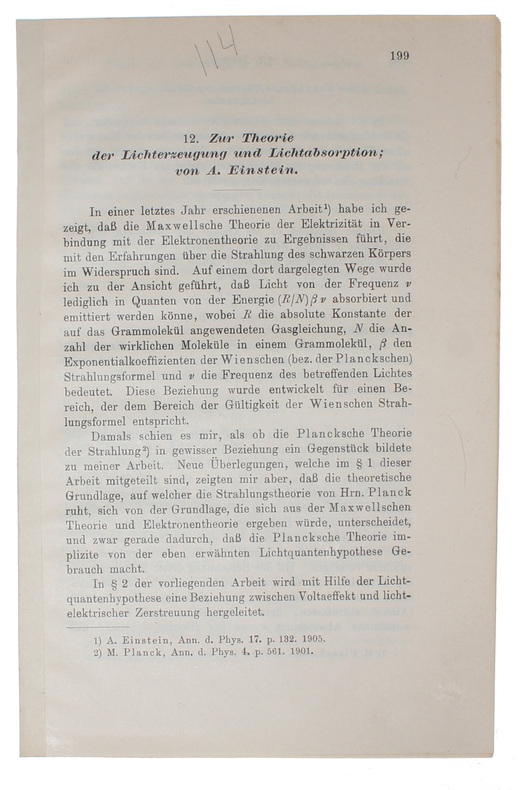
190646956(Leipzig, Johann Ambrosius Barth, 1906). No wrappers. Extracted from ""Annalen der Physik"" Vierte Folge. Bd. 20. Pp. 199-206. Clean and fine.
190659121Leipzig, Johann Ambrosius Barth, 1906. Full cloth. Spine with gilt lettering. In: ""Annalen der Physik. Vierte Folge. Band 20. Herausgegeben von Paul Drude."" , Portrait (Paul Drude), VIII,1048 pp. and 6 plates. Einstein papers: pp. 199-206 and 627-33. Internally fine and clean. The entire volume offered. Broad margins.
190638794Leipzig, Johann Ambrosius Barth, 1906. Bound together in one contemp. hcloth. Small tears to spine ends. (=) ""Annalen der Physik. Vierte Folge. Band 20. Herausgegeben von Paul Drude."" , Portrait (Paul Drude), VIII,1048 pp. and 6 plates. Einstein papers: pp. 199-206 and 627-33. Internally fine and clean. The whole volume offered.
190646962Leipzig, Johann Ambrosius Barth, 1906. Bound together in one contemp. halfcalf. Spine gilt. Minor scratches to spine. A stamp to titlepage and htitle. ""Annalen der Physik. Vierte Folge. Band 20. Herausgegeben von Paul Drude."" , Portrait (Paul Drude), VIII,1048 pp. and 6 plates. Einstein papers: pp. 199-206 and 627-33. The entire volume offered.
1906602Leipzig: Barth 1906. 1st Edition. Hardcover. Fine. FIRST EDITION of two important Einstein papers including one of the two papers on his Noble Prize winning work on the photoelectric effect. On the Theory of Light Production and Light Absorption: A continuation and development of Einstein's revolutionary first paper in 1905 on the photoelectric effect "On a Heuristic Point of View about the Creation and Conversion of Light". "In a companion paper to "On a Heuristic Point." published in 1906 Einstein exposed appeal to the quantum as fundamentally counter to the ethos of classical physics: 'the theoretical bases on which Planck's radiation theory rests are different from those of Maxwell's theory'. Planck had not initially intended to quantify light-radiation itself but Einstein demonstrated that his own 'light-quantum hypothesis' was implicit in Planck's earlier work. In viewing radiation not as a continuous wave but as composed of small packets of energy later called photons Einstein was again shaking the foundations of classical physics" Honner The Description of Nature 31. Particle Physics: One Hundred Years of Discoveries: "Corpuscular-wave dualism for photons. Explanation of the photoelectric effect using the quantum hypothesis of Planck. Nobel prize to A. Einstein awarded in 1921 'for services to Theoretical Physics and especially of he law of the photoelectric effect.'" Weil 12. The Principle of Conservation of Motion of the Center of Gravity and the Inertia of Energy: Einstein's further development of E=mc2. Einstein boldly uses his relationship to insist that the conservation of mass is a special case of the conservation of energy and broadens the law to include not only mechanical but electromagnetic processes as well. Weil 13. IN: Annalen der Physik Vol. 20 pp. 199-206; 627-633. Leipzig: Barth 1906. Octavo modern full green morocco. Rippling to the first few leaves of volume not affecting Einstein papers. Provenance: with library stamp on series title from the prestigious Gmelin Institute after 1996 part of the Max Planck Institute. Very handsomely bound. Barth hardcover books
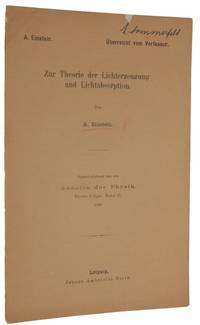
19066413Leipzig: Johann Ambrosius Barth 1906. First edition. <p>First edition a very rare author's presentation offprint with 'Überreicht vom Verfasser' from the library of the eminent German physicist Arnold Sommerfeld of this important sequel to Einstein's revolutionary 1905 paper introducing the light-quantum hypothesis</p> <p>- the foundation of quantum theory. In this follow- up work Einstein further develops the implications of his light-quantum hypothesis arguing that Max Planck's black-body radiation law implicitly relies on the same assumption: that light itself consists of discrete quanta of energy.</p>. <p>EINSTEIN ON HIS LIGHT-QUANTUM HYPOTHESIS</p> . <p>First edition very rare author's presentation offprint "Überreicht vom Verfasser" from the library of the great German physicist Arnold Sommerfeld of this brilliant follow-up to Einstein's landmark 1905 paper on the photoelectric effect for which he was awarded the 1921 Nobel Prize in physics. "Thomas Kuhn has argued that it is not to Planck in 1900 but to Einstein in 1905 that we owe the origins of quantum theory" Cassidy. In the 1905 paper 'On a heuristic point of view concerning the production and transformation of light' Einstein had explained the photoelectric effect-the emission of electrons from a metal when irradiated by light-by making the revolutionary proposal that light rather than consisting of continuous waves was instead made up of discrete particles of energy "light quanta" which transferred their entire payload of energy to an electron on impact. In the 1905 paper Einstein made use of Planck's formula for blackbody radiation which had introduced the concept of energy quantization. "In a companion paper published in 1906 offered here Einstein exposed appeal to the quantum as fundamentally counter to the ethos of classical physics: 'the theoretical bases on which Planck's radiation theory rests are different from those of Maxwell's theory'. Planck had not initially intended to quantify light-radiation itself but Einstein demonstrated that his own 'light-quantum hypothesis' was implicit in Planck's earlier work" Honner p. 31. "At first Einstein believed that the light-quantum hypothesis was merely 'heuristic': light behaved only as if it consisted of discontinuous quanta . In his 1906 paper Einstein used his statistical mechanics to demonstrate that when light interacts with matter Planck's entire formula can arise only from the existence of light quanta-not from waves" Cassidy. As Einstein stated when he published the 1905 paper "Planck's theory of radiation seemed to me in a certain respect the antithesis of my own. New considerations which are presented in section 1 of this paper demonstrated to me however that the theoretical bases on which Planck's radiation theory rests are different from those of Maxwell's theory and of electron theory. The difference furthermore is precisely that Planck's theory implicitly makes use of the light-quantum hypothesis" p. 199 of the present paper translation from Kuhn p. 182. Later in the paper p. 203 Einstein is forced to make the following assumption: "Although Maxwell's theory is not applicable to elementary resonators the average energy of such a resonator in a radiation field is the same as that which one would compute from Maxwell's theory". "That statement marks the emergence of the basic paradox of the old quantum theory. The theory has recourse to both Maxwell's equations and those of classical mechanics but its further formulation is incompatible with one or both of those classical theories. Other physicists were to exploit the resulting inconsistency as an argument against any form of quantum discontinuity and Einstein himself was deeply disturbed by it . But neither he nor anyone else was successful in finding a classical resolution of the quantum paradox. When two decades later Bohr and others found a way to resolve it Einstein was unable to accept their fundamentally non-classical interpretation" Kuhn pp. 184-185. RBH lists 4 other copies: in the offprint collections of Einstein himself Christie's June 17 2008 lot 100 Richard Green Christie's June 17 2008 lot 101 Hans Albert Einstein Christie's June 14 2006 lot 264 and Harvey Plotnick Christie's October 4 2002 lot 105. This copy was presented by Einstein to one of the leading physicists of the time surely hoping to make himself known in the scientific world when he was still a technical expert in the Swiss Patent Office.</p> <br /> <p>Provenance: Arnold Sommerfeld 1868-1951 his signature and characteristic numbering in red pencil '8' on front cover. "The son of a physician Sommerfeld was educated at the University of Königsberg. After teaching briefly at the universities of Göttingen Clausthal and Aachen he was appointed professor of physics at the University of Münich in 1906. Sommerfeld should have retired in 1936 in favour of his pupil Werner Heisenberg. Opposition from the Nazi party to Heisenberg's appointment prolonged Sommerfeld's tenure and it was not in fact until late 1939 that he finally retired to be succeeded not by Heisenberg but by Wilhelm Müller a Nazi aerodynamicist without a single publication in physics to his credit. Although Sommerfeld and Heisenberg were not Jewish they were regarded by the Nazis as Jewish sympathizers. Sommerfeld however survived the war and returned to his Münich chair in 1945 continuing to work at physics until he died in a car accident in 1951" Oxford Reference. "Arnold Sommerfeld was one of the most distinguished representatives of the transition period between classical and modern theoretical physics. The work of his youth was still firmly anchored in the conceptions of the nineteenth century; but when in the first decennium of the century the flood of new discoveries experimental and theoretical broke the dams of tradition he became a leader of the new movement and in combining the two ways of thinking he exerted a powerful influence on the younger generation. This combination of a classical mind to whom clarity of conception and mathematical rigour are essential with the adventurous spirit of a pioneer are the roots of his scientific success while his exceptional gift of communicating his ideas by spoken and written word made him a great teacher" Max Born p. 275. </p> <br /> <p>"Einstein started to study black-body radiation well before 1905. Mach's Wärmelehre which Einstein read in 1897 or shortly thereafter contains two chapters on thermal radiation culminating in a discussion of Kirchhoff's work. Kirchhoff showed that the energy emission spectrum of a perfectly black body defined as one absorbing all incident radiation at a given temperature is a universal function of the temperature and wavelength. He inferred that equilibrium thermal radiation in a cavity with walls maintained at a certain temperature behaves like radiation emitted by a black body at the same temperature. </p> <br /> <p>"H. F. Weber Einstein's physics professor at the ETH attempted to determine the universal black-body radiation function. He made measurements of the energy spectrum and proposed an empirical formula for the distribution function . anticipating Wien's formulation of the displacement law for black-body radiation. Weber described his work in a course at the ETH given during the winter semester of 1898-1899 for which Einstein registered. </p> <br /> <p>"By March 1899 Einstein had started to think seriously about the problem of radiation. In the spring of 1901 he was closely following Planck's work on black-body radiation. Originally Planck had hoped to explain irreversibility by studying electromagnetic radiation but came to recognize that this could not be done without introducing statistical elements into the argument. In a series of papers published between 1897 and 1900 Planck utilized Maxwell's electrodynamics to develop a theory of thermal radiation in interaction with one or more identical charged harmonic oscillators within a cavity. He was only able to account for the irreversible approach to thermal equilibrium by employing methods analogous to those Boltzmann used in kinetic theory. Planck introduced the notion of 'natural' that is maximally disordered radiation which he defined in analogy with Boltzmann's definition of molecular chaos . </p> <br /> <p>"Planck calculated the average energy of an oscillator by making assumptions about the entropy of the oscillators that enabled him to derive Wien's law for the blackbody spectrum which originally seemed well supported by the experimental evidence. But by the turn of the century new observations showed systematic deviations from Wien's law for large values of temperature. </p> <br /> <p>"Planck in 1900 presented a new energy density distribution formula that agreed closely with observations over the entire spectrum . this expression now known as Planck's law or Planck's formula involves a new constant h later called Planck's constant. To derive this formula Planck calculated the entropy of the oscillators using what Einstein later called 'the Boltzmann principle': S = k log W where S is the entropy of a macroscopic state of the system the probability of which is W and k is 'Boltzmann's constant'. Following Boltzmann Planck took W proportional to the number of 'complexions' or possible microconfigurations of the system corresponding to its state. He calculated this number by dividing the total energy of the state into a finite number of elements of equal magnitude and counting the number of possible ways of distributing these energy elements among the individual oscillators. If the size of the energy elements is set equal to hv where v is the frequency of the oscillators an expression for the entropy of an oscillator results that leads to Planck's formula .</p> <br /> <p>"In the 1905 paper Einstein showed that the expression for the volume dependence of the entropy of radiation at a given frequency is similar in form to that of the entropy of an ideal gas. He concluded that 'monochromatic radiation of low density behaves thermodynamically as though it consisted of quanta of energy which are independent of one another' . Einstein opened the paper by pointing out the 'fundamental formal distinction' between current theories of matter in which the energy of a body is represented as a sum over a finite number of degrees of freedom and Maxwell's theory in which the energy is a continuous spatial function having an infinite number of degrees of freedom. He suggested that the inability of Maxwell's theory to give an adequate account of radiation might be remedied by a theory in which radiant energy is distributed discontinuously in space. Einstein formulated 'the light quantum hypothesis' that the energy of a light ray emitted from a point is not continuously distributed over an ever increasing space but consists of a finite number of energy quanta which are localized at points in space which move without dividing and which can only be produced and absorbed as complete units . Einstein asserted that Planck's derivation implicitly assumes quantization of the energies of charged oscillators" Papers pp. 134-142.</p> <br /> <p>"In 1905 Einstein could not make sense of Planck's derivation of Planck's law. In fact he seems to have deliberately avoided any reference to Planck's law in his reasoning . The following year Einstein ceased to avoid Planck's law as he discovered a new way to justify Planck's formal steps toward this law. If a resonator of frequency ν can only emit or absorb full light quanta Einstein reasoned then its energy can only be an integral multiple of hν and Planck's characterization of the complexions for a set of resonators receives a dynamical justification. The only remaining difficulty is that Planck's derivation of the relation between the average energy of a resonator and the spectral density of radiation becomes void. Einstein expressed the need of a new derivation based on some quantized dynamics for the interaction between matter and radiation. Ten years elapsed however before he filled the gap" Janssen & Lehner p. 126. </p> <br /> <p>In the final section of this paper Einstein gives a new application of his 'heuristic principle' to the explanation of the 'Volta effect' - that when two different metals are placed in contact a potential difference between them is observed.</p> <br /> <p>BRL 12; Weil 12. Shields "Writings of Albert Einstein" in Albert Einstein: Philosopher-Scientist 1948 pp. 689-758 no. 13; also included in Shields' "Chronological list of principal works" on p. 757. The Cambridge Companion to Einstein Janssen & Lehner eds. 2014. The Collected Papers of Albert Einstein Vol. 2: The Swiss Years: Writings 1900-1909. Born 'Arnold Johannes Wilhelm Sommerfeld 1868-1951' Obituary Notices of Fellows of the Royal Society 8 1952 pp. 275-296.</p> <br /> <p>Cassidy "Einstein on the Photoelectric Effect." Einstein: Image and Impact. American Institute of Physics n.d. Honner The Description of Nature 1988. Kuhn Black-Body Theory and the Quantum Discontinuity 1894-1912 1978. Pais Subtle is the Lord 1982.</p> <br/> <br/> 8vo 222 x 144 mm pp. 199-206. Original printed wrappers small chip from upper edge of front wrapper. Johann Ambrosius Barth unknown
190659121Leipzig Johann Ambrosius Barth 1906. Full cloth. Spine with gilt lettering. In: "Annalen der Physik. Vierte Folge. Band 20. Herausgegeben von Paul Drude." Portrait Paul Drude VIII1048 pp. and 6 plates. Einstein papers: pp. 199-206 and 627-33. Internally fine and clean. The entire volume offered. Broad margins. <br/><br/><em>Both papers first edition. It was for the papers "Ueber einen die Erzeugung und Verwandlung des Lichtes betreffenden heuristischen Gesichtspunkt" of 1905 and "Zur Theorie der Lichterzeugung. Theory of light emission and absorption the offered item that Einstein was awarded the Nobel Prize in 1921. "The quantum theory has affected virtually every branch of physics. Its earliest and one of its most significant developments was Einstein's application of the theory to what is known as the 'photo-electrical effect'.Einstein explained this effext by suggesting that the classical view that light is emitted in the form of continous waves must be abandoned. The photo-electrical effect could be explained only as an example of quantum action where the waves of light or X-rays are emitted in minute particles or bullets. It is he size of the bullet the wave-lenght of the radiation which determines the number of electrons ejected. It was for this and not for the theory of relativity that Einstein was awarded the Nobel Prize in 1921. Einstein's two fundamental papers on this subject are "Ueber einem Erzeugung." 1905 and Zur Theorie der Lichterzeugung the paper offered here" PMM the note to 391. In the second paper Principle of the conservation of the centre of mass motion and the inertia of energy he shows that the conservation of mass is a special application of his energy principle E= Mc2 - Weil: 12 & 13.Among the many papers in this volume we have Max von Laue: Zur Thermodynamik der Inteferenzerscheinungen. pp. 365-378. </em> hardcover
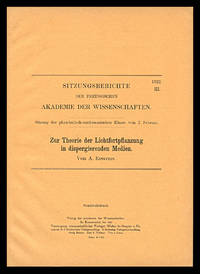
19221648Berlin: Verlag der Akademie der Wissenschaften 1922. 1st Edition. FIRST EDITION COMMERCIAL OFFPRINT ISSUE OF EINSTEIN'S THEORY OF THE LIGHT PROPAGATION IN DISPERSIVE MEDIA. WEIL 120. <br /> <br /> "After 1917 Einstein firmly believed that light-quanta were here to stay thus it is not surprising that he would look for new ways in which the existence of photons might lead to observable deviation from the classical picture. In this he did not succeed. At one point in 1921 he thought he had found a new quantum criterion but it soon turned out to be a false lead as demonstrated in this paper" Schilpp-Shields 162. <br /> <br /> That paper — the one offered here — is Einstein's evidence that his 1921 efforts were incorrect. In it Einstein introduces a calculation on the topic and explains why his earlier proposed experiment had not been well considered because it could not predict a good choice between two theoretical alternatives" Calaprice Einstein Encyclopedia 98. CONDITION & DETAILS: Berlin: Koniglich Akademie der Wissenschaften. Commercial offprint from Sitzungsberichte der Koniglich preussischen Akademie der Wissenschaften III 1916 pp. 18-22. Octavo 252 x 179 mm. Original printed wrappers. Pristine inside and out. Fine. Verlag der Akademie der Wissenschaften unknown
1930433141930. Offprint from Sitzungsberichte der preussischen Akademie der Wissenschaften 1930. Single sheet pp. 1-2. 256 x 184 mm. Upper edge a bit creased light toning but very good. First edition offprint issue. One of Einstein's last papers on Riemann metrics and distant parallelism written the year before he abandonded this approach to constructing a unified field theory. Pais Subtle is the Lord p. 347. Weil Albert Einstein Bibliography 173. unknown
192449431Berlin Springer 1924. 8vo. Bound in contemporary half cloth. In "Zeitschrift für Physik" Bd. 27. Entire volume offered. Stamp to front free end paper. Fine and clean. Einstein: Pp. 1-6; P. 392. Bose: P. 392. Entire volume: IV 395 1 pp. <br/><br/><em>First appearance of Einstein's paper on statistical mechanics and the physics of radiometers. Weil 139 143a </em> hardcover
190638794Leipzig Johann Ambrosius Barth 1906. Bound together in one contemp. hcloth. Small tears to spine ends. = "Annalen der Physik. Vierte Folge. Band 20. Herausgegeben von Paul Drude." Portrait Paul Drude VIII1048 pp. and 6 plates. Einstein papers: pp. 199-206 and 627-33. Internally fine and clean. The whole volume offered. <br/><br/><em>Both papers first edition. It was for the papers "Ueber einen die Erzeugung und Verwandlung des Lichtes betreffenden heuristischen Gesichtspunkt" of 1905 and "Zur Theorie der Lichterzeugung. Theory of light emission and absorption the offered item that Einstein was awarded the Nobel Prize in 1921."The quantum theory has affected virtually every branch of physics. Its earliest and one of its most significant developments was Einstein's application of the theory to what is known as the 'photo-electrical effect'.Einstein explained this effext by suggesting that the classical view that light is emitted in the form of continous waves must be abandoned. The photo-electrical effect could be explained only as an example of quantum action where the waves of light or X-rays are emitted in minute particles or bullets. It is he size of the bullet the wave-lenght of the radiation which determines the number of electrons ejected. It was for this and not for the theory of relativity that Einstein was awarded the Nobel Prize in 1921. Einstein's two fundamental papers on this subject are "Ueber einem Erzeugung." 1905 and Zur Theorie der Lichterzeugung the paper offered here" PMM the note to 391. In the second paper Principle of the conservation of the centre of mass motion and the inertia of energy he shows that the conservation of mass is a special application of his energy principle E= Mc2 - Weil: 12 & 13.Among the many papers in this volume we have Max von Laue: Zur Thermodynamik der Inteferenzerscheinungen. pp. 365-378. </em> hardcover
190646956Leipzig Johann Ambrosius Barth 1906. No wrappers. Extracted from "Annalen der Physik" Vierte Folge. Bd. 20. Pp. 199-206. Clean and fine. <br/><br/><em>First printing of one of the papers for which Einstein was awarded the Nobel Prize in 1921. It was for the papers "Ueber einen die Erzeugung und Verwandlung des Lichtes betreffenden heuristischen Gesichtspunkt" of 1905 and "Zur Theorie der Lichterzeugung. Theory of light emission and absorption the offered item that Einstein received the prize: "for his services to theoretical physics and especially for his discoveryof the law of the photoelectrical effect" - his reward was not based on relativity."The quantum theory has affected virtually every branch of physics. Its earliest and one of its most significant developments was Einstein's application of the theory to what is known as the 'photo-electrical effect'.Einstein explained this effext by suggesting that the classical view that light is emitted in the form of continous waves must be abandoned. The photo-electrical effect could be explained only as an example of quantum action where the waves of light or X-rays are emitted in minute particles or bullets. It is he size of the bullet the wave-lenght of the radiation which determines the number of electrons ejected. It was for this and not for the theory of relativity that Einstein was awarded the Nobel Prize in 1921. Einstein's two fundamental papers on this subject are "Ueber einem Erzeugung." 1905 and Zur Theorie der Lichterzeugung the paper offered here" PMM the note to 391.Weil: 12 with an asterix denoting a major paper - Boni:12. </em> unknown
190646962Leipzig Johann Ambrosius Barth 1906. Bound together in one contemp. halfcalf. Spine gilt. Minor scratches to spine. A stamp to titlepage and htitle. "Annalen der Physik. Vierte Folge. Band 20. Herausgegeben von Paul Drude." Portrait Paul Drude VIII1048 pp. and 6 plates. Einstein papers: pp. 199-206 and 627-33. The entire volume offered. <br/><br/><em>Both papers first edition. It was for the papers "Ueber einen die Erzeugung und Verwandlung des Lichtes betreffenden heuristischen Gesichtspunkt" of 1905 and "Zur Theorie der Lichterzeugung. Theory of light emission and absorption the offered item that Einstein was awarded the Nobel Prize in 1921."The quantum theory has affected virtually every branch of physics. Its earliest and one of its most significant developments was Einstein's application of the theory to what is known as the 'photo-electrical effect'.Einstein explained this effext by suggesting that the classical view that light is emitted in the form of continous waves must be abandoned. The photo-electrical effect could be explained only as an example of quantum action where the waves of light or X-rays are emitted in minute particles or bullets. It is he size of the bullet the wave-lenght of the radiation which determines the number of electrons ejected. It was for this and not for the theory of relativity that Einstein was awarded the Nobel Prize in 1921. Einstein's two fundamental papers on this subject are "Ueber einem Erzeugung." 1905 and Zur Theorie der Lichterzeugung the paper offered here" PMM the note to 391. In the second paper Principle of the conservation of the centre of mass motion and the inertia of energy he shows that the conservation of mass is a special application of his energy principle E= Mc2 - Weil: 12 & 13.Among the many papers in this volume we have Max von Laue: Zur Thermodynamik der Inteferenzerscheinungen. pp. 365-378. </em> unknown
192228358Berlin Gruyter & Co. 1922. 4to. Orig.printed orange wrappers. Offprint/Sonderabdruck aus Sitzungsberichten. pp. 18-22. Fine fresh copy. <br/><br/><em>First edition in the rare Offprint still called "Abdruck". - Weil No. 120.The early Offprints from "Sitzungsberichten." are called "Sonderabdruck" up to Weil No.165 including this. From Weil 166 they are called "Sonderausgabe.". - Before 161 up to 160 the Offprints do not have separate title and pagination the pagination follows the numbering in the periodical. From 166 the Offprint has both separate printed title and pagination. - So Weil Nos 161-165 is still "Abdruck" but with separate title and pagination. These facts are not mentioned in the bibliographies. </em> unknown
1906292Leipzig: Barth 1906. 1st Edition. FIRST EDITION FIRST ISSUE of two important 1906 Einstein papers. Einstein wrote two papers on the photoelectric effect his revolutionary 1905 paper and "Zur Theorie der Lichterzeugung und Lichtabsorption" his continuation of it. In them Einstein employed Planck's theory that luminous energy can be absorbed or emitted only in discrete amounts called quanta and proposed a theory of light quanta involving particles with no mass photons whose energy depended on frequency. All of Einstein's experimental results confirmed that light actually consisted of discrete energy packets. <br /> <br /> "Based on this theory Einstein wrote an equation describing how the photoelectric effect works. The energy of individual electrons emitted by a photocell is a function of the frequency of the light hitting the photocell and the rate of electron emission is a function of the light source's intensity number of photons with sufficient energy being emitted. This is contrary to what is predicted by classical physics" History of Physics: The Wenner Collection. <br /> <br /> In this Einstein's second paper on photoelectrics he revisited Planck's theory and from it developed his ideas to show that an electromagnetic wave such as light could be described as a particle photon with discrete quanta of energy that was dependent on its frequency. In the long history of quantum mechanics this would lead to a theory of unity between subatomic particles and electromagnetic waves called wave-particle duality in which particles and waves were neither one nor the other but had certain properties of both. <br /> <br /> At first Einstein believed that light-quantum hypothesis was merely 'heuristic': that it behaved only as if it consisted of discontinuous quanta. But in this paper and others to follow Einstein used his statistical mechanics to demonstrate that when light interacts with matter Planck's entire formula can arise only from the existence of light quanta -- not from waves. In other words in explaining the photoelectric effect by extending Planck's concept of quantum of energy had Einstein "demonstrated that his own 'light-quantum hypothesis' was implicit in Planck's earlier work" Honner The Description of Nature 31. <br /> <br /> ALSO included in this volume is "Daz Prinzip von der Erhaltung." The Principle of Conservation of Motion of the Center of Gravity and the Inertia of Energy. In this "ingenious thought experiment involving energy transport in a hollow cylinder Einstein returned to the relationship between inertial mass and energy giving more general arguments for their complete equivalence" Calaprice The Einstein Almanac 18. This was the first statement that the conservation of mass is a special case of the conservation of energy. CONDITION & DETAILS: Leipzig: Barth 1906. Octavo. 8.75 x 6 inches; 222 x 152mm. Ex-libris bearing minimal markings only a small stamp on the title page. Illustration: 6 plates and figures throughout. Entire volume in black cloth gilt-lettered at the spine. The cloth is a bit rubbed and scuffed and there is fading at the spine. Solidly and tightly bound. Bright and clean throughout. Barth hardcover
192232430Berlin: Sitzungsberichten der Preussischen Akademie der Wissenschaften 1922. First Thus. First Thus. Einstein Albert 1879-1955. Zur Theorie der Lichtfortpflanzung in dispergierenden Medien. Complete. Quarto. Offprint from Sitzungsberichten der Preussischen Akademie der Wissenschaften. Berlin: 1922. First edition in very fine condition. This superb offprint is a separate printing of the Prussian Academy's session reports here with independent pagination. A small number of such off prints were presented to the author by the publisher as voucher copies. References: Schilpp-Shields 162; Weil 120. This paper gives evidence that Einsteins ideas on the photon were not able to contradict classical theory. "Since after 1917 Einstein firmly believed that light-quanta were here to stay it is not surprising that he would look for new ways in which the existence of photons might lead to observable deviation from the classical picture. In this he did not succeed. At one point in 1921 he thought he had found a new quantum criterion but it soon turned out to be a false lead as demonstrated in this paper". An excellent example. "The early Offprints from "Sitzungsberichten." are called "Sonderabdruck" up to Weil No.165 including this. From Weil 166 they are called "Sonderausgabe.". - Before 161 up to 160 the Offprints do not have separate title and pagination the pagination follows the numbering in the periodical. From 166 the Offprint has both separate printed title and pagination. - So Weil Nos 161-165 is still "Abdruck" but with separate title and pagination. Sitzungsberichten der Preussischen Akademie der Wissenschaften unknown
1923432881923. <p>Einstein Albert 1879-1955 and Paul Ehrenfest 1880-1933. Zur Quantentheorie des Strahlungsgleichgewichts. Offprint from Zeitschrift für Physik 19 1923. 301-306pp. Original printed self-wrappers. 230 x 157 mm. Light toning but very good.</p> <p>First Edition Offprint Issue. In 1916 after publishing his great work on general relativity Einstein returned to the question of blackbody radiation. In November 1916 he wrote to his friend Besso that "a splendid light has dawned on me about the absorption and emission of radiation" quoted in Pais p. 405 one that led him to a new derivation of Planck's radiation law and convinced him of the reality of light-quanta photons. After publishing these results in three papers culminating with the famous "Zur Quantentheorie der Strahlung" 1917 Einstein kept looking for "new ways in which the existence of photons might lead to observable derivations from the classical picture" Pais p. 413. He found none until 1923 when Arthur Compton and Peter Debye independently derived the relativistic kinematics for the scattering of a photon off an electron at rest. The work of Compton and Debye led Wolfgang Pauli to extend Einstein's work of 1917 to the case of radiation in equilibrium with free electrons see Pais p. 414n. "Pauli examined the requirements of detailed balance under Lorentz transformations and found that scattering of light by free electrons must include a term of a form which we would now call stimulated emission . . . Einstein and Ehrenfest then showed that Pauli's results could be obtained by an extension of Einstein's 1917 paper with the unnecessary specialization to discrete energy levels removed . . . The core of Einstein's argument is that the scattering process should be broken into two parts: the absorption of energy from radiation of frequency 1 and the emission of energy as radiation of frequency 2" Lewis p. 42. Lewis "Einstein's derivation of Planck's radiation law" American Journal of Physics 41 1973: 38-44. Pais Subtle is the Lord ch. 21. Weil Albert Einstein Bibliography 138.</p> . unknown books