98 831 résultats
153139416Roma, Apud Antonium Bladum Asulanum (on colophon), 1531, mense Septembri. 4to. Sown, uncut and unbound. Title-page and a few other leaves with a bit of minor brownspotting" overall a very nice and well-preserved copy of this beautifully printed, extremely scarce work. Two quires with loose leaves. Floriated large initial at beginning. [32] ff. (being title-page, 29 ff. text, 1 f. errata, 1 f. blank).
Københaffn, (Hans Vingaard), 1557. 4to. Indbundet samlet i et senere enkelt hldrbd. fra omkr. 1850. Med brugsspor men repareret. Ad. 1: Titelblad trykt i sort/rød med sammensat træskåren ramme. (8),160,(1) blade - 2. Titelblad med træskåren ramme. (3),48 blade. - 3. Titelblad med træskåren ramme. (4),32,(12) blade (heraf de sidste 12 blade Apoteckerfortegnelsen). - 4. Titelblad med sammensat træskåren ramme. (7),20 blade. - 5. Titelblad med træskåren ramme. (5),10,(1) blade. Gennemgående i god stand, men her og der med brunpletter, brugspletter særligt på de første blade. Nogle af trykkene har et blankt blad til slut, disse er ikke tilstede i samlingen.
Roma, Apud Antonium Bladum Asulanum (on colophon), 1531, mense Septembri. 4to. Sown, uncut and unbound. Title-page and a few other leaves with a bit of minor brownspotting " overall a very nice and well-preserved copy of this beautifully printed, extremely scarce work. Two quires with loose leaves. Floriated large initial at beginning. [32] ff. (being title-page, 29 ff. text, 1 f. errata, 1 f. blank).
180330335BB2 Teile in 1 Band. Leipzig, Heinrich Gräff, 1803. Gross-Folio. 7 n.n. Bl., 216 S., 24 n.n. Bl. Mit gestochener Titelvignette, 2 Anfangsvignetten, 46 gestochenen Kupfertafeln und 21 Vignetten im Text. Halblederband um 1840 mit rotem, goldgeprägtem Rückenschild und wenig Rückenvergoldung.
180330335BBLeipzig, Heinrich Gräff, 1803. Gross-Folio. 7 n.n. Bl., 216 S., 24 n.n. Bl. Mit gestochener Titelvignette, 2 Anfangsvignetten, 46 gestochenen Kupfertafeln und 21 Vignetten im Text. Halblederband um 1840 mit rotem, goldgeprägtem Rückenschild und wenig Rückenvergoldung. 2 Teile in 1 Band.
Oblong 4to (264 x 195 mm). 14 leaves with 10 pen-and-ink maps, hand coloured with watercolours. Tissue guards. Full giltstamped cloth binding with tughra of Mehmed V (ruled 1908-18) on upper and "Album" on lower cover. A hand-drawn album of maps showing the western parts of the Ottoman Empire, with legends in Ottoman Turkish. Maps include northern Greece (from Macedonia to Constantinople), the Bosporus, the Dardanelles, Halkidiki, Albania, Crete, etc. - Finely preserved.
600:445 mm (Plattenrand), Blattmaß 668:507 mm. Ferdinand Schmutzers ikonisches Freud-Portrait mit eh. Widmung und U. für "Herrn Dr. J. J. van der Leeuw zur freundlichen Erinnerung an | Sigm. Freud | 1933/34". - Über Schmutzers Portrait schrieb Freud 1926 in einem Brief an Marie Bonaparte: "Zum Geburtstag ist eine Radierung von Schmutzer fertig geworden, die mir ausgezeichnet scheint. Andere finden ihren Ausdruck zu streng, fast böse. Wahrscheinlich bin ich innerlich so" (10. V. 1926). - Der niederländische Theosoph und Autor Jacobus Johannes (J. J.) van der Leeuw war im Jahr 1933 mehrmals bei Freud in Behandlung gewesen. Für Freud war er der "Fliegende Holländer", da er 1933 den Flugschein erworben hatte und ein begeisterter Flieger war. Am 23. August 1934 fand Leeuws Begeisterung jedoch ein jähes Ende, als er am Rückflug von einer Konferenz in Johannesburg über Tansania abstürzte und ums Leben kam. - Provenienz: Aus dem Nachlass Ferdinand Schmutzers (so in Bleistift am rechten unteren Rand bezeichnet), später im Besitz des Psychoanalytikers und Bibliophilen Haskell Field Norman (1915-1996), zuletzt in belgischem Privatbesitz und von dort erworben. - Von unbedeutenden Kleinigkeiten am Plattenrand abgesehen ausgezeichnet erhalten. Vgl. Stanford 78 & 80. Norman 170 & 171 (andere Exemplare). Sigmund Freud, Briefe 1873-1939. Ausgewählt und herausgegeben von Ernst und Lucie Freud. 3. korr. Auflage (Frankfurt a. M., S. Fischer Verlag, 1980), S. 384.
8vo. 16 pp. No wrappers, stored in marbled half calf folder. Inscribed by the author. First printing of this important early Freud work, an offprint from the "Neurologisches Centralblatt" (1895.2). Inscribed by the author on the first page: "Hommage de l'auteur". - "Freud's first independent entry into the field of psychopathology. Having recognized the etiological link between hysterical symptoms and earlier traumatic sexual experiences, Freud was curious as to what part sexual-etiological factors played in the other forms of neurosis, then loosely grouped together under Beard's overly broad category of 'neurasthenia'. Defining a closely related group of symptoms under the term 'anxiety neurosis', Freud proposed detaching this symptom complex from neurasthenia. He also described the sexual etiologies of both genuine neurasthenia (inadequate relief of sexual tension) and anxiety neurosis (no relief from an unbearable amount of sexual excitement)" (Norman). - Some light staining and browning with insignificant edge flaws. Provenance: from the collection of the psychoanalyst and bibliophile Haskell Field Norman (1915-96) with his bookplate on the lower inside cover of the half calf folder; acquired from a Belgian private collection. Meyer-Palmedo/Fichtner 1895b. Grinstein 39. Stanford 20. Norman F31 (this copy).
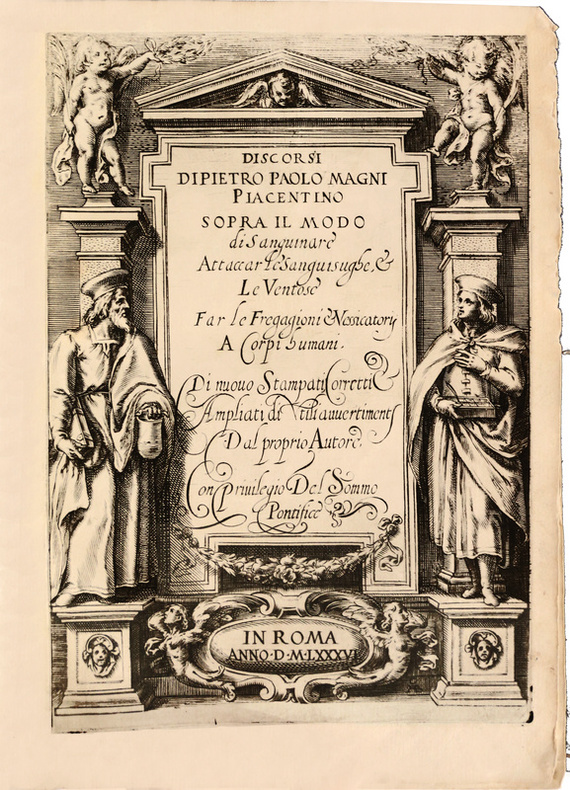
LCS-17596Bel exemplaire bien complet de toutes ses planches et conservé dans son pur vélin de l’époque. Roma, Bartholomeo Bonfadino, 1586. In-4 de (6) ff. dont 1 titre gravé encadré d’une bordure architecturale, 118 pp. y compris 11 figures en taille-douce à pleine page, (1) f.bl. Pte. déchirure dans la marge blanche inférieure de la p. 93 sans atteinte au texte. Plein vélin souple de l’époque, dos lisse, titre calligraphié sur la tranche inférieure. Reliure de l’époque. 210 x 154 mm.
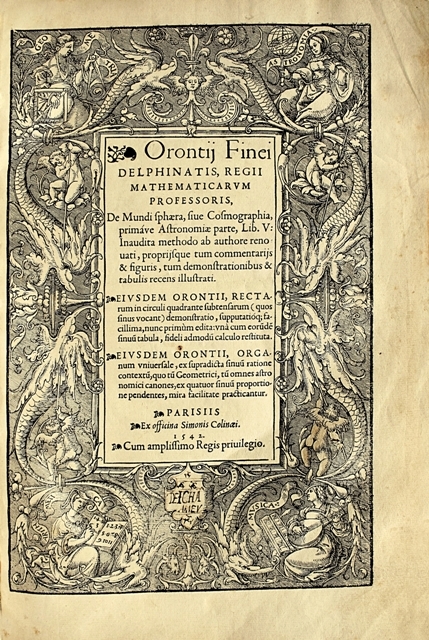
LCS-16146Paris, Simon de Colines, 1542. Paris, Simon de Colines, 1542. Cum amplissimo Regis privilegio. In-folio de (1) f.bl., (6) ff. dont le titre-frontispice et une gravure à pleine page, 112 ff., (2) ff.bl., 92 gravures et vignettes dans le texte. Longue note manuscrite au verso du dernier f. Vélin souple, dos lisse. Reliure de l’époque. 316 x 212 mm.
LCS-17788Précieux exemplaire de Cambacérès, relié en maroquin vert aux grandes armes de l’Archichancelier de l’Empire. Paris, J. G. Dentu, 1810.3 tomes en 3 volumes in-8 de : I/ (3) ff., viii pp., (1) p. de table, 394 pp., 1 planche dépliante en fin de volume, pages 5 à 12 reliées au mauvais endroit sans manque ; II/ (2) ff., 401 pp., 3 planches dépliantes en fin de volume ; III/ (2) ff., 452 pp., 1 planche dépliante en fin de volume, qqs témoins. Qq. rares piqûres.Plein maroquin vert, large dentelle dorée d’encadrement sur les plats, grandes armes dorées frappées au centre, dos lisses ornés, coupes décorées, tranches dorées. Reliures de l’époque.200 x 121 mm.
Folio. Engraved title-page, (20), CXXVIII, (2), 200, (2) pp. With 2 heraldic engravings and 33 engr. plates. - (Bound with) II: Valentijn, François. Abhandlung von Schnecken, Muscheln und Seegewächsen, welche um Amboina und den umliegenden Inseln gefunden werden. Als ein Anhang zu G. E. Rumphs Amboinischen Raritätenkammer [...]. Ibid., 1773. VIII, 148 pp. With 18 (2 folding) engr. plates. Contemporary calf with label to gilt spine. First German edition. The Hessian scientist Rumpf had come to Ambon Island (part of the Maluku Islands of Indonesia) in 1635 as a member of the Dutch East India Company. His description of Ambonese seashells remains a classic of early marine biology. The plates of this edition are reversed copies of plates 17-49 of the Dutch original, published in 1705. - II: First German edition of the "Verhandeling der Zee-Horenkens en Zee-Gewassen" (1754). Valentijn was a preacher in the Ambon and Banda Islands and published an important description of East India. - Engravings of I bound at the end of the text. Second dedication leaf slightly spotty; otherwise very clean. Several engravings show slight creases to the margins. Several gatherings in II slightly browned. Binding slightly scuffed; spine and hinges restored, using mainly the old material. - Altogether a very nice copy. I: Ebert 19609. Landwehr, VOC 593. Graesse VI.1, 192. Nissen, ZBI 3519. - II: Nissen, ZBI 4215.
235 x 286 mm. Mounted on cardboard. With an autograph letter signed by Victor Beuttell (see below). School photograph depicting the boys of Westcott House, Sherborne School, 1930, including Alan Turing (second row, second from right) and his friend Victor Beuttell (third row, far right), with the housemaster Geoffrey O'Hanlon seated centre with his dog. - Alan Turing attended Sherborne School from 1926 to 1931 and made an impression the moment he started his school career by cycling the 65 miles to the school from Southampton (where he had arrived from his parents' house in France during the General Strike), via an overnight stop at Blandford Forum, a feat that made the local paper. As his school reports reveal he showed "considerable promise" but his masters often complained that he failed to express himself adequately - his physics master Henry Shorland Gervis urged, "Cambridge will want sound knowledge rather than vague ideas". Other influential figures at Sherborne were his mathematics tutors Dr Edwin Davis and Donald Eperson, who instilled in the boys a love of problem solving and puzzles. Turing the schoolboy appears to have been an eccentric character but by no means the reclusive loner as he is sometimes portrayed: "At Sherborne he became the 'Mathematician-in-ordinary' who would help boys with their homework, and in his penultimate term at Sherborne his housemaster wrote in this school report that 'He takes a fatherly interest in his dormitory, and no doubt imparts his learning and curiosity to them" (Rachel Hassall, Vivat! Sherborne School magazine). This photograph was taken in July 1930 just six months after the sudden death of Turing's great friend Christopher Morcom - an event, it has been argued, that became the catalyst for his future achievements. - One of the boys he helped was Victor Beuttell, son of the British inventor Alfred William Beuttell, three years his junior, who mentions Turing three times in his letter home. Drawn together by a mutual sympathy (Turing was grieving for Christopher Morcom and Beuttell's mother was terminally ill), they were given special dispensation by the housemaster to spend time together. Victor was "also one who neither conformed, nor rebelled, but dodged the system" (Hodges, A., Alan Turing: The Enigma, 2014, p. 72), and they bonded over a love of codes and ciphers, inspired by the book 'Mathematical Recreations and Essays', which Turing had chosen as his Christopher Morcom Prize, awarded in 1930. He was obliged to leave the school in the same year as Turing after his father suffered financial losses and having failed the School Certificate, "telling Alan that it was because of too much time spent on chess and codes" (Hodges, p. 88) but they remained close. Victor was the one lasting friendship Turing retained from his time at Sherborne. Turing stayed with the family regularly and helped Victor's father Alfred with his work on lighting, with Victor in turn visiting Turing in Cambridge. Their last meeting was in 1943 when they met for lunch in London, but kept in touch for the remainder of Turing's life. Indeed, according to Victor's son, they spoke on the telephone just the night before he died in June 1954. - With an autograph letter from Victor Beuttell signed ("With heaps of love / Viccie") to his parents, reporting on his recent exam results and mentioning Turing several times ("On the additional maths [...] I think, and so does Turing that at the least I got passing marks. I didn't like the paper [...] Chemistry. According to Turing, got 70% an easy credit [...] Physics [...] By mistake did 6 questions instead of 5 [...] Even then I got a Pass according to Turing. Not so bad [...]"; 2 pages on 2 ff. on lined file paper, folio (325 x 210 mm), Westcott House, Sherborne, undated). - Provenance: Victor Beuttell (1915-93); and thence by descent.
Franckfort am Mayn, (Colophon: Johan Feyrabendt), 1590. Folio. (40,5x26 cm.). Contemporary full pigskin over wood, 5 raised bands, panels stamped in blind on covers. 2 clasps. Binding professionally restored at edges and corners, but still with traces of use, some scratches and overall wear. End-papers renewed with old paper. Title-page printed in red and black inside a broad woodcut compartment depicting Dioscorides and the author and with printed mottos around ovals. Both the title-page and the large printer's device at the end are by Jost Amman. (10),460,(2),(35) pp. With more than 800 woodcuts of plants in the text and several illustrations of destilling apparatus in the section ""Von Distillier un Brennoefen"" (fol.456 ff.). A few leaves neatly repaired at corners and at outer margins. At foot of title an ink-erasement repaired. A few leaves with faint dampstainings to upper and right margins. A few scattered brownspots. Some margins slightly brownspotted. Leaves of index at end with some small wormholes. In general a well preserved copy, professionally restored where needed.
In-folio (cm. 50), cc. (70). Con bell'antiporta allegorica e 119 tavole, il tutto finemente inciso in rame. Elegante legatura coeva in piena pelle, dorso liscio con titoli e fregi in oro. Solo qualche lieve piccola gora marginale ad alcune carte, peraltro esemplare genuino ed in ottimo stato di conservazione. Si tratta della seconda edizione latina di questa celebre opera in cui William Cowper compie una sorta di plagio nei confronti di Bidloo. Di quest'ultimo utilizza infatti la maggior parte delle tavole qui presenti, aggiungendo note esplicative e solo una piccola sezione iconografica (in tutto solo 14 tavole sono opera sua). Probabilmente una della più affascinanti pubblicazioni mai apparse in campo medico in cui la raffigurazione medica si sposa con un'ispirazione artistica assai appropriata. Raro.
1955120901Paris, Bachelier, 1866-1955. M. zahlr. Abb. Hldr. u. Hlwd. Teils m. Rsign. Einbde. teils angeschmutzt, einige fleckig u. meist etwas bestossen/angerissen. Einige Vors. m. leimschatt. Ecken bzw. gebräunt. St. a. Vors. u. Tit. Teils stockfl. Einige Tit. fehlen. Wenige S. etwas geknickt.
184760367Berlin, A. Hirschwald, 1847. 8vo. Uncut in the original printed wrappers. Previous owner's name (Kurt Egon Deutsch) to half-title. Wrappers a bit discoloured and frayed, and spine missing small part of paper. Spine skewed. Internally with light marginal brownspotting, otherwise a good copy. Housed in a cloth clam-shell box. XII, 228 pp. + 1 engraved plate.
154651055Venice, 1546. 4to. Contemporary full vellum. Neatly recased, endpapers renewed. A (mostly fairly faint) damp stain throughout and a marginal worm tract, far from affecting text. Inner blank margin of title-page re-enforced. Some contemporary marginal annotations. Woodcut title-vignette and woodcut printer's device to final blank verso. (4), 76, (4) ff.
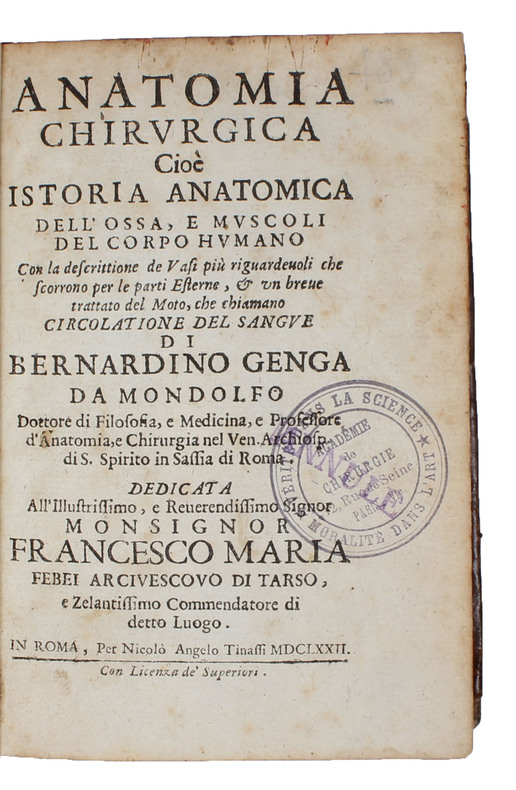
167251447Rome, Nicoloò Angelo Tinassi, 1672. Small 8vo. Near contemporary full calf biding with five raised bands to richly gilt spine. All edges of boards gilt. Hinges, capitals and corners with wear. Cords showing at front hinge, but still tight. Slight spotting to margins of title-page and some scattered brownspotting (not heavy). Overall a fine, unrestored copy with wide margins. Book plate to inside of front board and an old library stamp (Académie de Chirurgie) to title-page. (26), 455, (1) pp. Engraved frontispiece.
Venice, 1546. 4to. Contemporary full vellum. Neatly recased, endpapers renewed. A (mostly fairly faint) damp stain throughout and a marginal worm tract, far from affecting text. Inner blank margin of title-page re-enforced. Some contemporary marginal annotations. Woodcut title-vignette and woodcut printer's device to final blank verso. (4), 76, (4) ff.
Rome, Nicoloò Angelo Tinassi, 1672. Small 8vo. Near contemporary full calf biding with five raised bands to richly gilt spine. All edges of boards gilt. Hinges, capitals and corners with wear. Cords showing at front hinge, but still tight. Slight spotting to margins of title-page and some scattered brownspotting (not heavy). Overall a fine, unrestored copy with wide margins. Book plate to inside of front board and an old library stamp (Académie de Chirurgie) to title-page. (26), 455, (1) pp. Engraved frontispiece.
1869885781869. MEDICINE SUGITA Gempaku. RANGAKU KOTO HAJIME. Tokyo Tenshinro Meiji 2 1869. 22.5 x 15.1 cm. 2 vols. srting-bound Japanese-style fukuro-toji. Original covers and printed paper title labels. This memoir by the scientist behind the ground-breaking KAITAI SHINSHO was originally completed in Gempaku's old age in 1815. It was transmitted via manuscript until the fall of the ancien regime when Fukuzawa Yukichi and Gempaku's grandson arranged to have it published in a woodblock edition. The book was written in a very clear and simple style and reveals the great lengths of ingenuity the KAITAI SHINSHO author/translators went to to uncover the secrets and understand the esoteric Dutch vocabulary of Kulmas' anatomy that they translated therein. The RANGAKU KOTOHAJIME is often cited as perhaps the earliest Japanese text to explain techniques of cryptoanalysis from a practical and logically rigorous point of view. It is also a compelling story of scientific investigation in isolated traditional Japan. Finally despite its relatively late publication date the RANGAKU KOTOHAJIME is vanishingly rare. Our copy is in very good condition enclosed in a custom-fitted clasped chitsu case. unknown
In-8 p. (mm. 212x151), p. pergamena antica, titolo oro su tassello al dorso, 20 cc.nn. (di Indici), 291 cc.num., 1 c.b., marca tipografica al frontespizio, ornato da testatine, grandi capilettera figurati a vignetta e finalini, inc. su legno. Questa edizione contiene 4 opere di Andrea Cesalpino e precisamente: i 5 libri della “Quaestionum peripateticarum”, dedicata al Sereniss. Franciscum Medicem // “Daemonum investigatio Peripatetica”, dedicata al Rev.iss Archiepiscopum Pisanum Petrum Iacobum Borbonium” // “Quaestionum Medicarum Libri II” e “De Medicament. facultatibus Lib. II”, entrambe dedicate al Sereniss. Ferdinandum Medicem”. Rara "seconda edizione" delle prime due opere, molto importante perchè aumentata di altre due (qui in "prima edizione"). L’Autore “medico, nato ad Arezzo (1519-1603), fu professore di medicina a Pisa dove aveva compiuto i suoi studi. Nel 1555 divenne Direttore dell’Orto Botanico; nel 1592 fu chiamato a Roma da Clemente VIII e tenne cattedra di medicina alla Sapienza. Fu medico e filosofo insigne; aristotelico per i suoi studi, appassionatissimo della botanica come della mineralogia, sostenitore fervente dell’indirizzo biologico, creatore di un sistema filosofico che, precorrendo i tempi, s’avvicina a quello di Spinoza. Nel campo della fisiologia della circolazione del sangue, attaccò la concezione galenica dell’inclusione del fegato nella grande circolazione. Dimostrò l’esistenza della circolazione polmonare, affermando che il sangue giunge nel polmone dal cuore e viene a contatto con l’aria che arriva all’estremità dei bronchi e che l’aria diminuisce il calore del sangue e lo tempera. La sua scoperta fu pubblicata nel 1571 nel suo libro "Quaestionum peripateticorum libri V", quindi mezzo secolo prima di quella di Harvey (1628). Essa sta strettamente in nesso con la sua concezione filosofica, secondo la quale egli ammette l’esistenza di un unico principio, chiamato "anima" una e indivisibile che regge tutte le funzioni del corpo, e ha sede nel cuore, dal quale mediante il sangue si diffonde per tutto il corpo. Cesalpino fu il primo a pronunciare, nel 1559, la parola "circolazione" e a osservare ciò che avviene nelle vene dopo la legatura del braccio. Quantunque la discussione intorno alla priorità della scoperta della circolazione sia tuttora vivace, gli storici moderni riconoscono a Cesalpino il merito di averne concepito con geniale acutezza di mente l’idea.. I libri di Cesalpino furono molto letti e discussi anche fuori Italia, soprattutto in Germania. Egli fu uno degli scienziati italiani che ebbero la maggior fama oltre i confini della patria e fu detto dai contemporanei il “papa dei filosofi”. Così “Enciclopedia Italiana”, Treccani, vol.IX, p. 866. Cfr. anche Castiglioni “Storia della medicina”, pp. 436-440 - Wellcome Library,1182 - Durling,925 - Garrison and Morton,756 - Camerini “Annali dei Giunti”,II,991. Leggerm. corto del marg. super.; con qualche fioritura, arross. e lievi aloni ma complessivamente un più che discreto esemplare.
Parts 1-4 (of 6) in 1 volume. 1mo (full-sheet leaves, ca. 37 x 54 cm). (2), VI, 1-20; (2), VII-VIII, 21-40; (2), IX-X, 41-62; (2) XI-XII, 63-102 pp. With a general title-page, 4 part-titles (each with a woodcut vignette) and 50 engraved plates (signed I-XLVIII, including VII bis and XXX bis): 22 after Pierre Joseph Redouté, 17 after L. Freret, 4 after Fossier, 2 after P. Jossigny, 2 after J.G. Bruguiere, and 1 each after James Sowerby, Cl. Aubriet and Prévost. Original publisher's pink paste-paper wrappers over boards. Preserved in a professionally handmade box, made for this book. First and only edition of a sumptuous botanical work by the French botanist L'Héritier de Brutelle (1746-1800). In this work L'Héritier describes a great number of new taxa, including many growing in his own garden (of more than 8000 plants), the gardens of his friends and in the Jardin du Roi. Hunt describes this work as L'Héritier's "magnum opus" and as a benchmark in the history of 18th century flower books: "The book is splendid in spacious description, its charming exotic plates, its implications for taxonomic history; and fascinating as an imposing piece of eighteenth-century bookmaking, with its series of fascicles printed on broadsheets, its bibliographical algebra" (Hunt). - This is also the first publication of a work by the young botanical engraver Pierre Joseph Rédoute (1759-1840), who engraved at least the 22 plates he drew himself. It is in this work that Redouté emerges as an extraordinary botanical artist, because L'Héritier asked him to draw the majority of the plates. On the "Stirpes novae" L'Héritier and Redouté collaborated for the first time, but after that they worked together more often, for example on the "Sertum Anglicum" (1788). Their friendship proved a determining factor in Redouté's career and enabled him fully to develop his extraordinary talents. - "Stirpes novae" is in 1mo format (each leaf comprising a full sheet) rather than folio, as many bibliographies state, with pagination, but without quire signatures. Although the "Stirpes novae" was intended for publication in the years 1784 and 1785 and the part-titles of the fascicles are dated thus, Stafleu & Cowan and Hunt note that these are not the actual dates of publication. The present first four (of six) fascicles were published in March 1785, April 1786, April 1786 and March 1788 respectively. Originally the "Stirpes novae" were to comprise two volumes, but only the six fascicles of the first volume were actually published. - Pink paper wrappers rubbed and some paper missing on the front and back board. Board edges and corners worn. A tear in plate XXXI, otherwise a rare book in good condition. De Belder 215. Hunt 673. Johnston 555. Nissen (BBI) 1190. Pritzel 5268. Stafleu/Cowan 4484. Cf. Buchheim, "A bibliographical account of L'Héritier's 'Stirpes novae'", in: Huntia, vol. 2, (1965), pp. 29-58.
4to. (54), 1389, (23) pp. With separate engr. title-page, full-page engr. coat of arms on the reverse of the letterpress title (printed in red and black), and 61 engravings on 60 plates (6 folding). Contemporary full calf with giltstamped title to elaborately gilt spine. All edges sprinkled in red. Second edition, vastly expanded from the first (published in 1662): an extensive treatise on the wonders of animal and physical nature, in which Schott relates exact scientific observations to fabulous phenomena such as demons, witches, and monsters, seeking to bring them into agreement with each other. Includes discussions of demonology, household spirits, St. Elmo's fire, comets and their portents, etc. "Tout serait à citer de cet énorme ouvrage véritable encyclopédie du merveilleux et de l'occulte" (Caillet"). Schott, from Königshofen near Würzburg , entered the Society of Jesus in 1627 and studied at Würzburg under Athanasius Kircher. He subsequently taught in Sicily for many years, but "he was anxious to satisfy a strong thirst for knowledge and to resume his connection with Kircher, whom he always revered as his master. Schott was able to satisfy his desire in 1652, when he was sent to Rome, where for three years he collaborated with Kircher on his researches. Schott decided that since Kircher did not have time to publish all that he knew and all the information communicated to him by Jesuits abroad, he himself would do it" (DSB). - Variously browned due to paper; a few tears to the final plate professionally repaired. A fine copy in its first binding with the price of acquisition ("comp. 1-12") on the flyleaf in a contemporary hand and an 18th century engraved bookplate (letter "T" with star of David, work of Carl Friedrich Holtzmann for an unidentified collector) on the pastedown. VD 17 39:120052P. De Backer/Sommervogel VII, 909, 8. Dünnhaupt 3818, 7.2. Nissen, ZBI 3746. Ferguson II, 340. Coumont, Witchcraft S31.2 ("Numerous very curious plates"). Dorbon-Ainé 4441. Caillet 10005 ("Ouvrage fort recherché"). Cf. DSB XII, 211.