34 831 résultats
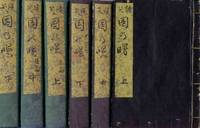
18792111902160201405Oseido Noriaki Ushiki Awajicho Kanda District 1879. Soft Cover. Fine. Number of books: 8 books Oseido Noriaki Ushiki (Awajicho, Kanda District) paperback
Signed and inscribed by author upon front free endpaper to General R.E. Wood [1879-1969], under whose leadership Sears Roebuck was transformed from a mail-order to a retail sales behemoth. pp. [6], 7-90. "Communist plotters, in the United States as elsewhere, are preparing for the conquest of political power. The discerning student, however, should consider how interventionism, under various enticing labels, is setting the stage for the final overthrow of the voluntary society, the market economy and constitutional government. [This work], by a world-famous expert, will prove a valuable aid to understanding in this field. It will help to explain the errors of those who believe a system based on individual freedom can be 'mixed' with socialism." - Foreword. Book clean and unmarked with moderate wear. Binding tight. Above-average wear to price-clipped dust jacket now preserved in archival-grade Brodart. Greaves & McGee B-14. Book
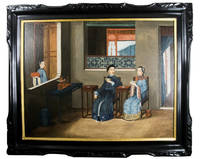
1820ABC_45805China 1820. 47 x 61 cm. picture; 61 x 74.5 cm. frame. Oil painting on canvas in a black lacquered Chinese export frame. An elegant interior scene from a Chinese Mandarins home in the early nineteenth century: a Manchu Mandarin and his consort taking tea in a domestic setting. He wears non-official semi-formal winter attire including rank badge sitting beside ahis beautiful Chinese lady surrounded by fine furniture and fittings. The whole scene reflects his good taste and social standing.Whilst tea had been the driving force of the China Trade since the early eighteenth century giving rise to export paintings illustrating its cultivation and production process the style and subject of the early export paintings was firmly rooted in traditional Chinese art and culture as in this delightful painting.l Cf. Choi Kee Il Tea and design in Chinese export painting in: The Magazine Antiques vol. 154 no. 4 October 1998. unknown
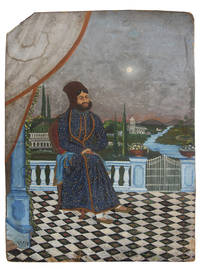
103283Bombay circa 1860. . Large painting on board signed 'Punir Shabab Bombay' signed in lower left-hand corner gouache on thick board depicting an elegantly robed gentleman seated on an open terrace with a moon-lit countryside and winding river in the background with stars illuminating the sky 600 x 440 mm; some light water-staining and a small section of the top-left corner chipped with loss rubbed and darkened as often; reverse blank in modern frame glazed. <br /> misc23 A very attractive and large portrait of a Governor of Bombay possibly of Parsi heritage apparently executed by a local Indian artist. The large verandah on which the subject is seated features some classical western architectural features including the column and balcony railing. These features paired with the silk embroidered robes and multiple strands of beaded jewellery of the subject signify that the sitter was of high rank and likely governor of the region and land that is disproportionately seen behind him as a vast and luscious landscape. The scene is rather unusually set at night-time with the light of the moon and stars shining against a darkened sky to create a very atmospheric and captivating image.<br /> Bombay, circa 1860. unknown
20132081502111906015Xizang People's Publishing House 2013. Soft Cover. Fine. The book is in fine condition. Xizang People's Publishing House paperback
Acquaforte e bulino, 1635, firmata e datata in lastra in alto, a puntasecca: Rembrandt ft 1635; sotto l’ovale l’iscrizione Quem pia miarari plebes, quem castra solebant, / damnare et mores aula coacta suos. Jactatus multum, nec tantum fructus ab anni / WTENBOGARDUS sic tuus, Haga redit. HGrotius. (La corte secolare fu costretta a condannare sia l’uomo tanto ammirato, sia le sue convinzioni. L’Aja, il tuo Uytenbogaert ritorna a te dopo lungo errare, provato solo dagli anni. Ugo Grozio). Esemplare nel V stato di VI, con i margini della lastra ripuliti. Magnifica prova, impressa su carta vergata coeva priva di filigrana, rifilata al rame, leggere ossidazioni in basso, per il resto in ottimo stato di conservazione. Il ritratto raffigurato è quello del predicatore Johannes Uytenbogaert (1577-1644), all’età di settantotto anni. Personaggio illustre ed assai influente del tempo, divenne il leader della Rimostranza, una corrente liberale della chiesa calvinista che formalizzava la dottrina di Arminio. Al Concilio di Dort (1618- 1619) la Rimostranza fu condannata e i seguaci perseguitati: Uytenbogaert fu costretto all’esilio, per porter far ritorno all’Aja solo nel 1629. La didascalia di Grozio - a sua volta appartenente alla fazione dei rimostranti e esiliato nel 1635 – non si limita a rievocare questi eventi, ma intende sottolineare il ritorno di Uytenbogaert a L'Aja. È probabile che il ritratto sia ordinato per diffonderne le stampe fra gli amici e gli estimatori dell'anziano pastore. Potrebbe essere lo stesso Uy- tenbogaert a commissionarlo, ma non è detto. Due anni prima Rembrandt lo ritrae in un dipinto, su richiesta di Abraham Antonisz. Recht, un mercante favorevole ai rimostranti. In quella occasione Uytenbogaert posa per Rembrandt, mentre per l'acquaforte non è sicuro che ciò sia avvenuto: infatti, nelle due opere il viso dell'uomo è rappresentato in modo quasi identico, perfino nelle ciocche di capelli che sfuggono dallo zucchetto. Per la testa, Rembrandt deve essere partito da un disegno oggi perduto. Esemplare in cornice dorata settecentesca. Bibliografia Hind 128; Bartsch 279; White & Boon 279, V/VI; E. Hinterding, Rembrandt, Dipinti, incisioni e riflessi sul ‘600 e ‘700 italiano, p.120, 26. Etching and engraving, 1635, signed and dated at upper edge Rembrandt ft 1635. Inscribed in Latin beneath the image: Quem pia miarari plebes, quem castra solebant, / damnare et mores aula coacta suos. Jactatus multum, nec tantum fructus ab anni / WTENBOGARDUS sic tuus, Haga redit. HGrotius. Example of the fifth state of six. Magnificent work, printed on contemporary laid paper without watermark, closely trimmed to the platemark, light oxidations at lower part, otherwise in good condition. Johannes Uytenbogaert (1557-1644), an important political and theological figure of the period , was a leader of the Dutch Remonstrants and a former chaplain to Maurice, Prince of Orange. Following the views of Jacobus Arminius, the Remonstrants presented to the States-General in 1610 a 'Remonstrance', setting forth their points of divergence from stricter Calvinism. Attacked on all sides, they were expelled from the Netherlands by the Protestant Synod of Dort (1618-19), which declared Remonstrant theology contrary to Scripture. Allowed back in the Netherlands by 1630, they were officially recognised in 1798. The inscription, in Latin, is far more extensive than in Rembrandt's other prints, and was composed by the leading Remonstrant Hugo de Groot - a Remonstrant still in exile in 1635. It alludes to Wtenbogaert's piety and court service, as well as his 'comeback' to the Hague in 1629. Rembrandt had previously depicted Uytenbogaert in a painting of 1633, in which the minister stands before a table and a large opened book (the portrait survives in the Rijksmuseum). Bibliografia Hind 128; Bartsch 279; White & Boon 279, V/VI; E. Hinterding, Rembrandt, Dipinti, incisioni e riflessi sul ‘600 e ‘700 italiano, p.120, 26.
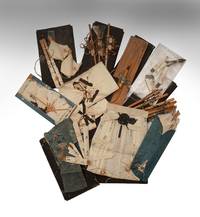
7079Various formats and sizes. Japan: ca. 1787-96.<br/> <br/> The Ogasawara School å°ç¬ åŽŸæµ founded in the 12th century laid the foundations of etiquette for the aristocratic and samurai classes throughout Japan for many centuries. The school specialized in teaching horsemanship archery mounted archery and samurai etiquette on and off the battlefield. Over the centuries the school transitioned itself to focus on a system of courtly manners along with skills in archery for ceremonial rituals. The school continues today supervised by the 31st generation leader Kiyotada Ogasawara. The Imperial House of Japan uses Ogasawara etiquette.<br/> <br/> This fascinating collection is made up of miniature models or samples of materials and objects required and used at formal Ogasawara events in the late 18th century as well as a number of manuscript documents.<br/> <br/> We begin with ten black paper four-sided folding envelopes each labeled and containing the items below. These envelopes are constructed of thick but flexible paper with string ties. The labels describe the contents of each envelope and have seals and signatures of either “Hisanobu†or “Nobumichiâ€:<br/> <br/> 1. a miniature paper model of a horo which is worn on the back of a samurai’s armor. Our horo is made of folded paper with a silk brocade adornment. Measurements are given in manuscript. With this is a model of the bag to carry the horo;<br/> <br/> 2. miniature fabric samples of pleated trousers a man’s formal kimono and vest along with samples of neatly wrapped objects elaborately tied which were to be carried. They include a sword a fan and a bolt of precious brocade;<br/> <br/> 3. three miniature tachi swords each for a specific occasion. Our sample tachi are made of wood and have thick thread attachments;<br/> <br/> 4. two kinds of miniature torches taimatsu along with their holders;<br/> <br/> 5. a most remarkable miniature wooden bow mounted on a wooden board. A quiver utsubo again made of wood and decorated in gold brocade is also mounted;<br/> <br/> 6. Six miniature examples of maku gushi poles to hold banners. They are joined by ropes here represented by fine decorative cord;<br/> <br/> 7. four samples of real hair cut off and tied during genpuku the Japanese coming-of-age ceremony;<br/> <br/> 8. a miniature target — an opened fan — mounted on a board for the hikime-no-gi the archery ritual;<br/> <br/> 9. two elaborate folded paper model sacks to protect the bow when it rains kasa yumi bukuro; and<br/> <br/> 10. seven strands of hay and 12 braided strips of paper kamioki which were used in ceremonies for two- and three-year-old aristocratic and samurai male children.<br/> <br/> These are accompanied by 69 examples of very complex ceremonial origami or origata. Origata as compared to recreational origami was developed amongst the higher class of samurai who stressed formal manners and a sense of decorum. It is a method of how to wrap gifts with very precious handmade papers used for gift-giving and ceremonies in order to maintain sound human relations. Each is folded in it own way and labeled with its intended contents for example an obi belt confectioneries a brush for calligraphy shark skin for sword handles incense wood a tooth-cleaning stick a fan Chinese silk thread hair ornaments gold dust sumi ink cake perfume belts for inner garments face powder tabi socks various sizes of fine writing paper feathers from hawks and cranes for arrows etc. Some examples of highly complex ornamental ties are also present.<br/> <br/> Finally there are about 20 contemporary letters all concerned with various aspects of Ogasawara etiquette including gastronomic matters. There is a stiff thick-paper folded cover for a gift signed “Ogasawara Taizen taifu Nagamasa.†There is also a packet of miscellaneous related papers.<br/> <br/> In fine condition and a remarkable survival. unknown
7079Various formats and sizes. Japan: ca. 1787-96. The Ogasawara School founded in the 12th century laid the foundations of etiquette for the aristocratic and samurai classes throughout Japan for many centuries. The school specialized in teaching horsemanship archery mounted archery and samurai etiquette on and off the battlefield. Over the centuries the school transitioned itself to focus on a system of courtly manners along with skills in archery for ceremonial rituals. The school continues today supervised by the 31st generation leader Kiyotada Ogasawara. The Imperial House of Japan uses Ogasawara etiquette. This fascinating collection is made up of miniature models or samples of materials and objects required and used at formal Ogasawara events in the late 18th century as well as a number of manuscript documents. We begin with ten black paper four-sided folding envelopes each labeled and containing the items below. These envelopes are constructed of thick but flexible paper with string ties. The labels describe the contents of each envelope and have seals and signatures of either "Hisanobu" or "Nobumichi": 1. a miniature paper model of a horo which is worn on the back of a samurai's armor. Our horo is made of folded paper with a silk brocade adornment. Measurements are given in manuscript. With this is a model of the bag to carry the horo; 2. miniature fabric samples of pleated trousers a man's formal kimono and vest along with samples of neatly wrapped objects elaborately tied which were to be carried. They include a sword a fan and a bolt of precious brocade; 3. three miniature tachi swords each for a specific occasion. Our sample tachi are made of wood and have thick thread attachments; 4. two kinds of miniature torches taimatsu along with their holders; 5. a most remarkable miniature wooden bow mounted on a wooden board. A quiver utsubo again made of wood and decorated in gold brocade is also mounted; 6. Six miniature examples of maku gushi poles to hold banners. They are joined by ropes here represented by fine decorative cord; 7. four samples of real hair cut off and tied during genpuku the Japanese coming-of-age ceremony; 8. a miniature target - an opened fan - mounted on a board for the hikime-no-gi the archery ritual; 9. two elaborate folded paper model sacks to protect the bow when it rains kasa yumi bukuro; and 10. seven strands of hay and 12 braided strips of paper kamioki which were used in ceremonies for two- and three-year-old aristocratic and samurai male children. These are accompanied by 69 examples of very complex ceremonial origami or origata. Origata as compared to recreational origami was developed amongst the higher class of samurai who stressed formal manners and a sense of decorum. It is a method of how to wrap gifts with very precious handmade papers used for gift-giving and ceremonies in order to maintain sound human relations. Each is folded in it own way and labeled with its intended contents for example an obi belt confectioneries a brush for calligraphy shark skin for sword handles incense wood a tooth-cleaning stick a fan Chinese silk thread hair ornaments gold dust sumi ink cake perfume belts for inner garments face powder tabi socks various sizes of fine writing paper feathers from hawks and cranes for arrows etc. Some examples of highly complex ornamental ties are also present. Finally there are about 20 contemporary letters all concerned with various aspects of Ogasawara etiquette including gastronomic matters. There is a stiff thick-paper folded cover for a gift signed "Ogasawara Taizen taifu Nagamasa." There is also a packet of miscellaneous related papers. In fine condition and a remarkable survival. unknown books
199050158Éditions C. I. P. New. 1990. Unbound. 2907729055 . FREE UPGRADE to Courier/Priority Shipping Upon Request IN STOCK AND IMMEDIATELY AVAILABLE FOR SHIPMENT - Text pristine pages unmarked excellent - FROM AN EDITION OF 300 - Boxed set of 23 folded broadsheets with essay in French by Bouté and introduction in French by Fidell-Beaufort and reproductions of 46 works by Daubigny. Includes a portrait of Daubigny as frontispiece and a portrait of the artist by Charles Chaplin. Also includes reproductions of various letters written by Daubigny. Éditions C. I. P. unknown
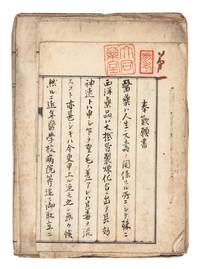
8335Ca. 52 leaves. 8vo leaves of various sizes but averaging 285 x 203 mm. written on paper with pre-printed columns stitched together. Osaka: 1872-75. <br /> <BR> <BR> The Osaka Medical School today part of Osaka University and one of the finest medical schools in Japan traces its origins and traditions to the Tekijuku an academy founded by Koan Ogata 1810-63 which based its teaching on Western learning mostly from the Dutch. The newly created Meiji government established the Osaka Medical School in 1869 with the help of Ogata’s son Koreyoshi and the Dutch doctor Antonius Franciscus Bauduin 1822-85. This was part of the massive effort in Japan to modernize. The “Fundamental Code of Education†promulgated in 1872 established a centralized national educational system which concentrated on Western science and technology.<br /> <BR> <BR> These manuscripts document the transformation of the medical school into a national institution. Details regarding rules for employees contracts for foreign employees including salaries housing matters of finance terms of severance standards regarding the making of pharmaceutical products lists of foreign employees correspondence with government officials etc.<br /> <BR> <BR> In fine condition. With the seal of the Shinto priest and physician Yasuaki or Kosho Nakano 1874-1947 and his private library Daido Yakushitsu. He was a major collector of kanpo the Japanese study of traditional Chinese medicine calligraphy maps illustrated scrolls waka poetry and paintings. unknown
21159501Japan 1826 n.p. Blue stitched wrs. very good 6 vol.set Chuban or 12 x 18 cm. very good 111 double folded leaves 23 b.w. illustrations many are hand tinted around the genit- alia wood block printed on hand-made paper minor old worm damage but properly mended. This set was likely illustrated by a very skilled Utagawa Kuniyoshi school artist. Since it was common for artists not to sign erotic book one can not know the exact artist name. The lavishly illustrated text is a good example of a skillful hand and illustrator. While there is no colophon which is also usual for erotic books a cyclical date is found in volume one for 1826. The story seems to be about Tokuseru a girl who has various affairs with several lovers. In one illustration she is shown asle- ep in a dream-state with an image floating above her. In this she is with her favorite lover Tokushichi who is making love to her. She is shown sleeping with her hand on an erotic book with Chirishi paper to wipe the aftermath of love-making while her cat looks on. She has been stimu- lated by looking at the erotic book and then her lover appe- ared in her dream. Another shows her being raped in the river by two boat boatman. Others show her with her favorite Tokushichi and other lovers. In one very dark midnight scene she is found making love to her lover while an unin- vited guest stumbles into their room by error. Contained in a period paper covered slipcase. unknown
17722750NANTES 1772 in-folio demi-vélin janséniste un Manuscrit, reliure demi-velin janséniste in-folio, dos 5 nerfs - titre manuscrit à l'encre brune façon Janséniste au dos à l'encre brune, les 3 premières pages ainsi que les deux dernières ont été habilement restaurées en marge sur un centimètre de large lors d'une restauration ancienne, texte manuscrit à l'encre brune orné de trés nombreuses lettrines calligraphiées réhaussées en couleurs sur toute les pages ainsi que des calligraphies en ornementation du texte, en bandeaux et culs-de-lampes réhaussées en couleurs (Thèmes : oiseaux divers, portraits divers, papillons divers, fleurs diverses, lapins divers etc...), orné d'un dessin à l'encre brune réhaussé en couleurs sur la moitié de la page de titre représentant "la manière de tenir la plume" et d'un dessin à l'encre brune réhaussé en couleurs représentant un portrait en pied d'un NÉGOCIANT dans son intérieur devant une Sphère Armilliaire, dessin prenant toute la dernière page , quelques légères piqûres, Table des Matières et sur les dernières pages : Rêgles d'Arithmétique, 545 pages avec une erreur de pagination (mais complet), Fait à Lourmarin, le huitième octobre 1772,
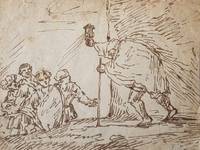
16502105Dutch mid-17th century drawing possibly by Rembrandt pupil Willem Drost. Depicted is Diogenes in robes with his lantern in his left hand and a staff in his right and a group of four figures. Diogenes the Cynic 4th cent. BC renounced material possessions and lived in poverty. He would go out with a lighted lantern in broad daylight to look for an honest man instead he would only find that everyone around him was morally corrupted. He would scare passersby with his lantern causing them to lose their mask and reveal their true intentions.In the present drawing the group of four is clearly scared by the lantern of Diogenes who seems to be towering over them. In fact the artist has placed Diogenes on a higher plane than the passersby an invention that effectively enhances the morality of the scene. This is not found in other contemporary depictions of the same story by artists like Rubens Sandrart Castiglione and Jordaens.The artistdisplays a masterful understanding and application of chiaroscuro. Not only does he use it for the composition he also applies it to benefit the narrative. Light is literally and figuratively at the center of the scene. The artist from the "Rembrandt school" who made most use of stark chiaroscuro in his drawings was Willem Drost 1633-1659. He became a student of Rembrandt around 1650 which corresponds with the dating of the watermark. The style of drawing is also close to drawings attributed to Drost. The facial type of Diogenes in particular the pointy nose corresponds with that found in each of Drost's drawings in the Rijksmuseum. Also the hatchingsmatch those in other works by Drost who made much use of individual lines instead of a continuous zig-zagging stroke and penstrokes of varying thickness to create depth in his compositions Bonny van Sighem 2000.<i>Condition: Number 3 in pencil at the bottom previous attribution to Ferdinand Bol written in pencil on the back. Several small brown spots and a couple minor defects including one on the face of the central figure in the group top edge slightly frayed and creaded. Old repair with tape on the back at the top.Literature: B. van Sighem 'attributed to Willem Drost David Prevents Abishai from Killing Saul Amsterdam c. 1650 - c. 1655' in J. Turner ed. Drawings by Rembrandt and his School in the Rijksmuseum online coll. cat. Amsterdam 2000 Bonny van Sighem 2000; for the watermark cf. Churchill fig. 305; Heawood 305 & 307.</i>
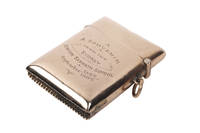
19055000696Sydney 1905. In exemplary original condition. 9 carat gold matchbox 15 gr; 45 x 30 mm; monogrammed on the back with interwoven letters "M.A.C." <p><p>A remarkable memento of the pioneer Jewish educator Maurice Moses Abraham Cohen 1851-1923. Objects from the Australian Jewish community at the start of the 20th century prior to the great waves of Jewish immigration are very scarce. The monogrammed initials on this attractive presentation piece identify it as a gift from the Sydney Jewish Sabbath School to M.A. Cohen the School's first principal.</p> <p>Born in Ukraine to a Sephardic family Cohen was a talented linguist. Educated in England after spells in India and Afghanistan he travelled to Australia in 1887 where he took up a role as the first headmaster of the Jewish Sunday School just then established in Sydney within the Great Synagogue Australia's finest synagogue. He went on to become head of the NSW Jewish Board of Education. At one time he was editor of Sydney's first Jewish weekly newspaper the Australian Jewish Weekly as well as a lecturer on Hebrew at a number of theological colleges in Australia. </p> <p>Cohen was one of the first European Australians to call attention to the plight of the Australian Aboriginal peoples and to argue for compensation and land rights even risking his position as editor of the Australian Hebrew Newspaper with his fiery opinion pieces on the subject. He also argued for increased non-discriminatory immigration drawing from all cultures and vehemently opposed the White Australia Policy. The Australian Jewish Historical Society "The First Jewish Educator for Sydney": online resource.</p> <p>So-called "Vesta" cases named for the Roman goddess of fire and the hearth are small portable boxes made to contain matches and keep them dry. More commonly made of tin or sometimes enamel or silver with later examples sometimes carrying advertising or being highly decorated gold examples from this period represent a high standard and were very suitable for presentation pieces; this fine example was perhaps made to join a pocket watch on its gold chain.</p> </p> . unknown
21570Paris, chez l'auteur, 1950. In-folio, 209 pp. en feuilles, couverture originale, étui cartonné, emboîtage de toile écrue (quelques petits frottements et taches à l'emboîtage et à l'étui).
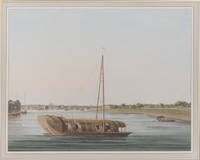
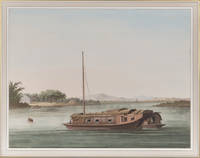
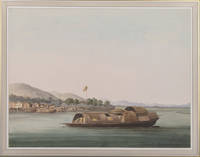
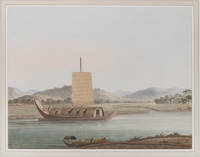
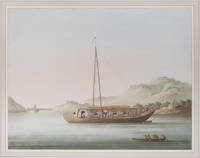
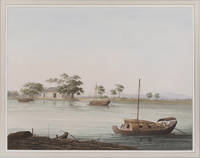
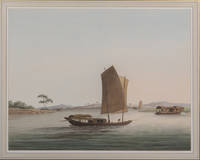
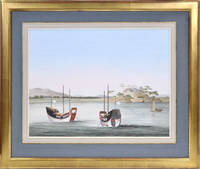
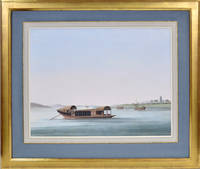
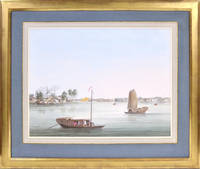
111580Canton circa 1810. . Pencil water colour and body colour drawing of craft heightened with white on paper watermarked 'J Whatman 1804' and '1805'. Framed and glazed overall size: 68.5cm x 58.5cm.<br /> Well executed and highly atmospheric watercolours capturing the importance of the river for trade in early nineteenth century China.<br /><br />A fine group of unusual and very attractive depictions of river life. Typically with the river in the foreground with a finely executed drawing of a native boat the backgrounds showing landscape scenes interspersed with occasional architectural details.<br /><br />The Pearl River is so named because of the pearl-colored shells that lie at the bottom of the river in the section that flows through the city of Guangzhou. Formerly often known as the Canton River it is an extensive river system in southern China. The name 'Pearl River' is also often used as a catch-all for the watersheds of the Xi 'West' Bei 'North' and Dong 'East' rivers of Guangdong. These rivers are all considered tributaries of the Pearl River because they share a common delta the Pearl River Delta. Measured from the farthest reaches of the Xi River the Pearl River system is China's third-longest river 2400 kilometres after the Yangtze River and the Yellow River and second largest by volume after the Yangtze.<br /> Canton, circa 1810]. unknown
111581Canton circa 1810. . Pencil water colour and body colour drawing of craft heightened with white on paper watermarked 'J Whatman 1804' and '1805'. Framed and glazed overall size: 68.5cm x 58.5cm.<br /> Well executed and highly atmospheric watercolours capturing the importance of the river for trade in early nineteenth century China.<br /><br />A fine group of unusual and very attractive depictions of river life. Typically with the river in the foreground with a finely executed drawing of a native boat the backgrounds showing landscape scenes interspersed with occasional architectural details.<br /><br />The Pearl River is so named because of the pearl-colored shells that lie at the bottom of the river in the section that flows through the city of Guangzhou. Formerly often known as the Canton River it is an extensive river system in southern China. The name 'Pearl River' is also often used as a catch-all for the watersheds of the Xi 'West' Bei 'North' and Dong 'East' rivers of Guangdong. These rivers are all considered tributaries of the Pearl River because they share a common delta the Pearl River Delta. Measured from the farthest reaches of the Xi River the Pearl River system is China's third-longest river 2400 kilometres after the Yangtze River and the Yellow River and second largest by volume after the Yangtze.<br /> Canton, circa 1810]. unknown
111583Canton circa 1810. . Pencil water colour and body colour drawing of craft heightened with white on paper watermarked 'J Whatman 1804' and '1805'. Framed and glazed overall size: 68.5cm x 58.5cm.<br /> Well executed and highly atmospheric watercolours capturing the importance of the river for trade in early nineteenth century China.<br /><br />An unusual and very attractive depictions of river life. Typically with the river in the foreground with a finely executed drawing of a native boat the backgrounds showing landscape scenes interspersed with occasional architectural details.<br /><br />The Pearl River is so named because of the pearl-colored shells that lie at the bottom of the river in the section that flows through the city of Guangzhou. Formerly often known as the Canton River it is an extensive river system in southern China. The name 'Pearl River' is also often used as a catch-all for the watersheds of the Xi 'West' Bei 'North' and Dong 'East' rivers of Guangdong. These rivers are all considered tributaries of the Pearl River because they share a common delta the Pearl River Delta. Measured from the farthest reaches of the Xi River the Pearl River system is China's third-longest river 2400 kilometres after the Yangtze River and the Yellow River and second largest by volume after the Yangtze.<br /> Canton, circa 1810]. unknown
111577Canton circa 1810. . Pencil water colour and body colour drawing of craft heightened with white on paper watermarked 'J Whatman 1804' and '1805'. Framed and glazed overall size: 68.5cm x 58.5cm.<br /> Well executed and highly atmospheric watercolours capturing the importance of the river for trade in early nineteenth century China.<br /><br />A fine group of unusual and very attractive depictions of river life. Typically with the river in the foreground with a finely executed drawing of a native boat the backgrounds showing landscape scenes interspersed with occasional architectural details.<br /><br />The Pearl River is so named because of the pearl-colored shells that lie at the bottom of the river in the section that flows through the city of Guangzhou. Formerly often known as the Canton River it is an extensive river system in southern China. The name 'Pearl River' is also often used as a catch-all for the watersheds of the Xi 'West' Bei 'North' and Dong 'East' rivers of Guangdong. These rivers are all considered tributaries of the Pearl River because they share a common delta the Pearl River Delta. Measured from the farthest reaches of the Xi River the Pearl River system is China's third-longest river 2400 kilometres after the Yangtze River and the Yellow River and second largest by volume after the Yangtze.<br /> Canton, circa 1810]. unknown
111579Canton circa 1810. . Pencil water colour and body colour drawing of craft heightened with white on paper watermarked 'J Whatman 1804' and '1805'. Framed and glazed overall size: 68.5cm x 58.5cm.<br /> Well executed and highly atmospheric watercolours capturing the importance of the river for trade in early nineteenth century China.<br /><br />A fine group of unusual and very attractive depictions of river life. Typically with the river in the foreground with a finely executed drawing of a native boat the backgrounds showing landscape scenes interspersed with occasional architectural details.<br /><br />The Pearl River is so named because of the pearl-colored shells that lie at the bottom of the river in the section that flows through the city of Guangzhou. Formerly often known as the Canton River it is an extensive river system in southern China. The name 'Pearl River' is also often used as a catch-all for the watersheds of the Xi 'West' Bei 'North' and Dong 'East' rivers of Guangdong. These rivers are all considered tributaries of the Pearl River because they share a common delta the Pearl River Delta. Measured from the farthest reaches of the Xi River the Pearl River system is China's third-longest river 2400 kilometres after the Yangtze River and the Yellow River and second largest by volume after the Yangtze.<br /> Canton, circa 1810]. unknown
111578Canton circa 1810. . Pencil water colour and body colour drawing of craft heightened with white on paper watermarked 'J Whatman 1804' and '1805'. Framed and glazed overall size: 68.5cm x 58.5cm.<br /> Well executed and highly atmospheric watercolours capturing the importance of the river for trade in early nineteenth century China.<br /><br />A fine group of unusual and very attractive depictions of river life. Typically with the river in the foreground with a finely executed drawing of a native boat the backgrounds showing landscape scenes interspersed with occasional architectural details.<br /><br />The Pearl River is so named because of the pearl-colored shells that lie at the bottom of the river in the section that flows through the city of Guangzhou. Formerly often known as the Canton River it is an extensive river system in southern China. The name 'Pearl River' is also often used as a catch-all for the watersheds of the Xi 'West' Bei 'North' and Dong 'East' rivers of Guangdong. These rivers are all considered tributaries of the Pearl River because they share a common delta the Pearl River Delta. Measured from the farthest reaches of the Xi River the Pearl River system is China's third-longest river 2400 kilometres after the Yangtze River and the Yellow River and second largest by volume after the Yangtze.<br /> Canton, circa 1810]. unknown
111582Canton circa 1810. . Pencil water colour and body colour drawing of craft heightened with white on paper watermarked 'J Whatman 1804' and '1805'. Framed and glazed overall size: 68.5cm x 58.5cm.<br /> Well executed and highly atmospheric watercolours capturing the importance of the river for trade in early nineteenth century China.<br /><br />A fine group of unusual and very attractive depictions of river life. Typically with the river in the foreground with a finely executed drawing of a native boat the backgrounds showing landscape scenes interspersed with occasional architectural details.<br /><br />The Pearl River is so named because of the pearl-colored shells that lie at the bottom of the river in the section that flows through the city of Guangzhou. Formerly often known as the Canton River it is an extensive river system in southern China. The name 'Pearl River' is also often used as a catch-all for the watersheds of the Xi 'West' Bei 'North' and Dong 'East' rivers of Guangdong. These rivers are all considered tributaries of the Pearl River because they share a common delta the Pearl River Delta. Measured from the farthest reaches of the Xi River the Pearl River system is China's third-longest river 2400 kilometres after the Yangtze River and the Yellow River and second largest by volume after the Yangtze.<br /> Canton, circa 1810]. unknown
101462Canton circa 1810. . Pencil water colour and body colour drawing of craft heightened with white on paper watermarked 'J Whatman 1804' and '1805'. Framed and glazed overall size: 67.8cm x 57.3cm x 2cm.<br /> 89 mp22pic Well executed and highly atmospheric watercolours capturing the importance of the river for trade in early nineteenth century China.<br /><br />Typically with the river in the foreground with a finely executed drawing of a native boat the backgrounds showing landscape scenes interspersed with occasional architectural details.<br /><br />The Pearl River is so named because of the pearl-colored shells that lie at the bottom of the river in the section that flows through the city of Guangzhou. Formerly often known as the Canton River it is an extensive river system in southern China. The name 'Pearl River' is also often used as a catch-all for the watersheds of the Xi 'West' Bei 'North' and Dong 'East' rivers of Guangdong. These rivers are all considered tributaries of the Pearl River because they share a common delta the Pearl River Delta. Measured from the farthest reaches of the Xi River the Pearl River system is China's third-longest river 2400 kilometres after the Yangtze River and the Yellow River and second largest by volume after the Yangtze.<br /> Canton, circa 1810]. unknown
101456Canton circa 1810. . Pencil water colour and body colour drawing of craft heightened with white on paper watermarked 'J Whatman 1804' and '1805'. Framed and glazed overall size: 67.8cm x 57.3cm.<br /> Well executed and highly atmospheric watercolours capturing the importance of the river for trade in early nineteenth century China.<br /><br />Typically with the river in the foreground with a finely executed drawing of a native boat the backgrounds showing landscape scenes interspersed with occasional architectural details.<br /><br />The Pearl River is so named because of the pearl-colored shells that lie at the bottom of the river in the section that flows through the city of Guangzhou. Formerly often known as the Canton River it is an extensive river system in southern China. The name 'Pearl River' is also often used as a catch-all for the watersheds of the Xi 'West' Bei 'North' and Dong 'East' rivers of Guangdong. These rivers are all considered tributaries of the Pearl River because they share a common delta the Pearl River Delta. Measured from the farthest reaches of the Xi River the Pearl River system is China's third-longest river 2400 kilometres after the Yangtze River and the Yellow River and second largest by volume after the Yangtze.<br /> Canton, circa 1810. unknown
101464Canton circa 1810. . Pencil water colour and body colour drawing of craft heightened with white on paper watermarked 'J Whatman 1804' and '1805'. Framed and glazed overall size: 67.8cm x 57.3cm.<br /> 91 mp22pic Well executed and highly atmospheric watercolours capturing the importance of the river for trade in early nineteenth century China<br /><br />Typically with the river in the foreground with a finely executed drawing of a native boat the backgrounds showing landscape scenes interspersed with occasional architectural details.<br /><br />The Pearl River is so named because of the pearl-colored shells that lie at the bottom of the river in the section that flows through the city of Guangzhou. Formerly often known as the Canton River it is an extensive river system in southern China. The name 'Pearl River' is also often used as a catch-all for the watersheds of the Xi 'West' Bei 'North' and Dong 'East' rivers of Guangdong. These rivers are all considered tributaries of the Pearl River because they share a common delta the Pearl River Delta. Measured from the farthest reaches of the Xi River the Pearl River system is China's third-longest river 2400 kilometres after the Yangtze River and the Yellow River and second largest by volume after the Yangtze.<br /> Canton, circa 1810]. unknown