School Mathematics ProjectBiblio.com
34 831 résultats
0521689961New. Brand new and still unused unknown
0521694310New. Brand new and still unused unknown
0521537932New. Brand new and still unused unknown
0521777917New. Brand new and still unused unknown
0521537916New. Brand new and still unused unknown
0521777925New. Brand new and still unused unknown
0199568545New. Brand new and still unused unknown
0198765975New. Brand new and still unused unknown
0198765967New. Brand new and still unused unknown
0886981557New. Brand new and still unused unknown
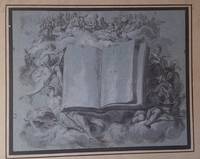
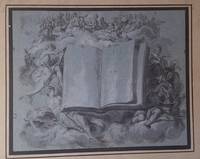
1750762Augusburg 1750. Original Drawing for Book Illustration. 160 x 197 mm. 6 ¼ X 7 ¾ inches. Drawn on blue paper laid down on 19th century paper. Black double fillet ink border. Shows some light wear but otherwise in very good condition. An attractive and well executed drawing in brown and white ink which illustrates the Book of Life surrounded by figures which probably illustrate the four seasons. This motif is crowned by a chorus of angels and saints also drawn in fine detail. Originally thought to be an Italian drawing the small-scale figures and the delicate pen strokes suggest the Augsburg School of the mid-18th century. Artists like Johann Wolfgang Baumgartner Joseph Christ and Godfried Göz all painters of considerable skill and reputation who also worked closely with local publishers creating designs for prints and book illustrations. The choice of blue paper and the application of white ink to heighten the image is typical of Augsburg style of the 1750's. For further information see Thomas Kaufmann's monograph Central European Drawings 1680-1800. Princeton 1989 and an essay by Peter Stoll in OPUS "Empire of Prints. The Imperial City of Augsburg and the Printed Image in the 17th and 18th Centuries" 2016. Both works are well illustrated and show examples of the drawings and prints from Augsburg artists during the period. unknown
305Augsburg. Original Drawing for Book Illustration. 160 x 197 mm. 6 ¼ X 7 ¾ inches. Drawn on blue paper laid down on 19th century paper. Black double fillet ink border. Shows some light wear but otherwise in very good condition. An attractive and well executed drawing in brown and white ink which illustrates the Book of Life surrounded by figures which probably illustrate the four seasons. This motif is crowned by a chorus of angels and saints also drawn in fine detail. Originally thought to be an Italian drawing the small-scale figures and the delicate pen strokes suggest the Augsburg School of the mid-18th century. Artists like Johann Wolfgang Baumgartner Joseph Christ and Godfried Göz all painters of considerable skill and reputation who also worked closely with local publishers creating designs for prints and book illustrations. The choice of blue paper and the application of white ink to heighten the image is typical of Augsburg style of the 1750's. For further information see Thomas Kaufmann's monograph Central European Drawings 1680-1800. Princeton 1989 and an essay by Peter Stoll in OPUS "Empire of Prints. The Imperial City of Augsburg and the Printed Image in the 17th and 18th Centuries" 2016. Both works are well illustrated and show examples of the drawings and prints from Augsburg artists during the period. unknown
18602206161860. With Inscription and descriptive text in pencil. 1 vols. 19 x 14 inches 48.3 x 35.6 cm. Framed and glazed. Fine. With Inscription and descriptive text in pencil. 1 vols. 19 x 14 inches 48.3 x 35.6 cm. unknown
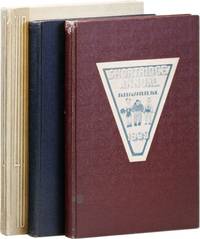
193833807Indianapolis: Shortridge High School Press 1938-1940. First Edition. Three volumes; quarto 25.5 - 27.25cm.; original cloth the two earliest Annuals with color pictorial plates mounted to upper covers last issue pictorially blind-embossed; illus. mostly photographic throughout. Light edge wear tiny loss to cover plate of earliest volume not approaching image or text the usual student signatures throughout else a Very Good or better set. High school yearbooks dating from Vonnegut's sophomore junior and senior years. We find images of Vonnegut on the student council in 1938 and 1940 though never the Fiction Club; ths Social Committee in 1939 and 1940; and the editorial staff in 1940. He was also listed one of the ten most popular boys "Uglymen" in school his senior year. Years later Vonnegut would famously write: "Shortridge High School is my dream of an America with great public schools. [Shortridge High School Press] unknown
1860313321Albany 1860. 62 vintage albumen prints comprising 60 oval gem portraits 1-1/2 x 1 inches 1 larger oval portrait 2-1/8 x 1-5/8 inches and 1 full-length 3-1/2 x 2-1/2 inches. 2 vols. 8vo. Contemporary brown morocco autograph album stamped in gilt and blindW.B. Sprague blindstamp on ffep. A few portrait photos damaged or loose 2 inscriptions are without photos. 62 vintage albumen prints comprising 60 oval gem portraits 1-1/2 x 1 inches 1 larger oval portrait 2-1/8 x 1-5/8 inches and 1 full-length 3-1/2 x 2-1/2 inches. 2 vols. 8vo. Early Albany Law School Photographic Yearbook. A photographic yearbook from the Albany Law School class of 1860 assembled by student Horatio Colony 1835-1917.<br/>Opened in 1851 Albany Law School is the oldest independent law school in the United States. Many of its students in the 1850s and '60s became prominent lawyers and judges.<br/>As is the custom with the professionally produced college photograph yearbooks produced by George Kendall Warren starting in the late 1850s each photograph is inscribed beneath by the sitter with his name and hometown. The album opens with professors Ira Harris Amasa Parker Amos Dean Nathaniel Harris and Levi Chamberlain. Some notable students include Alexander P. Ketchum who became a Colonel and Chief Appraiser of the Port of New York; Clayton H. Delano 1836-1920 who served eight terms as the Town of Ticonderoga's Supervisor and was elected twice to the New York State Assembly; and William S. Opdyke general counsel of the Delaware and Hudson Company. <br/>Horatio Colony 1835-1917 whose picture appears last and is unfortunately obscured by damage assembled this album. The photograph of Levi Chamberlain is inscribed to "Horatio friend and pupil." He was admitted to the bar in New Hampshire and New York in 1860; in 1869 he along with his brother George took over the management of the family business the Faulkner and Colony Woolen Mill. He held several other civic and local government positions before his death in an automobile accident in 1917. His son Horatio Jr. 1900-1977 a poet and novelist established the Colony family home as a museum upon his death.<br/><br/>With: Autograph album containing autographs of acquaintances and some notable figures including Amos Bronson Alcott "A. Bronson Alcott" and Octavius Frothingham "O.B. Frothingham". In near matching black morocco autograph album stamped in blind and gilt extremities rubbed. With later inscription of C.W. Lawbert on front free endpaper. unknown books
305Augsburg. Original Drawing for Book Illustration. 160 x 197 mm. 6 ¼ X 7 ¾ inches. Drawn on blue paper laid down on 19th century paper. Black double fillet ink border. Shows some light wear but otherwise in very good condition. An attractive and well executed drawing in brown and white ink which illustrates the Book of Life surrounded by figures which probably illustrate the four seasons. This motif is crowned by a chorus of angels and saints also drawn in fine detail. Originally thought to be an Italian drawing the small-scale figures and the delicate pen strokes suggest the Augsburg School of the mid-18th century. Artists like Johann Wolfgang Baumgartner Joseph Christ and Godfried Göz all painters of considerable skill and reputation who also worked closely with local publishers creating designs for prints and book illustrations. The choice of blue paper and the application of white ink to heighten the image is typical of Augsburg style of the 1750's. For further information see Thomas Kaufmann's monograph Central European Drawings 1680-1800. Princeton 1989 and an essay by Peter Stoll in OPUS "Empire of Prints. The Imperial City of Augsburg and the Printed Image in the 17th and 18th Centuries" 2016. Both works are well illustrated and show examples of the drawings and prints from Augsburg artists during the period. unknown books
1750762Augusburg 1750. Original Drawing for Book Illustration. 160 x 197 mm. 6 ¼ X 7 ¾ inches. Drawn on blue paper laid down on 19th century paper. Black double fillet ink border. Shows some light wear but otherwise in very good condition. An attractive and well executed drawing in brown and white ink which illustrates the Book of Life surrounded by figures which probably illustrate the four seasons. This motif is crowned by a chorus of angels and saints also drawn in fine detail. Originally thought to be an Italian drawing the small-scale figures and the delicate pen strokes suggest the Augsburg School of the mid-18th century. Artists like Johann Wolfgang Baumgartner Joseph Christ and Godfried Göz all painters of  considerable skill and reputation who also worked closely with local publishers creating designs for prints and book illustrations. The choice of blue paper and the application of white ink to heighten the image is typical of Augsburg style of the 1750's. For further information see Thomas Kaufmann's monograph Central European Drawings 1680-1800. Princeton 1989 and an essay by Peter Stoll in OPUS "Empire of Prints. The Imperial City of Augsburg and the Printed Image in the 17th and 18th Centuries" 2016. Both works are well illustrated and show examples of the drawings and prints from Augsburg artists during the period. unknown books
01-085816th Century . Bartsch XV no. 2. Engraving. 133 x 154 mm. 16th Century unknown
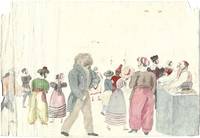
186018931860. Watercolor and pencil on cream wove J Whatman 1827 paper with a partial watermark 7 x 10 1/8 inches 176 x 256 mm the full sheet. The left sheet edge has significant wear; the result of its removal from a page in an album to which the sheet was tipped in. There is also a horizontal tear in the center left sheet edge which extends approximately one inch into the image through the image of the figure with outstretched arms. Small corner losses at the the top right and left sheet as well as a small 1/4 inch at the lower left corner. Colors are extensive and saturated. unknown
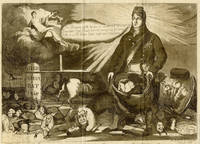
18111538London: The Satirist 1811. Etching with aquatint on buff wove paper with an 1808 watermark 9 3/4 x 13 inches 248 x 330 mm wide margins. Scattered paper repairs on the verso as well as four vertical hard creases and one horizontal crease in the lower quadrant of the sheet. Scattered uniform age tone. The Satirist or the Censor of the Times was a controversial 19th-century British newspaper which featured reports of scandals involving well known residents of London. It was published by Barnard Gregory who faced multiple libel charges and was later imprisoned due to its articles. The Satirist unknown
18602206161860. With Inscription and descriptive text in pencil. 1 vols. 19 x 14 inches 48.3 x 35.6 cm. Framed and glazed. Fine. With Inscription and descriptive text in pencil. 1 vols. 19 x 14 inches 48.3 x 35.6 cm. unknown books
183426035Italy 1834. Pen-and-ink watercolour and gouache painted black border titled and dated in white gouache in the lower margin within the border. Lovely 19th-century watercolour of Palermo.<br/> <br/> Catering to the foreigners flocking to the region on the Grand Tour this lovely watercolour shows the town of Palermo with its beautiful hills and mountains in the background with a large fort in the harbour with a British and French ship beside it. The sky is awash in pinks and blues displaying the incredible light of the region. unknown
193833807Indianapolis: Shortridge High School Press 1938-1940. First Edition. Three volumes; quarto 25.5 - 27.25cm.; original cloth the two earliest Annuals with color pictorial plates mounted to upper covers last issue pictorially blind-embossed; illus. mostly photographic throughout. Light edge wear tiny loss to cover plate of earliest volume not approaching image or text the usual student signatures throughout else a Very Good or better set. High school yearbooks dating from Vonnegut's sophomore junior and senior years. We find images of Vonnegut on the student council in 1938 and 1940 though never the Fiction Club; ths Social Committee in 1939 and 1940; and the editorial staff in 1940. He was also listed one of the ten most popluar boys "Uglymen" in school his senior year. Years later Vonnegut would famously write: "Shortridge High School is my dream of an America with great public schools. [Shortridge High School Press] unknown books
2081502111906891Tianjin Ancient Books Publishing House N.A. Soft Cover. Fine. The book is in fine condition. Tianjin Ancient Books Publishing House paperback
Acquatinta stampata ad inchiostro bistro, 1781, firmata in lastra in basso a destra e datate in basso al centro. Magnifica prova, impressa su carta vergata coeva con filigrana, sottili margini, leggere abrasioni al verso, nel complesso in eccellente stato di conservazione. Una delle quattro famose vedute del carnevale romane incise dal Sandby su disegno di David Allan (Alloa 1744 - Edimburgo 1796). Alla grande maggioranza di pitture, incisioni,acquerelli e disegni che illustrano le feste del carnevale romano con un eccesso di "colore", si contrappone questa serie, che descrive quei medesimi festosi eventi con un asciutto e spiritoso sguardo pur rilevandone la nascosta eleganza e sontuosità. Le acquetinte di Sandby sono tratte da una serie di dieci disegni di Allan eseguiti durante i suoi soggiorni romani e ora conservati nella Collezione Reale del Castello di Windsor. La tecnica dell’acquatinta, conferisce all’opera quel particolare tono simile all’acquarello rendendo le opere molto affascinanti. Aquatint printed in bistro ink, 1781, signed in plate at lower right and dated at lower center. Magnificent proof, printed on coeval laid paper with watermark, thin margins, light abrasions on verso, overall in excellent condition. One of the four famous Roman carnival views engraved by Sandby from a drawing by David Allan (Alloa 1744 - Edinburgh 1796). To the great majority of paintings, engravings, watercolors and drawings that illustrate the festivities of the Roman carnival with an excess of "color", is contrasted this series, which describes those same festive events with a dry and witty look while noting the hidden elegance and sumptuousness. Sandby's aquatints are taken from a series of ten drawings by Allan made during his Roman sojourns and now housed in the Royal Collection of Windsor Castle. Paul Sandby was a landscape painter and printmaker. David Allan was one of the first painters in Scotland to record the everyday life of ordinary people. He was based in Rome from around 1767 to 1777 where he painted historical subjects, portraits and the everyday life around him in a series of watercolours. In Scotland he enjoyed a successful career as both an artist and a teacher of art. Some of David Allan's watercolours of Rome were copied by Paul Sandby in London, as prints. The technique of aquatint (used here) allowed the engraver to create the effect of colour washes with the addition of etched lines for detail. This is a technique that provides an additional layer of meaning to the scene. The aquatint allows tonal variation and contrast which in turn creates atmosphere. There is a tremendous amount of detail in the print, and any British observer at the time would have received a good impression of what Rome was like from this print. Sandby's re-creation of Allan's watercolour would have made the image much more accessible through multiple copies. Only the most popular or marketable images would be copied as prints. The composition is quite complex. The background of the street and buildings is rendered with single point perspective, where the landscape appears to recede away to a single point in the distance. The viewpoint Allan chose was a low one. This means that the buildings appear to loom over the scene and a lot of sky is shown. In contrast, the action on the ground occupies only the lower third of the composition; Allan did not "zoom in" on any one aspect but created a general view of the scene. In this view, two British travellers on horseback are confronted by the extravagant costumes and masked figures from the entertainers at a Roman carnival. Despite their politeness these grotesque figures are slightly disturbing. Perhaps this scene demonstrates the alien and disorientating feeling of visiting a new city and discovering bizarre customs which the traveller has never experienced before.