34 831 résultats
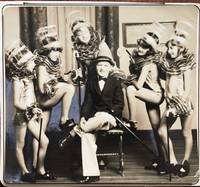
193058055Portland OR: Hollywood College of Music Dancing & Fine Arts Baker Studio Granada Studio La Vere Photo Shoppe Photo Craft Studios ca. 1930-1933. Oblong 4to. 24 original photographs all preserved in archival mylar sleeves sized 6.25 x 7 in. up to 8 x 10 in. some w/ photographer’s imprint w/in negative others w/ manuscript captions added a few w/ annotations and/or photographer’s instructions on versos all with bright strong contrast a few w/ offsetting from previous mounting on versos and one w/ very small pinholes at corners from prior mounting. Recent cloth binder stamping front cover excellent grouping. These photographs vividly document the dance and music studio operated by Annabelle Knowles reflecting the fast evolving costumes and aesthetics of the twilight of the Roaring 20’s as the U.S. descended into the Great Depression. These photos also clearly reflect the influence of Gus Edwards 1879-1945 vaudeville’s premier producer of kiddie acts and who had produced and released the shorts “Kiddie Revue†in 1930 and 1931. His influence was not only driven by his songs “By the Light of the Silvery Moon & “School Days†but also discovering such stars as Groucho Marx Eddie Cantor Mae Murray Sally Rand and many others. The images depict girls in two-piece outfits in front of Art Deco staging for “Body and Soulâ€; bare-backed girls in Flapper Era inspired costumes for chorus line “Kiddie Revueâ€; song and dance routines featuring Ronald Chetwood in top hat with Marcile Shillito Virginia Collins and chorus line in Jazz Age era costumes and canes; and several show Barbara Jane Wicks Shirley Jay Mulkey and Sunny Dentler in Spanish inspired costumes for “Baby Vanities.†Another shows adolescent boy and girl dance team in an “Apache†dance inspired costume number. The Hollywood College of Music Dance & Fine Arts offered classes and instruction in all ages with the last few photos showing teenage girls in chorus line with short hair coquettish expressions and teamwork or chorus line numbers. Annabelle Knowles 1900-1989 was a musician and dancer who founded the Hollywood College of Music Dancing & FIne Arts at 4112 NE Sandy Blvd. some time in the late 1920’s. Most of the street directory references focus on 1929-1932 and her British-America theatre-director husband at the time Vincent Knowles 1883-1944 worked at the studio as well. Baker 1882-1972 was a longtime commercial studio photographer in Portland OR who had initially begun as a photographer with noted tourist travel guide Howard Eaton photographing tours through National Pakrs. Beem 1892-1984 was founder and photographer at Granada Studio located in the 1930’s at 515 Swetland Building in Portland. Centlivere 1878-1964 owned and operated La Vere Photo Shoppe and Photo Craft Studios on Sandy Blvd. in Portland for nearly all of his career. We could find no similar collections or photographs or even references to Annabelle Knowles and very few examples of any of these three photography studios in institutional holdings. Hollywood College of Music, Dancing & Fine Arts, Baker Studio, Granada Studio, La Vere Photo Shoppe, Photo Craft Studios, hardcover
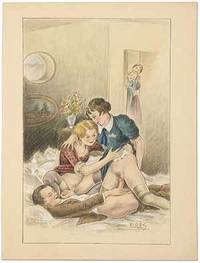
1935334200Paris: no publisher 1935. Near Fine. Hand colored lithographic print on fine wove paper. Image size approximately 7" x 11". Likely removed from a folio volume as indicated by a thin stub tipped-in along the left edge of the sheet. Near fine. Possibly one of the eight original Eres prints for the pornographic novel Aventures d'une satyre attributed to Jane de Rozat published in Paris in the mid-1930s. no publisher unknown
1930334203not indicated: not indicated 1930. Unbound. Near Fine. Hand colored pochoir print on fine wove paper. Image size height preceding width measures approximately 28 x 18 cm. Near fine. Signed "ERES." Could be one of the eight original prints also signed "Eres" for the pornographic novel Aventures d'une satyre attributed to Jane de Rozat published in Paris in the mid-1930s. not indicated unknown
19412111902160501206Published by Shigeki Nishizaki Kaifeng City 1941. Soft Cover. Fine. Number of pages: A5 2 columns 118p school photo and other 3p Published by Shigeki Nishizaki, Kaifeng City paperback
1943277008Kamnik district Slovenia: Tehnika RK VI 1943. 30pp. 8vo mimeographed text with images original tan wrappers with mimeographed cover.<br/><br/> This rare surviving pamphlet from World War II was produced by the Yugoslav Partisans the most accomplished armed resistance movement against the Axis occupation of Europe. Starting out as a guerilla group the Partisans soon created a complete underground society based on Communist principles including schools government and medical institutions financial systems and publishing presses. This pamphlet produced by one such press likely hidden in the mountains or forests of Slovenia addresses an emergent need in such a new clandestine society: that for maps. It proceeds in logical order: geographical vocabulary instructions for making field maps and later more sophisticated and symbolic drafting techniques. Within this technical know-how it also communicates tactical military advice that the Partisan guerillas employed in their battles with Axis armies. This tactical quality of the publication is most in evidence in the pamphlets many striking diagrams which demonstrate the importance of visual knowledge in situations of survival.<BR><BR>This pamphlet was one of many Partisan publications designed to educate protect and encourage members of the movement. It is particularly fascinating for its simple means of production since the secrecy of Partisan operations limited them to mechanical methods such as mimeographs--in witness here--as well as heliotypes linocuts and typewriting. Given its fragility the pamphlet is in excellent condition with clean text. Slight stains and some very small tears in margins. As one of the few Partisan publications on cartography this pamphlet is a rare and fascinating record of the World War II resistance.<br/><br/> Tehnika RK VI unknown books
18812091202133201037Shinshichi Okajima and others 1881. Soft Cover. Fine. Number of books: 50 books in total Shinshichi Okajima and others paperback
191112648Seattle 1911. 13.25 x 8.75" stitched plain grey wrappers 22 leaves illustrated with pasted in photographic magazine clippings; title page 15 typed text pages 12 page diary two pages of poetry and one page of statistics four illustration pages one page with a newspaper clipping one blank. A typescript account of an all-girls trip taken by the students of Professor Henry Landes at the University of Washington. Called the "Traveling School of Geology" this five week excursion to Victoria Island and to Northwest and Southwest Washington State consisted of ten girls and five staff members including "Madame Oakley" a chaperone and Landes Dean of Science and founding member of the University's geology department each individual is listed on the title page. This vivid playful account is mostly about adventures and hijinks rather than science with descriptions of clothing food and flirtations "studying heology instead of geology" throughout as well as lively accounts of mountain climbing camping local color and the participants. The group first toured Victoria Island and the San Juan Islands before visited the Cascades including an ascent of Pinnacle Peak and the climbing of glaciers on Mt. Rainier. The close bonds of the women comes through quite strongly with their silly nicknames "Madame Moraine" "Bonnie Boulder" etc used throughout and the long poem at the end describing the various subsets of five within the ten students "There were five who wore knickers and five who wore skirts and five who on the mountain always wore shirts." <br /> <br /> The confident carefree personalities of the girls are apparent for instance when one girl climbs onto an oil can to give a speech on a wharf in coastal Washington or when the girls spontaneously jump into the water to swim much to the chagrin of Professor Landes:<br /> <br /> "On the wharf due to 'Germany's' oratorical ability she was hastily lifted to the top of an oil can in order that she might give us an example of her 'ladies and gentleman'. During this flowery outburst our eminent fishologist 'Middy' employed her leisure time chasing 'Uneeda' with a rat-fish and 'Boots' made a doll-baby of kelp.It was about this time that 'Uneeda' replied to 'Madam' that she was studying heology and not geology. Was it this reply that caused Mr. Gilliam to offer to furnish her specimens of tear drop rocks at La Conner" July 11 1911<br /> <br /> "The 'Call of the Wild' was so strong that they could resist it no longer. Away they went into the water!.They were seagulls. They could scarcely be distinguished from their untamed relatives as they shrieked to each other while paddling around in the water.The Professor finally succeeded in coaxing them out of the water by promising them a launch-ride to Tikeland." August 1 1911<br /> <br /> Of particular interest are the passages describing the group as they hiked trails climbed mountains and crossed glaciers:<br /> <br /> "Another plunge into the forest for seven miles down grade and camp was near. 'Uneeda' began to lag so 'Bonnie' gave her a fifth egg which revived her. 'Dude' begged to be left by the wayside to die but Prof. Landes called her attention to a hickory stick and no more complaint was heard. Dinner served at 7:00 p.m. and all unconscious by 9:00 after a feast of cherries brought in by 'Boots'." July 8 1911<br /> <br /> "At 8:30 A.M. started for Pinnacle Peak to get what was to many of the party their first experience in mountain climbing. Antitalus in her No. 8 boots several skirtless among them modest Dakota and all with hideously painted faces carrying lunches and gay bandannas tied to their belts.Prof Landes determined to take everyone to the summit. After constant help from the patient professor Tailus gave a shout of victory from the top and considered herself quite a heroine.That night 'Uneeda' still held her own at dinner. Ate in relays and won an eating contest with 'Milwaukee'. For a part of the day a man joined our party and of course the 'Dude' monopolized him." July 19 1911<br /> <br /> A page of statistics at the end notes that the group traveled 1749 miles in total of which 184.5 was on foot. A vivid playful account of an early outdoor education expedition for women. In good condition with printed title label that was once on cover missing chipping to edges of wraps stain to lower corner of front wrap. paperback
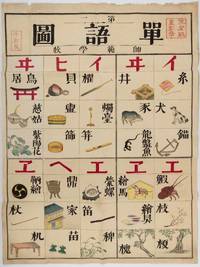
1873214113Japan. Meiji 6 1873. Four very attractive colour folded woodblock school posters 60 x 78cm each with accompanying woodblock printed textbook 32 double-folded leaves 22.5 x 15cm. Edges of posters worn with some minimal loss at margins the accompanying textbook is worn at edges with some thumb marks at lower corners but sound and generally clean. Overall good. Offers a fascinating glimpse into the beginnings of modern Japanese education. A wonderful collection of four primary school colour posters and a teacher's textbook dating to the very beginning of modern school education in Japan. The four posters contain sets of beautifully coloured and delicately printed pictures illustrating key words which children would be taught to read together with the corresponding kanji characters. The posters are divided by theme - one showing parts of the body and clothes; one showing crockery and cooking utensils; one with animals plants and tools; and one household items including a clock chair and abacus. They are particularly interesting for their combination of traditional Japanese and western items. The accompanying woodblock print text book 師範学校小学教授法 Shihan gakkō shōgaku kyōjuhō was published in Meiji 6 1873 and show how to explain each item in the classroom. <br> <br>The posters have the chops of Chikuma Prefecture current Nagano Prefecture and 1000 limited copies at the top. . hardcover
01-085716th Century . Engraving. Bartsch XV no. 3. 135 x 145 mm. 16th Century unknown
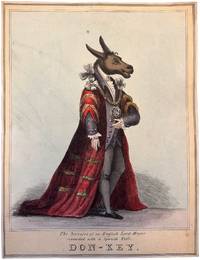
18301891London 1830. Lithograph with hand coloring in watercolor on cream wove paper 12 1/4 x 9 5/16 inches 312 x 235 mm full margins. In good condition with some light areas of minor foxing throughout. Hand coloring is extensive and vibrant. An ass wears his Lord Mayor's gown and chain over court dress with big bows on his shoulders. Published in November 1830 this anthropomorphic satirical caricature is of Sir John Key 1st Baronet 16 August 1794 - 14 July 1858 who was a wholesale stationer and Whig politician in England. He was elected Sheriff of the City of London in 1824 and Lord Mayor of London for two years from 1830 to 1832. <br /> <br /> An uncolored impression of this work may be found in the permanent collection of the British Museum accession No. 16302. unknown
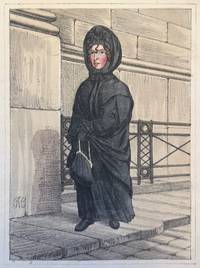
18201889London 1820. Lithograph with handcoloring in watercolor 9 x 6 1/2 inches 230 x 165 mm full margins. Light pencil inscriptions in the lower margins which are largely illegible. Light handling wear and some surface soiling otherwise in good condition with beautiful saturated watercolor work in the area of the subject's face. Whitehead's brother Philip was employed by the Bank of England from 1797 to 1810. During his employment at the Bank Philip Whitehead "adopted an extravagant lifestyle" and evidence came to light that he had defrauded Robarts & Co. by "forging an acceptance to a Bill." He was charged with forgery in 1811 and executed on 29 January 1812. The news of her brother's conviction was kept from his sister Sarah as long as possible. Learning of the execution Sarah Whitehead's mental health became unstable and she began to visit the Bank daily asking if Phillip was there. This continued until 1818 when the Directors offered Whitehead a financial grant on the condition that she stopped coming to the bank. Whitehead wore black crepe clothing which was a sign of mourning and as a result became known as the "Black Nun." To this day Whitehead's ghost reputedly haunts the Bank of England as well as the area on Threadneedle Street nearby. The myth of Whitehead's ghost appears in the poem New Year Letter by W. H. Auden. unknown
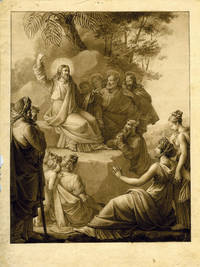
886Pen and ink with wash on watermarked J Whatman 1814 paper 11 x 8 1/4 280 x 210 mm. Scattered minor edge losses at the left sheet edge well outside of image area. Minor handling wear otherwise in very good condition. A truly masterful drawing by an unknown draughtsman. unknown
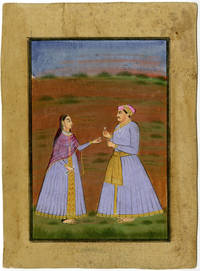
9191750. Gouache and ink with heightening in gold on handmade card stock 10 5/8 x 7 3/4 inches 270 x 197 mm the full sheet. Margins and verso are washed in tea with minor scattered surface soiling and some areas of light scattered discoloration. The top right and bottom left corners are very slightly dog-eared well outside of the image area. Colors remain fresh and well saturated. Mirza Nur-ud-Din Muhammad Salim 30 August 1569 - 28 October 1627 known by his imperial name Jahangir "Conqueror of the World' was the fourth Mughal Emperor who ruled from 1605 until his death in 1627. He was the third and only surviving son of Akbar and his chief empress Mariam-uz-Zamani born to them in the year 1569. He was named after the Indian Sufi saint Salim Chishti. <br /> - Singh Pashaura; Fenech Louis E. eds. 2014. The Oxford handbook of Sikh studies. Oxford University Press. p. 647. ISBN 978-0-19-969930-8. unknown
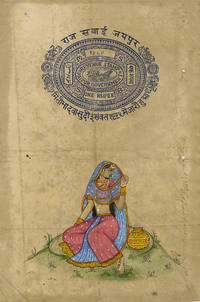
189513361895. Ink and gouache with gold heightening on fibrous brown laid paper with a Jaipur Court Fee tax stamp in purple ink 13 3/8 x 8 3/4 inches 340 x 222 mm. Toning handling creases and minor scattered surface soiling throughout. A typed and signed court order dated 1891 in reference to a landlord/tenant dispute appears on the verso as well as the purple blindstamp of the Treasury of Jaipur. There are scattered coeval Hindi inscriptions in ink on the recto. The following text appears typed on the verso:<br /> <br /> "Maloom order of 2nd July 1891 and 5 party No. b applied to the P.I.B. Department for redress.<br /> <br /> The P.W. Member opined that party No. b is entitled to live in the quarters which had been continually occupied by them and party No.a should not interfere with the other party in respect of the quarters which should be restored to the latter. <br /> <br /> Resolution No.34. <br /> <br /> Resolved that the proposal of the P.W.Member be accepted.<br /> <br /> TRUE COPY<br /> <br /> Registrar<br /> <br /> Mahakma Khas Jaipur."<br /> <br /> <br /> The first revenue stamps in India were issued in the mid-nineteenth century during the Raj and they are still being issued to this day. Apart from issues for the whole of India many princely states provinces and other states also had or still have their own revenue stamp issues. <br /> <br /> Before independence Indian revenue stamps were closely modeled on similar designs from Great Britain as is the case with this carriage motif stamp from Jaipur. The stamps were issued to denote various denominations including rupees and annas. An anna or Änna was a currency unit formerly used in British India equal to 1â„16 of a rupee. It was subdivided into four old Paisa or twelve pies thus there were 192 pies in a rupee. When the rupee was decimalized and subdivided into 100 new paise one anna was therefore equivalent to 6.25 paise. This particular stamp was used as evidence of court taxes remitted for property dealings. unknown
2111902158406808Sanseido N.A. Soft Cover. Fine. Number of pages: 232p Size: 19cm Sanseido paperback
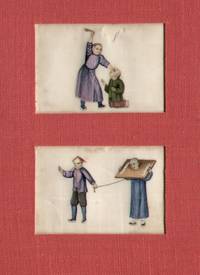
30018401Canton ca. 1800-1820 Lam-Qua. Red flax mat six goauche color paintings on pith paper each 10 x 7 cm two per mat very good clean two with marginal chipsimage not affected meticulously color drawn in much detail. R A R E . . . THE SUITE OF SIX COLOR GOUACHE PAINTINGS . . Begins with the a painting of Imperial police bringing the accused to where he will be punished. He wears a cangue or a large wooden collar clamped around his neck with his crime written on paper which is then glued to the wood. Image two shows the guilty on his knees being beaten with a leather strap by the punisher. Image three shows the policeman pulling a chain connected to a metal ring on the neck of the accused. The next shows the image of a large rock connected to a chain and the accused sitting on the rock with the chain fastened to his leg. The fifth shows the magistrate pointing his finger at the guilty as he while being admonished the guilty is forced to kneel on small rocks while a policeman holds ears. The last image shows the executioner with a long sword at the ready while the accused has a very sour look on his face his hands tied behind his back with his crime written on a long piece of wood at his side. It was common to parade the guilty through the streets for all to see the criminal as he was led to the execution grounds. . LAM-QUA TING-QUA SCHOOL: The works are done in the Canton style of Lam-Qua and his brother Ting-qua. See item #2 below for a link. . Ting-qua born ca. 1809; flourished 1840-70. He was the brother of Lam-Qua 1801-1860 and probably a close relation of Spoilum. Ting-qua's studio at 16 China Street Guangzhou was perhaps the most prolific source of Chinese export paintings of its time. Working in a manner influenced by Western artistic traditions Ting-qua and the painters of his studio restricted themselves to gouache and water-colors perhaps to avoid rivalry with Lam-qua's oil paintings. Their pictures which were often sold in sets." Quoted from item #2 below. . PITH PAPER: The paintings were done on pith paper. "Pith paper or rice paper" a misnomer as it is sometimes known is made from the inner pith of the plant Tetrapanex papyrifera which is a member of the Araliaceae family. The plant is a shrub native to Southern China and Taiwan. As well as a painting material pith paper was used to make artificial flowers and surgical dressings." Cited from item #1 below. . THE LEGAL SYSTEM OF CHINA IN EARLY 19TH CENTURY: Justice was swift and usually done to make an example of the accused. If the accused pleaded guilty and confessed his punishment was lessoned. If he persisted in innocence even though he was not guilty his punishment was more severe. Showing a cooperative attitude was of advantage. Nearly all people accused of a crime were assumed to be guilty. The punishment for various crimes were commonly known and justice was meted out by the magistrate. . RARITY: Gouache pith paintings are now rare most were damaged cracked and brittle rendering them useless. The few that survived are considered RARE and uncommon. The paintings were drawn with much skill and patience and were for the most part drawn for and sold to foreigners in the treaty ports of China in the early 19th century. Drawn with a fine brush in vivid colors the paintings depicted things that would fascinate foreigners and encourage them to bring home as souvenirs. The current examples often caught the eye of foreigners who may have actually seen some form of public punishment or execution. . CONDITION: The work is remarkable clean and solid. As usual when ever pith paper is fastened at the corners there is a reaction to moisture in the air and the paper will expand or contract and thus snap its connection. By and large these works are not damaged except for two corners where there was some loss. Please see link #1 below on how to mount and care for pith paintings. These can be re-matted per the link and preserved on acid-free paper and reframed for display. . Color photos are posted to our website. . BIBLIOGRAPHY: . C.L. Crossman: THE DECORATIVE ARTS OF THE CHINA TRADE p.173-203 and the associated color and b.w. photo examples. C.L. Crossman THE CHINA TRADE p.93-120 and the photos. A. Chu: ORIENTAL ANTIQUES AND COLLECTIBLES pp.62-67 photo #60. 1: see: artfacts dot org/artinfo/articals/pith_paper dot html 2. www dot answers dot com/topic/tingqua 3. Wikipedia: Lam_Qua C.L. Crossman: THE DECORATIVE ARTS OF THE CHINA TRADE p.173-203 and the associated color and b.w. photo examples. C.L. Crossman THE CHINA TRADE p.93-120 and the photos. A. Chu: ORIENTAL ANTIQUES AND COLLECTIBLES pp.62-67 photo #60. . unknown
222918Paris, Imprimerie du Comité de salut public, an III (1794) 41 parties en un vol. in-4, titre, puis pagination multiple, dérelié.
19307901919-1921 Journal d'un peintre Edition "Quatre Vents" , Paris - 1930. Tiré à 305 exemplaires numérotés, plus quelques exemplaires hors commerce numérotés en chiffres romains . Un des exemplaires hors-commerce. Ce volume comprend 16 aquarelles hors-texte, 13 in-texte, 5 bandeaux, 5 lettrines et une couverture reproduites par procédé JACOMET. format : broché, 22.5 x 28.5 cm, 300 pages, couverture rempliée. couverture salie avec une marque de pli, dédicace autographe en page de garde, marques de plis sur le dos, brochage un peu lâche, sinon bel état intérieur Rare ouvrage retraçant le périple du peintre Alexis Gritchenko en Turquie de 1919 à 1921 avant son installation en France magnifiquement illustré .
Acquaforte su ferro, 1579 circa. Primo stato di due, avanti la numerazione. Pubblicata nel Catalogus gloriae mundi, di Barthélemy de Chasseneuz (ca. 1480-1541) – noto anche con la forma latinizzata del nome Bartholomaeus Cassaneus, edito Francoforte nel 1579 da Sigmund Feyerabend. La tavola raffigura un re seduto su un trono che tiene uno scettro sullo sfondo centrale, a sinistra uno scriba, ai lati della stanza i consiglieri del re, soldati in piedi in primo piano. Inserita in una cornice ovale, gli angoli riempiti con motivi ornamentali. Il Catalogus gloriae mundi, tipico prodotto dell’enciclopedismo rinascimentale, opera umanistica e giuridica, si incentrava sull’onore, problema per definizione interdisciplinare e di vastissimo successo nella pubblicistica cinquecentesca. Ma nel saggio di Chasseneuz il concetto di onore divenne addirittura la griglia di una vera e propria enciclopedia di tutto il creato. In dodici libri l’intera esperienza secolare e celeste si condensava compatta, ritrovando intorno all’onore il proprio archetipico motivo d’ordine: I. considerazioni generali sull’onore II. onori e ordini dell’uomo e della donna in generale III. onori e ordini degli spiriti celesti e infernali IV. onori e ordini degli ecclesiastici V. onori e ordini dei Principi VI. onori e ordini degli ufficiali del sacro palazzo VII. onori e ordini dei magistrati e di tutti gli ufficiali di giustizia VIII. onori e ordini dei nobili IX. onori e ordini dei militari X. onori e ordini delle scienze e dei letterati XI. onori e ordini dei plebei e degli artigiani XII. onori e ordini di pietre, vegetali, animali e di tutti i rimanenti esseri, celesti e terrestri. Di famiglia borghese, Bathélemy de Chasseneuz studiò diritto alle Università di Dole, Poitiers, Bologna, Torino e Pavia. Dopo l’occupazione del Ducato di Milano da parte di Carlo VIII vi svolse incarichi giudiziari, conseguì nel 1502 il dottorato in utroque ed accompagnò Charles d’Amboise nella sua spedizione contro Bologna. Esercitò poi l’avvocatura ad Autun, divenendo avvocato del Re e baglivo dell’abbazia di Saint Martin d’Autun. Consigliere nel parlamento di Digione dal 1525, nel parlamento di Parigi dal 1531, fu presidente in quello di Aix dal 1532. Morì nel 1541. Di lui rimangono a stampa una raccolta di pareri legali, i commentari sulle consuetudini del Ducato di Borgogna e, appunto, il Catalogo della gloria del mondo. La prima edizione dell’opera fu pubblicata nel 1529. Nel 1579 Sigmund Feyerabend, tipografo di Francoforte, decise di pubblicare una nuova edizione dell’opera, arricchita dalle illustrazioni realizzate ad hoc da Jost Amman allo scopo di rendere più facilmente comprensibili le teorie del giurista e valorizzare maggiormente l’opera. Magnifica prova, ricca di toni, impressa su carta vergata coeva, rifilata al rame, tracce di colla al verso, per il resto in ottimo stato di conservazione. Bibliografia The New Hollstein, Part VI.87.144.23.i, p. 87. Etching on iron, 1579, unlettered. First state, of two, before the numbering 6 added lower right in the plate. The plate depicts a king sitting on a throne holding a sceptre in centre background, on the left a scribe, on either side of the room the king's advisors, soldiers standing in the foreground. Set in an oval frame, the corners filled with strapwork ornaments. A fine impression, printed on contemporary laid paper, trimmed to the paltemark, very good condition. Printed in Catalogus Gloriae Mundi by Barthélemy de Chasseneuz, printed in 1579, Frankfurt - Sigmund Feyerabend. Barthélemy de Chasseneuz (1480–1541) was a lawyer, and he was neither a narrow-minded one nor a bad one – quite the opposite. He had attended French and Italian universities and had been the student of some of the most famous teachers of his time. The talented legal scholar had acquired experience at the court of the duke of Milan and even at the court of the Pope himself. And yet, he returned to his home country in 1506 where he took up high offices. As his contemporaries, Barthélemy de Chasseneuz was convinced that everything on earth had a precise order. He believed that any kind of dispute arose solely from the fact that humankind was unaware of the exact structure of this order. It was obvious that the King of France was of higher status than a juggler. But what about the King of France and the King of Aragon? Who of them was of higher status? Being a good lawyer, Chasseneuz sat down and studied the sources. He wrote more than 1,000 pages setting out which office held which rank based on all theological, philosophical and legal sources available to him – from the hierarchy of the Heavens to the social ranks of humankind and to animate and inanimate nature. In 1529, this book was published for the first time. Chasseneuz’ book was of huge importance to all those who had to deal with issues of ceremonial protocol. All princes and city councillors had enough money to afford an expensive book. That’s why, at some point during the 70s of the 16th century, Sigmund Feyerabend from Frankfurt decided to publish a new edition of Chasseneuz’ work. He did not simply reprint the first edition, instead, he hired the famous book illustrator Jost Amman to transform Barthélemy de Chasseneuz’ theoretical considerations into impressive – and easily understandable – copper engravings. Bibliografia The New Hollstein, Part VI.87.144.23.i, p. 87.
Acquaforte. Lastra mm 118x152, foglio 160x222 mm. Firma a matita a sinistra Luigi Bart. Titolo a matita in basso a sinistra non ben leggibile. Possiamo ipotizzare Invadenza. L’incisione non è catalogata in nessuno dei numerosi repertori sull’artista da noi consultati; è notorio che la catalogazione delle opere di Bartolini non è ancora completa. Bellissima prova, impressa su carta coeva, piccolo strappo perfettamente restaurato nella parte superiore, leggera abrasione al verso, per il resto in ottimo stato di conservazione. Luigi Bartolini è considerato uno dei maggiori incisori italiani del Novecento, insieme a Giorgio Morandi e Giuseppe Viviani. Oltre ad essere un prolifico incisore (al suo attivo oltre mille acqueforti), fu anche pittore e scrittore. Partecipò sia come pittore che come incisore a diverse edizioni della Biennale di Venezia dal 1928 al 1962. Presente a varie manifestazioni artistiche, sviluppò diverse maniere definite: ‘maniera bionda’, ‘lineare’ e ‘nera’. Ricordiamo soprattutto le acqueforti della serie Marche e della serie Sicilia. Iniziò la sua produzione grafica nel 1914 e il suo stile si rifà alla tradizione naturalistica dell’Ottocento. Molte sue incisioni si possono ricollegare ad alcune opere del Goya, di Telemaco Signorini e di Giovanni Fattori. Eccellente nella rappresentazione della natura morta e del paesaggio, spesso il Bartolini rappresentò dolcemente le cose e gli oggetti più umili, i soggetti di natura più dimessi. In essi ritroviamo il sentimento che diviene immagine e la forma che si sviluppa in espressione. Con Bartolini l’incisione torna ad essere un mezzo di espressione poetica libera dal simbolismo e dal vedutismo allora in voga presso le accademie. Nelle sue acqueforti prevale ora un tratteggio leggero (genere biondo), ora una ricerca del chiaroscuro alla Rembrandt (genere nero). Etching. Plate mm 118x152, sheet 160x222 mm. Signature in pencil on the left Luigi Bart. Title in pencil at lower left not well readable. We can assume Invadenza. This work is not catalogued in any of the several repertories we consulted about the artist; it is well known that the cataloguing of Bartolini's works is not yet complete. Beautiful proof, printed on contemporary paper, small tear perfectly restored in the upper part, light abrasion on the back, otherwise in excellent condition. Born in Cupramontana near Ancona, Luigi Bartolini was the twentieth century Italian etcher, who came closest to the stature of his great rival, Morandi. As a teenager, he saw the collection of etchings, including work by Callot, owned by the Corradi family in Iesi. From 1907 to 1910 Bartolini studied at the Istituto di Belle Arti in Siena, and started to etch c. 1909. He moved to Rome in 1910, where until 1912 he frequented the Accademia di Belle Arti, while also attending lectures on literature and the history of art, and courses on anatomy at the University in Rome. Bartolini studied the etchings of Goya and took lessons on drawing at the Accademia di Spagna. From there, he went to Florence in 1913, where he attended the Scuola del nudo. Bartolini continued his anatomical research, as well as studying architecture, making himself the most assiduous student of all Italian twentieth century printmakers. He also visited the Uffizi and Florentine print dealers to look at the etchings of Rembrandt and Fattori. Bartolini painted his first oils just before the outbreak of the First World War. Although he painted pictures throughout the rest of his career, and was awarded the Premio Marzotto for them in 1956, they have been far eclipsed in fame by his etchings and writings. During the First World War, Bartolini published his first collection of poetry. A very prolific and accomplished writer, in this field he is best known today as the author of the novel, 'Ladri di biciclette' (Bicycle thieves), of 1946, which was quickly turned into a celebrated film by Vittorio de Sica and Cesar Zavattini. After the First World War, Bartolini held a series of minor teaching posts in Macerata, Sassari, Avezzano, Pola, and Caltagirone, while he continued to etch, and started a long career as a polemical journalist and critic of art and architecture. From 1923 to 1929, he wrote for the Naples periodical, 'Cimento', but he also contributed to 'Il Selvaggio', 'Quadrivio', 'Italia letteraria', and 'L'Ambrosiana'. Bartolini's 1924 exhibition of etchings at the Casa d'Arte Bragaglia in Rome was a great success, and later that year he showed 70 etched landscapes of the Marches at the Casa Palazzo di Roma. The following year he visited Paris, where he paid particular attention to the paintings of Van Gogh. Bartolini's political convictions led him to being assaulted by Fascists and hospitalised in 1928. Two years later, he won a prize at the Venice Biennale, where he had exhibited a portfolio of etchings. In 1930, the Turin publisher, Buratti, began to issue a series of portfolios of etchings by contemporary Italian artists under the editorship of Cipriano Oppi, selecting Bartolini for the first album. The following year, Buratti published 'Le carte parlanti', a portfolio of 10 of Bartolini's etchings, which was published in an edition of 20. In 1932, Bartolini shared the first prize at the Prima mostra dell'incisione moderna at the Uffizi with Morandi and Boccioni. His close friend, the leading anti-Fascist art historian, Lionello Venturi, acted as his agent selling his etchings in Paris. Bartolini's correspondence with his compatriots in exile led to his imprisonment, from which he was released on Mussolini's personal intervention. He was then placed under political surveillance. From 1933 to 1938, Bartolini taught in Merano, where he painted and etched in the open air, finding subjects on the banks of the fast flowing Adige. Despite being under political su...
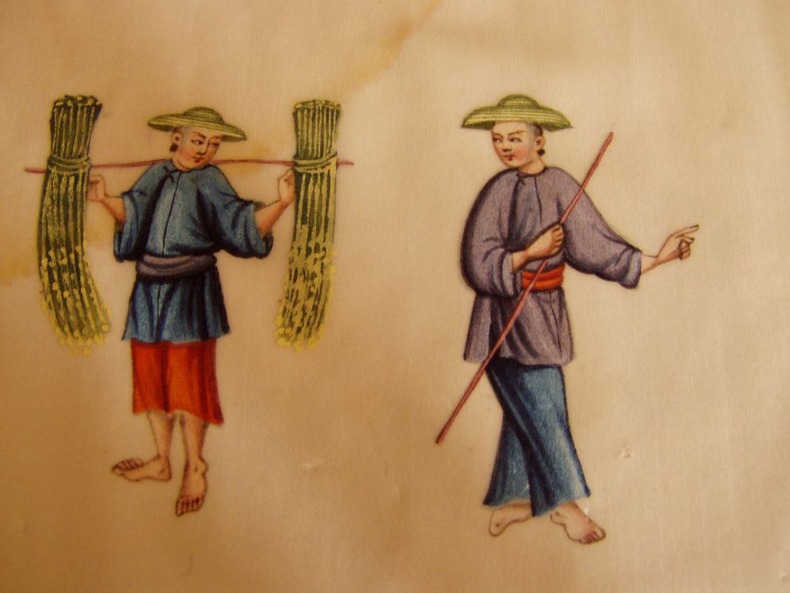
18033Album IN 8 oblong 21,5 x 29 cm recouvert de soie rouge,reunion de 9 planches aquarelles et gouaches originales scenes populaires de Chine,sur papier de “riz”,doublé par papier vergé et encadré par ruban bleu,coloris frais. A set of 9 watercolour and gouache studies on pith paper. Dimensions: 175 by 250mm.,c. 1845-1855
Silografia stampata in bruno, 1763, firmata e datata in tavola in basso a destra.Da un disegno di Luca Cambiaso, prima nella collezione Fawkener (come indicato nell'opera in basso al centro), ora al British Museum.Magnifica prova, impressa su due grandi fogli di carta vergata coeva, con margini, in perfetto stato di conservazione.L'opera è parte della raccolta di Charles Rogers, 'A Collection of Prints in Imitation of Drawings. To which are annexed lives of their authors', edita a Londra da John Boydell e altri nel 1778. Le tavole che sono contenute nell'opera riproducono a grandezza naturale e con gli stessi colori, una serie di disegni antichi nella collezione del Rogers. Woodcut printed in brown, 1763, signed at lower right.After a drawing by Luca Cambiaso, at that time in the Fawkener's collection and now at the British Museum.A fine impression, printed on two large sheet of contemporary laid paper, with margins, perfect condition.The work is part of Charles Rogers, 'A Collection of Prints in Imitation of Drawings. To which are annexed lives of their authors'. London: printed by J. Nichols, and sold by John Boydell, Benjamin White, and Peter Molini, 1778.The plates, which use a wide variety of techniques, show some old master drawings in Rogers's own collection. His preface states: 'That these prints may be faithful imitations, they are engraved the same way as, as well as the same size, as the Originals are drawn; and printed, as nearly as possible, in the same colours'
1971cROU-4941971 Paris, Mayer,1971; petit in-4° carré, pleine reliure skivertex bleu, illustration en couleurs contrecollée au centre du 1er plat, nom du peintre doré; 569pp., 2ff.nch. L'ouvrage forme le catalogue raisonné de l'oeuvre d'Armand Guillaumin, peintre de l'Ecole de Crozant, il renferme 847 œuvres de l'artiste reproduites en noir ou en couleurs.
18237un recueil de gravures , chemise double page marron clair Format : 32 x 23 cm, renfermant 6 gravures à l'eau-forte sur feuille volante, 1ère de couverture orné au centre d'un titre gravé : "6 SUJETS A L'EAU-FORTE par CH. JACQUE" et d'une scène "gardiens de cochons avec son troupeau" Format 76 x 67 mm (coup de planche) , une des gravures est notée 1849, les 6 gravures avant la lettre sur chine réimposées sont signées sur le cuivre, tirage à faibles exemplaires par l'auteur lui-même, sans titre....les 5 premières eaux-forte sont numérotées de 2 à 6 dans la gravure, en bas à gauche, une n'est pas numérotée...N°2 : (femme avec vache dans un bois) Eau-forte originale sur vélin, grandes marges, Format : 311 x 216 mm (toute la feuille) - 86 x 137 mm (coup de planche), N° 3 : (G.143. Buveurs) Eau-forte originale sur papier de chine monté sur velin, datée 1849, grandes marges, Format : 308 x 218 mm (toute la feuille) - 103 x 88 mm (coup de planche), N°4 : (gardienne et vaches s'abreuvant à la rivière) Eau-forte originale sur papier de chine monté sur velin, grandes marges, Format : 308 x 217 mm (toute la feuille) - 105 x 78 mm (coup de planche), N°5 : (cochons mangeant sous les chênes) Eau-forte originale sur vélin, grandes marges, Format : 309 x 216 mm (toute la feuille) - 85 x 68 mm (coup de planche), N6 : (troupeau de vaches sortant du bois avec gardien tenant une brassée d'herbe et chien) Eau-forte originale sur papier de chine monté sur velin, grandes marges, Format : 309 x 216 mm (toute la feuille) - 95 x 70 mm (coup de planche)...La Dernière non numérotée : (femme et vache en laisse broutant à l'orée d'un bois) Eau-forte originale sur papier de chine monté sur velin, grandes marges, Format : 317 x 239 mm (toute la feuille) - 95 x 65 mm (coup de planche)..
Bulino, 1593, monogrammata in lastra, nell’immagine in basso a destra “HG Jnve.” Numerata 5, in basso a sinistra. Stato unico. Eccellente esemplare, impresso su carta vergata coeva, rifilato ai margini, qualche spellatura al verso, in ottimo stato di conservazione.L’incisione appartiene a una serie di quattordici dedicata ai Vizi Capitali e alle Virtù. L’invidia è raffigurata dentro una nicchia, nelle sembianze di una vecchia megera nell’atto di mangiare un cuore, mentre nella mano sinistra tiene dei serpenti. Nei due alnoli superiori, i suoi attributi, il serpente e il caneSotto l’immagine, due versi in latino che definiscono il Vizio: “Invidia asperius nihil est, nec acerbius usquani/Tabificum pravis malum et exitiale venenum F.E[stius]”. Engraving, 1593, signed on plate, in the image lower right “HG Inve”, numbered 5 at lower left. Only state.Excellent example, printed on contemporary laid paper, trimmed at margins, some scratch on verso, in very good condition.In this print, which comes from a series of fourteen engravings, representing the Seven Capital Vices and Virtues, Envy is shown as an old hag eating a heart, inside a niche adorned with two shields that represent her two main attributes, the snake and the dog.Under the image, the following latin inscription: “Invidia asperius nihil est, nec acerbius usquani/Tabificum pravis malum et exitiale venenum F.E[stius]”. Hollstein 154