Thomas MANNBiblio.com
1 815 résultats
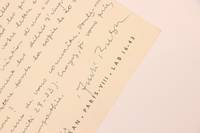
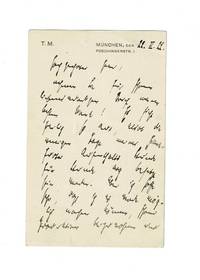
192275905Munich 1922. Fine. Munich 22 février 1922 8.70 x 13.70 cm une carte postale Signed autograph postcard from Thomas Mann addressed to Friedrich Karl Roedemeyer written on both sides in black ink. Professor Friedrich Karl Roedemeyer 1894-1947 taught linguistics at Frankfurt University where he invited Thomas Mann for the Goethe Festival. This is a letter of apology from the writer announcing that he will unfortunately not be able to give the lecture he was supposed to deliver. unknown
1950006352New York: Ziff-Davis Publishing Company 1950. First Edition . Illustrated Wrappers / Box. Very Good. Exceptionally Rare Signed Copy Of The Masters Of Sleep The Continuation Of Slaves Of Sleep In The First Printing In Fantastic Adventures October 1950. No Early Separate Hardcover Publication; This Was Published In Hardcover Several Decades After This Original Printing. First Published After The Beginnings Of Dianetics After Hubbard Stopped Writing Science Fiction. Signed In Aging Blue Ink At The Top Of Page Six The First Of Two Title Pages For "The Masters Of Sleep." This Copy Was Signed For His Agent Forrest Ackerman At A Luncheon Meeting. Any Magazine Appearances Signed By Hubbard Are Rare; We Are Unaware Of Any Other Copy Of This Story Signed By Hubbard Ever Being Offered For Sale; Hubbard Had Already Begun His Intense And Exclusive Involvement With Dianetics By The Time The Story Was Published And He Apparently Did Not Return To Science Fiction Until The Mid To Late 1970'S. The Signature Compares Favorably With Other Hubbard Signatures From This Time And Authenticity Is Guaranteed. The Signature Was Confirmed To Me Personally Some Years Ago By Forrest Ackerman Who Remembered When It Was Signed For Him On The Occasion Of Their Lunch Together While Ackerman Was Still Hubbard's Agent For Science Fiction. Probably The Only Signed Copy Of This Work. This Copy Worn At Ends Placed In Better Covers From Another Copy Of This Issue Of The Magazine; With Original Covers Loose. Both Housed Inside A New Deluxe All-Morocco Covered Archival Box With Gilt Lettering. <br/> <br/> Ziff-Davis Publishing Company unknown
1872036246Munich / Berlin: Friedrich Bruckmann 1872. 1st Edition Reprint. Hardcover. Very Good . 97 Pp With Mounted Plates. Red Cloth Heavily Embossed In Gilt Beveled Edges With Double Borders Embossed In Blind All Edges Gilt Cloth Endpapers. Bookplate Of Leopold Duke Of Albany. Inscription On Second Free Endpaper From Queen Victoria Of England To Her Son Leopold "For Dear Leopold From Illegible Two Words Dea---- ---A---A Shortened Name Used By Queen Victoria Osborne January 1 1873." Leopold Was Then A Student At Oxford. A Fine New Year's Gift With What May Be Viewed As Exceptionally Romantically Maternal Germanic-Victorian Plates. <br/> <br/> Friedrich Bruckmann hardcover
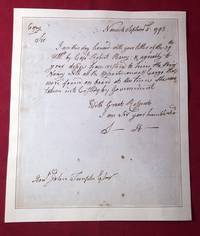
17934199Norwich CT: Original 1793. Original Letter. Very Good. 7 1/4 X 8 1/2 Inches. Autograph Letter Signed. Important letter from Samuel Huntington signer of the Declaration of Independence and Governor of Connecticut. In part: "I am this day honore'd with your letter of the 29th Ulto.by Capt. Robert Barry; & agreeably to your desire to have restored to him the Brig. Nancy with all the Appurtenances & Cargo that were found on board at the time she was taken into Custody by the Government. / With Great Respect / I am your humble Servant / S. H."<br /> <br /> This "copy" made in the hand of Samuel Huntington as Governor of Connecticut. Dated September 3 1793 this letter is an important handwritten record from the close of the Citizen Genet Affair. Huntington writes to John Temple the British Consul-General to the United States concerning the return of an English ship siezed by illegal French privateer "Petit Democrat." <br /> <br /> Tipped to another sheet. Some bleeding and a bit of toning. A nicely preserved letter ALS overall. Original unknown
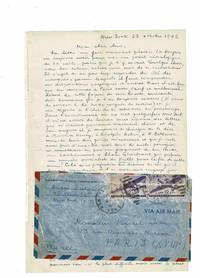
194576388New York 1945. Fine. New York 23 octobre 1945 17.10 x 25.40 cm 2 pages sur un feuillet et une enveloppe Unpublished autograph letter signed by André Breton addressed to Marcel Jean two pages written in blue ink on a sheet. ""Air mail"" envelope enclosed. Creases inherent to mailing. This letter is mentioned and very briefly quoted in Marcel Jean's autobiography Au galop dans le vent. Important and lengthy letter sent from New York when Breton in exile since 1943 as he was considered a ""dangerous anarchist"" by the Pétainist government was forced - like many intellectuals - to leave France in order to continue working. He shares with his friend the ""overwhelming despair"" ""l'accablement"" that the city brings him and one still senses his eagerness to return to his homeland. Painter draftsman and decorator Marcel Jean joined the Surrealist group in 1933 and became one of the movement's first chroniclers. One can sense all his emotion upon receiving this letter which he discusses at length in his autobiography: ""October 1945 I write to André Breton in New York. In response two densely written pages of fine calligraphy. My letter whose tone must have pleased him gave him ""real pleasure"" ""vraiment plaisir"". He finds me ""healthy safe and by no means lacking in that lucid smiling very human way of seeing"" ""sain sauf et nullement dénué de cette façon de voir lucide souriante très humaine"" that he has always known in me ""I just thought ""Je viens de penser"" he says of your firm handshake ""à ta rude poignée de main""."". I had mentioned to him the study on Lautréamont whose elements I am gathering he encourages me to give extracts of it for a Surrealist issue being prepared for the magazine Vrille ""this without prejudice to a drawing by you that Vrille should reproduce"" ""cela sans préjudice de dessin de toi que Vrille devrait reproduire"" and for the same magazine to submit ""a certain number of recent works to an in-depth analytical and critical commentary"" ""un certain nombre d'ouvrages récents à un commentaire analytique et critique approfondi"". This is followed by advice and encouragement regarding a work of literary criticism he would like to see me undertake. Then some news from America and our friends: Max Ernst Tanguy Péret who is bored in Mexico Matta who ""paints large panels in a new genre sadistic figurative much remarked upon."" ""peint de grands panneaux dans un nouveau genre figuratif sadique très remarqués."". And the vigorous signature. Breton's letters their contrast between the text with extremely regular handwriting and the flourish hurried and in both scripts something controlled have always given me the impression that in writing to me he was doing me the favor of an autograph. His message outlined for me a program as chronicler in view of his return to Paris in the spring but I had in mind something other than commenting on the commentaries of critics whose interest he pointed out to me - Maurice Blanchot or Léon-Pierre Quint. My projects concerned the study of Lautréamont and then - or at the same time: to paint and to draw."" unknown
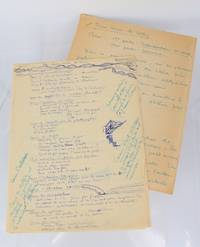
1950762671950. Fine. s. d. circa 1950 21 x 27 cm 8 pages sur 8 feuillets & 10 pages sur 10 feuillets Complete unpublished autograph manuscript of a sketch project by Boris Vian entitled ""Deux heures de colles"". Each bundle containing eight and ten sheets respectively is held together with a staple. The first written in different colored inks and featuring numerous crossings-out additions and small marginal drawings comprises two sheets of ideas for the sketch outline one sheet describing its structure and five sheets of text and stage directions. The second less corrected and entirely written in green ink is a final version of the text incorporating the structure and ideas from the first draft without preserving them in their entirety. In these notes never published nor performed the sketch takes place in a classroom where different teachers take turns delivering lessons in each of their subjects. The audience is supposed to form an assembly of unruly pupils and actively participate in the various activities imagined by Vian. The shameless teachers mistreat the pupils: ""vous êtes des khons de lamentables ratés . quelques interrogations auxquelles je vais procéder maintenant vont vous démontrer mieux qu'un long discours à quel point vous être abrutis."" ""you are fools pathetic failures . a few questions which I shall now proceed with will demonstrate to you better than a long speech just how stupid you are."" The text very humorous and remarkably modern recalls the genre of current ""talk shows"" and their cascades of gags and games. We thus find a large number of fanciful subjects designed to structure the different interventions: ""cours du supporter de match"" ""sports fan class"" ""cours de digest"" ""digest class"" ""cours d'optimisme bourgeois"" ""bourgeois optimism class"" ""cours de liberté"" ""freedom class"" ""cours de diffamation"" ""defamation class"" ""cours d'exploitation de psychanalyse"" ""psychoanalysis exploitation class"" etc. We perceive Vian's nostalgia for the past and his fascination with the future: ""Vous voyez 1900 avec 50 ans de recul avec vos yeux de 1950 mais pour les gens de l'an 2000 1950 sera aussi charmant que 1900 pour nous. Apprenez à voir votre époque avec les yeux de l'an 2000."" ""You see 1900 with 50 years' hindsight with your 1950 eyes but for people in the year 2000 1950 will be as charming as 1900 is for us. Learn to see your era through the eyes of the year 2000."" His love of cars also shows through in the staging of a ""type qui rentre par le fond de la scène dans un bruit effrayant avec sa traction une calandre ou un moteur sous le bras ."" ""fellow who enters from the back of the stage with a frightening noise with his Citroën a grille or engine under his arm ."" Visionary Vian This text is in any case imbued with ecological awareness: ""Le professeur insiste sur le gâchis qui caractérise la société actuelle et l'intérêt par conséquent d'un cours de récupération des produits inutilisés."" ""The teacher insists on the waste that characterizes current society and the interest consequently of a class on recovering unused products."" The brilliant inventor in any case envisages presenting a recycling ""machine"" ""machine"" to his audience. He also denounces under cover of humor the shortage of Parisian housing and its poor layout: ""on ne trouvait pas d'appartement à cause des collectionneurs d'appartements . Ce qui est difficile c'est de vivre dans les appartements qu'on vous propose ; mais quelques-uns de nos anciens élèves qui ont eu la chance de faire un stage dans un immeuble d'essai construit par Le Cornemusier vont vous faire une démonstration. . façon de vivre en rampant en rampant dans les appartements extrêmement bas de plafond."" ""you couldn't find an apartment because of apartment collectors . What's difficult is living in the apartments they offer you; but some of our former students who had the chance to do an internship in a test building con unknown
182787771Paris 1827. Fine. ""the time for planting has come"" Paris 14 mars 1827 16.20 x 19.30 cm trois pages et demi sur un bifeuillet ""the time for planting has come"" Autograph letter signed by François-René de Chateaubriand dated March 14 1827. 3 1/2 pages in black ink on a bifolium addressed to Michel-Augustin Varcollier. Chateaubriand writes to the husband of his goddaughter Atala Stamaty-Varcollier the first to bear the name of the heroine of his famous novel that propelled him onto the literary scene in 1801. Head of the Fine Arts Division of the Seine Prefecture Michel-Augustin Varcollier acted as Chateaubriand's intermediary in the development of the grounds of l'Infirmerie Marie-Thérèse his wife Céleste's grand project to house elderly priests and nobles widowed by the French Revolution. Here Monsieur is a bill from Madame de Chateaubriand to M. de Chabrol inviting him to attend Marie-Thérèse's council meeting which will take place next Wednesday the 21st at 2 a.m."". M. de Chabrol was kind enough to suggest Friday of this week but it has been impossible to gather MM. the Counselors for that day. Kindly explain this to Monsieur de Chabrol. . I have obtained permission from the Prefect of Police to place palisades along the walls. Now I need permission from M. le Préfet de Paris to plant within these palisades. I'm going to pretend I've already got it because the time for planting has come. I have no doubt that Mr. Préfet will continue his gestures of kindness. There is still to complete the work on the trellis on my little boulevart sic to give two coats of paint to the barriers. I recommend myself to M. de Fresnes for the completion of this great work. I must thank him and you Monsieur for all the kindness you have shown me.""  unknown
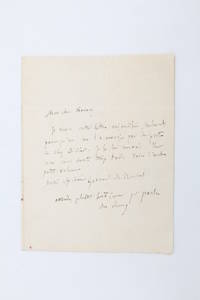
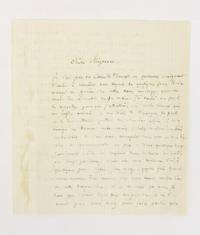
185280738Paris 1852. Fine. Paris s. d. fin 1852 - début 1853 10.30 x 13.20 cm quelques lignes sur un double feuillet Autograph letter signed ""Gérard de Nerval"" addressed to historian Charles Romey: ""Mon cher Romey Je reçois votre lettre aujourd'hui seulement parce qu'on me l'a envoyée par la poste de chez Didier. Je la lui renvoie. Il sera sans doute trop tard. Voici l'autre petit volume. Votre affectionné Gérard de Nerval. Attendez plutôt huit jours pour parler des deux."" ""My dear Romey I am only receiving your letter today because it was sent to me by post from Didier's. I am returning it to him. It will probably be too late. Here is the other small volume. Your devoted Gérard de Nerval. Rather wait eight days before discussing the two."" Folds inherent to being placed in envelope. This note has been transcribed in the correspondence published in the Pléiade volume 3 p. 799. unknown
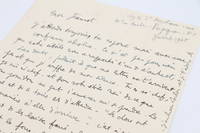
194084633Perpignan 1940. Fine. Perpignan juillet 1940 21 x 27 cm deux pages sur un feuillet Autograph letter by Jean Cocteau signed with his famous star addressed to his great love the actor Jean Marais. Dated by the author July 1940. One and a half pages in black ink on a sheet. Two small marginal tears not affecting the text. Traces of transverse folds inherent to posting. Magnificent love letter from Cocteau to Marais who formed one of the most legendary artistic couples of the 20th century. Against the backdrop of defeat and German Occupation their unbreakable bond is embodied in this letter from the writer with its desperate accents. Published in the Lettres à Jean Marais 1987 p. 157. This missive from a love-stricken Cocteau was written shortly after the Armistice of June 22 1940 marking the end of the French defeat. Marais mobilized had joined the front in May 1940 while Cocteau had taken refuge in Perpignan. Communication in these troubled times proved difficult: ""Mon Jeannot j'attends toujours ta réponse mais avec une confiance absolue. Ce n'est pas pour rien que notre étoile nous a rapprochés l'un de l'autre et sans doute fallait-il que mes lettres ne t'arrivent pas et que je souffre de mon silence"" ""My Jeannot I am still waiting for your response but with absolute confidence. It is not for nothing that our star brought us closer to one another and no doubt it was necessary that my letters not reach you and that I suffer from my silence"" ""Tu es né chef je suis né chef. Et sous notre étoile rien de ce que nous . ne peut s'annexer ni se perdre. Le principal est de se taire et d'attendre. entre guillemets : les choses ont une manière à elles d'arriver."" C'est à nous de le savoir et de les laisser faire ."" ""You were born a leader I was born a leader. And under our star nothing of what we . can be annexed or lost. The main thing is to remain silent and wait. in quotation marks: things have their own way of happening."" It is up to us to know this and let them do so ."" The Cocteau - Marais partnership would soon return to Paris and endure the torments of the German occupation which would ban the revival of their scandalous play Les Parents terribles which had enjoyed great success in 1939. unknown
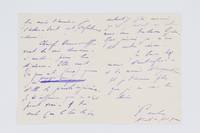
190679020Paris 1906. Fine. Paris 3 mars 1906 12.40 x 16.80 cm 3 pages 1/2 sur un double feuillet Autograph letter signed ""Paule"" from Renée Vivien addressed to Natalie Clifford Barney and written in purple ink on a double sheet with violet letterhead and address of 23 avenue du Bois de Boulogne. Transverse folds inherent to posting. Charming letter allowing hope for an appeasement in Renée Vivien's amorous ubiquity who seems to have finally chosen Hélène de Zuylen: ""Je t'envoie des vers. Les aimes-tu Ils ne me plaisent qu'à moitié c'est déjà beaucoup ! Tu as oublié que tu voulais te tuer pour moi. A part ce léger détail tu as été parfaite Mon amie t'aime je t'adore tout est parfaitement ordonné . N'est-ce pas que mon amie est parfaitement bonne et charmante Je l'aime tant d'une façon si poignante si simple et si bête. ce qui est après tout la meilleure façon d'aimer !"" ""I am sending you verses. Do you love them They only half please me that's already a lot! You have forgotten that you wanted to kill yourself for me. Apart from this slight detail you have been perfect My friend loves you I adore you everything is perfectly ordered . Is it not true that my friend is perfectly good and charming I love her so much in such a poignant simple and silly way. which is after all the best way to love!"" One senses here however a still very deep attachment of the Muse of violets to the Amazon: ""Je baise tes mains d'autrefois et tes mains d'aujourd'hui Et je t'aime plus que je ne sais le dire."" ""I kiss your hands of yesteryear and your hands of today And I love you more than I know how to say."" It was at the end of 1899 and through the intermediary of Violette Shillito that Renée Vivien - then Pauline Tarn - made the acquaintance of Natalie Clifford Barney ""cette Américaine plus souple qu'une écharpe dont l'étincelant visage brille de cheveux d'or de prunelles bleu de mer de dents implacables"" ""this American more supple than a scarf whose sparkling face shines with golden hair sea-blue pupils implacable teeth"" Colette Claudine à Paris. Natalie who had just lived a summer idyll with the scandalous Liane de Pougy who had initiated her into sapphism paid only discrete attention to this new acquaintance. Renée however was totally captivated by the young American and would relate this thunderbolt in her autobiographical novel Une Femme m'apparut: ""J'évoquai l'heure déjà lointaine où je la vis pour la première fois et le frisson qui me parcourut lorsque mes yeux rencontrèrent ses yeux d'acier mortel ses yeux aigus et bleus comme une lame. J'eus l'obscur prescience que cette femme m'intimait l'ordre du destin que son visage était le visage redouté de mon avenir. Je sentis près d'elle les vertiges lumineux qui montent de l'abîme et l'appel de l'eau très profonde. Le charme du péril émanait d'elle et m'attirait inexorablement. Je n'essayai point de la fuir car j'aurais échappé plus aisément à la mort."" ""I evoked the already distant hour when I saw her for the first time and the shiver that ran through me when my eyes met her eyes of mortal steel her sharp blue eyes like a blade. I had the obscure presentiment that this woman was giving me destiny's order that her face was the dreaded face of my future. I felt near her the luminous vertigos that rise from the abyss and the call of very deep water. The charm of peril emanated from her and attracted me inexorably. I did not try to flee from her for I would have escaped death more easily."" ""Hiver 1899-1900. Débuts de l'idylle. Un soir Vivien est invitée par sa nouvelle amie dans l'atelier de Mme Barney mère de Natalie 153 avenue Victor-Hugo à l'angle de la rue de Longchamp. Natalie s'enhardit à lire des vers de sa composition. Comme Vivien lui dit aimer ces vers elle lui répond qu'il vaut mieux aimer le poète. Réponse bien digne de l'Amazone."" ""Winter 1899-1900. Beginning of the idyll. One evening Vivien i unknown
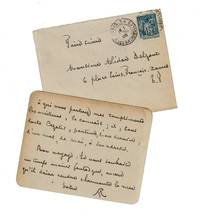
189576327Paris 1895. Fine. Paris 31 mars 1895 11.40 x 8.80 cm une carte recto-verso et une enveloppe Autograph card signed by Stéphane Mallarmé addressed to Alidor Delzant written on both sides in black ink. Envelope enclosed. Alidor Delzant was a lawyer collector and bibliophile. A friend of the Goncourt brothers he devoted a book to them and served as Edmonds secretary and executor. ""Je ne sais plus personne à Londres envers qui je fus si infidèle ; mais pour Oxford voici ma carte avec un mot à l'adresse de mon hôte et ami M. York Powell. M. Louis Dyer à qui vous porterez mes compliments les meilleurs le connaît ; et sans doute Cazalis porteur l'an dernier d'un mot de moi à son adresse. Je vous souhaite un temps moins fantasque encore qu'il doive rendre charmante la mer."" Mallarmé was well acquainted with Oxford where he had given a lecture the previous year under the auspices of Frederick York Powell professor of history. Louis Dyer a friend of Delzants was an Oxford alumnus and then professor of Greek at Harvard. Through Delzants mediation he had offered Mallarmé his hospitality. unknown
187164361Versailles 1871. Fine. Versailles s. d. 20-30 avril 1871 10.50 x 11.50 cm un feuillet Autograph letter signed by Théophile Gautier 34 lines in black ink address at foot on verso of the letter: ""Versailles avenue de St-Cloud n°3"". Folds inherent to mailing. The letter appears to be unpublished not mentioned in the Correspondance Générale de Théophile Gautier edited by Claudine Lacoste-Veysseyre under the direction of Pierre Laubriet Droz Geneva-Paris 12 vol. 1985-2000. Rare glimpse into Gautier's private life the letter captures the anguish that struck the author and his family during the Paris Commune. Separated from his family by the Prussian invasion of 1870 and the Parisian insurrections of 1871 Théophile Gautier confides the extent of his torments both financial and due to the Paris Commune to his ""dear sweetheart"" his younger daughter Estelle Gautier: ""I may yet manage to recover from this collapse . I am happy that these atrocious ordeals have been spared you. For my part I nearly lost my life and I am still not in brilliant condition"". Gautier's usual supporters are evident here through the names of academician Camille Doucet and dancer Carlotta Grisi. The virulence of the fighting between communards and repressive forces can be sensed in the evocation of Gautier's sister Emilie called ""Lili"": ""Lili is still in her cellar. Coming out is too perilous but she will be delivered within a few days. Alas! Very long ones"". Characteristic of the personal register rare in Gautier's correspondence the letter is imbued with the paternal love the author bears for his family: ""What a celebration when we are all reunited for my heart suffers greatly from this dispersion"". unknown
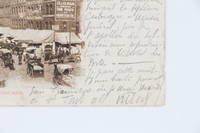
190278605Chicago 1902. Fine. Chicago 23 octobre 1902 14 x 8.80 cm une carte postale Autograph signed postcard sent from Chicago and addressed to Émile Mignard Chicago 23 October 1902 14 x 88 cm one postcard Handwritten signed postcard from Victor Segalen sent from Chicago and addressed to Emile Mignard. A few lines written in pencil in the corner of the black and white photographic reproduction of a view of South Water Street in Chicago handwritten address on the verso. Some minor stains and folding. Emile Mignard 1878-1966 also a doctor and Brest-born was one of Segalen's closest friends of youth whom he met at the Jesuit Notre-Dame-de-Bon-Secours School in Brest. The writer interacted with this comrade in an abundant and closely followed correspondence in which he described with humour and intimacy his daily life in all corners of the world. It was at Mignard's wedding on 15 February 1905 that Segalen met his wife Yvonne Hébert. This postcard had been addressed by Segalen to his friend from Chicago as he travelled to Tahiti via San Francisco. It is the first time that the Breton has been to the United States and his impressions are rather pessimistic: Chicago. The deplorable pinnacle of acute budding Americanism. Imagine a mass of sandstone that has crystallised following the Cubic system. A childlike museum: close to the Apollo Belvedere a reproduction of the Hôtel des Postes. I leave tonight for a straight through journey to San Francisco where I will be on Tuesday at 4am. unknown
193078314New York: ca. 1930s. purchased illustrated autograph album in printed wrappers. Wrappers quite worn and front wrapper detached. 12mo. Designed by Elisa E. Edwards. Herbert Hoover was present in the form of a clipped signature which is absent. Also pasted in is a beverage check from the Players bar signed by W. Spencer Wright "the first autograph after the Great Volsteadian Drought" unknown
17520This legendary R & B tenor hit the charts in the mid-50s with the Drifters and such hits as "Money Honey" "Such a Night" and "Honey Love" before going solo. Two items: First an AQS 1p irregularly-trimmed roughly rectangular 8" X 4½" n.p. n.d. January 1958. Very good. Yellowed tape stain at each corner and two more small tape stains along right edge touching slightly upon a couple of words. Curious free verse poem or song lyrics -- whether to one of McPhatter's published songs is uncertain. "I want to walk in the shadow of your arms" it begins. "I want to live by the touch of your lips. I want to be in the River with you while the sea's calm I want to live and love I don't want to miss. I want to live with a love that's divine I want to be with you and give you all my love. I want to say that you are mine. I want to ask faith from the one above." Boldly signed at the conclusion. An unheard-of McPhatter rarity quite intriguing and exceedingly scarce -- and worthy of further research. Second an IPS 8" X 10" n.p. n.d. Very good. Faint yellow tape stain at each corner. Classy handsome half-length glossy portrait of a young smiling McPhatter in suit and tie inscribed large and bold in thick black marker at the upper right "To / 'Donald' / ALL the best / ALL the time! / Clyde McPhatter." Very choice and very scarce. McPhatter who suffered from alcoholism died of a heart attack at age 39 making his autograph material quite uncommon. unknown
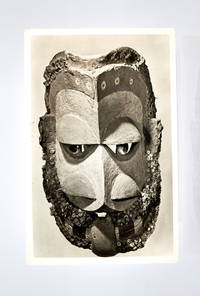
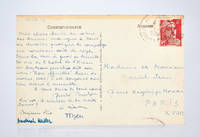
195875712Amsterdam 1958. Fine. Amsterdam 1958 13.90 x 8.90 cm une carte postale Autograph signed postcard addressed to Jean Schuster Amsterdam 1958 13.9 x 8.9 cm a postcard Handwritten postcard signed by André Breton addressed to Jean Schuster written in blue ballpoint pen on the back of a postcard reproducing a black and white photography of a Melanesian mask preserved at the Tropenmuseum in Amsterdam and which André Breton designates under the highly significant qualifier friend responsible for showing his affection to Jean Schuster. This grid pattern of canals and the tulip tiling leaves us in great indecision. . This country is decidedly very beautiful. His wife Elisa Breton added a few lines of a Surrealist tone following the main text: Elisa in Amsterdam comes from a gingerbread tin and a potential twisting from antiquarians. Jean Schuster 1929-1995 joined the Surrealist group in 1947. Close to Benjamin Péret and André Breton he will become Breton's executor. unknown
194975342Île-de-Sein 1949. Fine. Île-de-Sein Août 1949 13.60 x 9 cm une carte postale Handwritten postcard from André Breton signed by himself his wife Elisa Benjamin Péret Toyen and Jindich Heisler addressed to Marcel Jean and his wife and written on the back of a black and white photograph view of the Chaise-du-Curé rocks on the Île de Sein Finistère. Charming poetic postcard written during a stay in Brittany: ""la corne de brume manque à tous ses devoirs quoique le coupage au couteau soit de règle. Dans la vase à quoi se limite la vue de l'hôtel de l'Océan un bateau penché dit son nom : ""Rose effeuillée"". Rien de moins. Mais c'est toujours très bien dans l'ensemble."" Returning to more professional discussions Breton asks for news of the American gallery owner Sidney Janis: What was the result of the Janis' visit unknown
194774239Paris 1947. Fine. Paris mercredi 12 mars 1947 20.80 x 27 cm 1 page sur un feuillet enveloppe jointe Unpublished autograph letter signed addressed to Sarane Alexandrian one page written in blue ink on a sheet with the letterhead of the 1947 International Exhibition of Surrealism. Envelope enclosed. This letter is a response to a letter sent the day before by Sarane Alexandrian partially accessible on the Breton Archives website. Born in Baghdad and engaged in the Resistance in the Limousin it was during this period that Sarane Alexandrian discovered Dadaism. At twenty years old he became André Breton's right-hand man and was entrusted by the latter with directing the secretariat of Cause in order to respond to applications from numerous young artists from around the world wishing to join the Surrealist movement. In October 1948 he broke with the pope of Surrealism while maintaining his esteem and admiration for him: ""Near him one learned the savoir-vivre of poets whose essential article is a savoir-aimer. We admired him for the dignity of his behavior as a writer thinking neither of prizes nor decorations nor academies"" Alexandrian André Breton par lui-même 1971. The letter we offer marks the beginnings of this ephemeral but important relationship between the two writers. André Breton twenty years Sarane Alexandrian's senior seems to place great hopes in this young theorist who takes interest in his writings: ""Max-Pol Fouchet has not yet had me read 'Poetry and Objectivity' but your letter tells me enough for me to believe in a profound accord between us an accord based less on the reception you give to what my message has been able to be until now than on the very nature of your personal project which largely coincides with mine."" As for ""Poetry and Objectivity"" he adds: ""I would see the greatest interest in publishing in the catalog of the Surrealist exhibition some pages by you in which the principal ideas expressed in your letter would need to be barely transposed and especially those which touch upon the creation of an 'erotic mystique'."" This publication taking the form of a manifesto would indeed see the light of day and appear in the review Fontaine produced for the occasion of the 1947 International Exhibition of Surrealism at the Galerie Maeght. The text would earn great success for young Alexandrian who would henceforth be considered by his peers as the number two theorist of Surrealism. A very fine letter marking the beginning of the important but ephemeral relationship between the two master thinkers of Surrealism. unknown
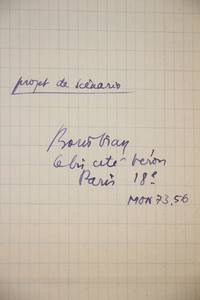
195376370Paris 1953. Fine. Paris 23 octobre 1953 21 x 27 cm 14 pages tapuscrites sous chemise 1 enveloppe Complete typescript of a draft film script entitled Le Cow-boy de Normandie. Fourteen typed pages bound in a squared paper cover inscribed in Boris Vians hand: Projet de scénario Boris Vian 6 bis Cité Véron Paris 18e. Accompanied by the original envelope from the S.A.C.D. This script was later reproduced in the collection Rue des ravissantes and adapted as a short film by Clémence Madeleine-Perdrillat in 2015. This parody of a western tells the story of Jim Lacy a disillusioned cowboy who leaves Nevada in search of a more genuine land: Fleurville in Normandy. Provenance: Fondation Vian. unknown
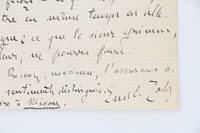
188379106Bénodet 1883. Fine. Bénodet 10 septembre 1883 13.20 x 20.30 cm 2 pages sur un double feuillet Signed autograph letter by Emile Zola - apparently unpublished - addressed to an unknown correspondent written in black ink on a double sheet. Folds inherent to mailing. Interesting letter relating the translation of Emile Zola's works and the legal disputes inherent to their clandestine distribution. This missive is visibly addressed to a correspondent considered for the German translation of La Joie de vivre: ""I would ask you to give me the promptest possible response regarding the translation of La Joie de vivre; for I am already receiving proposals from Germany and I would like to know where I stand."" In this autumn of 1883 Zola - though vacationing in Brittany - is very occupied with managing the translation of his works which he handles directly with publishers. We see here the determination with which he conducts negotiations: ""I repeat that I will only accept a fixed sum paid in advance. It is simpler and without possible surprises."" But things are not simple and Zola whose works already enjoy great success must fight against the clandestine publication of his novels. Completely overlooked by biographers the disputes with Hungarian publisher Gustav Grimm are nonetheless a leitmotif of Zolian correspondence: ""Monsieur Grimm of Budapest is a simple thief who has my novels translated as they are published in French newspapers without any authorization. Already the Neue Freie Presse of Vienna has sued him in my name. But it appears we have no treaty with Hungary. I await the signing of a treaty which they say is imminent."" Indeed Grimm had already published without Zola's authorization German translations of two novels: Nana 1881 and Pot-Bouille Der häusliche Herd 1882. These illegal publications discouraged German publishers Curt Busch and George Kuhr who very interested in distributing the novel to German-speaking readers declared forfeit. Gustav Grimm who finally agreed to respect commercial treaties won the battle and published the very first German translation of La Joie de vivre in 1889 under the title Die Lebensfreude. The man whom Zola here calls a ""simple thief"" would finally obtain authorization to distribute the German translation of the entirety of the twenty volumes of the Rougon-Macquart between 1892 and 1899. Interesting letter revealing the editorial mechanisms of the Rougon-Macquart and testifying to the ardor with which Zola conducted negotiations inherent to the translation of his great hereditary fresco. unknown
190375723Boscolungo 1903. Fine. Boscolungo 29 août 1903 11.20 x 18 cm 2 pages sur 2 feuillets Unpublished autograph letter signed by Giacomo Puccini to a patron; two pages written in black ink on two leaves. Leaves uniformly shaded traces of former pasted mounts on verso. A photographic reproduction of the famous composer's portrait is enclosed. Puccini responds to a patron's request to have La Bohème performed at a charity event: ""Io non ho niente in contrario che la Bohème venga eseguita per una sera corta a scopo benefico."" I have no problem with La Bohème being performed for a charity event. ""Credo pero che sarebbe bene avere anche la adesione della Casa Ricordi proprietaria dello spartito."" I believe however that it would be good to have the authorization of Casa Ricordi Puccini's publishing house owner of the score. Despite the failure of the first performance on February 1 1896 La Bohème subsequently enjoyed worldwide success rapidly becoming one of the finest operas in the Romantic repertoire. A fine tribute to the triumph of one of the greatest composers of the late 19th-century. unknown
197687298Fleury-Mérogis 1976. Fine. Fleury-Mérogis 21 Septembre 1976 21 x 29.50 cm une page recto verso Autograph letter dated and signed by Jacques Mesrine dated Tuesday September 21 1976 68 lines in blue ink on one recto-verso page addressed to his lover at the time Jeanne Schneider thanks to whom the manuscript ofInstinct de mort was discreetly smuggled out of prison. A horizontal fold inherent to the envelope placement a small tear in the right margin of the letter at the fold level. Jacques Mesrine then incarcerated at Fleury-Mérogis prison arranged with his mother for her to cede upon her departure from the Paris region her Clichy apartment to Jeanne Schneider after his possible provisional release: ""J'ai eu un très agréable parloir avec maman. J'ai au moins une bonne nouvelle à t'annoncer. Pour Clichy c'est d'accord. Comme elle va vivre presque tout le temps à la montagne tu auras l'appartement pour toi. Je paierai le loyer. Elle a tout de suite dit d'accord après mon explication. . Je me doute de ta joie de savoir que tu pourras vivre à Clichy - si près de notre papy. toujours présent de par l'amour que nous avons pour lui. Je suis certain que cette petite nouvelle te remonte le moral."" I had a very pleasant visit with mama. I have at least one good piece of news to tell you. For Clichy it's agreed. Since she's going to live almost all the time in the mountains you'll have the apartment to yourself. I'll pay the rent. She immediately said yes after my explanation. . I can imagine your joy knowing that you'll be able to live in Clichy - so close to our grandpa. always present through the love we have for him. I'm certain this little news will lift your spirits. His daughter Sabrina worries him and he senses that he will have to be severe regarding her behavioral lapses: ""De Sabrina rien ! Il y a une chance pour qu'actuellement elle me prépare un ""douze"" je ne peux t'en parler sur lettre. mais j'ai l'impression que la puce me ment sur certaines choses. elle prend peut-être une route où il va me falloir la plus grande fermeté. J'ai demandé à maman de vérifier si elle va bien à l'école."" Nothing from Sabrina! There's a chance that currently she's preparing a ""twelve"" for me I can't talk about it in a letter. but I have the impression that the kid is lying to me about certain things. she's perhaps taking a path where I'll need the greatest firmness. I asked mama to check if she's doing well in school. News of his ""godson"" the famous robber Jean-Charles Willoquet with whom he organized his escape from La Santé prison where they had met makes him prouder: ""J'ai reçu la photo du plus jeune détenu de France à savoir mon filleul ""Willy Willoquet"" dans sa cour de promenade. c'est émouvant et triste à la fois !"" I received the photo of the youngest prisoner in France namely my godson ""Willy Willoquet"" in his exercise yard. It's moving and sad at the same time! The situation of his young protégé cut off from all contact with his loved ones and the people who love him reminds him of his own personal situation and the indignities of a prisoner's isolated existence: ""Je me demande comment va réagir Martine quand on va lui enlever Enfin c'est le destin qu'elle a choisi et accepté. Elle paie cher le prix de l'amour. Vous le payez toutes ""très cher""."" I wonder how Martine will react when they take him away from her Well it's the destiny she chose and accepted. She pays dearly the price of love. You all pay it ""very dearly"". In order to quickly erase this morose and implacable truth Jacques Mesrine plunges into schoolboy humor and affectionately mocks his lover's physical flaws: ""J'espère que la bonne nouvelle va te rendre ton sourire. eh ! la mémé. boutons sur la gueule. ou pas ! Je t'adore. il ne fallait pas flirter avec ""voyou"" ! C'est lui qui t'as passé cela sic nanou d'amour ton viejo pirate monte à l'abordage de tes lèvres. et. !! tu coules ! "" I hope the good news will bring back yo unknown
197684669Paris 1976. Fine. Paris 12 Octobre 1976 21 x 29.50 cm une page recto verso Autograph letter dated and signed by Jacques Mesrine dated Tuesday October 12 1976 70 lines in blue ink on one recto-verso page addressed to his love of the time Jeanne Schneider thanks to whom the manuscript of Instinct de mort was discreetly smuggled out of prison. Jacques Mesrine then incarcerated at La Santé shows great tenderness and reveals himself in another light that of the affectionate and attentive lover: ""Bonsoir petite fille. tu aimes bien jouer ""au St Bernard"" tu ne changeras jamais à ce sujet. C'est toi qui a 7 ans 1/2 de taule et tu dois remonter le moral des ""gamines"" qui ont joué du calibre !"" ""Good evening little girl. you like to play 'the St Bernard' you'll never change about that. You're the one who has 7 and a half years of jail and you have to cheer up the 'girls' who played with guns!"" He praises and is somewhat amazed by his companion's devotion to a couple of young criminals: ""Tu me parles d'une sentence de 20 ans pour elle ! tu rigoles ou quoi. elle ne peut pas prendre plus de 8 ans je la vois plutôt avec 5 ou 6 si les choses s'arrangent. Son mari avec 20 ans au maximum."" ""You talk to me about a 20-year sentence for her! are you kidding or what. she can't get more than 8 years I see her more with 5 or 6 if things work out. Her husband with 20 years maximum."" and tries to transmit all his optimism his pugnacity and to cheer her up: ""Tu sais ma puce; quand tu m'écris que la cause de Michou est une cause perdue d'avance je ne te comprends plus. Il n'y a pas de cause perdue d'avance. Dans la vie il faut se battre jusqu'au bout. tu sais pourtant ce que cela représente. Tu vois moi je vais au maximum ! et pourtant je vais me défendre toutes dents dehors. Car ma liberté il faudra me la prendre. Je ne la donnerai pas faute de combat !"" ""You know my darling; when you write to me that Michou's cause is a lost cause from the start I don't understand you anymore. There is no lost cause from the start. In life you have to fight to the end. you know what that represents though. You see I'm going for the maximum! and yet I'm going to defend myself tooth and nail. Because my freedom will have to be taken from me. I won't give it up for lack of fighting!"" Jacques Mesrine also evokes his love of horse racing while boasting of being a betting specialist: ""Oui j'avais joué ""Dernier tango"" mais seulement à la place. J'avais 2000frs dessus je gagne donc 6000frs. Ce n'est pas de la chance mais un savant calcul. Il m'arrive de perdre mais avec ma méthode je suis obligé d'être gagnant. Forécement pour la suivre il faut un certain capital. J'ai mis plus d'un an à faire tous les calculs de probabilité. Cela doit me rapporter à peu près 7000frs par mois. Net d'impots sic."" ""Yes I had bet on 'Dernier tango' but only for place. I had 2000frs on it so I win 6000frs. It's not luck but a scientific calculation. I sometimes lose but with my method I have to be a winner. Obviously to follow it you need a certain capital. I spent more than a year doing all the probability calculations. It should bring me about 7000frs per month. Net of taxes sic."" He ironizes about his situation as a prisoner having plenty of time to devise his financial gain strategies: ""J'ai aussi mis au point une méthode pour le jeu de baccara. Que veux-tu. j'ai le temps de calculer un tac de choses sic ! Tu me comprends . L'administration aussi ! resic. "" ""I also developed a method for baccarat. What do you want. I have time to calculate a bunch of things sic! You understand me . The administration too! resic."" but deplores his impossibility to continue writing Instinct de mort: "". je suis actuellement incapable d'écrire une page de mon bouquin. je ne sais pas comment tourner ce passage-là. enfin je vais bien trouver la solution."" "". I am currently unable to write a page of my book. I don't know how to phrase this passag unknown
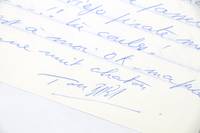
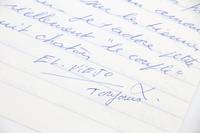
197684900Fleury-Mérogis 1976. Fine. ""Le pire que l'on puisse faire à un juge c'est lui enlever toute autorité devant les autres et crois moi il l'a bien compris"" ""The worst thing you can do to a judge is to remove all his authority in front of others and believe me he understood it well"" Fleury-Mérogis 2 Décembre1976 21 x 29.50 cm une page recto verso Autograph letter dated and signed by Jacques Mesrine dated Thursday December 2 1976 65 lines in blue ink on one recto-verso page addressed to his love at the time Jeanne Schneider thanks to whom the manuscript of Instinct de mort was discreetly smuggled out of prison. Jacques Mesrine then incarcerated at Fleury-Mérogis prison feels unwell and helpless far from his companion and from all human warmth: ""Ce soir je suis très mal foutu. il est 19 heures et je me couche juste après la fin de ta lettre. de rien de grave. juste une grande fatigue à rien faire"" ""Tonight I feel really awful. it's 7 PM and I'm going to bed just after finishing your letter. nothing serious. just very tired from doing nothing"" As a good father Jacques Mesrine rejoices in his daughter's happiness: ""Je suis heureux que sa veste lui plaise. de plus c'est la mode. son Loïc chéri ne va plus la reconnaître."" ""I'm happy that she likes her jacket. plus it's fashionable. her dear Loïc won't recognize her anymore."" and shows himself neither surprised nor more than amused that his daughter wants to embrace the Jewish religion: ""Comme cela la puce veut prendre la religion juive. encore une idée à elle. oui je sais elle a fait croire à ses copains qu'elle était juive. car eux l'étaient.si cela l'amuse je la laisse libre. mais ça démontre aussi un dédoublement de personnalité."" ""So the little one wants to take up the Jewish religion. another one of her ideas. yes I know she made her friends believe she was Jewish. because they were. if it amuses her I leave her free. but it also shows a split personality."" Public enemy No. 1 evokes with a certain pride his latest confrontation with his judge a fierce revenge of the insubordinate against the penitentiary universe that crushes men: ""Aujourd'hui j'ai eu la visite du juge Madre. Tu aurais rigolé car il a eu droit à tout mon vocabulaire. il en perdait la parole j'ai pris mon pied sic A un moment il me dit ""mais c'est quand même moi qui commande. Réponse de ton bibi : ""Ici pédé"" c'est moi ton patron"". Il était vert et les flics se marraient comme des perdus."" ""Today I had a visit from Judge Madre. You would have laughed because he got my full vocabulary. he was speechless I had a ball At one point he tells me 'but I'm still the one in charge. Your boy's response: 'Here faggot I'm your boss.' He was green and the cops were laughing like crazy."" and against all submission to any form of power or violence: ""Le pire que l'on puisse faire à un juge c'est lui enlever toute autorité devant les autres et crois moi il l'a bien compris. Il était venu avec 5 anti-commandos. L'un avait la bombe de gaz à la main. au cas où Loin d'être impressionné. cela me rend con."" ""The worst thing you can do to a judge is to remove all his authority in front of others and believe me he understood it well. He had come with 5 anti-commandos. One had the gas canister in his hand. just in case Far from being impressed. it makes me crazy."" The eternal rebel ends his letter with a beautiful testimony of tenderness for his beloved: ""Là ma puce je vais prendre mon lit en marche.Ton vieux voyou pose ses lèvres sur le tiennes en une douce caresse d'amour. je t'adore petite fille. car nous sommes réellement le ""couple"" et plus encore. Bonne nuit chaton."" ""There my little one I'm going to take to my bed. Your old rogue places his lips on yours in a sweet caress of love. I adore you little girl. because we are truly the 'couple' and even more. Good night kitten."" Rare and very fine letter by Jacques Mesrin unknown
197684675Paris 1976. Fine. Paris 11 Octobre 1976 21 x 29.50 cm une page recto verso Autograph letter dated and signed by Jacques Mesrine dated Monday October 11 1976 70 lines in blue ink on one recto-verso page addressed to his love of the time Jeanne Schneider thanks to whom the manuscript of Instinct de mort was discreetly smuggled out of prison. Jacques Mesrine then incarcerated at La Santé showers with gifts the people he loves because he wants their happiness: ""Comme cela j'ai payé une mobylette à mes trois gamines. Toi ce sera une quatre roues sic."" ""Like this I paid for a moped for my three girls. For you it will be four wheels sic."" He shows all his affection for a young girl named Betty whom he seems to cherish more than his own daughter Sabrina: ""Peut-être que je recherche en Betty ce que je ne trouve pas en Sabrina et que Mury m'a refusé ! Tu sais mon ange ; à 15 ans j'aurais tellement aimé avoir un copain de 40 ans à qui je puisse tout dire qui sache m'aider ou m'offrir mon rêve. Peut-être que ce cadeau je me le fais à moi-même."" ""Maybe I'm looking for in Betty what I don't find in Sabrina and what Mury refused me! You know my angel; at 15 I would have loved so much to have a 40-year-old friend to whom I could tell everything who would know how to help me or offer me my dream. Maybe this gift I'm giving it to myself."" for whom he has no more confidence feeling betrayed: ""Mais on ne devient jamais l'ami de quelqu'un qui vous juge. Pas plus que pour Sabrina ! qui elle m'a trompé dans ma confiance donc dans mon amour. Quand on use les sentiments ils ne redeviennent jamais les mêmes."" ""But one never becomes the friend of someone who judges you. No more than with Sabrina! who deceived my trust and therefore my love. When feelings are worn out they never become the same again."" Public enemy No. 1 takes great pride in his relationship with Jeanne Schneider based on honesty: ""C'est peut-être pour cela que je me suis toujours refusé à te mentir - quitte à te faire souffir. Je n'ai aucun passé.mais un seul présent ""Toi"". C'est peut-être cela qui fait que notre amour dure depuis 10 ans "" ""Maybe that's why I've always refused to lie to you - even if it means making you suffer. I have no past.but only one present 'You'. Maybe that's what makes our love last for 10 years "" Jacques Mesrine then turns to material considerations so important for a prisoner: ""J'ai reçu ton linge. Je ne risque pas d'avoir froid cet hiver. Le polo est très bien."" ""I received your clothes. I won't risk being cold this winter. The polo shirt is very good."" before castigating the inhumanity of the prison system and its indifference to suffering: ""Mais nous n'avons rien à attendre des juges et si ma lettre au président a été ferme c'est le genre de lettre qu'il comprendra mieux que le style ventre à terre."" ""But we have nothing to expect from judges and if my letter to the president was firm it's the kind of letter he will understand better than the groveling style."" As an eternally untamed man Jacques Mesrine never ceases to advocate fighting against the prison administration: ""On ne se défend pas en mettant sa tête dans le sable comme l'autruche ! Dès l'instant où l'on prend une arme dans la main. il faut s'attendre à payer ! que Michou le comprenne ce n'est pas le moment d'être ""bébé"" mais celui d'être femme."" ""You don't defend yourself by putting your head in the sand like an ostrich! From the moment you take a weapon in your hand. you must expect to pay! let Michou understand this is not the time to be a 'baby' but to be a woman."" Jacques Mesrine ends this beautiful letter with a moving declaration of love full of optimistic humor: ""Ton vieux tigre pose de doux bécots sur tout ce qui est toi. Bonne nuit chaton et un moral d'acier est de rigueur ok. Je t'adore chanceuse & Ton mystère Jacques !! ""Te adoro A toi seule."" ""Your old tiger puts gentle kisses on everything that is you. Good night kitten and a steel hardcover