Paul SIGNAC - (to Camille PISSARRO)Biblio.com
1 815 résultats
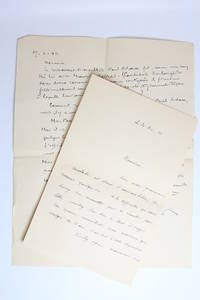
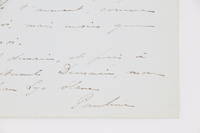
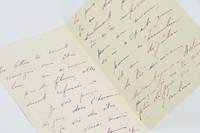
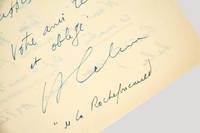
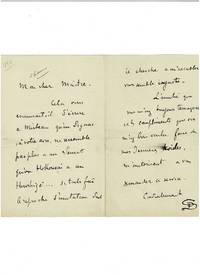
1894755111894. Fine. s. d. 23 janvier 1894 22.60 x 17.50 cm 2 pages sur un double feuillet déplié Autograph letter signed by Paul Signac addressed to Camille Pissarro written in black ink over two pages and signed with the artists monogram. This letter was transcribed in the article by Pierre Michel and Christian Limousin entitled ""Octave Mirbeau et Paul Signac - Une lettre inédite de Signac à Mirbeau"" in Cahiers Octave Mirbeau no. 16 March 2009 pp. 202-210. ""Mon cher Maître Cela vous ennuirait-il sic d'écrire à Mirbeau qu'un Signac à votre avis ne ressemble pas plus à un Seurat qu'un Hokousai à un Hiroshigé. si toutes fois sic le reproche d'imitation dont il cherche à m'accabler vous semble injuste. L'amitié que vous m'avez toujours témoignée et les compliments que vous avez bien voulu faire de mes toiles m'autorisent à vous demander ce service. Cordialement. PS"" A fine letter in which Paul Signac seeks the support of his master Camille Pissarro after a scathing critique published by Octave Mirbeau in L'Echo de Paris. In this article featured on the front page of L'Echo de Paris of 23 January 1894 Octave Mirbeau spares Signac no harshness: « M. Signac a voulu continuer Seurat. Je ne puis me faire à sa peinture. Je ne méconnais pas ses qualités mais elles disparaissent sous l'amoncellement de ses défauts. Ce qu'on admettait de Georges Seurat . on le comprend moins chez M. Signac qui n'en est que l'adepte trop complaisant et trop littéral. Et puis cette continuelle sécheresse me choque. M. Signac fait la nature immobile et figée. Jamais le vent n'a secoué la surface inerte de ses mers ni tordu les branches de ses pins ni animé l'éternelle fixité de ses nuages la raideur cartonnée de ses ciels. Il ignore le mouvement la vie l'âme qui est dans les choses. . Il serait peut-être temps pour notre joie que M. Signac voulût bien nous donner du Signac. Je crois qu'il le peut.» Why this obsession with Seurat « At the beginning of 1894 the position of Mirbeau Geffroy Pissarro and a few others was to consider that Neo-Impressionism had in fact died in 1891 with the passing of Seurat. Their retrospective view of this artistic venture led them to think that it was not a continuation of Impressionism by new scientific means but a reaction against it even a liquidation of the movement.» Cahiers Octave Mirbeau. Pissarros reply to Signac also transcribed by Michel and Limousin was not long in coming: it « l'ennuirait d'écrire ce que vous me demandez à Mirbeau et cela pour plusieurs raisons. . Premièrement parce que je suis en froid avec lui vous le savez bien. Deuxièmement parce que pour vous-même il ne sied pas de discuter l'opinion d'un critique même étant persuadé d'être dans le vrai et si vous voulez franchement ma façon de penser et que je suis heureux d'avoir l'occasion de vous exprimer je trouve que la méthode même est mauvaise. Au lieu de servir l'artiste l'ankylose et le glace. Si je vous ai fait des compliments cette année c'est parce que j'ai trouvé vos dernières toiles mieux que celles que vous aviez exposées aux Indépendants mais je suis loin de trouver que vous êtes dans la voie qui convient à votre tempérament essentiellement peintre et si jusqu'à présent je ne vous ai rien dit à ce sujet c'est parce que j'étais sûr de vous être désagréable et somme toute mes convictions peuvent ne pas être partagées par vous. Réfléchissez mûrement et voyez si le moment n'est pas venu de faire votre évolution vers un art plus de sensation plus libre et qui serait plus conforme à votre nature.» « Disheartened and deprived of the authority of a master revered by the critic Signac was left to devise himself without delay the reply to address to Mirbeau . » ibid. This response took the form of a long letter written the same day as the one offered here and now preserved at the Harry Ransom Center at the University of Austin Texas: « Je reconnais hautement que c'est Seurat qui a insta unknown
188878162Dizy Dizy-le-Gros 1888. Fine. Dizy Dizy-le-Gros samedi 15 septembre 1888 13.70 x 21.20 cm 20 pages sur 5 doubles feuillets & une enveloppe Very long autograph letter signed by Pierre Louÿs addressed to Georges Louis. Twenty pages written in blue ink on five double sheets of graph paper. Enclosed is an envelope on which is written in pencil in Pierre Louÿs's hand: ""Letter of 20 pages about my stay in Limé"" Amusing letter addressed to his brother Georges Louis with whom Pierre Louÿs maintained a very intimate relationship and whom he considered as his own father. The question of Pierre Louÿs's real father's identity still fascinates biographers today: ""His father Pierre Philippe Louis . had married in 1842 Jeanne Constance Blanchin who died ten years later after having given him two children Lucie and Georges. In 1855 he remarried Claire Céline Maldan and from this union was born in 1857 a son Paul; then in 1870 our writer who received the first names Pierre Félix. This late birth the differences in character between father and son the former's disaffection toward the latter the profound intimacy that always reigned between Louÿs and his brother Georges all this has led certain biographers and critics to suspect that the latter was in reality the writer's father. The exceptionally intimate and constant relationship that Pierre and Georges maintained between them throughout their lives could be an argument in this sense. Of course no irrefutable proof has been discovered and probably never will be. Nevertheless certain letters . are quite troubling. In 1895 for example Louÿs writes gravely to his brother that he knows the answer to 'the most poignant question' he could ask him a question he has had 'on his lips for ten years.' The following year at the height of Aphrodite's triumph he thanks Georges effusively and ends his letter with this sentence: 'Not one of my friends has a FATHER who is to him what you are to me.' Arguing from the close intimacy between Georges and Claire Céline during the year 1870 and from the jealousy that the father never ceased to show toward his younger son Claude Farrère did not hesitate to conclude in favor of Georges Louis. And what to think of this dedication by Louÿs to his brother on a deluxe copy of the first edition of Pausole: To Georges his eldest son / Pierre."" Jean-Paul Goujon Pierre Louÿs In this titillating letter bearing at the top the mention ""Papa doesn't know I'm writing you this letter"" underlined three times young Pierre Louÿs eighteen years old tells his elder about his vacation in Limé Aisne with the Glatron family. Visibly very excited he announces to his brother after some brief family news: ""And I have great news to announce to you which will decide the happiness of my life: I'm getting married. Don't look for a match for me anymore: I've found one."" In order to keep his reader in suspense he first tells him at length about his stay in Limé and paints a portrait of the Glatron family: ""Here first is the introduction to the little work I'm sending you by way of a letter and which may be very boring. It's the tableau of the Glatron family; it amused me to study them a bit while I was there. I wanted to find for each of them three or four words to paint them completely but I soon realized that I couldn't do so for any of them."" Far from being ""boring"" this very long passage allows Pierre Louÿs to deploy his talents as storyteller and caricaturist. Each member receives a colorful description ""the queen mother"" ""a nonentity"" ""a very special character"" ""petrified phlegm"" ""a repetitive Paulus"" ""the little invalid"". and Louÿs also gives pride of place to dialogues which he deliberately exaggerates: ""'I tell you that you took her by the waist! I saw you! Don't say no I saw you!'"" These humorous observations continue with the quasi-anthropological description of a village festival in Limé: ""I arrived in Limé the day before the patron saint's festival. unknown
190679014Villa Clos fleuri Nice Nice 1906. Fine. Villa Clos fleuri Nice Nice 3 mars 1906 12.40 x 16.80 cm 3 pages sur un double feuillet Autograph letter signed ""Pauline"" by Renée Vivien addressed to Natalie Clifford Barney and written in violet ink on a double sheet with violet letterhead the Parisian address on the letterhead crossed out. Transverse folds inherent to mailing. Fine letter evoking Renée Vivien's execration for Nice: ""Ici un soleil insolent d'ignobles bâtisses des gens Je regrette Mytilène . Mon Dieu entre Nice et Paris il n'y a pas de différence bien marquée quelques oranges de plus ici des palmiers d'opéra comique - une illusion de chaleur c'est tout."" ""Here an insolent sun ignoble buildings people I miss Mytilene . My God between Nice and Paris there is no marked difference a few more oranges here comic opera palm trees an illusion of warmth that's all."" The evocation of Mytilene where the two lovers had traveled the previous summer continues in this missive: ""Encore une lettre de ce vieux filou de Paradellis Je l'ai envoyé promener Il est capable de faire main basse sur tout ce qu'il y a dans la maison "" ""Another letter from that old rogue Paradellis I sent him packing He's capable of making off with everything in the house "" It was Passagisti Paradellis who rented a villa on site with a two-year lease to Renée and Natalie. ""The villa had been tastefully furnished. Collections of rare porcelain mother-of-pearl inlaid furniture a dining room with high-backed armchairs."" J.-P. Goujon Tes blessures sont plus douces que leurs caresses In this letter the Violet Muse also gives the key to one of the characters in Une femme m'apparut whose revised version had just appeared: ""Dis à Madame Mardrus pas de ma part de la tienne ! que Doriane c'est elle telle qu'elle s'est révélée à moi un jour dans l'ardeur et dans la tristesse."" ""Tell Madame Mardrus not from me from you! that Doriane is her as she revealed herself to me one day in ardor and in sadness."" The work whose rewriting had nevertheless tried the poetess is here devalued by the latter: ""En somme je n'aime pas ce volume ou plutôt il m'est indifférent ce qui est plus triste encore "" ""In sum I don't like this volume or rather it is indifferent to me which is even sadder "" It was at the end of 1899 and through the intermediary of Violette Shillito that Renée Vivien - then Pauline Tarn - made the acquaintance of Natalie Clifford Barney ""cette Américaine plus souple qu'une écharpe dont l'étincelant visage brille de cheveux d'or de prunelles bleu de mer de dents implacables"" Colette Claudine à Paris. Natalie who had just lived through a summer idyll with the scandalous Liane de Pougy who had initiated her into sapphism paid only discreet attention to this new acquaintance. Renée on the other hand was completely captivated by the young American and would relate this love at first sight in her autobiographical novel Une Femme m'apparut: ""J'évoquai l'heure déjà lointaine où je la vis pour la première fois et le frisson qui me parcourut lorsque mes yeux rencontrèrent ses yeux d'acier mortel ses yeux aigus et bleus comme une lame. J'eus l'obscur prescience que cette femme m'intimait l'ordre du destin que son visage était le visage redouté de mon avenir. Je sentis près d'elle les vertiges lumineux qui montent de l'abîme et l'appel de l'eau très profonde. Le charme du péril émanait d'elle et m'attirait inexorablement. Je n'essayai point de la fuir car j'aurais échappé plus aisément à la mort."" ""Winter 1899-1900. Beginning of the idyll. One evening Vivien is invited by her new friend to Mme Barney's studio Natalie's mother 153 avenue Victor-Hugo at the corner of rue de Longchamp. Natalie ventures to read verses of her composition. When Vivien tells her she loves these verses she replies that it is better to love the poet. A response quite worthy of the Amazon."" J.-P. Goujon op. cit. Two ye unknown
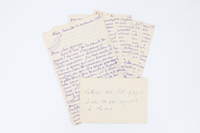
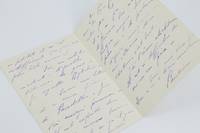
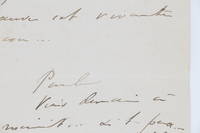
190578939s. l. Paris 1905. Fine. s. l. Paris s. d. ca. 1905 12.50 x 16.70 cm 4 pages sur un double feuillet Autograph letter signed ""Pauline"" and ""P.M.T."" by Renée Vivien addressed to Natalie Clifford Barney and written in black ink on a double folio with silver-violet letterhead and the address 3 rue Jean-Baptiste Dumas. Transverse fold inherent to mailing. Very fine love and reproach letter written after the long two-year separation and probably upon return from Mytilene Lesbos: ""Est-ce vraiment pour moi que tu restes demain Tout-Petit . Qui le saura jamais . Ce doute que le passé justifie un peu entrave mes plus hautains élans et fait de moi la créature misérable et triste que je suis."" ""Is it really for me that you stay tomorrow Little One . Who will ever know . This doubt which the past somewhat justifies hampers my most haughty impulses and makes me the miserable and sad creature that I am."" Renée weakened by Natalie's infidelities struggles to trust her again ""Je ne puis croire en toi"" ""I cannot believe in you"" but continues despite her suffering to be entirely devoted to her: ""Tu m'as dédaignée alors que tu aurais été pour moi la révélation miraculeuse - Tu m'as dédaignée. Et aujourd'hui tu t'étonnes de ne point me trouver telle que tu m'aurais rêvée toi qui n'as pas pris le soin de me façonner à ta guise ! Ecoute. Tu es comme un potier qui voyant à ses pieds un argile informe le repousserait et qui plus tard voyant un de ses élèves en fait une statue imparfaite exhalerait en termes amers sa colère et son dédain."" ""You scorned me when you would have been for me the miraculous revelation - You scorned me. And today you are surprised not to find me as you would have dreamed me you who did not take the care to shape me to your liking! Listen. You are like a potter who seeing at his feet an unformed clay would push it away and who later seeing one of his students make an imperfect statue from it would exhale in bitter terms his anger and disdain."" Torn between pain and desire Renée nevertheless calls for her lover: ""Viens demain à minuit.si tu peux. si tu veux. si Ilse n'en décide pas autrement et si ton caprice te le permet."" ""Come tomorrow at midnight.if you can. if you want. if Ilse doesn't decide otherwise and if your whim allows it."" These reunions would not last however: torn between Baroness Hélène de Zuylen and Natalie Renée would chain together travels; in turn to Holland Germany Switzerland and Venice she would confide her hesitations to Kérimé Turkhan-Pacha her epistolary companion from the Bosphorus. It was at the end of 1899 and through Violette Shillito that Renée Vivien - then Pauline Tarn - made the acquaintance of Natalie Clifford Barney ""cette Américaine plus souple qu'une écharpe dont l'étincelant visage brille de cheveux d'or de prunelles bleu de mer de dents implacables"" ""this American more supple than a scarf whose sparkling face shines with golden hair sea-blue eyes implacable teeth"" Colette Claudine à Paris. Natalie who had just lived a summer idyll with the sulfurous Liane de Pougy who had initiated her into sapphism paid only discreet attention to this new acquaintance. Renée on the other hand was totally captivated by the young American and would relate this love at first sight in her autobiographical novel Une Femme m'apparut: ""J'évoquai l'heure déjà lointaine où je la vis pour la première fois et le frisson qui me parcourut lorsque mes yeux rencontrèrent ses yeux d'acier mortel ses yeux aigus et bleus comme une lame. J'eus l'obscur prescience que cette femme m'intimait l'ordre du destin que son visage était le visage redouté de mon avenir. Je sentis près d'elle les vertiges lumineux qui montent de l'abîme et l'appel de l'eau très profonde. Le charme du péril émanait d'elle et m'attirait inexorablement. Je n'essayai point de la fuir car j'aurais échappé plus aisément à la mort."" ""I evoked the already distant hour when unknown
17700005130No place: Le chev de Berny 1770. Hardcover. Near Fine. 12mo 49pp. 3pp. of Table 3pp. with mss. borders inkspot and inked names on flyleaf flyleaf and title leaves nicked at top edge parchment-backed sprinkled boards <br/><br/>This is a UNIQUE MSS. executed by Chevalier de Berny who after a military career became the master of a writing academy in Brussels. Rather few of his works have survived. These love poems are addressed to Louise Madame Messiery M. Le Baron de H . It incoporates French masonic ideas including p. 3 "L'Amour recu Franc macon" and p. 48 in "Reflexion sur L'Amour". Le chev de Berny hardcover
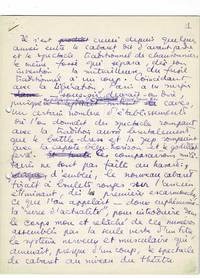
195376377Paris: s. n. 1953. Fine. s. n. Paris s. d. ca 1953 21 x 27 cm 11 feuillets rédigés au recto Manuscript partly unpublished of an article on cabaret nine pages plus two additional pages written in purple ink on perforated squared paper sheets. Numerous deletions and corrections as well as several additions. The sheets are numbered in the upper right margin from 1 to 9 then 12 and 13. The first nine sheets of this text which was never published during Boris Vian's lifetime were transcribed in Les Vies posthumes de Boris Vian by Michel Fauré 1975. The text was erroneously dated 1948 by Fauré: the mention of Samuel Beckett's En attendant Godot whose premiere took place in 1953 makes this dating impossible. An interesting text evoking cabarets and the ""troglodytes"" a fine echo to the famous Manuel de Saint-Germain-des-Prés 1951: ""Let us give back to Saint-Germain-des-Prés what rightfully belongs to it: besides a certain tonnage provided to journalists short of copy this much-decried district - by those who precisely only knew it in its journalistic aspect - is at the origin of the profound transformation of cabaret. Yes there was indeed a reason why intelligent people like Sartre Prévert Camus Merleau-Ponty etc. in short all those who today count in literature or the arts followed with such attention the great movement of the cellars despite the turbulence of the troglodytes and the incongruity of the photographer monkeys despite the muddled activity of a generation of illiterate and boorish journalists despite the vacant curiosity of the gawker and the bitter resentment of the chamber pot emptiers of rue Dauphine."" After briefly evoking jazz a subject on which he is usually dithyrambic Boris Vian devotes the greater part of his text to theater: ""Jazz on one side carved out with great trumpet blows a place in the shade on the engine room side; that is its true environment: a smoky cellar a back room a dark laboratory where the faithful gather. . The musicians finally relaxed. But for their part the actors did not remain inactive."" Visionary Vian senses ""in the air a scent of renewal"" understanding the importance that cabaret theater would assume in the years to come. Two sheets not transcribed in Fauré's work evoke the theatrical avant-garde of the early 1950s: ""And it is no accident if En attendant Godot Samuel Beckett's astonishing play is a clown entrance that lasts two hours deals with nothing in particular poses all problems wrests laughter at the moment when one should be terrified . And it is no accident if the principal interpreter of Beckett's work this pillar of avant-garde theater is a cabaret veteran."" s. n. unknown
194273853s. l. 1942. Fine. s. l. 17 février 1942 21 x 27 cm 2 feuilles Autograph letter signed by Félix Fénéon to Gabriel Mourey 18 lines in black ink folds from mailing. A key witness and actor of his time the art critic and collector Félix Fénéon assists the writer Gabriel Mourey in his search for the correspondence between Paul Adam and Maurice Barrès: ""Le romancier et occultiste Paul Adam fut comme vous savez très lié à Maurice Barrès. Candidats boulangistes dans deux circonscriptions lorraines contiguës il firent fraternellement une campagne électorale et journalistique à laquelle leur amitié ne survécut guère. Comment retrouver tous les papiers de Paul Adam mort il y a une vingtaine d'années Mme Paul Adam vit-elle encore. - je n'en sais rien. Mais il est probable que vive une de ses soeurs veuve depuis quelques trois ans de ce L. Cappiello auteur de tant d'affiches - peintre elle aussi et de plus fort sourde. Leur demeure était 8 rue Lechatelier XVIIe. Par Mme L. Cappiello vous retrouverez peut-être des papiers barrésiens laissés par Paul Adam. Pour le cas où vous chercheriez dans cette direction je note que que j'ai été en excellents termes avec toute la famille et que vous pouvez donc user de mon nom à votre gré."" A leading figure of the avant-garde Fénéon possessed a singular gift for discovering major artists. A deliberately discreet and eccentric dandy he devoted himself almost religiously to all that contributed to a new artistic sensibility. A staunch defender of the Neo-Impressionists Seurat and Signac and a friend of Mallarmé Camille Pissarro Paul Adam and Gustave Kahn Fénéon was successively an anarchist and a communist and directed a dozen small reviews. He published groundbreaking works such as Rimbauds Illuminations André Gides Paludes and James Joyces Dedalus. A prolific journalist he wrote for numerous publications often unsigned or under fanciful pseudonyms such as Gil de Bache Porphyre Kalouguine and even Thérèse or Louise. A rare letter from Félix Fénéon discussing his contemporaries. Also included is an autograph letter signed by Fanny Fénéon wife of Félix Fénéon dated 30 December 1941 written while her husband was ill and bedridden; 10 lines in black ink with folds from mailing. ""Mon mari gravement malade est dans l'impossibilité de recevoir quelqu'un. Si la difficulté que vous désirez lui remettre peut se résoudre par lettre veuillez lui dire ce dont il s'agit. Une réponse immédiate vous montrera que malgré ses 80 ans il est tout à votre disposition. ."" unknown
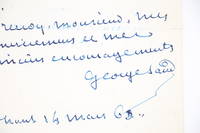
186376837Nohant Nohant-Vic 1863. Fine. Nohant Nohant-Vic 14 mars 1863 13.40 x 20.60 cm 3 pages sur un double feuillet Autograph letter signed by George Sand addressed to René Biémont. Three pages written in blue ink on a double sheet bearing at the head of the first page the blind stamp of Sand's initials. Envelope included. Folds inherent to mailing. This letter was published in the complete correspondence of George Sand established by Georges Lubin. Fine letter of congratulations addressed to René Biémont after sending his work Le Petit Fils d'Obermann: ""Your little book is very original and you show qualities of talent that will develop if you look ahead."" As an attentive reader much solicited by her young peers Sand develops her literary criticism: ""Obermann and his grandson the monk belong to the past. They are true and the timid Jean is well drawn. There is grandeur and truth in this exceptional type. But Constant d'Heurs is too passive to events. He should react against this powerless man and cure him or pity him more ."" Sententiously she thus concludes her letter: ""Do not complain of thankless work and accept it as a good thing three-quarters of life sacrificed to some duty makes the last quarter very strong and very alive. It is very good to be attached to poetry and thwarted in the possession of a beautiful dream. As soon as one can savor it without respite it fades or becomes troubled. I speak to you from experience. One is never happier and more inspired than when one believes one does not have time to be so."" Very fine testimony to the leading role that George Sand played on the literary scene of the Second Empire. unknown
192384822Pantelleria 1923. Fine. Pantelleria 22 Juin 1923 21 x 27 cm deux pages sur un feuillet Autograph letter dated and signed by Jean-Baptiste Charcot known as Commandant Charcot on Pourquoi pas letterhead 56 lines written in blue ink on a single leaf recto-verso addressed to his friend Raymond Hovasse. Folds from mailing ink faded. Adverse weather conditions prolonged a Mediterranean cruise that was initially meant to last only four days: ""Mais comme la caractérisation de cette croisière depuis que nous avons quitté la Provence est le coup de vent qui dure trois jours puis 1 jour de calme et de nouveau 3 jours de vent nous travaillons 1 jour et tachons de nous abriter qq. part pendant les 3 mauvais. Et cela peut durer longtemps ainsi."" The explorer nevertheless found some interest in this navigation disrupted and made difficult by the weather: ""Par ailleurs notre tournée n'a pas manqué de charme l'Orient en a toujours mais ce sale temps l'a empêché probablement d'être aussi fructueuse qu'elle aurait pu l'être le temps parce qu'il va falloir songer au retour."" This voyage also gave Jean-Baptiste Charcot the opportunity to become better acquainted with his friend and his family: ""J'ai été tout particulièrement enchanté d'avoir l'honneur et le plaisir d'être présenté à votre femme et de connaître vos gosses et d'entrer ainsi un peu dans votre vie familiale j'ai été également très heureux de vous avoir pendant qq heures à bord de nouveau."" which he hoped to repeat if the sea deities remained favorable: "". si le bateau reste jeune. si tous les maîtres de la mer me permettent de continuer."" Upon his return to Paris the navigator promised to intercede on his behalf and was confident that his efforts would be rewarded: "". je serais bien étonné si je n'obtenais pas satisfaction."" unknown
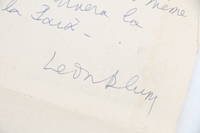
1948873581948. Fine. « A Londres pour la première fois des possibilités d'accord sont apparues pour les problèmes allemands même sur les Réparations. » In London for the first time possibilities for agreement have appeared on German problems even on Reparations. s. d. 1948 21 x 27 cm quatre feuillets Signed autograph manuscript entitled ""A Compiègne et au Palais Bourbon"" by Léon Blum 3 and a half pages in blue ink on the verso of four sheets with letterhead from the newspaper Le Populaire Central Organ of the Socialist Party S.F.I.O. Numerous passages crossed out and rewritten in black ink. Horizontal fold mark on each sheet notes from a previous bibliographer in pencil at the head of the first sheet. The article appeared in the daily newspaper Le Populaire on March 9 1948. Fine and virulent diatribe by Léon Blum following General De Gaulle's Compiègne speech denouncing his maneuvers toward a ""strong State."" He paints a hopeful picture of German reconciliation European construction as well as the Marshall Plan soon to be ratified - of which he had been the great negotiator. On March 7 1948 the general who had just founded the Rally of the French People was invited by the new mayor Jean Legendre who had rallied to the RPF. At a pivotal moment of international tensions before several tens of thousands of people gathered at the château square De Gaulle called on the French to unite to refound the Fourth Republic and free countries to unite against communism following the ""Prague coup."" Remaining excluded from power he then began his crossing of the desert until his return in 1958 thanks to the Algerian crisis which brought down the weak Fourth Republic. Having established the foundations of this same Republic Blum disapproves in these pages of De Gaulle's challenge to parliamentary institutions - even as his own Gaullists deputies obstruct debates in the assembly. He opposes the general's catastrophist discourse with an optimistic vision of European and international reconstruction convinced of the great resilience of the French nation and confident in its institutions. « Chose curieuse c'est la presse gaulliste qui attendait le discours de Compiègne avec la curiosité et l'impatience la plus marquées. . En fin de compte le discours de Compiègne n'a apporté rien de neuf. Il a fait entendre que toutes ses mesures étaient arrêtées et que sans doute aussi ses hommes étaient choisis. Il a déclaré que la situation était trop critique en France en Europe et dans le monde pour permettre qu'on différât davantage. Mais il a persisté cependant à affirmer - c'est du moins ainsi que j'interprète un texte volontairement obscur biffé : ambigu - qu'il ne gouvernerait pas dans le cadre des institutions présentes biffé : anciennes et qu'il n'accepterait qu'un pouvoir taillé à sa mesure . Rien de bon ne peut en sortir a-t-il conclu ; il n'est que temps de tirer la France de ce marécage pour l'installer sur le sol ferme et salubre de l'Etat fort. Tout cela va fort bien. Seulement à l'heure même où le général prononçait contre les partis et les institutions parlementaires le réquisitoire altier l'Assemblée nationale siégeait au Palais Bourbon. Elle promouvait l'examen des propositions relatives au prélèvement René Mayer. Et là on voyait la coalition du parti gaulliste avec ces mêmes « séparatistes » que le discours de Compiègne dénonçait comme des traîtres s'étaler avec une impudence plus scandaleuse de jamais . Dénoncer l'impuissance parlementaire tout en l'organisant stigmatiser la malfaisance et l'immoralité des partis tout en en fournissant l'exemple éhonté c'est une attitude commode mais qui brave par trop violemment le bon sens et l'honnêteté. . Certes la situation intérieure est sérieuse et la situation internationale ne l'est pas moins. Mais le redoutable hiver s'achève le ravitaillement s'améliore. La tendance s'améliore vers la baisse des produits alimentaires s'accentue et s'acce unknown
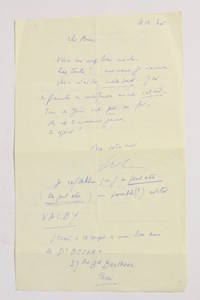
194962588Korsør Danemark Korsør 1949. Fine. Korsør Danemark Korsør 12 Novembre 1949 21 x 34 cm deux pages sur un feuillet Letter autograph signed by Louis-Ferdinand Céline two pages envelope attached to Charles Deshayes 25 lines in blue ink dated November 12 1949 and written since his Danish exile Korsor. Traces of central folds inherent to a letter slipped into an envelope that we enclose to the letter. Louis-Ferdinand Céline begins his letter in the grip of doubts and insults: ""It's a very ugly shot what to try I can not avoid myself nowhere I have complaints of counterfeiting That's all all these people are basically afraid they'll never admit it. Then in postscript he thinks that he may have found a publisher ""very possibly"" a possible Publisher Valby and that he will pass through a Parisian friend for the contact ""I write about it to my good friend Dr. Becart"" and recommend to his correspondent to also write to him. He continues his letter by evoking concerns of writing: ""I changed your title.By the love of God leave the night quiet! And surtoutr the end! It is a nightmare"" and ends with a scathing paranoid and all Céline remarks : ""The Celine affair seems to me the best like the Dreyfus Affair"" unknown
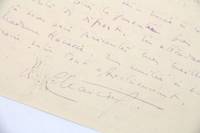
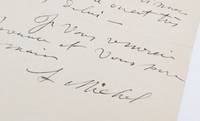
188683952s. l. Paris 1886. Fine. Letter to the Tiger: ""Before returning to the cage"" s. l. Paris 7 août 1886 13.20 x 19.20 cm 3 pages sur un bifeuillet Autograph signed letter from Louise Michel addressed to Georges Clemenceau; three pages written in black ink on a bifolium of white paper. Transverse creases inherent to posting. Fine letter from Louise Michel to Clemenceau one of her most important supporters before yet another incarceration: « Il faut avant de rentrer en cage . que je vous demande le grand service de faire entrer à l'hospice mon cousin le petit Dacheux à qui vous avez bien voulu faire avoir sa dispense d'âge. » ""Before returning to the cage . I must ask you the great favor of having my cousin little Dacheux admitted to the hospice for whom you were kind enough to obtain his age exemption."" The former communard has indeed just been sentenced to four months in prison for having given a speech in favor of the Decazeville miners alongside Jules Guesde Paul Lafargue and Étienne Susini. But for now it is the condition of her cousin Lucien Dacheux that concerns her: « Son genou étant de plus en plus malade on l'envoie en congé de deux mois mais il faut qu'il entre à l'hospice s'il ne veut pas rester estropié. De plus on n'a pu lui donner une mécanique pour son genou et en même temps le médecin lui disait que c'était indispensable - peut-être pourra-t-il en avoir une au Val de Grâce - je le recommande bien à vous et au citoyen Lafont - J'irai vous voir pour cela et une autre chose du même genre avant le 12 mais s'il était possible de faire entrer avant à l'hospice le petit Lucien Dacheux je serais bien heureuse car il sera tout à fait estropié et incapable de continuer son service où on est très content de lui. » ""His knee being increasingly ill they are sending him on two months' leave but he must be admitted to the hospice if he doesn't want to remain crippled. Moreover they couldn't give him a mechanism for his knee while at the same time the doctor told him it was indispensable - perhaps he could get one at Val de Grâce - I recommend him highly to you and to citizen Lafont - I will come to see you about this and another matter of the same kind before the 12th but if it were possible to have little Lucien Dacheux admitted to the hospice beforehand I would be very happy because he will be completely crippled and unable to continue his service where they are very pleased with him."" Louise Michel met Clemenceau in October 1870 when he was mayor of Montmartre and she was assistant schoolmistress. From their first meeting was born a strong friendship that lasted until Louise Michel's death. Clemenceau never ceased to support her particularly during her banishment to Nouméa and they maintained an extensive correspondence. A moving letter testimony to the unwavering devotion of the former communard and to the great friendship that united Louise Michel to Georges Clemenceau. unknown
190078919s. l. Paris 1900. Fine. s. l. Paris s. d. ca. 1900 12.30 x 16.50 cm 4 pages sur un double feuillet Autograph letter signed ""Pauline"" by Renée Vivien addressed to Natalie Clifford Barney and written in black ink on a double sheet with the poetess's silver monogram letterhead. Very beautiful and poetic love letter from the Muse of violets languishing for her ""dear white Lily"": ""Je n'ai pas pu te demander cet après-midi si je te verrais demain mon doux Avril mais tu as bien compris n'est-ce pas qu'il me serait aussi impossible de vivre un jour sans toi que de me priver des lumières du soleil ou des fleurs. . Avril mon doux petit Avril chaque fois que tu t'en vas tu emportes un peu de mon cur qui ne peut se détacher de toi et te suit tristement. Tu es pour moi la poésie la consolation et le rêve. Tu mets de la beauté dans ma vie et dans mon âme - quand je me réveille chaque jour et je pense à toi c'est la perpétuelle éclosion de quelque miraculeuse amour. Je vis dans un conte de fées un pays où tout est bleu et d'où la tristesse a disparu. Pense à moi ce soir avant d'aller rêver dans l'au-delà et le lointain du sommeil."" ""I could not ask you this afternoon if I would see you tomorrow my sweet April but you understood didn't you that it would be as impossible for me to live a day without you as to deprive myself of light sun or flowers. . April my sweet little April each time you leave you take with you a piece of my heart which cannot detach itself from you and follows you sadly. You are for me poetry consolation and dream. You bring beauty into my life and into my soul - when I wake each day and think of you it is the perpetual blossoming of some miraculous love. I live in a fairy tale a country where everything is blue and from which sadness has disappeared. Think of me tonight before going to dream in the beyond and the distance of sleep."" The letter then takes on a more sensual tone: ""J'aime tes cheveux blonds. Je leur envoie un long baiser. Les lys que j'ai dans ma chambre sont tristes parce que tu n'es plus là. Ils t'envoient leur âme dans un parfum. Ils t'aiment comme moi ; mais moins que moi."" ""I love your blonde hair. I send them a long kiss. The lilies I have in my room are sad because you are no longer there. They send you their soul in a fragrance. They love you like me; but less than me."" During their first night of love Renée had filled her room with lilies transforming it into a ""chapelle ardente"" N.Clifford Barney Je me souviens. Jean-Paul Goujon notes: ""The choice of lilies was very much in the taste of the period: let us remember Mucha's posters Schwabe's paintings Lorrain's poems. But Vivien who certainly remembered certain pages filled with flowers and perfumes from Zola's La Faute de l'abbé Mouret seems to have wanted to celebrate mystical nuptials coupled with a sort of perfumed death."" It was at the end of 1899 and through Violette Shillito that Renée Vivien - then Pauline Tarn - made the acquaintance of Natalie Clifford Barney ""cette Américaine plus souple qu'une écharpe dont l'étincelant visage brille de cheveux d'or de prunelles bleu de mer de dents implacables"" ""this American more supple than a scarf whose sparkling face shines with golden hair sea-blue eyes implacable teeth"" Colette Claudine à Paris. Natalie who had just lived through a summer idyll with the scandalous Liane de Pougy who initiated her into Sapphism paid only discreet attention to this new acquaintance. Renée however was totally captivated by the young American and would relate this coup de foudre in her autobiographical novel Une Femme m'apparut: ""J'évoquai l'heure déjà lointaine où je la vis pour la première fois et le frisson qui me parcourut lorsque mes yeux rencontrèrent ses yeux d'acier mortel ses yeux aigus et bleus comme une lame. J'eus l'obscur prescience que cette femme m'intimait l'ordre du destin que son visage était le visage redouté de mon avenir. Je sentis p unknown
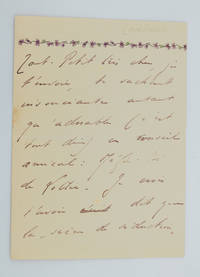
190679012s. l. Paris 1906. Fine. s. l. Paris s. d. ca 1906 11.50 x 15.90 cm 4 pages sur un double feuillet Autograph letter by Renée Vivien addressed to Natalie Clifford Barney and written in violet ink on a double sheet bordered with violets. Transverse folds inherent to mailing. Interesting letter of warning against the opportunist ""Lottie"": ""Tout-Petit très cher je t'envoie te sachant insouciante autant qu'adorable c'est tout dire ce conseil amical : Méfie-toi de Lottie. Je crois t'avoir dit que la « scène de séduction » chez moi était très savamment préparée et combinée. Lottie a besoin d'argent. Elle en cherche avec âpreté. Elle me demande maintenant une « lettre d'introduction » pour Lugné-Poë. et moi qui ne le connais pas ! Elle « t'embêtera » . c'est le mot cru le seul qui convient Elle est exaspérée contre moi parce que je n'ai pas succombé et surtout parce que je ne lui donnerai pas d'argent. Si elle m'en avait demandé loyalement franchement au nom des jours d'autrefois j'aurais cédé mais cette comédie amoureuse me répugne Je te le répète : Méfie-toi Ne la vois point si cela t'est possible."" ""Very dear Little One I send you knowing you to be as carefree as you are adorable which says everything this friendly advice: Beware of Lottie. I believe I told you that the 'seduction scene' at my place was very cleverly prepared and planned. Lottie needs money. She seeks it eagerly. She now asks me for a 'letter of introduction' to Lugné-Poë. and I who don't know him! She will 'bother you'. that's the crude word the only one that fits She is exasperated with me because I did not succumb and especially because I will not give her money. If she had asked me loyally frankly in the name of days gone by I would have given in but this amorous comedy disgusts me I repeat: Beware Do not see her if it is possible for you."" Charlotte ""Lottie"" Stern Countess Venturini was an actress also known by the name of Yorska and a close friend of Sarah Bernhardt. Alice Pike Barney Natalie's mother painted a very beautiful profile of her in pastel entitled ""Vamp of 1900"" and today preserved at the Smithsonian American Art Museum in Washington. The Jacques Doucet library holds eighteen autograph letters that she addressed to Natalie Clifford Barney. It was at the end of 1899 and through the intermediary of Violette Shillito that Renée Vivien - then Pauline Tarn - made the acquaintance of Natalie Clifford Barney ""cette Américaine plus souple qu'une écharpe dont l'étincelant visage brille de cheveux d'or de prunelles bleu de mer de dents implacables"" Colette Claudine à Paris. Natalie who had just lived through a summer idyll with the scandalous Liane de Pougy who had initiated her into sapphism paid only discreet attention to this new acquaintance. Renée on the other hand was completely captivated by the young American and would relate this love at first sight in her autobiographical novel Une Femme m'apparut: ""J'évoquai l'heure déjà lointaine où je la vis pour la première fois et le frisson qui me parcourut lorsque mes yeux rencontrèrent ses yeux d'acier mortel ses yeux aigus et bleus comme une lame. J'eus l'obscur prescience que cette femme m'intimait l'ordre du destin que son visage était le visage redouté de mon avenir. Je sentis près d'elle les vertiges lumineux qui montent de l'abîme et l'appel de l'eau très profonde. Le charme du péril émanait d'elle et m'attirait inexorablement. Je n'essayai point de la fuir car j'aurais échappé plus aisément à la mort."" ""Winter 1899-1900. Beginning of the idyll. One evening Vivien is invited by her new friend to Mme Barney's studio Natalie's mother 153 avenue Victor-Hugo at the corner of rue de Longchamp. Natalie ventures to read verses of her composition. When Vivien tells her she loves these verses she replies that it is better to love the poet. A response quite worthy of the Amazon."" J.-P. Goujon Tes blessures sont plus douces que leurs caresses Two year unknown
190579002s. l. Paris 1905. Fine. s. l. Paris s. d. 1905-1906 11.50 x 15.90 cm 3 pages sur un double feuillet Autograph letter signed ""Pauline"" by Renée Vivien addressed to Natalie Clifford Barney and written in violet ink on a double sheet bordered with violets. Transverse creases inherent to the mailing. Icy and a fresh attempt at rupture or at the very least a rebuff this letter is completely devoid of courtesy and tenderness: ""Je ne suis pas pareille à toi - j'ai de l'orgueil et de la fierté - cet orgueil tu l'as blessé cette fierté tu l'as froissée - je ne m'exposerai plus à des dégoûts de ce genre. Tes lettres te seront renvoyées sans être lues - ne m'envoie pas de fleurs elles seront refusées. Je vois peu de gens dans l'horreur où je vis des êtres j'en verrai moins encore - cela me procurera peut-être la paix. Je me demande seulement pourquoi tu m'as importunée pour me revoir si ce n'était pour m'humilier et me dégoûter de toi encore davantage. Adieu puisque je ne te reverrai plus de ma vie. Pauline"" ""I am not like you - I have pride and dignity - you have wounded that pride you have bruised that dignity - I will no longer expose myself to such disgust. Your letters will be returned unread - do not send me flowers they will be refused. I see few people in the horror I feel for human beings I will see even fewer - that will perhaps bring me peace. I only wonder why you bothered me to see me again if it was not to humiliate me and disgust me with you even more. Farewell since I will never see you again in my life. Pauline"" Moving letter revealing the suffering and isolation of the Muse of violets sliding inexorably toward her tragic end. It was at the end of 1899 and through the intermediary of Violette Shillito that Renée Vivien - then Pauline Tarn - made the acquaintance of Natalie Clifford Barney ""cette Américaine plus souple qu'une écharpe dont l'étincelant visage brille de cheveux d'or de prunelles bleu de mer de dents implacables"" ""this American more supple than a scarf whose sparkling face shines with golden hair sea-blue eyes implacable teeth"" Colette Claudine à Paris. Natalie who had just experienced a summer idyll with the scandalous Liane de Pougy who had initiated her into Sapphism paid only discrete attention to this new acquaintance. Renée however was completely subjugated by the young American and would relate this coup de foudre in her autobiographical novel Une Femme m'apparut: ""J'évoquai l'heure déjà lointaine où je la vis pour la première fois et le frisson qui me parcourut lorsque mes yeux rencontrèrent ses yeux d'acier mortel ses yeux aigus et bleus comme une lame. J'eus l'obscur prescience que cette femme m'intimait l'ordre du destin que son visage était le visage redouté de mon avenir. Je sentis près d'elle les vertiges lumineux qui montent de l'abîme et l'appel de l'eau très profonde. Le charme du péril émanait d'elle et m'attirait inexorablement. Je n'essayai point de la fuir car j'aurais échappé plus aisément à la mort."" ""I evoked the already distant hour when I saw her for the first time and the shiver that ran through me when my eyes met her mortal steel eyes her sharp blue eyes like a blade. I had the obscure prescience that this woman was giving me destiny's orders that her face was the dreaded face of my future. I felt near her the luminous vertigo that rises from the abyss and the call of very deep water. The charm of peril emanated from her and attracted me inexorably. I did not try to flee her for I would have escaped death more easily."" ""Hiver 1899-1900. Débuts de l'idylle. Un soir Vivien est invitée par sa nouvelle amie dans l'atelier de Mme Barney mère de Natalie 153 avenue Victor-Hugo à l'angle de la rue de Longchamp. Natalie s'enhardit à lire des vers de sa composition. Comme Vivien lui dit aimer ces vers elle lui répond qu'il vaut mieux aimer le poète. Réponse bien digne de l'Amazone."" ""Winter 1899-1900. Beginning of the idyll. One evening Vivie unknown
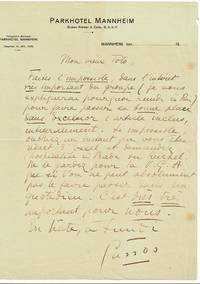
191475402Mannheim: s. n. 1914. Fine. Roland Garros comes to the aid of aviators' widows and orphans s. n. Mannheim s. d. juin 1914 22.20 x 28.80 cm une page sur un feuillet Autograph letter signed by Roland Garros addressed to his ""vieux Toto"" Jacques Mortane written in black ink on Parkhotel Mannheim letterhead. Horizontal folds from mailing a few marginal tears without loss. A rare and attractive letter in which the aviator refers to ""Le Groupe"" and the ""Jour des Aviateurs"" at Juvisy: ""Faites l'impossible dans l'intérêt très important du groupe je vous expliquerai pourquoi jeudi à Paris pour faire passer en bonne place dans Excelsior l'article inclus intégralement."" Mortane successfully managed to transmit the article which was published in the 14 June 1914 issue under the title ""Le Gala des Aviateurs - La fête aérienne d'aujourd'hui à Juvisy."" It was Roland Garros who initiated the association with Jacques Mortane serving as secretary general which he named ""Le Groupe."" Bringing together around fifteen aviation celebrities its purpose included supporting the widows and orphans of fellow aviators who had perished in pursuit of their passion. The ""Journée des aviateurs"" was the first charitable event organized by ""Le Groupe"" and as this letter testifies held great significance for Garros: ""C'est très très important pour nous."" The letters and signatures of the most famous of aviators who died at only twenty-nine are rare and much sought after. s. n. unknown
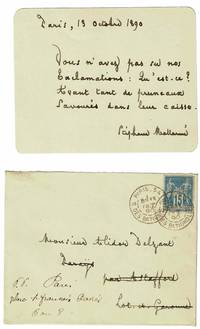
189076344Valvins 1890. Fine. Valvins 13 octobre 1890 11.40 x 8.80 cm une carte recto et une enveloppe Autograph quatrain signed by Stéphane Mallarmé addressed to Alidor Delzant written in black ink on the verso of a card. Envelope included. Alidor Delzant was a lawyer collector and bibliophile. Friend of the Goncourts he devoted a work to them and was Edmond's secretary and testamentary legatee. ""Vous n'avez pas su nos / Exclamations : Qu'est-ce / Avant tant de pruneaux / Savourés dans leur caisse"" ""You did not know our / Exclamations: What is this / Before so many prunes / Savored in their box"" Amusing stanza of thanks for the sending of prunes. unknown
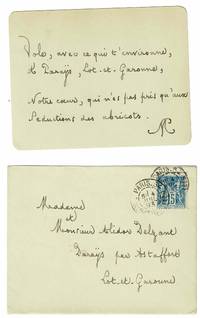
189376341Valvins 1893. Fine. Valvins 4 juillet 1893 11.40 x 8.80 cm une carte recto et une enveloppe Autograph quatrain signed by Stéphane Mallarmé addressed to Alidor Delzant written in black ink on the verso of a card. With envelope. Alidor Delzant was a lawyer collector and bibliophile. Friend of the Goncourts he devoted a work to them and was Edmond's secretary and testamentary legatee. ""Vole avec ce qui t'environne / A Paraÿs Lot-et-Garonne / Notre coeur qui n'es pas pris qu'aux / Séductions des abricots"" ""Fly with all that surrounds you / To Paraÿs Lot-et-Garonne / Our heart which is not taken only by / The seductions of apricots"" Amusing stanza of thanks for sending apricots. unknown
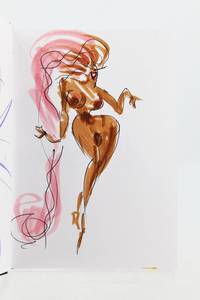
2012834232012. Fine. Supermanfred man of style s. d. ca 2012 15.50 x 21.50 cm relié Black cloth binding. A white star made by Mugler in corrector fluid on the first cover. Fifteen pages of the notebook filled in by the fashion designer: - The first page in neon blue felt-tip pen with the word ""Yes"" as and large exclamation mark ending with the iconic Mugler star. - A double page with the word ""white"" enhanced with corrector fluid and in capital letters on a black felt-tip background in orange the words ""Indehain"" and ""TRIBE"" with a drawing depicting a sun several notes in black ballpoint pen: ""Aelino Rock-Elektro"" ""DJ"" ""Syath Choreographie"". - A double page with a wonderful drawing of a naked Black woman with voluminous pink hair and on the left with a black ballpoint pen the words ""Super NOVA MAMA"" with star enhanced with purple marker. - A double page with three lines in green red and purple markers: ""- La Perle de l'Afrique. / RIEN QUI BOUGE !!! / Le chic des mains de Paris !"" - The Pearl of Africa. / NOTHING THAT MOVES!!! / The chic of the hands of Paris! The last exclamation point ends with a star. - Several drawings of stars and perfume bottles sketches in pencil. - A list of names in pencil opposite some of them the letter ""G"" in blue marker the mention ""Kab"" in red marker and a spiral in orange marker. - A double page with a drawing of a perfume bottle and a planet with a phallus on it; above several lines in blue purple orange green and red markers with the following text: Alice se perdit dans Brocéliande et se fit courser par le centaure Manfred.et ses dangereux attributs.Pauvre petite fille riche.Ce n'est pas le luxe qui va la sauver. Ombres d'arbres sous la lune ""EN TRAVERS"" CQFD. Testosterone et innocence.la Belle et la Bête !!! Rugissement furieux de métal.Perforation du Tympan et l'Hymen.L'HISTOIRE DU MONDE !"" Alice got lost in Broceliande a forest in Brittany and was chased by the centaur Manfred.and his dangerous attributes.Poor little rich girl.It's not luxury that will save her. Shadows of trees under the moon ""IN THE WAY"" QED. Testosterone and innocence.Beauty and the Beast!!! Furious roar of metal.Tympanum and Hymen perforation.THE HISTORY OF THE WORLD! - A double page in pencil with a sketch of a pole dancer with her head upside down in the left margin; with a text around it: ""Strip Tease intello : laide pas laide. Qui suis je Oui !. Je suis belle. Non ! Je suis laide. Regardez moi ! Non ne me regardez pas ! Voyez moi ! Aimez moi ! BAISE MOI !!! VAS T'EN ! Reviens. Folle. Pas folle. Grand Corps Malade Fabien"" Strip Tease nerd: ugly not ugly. Who am I Yes !. I am beautiful. No! I am ugly. Look at me ! No don't look at me! Look at me! Love me! FUCK ME!!! GO AWAY! Come back. Crazy. Not crazy. Grand Corps Malade Fabien"" French singer Grand Corps Malade whose real name is Fabien wrote a song for the designer's music-hall show Mugler Follies - A pencil note: ""Acte Vente Chelsea AT 92"". Thierry Mugler sold his penthouse in New York's Chelsea neighborhood in 2012. The personal archives of Manfred Thierry Mugler are exceedingly rare. Clear pictures upon request hardcover
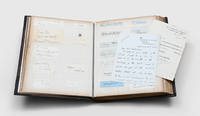
18831767411883-1916. Autograph hunting among British high society A fine assemblage of around 250 signatures of the luminaries of the Victorian and Edwardian age including a signed portrait of Ernest Shackleton the signatures of Prime Ministers Arthur Balfour and H. H. Asquith and the writers George Trevelyan John Morley and George Augustus Sala. Most of the signatures are clipped and mounted alongside their letterhead. The rest are tipped-in letters many of which are made out to Samuel Holliday 1846-1912 who worked as a superintendent for the North Eastern Railway for 48 years and consequently encountered many notable travellers - some are letters of thanks for his service. His obituary noted "he was one of the best known figures in railway circles at York and Newcastle and was held in the highest esteem by all who knew him either in his official or private capacity" North Mail Newcastle Daily Chronicle 20 August 1912. Other letters are addressed to different people and acquired elsewhere. Where dated the letters range from 1883 to 1916. Also included are loose signed photographic portraits of William Booth Liza Lehmann and Harry Lauder and a signed sketch of Harry Furniss. Provenance: Anon. Sale: Sotheby Parke Bernet & Co. London May 9 1983 Lot 356; sold to Steve Forbes chairman of Forbes Magazine and presidential candidate in the 1996 and 2000 US elections; his book label is loosely inserted. Contemporary half morocco album 283 x 229 mm brown cloth sides silk moiré endpapers cloth inner hinge supports. Together with five loose portraits of which four signed see note. Album rubbed some signatures loose contents a little toned. In very good condition. hardcover
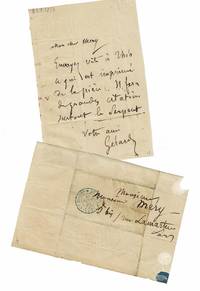
185373292Paris 1853. Fine. Autograph letter signed ""your friend Gérard"" addressed to Joseph Méry Paris 23 septembre 1853 9.70 x 14.50 cm une page sur un feuillet enveloppe jointe Autograph letter signed ""your friend Gérard"" addressed to Joseph Méry. Envelope with a small angular tear due to the original sealing enclosed. Horizontal folds. This letter is reproduced in the Pléiade edition of his correspondence vol. 3 p. 811. ""Envoyez vite à Théo ce qui est imprimé de la pièce. Il fera de grandes citations surtout le Serpent."" The ""pièce"" in question is Gusman le Brave first performed at the Odéon on 23 September 1853. On 4 October Théophile Gautier discussed the play in La Presse. ""Le Serpent"" refers to Josés tale in Act II scene 1. unknown
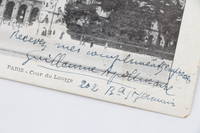
191382418Paris 1913. Fine. Paris 1913 13.30 x 21 cm une carte Unpublished autograph signed postcard by Guillaume Apollinaire addressed to the Dijon art historian Marcel Mayer. Two pages written in black ink on a photographic postcard depicting the courtyard of the Louvre. Charming letter praising the attachment to their roots of the "".fameux Flamands-Espagnols Hollandais et Bourguignons que j'admire tant"" ""famous Flemish-Spanish Dutch and Burgundians whom I admire so much"" and informing his correspondent of the writing and forthcoming publication of a ""petit livre sur Rude"" ""little book on Rude"" that Guillaume Apollinaire will not fail to send him. Fine autograph signature with the autograph address of 202 Boulevard Saint-Germain. unknown
195075963s. l. Klarskovgaard 1950. Fine. s. l. Klarskovgaard 12 octobre 1950 21 x 34 cm 2 pages sur un feuillet Partly unpublished autograph letter signed by Louis-Ferdinand Céline ""ami tenace et obligé"" addressed to his lawyer Maître Thorvald Mikkelsen. Two pages written in blue ink on a large sheet of white paper; number ""579"" in Céline's hand in red pencil at top left. Transverse folds inherent to posting. This letter was very partially transcribed in the Année Céline 2005. Very enigmatic letter: ""Aladin avait déjà une très jolie lampe - avec celle là vous allez voir un peu les trésors que je vais découvrir. Vous avez raison du reste - Carpe Diem ! Mais vous savez la moitié au moins du destin : c'est le PASSEPORT. Le passeport français est moche et moch. mais il vaut mieux que rien."" ""Aladdin already had a very pretty lamp - with this one you're going to see the treasures I'm going to discover. You're right besides - Carpe Diem! But you know at least half of destiny: it's the PASSPORT. The French passport is ugly and ugly. but it's better than nothing."" Note in passing the play on words with the name of Jules Moch vice-president of the council from 1949 to 1950. He informs Mikkelsen: ""J'ai aussi merde ! un cadeau à vous offrir et que vous accepterez nom de dieu ! parce que c'est un livre en Suédois ! donc scandinave ! donc divin ! donc touchable acceptable recevable non puant."" ""I also have damn! a gift to offer you and which you will accept by God! because it's a book in Swedish! therefore Scandinavian! therefore divine! therefore touchable acceptable receivable non-stinking."" In 1947 Céline pursued by French justice for his collaborationist involvement is confined in Denmark. It is in May 1948 accompanied by Lucette and Bébert that he arrives at his lawyer Maître Thorvald Mikkelsen's home in Klarskovgaard. The latter owns a large property by the Baltic Sea and invites the exile to stay there. On February 21 1950 as part of the purification process the writer is definitively sentenced in absentia by the civic chamber of the Paris Court of Justice for collaboration to one year's imprisonment which he had already served in Denmark. The Swedish consul general in Paris Raoul Nordling intervenes on his behalf with Gustav Rasmussen Danish Minister of Foreign Affairs and manages to delay his extradition. On April 20 1951 Jean-Louis Tixier-Vignancour his lawyer since 1948 obtains Céline's amnesty as a ""severely disabled veteran of the Great War"" by presenting his file under the name Louis-Ferdinand Destouches without any magistrate making the connection. Céline would leave Denmark the following summer after three years spent at his lawyer's home. unknown
190079000s. l. Paris 1900. Fine. s. l. Paris s. d. 1er semestre 1900 12.30 x 16.70 cm 2 pages sur un double feuillet Handwritten signed letter addressed to Natalie Clifford Barney: I am in the grips of one of my bouts of black and wild melancholy - I can no longer see anyone. Paris 1st half-year 1900 12.3 x 16.7 cm 2 pages on a double leafHandwritten letter from Renée Vivien signed Paule and written in pencil on a double leaf with a silver-coloured heart with the poet's monogram at the top of the first sheet. Transverse fold from having been sent. Beautiful letter of apology after a dispute with the Amazone: Suis en proie à un de mes accès de mélancolie noire et sauvage je ne peux plus voir personne. Je m'en vais demain à Fontainebleau pour y rester jusqu'à ce que je sois guérie je dis : guérie avec intention car c'est une espèce de maladie morale dont je souffre en ce moment. C'est pour cela que j'étais si mauvaise hier j'aurais dû m'enfermer comme je le fais toujours en pareil cas. Une autre fois je m'en irai à temps pour ne pas te faire du mal si toutefois tu me permets de dire : une autre fois et si tu ne me renvoies pas à jamais de ta présence. Je n'ai qu'une excuse c'est que je souffre. Je n'ai pas été digne de l'amour que tu m'as si généreusement et si largement donné je n'ose plus te demander pardon je t'ai tant de fois offensée ! I am in the grips of one of my bouts of black and wild melancholy - I can no longer see anyone. Tomorrow I am going to go to Fontainebleau to stay there until I am healed - I say: healed with intent because it is a kind of moral illness from which I suffer at the moment. That's why I was so bad yesterday - I should have locked myself up as I always do in such a case. Another time I will go sooner so as not to cause you harm - if nevertheless you allow me to say: another time and if you do not dismiss me forever from your presence. I only have one excuse that is that I suffer. I have not been worthy of the love that you have so generously and so widely given me - I dare not ask you anymore for forgiveness - I have offended you so many times! unknown
190078899s. l. Paris 1900. Fine. s. l. Paris s. d. ca. 1900 12.30 x 16.50 cm 1 page1/2 sur un double feuillet Autograph manuscript letter by Renée Vivien signed ""Pauline"" addressed to Natalie Clifford Barney and written in black ink on a double sheet with the poetess's silver monogram letterhead. A very charming letter evoking the flowers so dear to Renée ""Tout-Petit que j'aime je t'envoie des pensées toutes blanches. Garde-les dans ta chambre auprès de toi où sont mes vraies pensées tu le sais."" ""Little one I love I send you pansies all white. Keep them in your room near you where my true thoughts are you know."" as well as a gift from her ""tout petit chéri"" ""dear little one"": ""J'adore mes tablettes tu te rappelles les tablettes des deux petites joueuses de flûte - seulement elles les ont perdues et moi je ne veux pas perdre les miennes. J'ai écrit dessus en grec J'aime Natalie ! Cela m'a fait tant de plaisir ! - quelle bonne et jolie pensée tu as eue là ! -"" ""I adore my tablets do you remember the tablets of the two little flute players - only they lost them and I don't want to lose mine. I wrote on them in Greek I love Natalie! It gave me such pleasure! - what a good and lovely thought you had there! -"" Renée Vivien's Hellenist passion was born from her encounter with Eva Palmer during their stay in the United States where she accompanied Natalie Clifford Barney. This beautiful twenty-six-year-old redhead who it is said had translated all of Plato's Symposium with the Amazon gave Renée her first lessons in ancient Greek and awakened in her the passion for the poetess Sappho that never left her thereafter. It was at the end of 1899 and through Violette Shillito that Renée Vivien - then Pauline Tarn - made the acquaintance of Natalie Clifford Barney ""this American more supple than a scarf whose sparkling face shines with golden hair sea-blue eyes and implacable teeth"" Colette Claudine à Paris. Natalie who had just lived a summer idyll with the sulfurous Liane de Pougy who had initiated her into sapphism paid only discreet attention to this new acquaintance. Renée however was totally captivated by the young American and would relate this love at first sight in her autobiographical novel Une Femme m'apparut: ""I evoked the already distant hour when I saw her for the first time and the shiver that ran through me when my eyes met her eyes of mortal steel her sharp blue eyes like a blade. I had the obscure presentiment that this woman was giving me destiny's order that her face was the dreaded face of my future. I felt near her the luminous vertigo that rises from the abyss and the call of very deep water. The charm of peril emanated from her and attracted me inexorably. I did not try to flee her for I would have escaped death more easily."" ""Winter 1899-1900. Beginning of the idyll. One evening Vivien is invited by her new friend to Mme Barney's studio Natalie's mother 153 avenue Victor-Hugo at the corner of rue de Longchamp. Natalie ventures to read verses of her own composition. When Vivien tells her she loves these verses she replies that it is better to love the poet. A response quite worthy of the Amazon."" J.-P. Goujon Tes blessures sont plus douces que leurs caresses Two years of unequal happiness followed punctuated by Natalie's recurring infidelities and Renée's pathological jealousy whose letters oscillated between passionate declarations and painful mea culpa. ""Renée Vivien is the daughter of Sappho and Baudelaire she is the flower of evil 1900 with fevers broken flights sad voluptuousness."" Jean Chalon Portrait d'une séductrice In 1901 came an important rupture that would last almost two years; Renée despite Natalie's solicitations and the intermediaries she sends to win her back resists. ""The two friends saw each other again and it was in August 1905 the pilgrimage to Lesbos which constituted a disappointment for Natalie Barney and remained without consequence. . unknown