Jacques MESRINEBiblio.com
1 815 résultats
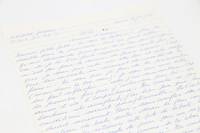
197684739Fleury-Mérogis 1976. Fine. Fleury-Mérogis 21 Octobre 1976 21 x 29.50 cm une page recto verso Autograph letter signed and dated by Jacques Mesrine dated Thursday October 21 1976 70 lines in blue ink on one recto-verso page addressed to his lover at the time Jeanne Schneider thanks to whom the manuscript of Instinct de mort was discreetly smuggled out of prison. Jacques Mesrine then incarcerated at Fleury-Mérogis prison rejoices at having been able to speak with his beloved in the visiting room who was also imprisoned: ""What a very pleasant visit you were moreover very feminine in that outfit which is very much in your style as a woman. even worth double the price because I like it"" and attempts to reassure her so that she does not lose all fight against the prison system that crushes inmates: ""But if by misfortune a new refusal should affect you do not have that bad reaction you told me about because those who surround you and have helped you do not deserve to pay for the injustice of others. You will have to face it as always. Because the doors will open one day and you know it."" As a protective patriarch Jacques Mesrine worries about the despair that could strike her and her daughter Murielle placed with social services: ""But I worry enormously about you because you have a limit. and I believe you have reached it! or almost. Regarding Mury and that bogus judge. we will see about removing her from social services. I prefer to pay for her studies and Mrs. Chevallier and all her upkeep if necessary. If you get out! Tell me. so many women to support. I'd better work overtime sic"" Public enemy No. 1 evokes Jeanne Schneider's upcoming freedom while ordering her not to fall back into criminality: "".If you get out formal prohibition from getting involved with me on a level that we both understand very well. I don't want to see you in prison anymore because you outside is a little bit of myself that will be free. You give your word for this freedom. prove that we others always keep it in good times as in bad"" Jacques Mesrine praises his companion's integrity the keystone of their strong union through the deprivation of freedom: ""This is what unites us most; criminals dangerous. but honest. This is what makes me love you with you no unpleasant surprises; you are 'white-blue' and for me you have the value of a diamond. It is the only stone that is harder than steel sic. but less hard than me resic"" He ends this missive with this humorous note reflecting the terrible intrusive reality of the penitentiary system: ""And if my Christmas package is prepared by you. the administration will X-ray it"" but also with these tender words: ""Sweet kisses rest on your lips. gesture of love that has united us always and for a long time. EL VIEJO Bandido!"" Rare and very beautiful letter from Jacques Mesrine in which we discover him protective and eager for freedom for his companion and for whom honesty must be erected as a rule of life. unknown
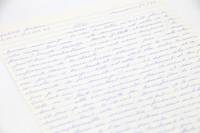
197685089Fleury-Mérogis 1976. Fine. Fleury-Mérogis 18 Octobre 1976 21 x 29.50 cm une page recto verso Autograph letter dated and signed by Jacques Mesrine dated Monday October 18 1976 68 lines in blue ink on one recto-verso page addressed to his love of the time Jeanne Schneider thanks to whom the manuscript of theInstinct de mort was discreetly smuggled out of prison. Jacques Mesrine then incarcerated at Fleury-Mérogis prison seeks to reassure his love whom he is helping through his lawyers so that she might obtain provisional freedom: ""C'est que je sens que cela va être bon et cela malgré que les avocates m'avaient déconseillé de le faire. tu sais que je fais de la prémonition mais dans le bon sens. Je sais que ma lettre les fait réfléchir. cela j'en suis certain. C'est la première fois que j'interviens pour toi. Ca aussi a de l'importance."" ""It's that I feel this is going to be good despite my lawyers having advised me against doing it. you know I have premonitions but in a good way. I know my letter makes them think. of this I am certain. This is the first time I'm intervening for you. That too is important."" and thanks to whom she should regain freedom: ""Mais le plus important est que tu retrouves cette pute de liberté. Après ce sera aux avocates de jouer pour un régime plus souple. Je te parle comme si tu étais déjà libre.Que ""veux-tu"" j'y crois."" ""But the most important thing is that you regain this damn freedom. After that it will be up to the lawyers to work for a more lenient regime. I'm talking to you as if you were already free. What can I say I believe in it."" Overflowing with enthusiasm and certainty for the success of these proceedings regarding Jeanne's provisional freedom and sure of the weight of his intervention the indomitable Mesrine fumes at the idea of a hypothetical refusal by the prison authorities: ""Quel affreux pirate qui te donne de l'espoir. Non mon ange je ne sais absolument rien. Sauf que le Président a dit que je le menaçais sur ma lettre. J'ai été très dur et à juste raison car la plaisanterie a assez durée. Toi tu supporteras ton refus. moi je ne l'accepterai plus. C'est pas plus compliqué que cela. Car tu as assez payé. même trop."" ""What a terrible pirate giving you hope. No my angel I know absolutely nothing. Except that the President said I was threatening him in my letter. I was very harsh and rightly so because the joke has gone on long enough. You will endure your refusal. I will no longer accept it. It's no more complicated than that. Because you have paid enough. even too much."" Public enemy No. 1 takes the opportunity again to shatter this reputation as a bloodthirsty beast that sticks to his skin: ""Si les journalistes savaient que toutes les infirmières entraient seules dans ma cellule et en toute confiance on serait loin du ""fauve"" et de la prise d'otages à la Buffet. Les infirmières ont toujours été sacrées pour moi. Elles sont intouchables comme pas mal d'autres personnes mais cela les pédés de journalistes l'ignorent ; car ils ne sont pas dans mes pensées et c'est regrettable parfois."" ""If journalists knew that all the nurses entered my cell alone and in complete confidence we would be far from the 'beast' and the hostage-taking like Buffet. Nurses have always been sacred to me. They are untouchable like many other people but those journalist faggots don't know this; because they are not in my thoughts and that's sometimes regrettable."" Jacques Mesrine speaks of the creation of his work L'instinct de mort and his health in a fatalistic manner: ""Autrement tout est ok sauf mes douleurs au coeur qui me reprennent. mais je laisse faire car je n'aime pas prendre de médicaments. Et puis le mécanisme s'arrêtera le jour ""J"" du destin. Peut-être dans tes bras. qui sait ""Otherwise everything is ok except my heart pains that are returning. but I let it be because I don't like taking medication. And then the mechanism will stop on the 'D' day of d unknown
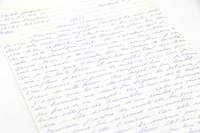
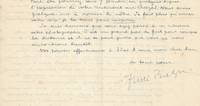
197685081Fleury-Mérogis 1976. Fine. ""She's an exceptional woman . I considered her like a mother . Woe to anyone who would touch a single hair on her head."" Fleury-Mérogis 22 Septembre1976 21 x 29.50 cm une page recto verso Autograph letter dated and signed by Jacques Mesrine dated Saturday September 22 1976 67 lines in blue ink on one page recto verso addressed to his love of the time Jeanne Schneider thanks to whom the manuscript of Instinct de mort was discreetly smuggled out of prison. Jacques Mesrine then incarcerated at Fleury-Mérogis prison and deprived of human warmth is enthusiastic about all the visits he receives in the visiting room thus dispelling the myth of the antisocial bandit devoid of human feelings: ""And after that they'll say I'm a savage! No quite the contrary and people who have had contact with me want to see me again. This gave me immense pleasure and do you know what happened next. she's also going to ask to see you. Apparently I'm missed by the nurses 'mister smile' that's the secret."" He particularly appreciated the visit from the nurse at La Santé prison who would also be their wedding witness with Jeanne Schneider and whom he praises: "". an enormous surprise! You'll never guess who came to see me! My nurse from La Santé. yes my darling. that charming lady with white hair whom you had seen in the visiting room at La Santé and who is to be our witness at our wedding . She's an exceptional woman a former military nurse and quite well-placed in the ministry. During my 2 and a half years at La Santé I considered her like a mother this woman is so devoted it's unthinkable. Woe to anyone who would touch a single hair on her head."" Public enemy No. 1 takes the opportunity again to break this reputation as a bloodthirsty beast that sticks to him: ""If journalists knew that all the nurses entered my cell alone and with complete confidence we'd be far from the 'beast' and hostage-taking à la Buffet. Nurses have always been sacred to me. They are untouchable like quite a few other people but those journalist faggots don't know that; because they're not in my thoughts and that's regrettable sometimes."" Jacques Mesrine the rebel is surprised to find himself appreciating his prison solitude: ""Do you know that I'm beginning to like it here. What calm you know manou my isolation I bear it insofar as I have peace. In detention it's not proven that I would have it. It's my reactions I'm afraid of. and the mentality of so-called crooks is increasingly disgusting! . in my isolation there's good and bad. but personally I don't want to complain. because there's no reason to do so."" and ends his letter with paternal considerations for his daughter who is not very assiduous at school and for whom he worries: ""I'm going to find out if Sabrina has been regularly attending her classes. I hope so because if the opposite were the case. no mercy this time. But what worry this kid can represent and what powerlessness I have to control her being here!"" Rare and very fine letter from Jacques Mesrine overflowing with reverence for the nursing profession and regrettable detestation for that of journalists. unknown
197684696Fleury-Mérogis 1976. Fine. Fleury-Mérogis 31 Décembre 1976 21 x 29.50 cm une page recto verso Autograph letter dated and signed by Jacques Mesrine dated Friday December 31st 1976 approximately 70 lines in blue ink on one recto verso page addressed to his love of the time Jeanne Schneider thanks to whom the manuscript of Instinct de mort was discreetly smuggled out of prison. Jacques Mesrine then incarcerated at Fleury-Mérogis prison wondered about the difficulties he might encounter if his Instinct de mort were to appear soon and with which sufficiently courageous publisher it could be edited: ""Je vais voir avec mon avocate pour les ""presses de la cité"" car je crois que l'on peut tirer un trait sur Simone. De toute façon il sera publié par celui acceptera d'en courir le risque"" ""I'm going to see with my lawyer about the ""presses de la cité"" because I think we can draw a line under Simone. In any case it will be published by whoever will accept to run the risk"" He also advised his beloved on her working conditions: ""Au sujet de ton boulot. j'espère que tu as discuté avec ta patronne car les horaires ne sont pas légaux. ne te laisse pas faire à ce sujet. Vis à vis du procureur tu es obligé de travailler. cela ne veut pas dire être esclave au boulot."" ""About your job. I hope you discussed with your boss because the hours are not legal. don't let yourself be taken advantage of on this subject. With regard to the prosecutor you are obliged to work. that doesn't mean being a slave at work."" and worried about the future of his daughter Sabrina: ""Demain j'espère la visite de la puce. je vais avoir une très sérieuse conversation avec elle au sujet de l'avenir. Car elle ne fait rien en classe. donc le mieux pour elle est de travailler pour obtenir un CAP en quelque chose. Elle veut jouer les adultes. alors il va falloir qu'elle se conduise en adulte."" ""Tomorrow I hope for a visit from the little one. I'm going to have a very serious conversation with her about the future. Because she does nothing in class. so the best thing for her is to work to get a vocational certificate in something. She wants to play at being an adult. so she'll have to behave like an adult."" Public enemy No. 1 evoked the coming new year: "".l'année nouvelle qui s'annonce. que nous réservera-t-elle. je l'ignore mais rien de bon si la logique se fait loi. cela ne m'empêchera pas de garder mon moral."" "".the new year that is coming. what will it hold for us. I don't know but nothing good if logic becomes law. that won't stop me from keeping my morale up."" Jacques Mesrine alone in his cell on the evening of December 31st New Year's Eve ended this beautiful letter with affectionate thoughts for Jeanne Schneider: ""Ce soir j'ai la tête un peu vide. tu comprends mais j'ai le coeur plein de toi et c'est cela qui compte. je vais me mettre dans les draps et penser à toi. Ton vieux voyou pose de tendres bécots sur tout ce qui est toi. Bonne nuit chaton. Te quiero."" ""Tonight my head is a bit empty. you understand but my heart is full of you and that's what counts. I'm going to get into the sheets and think of you. Your old rogue places tender kisses on everything that is you. Good night kitten. Te quiero."" and with this humorous note: "".tu connais cette blague : c'est une femme condamnée à mort. arrivée devant la guillotine elle embrasse le verre que l'on vient de lui servir. Le procureur demande : ""elle est folle que fait-elle"". L'avocat lui répond ""elle embrasse son dernier rhum"" Pas mal hein. un petit sourire ma puce."" "".do you know this joke: it's a woman condemned to death. arrived in front of the guillotine she kisses the glass that has just been served to her. The prosecutor asks: ""is she crazy what is she doing"". The lawyer replies ""she's kissing her last rum"" Not bad eh. a little smile my darling."" Rare and very beautiful letter from Jacques Mesrine in which we see him preoccupied with his daughter's future where he sho unknown
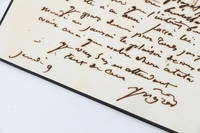
1823829561823. Fine. s. d. jeudi 9 13.50 x 20.80 cm une feuille Autograph letter signed by painter Jean-Auguste-Dominique Ingres about his pupil Albert Magimel with whom he worked in close collaboration. Magimel published a catalogue raisonné of his master's artworks. Handsome signature of Ingres in the lower part of the letter. unknown
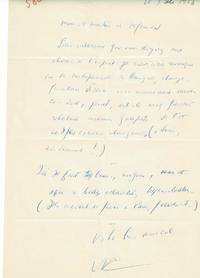
195076186s. l. Klarskovgaard 1950. Fine. s. l. Klarskovgaard 7 octobre 1950 21 x 34 cm 2 pages sur 2 feuillets Partly unpublished autograph letter signed by Louis-Ferdinand Céline addressed to his ""dear Master and defender"" Maître Thorvald Mikkelsen. Two pages written in blue ink on two large sheets of white paper; numbers ""580"" and ""581"" in Céline's hand in the upper left corner in red pencil. Transverse folds inherent to the mailing. This letter was very partially transcribed in the Année Céline 2005. Autograph letter signed by Louis-Ferdinand Céline addressed to his ""dear Master and defender"" Maître Thorvald Mikkelsen. Two pages written in blue ink on two large sheets of white paper; numbers ""580"" and ""581"" in Céline's hand in the upper left corner in red pencil. Transverse folds inherent to the mailing. Céline sends Mikkelsen an article: ""Pour intéressé que vous soyez aux choses de l'esprit je crois avoir remarqué que les turlupinades des banques changes fricoteries diverses vous amusaient aussi. Ci-donc joint article assez farceur relatant certaines galipettes de l'or et ses escrocs changeurs à Paris évidemment !"" ""However interested you may be in matters of the mind I believe I have noticed that the buffooneries of banks exchanges and various swindles also amuse you. Here therefore attached is a rather farcical article relating certain antics of gold and its swindling money-changers in Paris obviously!"" The writer attached to his letter another sheet whose numerous underlinings bear witness to the persecution he felt victim to: ""Maintenant qu'on remonte la Ligne Maginot qu'on recrée une Légion Anti Bolchéviques une armée franco-allemande il paraît qu'il est question de me poursuivre à nouveau d'après les Beaux Draps mais cette fois pour antigermanisme et sabotage de l'Europe Nouvelle et irrespect pour Hitler ! Oh je n'en mène pas large !"" ""Now that they're rebuilding the Maginot Line recreating an Anti-Bolshevik Legion a Franco-German army it seems they're planning to prosecute me again based on Les Beaux Draps but this time for anti-Germanism and sabotage of the New Europe and disrespect for Hitler! Oh I'm not feeling very confident!"" In 1947 Céline pursued by French justice for his collaborationist involvement was confined in Denmark. It was in May 1948 accompanied by Lucette and Bébert that he arrived at his lawyer Maître Thorvald Mikkelsen's home in Klarskovgaard. The latter owned a large property by the Baltic Sea and invited the exile to stay there. On February 21 1950 as part of the purge the writer was definitively condemned in absentia by the civic chamber of the Paris Court of Justice for collaboration to one year of imprisonment which he had already served in Denmark. The Swedish Consul General in Paris Raoul Nordling intervened on his behalf with Gustav Rasmussen the Danish Foreign Minister and managed to delay his extradition. On April 20 1951 Jean-Louis Tixier-Vignancour his lawyer since 1948 obtained Céline's amnesty as a ""severely disabled veteran of the Great War"" by presenting his file under the name of Louis-Ferdinand Destouches without any magistrate making the connection. Céline would leave Denmark the following summer after three years spent at his lawyer's home. In 1947 Céline pursued by French justice for his collaborationist involvement was confined in Denmark. It was in May 1948 accompanied by Lucette and Bébert that he arrived at his lawyer Maître Thorvald Mikkelsen's home in Klarskovgaard. The latter owned a large property by the Baltic Sea and invited the exile to stay there. On February 21 1950 as part of the purge the writer was definitively condemned in absentia by the civic chamber of the Paris Court of Justice for collaboration to one year of imprisonment which he had already served in Denmark. The Swedish Consul General in Paris Raoul Nordling intervened on his behalf with Gustav Rasmussen the Danish Foreign Minister and managed to delay his extradition. On unknown
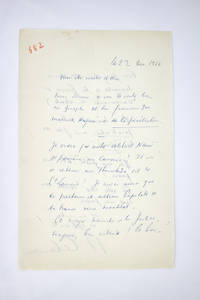
195075962s. l. Klarskovgaard 1950. Fine. s. l. Klarskovgaard 22 octobre 1950 21 x 34 cm 2 pages sur un feuillet Signed autograph letter partly unpublished by Louis-Ferdinand Céline addressed to his lawyer Maître Thorvald Mikkelsen. Two pages written in blue ink on a large sheet of white paper; number ""582"" in Céline's hand in red pencil at top left. Cross-folds inherent to mailing. This letter was very partially transcribed in Année Céline 2005. Fine letter mentioning Marcel Aymé: ""We will say if you please in simple and good French that Marcel Aymé has: penetration. . And if Marcel has penetration I have vision."" We will not revisit the friendship that united Céline and Aymé - the latter even visited him at Klarskovgaard in March 1951 - but we will content ourselves with quoting a passage from the text that the Montmartre writer composed in homage to his sulphurous friend: ""I knew him twenty-five years ago before the war when he was celebrated everywhere admired - but rarely understood - and after his return from Denmark during the nine years of suffering that led him to death. Before as after the storm his conversation revealed the idealist whose sarcasms denounced the hundred thousand miseries of a cruel vain bulimic humanity bent on its own destruction. 'Before' his indictments against man's murderous and suicidal follies against the injustices and snares of society had the joyful force of a fighter bursting forth with inexhaustible verbal invention that amazed his listeners."" Ecrits sur la politique 1933-1967 Céline also speaks in this letter of Albert Naud his lawyer between 1947 and 1951 who ""is strolling in Canada"" and ""is going to get himself a Thénardière on the St Lawrence"". This is followed by a very Célinian consideration: ""I also believe that the next and ultimate Capital of France will be Montreal."" The Danish exile then fantasizes about a world government to be established: ""And René Meyer sic minister of Justice always of course! over there! You will then yourself be minister of War in Denmark in retirement."" In 1947 Céline pursued by French justice for his collaborationist commitment is confined in Denmark. It is in May 1948 accompanied by Lucette and Bébert that he arrives at his lawyer Maître Thorvald Mikkelsen's home at Klarskovgaard. The latter owns a large property by the Baltic Sea and invites the exile to stay there. On February 21 1950 as part of the purge the writer is definitively condemned in absentia by the civic chamber of the Paris Court of Justice for collaboration to one year's imprisonment which he had already served in Denmark. The consul general of Sweden in Paris Raoul Nordling intervenes on his behalf with Gustav Rasmussen Danish minister of Foreign Affairs and manages to delay his extradition. On April 20 1951 Jean-Louis Tixier-Vignancour his lawyer since 1948 obtains Céline's amnesty under the title of ""grand invalide de la grande guerre"" by presenting his file under the name Louis-Ferdinand Destouches without any magistrate making the connection. Céline will leave Denmark the following summer after three years spent at his lawyer's home. unknown
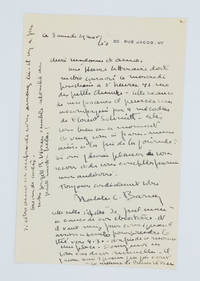
195278894Paris 1952. Fine. Paris samedi 29 novembre 1952 13.50 x 20.80 cm une page sur un feuillet Handwritten signed letter addressed to a friend: There will also be three poems that I wrote in memory of Renée Vivien Paris Saturday 29 November 1952 135 x 208 cm one page on a leaf Handwritten letter signed by Natalie Clifford Barney addressed to a friend and written in black ink on a stationery from 20 rue Jacob Paris VIe. Central fold from having been sent. Interesting letter mentioning a future reading of Natalie Clifford Barney: A literary hour must be devoted to me this Wednesday at 5pm 41 rue des Petits champs. This session of my poems and thoughts will be accompanied by 4 melodies by Florent Schmidt. The so-called literary hour will also be a tribute to one of Natalie's greatest loves who died several decades earlier: There will also be 3 poems that I wrote in memory of Renée Vivien. The two women experienced an intense and tumultuous relationship in their youth. After the tragic and early death of her lover Natalie Clifford Barney continued to honor her memory notably by becoming a patron of the Prix Renée-Vivien created by the baroness Hélène de Zuylen another of Renée's lovers. It is at the end of 1899 and through Violette Shillito that Renée Vivien then Pauline Tarn met Natalie Clifford Barney ""this American woman softer than a scarf whose sparkling face shines with golden hair sea blue eyes never-ending teeth"" Colette Claudine à Paris. Natalie who had just experienced a summer romance with the scandalous Liane de Pougy who introduced her to sapphism paid little attention to this new acquaintance. Renée on the other hand was totally captivated by the young American woman and describes this love at first sight in her autobiographical novel Une femme m'apparut: ""I lived again the hour already well past when I saw her for the first time felt the shiver that ran through me when my eyes met the mortal steel of her look those eyes blue and piercing as a blade. I had a dim premonition that this woman would determine the pattern of my fate and that her face was the predestined face of my Future. Near her I felt the luminous dizziness which comes at the edge of an abyss or the attraction of a very deep water. She radiated the charm of danger which drew me to her inexorably."" ""Winter 1899-1900. Beginnings of the idyll. One evening Vivien is invited by her new friend to Mme Barney's studio Natalie's mother 153 avenue Victor-Hugo on the corner of the rue de Longchamp. Natalie finds the courage to read the verses of her composition. As Vivien tells her to love these verses she tells her that it is better to love the poet. A response worthy of the Amazon."" J.-P. Goujon Tes blessures sont plus douces que leurs caresses Two years of unequal happiness will follow punctuated by Natalie's recurring infidelities and Renée's sickly jealousy the letters of which oscillate between inflamed declarations and painful admissions of guilt. ""Renée Vivien is the daughter of Sappho and Baudelaire she is the 1900 flower of evil with fevers broken-up fights sad delights."" Jean Chalon Portrait d'une séductrice In 1901 a major break-up occurred which lasted almost two years; Renée despite requests from Natalie and the others she sent to win her back resisted. ""The two friends saw each other again and in August 1905 went on a pilgrimage to Lesbos which was a disappointment for Natalie Barney and was short-lived. . The spring was broken once and for all. The two former friends stopped seeing each other in 1907 and Vivien died without them seeing each other again."" J.-P. Goujon ibid. unknown
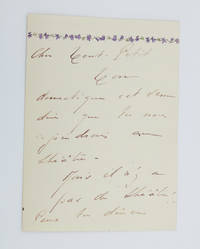
190679017s. l. Paris 1906. Fine. s. l. Paris s. d. ca 1906 11.50 x 15.90 cm 4 pages sur un double feuillet Autograph letter signed ""Paul"" from Renée Vivien addressed to Natalie Clifford Barney and written in black ink on a double sheet bordered with violets. Baroness Hélène de Zuylen has added a small manuscript message signed at the end of the letter: ""Paule a raison vous êtes un être charmant et féerique !"" ""Paule is right you are a charming and fairy-like being!"" Transverse folds inherent to mailing. ""Cher Tout-Petit Ton domestique est venu dire que tu nous rejoindrais au théâtre. Mais il n'y a pas de théâtre ! Peux-tu dîner avec nous jeudi ou vendredi Si dans la soirée de jeudi tu n'es libre qu'après le dîner viens nous rejoindre à n'importe quelle heure. Donne-moi un petit coup de téléphone pour me dire ce que tu feras et si je dois te faire chercher et à quelle heure Dis à tes cheveux que je les aime."" ""Dear Little One Your servant came to say that you would join us at the theater. But there is no theater! Can you dine with us Thursday or Friday If on Thursday evening you are only free after dinner come join us at any hour. Give me a little telephone call to tell me what you will do and if I should have you collected and at what time Tell your hair that I love it."" It was at the end of 1899 and through Violette Shillito that Renée Vivien - then Pauline Tarn - made the acquaintance of Natalie Clifford Barney ""cette Américaine plus souple qu'une écharpe dont l'étincelant visage brille de cheveux d'or de prunelles bleu de mer de dents implacables"" ""this American more supple than a scarf whose sparkling face shines with golden hair sea-blue eyes implacable teeth"" Colette Claudine à Paris. Natalie who had just experienced a summer idyll with the scandalous Liane de Pougy who initiated her into sapphism paid only discreet attention to this new acquaintance. Renée on the other hand was totally captivated by the young American and would relate this coup de foudre in her autobiographical novel Une Femme m'apparut: « J'évoquai l'heure déjà lointaine où je la vis pour la première fois et le frisson qui me parcourut lorsque mes yeux rencontrèrent ses yeux d'acier mortel ses yeux aigus et bleus comme une lame. J'eus l'obscur prescience que cette femme m'intimait l'ordre du destin que son visage était le visage redouté de mon avenir. Je sentis près d'elle les vertiges lumineux qui montent de l'abîme et l'appel de l'eau très profonde. Le charme du péril émanait d'elle et m'attirait inexorablement. Je n'essayai point de la fuir car j'aurais échappé plus aisément à la mort. » ""I evoked that already distant hour when I saw her for the first time and the shiver that ran through me when my eyes met her deadly steel eyes her sharp blue eyes like a blade. I had the obscure prescience that this woman was giving me destiny's order that her face was the dreaded face of my future. I felt near her the luminous vertigo that rises from the abyss and the call of very deep water. The charm of peril emanated from her and attracted me inexorably. I did not try to flee her for I would have escaped death more easily."" « Hiver 1899-1900. Débuts de l'idylle. Un soir Vivien est invitée par sa nouvelle amie dans l'atelier de Mme Barney mère de Natalie 153 avenue Victor-Hugo à l'angle de la rue de Longchamp. Natalie s'enhardit à lire des vers de sa composition. Comme Vivien lui dit aimer ces vers elle lui répond qu'il vaut mieux aimer le poète. Réponse bien digne de l'Amazone. » ""Winter 1899-1900. Beginning of the idyll. One evening Vivien is invited by her new friend to the studio of Mme Barney Natalie's mother 153 avenue Victor-Hugo at the corner of rue de Longchamp. Natalie grows bold enough to read verses of her own composition. When Vivien tells her she loves these verses she replies that it is better to love the poet. A response quite worthy of the Amazon."" J.-P. Goujon Tes blessures sont plus douces qu unknown
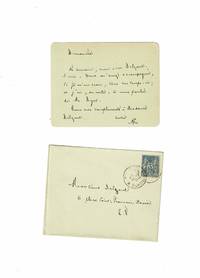
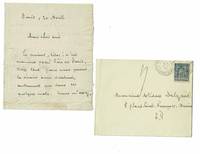
189476276Paris 1894. Fine. Paris 11 mars 1894 11.40 x 8.80 cm une carte recto et une enveloppe Autograph card signed by Stéphane Mallarmé addressed to Alidor Delzant written on the recto in black ink. Envelope attached. Alidor Delzant was a lawyer collector and bibliophile. Friend of the Goncourts he devoted a work to them and was the secretary and testamentary legatee of Edmond. Card written upon return from a trip to Oxford during which Mallarmé gave a lecture on aesthetics: "".j'ai du reste à vous parler de M. Dyer."" "".I have moreover to speak to you about M. Dyer."" Louis Dyer friend of Delzant is an Oxford alumnus and was then professor of Greek at Harvard. Through Delzant's intermediary he had offered hospitality to Mallarmé who did not know him before his lecture but this card attests that the two men finally met. unknown
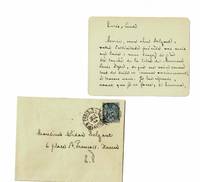
189476272Paris 1894. Fine. Paris 12 février 1894 11.40 x 8.80 cm une carte recto-verso et une enveloppe Autograph letter signed by Stéphane Mallarmé addressed to Alidor Delzant written on both sides in black ink. With envelope. Alidor Delzant was a lawyer collector and bibliophile. A friend of the Goncourts he devoted a work to them and served as secretary and testamentary legatee to Edmond. Mallarmé mentions a future stay in Oxford and thanks Delzant for having recommended him to a friend: "".vous songez si j'ai été touché de la lettre de Monsieur Louis Dyer de qui me voici connu tout de suite et comme anciennement à travers vous. Je lui réponds avant que je ne fasse si heureux sa connaissance. Hôte je ne pourrai l'être M. Powell qui a eu l'initiative de ma conférence m'ayant de longue date offert son toit pendant mon bref séjour à Oxford."" "".you can imagine how touched I was by the letter from Monsieur Louis Dyer through whom I find myself known immediately and as if from long ago through you. I am writing back to him before I have the pleasure of making his acquaintance. I will not be able to be a host as M. Powell who initiated my lecture has long since offered me his roof during my brief stay in Oxford."" Mallarmé would indeed give a lecture on aesthetics on March 1st 1894 at Oxford the text of which was published in 1895 under the title Oxford Cambridge. La musique et les lettres. unknown
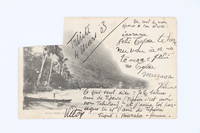
190379067Tahiti Tahiti 1903. Fine. Tahiti Tahiti 4 mars 1903 14 x 9 cm une carte postale ""Tépéva is my name"". Handwritten postcard signed sent from Tahiti and addressed to Émile Mignard Tahiti 4 March 1903 14 x 9 cm one postcard Handwritten signed postcard from Victor Segalen sent from Tahiti and addressed to émile Mignard. A few lines written in black ink around the black and white photographic reproduction of a view of Bora-Bora correspondent's address handwritten on the verso. Some minor stains a cut corner likely due to the removal of the stamp. Doctor Segalen seems to have taken a wife: A word from my wife to you: written by the hand of said wife iaorana fetii Tepeva te here neivou ia se no te mea e fetii no Tapeva Maraéa Vahine. Written by Segalen again Which means: I greet you friend of Tépéva Tépéva is my name in Tahitian and I love you because you are a friend of Tépéva. signed Maraéa-wife. Segalen's biography makes no mention of this exotic wife. Emile Mignard 1878-1966 also a doctor and Brest-born was one of Segalen's closest childhood friends whom he met at the Jesuit Notre-Dame-de-Bon-Secours School. The writer interacted with this comrade in an abundant and closely followed correspondence in which he described with humor and intimacy his daily life in all corners of the world. It was at Mignard's wedding on 15 February 1905 that Segalen met his wife Yvonne Hébert. unknown
1950008118London: Methuen 1950. First Edition 1st Printing. Boards. Near Fine/Very Good DJ. One Of 3 370 Copies Publisher Out-Of-Print In May 1953. 187 Pp. Purple Cloth Gilt. Signed Neatly By Philosopher And Science-Fiction Writer Stapledon Below His Name On The Title Page And Later Inscribed On The Front Endpaper From Golden Age Literary Agent Forrest J. Ackerman To His Client Golden Age Science Fiction Writer A. E. Van Vogt Winner Of The Retroactive Hugo For "Slan". Included Is Ackerman's Publicity Sheet For Stapledon One Page "The Philosopher Of Fantasy" Circa 1949 Mentioning That Stapledon's Next Book Would Be "A Man Divided" The Sheet Signed At Bottom For Me By Mr. Ackerman. Signed Copies From Stapledon Are Scarce Although Apparently Forrest Ackerman Brought A Number Of Signed Copies Of This Particular Book To America Before Stapledon's Death The Same Year. Ackerman Was A Great Fan Of Stapledon And Was Involved In Promoting His Trip To The Us. This Copy With A Little Rippling To Cloth On Rear Cover With Bleed Through Of The Red Color In A Strip 3/8" Wide Along Bottom And Foredge Of Rear Pastedown No Other Traces Of Damp. Dustjacket Is Unusually Complete With No Chipping Not Price-Clipped Just A 1/8" Closed Tear On Bottom Of Front Panel As Usual But Some Rubbing/Dustiness And Some Fading To Spine Although All Lettering Remains Quite Clear. <br/> <br/> Methuen hardcover
185473343Paris 1854. Fine. Paris s. d. après le 8 août 1854 9.70 x 13.20 cm une page sur un feuillet enveloppe jointe Autograph note signed ""Gérard"" addressed to his close friend Eugène de Stadler. Envelope included. Folds inherent to posting. A small hole in the envelope consequence of its sealing. This note has been transcribed in the correspondence published in the Pléiade edition volume 3 p. 889. Astonishing and succinct note written just after his arrival at Doctor Blanche's inviting his friend to dinner ""à la meson sic Blanche"" ""at the Blanche house"". On the envelope in an even more disordered handwriting than that of the note one reads a few words in pencil: ""J'ai donné à Antony et à Blanche . Mirecourt"" ""I gave to Antony and to Blanche . Mirecourt"". Gérard de Nerval had indeed discovered a few months earlier a pamphlet by Eugène de Mirecourt dedicated to him: "".j'ai trouvé la biographie sur l'étalage d'un libraire. Mirecourt m'a bien chargé. Il m'a peint en beau.et en buste. Je relèverai les erreurs quelque autre jour mais il a trop parlé de ma misère"" "".I found the biography on a bookseller's stall. Mirecourt has really gone after me. He has painted me favorably.and in bust. I will point out the errors some other day but he has talked too much about my poverty"" Letter to Georges Bell of June 1 1854. unknown
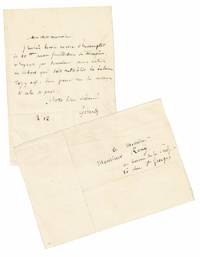
184973289s. l. 1849. Fine. s. l. 1837 ou 1849 9.90 x 14.30 cm une page sur un feuillet enveloppe jointe Autograph letter signed ""votre bien dévoué Gérard"" addressed to Daniel Rouy. Envelope included. This letter simply dated ""Le 12"" could have been written in August 1849 if we refer to a letter to Ernesta Grisi companion of his friend Théophile Gautier in which the poet mentions such a discount: ""Je n'ai pu toucher l'argent qu'aujourd'hui mercredi. M. Rouy n'y était pas. J'y suis allé 4 fois et j'ai porté les 10F. aujourd'hui je ne sais pas s'il faut faire le prochain feuilleton ni comment il faut signer."" ""I could only get the money today Wednesday. Mr. Rouy was not there. I went 4 times and brought the 10F. today I don't know if I should do the next serial or how to sign it."" Pléiade volume 1 letter 143 of August 30 1849. However Michel Brix author of Nerval Glanes et miettes de presse and member of the Royal Academy of French Language and Literature of Belgium very kindly pointed out to us that Nerval signed ""Gérard"" rather between 1837 and 1840 and that in 1849 he signed this type of note ""Gérard de Nerval"". unknown
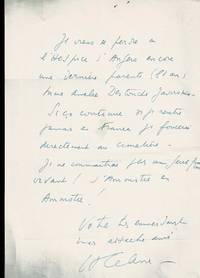
195076172s. l. Klarskovgaard 1950. Fine. s. l. Klarskovgaard 8 décembre 1950 21 x 34 cm 2 pages sur un feuillet Autograph letter signed partly unpublished by Louis-Ferdinand Céline addressed to his lawyer Maître Thorvald Mikkelsen. Two pages written in blue ink on a large sheet of white paper; numbered 575 in Célines hand in red pencil at the top left corner. Fold marks from mailing. This letter was only partially transcribed in Année Céline 2005 p. 64. A moving and bitter letter by Céline who had just lost his aunt Amélie the Aunt Hélène of Death on Credit and witnesses the slow disappearance of the world he once knew. The writer finds solace in the memoirs of Élisabeth de Gramont another witness to a bygone era. From his Danish exile Céline learns with sorrow of the death of his Aunt Amélie the last surviving member of the Destouches family: Je viens de perdre à l'hospice d'Angers encore une dernière parente. Although he had not spared his alter ego in Death on Creditthe scandalous Aunt Hélène meets a shameful end trailed by suitors lovers or clientshe recalls: À Saint-Pétersbourg elle est devenue grue. . Elle est venue nous voir au Passage deux fois de suite frusquée superbe comme une princesse et heureuse et tout. Elle a terminé très tragiquement sous les balles dun officier. The real Aunt Amélie had settled in Romania married to a diplomat Zenon Zawirski. Unfortunately reality caught up with fiction: she returned to Paris in utter destitution at the age of 80. Céline arranged for her transfer from the hospice of the Little Sisters of the Poor in Breteuil to the hospital in Angers where she died in December 1950 Que la pauvre femme meure gentiment. Assez de fins tragiques dans la famille ! he had written to Dr. Camus on 11 July 1949. His secretary Marie Canavaggia met her before her arrival in Angers: elle avait par moments des gestes et des expressions qui en éclairs me rappelaient son neveu 13 July 1949. With the last of his family gone Céline reflects on his own end: si ça continue si je rentre jamais en France je foncerai directement au cimetière. Devouring the books his lawyer sent to ease the burden of exile Céline describes his current readings: Le Temps des équipages by Élisabeth de Gramont est un des livres fameux parus vers 1920 ! Lun des « Guides des Snobs » les mieux réussis de lÉpoque. It is striking to imagine Céline delighting in this aristocrats social chronicle so alien to his world: Javais un ami Carré de Rennes étudiant en droit qui lavait appris par cur ! . il sen est établi marchand de tableaux. As a young medical student Céline had indeed crossed paths with Louis Carré later a successful Parisian art dealer who exhibited Paul Klee Juan Gris Le Corbusier and Picasso: il y a fait 10 fois fortune ! Preuve que tous les livres ne sont pas déprimants ! In 1947 pursued by French justice for his collaborationist stance Céline took refuge in Denmark. In May 1948 accompanied by Lucette and Bébert he arrived at the home of his lawyer Maître Thorvald Mikkelsen in Klarskovgaard. Mikkelsen owned a large estate on the Baltic Sea and welcomed the exiled writer to stay. On 21 February 1950 as part of the post-war purge Céline was definitively sentenced in absentia by the Civic Chamber of the Paris Court of Justice to one year in prison for collaboration a sentence already served in Denmark. Raoul Nordling the Swedish consul general in Paris intervened on his behalf with Gustav Rasmussen the Danish Foreign Minister successfully delaying his extradition. On 20 April 1951 Jean-Louis Tixier-Vignancour his lawyer since 1948 obtained Célines amnesty as a severely disabled veteran of the Great War submitting the case under the name Louis-Ferdinand Destouches without the magistrates making the connection. Céline left Denmark that summer after three years spent in his lawyers home. unknown
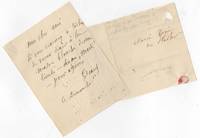
189476269Paris 1894. Fine. Paris 30 avril 1894 11 x 13.20 cm 3 pages sur un double feuillet et une enveloppe Autograph letter signed by Stéphane Mallarmé to Alidor Delzant; three pages written in black ink on a bifolium. With the original envelope. Alidor Delzant was a lawyer collector and bibliophile. A friend of the Goncourt brothers he devoted a book to them and served as Edmonds secretary and executor. A cordial letter in which the poet offers his condolences to his friend following his fathers death: ""Vous m'avez au hasard de nos rencontres amicales plusieurs fois parlé de votre père de façon à ce que je devinasse bon haut et délicat et que cette tardive mais prompte séparation à un âge qui donne une illusion chère de continuelle durée soit pour moi comme pour ceux qui vous aiment un deuil."" unknown
1938008119London- New York-Toronto: Longmans Green and Co. 1938 1938. First Edition . Cloth. Very Good /Very Good DJ. Photographs And Reproductions. 252 Pp. Red And Yellow Cloth First Binding With Yellow Dj Printed In Red And Black. Correct Alignment Of Black Printing On Tile Page "Painting By Siqueiros" Does Not Touch The Illustration But Does In The Limited Editon. Inscribed By The Dedicatee Ira Gershwin And Signed With His Characteristic Drawing Of Himself Bowing Dated In 1953 As A Gift From Ira Gershwin To A Friend Of His Then-Archivist Lawrence Stewart And With A George Gershwin Signed Personal Check 1934 Laid In Loosely As An Additional Personal Gift From Ira Gershwin. Merle Armitage's Well-Designed And Edited Collection Of Tributes To George Gershwin From Luminaries Including His Brother Ira Oscar Hammerstein Ii Paul Whiteman Walter Damrosch Dubose Heyward Irving Berlin Arnold Schoenberg Serge Koussevitzky And Jerome Kern. Book Is Very Good Light Wear At Corners; Dj Very Bright Yellow Very Clean Without The Usual Browning To Spine Light Wear Short Corner Tears And Tiny Losses At Corners. <br/> <br/> London- New York-Toronto: Longmans, Green and Co. 1938 hardcover
1890000615bChicago Illinois IL. Good. 1890. Important archive of post Civil War GAR letters of the Chicago Mercantile Battery Light Infantry Chicago Illinois including two Medals of Honor winner's autographs Kretsinger and Stevens. This archive comes from the Dick Ransom estate from his former Civil War comrades specific to the GAR activities for the "Battery Boys." 1 Letter written on behalf of battery mate Dick Ransom by Gardner Willard and signed by 8 additional Chicago Mercantile Battery boys. Two of these signatures belong to Medal of Honor winners William Stevens and George Kretsinger. Other signatures include David Crego Orin Nash W. Brown Richard Powel Florus D. Meachem. Dated 1891. 2. Hand written letter in support of Dick Ransom and signed by battery mate J. H. Swan. 1891. 3. Dec. 15th 1890 carbon-type copy of a letter Ransom had sent to fellow battery comrade George Kretsinger. 4. great personal letter from fellow Battery comrade Henry C. Gray .single page ink dated Feb. 13 1888. 5. Wonderful period civil war letter from Battery Comrad to Ransom from Gardner G. Willard single sheet and dated during the civil war April 18th 1863. 6 wonderful 4 page letter from former Battery mate Chapin. Letter in ink dated Jan. 1876 being sent to Dick Ransom sharing Chapin's heart felt concern over the recent loss of Ransom's wife. 7. typed letter by Battery Mate James H. Swan in support of Dick Ransom. BIO NOTES: Dick Ransom; Residence Chicago IL; Enlisted on 8/7/1862 as a Private. On 8/29/1862 he mustered into Illinois Chicago Mercantile Light Artillery. He was discharged for disability on 3/24/1863. David R. Crego; First Lieutenant 8/29/62 through 2/6/63. Orrin Nash: 8/29/1862 through 7/10/65. William L. Brown : 8/29/1862 through 7/10/65. Richard Powel; On 10/5/1863 he mustered into IL Chicago Merc He was discharged for disability on 6/17/1864. Florrus D. Meachem; Served 8/29/1862 through 7/10/65. James H. Swan; Enlisted on 8/29/1862 as a 1st Lieutenant. George Kretsinger; Entered service at: Chicago Ill. Birth: Herkimer County N.Y. Date of issue: 20 July 1897. Citation: Carried with others by hand a cannon up to and fired it through an embrasure of the enemy's works. Medal of Honor Winner. Henry C. Gray; Enlisted on 8/15/1862 as a Private. Gardner G. Williard; Enlisted on 8/5/1862 as a Private. James H. Swan; Enlisted on 8/29/1862 as a 1st Lieutenant. Generally very good though a stain has affected a few items none touching signatures.; Manuscript; 4to - over 9¾" - 12" tall; KEYWORDS: HISTORY OF HANDWRITTEN MANUSCRIPT DOCUMENT LETTER AUTOGRAPH WRITER HAND WRITTEN DOCUMENTS SIGNED LETTERS MANUSCRIPTS HISTORICAL HOLOGRAPH WRITERS AUTOGRAPHS PERSONAL PERSONAL HISTORY MEMOIR MEMORIAL DIARY JOURNAL DIARIES JOURNALS LOG LOGS KEEPSAKE AMERICANA Civil War War Between the States VICKSBURG MANASSASS BULL RUN LINCOLN ILLINOIS MERCHANTILE ILLINOIS INFANTRY GAR GRAND ARMY OF THE REPUBLIC VETERANS . unknown
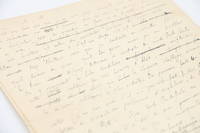
191388289Londres 1913. Fine. It is no longer a question of conquering the world; but of pacifying it. Work let us work together for world peace. Londres 12 décembre 1913 20 x 25.50 cm en feuillets Complete autograph manuscript in French by Anatole France 7 pages in black ink on 7 leaves and a signed autograph note on a bifolium. Complete and extensively corrected speech by Anatole France on the occasion of a banquet given in his honor in London. The future Nobel Prize winner for Literature delivers a passionate appeal for peace between nations and an ode to England - its philosophy literature and politics - less than a year before WW1. The writer offered this manuscript with a signed note: Keep dear colleague and friend keep these leaves of paper if they are of any value to you. Anatole France London December 12 1913. Anatole France's English biographer witnessed this speech which foreshadowed the absolute necessity of a close relationship between France and England based on their long and rich relationship: ""In December 1913 the Master paid a brief but memorable visit to this country. The central event of his sojourn in London was the banquet given in his honour at the Savoy Hotel. On this occasion it was apparently decided in those remote and exalted circles where such decisions are made that the socialist should be ignored his turn was to come later with the Fabians but that honour could and should be paid to the man of genius the foremost man of letters of the day. The feast was therefore presided over by a peer the late Lord Redesdale himself a gifted writer. The company was numerous and distinguished. . Monsieur France though an inimitable talker is not a speaker and on this occasion he read his discourse. All that I now remember of it was the rich deliberate music of the voice that uttered it and the words which he repeated with strange insistency: 'Travaillons de concert a la paix du monde''Let us work together for the peace of the world.' This was in December 1913. The exhortation thus reiterated seemed even then to be fraught with ominous significance and now looking back over the years of horror that were so soon to follow one wonders whether this old man with his strange inscrutable eyes and musical melancholy voice had somehow seen the shadow of the coming catastrophe."" J. Lewis May Anatole France the man and his work: an essay in critical biography p. 98-99. The manuscript contains numerous crossed-out and rewritten passages and shows the genesis of the writing of this beautiful speech: M.M. I am not sure that I am not dreaming. Welcomed with this splendid cordiality by so many men whose names works and thoughts represent so much greatness strength and beauty. . Your compatriots have authored masterpieces of this kind for two centuries. Need I remind you of Richardson and Fielding Swift and Daniel Defoe Walter Scott Dickens and Thackeray George Elliott . the novel is in England in its favorite soil like the apple in Normandy and the orange in Valencia. Why It takes a large volume or a single word to explain it. Well let's say it in a word. This word Lord Redesdale gave us a foretaste of it. It is that the novel is intimate cordial and familiar by nature and that the English has a familiar intimate and cordial spirit. Gentlemen I am not dreaming: it is a banquet I see the shining cups and the benevolent faces of the guests. And I can understand why you invited me. I am a symbol an allegory for you. I represent at this table the French literati just as at the festivals of the French Revolution the citizen Momoro represented the goddess Reason. Without being a goddess or particularly reasonable this idea puts me at ease and I won't quibble too much with you about the choice of your symbol. I tell myself that perhaps you didn't mind having a Frenchman at your table who having the weakness to write at least had the merit which you greatly value of never d unknown
194875175Antibes 1948. Fine. Antibes 9 mars 1948 21.80 x 27 cm 2 pages sur un feuillet Unpublished autograph letter signed by André Breton addressed to Gaston Puel; two pages on one leaf written in blue ink with fine and careful handwriting numerous underlinings. Foxing and marginal adhesive traces. A very fine letter imbued with benevolence in which the Pope of Surrealism shares his numerous and time-consuming occupations with his young correspondent while reassuring him about his talent and future. Gaston Puel began corresponding with André Breton at the Liberation. They had never met at the time of this letter written four years later: « Je suis heureux que vous ayez pensé à m'adresser votre photographie. C'est un grand pas de fait pour rompre la distance et il ne se peut guère que nous ne nous rencontrions bientôt. » ""I am happy that you thought to send me your photograph. It is a great step towards breaking the distance and it can hardly be that we will not meet soon."" The two writers seem very close as evidenced by Breton's paternal and reassuring tone: « Ne parlez pas comme à regret de ceux qui avancent : vous en êtes et j'en sais bien peu qui soient si loin que vous déjà. Ce que vous m'écrivez - pas seulement cette fois - est toujours pour moi de haute importance. » ""Do not speak regretfully of those who advance: you are among them and I know very few who are already as far along as you. What you write to me - not just this time - is always of great importance to me."" A tireless worker Breton here shares his frustration and weariness with Puel: « Mais il faut continuer à vivre et pour cela se réserver une part de solitude qu'avec angoisse aussi je vois diminuer chaque jour. » ""But one must continue to live and for that reserve a share of solitude which I also see diminishing each day with anguish."" Gaston Puel then 24 years old had been participating for some time in the activities of the surrealist group around Joë Bousquet André Breton and René Char. His mentor here predicts a clear future for him: « Mon cher Ami je souhaite très vivement que vous preniez une part active à la rédaction de « Néon ». Il suffirait d'une très légère transposition de ton pour que les pages que vous m'adressez puissent y trouver place et en constituer un des éléments primordiaux. Il en va naturellement de même pour « Supérieur inconnu » si cette revue peut voir le jour. » ""My dear Friend I very much wish that you would take an active part in the editing of 'Néon'. It would only require a very slight transposition of tone for the pages you send me to find their place there and form one of its primordial elements. The same goes naturally for 'Supérieur inconnu' if this magazine can see the light of day."" This latter review meant to reconcile and unite the conservatives and innovators of surrealism would only come to light forty-eight years later under the impetus of Sarane Alexandrian. Gaston Puel would indeed join the editorial team of Néon but would eventually turn away from the surrealists - while maintaining his friendship with Breton - in 1950. unknown
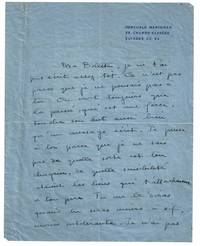
193674160Paris 1936. Fine. Paris s. d. 12 mars 1936 17.80 x 22.60 cm 2 pages sur un feuillet Fine autograph letter signed by Colette addressed to her friend Bolette Natanson. Two pages written in ink on blue headed paper from the Marignan building the writer's residence between 1936 and 1938. Transverse folds inherent to the folding of the letter for mailing. Moving letter addressed by Colette to her close friend following the death of her father Alexandre Natanson: "". ce dimanche va être un dimanche bien pénible. Je t'écris à l'heure juste où tu conduis ton père."" ""this Sunday is going to be a very painful Sunday. I am writing to you at the very moment when you are laying your father to rest."" Conscious of the suffering and ""chagrin"" ""grief"" of her ""chère Bolette"" ""dear Bolette"" she affectionately offers her support ""On croit toujours que la pensée qui est une force touche son but aussi bien qu'un message écrit."" ""We always believe that thought which is a force reaches its target as well as a written message."" ending her letter with a very beautiful declaration: ""Beaucoup de visages humains se penchent vers le tien et tu ne les aimes pas tous. Le mien que tu ne verras pas te suit de loin et s'inquiète de toi."" ""Many human faces lean toward yours and you do not love them all. Mine which you will not see follows you from afar and worries about you."" Bolette would commit suicide a few months later. Having evolved since her earliest childhood in artistic circles - she was the daughter of Alexandre and the niece of Thadée Natanson the creators of the famous Revue Blanche - Bolette Natanson 1892-1936 became friends with Jean Cocteau Raymond Radiguet Georges Auric Jean Hugo and also Colette. Passionate about couture she left Paris for the United States with Misia Sert a great friend of Coco Chanel and was hired at Goodman. With her husband Jean-Charles Moreux they created in 1929 the gallery Les Cadres on boulevard Saint-Honoré and frequented numerous artists and intellectuals. Their success was immediate and they multiplied their projects: the creation of the fireplace for Winnaretta de Polignac the decoration of the château de Maulny the arrangement of Baron de Rothschild's private mansion the creation of frames for industrialist Bernard Reichenbach and finally the creation of the storefront for Colette's beauty institute in 1932. Bolette Natanson also framed the works of her prestigious painter friends: Bonnard Braque Picasso Vuillard Man Ray André Dunoyer de Segonzac etc. Despite this meteoric rise she would end her life in December 1936 a few months after her father's death. unknown
185372618s. l. 1853. Fine. s. l. s. d. 1853 13.50 x 8.80 cm une feuille Autograph letter signed by Gérard de Nerval addressed to his friend Georges Bell four lines written in pencil and signed with his first name ""Gérard"". Stamp mark on verso. Two small pin holes not touching the text two transverse fold marks inherent to the folding of the letter. This short note was written during the writer's penultimate stay at Doctor Blanche's in 1853. This letter has been transcribed in volume 3 of Nerval's Complete Works in the Pléiade edition. Gérard de Nerval met Joachim Hounau known by his pen name Georges Bell at Joseph Méry's home in Marseille in 1843 upon his return from his journey to the Orient. Bell was a very close friend of Gérard de Nerval who on his deathbed would call him to his bedside. Gérard de Nerval's autographs are very rare. unknown
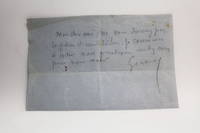
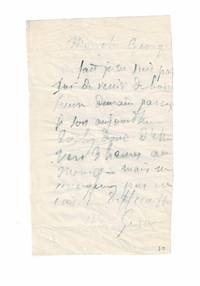
1853733061853. Fine. s. d. 1853-1854 8.50 x 13.90 cm un billet sur un petit bout de papier Autograph note by Gérard de Nerval signed ""votre Gérard"" addressed to Georges Bell: ""Au fait je ne suis pas sûr de venir de bonne heure demain parce que je sors aujourd'hui. Tâchez donc d'être vers 3 heures au Mousquetaire. Mais ne vous gênez pas en cas de difficulté."" ""Actually I'm not sure I'll come early tomorrow because I'm going out today. Try to be at the Mousquetaire around 3 o'clock. But don't inconvenience yourself if there are any difficulties."" Some transverse folds and tiny pinholes. This note has been transcribed in the correspondence published in the Pléiade edition volume 3 p. 839 it was written during Nerval's penultimate or final stay at Doctor Blanche's clinic. unknown
185073342Paris 1850. Fine. Paris s. d. circa janvier 1850 9.80 x 13.30 cm une page sur un feuillet enveloppe jointe Autograph letter signed ""Gérard de Nerval"" addressed to probably addressed to Achille Denis editor-in-chief of the Messager des Théâtres. Envelope included. Folds inherent to being placed in envelope. A strip of glued paper in the left margin of the sheet and envelope. This letter has been transcribed in the correspondence published by Pléiade volume 3 p. 923. In this short note Nerval requests ""three seats for Les Porcherons"" an opéra-comique by Thomas Sauvage with music by Albert Grisar. unknown