66 616 résultats
189289339Sans nom d'éditeur | Sans lieu d'édition s. d. (ca 1892) | 21 x 34.5 cm | Relié
4to. 1 page. Previously unpublished letter written in triumph three weeks after Che took Havana. His recipient is the Cuban magazine La Revista Bohemia, whom he congratulates and thanks for their work furthering his and Fidel Castro's cause: "las dedico este Fraternal y caluroso mensaje a ese maravilloso colectivo que son ustedes, incansables constructores de las ideas revolucionarias, paradi pura del socialismo y el comunismo, y baluartes y estandartes de la contribución a la edificación de la sociedad proletaria, les ex orto a que siguán trabajando con esmero y dedicación para que si guamos consolidando el triunfo." Over the course of the Cuban Revolution, Che came to understand the importance of media coverage in achieving his goals; La Revista Bohemia was one such media outlet. He signs off with what would become one of his standard closing phrases: "Patria o Muerte. Con fervor revolucionario. Che". - Gently creased, minor chipping.
Oblong folio. German, French, English etc. handwriting on paper. 98 (2 of which repeated) signatures (several pasted) and 3 pasted picture postcards and photographs on 83 pp. (on a total of 94 ff.). Contemporary cloth with stamped and sparely gilt covers. Silk endpapers. - Includes 4 ff. of letters and album leaves by Pope Pius IX (with autogr. date and signature) and the Societé des gens de lettres (copy with facsimile signatures by Georges Sand, Victor Hugo, Ludovic Halévy, Champfleury, Jules Claretie, etc.), as well as by 2 unidentified writers. Impressive autograph album compiled by the biographically unrecorded composer Wilhelmina Simson. Among the most significant contributors to this unique item are Alessandro Manzoni (Brusuglio, 7. X. 1865; f. 14v), Franz Grillparzer (pasted AQS, Vienna, 13. X. 1865; f. 16r), Henrik Ibsen (Dresden, 8. VI. 1873; f. 28r), Friedrich Frh. von Flotow (pasted AQS, Vienna, 12. X. 1865; f. 31v), Henri Vieuxtemps (pasted MusQS, Vienna, 28. I. 1854; f. 33r), Giacomo Meyerbeer (pasted ALS to an unnamed recipient, 1 p., 8vo, n. p. o. d.; f. 34v), Alexander Frh. von Humboldt (pasted fragment of an ALS to an unidentified recipient; 24. VII. 1853; f. 35r), Désirée Clary, Queen of Sweden (pasted QS with 5 autogr. lines; f. 38v), Joséphine, Queen of Sweden and Norway, née Duchess of Leuchtenberg (pasted QS; f. 39r), Daniel Auber (pasted AMusQS, Paris, 25. VIII. 1861, 1 p., oblong 8vo; f. 43v), Hector Berlioz (pasted AMusQS with autogr. dedication "pour l'album de Mr. Lang", Bade [?], 12. VIII. 1862, oblong 8vo; f. 45r), Ivan Turgeniev (19. VII. 1873; f. 48v), and Adolph Menzel (pasted fragment of a LS, f. 77v). - Apart from these, the album contains a twenty-line poem by the writer and translator Julie Ruhkopf (b. 1799; Dresden, 23. IX. 1864, f. 3r), a twelve-line poem by the anatomist Karl Aberle (1818-92; Salzburg, 3. X. 1864, f. 3v), a twelve-line poem by the actress Clara Jahn (1825-82; Dresden, 20. X. 1865; f. 9v), a four-line poem by the playwright Friedrich Halm (pasted AQS, Vienna, 13. X. 1865; f. 16v), 5 autogr. lines by L. A. Frankl Ritter von Hochwart (pasted AQS, Vienna, 13. X. 1865; f. 30v), 8 autogr. lines by the writer and musical scholar Arvid August Afzelius (pasted AQS, f. 46r), and an eight-line moral dictum by the writer Gustav von Moser (pasted AQS, Karlsbad, 2. VI. 1876; f. 51r). - In addition, the album contains dedications by the art critic and painter Agostino Gallo (1790-1872; Palermo, 11. IV. 1863, f. 6r), the writer Ciro Marzullo (f. 6v), the physicist and philosopher Pietro Blaserna (1836-1918; f. 7r), the anatomist and zoologist Carl Gustav Carus (1789-1869; Dresden, 20. X. 1865; f. 15r), the writer Salomon Hermann Ritter von Mosenthal (1821-1877; pasted AQS, Vienna, 13. X. 1865, f. 15v), the painter Raffaello Politi (May 1865; f. 19r), the composer Pietro Romani (pasted AQS, f. 22v), the writer Friedrich Ritter von Hackländer (pasted QS, f. 24r), the painter Salvadore Politi the Elder (with full-page drawing of a Medusa bust, 2. VII. 1865; f. 54r), the classical scholar J. J. Schubring (b. 1839; ff. 62r and 63r), the archaeologist and painter Saverio Francesco Cavallari (1809-96; pasted QS with autogr. sketch on f. 61v and pasted AQS with autogr. dedication on f. 62v), the painter Egron Sellif Lundgren (pasted ALS to an unidentified recipient; f. 65r), the composer Friedrich Pacius (1809-91; pasted QS; f. 65v), the musician Joseph Hellmesberger the Elder (1828-93; pasted QS, Vienna, 12. X. 1865; f. 66r), as well as signatures by Gustav Klemm (art historian, 1802-67; Dresden, 23. IX. 1864, f. 2r), Johan Bravo (consul and painter, 1796-1876; 3. XII. 1864, f. 4r), Maria Vinzenz Süß (archaeologist and founder of the Salzburg Museum Carolino Augusteum, 1802-68; pasted AQS, f. 5r), Bror Emil Hildebrand (archaeologist and historian, 1806-84; f. 38r), Ludwig Ettmüller (literary historian, 1802-77; f. 53v), and Amalia Lindegren (painter, 1814-91). - Two not fully identified entries are by "His Excellency Herr von Bülow" (f. 46v) and by a member of the Manteuffel family (f. 47r). - As several of the entries within the album reveal, Wilhelmina Simson was herself active as a composer. Altogether well preserved, in spite of a loosened front cover.
Oblong 8vo. 179 ff. with 51 entries and Weber's holograph note of ownership on fol. 2r. Contemporary brown calf with richly gilt spine and covers. Brocade endpapers. All edges gilt. Unique scholars' album of the philologist Nikolaus Weber (1699-1751), headmaster of the Nuremberg Holy Ghost school, with entries by scholars mainly based at the Universities of Nuremberg and Altdorf. One of the most important among the contributors to this volume, almost all of which are biographically recorded, is the Swedish astronomer Andreas Celsius (1701-44), who on 22 July 1733 penned these lines: "Problema: Unam eandemq[ue] theologiam et religionem per universum terrarum orbem propagare. - Resolutio: Doceatur ubiq[ue] gentium Philosophia certa et solida" (Problem: How to spread the same theology and religion throughout the entire world? - Solution: Teach all peoples a certain and solid philosophy). On behalf of the Swedish king, Celsius had visited the principal observatories of Europe in 1732/33 to form an opinion of the current developments in astronomy. His scientific "Grand Tour" had also led him to Nuremberg, where he had spent three months at the home of the astronomer Johann Gabriel Doppelmayr (see below) and had regularly participated in the specialist discussions hosted by the physician Christoph Jacob Trew (see below). 1733 is also the year of Celsius's "316 Observationes de Lumine Boreali", the first comprehensive treatise on the Northern Lights, published by Endter in Nuremberg. That year, Celsius also performed the first exact geographical measurement of the town's dimensions. - Celsius's host Johann Gabriel Doppelmayr (1677-1750), known for his 1750 "Atlas coelestis", contributed his entry many years before Celsius: on 17 July 1717, he dedicated a quotation from Seneca ("Animum sursum vocant initia sua", Epist. 79). The two opposite pages by Celsius and Doppelmayr are connected by a caption (by one of the two scientists): "Sic pagina jungit amicos" (thus a page links friends). - Another important entry is that of the physician and botanist Christoph Jakob Trew (1695-1769), who had studied medicine in Altdorf and then undertook a three-year tour through Germany, Switzerland, France, and the Netherlands. In 1720 he settled in Nuremberg as a general practicioner and became a member of the most important scientific academies; his library, encompassing more than 34,000 volumes, was considered the greatest collection of naturalist literature of its time. No less important was Trew's autograph and correspondence collection with its natural-scientific focus, containing more than 19,000 letters by polymaths from the early Renaissance to Enlightenment (including Albrecht von Haller, Conrad Gesner, and Lorenz Heister). Today, Trew is frequently associated with his principal botanical work, "Plantae selectae" (1750-73). - For many entries, Weber later added the date of the contributor's death (if he outlived them), which in several cases offers a more precise date than hitherto available. - Other contributors include Siegmund Jakob Apin (writer, pedagogue, and classical scholar, 1693-1732), Andreas Christian Eschenbach (theologian and classical scholar, 1663-1722), Johann Wilhelm Feuerlein (theologian, 1689-1766), Christoph Fürer von Haimendorf (poet, 1663-1732), Gottfried Engelhart Geiger (pedagogue, 1681-1748), Johann Jakob Hartmann (theologian, 1671-1728), Georg Jeremias Hofmann (teacher of oriental languages and theologian, 1670-1732), Johann David Köhler (historian, 1684-1755), Michael Friedrich Lochner von Hummelstein (physician and polymath, 1662-1720), Bernhard Walther Marperger (theologian and Lutheran poet, 1682-1746), Jonas Meldercreutz (mathematician and bibliophile, 1713-85), Gustav Philipp Mörl (theologian and librarian, 1673-1750), Johann Heinrich Müller (physicist, astronomer, and mathematician, 1671-1731), Joachim Negelein (theologian and classical scholar, 1675-1749), Johann Heinrich Schulze (physician and classical scholar, 1687-1744), Christian Gottlieb Schwarz (classical scholar and historian, 1675-1751), Gottfried Thomasius (polymath and physician, 1660-1746), Johann Siegmund Wernberger von Wernberg (jurist, 1678-1737), Justin Wetzel (preacher and professor of history and politics, 1667-1727), Georg Karl Wölker (jurist, 1660-1723), and Johann Wülfer (classical scholar and professor of church history, 1651-1724). - Decorative binding insignificantly rubbed, otherwise splendidly preserved autograph album of enormous value for the history of science. Autographs by Celsius, Trew, and Doppelmayr are of the utmost rarity. - Detailed list available upon request.
4to. 34 ff., some written on both sides, irregularly counted, containing more than 250 entries (some pasted in). Red morocco with giltstamped borders and cover stampting inspired by the royal arms of Sardinia. Silk endpapers. All edges gilt. Exceptionally plentiful friendship album owned by Comtesse de La Bédoyère, daughter of the senator Henri de La Rochelambert (1789-1863), wife of Georges Huchet de La Bédoyère (1814-67) and court lady to Empress Eugénie, wife of Napoleon III. Indeed, the first entry in the album belongs to the the emperor himself; this is followed on the same page by Eugénie with a quotation from Sophie d'Arbouville's poem "Je crois": "Je crois au Souvenir, au long regret du cœur, / Regret que l'on bénit comme un dernier bonheur, / Crépuscule d'amour, triste après la lumière / Mais plus brillant encore que le jour de la terre!" This is succeeded by the signature of the couple's only son, the eight-year-old Napoléon Eugène Louis; at the bottom of the page is a four-line German quotation from Schiller, which Napoléon III adds in Biarritz on 8 Oct. 1865. Another entry by Eugénie is on fol. 27r, and there are further entries by her son on fol. 21r and 27r (with a little drawing). - Two other noteworthy entries are on pages 21v and 23v: the first is by Bismarck, who signed in Biarritz on the 19th of October 1865, the very month when the secret negotiations between Prussia and France had begun over possibly coalitions before the Austro-Prussian War of 1866. The second, written at about the same time, is by Leopold, Prince of Hohenzollern and his wife Antonia (fol. 23v). Leopold is considered a pawn of the high politics of his age. In 1870 Bismarck would urge him to accept the Spanish Crown, a move fiercely opposed by Napoléon III. Although Leopold quickly yielded, it was this affair that would ultimately spark the Franco-Prussian War. - The numerous other contributors include: Alexander II of Russia (9r); Amadeus I of Spain (16r); Isabella II of Spain and her children Isabella and Alfonso (17r); Sophie Queen of the Netherlands (8r); Emperor Franz Joseph I and his wife Elisabeth (14r), as well as Elisabeth's lady-in-waiting, countess Caroline Hunyady (12v); Frederick Grand Duke of Baden, and his wife Louise (9a); Marie, Princess of Baden and Duchess of Hamilton (10r); Charles, King of Württemberg, and his wife Olga (37r); Frederick, Prince of Denmark (24r); Umberto I of Italy (7r); Marie Clotilde of Savoy (wife of Prince Napoléon, 7r); Grand Duchess Maria Nikolaievna of Russia (27v); Grand Duke Charles Alexander of Saxe-Weimar-Eisenach and his wife Sophie Princess of the Netherlands (22r); Louis I of Portugal and his wife Maria Pia of Savoy (19v); Frederick, Grand Duke of Mecklenburg (13r & 17r); George, Duke of Mecklenburg, and his wife Catherine, Grand Duchess of Russia (18r); Marie, Grand Duchess of Mecklenburg-Strelitz (4v); Adolf, Duke of Nassau (9r & 14v); Pauline, Princess Metternich (2v, 8v, 14v with her daughter Sophie and her aunt Hermine, 31r with her daughters Sophie, Antoinette Pascalina, and Clementine Marie, as well as Rosa, Duchess of Hohenlohe-Sternberg); Richard, Prince Metternich (9r); William I of Prussia and his wife Augusta (10r); Francis, Duke of Harrach (4v); Joseph Joachim Napoleon Murat (2r & 20v); Field Marshal Frederick of Wrangel (7v); the Duchess of Castiglione Colonna (known as a sculptor under the name Marcello, née Adèle d'Affry, 3v); Mélanie Renouard de Bussière Comtesse de Pourtalès (14v); Admiral Edmond Jurien de La Gravière (a four-line poem signed, 9v); Admiral Wilhelm von Tegetthoff (28v); Gustav Prince Blücher von Wahlstatt (9v, born 11 Oct. 1837, knight of the Order of Malta); the Mexican monarchist and ambassador to the court of Napoléon III, José Manuel Hidalgo y Esnaurrízar (3v); the philosopher Elme Marie Caro (a three-line poem, 11r); the politician and economist Félix Esquirou de Parieu (a nearly full-page poem, 10v & 11r); the artist Gustave Doré (with a fine drawing, 11r); the writers Hortense Cornu (7v), Edmond About (28r), and Prosper Mérimée (19r & 20v); Princess Alexandrine Dolgorouky (1834-1913, the mistress of the Tsar, 2v, with two lines from Byron); Ignacio Álvarez de Toledo y Palafox Portocarrero, Conte di Sclafani (son of the 16th Duque de Medina Sidonia, 1812-78, full-page sonnet 22v); Alexandre conte Colonna-Walewski (14v; possibly with his second wife Anna Maria Ricci, daughter of count Zanobi di Ricci and Isabelle née Princess Poniatowska, signing "Maria Walewski(y)". The album's final contribution is a photographic reproduction of F. X. Winterhalter's well-known portrait of Empress Eugénie. - Binding slightly rubbed; interior shows occasional brownstaining, but altogether in excellent state of preservation.
Oblong folio (340 x 202 mm). 272 written pages with a total of 252 numbered chorales (and 4 pages of empty pen-staves). Contemporary half calf over mottled boards with manuscript title label to upper cover. All edges sprinkled in red. Highly interesting collection of Bach chorales, very likely assembled from 1765 onwards at St. Thomas School, Leipzig under the direction of Johann Friedrich Doles, the student of and successor to Johann Sebastian Bach, who sought to make his master's works more widely known. According to an expert opinion included with the volume (ca. 1940), the late head of the Peters Music Library, Kurt Taut (1888-1939), had surmised that the book was "written in Doles's own hand". This assumption is sustained by the apparently autograph entry "di Doles" at the beginning of the Doles chorales which entirely resembles the writing of the remainder of the manuscript. - The volume comprises a total of 252 chorales in a clean, contemporary copy by a single hand, numbered in red ink and (by a later editor) in pencil. Numbers 1 through 200 broadly agree with the two-part printed edition of Bach's chorales issued by Carl Philipp Emanuel Bach (Berlin/Leipzig 1765 & 1769), while numbers 231-251 represent the melodies for Gellert's "Geistliche Oden und Lieder" which Doles published in 1758, but in a revised order. As far as they could be identified, the final piece as well as the thirty pieces between the (real or ascribed) Bach music and Doles's settings consist of works by various composers of the 16th through 18th centuries, including Doles. - Provenance: In 1882 the book was in the library of the Leipzig-based cultural anthropologist and Bach collector Albrecht Kurzwelly (1868-1917), as shown by his label on the pastedown and his ownership on the flyleaf. After his death, it passed into the possession of the Zwenkau music publisher and collector Walter Höckner (cf. his stamp and the end). - Extremeties slightly bumped; a few spine defects have been professionally repaired. Signed expertise (1878) by the Leipzig choirmaster and Bach scholar Wilhelm Rust (1822-92); another opinion (1918) by Rust's successor Bernhard Friedrich Richter (1850-1931) is pasted between the upper cover and the flyleaf.
Series of 34 watercolours showing 17 male and 17 female costume figures. Wove paper (mostly watermarked Whatman 1821). C. 195 x 165 mm each. In custom-made half calf portfolio. Charming, beautifully executed set of 34 watercolours: two series of Tyrolean costumes (men and women) numbered 1 through 17. Spitzer, born in Vienna around 1780 according to AKL, worked in Innsbruck between 1810 and 1825 before moving to Salzburg (cf. Thieme/Becker XXXI, 393). He apparently was close with the Vienna-trained artist Johann Georg Schedler (1777-1866), a native of Constance. Schedler, who lived in Innsbruck from 1804 and witnessed the Tyrolean Rebellion, was known for his landscapes and costume scenes of his adopted country (cf. Wurzbach XXIX, 154). One of his published series, a collection of engravings showing the costumes of Tyrol and Vorarlberg, appeared in Innsbruck around 1824 (the Ferdinandeum copy containing 20, the Berlin copy 17 plates: Hiler 780 and Lipperheide Eba 10). The Lipperheide collection also includes a corresponding set of 34 watercolour plates, bound as an octavo volume (Eba 11). This book is from the library of Schedler himself and contains his autograph title: "Tiroler Volkstrachten nach Entwürfen von Joh. G. Schedler gemalt von Spitzer in Innsbruck". Spitzer, apparently, had forged an agreement with Schedler to produce a small number of watercolour copies of his costume series, which he would offer to customers willing to pay a premium for an original work of art rather than buy the published engravings. The present set thus constitutes Spitzer's second known watercolour version of Schedler's series of Tyrolean costumes, and the only one in the trade. - Occasional slight browning and duststaining; the colour shows exceptionally fine hues and tonal values; extremely well preserved. Cf. Lipperheide Eba 10 & 11. Hiler 780.
8vo. 1 blank f., (6), 183, (1) pp. Contemporary half calf with giltstamped spine and green marbled covers. Publisher's original printed front wrapper bound within. First edition of Andersen's sixth and final novel, "Lucky Peer". With a fine inscription to the daughter of his benefactor and friend, the great Danish physicist Hans Christian Oersted: "Kaere Froeken Mathilde Ørsted! Forrige Fredag skulde alle-rede 'Lykke Peer' have bragt Hislen og Lykoenskning, nu kommer han een Uge for seent, men han faaer vel nok Lov til at blive i Stuen? Erboedigst H. C. Andersen En 11 November 1870" ("Dear Miss Mathilde Oersted! 'Lucky Peer' should have presented his greetings and congratulations last Friday; now he arrives with a week's delay, but surely he still will permitted to stay in the your sitting room? Yours very sincerely, H. C. Andersen, November 11, 1870"). Hans Christian Oersted (1777-1851), famous as the discoverer of electromagnetism, was one of the few notable men of Danish society who advanced H. C. Andersen from the very beginning. - Binding slightly rubbed, but altogether a fine copy. Provenance: 1) Mathilde Ørsted; 2) Bent W. Dahlström, Danish publisher (his bookplate); 3) collection of Pierre Bergé (his bookplate). Nielsen, Bibliografi, 1942, no. 1006. Bork, no. 76. R. Boyer, Histoire des littératures scandinaves, 1996.
220:160 mm. Mounted on cardboard. An appealing knee-length portrait en face, dedicated to the Sinop Red Cross Society (Sinop Hilali Ahmer Cemiyeti).
8vo. 1 page. In German. To an unnamed addressee: "Please excuse my not coming today, but it was impossible for me, as I was already committed elsewhere. Even tomorrow I will not be able to see you, as I want to take advantage of an extraordinary opportunity to write to Russia. But the day after tomorrow I certainly want to see your home. Your unchanged, albeit older M. Bakunin" (transl.). - The aristocratic Russian anarchist, a figurehead of permanent revolution, had escaped from Siberia to Japan in 1861, made his way from there to San Francisco, and then to London, where he began to renew his associations in revolutionary circles. A compelling if somewhat intemperate figure, Bakunin loathed Karl Marx and vigorously challenged his authority. This enmity led to Bakunin's expulsion from the International in 1872.
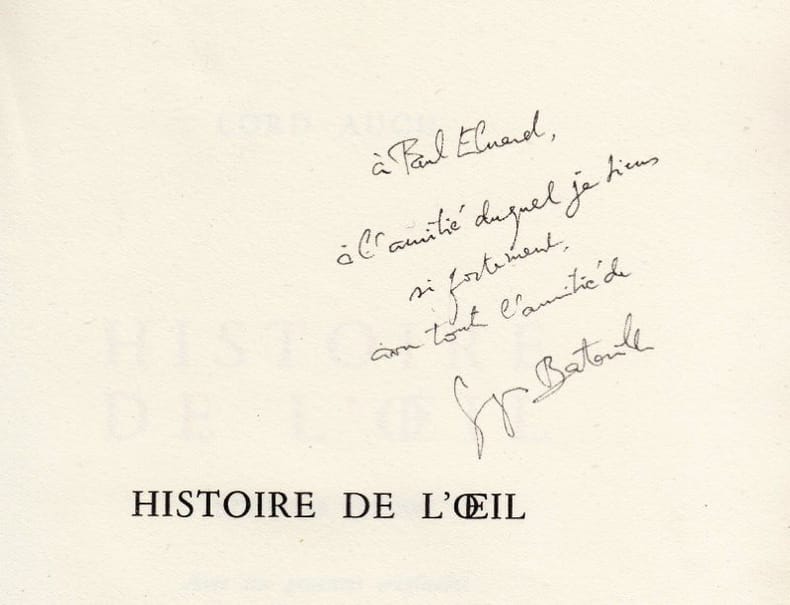
194770720Séville [Paris] s.n. [K éditeur] 1940 [1947] 1 vol. broché gr. in-8, broché, couverture rempliée, sous chemise et étui de demi-maroquin noir, 133 pp.Premier livre illustré par Hans Bellmer, comprenant 6 gravures originales à l'eau-forte et au burin. Tirage limité à 199 exemplaires, celui-ci un des 50 numérotés sur vélin de Rives B.F.K. comportant une suite en noir des gravures et exceptionnellement enrichi de la suite des gravures en couleurs (réservée normalement aux 28 exemplaires de tête).Bel envoi autographe signé de l'auteur : "à Paul Eluard, à l'amitié duquel je tiens si fortement".Remarquable provenance sur cette publication clandestine et antidatée due à l'équipe de K Editeur : dès 1946, Eluard avait en effet confié à cette toute jeune maison d'édition le soin d'imprimer Les Jeux de la poupée avec des photographies originales de Bellmer. Le bulletin de souscription fut diffusé mais l'ouvrage ne put voir le jour, faute de financement (il paraîtra finalement en 1949 aux dépens de Berggruen). C'est pour se rattraper de cet échec que K éditeur proposa à Bellmer d'illustrer cette nouvelle version d'Histoire de l'oeil. En parfaite condition.
Oblong folio. 2 pp. From Act II, Scene 2; one page with the text. - After the enormous success of "Bianca e Fernando" in Naples (May 1826), Bellini was introduced to the librettist Felice Romani, who proposed the subject of the composer’s first project, "Il pirata". Its premiere, given on 17 October 1827, was "an immediate and then an increasing, success. By Sunday, December 2, when the season ended, it had been sung to fifteen full houses" (Weinstock, Bellini: His life and His Operas. New York, Knopf, 1971, pp. 40f.). - Margins somewhat spotty and browned. With an early certification of authenticity in the left margin, written by the lawyer (to the heirs of Vincenzo, his brothers Carmelo and Mario), Francesco Chiarenza, and dated Catania, June 21, 1902.
Large 4to. 3 pp. on bifolium. To his friend Rodolf Weinwurm, the conductor of the Wiener Singakademie, about the premiere of his Mass No. 1 in D-minor in the Linz cathedral and the Redoutensaal, expressing his surprise that the latter was packed with listeners despite the seriousness of his composition, and mentioning that his concert was attended by Josef, Archduke of Austria - He intends to have a clean copy of the full score made, which he would like to send to the Weinwurm to deliver to the critic Eduard Hanslick and the composer and conductor Johann Herbeck, hoping the latter would agree to have it performed in the Vienna Musikverein, as a performance in the church would require too much rehearsal. - The mass, which was highly successful both among the critics and the audience, was a breakthrough for Bruckner as a composer. It was performed in Vienna on 10 February 1867, conducted by Johann Herbeck and with Bruckner playing the organ.
16mo. 4 pp. on bifolium with United Services Club embossed letterhead. In custom quarter morocco folder. To Colonel Montgomery, referencing the success of the "Arabian Nights": "[...] To my great astonishment The Nights has hit the public taste: it has of later years been so stuffed with goody-goody, namby-pamby Maria-Matilda that it wants 'strong meat' and by Jove it has got it. We had the pleasure of seeing my good friend Thayer here and I (unhappily) forgot to put his name down for the Athenaeum Club - London without a club is like a park without games. We are both living well under influence of beef and port (wine) and shudder at the lean flesh pots of Trieste (veal) [...]". - Burton published his famous translation of the "Arabian Nights" ("The Book of the Thousand Nights and a Night") in a private printing for the Kama Shashtra Society in 1885. The private publication, by subscription only, was necessary to avoid Victorian obscenity strictures. - Reinforcement at fold, a little smudging to signatures.
Various formats. Altogether 12¾ pp. on 11 ff. With 5 autogr. envelopes, 2 letters on airmail paper with integral address panel. In Hungarian language, to the violinist André Gertler (1907-1998). - The letter from October 28, 1938, comprises an autogr. musical quotation (3 bars).
8vo. 2 pp. With autograph address. To the Franco-Hungarian sculptor István Beöthy (Etienne Beothy) in Montrouge/Seine, announcing his arrival in Paris for the end of June. The sketch on the card's picture side, partly hand-coloured by Calder, shows a "collaboration entre vaches et sculpteur" ("collaboration between cows and sculptor").
8vo (125 x 205 x 50 mm). Autogr. ms. on paper, with Elizabeth's silverstamped crowned initials on every other leaf. 3 ff., 400 pp., 4 ff. Splendid contemporary ochre velveteen binding with nine metal fittings, seven bosses and two clasps, studded with a total of 20 facetted garnets and 9 freshwater pearls. Brown moirée silk endpapers; pastedowns framed with a wide border of dark green giltstamped calf. Silver edges, goffered. Elisabeth I of Romania, chiefly known under her pen name "Carmen Sylva", probably composed these devotional texts during a protracted stay in Italy and with her mother in Segenhaus (Neuwied, Rhineland-Palatinate) during the years 1882/83. The 21 devotions were first published in 1888 in Romanian (as "Cuvinte Sufletesti", "Words of the Soul"); a German edition appeared in Bonn in 1900 as "Seelengespräche". The Queen drew up this present fair copy specially for her mother and dedicated it to her, bound in a luxury binding, for her 59th birthday: "Meiner Mutter, meinem Religionslehrer und Vorbild auf dem Erdengange" ("To my mother, my religious instructor and role model throughout my life", f. 2). - Velvet binding shows signs of age in places, but is only very slightly rubbed. Silver edges are oxydized; wants a headband. The paper is unstained and immaculately white. Cf. Silvia I. Zimmermann: Die dichtende Königin. Selbstmythisierung und prodynastische Öffentlichkeitsarbeit durch Literatur (Stuttgart 2010). For the first printing: Schmidt 459.
8vo. 4 pp. on bifolium. An important letter which underscores Darwin's belief in the scientific significance of the study of Cirripedia (barnacles). To Nathaniel Thomas Wetherell: "I fear that you will think me a sad trespasser on your kindness & forbearance, when I tell you that I have not actually completed my description of Loricula; but I shall do it directly & write now to obtain your permission to take (myself) your specimen to Mr. James De C. Sowerby to [be] drawn for publication by the Palæontographical Society.- I have received Mr [John Wickham] Flower's specimens, & some from Denmark but none are related to the Loricula, which is as perplexing as ever to me.- Immediately that Mr Sowerby has with your permission figured the Loricula (& I shall take it up in a fortnight) it shall be returned to you. - Is there any safe place where I could leave it in London for you, or shall I return it by a messenger? - I believe I did once before ask you, whether you have any other fossil Cirripedia. - To save you the trouble of answering, I will assume, without I hear to the contrary that Mr Sowerby may figure it. - With my best thanks | I remain dear Sir | Yours faithfully | C. Darwin | I assure you that it has not been idleness which has delayed me, but numbers of specimens of other fossil Cirri[pe]des". - We are able to date this letter precisely because August 1850 was the only month with a 'Thursday 8th' in the period between the Palaeontographical Society's decision to publish Fossil Cirripedia and the publication of the first volume of this work in 1851, in which Loricula pulchella is described (Fossil Cirripedia (1851): 81-6). - James de Carle Sowerby drew all the figures of the specimens in the first volume of Fossil Cirripedia. At the time of writing, Darwin does not seem to have known that George Brettingham Sowerby Jr had described and figured this particular specimen in 1843. However, since that time Wetherell had cleared away more material from the specimen, revealing features not seen by G.B. Sowerby Jr, and a new drawing was made for Darwin's description (Fossil Cirripedia (1851): 81). (Darwin Correspondence Project). - Published by the Darwin Correspondence Project, University of Cambridge, as Letter no. DCP-LETT-1267. - Slight damage to paper (no loss to text) and in some parts professionally restored.
8vo. 4 pp. To his second wife Mina Miller, here called "Billy", about a strenuous field trip to Ontario to explore nickel reserves, involving an honorary reception by the city of Sudbury: "John writes you today & I assume tells you all about the trip in the woods - as I do not know what he told you I will recite all the events after you left. After the boys came from the Laboratory we took a carriage and 6 of us went out on the upper Wanatapae [i. e. Wanapitei] road to the Credyman mine [...] The mine is about 10 or 12 miles NE from Sudbury. It has been cleared & exposed so we had a good chance to see the whole of the surface and the amount of nickel ore exposed. We also took along our magnetic needles and made a rough survey of the mine [...] This gave us lots of information which will be good for future use [...] Right near the mine we came onto a typical Canadian Lumber Camp. There was 5 low log cabins and 3 log stables, the latter containing about 30 horses [...] The strangest thing was that they had a railroad, a narrow gauge with regular steel rail, Locomotives & logging cars [...] The Municipality of Sudbury gave me an address, which was read by the mayor [...] after it was over I asked several of the city fathers to come down stairs and have some lemonade, there were seven or eight and all took whisky instead of lemonade [...] We left Monday morning for Worthington [...] at this point we were to leave the Railroad & start south into the country which is very heavily wooded [...] we could only find swamp water which had the color of tea, this we boiled before drinking. We slept on the ground with a little hay upon which we laid our blankets. Towards morning it got very cold and a heavy fog settled down [...] we cooked breakfast & started out early for a lake to the south, the swamps, rocks, & fallen timber made progress very slow and very exhausting [...] I sprained my ankle slightly but the next morning it was ok. The guide preceded us and cut with an axe a bare spot on both sides of trees about 20 ft apart, we followed these spots very readily - it's called 'Blasing a trail'. We came to a pretty fine lake & made camp [...] The last 2 days I have been in camp, the boys have been out hunting corners & yesterday for the 1st time tried a survey with their needles. Today is Sunday & we keep it holy, tomorrow I am going out with the boys & try a new plan to surveying from Diorite to Huronian instead of surveyors posts which it's impossible to find [...]". - Small marginal tears.
I: Albert Einstein. 4to. 2 pp. - II: Elsa Einstein: 8vo. 2 pp. - III: Helene Dukas. 4to. 2 pp. Grünberg, who later in life changed his name to Waldemar A. Craig, was a hydrodynamic engineer who developed an important design for the hydrofoil. The letters accompany a large archive of Grünberg's papers, consisting of well over 1,000 pages of material including some of his original drawings for his hydrofoil improvements, copies of his patents, (including a large dossier of declassified tests performed in the years immediately following WWI), photographs, correspondence, and other related documents and ephemera. - Wsevolode Grünberg was the nephew of the Russian orthodontist and collector Josef Grünberg, one of the few close friends of Albert Einstein, who gave him the nickname "Bolshie". It appears that Einstein and his second wife Elsa had become acquainted with Wsevolode Grünberg shortly before their friend's death in 1932, if not personally, then by correspondence. In an undated letter from Berlin, written sometime before 1932, Elsa Einstein commented to Wsevolode Grünberg: "I am assuming you are just as kind and clever as your uncle, our dear friend. My husband and I were so glad having been able doing this small favor for you. Mr. Dunne wrote a most gracious note to us from Florida. In particular I want to thank you for the delicious grapefruits [...]", adding, "Feel free to call on me anytime if you think I could be of help. Please be sure and do so". - Apparently Grünberg acted on her advice, and travelling to the United States in 1939 approached Einstein for an introduction to fellow engineers in the U.S. in order to demonstrate his hydrofoil designs. The two met in June 1939 at the home of Irving Lehman in Port Chester, New York. Einstein assisted Grünberg with the inheritance issue, acting as a go-between for Grünberg in the U.S. and Plesch in England. - Despite some annoyance, Einstein did what he could for Grünberg both regarding his inheritance and his scientific pursuits. Grünberg's personal papers concern his research on his hydrofoil designs which he first developed in France. The archive includes some of Grünberg's original drawings demonstrating applications for his design as well as some manuscript calculations in his hand, some original U.S. patent certificates for several inventions, one German patent awarded to him in 1930, original photographs, likely from the early 1930s, and several magazines including Popular Science and others discussing Grünberg's work and designs. - Detailed description available upon request.
4 SS. auf Doppelblatt. 4to. An den Brockhaus-Verlag bei Übersendung des Manuskripts zu "Paul Johann Anselm Ritter von Feuerbachs Leben und Wirken veröffentlicht von seinem Sohne Ludwig Feuerbach", zu dem nur noch zwei Stücke fehlten, darunter das "der Königin Caroline [...] überreichte Memoire über K. Hauser, worin F. mit seinem bekannten juristischen Scharfsinn es wahrscheinlich [...] macht, daß K. H. allerdings der sei, wofür ihn die bekannte Fama publica, namentlich in Baden, ausgegeben hat [...] Ich selbst habe an diesem Memoire dieses, aber auch nur dieses auszusetzen, daß selbst einige (frühere) Träume K. H.s zu den Indicien gezählt werden, doch dieß ist [...] gleichgültig: das Memoire gehört nothwendig zum Ganzen u. ist vielleicht in den Augen des allgemeinen Publicums das Allerwichtigste in der ganzen Sammlung [... ]." - Unveröffentlicht.
3 Zeilen. 112:186 mm. Auf festem, bräunlichem (Pack-?)Papier. Mit dem oberen Rand auf ein kleineres Kartonblatt montiert. "Zwey Flaschen guten Champagners erhalten zu haben bescheinigt - Goethe". Die Champagner-Bestellung gehörte vermutlich zu Goethes Silvester-Vorbereitungen. - Die Schrift stellenweise etwas verblasst. Nicht in der Weimarer Ausgabe.
Small 8vo. 51 unnumbered ff. Original red morocco. Green moirée silk endpapers; all edges gilt. Signed by Grassi on front flyleaf. The personal travel notebook of Joseph Grassi, one of the foremost portraitists of his age and remembered today as the painter of one of the very few authentic Mozart portraits. In her biographical sketch of the artist, Elisabeth Eixner deplores the lack of studies concerning Grassi's Roman years: "It would be a rewarding task for scholarship to investigate Grassi's activities in Rome, which he first visited in 1808-10 (becoming member of the Academy of San Luca in 1810), and again in 1816-21 as 'Director of Studies of Saxon Artists in Italy'" (NDB VII, 5). Clearly, the present notebook constitutes the principal and hitherto entirely undocumented source for such an investigation: apparently begun during his first journey to Italy, the booklet also served Grassi upon his return, containing his travel plans as well as lists of important events, meetings, addresses, and contacts in Rome. The detailed schedule of his itinerary from Gotha to Rome (no less than 60 stations, stating the distances and length of stay) is followed by a five-page catalogue of artists active in Rome, most of which Grassi managed to visit, a brief account of social life in the city, and a list of various works of art and their locations. The names of numerous art dealers and antiquarians as well as several paintings offered to Grassi (including works by van Dyck, Raffael, Michelangelo, and Rubens) give evidence of his activity as an agent for the Ducal collections. Among the extensive notes at the end of the volume (which include payments to his coachman) we also find a three-page autobiography in which Grassi records the principal events of his life with their respective dates. - After his last visit to Rome "Grassi returned to Dresden, where he died in 1838, lonely and after years of illness. For a decade (1781-1791), Mozart and Grassi both lived in Vienna. The close connection between Joseph Grassi, the Mozarts and their in-laws Lange is proved by a letter of 12 March 1783 from Wolfgang to Leopold Mozart in which he discusses a performance of his pantomime 'Pantalon und Colombine' (with his music, KV 446) on March 3rd, an event held in the Hofburg Redoutensaal and attended by his friends" (cf. Angermüller). - Perfectly preserved. Autographs in Grassi's hand are of the utmost rarity: the past decades' auction records list a single specimen (Stargardt, 21 March 1996, lot 672: his signature on a receipt for Duke August of Saxe-Gotha). R. Angermüller, Mozart: Bilder und Klänge. Salzburg, Internationale Stiftung Mozarteum, 1991, p. 358. NDB VII, 4-5.
"With Haeusserman, a part of Vienna died", wrote Rolf Hochhuth in his obituary in the "Weltwoche", and truly, the final, splendid age of Austrian theatre history passed away with this great man, an age that had begun in 1954, when Haeusserman was appointed director of the Josefstadt Theatre. A favourite of 1930s audiences, the yong romantic lead Haeusserman had to forsake his acting career when Austria joined the Third Reich; after his emigration to the U.S., he continued behind the scenes as personal assistant to Max Reinhardt. After the end of the war, he served as director of the Vienna Burgtheater and of other important Viennese playhouses. - Haeusserman's copious estate contains not only 317 pp. of manuscripts and typescripts and 45 pp. of autograph letters, but also some 3680 pp. of letters to him by such prominent writers as Rosa Albach-Retty, Ingeborg Bachmann, Albert Bassermann, Hedwig Bleibtreu, Franz Theodor Csokor, Ernst Deutsch, Richard Eybner, Adrienne Gessner, Nora Gregor, Friedrich Hacker, Marte Harell, Mirko Jelusich, Oscar Karlweis, Fritz Klingenbeck, Leopoldine Konstantin, Alexander Lernet-Holenia, Wolfgang Liebeneiner, Fred Liewehr, Ernst Lothar, Lilly Marberg, Fritz Molden, Lothar Müthel, Susi Nicoletti, Marcel Prawy, Géza von Radványi, Gottfried Reinhardt, Hermann Röbbeling, Adolf Rott, Robert Stolz, Hans und Helene Thimig, Hilde Wagener, Oskar Werner, Else Wohlgemuth, and Carl Zuckmayer. - Upon Haeusserman's death, Senta Berger, Maria Bill, Gertrude Fröhlich-Sandner, Paul Hubschmid, Friedrich Kayssler, Marthe Keller, Rudolf Kirchschläger, Erni Kniepert-Fellerer, Cissy Kraner, Gustav Kropatschek, Erwin Lanc, Ingrid Leodolter, Conrad H. Lester, Ernst Wolfram Marboe, Fritz Marsch, Peter Matic, Kitty Mattern, Federik Mirdita, Heinz Moog, Herbert Moritz, Klaudia Nagy, Brigitte Neumeister, Romuald Pekny, Gisela Prossnitz, Harry Reich-Ebner, Gottfried Reinhardt, Georg Robor, Sieghardt Rupp, Günther Schneider-Siemssen, Walter Schuppich, Dany Sigel, Marietta Torberg, Siegfried Trebitsch, Michael Verhoeven, Eberhard Waechter, Senta Wengraf, Oskar Werner, Guido Wieland und Hugo Wiener were among those who offered their condolences (a total of 224 pp.). No less interesting is the partial Nachlass of Ernst Haeusserman's father, the Burgtheater actor Reinhold Häessermann (1884-1947), containing some 275 ff. of letters to him, 267 ff. of various documents, 163 photographs (portraits and costume photos, photographed postcards and snapshots, notebooks, and speeches by contemporaries such as Rosa Albach-Retty, Hedwig Bleibtreu, Eugen Schmalenbach, and Otto Tressler. Cf. E. Haeusserman, Der Weg war schon das Ziel. Chiffre für das Unverwechselbare (Munich, 1978).