66 615 résultats
4to. Altogether 44 pp. on 31 ff. 4to. Partly with autograph address. Extensive, interesting correspondence with his friend and publisher Tobias Haslinger concerning matters of contracts and publication, in particular about his piano instruction book ("Ausführliche theoretisch-praktische Anweisung zum Pianoforte Spiel"), for which he sends the corrections to part one (June 14), about his travel plans ("I will be travelling to Carlsbad with my family on the 24th to take the waters and rid myself of all the old waste"; ibid.), negotiations with his French publisher Aristide Farrenc (who had requested Hummel "to send him a manuscript of mine, which he has announced as a facsimile for the instruction book and wishes to include", June 20), preparations for the funeral of the Grand Duke (Weimar, July 16), corrections for part three of the instruction book (October 23), book requests ("Would you be so kind as to obtain for me from Wallishauser the printed textbooks of the following operas and send them to me by stagecoach at your earliest convenience", November 17), and about his disdain for Paganini: "Paganini's dirtiness is little surprise to me; he is, after all, an Italian; but for all that and because he is not German, he has been created a knight and a chamber virtuoso by the Emperor - indeed, soon I shall be ashamed of my fatherland. Were he a German, such a distinction would never have been conferred on him, even if he were possessed of Paganini's virtuosity three times over" (18 August 1828). - Unpublished.
8vo and oblong 8vo. Altogether 8 pp. on 5 ff. With 4 autogr. envelopes. Intimate, longing missives to Antonia Mangelmann, probably a former model or student of Kokoschka's at his Salzburg Summer Academy: "You have proven to me a dedication, truly limitless for a mother, in this, your possibly finest letter; do not be angry if the Swan proves human in his desire to embrace you in thanks for all that you keep so close to my imagination that I was overjoyed all day, so very happy. How sweet are your two hearts, and how beautiful your two bodies, such harmony of earthly forms and divine souls was known only to Greek antiquity, and I confess frankly that I return to Salzburg on your behalf alone. To have to leave such wonderful sweetness! for soon I shall have to die, a fate which I find it hard to get used to! That there shall be a wall between the three of us, that the world of shadows shall remove me forever, while you and Inge strew like buds your charm and love beneath the sky, in the light of day and the star's nightly gleam, this hurts me as my love hurts me but still keeps alive / your Oskar" (translation). The reverse of this undated letter shows a sketch of three embracing persons, inscribed "for dear Antonia / variation on our theme / by OK". The persons depicted are apparently Antonia, her daughter Inge, and Kokoschka himself. - All letters with printed letterhead. Includes 11 pp. of responding letters.
Ca. 184 x 58 mm, mounted on backing paper with note by a later collector (ca. 222 x 138 mm). The beginning of an unpublished letter to an unidentified recipient. It often happens to him, writes van Leeuwenhoek, that he finds himself working on matters the full import of which he does not grasp, and so he would be glad to learn the opinions of Mr. Tevenot (i.e., the French scholar Melchisédech Thévenot, 1620-92): "Myn Heer. Gelijk ik veeltijts verschijde saaken bij de Hant neem omme die haer wesen te ontdecken, daer ik niet kan door komen, soo sal het mij niet onaengenaem sijn, dat de Heer Tevenot mij eenige voorstellen dede waar sijn speculatien mogten komen te vallen, omme alsdan daer op te antwoorden". - In 1683 van Leeuwenhoek wrote to Heinsius: "I have heard Mr. H. van Bleyswyk's high praise of Mons. Thevenot, and I am anxious to hear what that learned and curious gentleman will say about my statements" (Leeuwenhoek, Alle de brieven IV, no. 78). In 1688 he wrote to Thévenot directly: "A few years ago I took the liberty to send you a few of my modest ideas and observations, to which Your Honour replied in courteous terms. Now it so happens that, among several observations, I have discovered the circulation of the blood [...]" (ibid., vol. VIII, no. 111). The present fragment would seem to belong to the context of the former letter. - Identified by a slightly later hand on the leaf itself ("Dit is van Leeuwenhoek"); the backing paper has a note by a German 19th century collector. - The Delft entrepreneur van Leeuwenhoek is one of the most notable representatives of the golden age of Dutch science and technology. A draper by trade and a largely self-taught amateur scientist, he pioneered the field of microscopy and is hailed as the "Father of Microbiology". His instruments, built by a secret and carefully guarded method, achieved magnification of up to 275 times and more - a resolution not reproduced until more than two centuries after his death. "[O]ne can say with truth that [...] protozoology, bacteriology and microbiology begin with Leeuwenhoek" (PMM 166). Autographs by Leeuwenhoek are of the utmost rarity; not a single specimen has been traced in trade records.
12mo. 3½ pp. on bifolium. To Alexandre Perrin, the director of Geneva's Évêché prison, asking him to make another prisoner named Klein stop bothering him during his walks, knowing that Klein's sole objective is to drive his co-prisoners to causing trouble or to denigrating the director: "Bien qu'il soit genevois et qu'il se vaute d'avoir de nombreuses reconaissances parmi les magistrats de Genève, veuillez aviser le détenu Klein de me laisser tranquille lorsque je suis à la promenade. Ne lui adressant jamais la parole parce qu'il m'a prouvé à plusieurs reprises - et cela malgrè le titre de Franc-Maçon qu'il se donne - que son sejour ici a l'Évêché semble n'avoir d'autre but que celui de pousser ses codétenus à faire le mal ou à dénigrer votre direction vis-à-vis de vos superieurs [...]". - He hopes the director will advise Klein not to approach him when he has a complaint and mentions another encounter that same morning, in the course of which Klein threatened him, predicting he would soon make enemies and suggesting he complain to Perrin about the matter: "En tout cas, j'espère que vous l'aviserez de me laisser tranquille et lui faire comprendre que Lucheni n'a pas besoin d'être poussé par Klein lorsque il eut de plainte a adresser au Departement. Encore ce matin il s'est arreté près de moi pour me dire: 'vous savez d'ici a quelques jours, vous allez avoir des enemis, car j'ai appris que le grossier Lée vient reprendre son service comme chef du quartier B. Pourquoi vous ne complaignez pas à M. le Président du Departement en le mettant au courant de ce qui s'est passé; car c'est encore lui qui va diriger l'Évêche' [...]". - On delicate paper with a horizontal tear through the second leaf, touching the text but not affecting its legibility; smaller tears along the centrefold.
Oblong 8vo. 1 p. With autograph address. In Russian, to his third wife, Natalya Andreevna (née Manchenka, 1902-90): "I have received all your letters, it upsets me a good deal, everything is particularly difficult if you are upset, but I still cannot leave. It is very difficult to leave. I have taken steps through Narkompros [the People's Commissariat for Education] and obtained a ticket for May 23. I will arrive around 12 o'clock noon [...] Unfortunately, I cannot send any money for I have not drawn my salary [...]". Malewitsch über sich. Zeitgenossen über Malewitsch. Briefe. Dokumente. Erinnerungen. Kritik. Vol. 1, Moscow 2004, no. 38.
Oblong 8vo. 1 p. With autograph address. In Russian, to his third wife, Natalya Andreevna (née Manchenka, 1902-90), about a committee meeting which appreciated his project, and about the closure of several artists' associations. His nephew Edsik (brother of Malevich's brother Myachislav) will buy some tickets, and he himself expects an advance payment. "[...] As for the cottages, it looks quite bad. A shared bathroom between 400 and 500 rubles. Neli promises to get a room and a terrace from a friend [...]". Malewitsch über sich. Zeitgenossen über Malewitsch. Briefe. Dokumente. Erinnerungen. Kritik. Bd. 1, Moskau 2004, Nr. 32.
Oblong 8vo. 1 p. With autograph address. In Russian, to his third wife, Natalya Andreevna (née Manchenka, 1902-90), on being terribly busy, and some plans to meet her on the 25th: "[...] I bought the ticket via Moscow again, so if I do not stop over in Moscow for a day because of the matter with Glawiskusstwo and the porcelain, I will arrive on the morning of the 25th by fast train, or on the morning of the 26th if I must stay the day [...] Overshoes cannot be found here, they have only black ones, but only upon presentation of the receipt. Maybe I'll get some at Moscow [...] I don't know how it will work out in Kiev. There is a lot of trouble at the moment [...]". Malewitsch über sich. Zeitgenossen über Malewitsch. Briefe. Dokumente. Erinnerungen. Kritik. Bd. 1, Moskau 2004, Nr. 22.
Small 4to. 1/3 page. With address. In this note Napoléon refers to another letter he wrote previously, urging the recipient to pursue matters in his sense and presenting himself as the most suitable person to promote things: "Je ne avais parlé qu'après donner dictat [?] à cette lettre et je vous prie d'elle faire la petition d'écrire que personne n'est destiné autant [...] que moi et non plus noté à pouvoir faire quelque chose que puisse le poursuivre. Si mes occupations me laisse[nt] [...] je ferais moimême avec urgence sa lettre. | Bonaparte". (Translation: "I only spoke after having dictated [?] the letter, and I request you to make a petition of it, writing that nobody is so destined or more respected than I am to do something that could advance it. If my occupations permit me I will treat your letter urgently myself. Bonaparte". - Addressee illegible. Extensive spotting with slight damage to folds, reinforced in parts.
102:103 mm. Mounted on a single page (8vo) together with a contemporary handwritten transcription. Notes on the Battle of Voltri (1796): "Rampon et la Harpe [-] par le Gal en chef lui meme la deroute fut complette tout le corps d'Argenteau fut ecrase dans le tem[p]s queu Beaulieu descendait a Voltri ou il ne trouvait plus personne" (transl.: "Rampon and la Harpe - by the commanding General himself - defeat was complete - all of d'Argenteau's corps was erased while Beaulieu descended to Voltri, where he found nobody left"). - With a certification of authenticity at the bottom: "corrections de la campagne d'Italie écrit par Napoleon à Briars, isle Ste helene en 1815 / Cte. de Las Cases". Emmanuel, comte de Las Cases and his son accompanied the former emperor to Saint Helena. There, he acted informally but very assiduously as his secretary, taking down numerous notes of his conversations which thereafter took form in the famous "Mémorial de Sainte-Hélène".
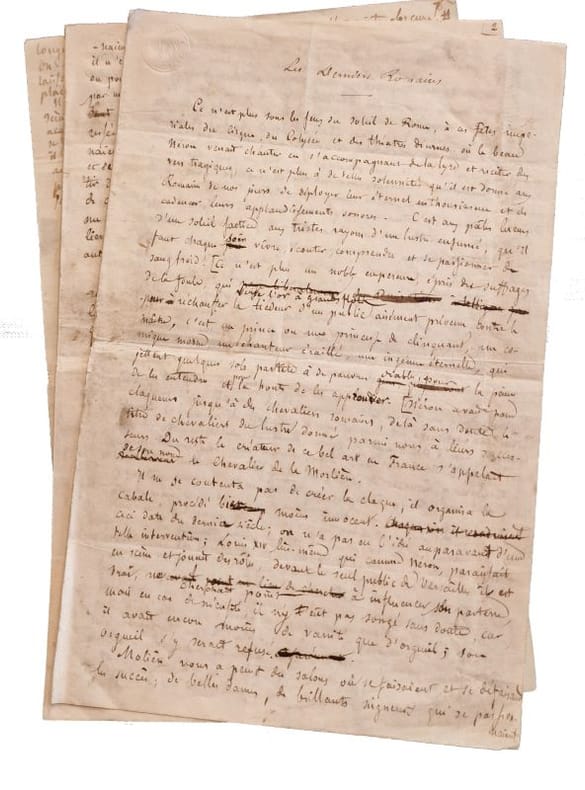
1844888601844 8 pages in-8 à l'encre brune (21 x 13,8 cm) sur 4 double feuillets, adresse autographe et marques postales au dos du dernier feuillet (avec petit manque de papier amputant la fin de deux mots), sous chemise demi-maroquin noir.Manuscrit complet, seul connu, de cette fantaisie sur les théâtres parisiens rédigée pour Le Diable à Paris. Nerval y esquisse une sorte de physiologie des claqueurs, ceux qu'on appelle "Romains" dans l'argot du théâtre : ces faux spectateurs recrutés pour ovationner ou bien huer les spectacles et dépeints notamment par Balzac dans ses Illusions perdues. Après un rappel des origines de cette tradition, Nerval constate sa généralisation dans le théâtre de son temps, et il s'amuse à détailler l'influence et la hiérarchie des claqueurs à partir de sa propre expérience de critique dramatique.Ce beau manuscrit de premier jet surchargé de corrections fut adressé à Pierre Jules Hetzel par courrier depuis Amsterdam le 23 septembre 1844 avec une amusante apostille signée "Gérard" in-fine et les cachets de la poste faisant foi. L'éditeur fit tirer un jeu d'épreuves conservé à la bibliothèque Spoelberch de Lovenjoul, mais le texte ne parut finalement pas dans Le Diable à Paris. Il est resté inédit jusqu'en 1948 où la "Revue d'histoire du théâtre" en publie une version fautive, avant d'être repris en Pléiade dans les Œuvres complètes (tome I, p. 848-854) avec cette note des éditeurs J. Guillaume et Cl. Pichois : "On ne sait pour quelle raison cet article fut exclu : par le pittoresque du sujet et la vivacité de l'expression, c'est un bel exemple de l'article de genre" (p. 1819).Les manuscrits littéraires de Nerval sont rares et très recherchés.
More than 100 letters and documents by, to and about Franz Xaver Niemetschek and his family. Copious archive aquired from the direct descendants of Mozart's first biographer. While the documents contain no new information on Mozart himself, they do shed new light on Niemetschek's hitherto rather obscure biography and provide a vivid account of the life of the Viennese and Bohemian bourgeoisie during the Biedermeier period. In particular, the present material provides documentation that the musically-minded scholar Niemetschek, a pianist himself, could very well have visited Mozart's concerts in 1787 during his time at the University of Prague, thus once more fuelling the old debate whether the biographer and his subject did in fact meet. The archive comprises material from Niemetschek's lifetime and from that of his two children up to the early 1860s. A detailed catalogue is available upon request.
4to. 1½ pp. on 1 bifolium and 1 single leaf. Notes on silkworm disease. Pasteur compiled the present notes in the Swiss Alps in 1857 with the help of observations made by a silkworm breeder. They contain comparative information on the disease afflicting silkworms and diseases of vineyards and mulberry trees: "Note sur les éducations de vers à soie destinée à la confection de la graine, faite en 1857 dans la Suisse, les montagnes des Basses-Alpes et d'autres localités où l'épidémie n'a pas paru; par M. Guérin [illegible]. […]". Undoubtedly, Pasteur relied on these notes and other accounts when he travelled to the south of France in 1865 to investigate the diseases among silkworms wreaking havoc in the French silk industry, as he had no prior knowledge of the silkworm disease he was comissioned to investigate. Within three years he succeeded in isolating the bacilli of two distinct diseases and in finding a procedure to prevent contagion as well as in detecting diseased stock. - Slight marginal soiling, otherwise in mint condition.
8vo (104), oblong 8vo (2), oblong 12mo (1), 136 x 33 mm (1). A total of 239 pp. on 50 bifolia and 59 single leaves. One letter with autograph address on verso. Remarkable political correspondence from the exile to Maurice Lachâtre. Pyat, sentenced to death by the 3rd War Council on 28 March 1873, took refuge in London. Lachâtre, to be deported to a fortified compound, fled to Spain in December 1873. Following the amnesty (11 July 1880), the two outlaws, returned in France, co-directed "La Commune", a socialist newspaper (45 issues, 21 Sept.-4 Nov. 1880). - 1872: Pyat recounts his flight from Paris to London and deplores France's state of despondency. - He advises against a return from Spain and attests to horrors committed during the fall of the Commune. Pyat notes the desired conditions for publishing a history of the Commune, combining a newspaper, collaborating with the printer Juste Vernouillet, pros and cons of publishing in Paris or Brussels. Under the pseudonym "Solange" he considers the lifting of the state of siege, weighs the interest of a rapid or deferred publication of the history and the newspaper, and underlines risks to the country. He speaks of help for the outlaws, urges Lachâtre to keep away from the rigors of Thiers, shows interest in other Lachâtre authors (including Karl Marx and Eugène Sue), and makes political predictions: the monarchists, he says, would rally around Thiers, and political opinion would become more radical. - 1873: Pyat promises to provide souvenirs for Lachâtre's biography of Sue, is alarmed at Lachâtre's idea of returning home to Thiers' "orgy of blood", and reacts with ironic pride to his condemnation by the Council of War. He worries about Lachâtre due to the conditions in Spain. Pyat mentions how Thiers' fall corresponds to the laws of political science and invokes quarrels among the international (Vésinier, Landeck, Vaillant, Arnault, etc.). - 1874: Pyat sets out his observations on Castelar's fall and the Spanish Bourbon restoration, as well as on Lachâtre's setbacks in Belgium. - 1875: Pyat communicates a letter by Garibaldi (two ms. copies attached) for the press "for French propaganda". He considers a newspaper proposal. The justice of Paris turns out to be the triumph of the murderers. He debates the project of an exile newspaper, mentioning "La Voix du procrit" of Ledru and "Le Nouveau Monde" of Louis Blanc. - 1876: the amnesty was spoiled. He fights Lachâtre's hesitations to invest in a French newspaper, recalls the success of "Le Combat", and comments on the clumsiness of human rights. - 1877: his friend Gambon has told him about Lachâtre's plan of moving to Naples. Pyat would only agree to direct Duportal's "La Marseillaise" under a different title and with an adopted focus, criticizing the paper's unclear policies. - 1878: Pyat discusses their newspaper "La Commune", finances, seizure of the first issues, a guarantee for the citizen Castelnau, a friend and collaborator of Delescluze, summonses by the correctional police for non-payment of a fine, complaints about Dr Lux and the administrator Avenant. Several times he refers to Lachâtre's safe conduct to Paris. - 1879: New reflections on the amnesty. Versailles had no right to punish, no right to pardon; the outlaw's duty is to return only if he can win his cause and make the others return. Pyat urged Lachâtre to return to launch the newspaper; he was not mistaken: no amnesty. Pyat considers "Le Travail", in regard to declaration, title, administration, drafting (Rogeard, Gambon, Cluseret, Reclus, Protot, etc.). He hopes that General de Wimpffen will pardon Lachâtre. He gives advice in case of Lachâtre's reprieve and return, and receives emotionally the portrait of a martyr who redeems mankind. He warns of an agreement with Blanqui, whose "La Patrie" in danger proves that he is not the best journalist, and advises for caution until after the vote of the Senate. - Includes 2 ms. (copy): Pyat's Speech (Faubourg St.-Antoine, 14 Nov. 1869), declaration of the 1869 amnesty, which is sworn to the people, not to the Emperor; "Felix Pyat and the Tuileries" (London, 25 Jan. 1877), addressed to the editor of the "Standard", on Pyat's role in the Commune. Also includes: ALS by André Mellado (from the newspaper "La Igualdad", 27 May 1873), Spanish Republican tribute; ALS by General de Wimpffen (19 Oct. 1877), with comments on the French press.
4to. 1 p. (24 lines). An important sociopolitical text (notes for "Terre des Hommes", presumably for an article), in which Saint-Exupéry examines different ways of perceiving civilization: "Ah! Hitler tu as fait une belle decouverte en verite quand tu as decouvert que la civilisation ce n'etait pas [...], quand tu as decouvert [...] que l'on avait pas à qui ca mature [...] et que nous etions le loup et le tigre. Le [...] [...] [...], nous le [...] depuis cent mille ans - Tu confonds la decouverte du persecuteur avec la decouverte du [...] et tu decouvriras demain que [...] de l'homme si les pouvoir ne [...] sa proie, mais, [...] [...] de la manger - Et tu diras, j'ai trouvé le vrai dens de l'honneur? [...]".
Oblong 8vo. 1 p. With autograph envelope. On orange stationery. In German, to his friend, the Austrian painter and engraver Robert Philippi, who had initiated him to engraving, announcing his arrival: "Entschuldigen Sie, ich habe an den von mir bestimmten Tagen nicht kommen können, - werde aber bestimmt morgen Montag 5-6 zu Ihnen kommen". - Stamp clipped from the envelope.
Oblong folio. 2 pp. In pencil. A draft for the opera "Die ägyptische Helena" (op. 75), which premiered in 1928 in Dresden, as confirmed by the Richard-Strauss-Institute in Garmisch-Partenkirchen. - Hardly visible centrefold, slightly creased, two small ink blots in the left margin. From the estate of Wolfgang Sawallisch.
188788480s. n. | s. l. [1887 ?] | 20 x 32 cm | 1 portrait-frontispice, 1 titre à l'encre, 83 p. manuscrites, qq. feuillets vierges
Large 8vo. 5 pp. on 3 ff. Includes autogr. envelope with embossed sender's monogram and initials on verso. Long, important letter to Josephine Maier, mother of Wagner's close friend Mathilde Maier. As a matter of form, Wagner's oft-quoted request that Mathilde move in with him as his companion is directed to her mother: "My dear and esteemed friend! Only to someone to whom I already owe so much love and true dedication as I do to you may I dare submit a question and indeed a request as I must today. I must now decide how to go about keeping my home tolerable in such a fashion that the fine external security now achieved also serves my inner prosperity. As you know, I live in separation from my wife: my desire to transfer my household to a female being has recently become so strong in me once more that I seriously considered whether it might not be better to call back my wife rather than live alone. Only the conviction, gained from long experience and confirmed by the observations of all my friends and relations, that a reunion must needs bring about for the both of us a condition much less bearable than separation, has utterly disabused me of this plan [...]" (transl.). - While this remarkable letter is addressed to Josephine Maier, Wagner sent it directly to Mathilde Maier, who read it without passing it on to her mother. She rejected Wagner's offer, but remained his friend for the rest of his life. Published in M. Dürrer (ed.), Richard Wagner. Sämtliche Briefe, vol. 16. Briefe des Jahres 1864, Wiesbaden/Leipzig/Paris 2006, no. 204, p. 245ff., commentary p. 599 with references to earlier editions.
Various formats. Altogether ca. 23 pp. on 32 ff. Together with 2 postcards by Lili Dubuffet, 1 letter by Alexandre Vialatte, a facsimile postcard by Jean Dubuffet, the reproduction of a group photograph with Dubuffet and Sibille Boffard, a poster for a 1950 exhibition at Galerie Nina Daucet, a short text on the relationship between Dubuffet and Boffard, and other documents. In French. Correspondence with his neighbour in Paris, informal assistant, and close friend Sibille Boffard. Most letters are charming documents of the friendship, including the earliest two letters from Dubuffet's 1948 stay in El Meniaa (El Golea), Algeria. On 23 January he sends greetings to Boffard and mutual friends including the writer Alexandre Vialatte and complains about the weather: "Who expects to find heat here is terribly mistaken. One lives wrapped in the wide and heavy burnous that deprives you of the usage of the hands and the hood makes it impossible to see and to move the head". The second letter from 22 April is no less skeptical: "Travelling is like hunting marsh birds - long, tedious times, inconvenience and annoyance - occasionally rewarded with a good catch. Travelling to countries that are very uncomfortable for the body and the mind has this advantage over others that they make the return more enjoyable. We have been waiting for several days for a car that removes us from this place in the desert [...]". In a letter from 15 May 1949, Dubuffet contemplates the institution of "two kinds of marriage", one that is easily dissolved and one "for the venturers" that is inseparable, and invites Boffard for cake. In an undated letter, he thanks her enthusiastically for a party, underlining that it "has been a long time since I had been so highly amused". Two letters, one of which is dated 13 July 1955, the other undated, of a personal nature strike a darker note. In the dated letter from Vence, Dubuffet first thanks Boffard for sending him yearbooks that he uses to clean his brushes. He then mentions that she has been "severely tested" by life, wishing her well and discusses his wife's depression that renders the atmosphere in the house "often sombre". In the second letter, also to thank Boffard for yearbooks, Dubuffet writes about a severe case of lumbago that keeps him from work. - Two undated letters probably from the late 40s contain work-related instructions for Boffard. In a typed letter, Dubuffet instructs her to varnish a glass pane in his workshop, to convey two drawings of hippos from his "Collection de l'art brut" to a photographer, and to gather information concerning possibilities for the reproduction of a drawing of Slavko Kopac, the longtime curator of the Art brut collection. The second letter with instructions is truly remarkable, as Dubuffet had sent art supplies to Boffard to be distributed to the outsider artists Georges Berthomier (1897-1963) and Fernand Costa in the psychiatric hospital of Ville-Évrard. Dubuffet added a sketch of the hospital, indicating the pavilion of Juliette Élisa Bataille and enclosing a list of several patients with details concerning their interest in artistic work. He also asks Boffard to meet a Madame Sée in order to establish contact with a Swedish psychiatrist. Dubuffet's famous and groundbreaking Art brut exhibition was held in October 1949 at the Galerie René Drouin. The enclosed facsimile postcard was Boffard’s invitation to the opening. - The final three letters concern works by Dubuffet in Boffard’s possession. In an undated letter, he asks her to lend him a "small gray gouache" of his for an exhibition at the gallery of René Drouin, possibly the Art brut exhibition. This is possibly the same gouache that Dubuffet discusses in a long typed letter from 15 April 1960. There he bitterly complains to Boffard, as she "refuses to help him with the research" on the gouache that had apparently changed ownership in the meantime. Dubuffet explains to her that it is normal and beneficial for a collector to participate in the preparation of an artist's catalogue raisonné. In the final letter from 22 April 1960, Dubuffet thanks Boffard for her response, explaining that he is convinced that the new owner, a Mrs de Gavardy, will permit photographs to be taken. - Ten notes are instructions for Sibille Boffard or indicate the names of businesses, including a frame maker and a bookbinder, with which she had to deal for him. Three notes contain short aphorisms on love: "On est toujours soûlé quand on est amoureux". - Well preserved overall. Several notes and letters with instructions crossed out by Sibille Boffard. Some browning, occasional minor tears, particularly to the notes and receipts.
8vo (125:130 mm). 1½ pp. In Russian, to his third wife, Natalya Andreevna (née Manchenka, 1902-90), about the chaos going on at the State People's Home (Gosnardom) at Alexandrovsky Park, Leningrad ("A complete refurbishment will be realised next year, so I have to work from 10 to 7 just to get the most urgent things done"), on plans to travel with Angelina, for which reason he wants to receive his wages much earlier than usual: "[...] I am going to bed now, can hardly stand on my feet anymore. After work is done, one has to run around for two hours to find something to eat. My canteen has been closed, and all that's left are shabby bars [...]". Malewitsch über sich. Zeitgenossen über Malewitsch. Briefe. Dokumente. Erinnerungen. Kritik. Bd. 1, Moskau 2004, Nr. 25.
Oblong 8vo. 1 p. With autograph address. In Russian, to his third wife, Natalya Andreevna (née Manchenka, 1902-90), about Unochka's recovery, sending money by money order, and about common friends: "[...] There is frost in Moscow. I went in a railway carriage on Wednesday, it was extremely cold since they do not heat yet [...] And then I shall have to be at the Maljarstroi [...]. I would have written a letter, but there was no paper [...]". Malewitsch über sich. Zeitgenossen über Malewitsch. Briefe. Dokumente. Erinnerungen. Kritik. Bd. 1, Moskau 2004, Nr. 26.
Oblong 8vo. 1 p. With autograph address. To his third wife, Natalya Andreevna (née Manchenka, 1902-90), about his journey to Moscow: "[...] The trip was all right, I had a compartment of my own. The train was a fast one, so that I even shook from time to time. The weather here is fine, the sun is shining and I am heading straight for Nemchinovka [...]" (transl.). Malewitsch über sich. Zeitgenossen über Malewitsch. Briefe. Dokumente. Erinnerungen. Kritik. Vol. 1, Moscow 2004, no. 16.
Folio. ½ p. Addressed during the first months of the Revolution to the Administrator of the Royal Treasury, responsible for the expenditure of the household, M. Marc Antoine Francois Marie Randon de la Tour, ordering him to "pay in cash to our two valets of the wardrobe the sum of seven hundred and thirty two livres, which we granted them as an additional food payment, in consideration of their service during the year" (transl.). - Counter-signed by Pierre Jean Baptiste Beaugeard (1764-1832). Somewhat browned and spotty.
3 SS. auf Doppelblatt. Gr.-4to. Mit eh. Adresse (Faltbrief). "Auf das Dampfboot wartend, das meine Frau und mich nach England bringen soll", um dort seine Schottische Sinfonie zu dirigieren, schrieb Mendelssohn den vorliegenden Brief an den Musikkritiker Alfred Julius Becher, der angeboten hatte, Mendelssohn gegen eine Kritik Heines zu verteidigen: "Aber warum fangen Sie auch einen ersten Brief seit langer Zeit von einem faulen ovo an, nicht lieber von irgend einem frischen, wohlschmeckenden? Ich weiß nicht, was das für ein Artikel von Heine ist, von dem Sie sprechen, und habe mich also erst darüber geärgert, weil Sie mir schrieben, daß Sie es gethan hätten. Sie wollen so freundlich sein, mich wieder dagegen zu vertheidigen; aber bitte thun Sie das doch nur im Falle er so gut oder so böse ist, daß Sie dergleichen geradezu nothwendig finden - auch nach reiflicher Überlegung nothwendig finden. Eigentlich ist es doch immer am besten, gar nicht zu antworten und immer neue und bessere Musik zu bringen [...]". - Bechers Bitte, einen Artikel über das Niederrheinische Musikfest zu schreiben und an der "Wiener Allgemeinen Musik-Zeitung" mitzuarbeiten, muss Mendelssohn ablehnen, "weil ich gar zu lebhaft fühle, daß es mir unmöglich ist; eben auch weil ich in ähnlichen Fällen (namentlich bei Breitkopf & Härtels) mich so hartnäckig dagegen gewehrt habe auch nur meine Meinung zu sagen oder einen Rath zu geben". - Einige Irrtümer und Gerüchte gelte es zu berichtigen, etwa "daß ich für Paris eine Oper schreibe und daß Scribe mir einen Text dazu gemacht hat [...] Kommt denn diese Nachricht auch aus der allgemeinen Zeitung? Dann scheint sie sichs ja recht angelegen sein zu lassen, mir Unwahrheiten nachzusagen, denn eben daher kam eine Nachricht mit der mich vor kurzer Zeit alle Menschen quälten und verdrossen: daß ich mich um die ThomasCantorstelle [!] in Leipzig bewärbe, und die und die Mitbewerber hätte, und die und die Schritte gethan hätte. Da war auch keine wahre Sylbe daran, und das verdroß mich eben [...]". - Was jedoch stimme, sei, dass er fortwolle aus Berlin (wohin er 1841 als Kapellmeister von Friedrich Wilhelm IV. berufen worden war), "denn ich liebe das Leben dort nicht und bin verfremdet mit den Menschen und dem Wesen. Aber ich sehe nicht ein, wie ich wieder fortkommen solle, da auf mehrere Versuche und Anfragen der Art mir der König die Antwort gegeben hat, ich möge thun was ich wolle und auch nicht thun, was ich wolle, nur in Berlin wohnen bleiben solle ich, darauf bestände er. Daß ich mit der Oper nichts zu thun bekomme, ist jedenfalls bestimmt, das Wahrscheinlichste ist mir aber, daß ich überhaupt nichts da zu thun bekomme, und auf das ganze dortige Musiktreiben ohne den geringsten Einfluß bleibe [...] es ist doch nur der Egoismus, der da zum Bleiben räth, und gerade an dem leidet alles in Berlin, und gerade durch den ist alle Musik dort so entsetzlich undeutsch und entartet geworden [...]". - Ein Jahr später hatte Mendelssohn dann schließlich doch Berlin hinter sich gelassen und gründete in Leipzig das Conservatorium, die erste Musikhochschule Deutschlands, die er am 3. April 1843 in den Gebäuden des Gewandhauses eröffnete. - J. A. Becher sollte einige Jahre später einer der Hauptführer des Wiener Oktoberaufstands von 1848 sein und nach dessen Niederwerfung von einem Standgericht zum Tod verurteilt werden. - Bl. 2 mit wenigen winzigen Einrissen in den Faltungen. - Provenienz: J. A. Stargardt, Kat. 508 (5. Mai 1953), Nr. 67; Dr. Otto Liebmann; Antiquariat Hinterberger, Wien. Mit geringfügigen Abweichungen gedruckt in: Renate Federhofer-Königs, "Der unveröffentlichte Briefwechsel Alfred Julius Becher (1803-1848) - Felix Mendelssohn Bartholdy (1809-1847)", in: Studien zur Musikwissenschaft 41 (1992), SS. 7-94 (Nr. 20a). - Felix Mendelssohn Bartholdy, Sämtliche Briefe. Hrsg. und kommentiert von Susanne Tomkovic u. a. Bd. 8, Nr. 3533.