66 616 résultats
Large 8vo. 3 pp. on bifolium. To the director of the Stuttgart Court Theatre about his tireless efforts to stage Wagner's "Tannhäuser". As the court theatres at Stuttgart and Braunschweig were hesitant to perform the opera, Wagner is pleased that the recipient is interested in the project and provides him detailed information concerning his professional fee ("at least 50 Louisd'or"): "So werden einem alle Vorsätze durchkreuzt! Das Stuttgarter, wie das Braunschweiger Hoftheater (die einzigen, die meinen Tannhäuser so schandhaft ignorirten) sollten mir das einmal büssen. Mit Stuttgart machen Sie es mir nun zu nicht. Seien Sie versichert, dass ich mit einer angenehmen Genugthu[u]ng, die, späteren Erfahrungen gegenüber, durch die längere Erinnerung nur wachsen kann, Ihres ältesten, freundlichen, ächt wohlwollenden Entgegenkommens gegen den gänzlich Unbekannten, gedenke [...] Dass Sie nun meinen Tannhäuser, den so obstinaten Hindernissen in Stuttgart zum Trotz, herausbringen wollen, freut mich sehr, und weil es Ihnen Genugthu[u]ng geben wird, kann ich unmöglich bei meinem früheren, etwas rachsüchtigem Vorsatze, betreffs Ihres Theaters, bleiben. Aber ein ordentliches Honorar müssen Sie mir auswirken, zum mindesten dasselbe, was mir die andren Königlichen Hoftheater, München und Hannover, zahlten, nämlich fünfzig Louisd'or. Die Partitur ist nur durch mich zu beziehen, und falls Sie von Ihrer Intendanz die sofortige Zuwendung eines Honorars von fünfzig Louisd'or - mindestens! - an meine Adresse nach Venedig auswirken, so ersuche ich Sie, von dem beiliegenden Bestellzettel Gebrauch zu machen, wonach Sie von Dresden sogleich Partitur und Buch erhalten werden. Besondre Bemerkungen wegen der Aufführung habe ich Ihnen nun nicht mehr zu machen. Am sinnigsten, glaube ich, ist Ed. Devrient in der Scene damit umgegangen; auch hat er für den Schluss einen guten Einfall gehabt, den ich Sie bitte, sich von ihm mittheilen zu lassen [...]". - Somewhat soiled and spotty; slight damage to edges.
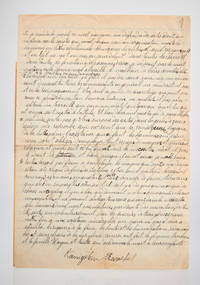
- [Bruxelles] Dimanche matin 14 [août 1864], 13,4x20,6cm, 3 pages sur un feuillet remplié. - Autograph letter signed addressed to his mother by a fading Baudelaire: "L'état de dégoût où je suis me fait trouver toute chose encore plus mauvaise" N. p. [Bruxelles] Sunday morning 14 [August 1864], 13,4 x 20,6 cm, 3 pages on a folded leave Autograph letter signed in black ink, addressed to his mother and dated "Sunday morning the 14th." A few underlinings, deletions and corrections by the author. Formerly in the collection of Armand Godoy, n°188. A fading Baudelaire: "The state of disgust in which I find myself makes everything seem even worse." Drawn by the promise of epic fame, Baudelaire went to Belgium in April 1864 for a few conferences and in the hope of a fruitful meeting with the publishers of Les Misérables, Lacroix and Verboeckhoven. The meeting didn't happen, the conferences were a failure and Baudelaire felt boundless resentment for "Poor Belgium". Nonetheless, despite numerous calls to return to France, the poet would spend the rest of his days in this much-castigated country, living the life of a melancholic bohemian. Aside from a few short stays in Paris, Baudelaire, floored by a stroke that left him paralyzed on one side, would only return to France on 29 June 1866 for a final year of silent agony in a sanatorium. Written barely a few months after his arrival in Brussels and his initial disappointments, this letter shows us all the principal elements of the mysterious and passionate hatred that would keep the poet definitively in Belgium. In his final years in France, exhausted by the trial of The Flowers of Evil, humiliated by the failure of his candidacy to the Académie Française, a literary orphan after the bankruptcy of Poulet-Malassis and disinherited as an author by the sale of his translation rights to Michel Lévy, Baudelaire was above all deeply moved by the inevitable decline of Jeanne Duval, his enduring love, while his passion for la Présidente had dried up, her poetic perfection not having withstood the prosaic experience of physical possession. Thus, on 24 April 1864, he decided to flee these "decomposing loves", of which he could keep only the "form and the divine essence." Belgium, so young as a country and seemingly born out of a Francophone Romantic revolution against the Dutch financial yoke, presented itself to the poet phantasmagorically as a place where his own modernity might be acknowledged. A blank page on which he wanted to stamp the power of his language while affirming his economic independence, Belgium was a mirror onto which Baudelaire projected his powerful ideal, but one that would send him tumbling even more violently into the spleen of his final disillusionment. Published in the Revue de Paris in November 1917, without the sensitive passage about his cold enemas, this emblematic letter evokes all of Baudelaire's work as poet, writer, artist and pamphleteer. The first such reference is via the reassuring, mentor-like figure of the publisher of The Flowers of Evil, Poulet-Malassis: "If I was not so far from him, I really think I'd end up paying so I could take my meals at his." This is followed by a specific reference to the "venal value" of his Aesthetic Curiosities: "all these articles that I so sadly wrote on painting and poetry" . Baudelaire then confides in his mother his hopes for his latest translations of Poe which, to his great frustration "are not getting published by L'Opinion, La Vie Parisienne, or in Le Monde illustré". He concludes with his Belgian Letters, which Jules Hetzel had just told him had been, after negotiations with Le Figaro, "received with great pleasure." Nonetheless, as Baudelaire literally underlined, they were "only to be published when I come back to France." His perennially imminent return to France is a leitmotiv of his Belgian correspondence: "Certainly, I think I'll go to Paris on Thursday." It is nonetheless always put off ("I'm putting off going
- Michel Levy Frères, Paris 1847, 17x27cm, relié. - Première édition en grand format du théâtre d'Hugo, publiée chez Michel Lévy, qui deviendra son principal éditeur après avoir racheté les droits de l'écrivain. Reliure en demi maroquin noir à coins, dos à quatre nerfs sertis de pointillés dorés et orné de doubles caissons dorés décorés en angles, date et mention «?Ex. de J. Drouet?» dorées en queue, plats de papier marbré, gardes et contreplats de papier à la cuve, couvertures et dos conservés, tête dorée, reliure signée de René Aussourd. Le dos conservé présente quelques manques comblés et a été doublé. Précieux et amusant envoi autographe signé de Victor Hugo à Juliette Drouet, le grand amour de sa vie?: « à Madame Juju signé Monsieur Toto?». Signé du célèbre surnom qu'elle lui donne dans ses lettres d'amour, ce bel exemplaire du théâtre d'Hugo imprimé sur papier vélin illustré par Louis Boulanger marque ici la complicité facétieuse des amants les plus célèbres de la littérature française. Cet envoi rappelle la carrière de comédienne de Juliette Drouet, qu'elle abandonna à la fin des années 1830 afin de se consacrer exclusivement à son illustre amant. De leur mythique rencontre quinze ans plus tôt lors d'une lecture de Lucrèce Borgia, à la jalousie d'Adèle Hugo qui lui refusa le rôle de l'héroïne de Ruy Blas écrit pour elle, la relation d'Hugo et Juliette Drouet, la comédienne contrariée, n'aura de cesse de revenir au théâtre. L'exemplaire provient de la bibliothèque de Pierre Duché (1972, n° 72). Ce dernier avait fait l'acquisition de la totalité de la bibliothèque de Juliette Drouet, et confié les volumes à René Aussourd pour les faire relier de manière uniforme avec l'inscription permettant leur identification en queue. Ex-libris encollés sur un contreplat et une garde. Exemplaire de la plus intime provenance. [ENGLISH DESCRIPTION ON DEMAND]
Various sizes. Altogether 39 pp. on 23 ff. Two addenda (cf. below). Comprehensive family correspondence centered around Walter Benjamin and his brother, the physician (and later resistance fighter) Georg, Georg's fiancée Grete Kliem, and her friend Lisabeth. The 18 letters and postcards highlight the ideological distance between the socialist Georg Benjamin, from wealthy Jewish merchant stock, and his bourgeois, conservatively Christian fiancée, which ultimately led to the couple's separation. Georg Benjamin, who was to be murdered at Mauthausen concentration camp in 1942, instead married Hilde Lange in 1926. The jurist Lange later served as minister of justice to the German Democratic Republic, earning her the nickname "Bloody Hilde". - On 21 January 1923, Walter Benjamin writes to his brother Georg: "When I received your message, I once again saw how little feminine skill for investigation I possess in matters of marriage and engagement, for if I had but a small measure of it, I could well have guessed at the purpose of your frequent trips to Hagen [where Grete Kliem lived]. With as much heartfelt warmth as surprise I congratulate you and your future wife on your decision [...] Dora will stay here another while; her recuperation is necessarily progressing slowly, but she is gaining weight. Still, the doctor has advised rest for the foreseeable future [...] I am working here all well as I can, preparing the edition of my friend's [Fritz Heinle's] posthumous papers. The news from Germany are extremely sombre [...]". - Comprises individually: Walter Benjamin: 1) ALS. 21 Jan. 1923. 1 p. 8vo. To Georg. ALS by his wife Dora on reverse. - Georg Benjamin: 1) APcS. [22 Aug. 1923]. 2 pp. 8vo. With autogr. address. To Grete. 2) ALS. 6 Jan. 1923. 1 p. 8vo. To Grete. 3) ALS. Undated. 2 pp. 8vo. To Grete. 4) Autogr. lettercard signed. 16 Feb. 1923. 1 p. Oblong small 8vo. To Grete. 5) ALS. Undated. 1½ pp. 8vo. With autogr. envelope. To Grete. 6) ALS. Berlin, 28 Dec. 1922. 1 p. 8vo. With autogr. envelope. To Grete. With autogr. draft reply from Grete (½ p). 7) ALS. Undated. 4 pp. on bifolium. 8vo. To Grete. 8) ALS. Undated. 3 pp. on bifolium. 8vo. To Grete. - Grete Kliem: 1) Autograph letter draft signed. Undated. 2 pp. Oblong small 4to. To Georg. 2) Autograph letter draft signed. Undated. 1½ pp. Large 8vo. On headed paper of Beyersmann, Hagen i. W. To Georg. 3) Autograph letter draft signed. Undated. 1 p. Small 4to. To Georg. - Lisabeth: 1) ALS. 20 Oct. 1920. 4 pp. on bifolium. 4to. To Grete. 2) ALS. 22 Oct. 1920. 2 pp. 4to. To Grete. 3) ALS. Ilsenburg, 27 Gilbhard [October] 1920. 2 pp. Large 4to. To Grete. 4) ALS. 6 Dec. 1920. 2 pp. 4to. To Grete. 5) ALS. 21 Jan. 1922. 4 pp. on bifolium. 4to. To Grete. - 6) ALS. Undated. 4 pp. on 2 ff. Small 4to. - Includes: 1) Postcard by various undersigners to Hilde Lange, sending congratulations on her betrothal. 2) Addressed envelope from Georg Benjamin to his fiancée.
44 pp. ½ in-folio, montées sur onglets, reliées en un volume. Demi-reliure à petit coin en veau glacé noir, dos lisse avec titre argent. "Ainsi qu'il est précise en page de garde, il s'agit du "scénario pour un film, Ballet ou dessin animé". - L'auteur expose rapidement le thème: "[...] Neptune a épousé sur le tard Vénus. - On ne rigole pas tous les jours dans le ménage des Dieux [...]". La sauvagerie des hommes massacre allégrement le peuple de Neptune. Les plus pitoyables victimes sont les malheureux bébés phoques, jusqu'au jour où une petite sirène, Pryntyl, inversera, par tout le poids d'une tragédie, le déroulement de ce "jeu" cruel. - Célèbre pour ses romans, Céline s'essaya tout d'abord au théâtre, notamment avec L'église, pièce écrite en 1926, éditée en 1933 et jouée pour la première fois à Lyon en 1936. Il composa également des scénarios ("Secret dan l'île, 1936; "Arletty, jeune fille dauphinoise", 1948) ainsi que des ballets ("Foudres et flèches", 1948). "Scandal aux Abysses" fut composé entre 1938 et 1944 et publié chez Denoël en novembre 1950. Si le rôle de la sirène Pryntyl fut proposé à Arletty, le projet n'aboutit cependant pas et il fallut attendre 1979 pour qu'un extrait de se texte soit représenté au théâtre du Lucernaire (Paris) sous le titre "Une heur avec L. F. Céline" (spectacle créé par Stéphane Varègues et Catherine Morelle).
8vo. 1 page on bifolium. To a "dear Sir", politely rejecting a proposed translation: "I am much obliged for your offer, but I have already agreed with Herr Koch & Prof. Victor Carus for a Translation [...]. - On headed stationery of Down House. Small traces of former mounting on reverse.
Small 4to. (203 x 166 mm). Altogether (¾+2 =) 2¾ pp. on 2 ff. The second letter with scientific formulae and notations, annotated by Silberstein at the top left corner. Two densely scientific letters on "operational calculus", vector notation and the laws of dynamics by the pioneering physicist and electrical engineer Oliver Heaviside, from the archive of the Polish-American physicist and opponent of Einstein, Ludwik Silberstein (1872-1948). - The first letter responding to Silberstein's request for copies of his papers, "On Operators in Physical Mathematics" (published 1892/93), the final part unavailable "because it received the honour of being declined [for publication]". Heaviside notes that the second part of his E.M.T. ("Electromagnetic Theory", 1899) contains the same material, while the third part, whose publication has been "delayed by editorial inappreciation", has more on "operational stuff", on which he elaborates a little. - The second letter opens with Heaviside confirming receipt of Silberstein's book (presumably "Vectorial Mechanics", 1913) and paper - "I am very glad you adopted (in the main) my notation in vectors. To be practically useful, we must not conflict with ordinary alg[ebraic] practices, tho' we may extend their meanings" - before launching into a detailed set of improvements that might be made to Silberstein's system of formulae and notation of vectors in a second edition. "Physicists have no interest in elaborations of formulas they don't use, & c'd not remember. Besides, in more advanced work the needed extensions can be introduced when wanted". He continues at length, broadening his exposition to touch on the physics of d'Alembert, Lagrange and Newton and current understanding of the laws of motion. - Provenance: from the sale of Ludwik Silberstein's archive, RR Auctions, 20 May 2021, lots 4031 and 4033. Autograph material by Heaviside is notably rare on the market.
Zusammen ca. 43 SS. Verschiedene Formate. Dabei: Widmungsexemplar von J. Zemperle, Zeit und Stunde. Ludwig Ficker zum 75. Geburtstag gewidmet (Salzburg: Otto Müller, 1956); Familienphotos Wittgenstein (Kopien); gedr. Todesanzeige von Ludwig Wittgenstein (Wien, 4. V. 1951); 1 Brief eines nicht identifizierten Absenders (I. Hertz?). Teilnachlass von Ludwig Wittgensteins langjährigem Freund Ludwig Hänsel (1886-1959) und seinem Sohn Hermann. Herzstück der Sammlung sind 6 Briefe, 2 Karten und 1 Telegramm von der bedeutenden Philosophin Elizabeth Anscombe (1919-2001), Schülerin Wittgensteins, an Ludwig Hänsel, die einen detaillierten Bericht von Wittgensteins Tod am 29. April 1951 enthalten. Hinzu kommen Briefe von Wittgensteins österreichischen Freunden: 4 von Rudolf Koder und 1 ms. Brief von Ludwig Hänsel an Wittgenstein, 2 eh. Briefe von Felix Braun and Ludwig und Hermann Hänsel, weiterhin 1 Briefkarte von Wittgensteins ältester Schwester Hermine (1874-1950) und je 1 ms. Aerogramm mit U. der amerikanischen Philosophin Alice Ambrose und des finnischen Philosophen Georg Henrik von Wright an Hermann Hänsel. - In den Monaten vor Wittgensteins Tod berichtet Anscombe von dessen Gesundheitszustand und seiner asketischen Lebensweise: "Nur habe ich Herrn Wittgenstein ein paar Mal in Oxford besucht. Das erste Mal war ich mit seinem Zustand nicht zufrieden, er sah - so schien es mir - sehr schlecht aus, und er fühlte sich gewiß nicht ganz wohl. Er versuchte viel zu diskutieren, aber alles war langsam und schwer. Seit dieser Zeit aber ist er plötzlich besser geworden und jetzt geht es ihm erstaunlich gut, obwohl, erinnert man sich an sein früheres ansehen [!], glaubt man daß er ziemlich fragile [!] sei. Ich bin überzeugt, daß die meisten Professoren sagen würden, daß er sehr streng lebt, wenn sie es nur sehen könnten. In einem kleinen Zimmer, das jemand für ihn reinigt, aber sonst macht er alles für sich selbst. Er könnte wohl klagen, schreibt er mir, besonders weil die Wände nicht dick genug sind. Die anderen Leute im Haus haben gelernt nicht viel lärm zu machen, aber es ist nicht möglich daß er keine Störung empfindet. Trotzdem trägt er alles sehr mild und freundlich und klagt fast nie [...]" (Oxford, [Sommer 1950]). Ende November 1950 zog der an Prostatakrebs erkrankte Wittgenstein zu seinem Arzt Edward Bevan: "Gewiß wissen Sie, daß es dem Herrn Wittgenstein gar nicht gut geht - aber daß [!] darf ich nur Ihnen sagen, weil Sie es schon wissen. Jetzt bleibt er hier in Cambridge bei seinem Arzt [...]. Es geht ihm besser als vor einigen Wochen; im Jänner war er sehr krank und hat ziemlich viel Schmerz gehabt. Er war immer sehr ausdauernd [...]" (Oxford, 13. März 1951). - Am 30. April 1951 benachrichtigte Anscombe per Telegramm Hänsel vom Tod Wittgensteins: "Wittgenstein ist gestern Abend gestorben Brief folgt." Im angekündigten undatierten Brief berichtet sie ausführlich über den Tod des Philosophen: "Herr Wittgenstein ist in der letzten Woche seines Lebens fast frei von Schmerz durch die Röntgenstrahlen-Behandlung geworden, aber er war zu schwach und hinfällig die geringste Krankheit zu überleben. Er hat ziemlich viel gearbeitet, eine geistige Activität lebte plötzlich wieder auf. Er schrieb weiter bis 27. April. An diesem Tag ist er spazieren gegangen, es ist in dieser Zeit plötzlich kalt gewesen (es war davor sehr warm) und er ist spazieren gegangen ohne sich warm genug anzuziehen. Er hat eine 'gastro-enteritis' bekommen [...] und ist nach 2 Tagen gestorben. [...] Am Samstag Abend, wissend daß er bald sterben würde, hat er es erlaubt, daß sein Arzt seine Freunde aus Dublin, Derby und Oxford zu ihm ruft und, so hat der Arzt uns gesagt, hat Freude daran gehabt, als er wüßte daß wir kamen. Wir alle sind zu ihm am Sonntag angekommen [...] Er war den ganzen Tag fast bewußtlos, während einige [!] Momente würde er von Zeit zu Zeit erwachen [...] aber er konnte nicht sprechen. Er wußte, so glaube ich, daß wir da waren. Er wollte immer, daß man die Hand haltet und so haben wir den ganzen Tag gewacht. [...] Der Priester ist zu ihm gekommen und hat ihm die bedingte Absolution gegeben und ist dort mit uns betend geblieben bis zum Ende [...]" (Oxford, o. D.). In den beiden nach Wittgensteins Tod verfassten Briefen geht es um dessen Nachlass und die Publikation der "Philosophischen Untersuchungen", die 1953 auf deutsch und in Anscombes englischer Übersetzung erschienen sind. - Alice Ambrose beschreibt in ihrem Brief an Hänsels Sohn Hermann ihre Rolle im engsten Kreis Wittgensteins bei der Entstehung der berühmten "Blue and Brown Books": "Professor G. H. Wright has suggested to me that you might be interested in my intellectual-biographical portrait of Dr. Ludwig Wittgenstein which has just appeared in a book of essays, Ludwig Wittgenstein: Philosophy and Language [...] I was one of a small group to whom Wittgenstein dictated The Blue Book, and it was to Francis Skinner and me that he dictated The Brown Book. My study covers the three-year period I had with him in Cambridge (1932-35), a period about which little is written [...]" (Northampton, MA, 8. April 1972). - Die Briefe des Musiklehrers Rudolf Koder stammen aus der Zeit unmittelbar nach dem berüchtigten Vorfall Haidbauer in Otterthal im April 1926. Nachdem Wittgenstein einen seiner Volksschüler geschlagen und dieser das Bewusstsein verloren hatte, quittierte er sofort den Dienst und kehrte nach Wien zurück. Zur Strafverfolgung kam es nach einer gerichtlichen Anhörung in Gloggnitz nicht. Wittgenstein blieb bis 1929 in Wien, wo er als Gärtnergehilfe in einem Kloster in Hütteldorf arbeitete, und kehrte dann nach Cambridge zurück. Koder war einer von Wittgensteins Kollegen in Puchberg gewesen und sollte ihm freundschaftlich verbunden bleiben. In einem Brief, der auf Mai 1926 datiert werden kann, geht er auf Wittgensteins Situation ein und berichtet, dass sein Austritt aus dem Schuldienst wider Erwarten wenig Aufsehen erregt hat: "Du wirst doch auch leichtere Arbeit haben, wenn die Umstecherei einmal vorüber ist, oder geht das immer so weiter? Hast du die Zuschrift vom Gericht schon bekommen? Dein Austritt ist über Otterthal u. Puchberg hinaus nicht weiter bekannt geworden. Peham [?] in Ternitz z. B. hat nichts gewusst, obwohl er doch in der Nähe des Inspektors ist. Dieser muss vielleicht Ursache haben, das geheim zu halten. Denn sonst wird doch so etwas gleich an die grosse Glocke gehängt [...]". 1936 besuchte Wittgenstein die Region wieder, um sich bei mehreren Schülern, die er geschlagen hatte, zu entschuldigen. - Insgesamt in gutem Zustand mit vereinzelten Einrissen, Braunflecken und Knitterfalten. Das Aerogramm von Wright mit tieferem Einriss durch Brieföffnung. Ilse Somavilla, Ludwig Hänsel - Ludwig Wittgenstein: eine Freundschaft. Briefe, Aufsätze, Kommentare (Innsbruck: Haymon, 1994).
12mo. 1 p. To Louis Marcelin, artistic director of La Vie parisienne: "Cher Monsieur, Un extrême besoin d'argent me servira d'excuse auprès de vous si je vous reprends les habitations imaginaires, et si je vous prie de les remettre à Julien Lemer qui en fera ce qu'il voudra. - En vérité je n'ai pas de chance auprès de vous. J'espère que je me dédommagerai chez vous par un paquet de poèmes en proses. J'en ai bien une trentaine sur ma table mais ce sont des horreurs et des monstruosités qui feraient avorter vos lectrices enceintes [...]".
4to. Altogether (¾+¾ =) 1½ pp. on 4 ff. With integral address leaves. These two evocative letters, written in Italian and in the hand of Count Pietro Gamba (the brother of his beloved Teresa Guiccioli), were written while Byron was making his final preparations for his voyage to Greece, where he was to die nine months later "that Greece may still be free". Their addressee is the Greek patriot Giorgio Vitali (1776-1854) at Leghorn, from an ancient Venetian family and the commander of the Ionic vessel "Hercules" that Byron wanted to take. (I) In the first letter (July 7), Byron is rescheduling his departure to July 12: "[...] Capisco che il momento del forte conflitto è giunto [...]". (II) In the second (July 9), stating that in order not to lose a moment of his time, he has resolved not to make a stop at Leghorn except to take him on board along with an other English gentleman (James Hamilton Browne), and asking Vitali to tell his compatriots to have any despatches and instructions relating to his mission ready for his arrival. - Byron was to bid farewell to Teresa and board the "Hercules" on 13 July. However, his departure was to be delayed by calms, and then a storm. By some accounts, his mood at this time was despondent, almost fatalistic. During the delay he went on shore again to visit the house outside Genoa that he had shared with Teresa; as her brother recalled: "His conversation was somewhat melancholy on our way to Albaro, he spoke much of his past life, and of uncertainty of the future, 'where', said he, 'shall we be in a year?'" (quoted by Leslie A. Marchand, Byron: A Biography [1957] III, 1089). They eventually set sail from Genoa on the 16th. During the couple of days spent at Leghorn, Byron received a verse-tribute from Goethe and dashed off his famous reply: "I sailed from Genoa some days ago - was driven back by a Gale of Wind - and have since sailed again - and arrived here (Leghorn) this morning to receive on board some Greek passengers for their struggling country" (22 July 1823). They set sail once again on 24 July, and finally reached Cephalonia on 2 August. - In fine condition. Not published in Marchand's edition of Byron's Letters and Journals (1973-1994).
8vo. Manuscript: 16 pages on 4 bifolia. Letter: 1 page. In French. To Jacques Guenne, editor of "L'Art vivant". A moving autobiography in which Chagall recalls his childhood in the Tsarist Empire and his early years of artistic training: "My father, with blue eyes and hands covered with calluses, worked, prayed and kept silent all his life. I too was silent. I did not know what I was going to do... I had delicate hands and I sought a daintier occupation, and the most important thing, which would not make me turn away from the sky and the stars [...] In my province I have never heard the words art, the artist. But one day a comrade came to see me and, seeing my drawings, exclaimed: 'But you are a true artist'. What's an artist?, I asked". He also recalls his arrival in Paris in 1910 and his reaction to the works of the major artists of the second half of the 19th century: "At the Louvre I was afraid of Delacroix, Courbet, Manet, and soon my studio was full of paintings". He describes the evolution of his style, of his aesthetic ideas: "Everything around me, from the impressionists to the cubists, seemed too realistic [...] What tempted me the most was the invisible or so-called illogical side of form and spirit, without which the external truth was not complete for me, without resorting to the fantastic" (transl.). - Some stains, tiny marginal tears, a few small holes in the first leaft, but overall in fine condition.
1 S. 4to. An seinen ehemaligen Assistenten, den Mathematiker Ernst Gabor Straus, über dessen "schönen mathematischen Fund" und ein Manuskript von dessen Onkel: "Vor allem möchte ich Ihnen gratulieren zu dem schönen mathematischen Fund, den Sie gemacht haben. Es sieht so aus, wie wenn Ihr Transcendenz-Beweis für [folgt eine Auslassung] einfacher wäre als der bisher gegebene. Den Brief Ihres Onkels habe ich bereits vor mehreren Tagen beantwortet und ihn gebeten, das Manuscript zu schicken, das ich auch gewissenhaft lesen werde. Allerdings mit geringer Hoffnung, eine Publikation durchsetzen zu können, selbst wenn ich eine solche als objectiv berechtigt beurteilen würde. Das Mitteilungsbedürfnis des isolierten Mannes ist begreiflich, zumal es schwer für ihn zu beurteilen sein dürfte, ob das Mitgeteilte gegenwärtig Originalität beanspruchen kann. Ich selber habe in dem Problem (Prüfung) noch nichts fertig gebracht, habe aber über den Weg bestimmte Vorstellungen gewonnen. Ausserdem habe ich im Winter, kurz vor meiner Operation, eine Arbeit geschrieben, in der die Feldgleichungen aus den Bianchi Identitäten abgeleitet werden (noch nicht erschienen in dem neuen Canadischen Journal). Diese Sache ist nach meiner Meinung sehr überzeugend [...]". - Ernst Gabor Straus war von 1944 bis 1948 Einsteins Assistent am Institute for Advanced Study gewesen und hatte mit ihm zusammen drei Arbeiten verfasst. 1946 veröffentlichten sie "A Generalization of the Relativistic Theory of Gravitation II" in den "Annals of Mathematics". Darin stellen sie eine Neuherleitung der Feldgleichungen dar, die notwendig geworden war, da die Herleitung in Einsteins im Vorjahr veröffentlichter Einzelarbeit auf einem Fehler beruht hatte. Straus reichte seine Doktorarbeit über Einsteins einheitliche Feldtheorie an der Columbia University ein und wurde 1948 promoviert. 1949 veröffentlichte er "Some Results in Einstein's Unified Field Theory", die auf seiner Dissertation beruhten. - Auf Briefpapier mit gepr. Briefkopf. Tadellos erhalten.
Typescript comprising 6 poems (altogether 6 pp.), each illustrated with an original watercolour. 6 bifolia within autograph wrapper. 4to. Presentation copy of the kind Hesse repeatedly prepared for close friends, comprising the poems: "Immer wieder", "Blumen nach einem Unwetter", "Karfreitag", "Der Klang", "Häuser am Abend" and "Tessiner Winter". Dedication to his sister Adele Gundert (1875-1949) on the occasion of her birthday on 15 August 1935 on the inside of the wrapper.
Zusammen (2+1+1 =) 4 SS. auf 4 Bll. Kl.-4to und 8vo. Mit einem eh. adr. Kuvert. An den Kunsthistoriker Hans Secker, den ehemaligen Direktor der Neuen Gemäldesammlung des Walraff-Richartz-Museums in Köln. 1) Nach seiner Berufung an die Düsseldorfer Kunstakademie. "Es kann mir nur angenehm sein, wenn Sie mir nicht böse sind und ich erwarte im neuen Jahr Ihren werten Besuch in meinem Düsseldorfer Atelier (jeweils etwa Mitte des Monats bin ich sicher dort). Bei solcher Gelegenheit können wir dann über Ihre Pläne sprechen […]" (Dessau, 11. XII. 1931). Während seiner Lehrtätigkeit an der Akademie lebte Klee in 14tägigem Turnus abwechselnd in Dessau und in Düsseldorf. - 2) "Ich werde am Freitag den von Ihnen vorgeschlagenen Eilzug [...] benutzen, ob alleine oder mit Zschokke [d. i. der. befreundete schweizerische Bildhauer A. Zschokke, der eine Büste von ihm angefertigt hatte], das war bis dahin nicht festzustellen. Vielleicht muss ich nachmittags od. gegen Abend doch wieder nach Düsseldorf fahren, ich muss also auf Ihr so freundliches Anerbieten, mir Fahrschein und Bettkarte zu besorgen mit vielem Dank verzichten […]" (Düsseldorf, 20. I. 1932). - 3) Kurz vor dem Wegzug aus Dessau: "Ich verbringe hier die Ferien um meine Ateliereinrichtung transport fähig [sic] zu machen. Denn wir ziehen jetzt endlich um, wo sich so manches zu einem interessanten Knoten verschnürt, ohne bis dahin irgend Entscheidendes zu bringen. Durch mein Hiersein erhalte ich Ihre so freundliche Einladung so spät, dass ich kaum mehr rechtzeitig danken kann […]" (Dessau, "Samstag, vor Ostern", d. i. der 15. IV. 1933). Nach seiner Entlassung durch die Nationalsozialisten gab Klee das Dessauer Meisterhaus auf, das er seit 1926 bewohnt hatte; Ende des Jahres übersiedelte er nach Bern. - Jeweils im linken Rand gelocht (geringf. Buchstabenberührung).
8vo. 1 page on a bifolium. In German. To his patron, the Viennese lawyer and collector Alfred Spitzer (1861-1923): "Ich habe bis zur Stunde leider noch nicht Nachricht ob und wieviel an Geld [ich] von Goltz und einem Kunsthändler in Dresden, von denen ich einiges erwarte, bekomme; - was also mit den Zahlungen geschehen wird, die ich diesen 25. leisten soll, weiß ich nicht, - jedenfalls werde ich sobald ich etwas bekomme augenblicklich meine Pflicht tun. Sollte dies aber nicht eintreffen! könnten Sie, selbst nicht für mich dies bezahlen? - wir würden uns schon ausgleichen mit einem kleineren Bild [...]" ("Unfortunately, I have so far not received any notice as to whether and how much money I shall be having from Goltz and an art dealer in Dresden, from both of whom I expect not insubstantial sums; - hence, I do not know what will happen regarding the payments that I am to make on the 25th inst., - in any case I will do my duty immediately upon my receiving anything. But failing that - could not you pay this for me, yourself? - I have no doubt but we should find a way to settle accounts through a smallish canvas [...]", transl.). Indeed, the expected payment arrived the next day, when Schiele received 100 marks from Hans Goltz, his art dealer in Munich. - One small ink smudge and a few creases, otherwise in excellent state of preservation.
2 SS. 4to. Schöner Brief an den nicht namentlich genannten Schriftsteller und Musiker Johann Wilhelm Christern über eine geplante Oper nach Novalis' "Heinrich von Ofterdingen" und das vor Kurzem zu Ende gegangene dritte Norddeutsche Musikfest: "Hat mich Schuberth bei Ihnen entschuldigt? Hat er Ihnen auch vorläufig gedankt? Das erste, weil ich verreist war und wirklich viel beschäftigt überhaupt - das letztere für Ihre warme Theilnahme an meinem Streben, wie Sie sie in Ihrem Aufsatz gezeigt. Möchte die Zukunft manche Ihrer Worte nur zur Hälfte wahr machen! An Fleiß und Eifer meiner Seits soll es nicht fehlen. Am meisten verlangt's mich nach einer Oper. An Ofterdingen dachte ich schon seit Jahren. Aber schriftlich läßt sich das nicht besprechen, und dann müßte ich auch erst meine Redaction der Zeitschrift abgeworfen haben, ehe ich die Arbeit vornehmen könnte. Also erst in Jahresfrist. Einstweilen vergessen Sie den Ofterdingen nicht. Auch der Eulenspiegel scheint mir ein glücklicher (komischer) Stoff. Ihren Aufsatz über Liszt sende ich Ihnen zurück, da man uns übel danken würde, wenn wir vom ganzen Musikfeste, das ja äußerst glänzend gefeiert worden sein soll, nur Liszt'en hervorhöben. Dagegen bitte ich Sie mir sobald wie möglich eine treue Skizze des ganzen Festes für meine Zeitschrift zu schicken, wo Sie dann Liszt'en die ihm gebührende Stelle anweisen möchten [...]". - Der Musikverleger und Buchhändler Julius Schuberth hatte im Jahr zuvor den Norddeutschen Musikverein gegründet. Das dritte Norddeutsche Musikfest hatte vom 4. bis 8. Juli in Hamburg stattgefunden. "Der erste Tag brachte Händels Messias, der dritte: 'Messe von Mozart', 'Chor' von J. S. Bach. Der zweite war der weltlichen Musik eingeräumt. Liszt spielte Beethovens Chor-Phantasie, 'die man in solcher Vollendung wohl nie gehört', und die 'Robert-Phantasie'. Am 9. Juli gab er noch ein eigenes Konzert, in dem er mit dem Quintett op. 16 von Beethoven entzückte. In den Zeitungen entbrannte ein Streit über seine Beethoven-Auffassung, die eben mehr vom Beethovenschen Geist als von gedruckten Tempo-Angaben beeinflußt wurde, der lange nicht zur Ruhe kam" (Kapp, S. 80). Julius Kapp: Liszt. Eine Biographie. 4. Und 5. Auflage. Berlin, Schuster & Löffler, 1916.
8vo. 2 pages on paper with perforated upper margin. In Russian. With one enclosure. To the unnamed philosopher Pyotr Petrovich Nikolaev in response to Nikolaev's new book. Tolstoy has read Nikolaev's book, and writes with a critique: "There is a lot of very good material in it, but you did well not to release it, and to want to work on it some more. The criticism of materialism is excellent, but you have not clarified what we feel and call matter. I think that there are other spiritual essences in which, just as in us, the basic essence (God) manifests itself partially, limitedly [...] / The book, as it is now, has merits [...] but the subject is so important that one cannot treat it seriously and attentively enough. / It is a shame that you live abroad [...]" (transl.). - P. P. Nikolaev (1873-1928) was philosopher and Tolstoyan who published a number of works in defence of freedom of religion. He was forced into exile in 1904, and lived in Nice from 1905 onwards. Tolstoy corresponded frequently with Nikolaev and engaged closely with his works - indeed, one of his last diary entries refers to reading one of his books. The work Tolstoy comments on in the present letter has not survived in the Yasnaya Polyana library, but may have been "Poniatie o boge kak o sovershennom sodanii" ('The Concept of God as the Perfect Basis of Consciousness', Geneva, 1907), which attempts to elucidate Tolstoy's ideas of God and the soul. - Enclosed is a letter to Nikolaev from Tolstoy's friend and editor V. G. Chertkov from 20 January 1903, encouraging him to send the manuscript of an article for Tolstoy to comment on (4to, ¾ page). Published on the basis of the retained copy in copy book 7, fol. 392f.
192:140 mm. In Passepartout und hinter Glas gerahmt (270:210 mm). Drei Takte für Gesang aus Abendland II (aus den "Liedern nach Gedichten von Georg Trakl") mit unterlegtem Text "So leise sind die grünen Wälder unsrer Heimat". Laut einer kleinen Notiz verso war der Adressat der Widmung ("Ihres Anton Webern") der Wiener Photograph Ludwig Schwab (1899 od. 1900-1939). - Stellenweise leicht verblasst. Aus dem Nachlass des Dirigenten Hans Swarowsky mit dessen Nachlassetikett auf der Rückseite des Rahmens.
1892734381892. Fine. 1892 20 x 29.50 cm 4 pages sur un double feuillet Exceptional complete autograph manuscript of Ravachols true last testament largely unpublished unknown in this form preceding its rewriting by a third party for publication in the press. A unique testimony to the genuine thought of the anarchist icon. Four-page lined quarto manuscript entirely written in black ink and signed twice Konigstein Ravachol at the foot of each sheet. Pencil corrections within the text possibly in the hand of his lawyer. Some horizontal folds and very minor marginal tears without loss. Written in his prison cell during the second Montbrison trial that led to his death sentence this text hastily penned without punctuation or capital letters and in naïve spelling was meant to be delivered orally by Ravachol during the hearing. Ravachol was dead set on putting in his two cents for the defence not to defend himself but to explain. No luck dammit! Four words in and the judge cut him off. His statement isnt lost by Jove! Émile Pouget in Père Peinard July 310 1892. This self-styled Rocambole of anarchism was not allowed to read his statement aloud but he handed it to his lawyer Maître Lagasse and by June 23 the forbidden text appeared in the conservative newspaper Le Temps. This first publication was so faithful to the original that it preserved the author's eccentric spelling a fidelity that Émile Pouget would ironically criticise in the Père Peinard issue of July 3 1892 one week before Ravachols execution: Le Temps that opportunist bedsheet printed it as is. Like a true Jesuit it even printed it too true. Ravachol had written the thing for himself; he knew how to read it but there wasnt a word of correct spelling seeing as he knew about spelling as much as he knew about cabbage farming. Le Temps printed the thing without changing a line so its practically unreadable . Thats exactly what the bastards wanted dammit! . Im reprinting it below without changing a word just fixing the spelling. That same July 3 issue of Père Peinard included a corrected version orthographically of the statement initially published in Le Temps. This dual publication combined with Ravachols defiant bearing before the guillotine had a powerful effect on public opinion. Until then even anarchist publications had kept a certain distance from this provocative criminal suspected of using the anarchist cause for personal gain. But following his execution the testament was quickly reproduced in other newspapers and Ravachols final cry of revolt soon became a genuine anarchist anthem among libertarians worldwide. However the version circulated in the press the only known version until now the original manuscript having disappeared differs markedly from the manuscript in our possession. Indeed the style was lightly polished several turns of phrase refined and most significantly entire passages were excised including the conclusion paragraph which was fully replaced. Our manuscript with its crossings-out and revisions is likely the original version of this political testament. Written in a single burst in dense handwriting without punctuation or paragraph breaks it includes two lengthy sections expressing concerns for public health that are entirely absent from the published version. The first is a third of a page-long passage about the dangerous ingredients added to bread: no longer needing money to live thered be no fear of bakers adding dangerous ingredients to bread to make it look better or heavier since it wouldnt profit them and theyd have like everyone else and by the same means access to what they needed for their work and existence. Thered be no need to check whether the bread weighs right if the money is counterfeit or if the bill is correct. The second nearly a full page long concerns the silk-dyeing industry in which Ravachol had worked: If one reflects atten unknown
- 1892, 20x29,5cm, 4 pages sur un double feuillet. - Exceptionnel manuscrit autographe complet signé du véritable testament de Ravachol - en grande partie inédit - inconnu sous cette forme, précédant sa réécriture par un tiers pour la publication dans la presse. Unique témoignage de la véritable pensée de l'icône de l'anarchie. Manuscrit de quatre pages in-4 lignées, entièrement rédigé à l'encre noire et doublement signé « Konigstein Ravachol » en pied de chaque feuillet. Corrections au crayon de papier dans le texte, peut-être de la main de son avocat. Quelques pliures transversales et très infimes déchirures marginales sans manque. Écrit en cellule durant le second procès de Montbrison qui mènera à sa condamnation à mort, ce texte, rédigé d'une écriture hâtive, sans ponctuation ni majuscules et à l'orthographe naïve, devait être prononcé par Ravachol lors de l'audience. « Ravachol avait une sacrée envie de coller son grain de sel dans la défense, non pour se défendre, mais pour s'expliquer. Y a pas eu mèche, nom de dieu ! à la quatrième parole, le chef du comptoir lui a coupé le sifflet. Sa déclaration n'est pas perdue, nom d'une pipe ! ». (Émile Pouget, in Père Peinard 3-10 juillet 1892). Le Rocambole de l'anarchisme ne sera en effet pas autorisé à déclamer son texte, mais il le remettra à son avocat Maître Lagasse et, dès le 23 juin, la déclaration interdite se retrouvera reproduite dans le journal Le Temps. Cette première parution dans un journal conservateur se veut fidèle au texte original jusqu'à reproduire l'orthographe fantaisiste de son auteur. Ce souci d'exactitude sera d'ailleurs dénoncé par Émile Pouget dans le Père Peinard du 3 juillet 1892, une semaine avant l'exécution de Ravachol : « Le Temps, le grand drap de lit opportunard l'a collée nature. En vrai jésuitard, il l'a même collée trop nature. Ravachol avait écrit le flanche pour lui ; il savait comment le lire, - mais y avait pas un mot d'orthographe, vu qu'il se connait à ça, autant qu'à ramer des choux. Le Temps a publié le flambeau sans rien changer, de sorte que c'est quasiment illisible [...]. C'est ce que les jean-foutre voulaient, nom de Dieu ! [...] Je colle ci-dessous, sans y changer un mot, m'étant contenté d'y mettre de l'orthographe. » Suit, dans ce même numéro du 3 juillet 1892, la reproduction exacte, mais sans les fautes, du discours initialement publié dans Le Temps. Cette double publication associée à la noble attitude de Ravachol devant la guillotine aura un impact considérable sur l'opinion publique. En effet, même les organes anarchistes avaient jusqu'à lors conservé une certaine distance avec ce criminel provocateur accusé d'utiliser la cause anarchiste à des fins crapuleuses. Mais après l'exécution, ce testament sera rapidement repris par de nombreux autres journaux et l'ultime cri de révolte de Ravachol deviendra bientôt un véritable hymne de l'anarchie pour les libertaires de toutes nations. Pourtant, la version reproduite par ces journaux, seule connue à ce jour mais dont la source manuscrite a disparu, diffère sensiblement du manuscrit en notre possession. En effet, le style a été légèrement amélioré, quelques tournures ont été arrangées, et surtout, de larges passages ont été supprimés, dont le paragraphe de conclusion qui a été entièrement remplacé. Notre manuscrit, comportant des ratures et des reprises semble ainsi être, à tout le moins, la version primitive de ce testament politique. Écrit d'une traite, d'une graphie compacte, sans ponctuation, ni paragraphe, ce manuscrit comporte deux longs passages révélant des préoccupations de santé publique totalement absentes de la version publiée. La première concerne un long passage, d'un tiers de feuillet, sur les « ingrédients dangereux » adjoints à la fabrication du pain : « n'ayant plus besoin d'argent pour vivre, plus de crainte que le boulanger introduise dans le pain des ingrédients dangereux pour la santé et dans l'intention de lui donner une belle apparence ou le ren
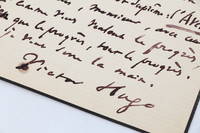
1871833181871. Fine. « So that justice finally be done for women » Mardi 7 novembre 1871 13.30 x 20.80 cm 2 pages sur un feuillet double Autograph letter signed by Victor Hugo to Léon Richer two pages in black ink on a double sheet framed in black. Crosswise folds inherent to envelope inserting. A central tear at the junction of the two sheets. Published in uvres complètes de Victor Hugo Ollendorff 1905. Manuscript housed in a blue half morocco chemise and slipcase marbled paper boards marbled paper slipcase signed Boichot. A magnificent and important letter to Léon Richer one of the first male feminist activists considered by Hubertine Auclert as the ""father of feminism"" and later regarded by Simone de Beauvoir as its ""true founder"". This deeply humanist text is a compendium of Victor Hugo's campaign for the abolition of capital punishment and the female attainment of social equality and civil rights. « Mardi 7 novembre 1871 Monsieur on m'a demandé d'urgence mon intervention pour les condamnés à mort. L'accomplissement de ce devoir a retardé ma réponse à votre excellente lettre. Vous avez raison de compter sur moi pour affirmer l'avenir de la femme. Dès 1849 dans l'Assemblée nationale je faisais éclater de rire la majorité réactionnaire en déclarant que le droit de l'homme avait pour corollaires le droit de la femme et le droit de l'enfant. En 1853 à Jersey dans l'exil j'ai fait la même déclaration sur la tombe d'une proscrite Louise Julien mais cette fois on n'a pas ri on a pleuré. Cet effort pour qu'enfin justice soit rendue à la femme je l'ai renouvelé dans les Misérables je l'ai renouvelé dans le Congrès de Lausanne et je viens de le renouveler encore dans ma lettre au Rappel que vous voulez bien me citer. J'ajoute que tout mon théâtre tend à la dignification de la femme. Mon plaidoyer pour la femme est vous le voyez ancien et persévérant et n'a pas eu de solution de continuité. L'équilibre entre le droit de l'homme et le droit de la femme est une des conditions de la stabilité sociale. Cet équilibre se fera. Vous avez donc bien fait de vous mettre sous la protection de ce mot suprême : l'Avenir. Je suis Monsieur avec ceux qui comme vous veulent le progrès rien que le progrès tout le progrès. Je vous serre la main. Victor Hugo » ""Tuesday november 7 1871 Sir I have been urgently asked to intervene on behalf of those sentenced to death. The fulfillment of this duty has delayed my reply to your excellent letter. You are right to count on me to defend the future of women. As early as 1849 in the National Assembly I made the reactionary majority burst into laughter by declaring the rights of man as natural counterparts to the rights of woman and the rights of children. In 1853 in my Jersey exile I made the same declaration on the grave of an outlaw Louise Julien but this time people didn't laugh they wept. I renewed this effort to finally do justice to women in Les Misérables I renewed it in the Congrès de Lausanne and I've just renewed it again in my letter to Le Rappel which you are kind enough to publish. I would add that every single one of my theatrical works aims to dignify women. As you can see my plea for women is long-standing and persevering and no other has ventured to continue with this endeavor. Balance between men's rights and women's rights is one of the conditions of social stability. This balance will be achieved. I commend you for placing yourself under the protection of this supreme word: the Future. I am Sir with those who like you want progress nothing but progress the whole of progress. I shake your hand. Victor H Although this letter focuses primarily on advocating for women's rights it begins with the death penalty: I have been urgently asked to intervene on behalf of those sentenced to death. The fulfillment of this duty has delayed my reply to your excellent letter. Shortly after the Paris Commune the October 1871 pages of Hugo's diary la hardcover
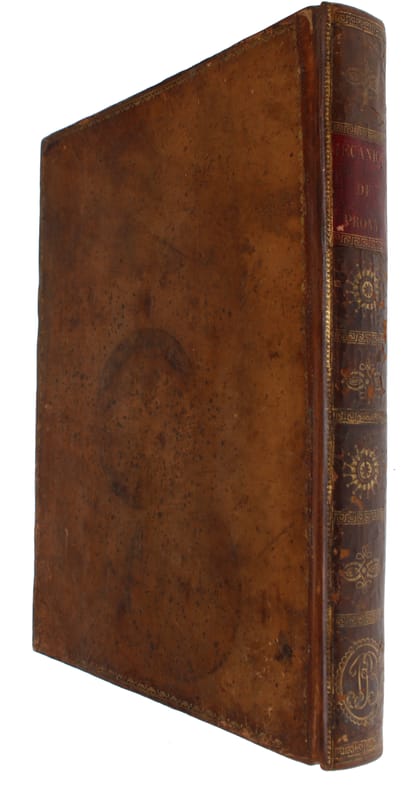
180060104Paris, Imprimerie de la République, an VIII [i.e. 1800]. 4to. Bound in a lovely full mottled calf binding with fine, gilt ornamental borders to boards, double gilt line-borders to all edges of boards and a richly gilt spine. Spine with gilt red leather title-label and with the gilt monogram of Joséphine and Napoléon - ""JB"" - to lower spine. Neatly rebacked. With a handwritten inscription for Napoleon to title-page ""Au Citoyen Bonaparte/ premier Consul de la République francaise/ De la part du Conseil [de]/ L'Ecole Polythechnique"", with a signature underneath and the stamp of the Ecole Polytechnique. The inscription is slighly cropped at the outer margin. A bit of brownspotting here and there. (4), VII, (1), 477, (3) pp.
Paris, Imprimerie de la République, an VIII [i.e. 1800]. 4to. Bound in a lovely full mottled calf binding with fine, gilt ornamental borders to boards, double gilt line-borders to all edges of boards and a richly gilt spine. Spine with gilt red leather title-label and with the gilt monogram of Joséphine and Napoléon - ""JB"" - to lower spine. Neatly rebacked. With a handwritten inscription for Napoleon to title-page ""Au Citoyen Bonaparte/ premier Consul de la République francaise/ De la part du Conseil [de]/ L'Ecole Polythechnique"", with a signature underneath and the stamp of the Ecole Polytechnique. The inscription is slighly cropped at the outer margin. A bit of brownspotting here and there. (4), VII, (1), 477, (3) pp.
1 S. Gr.-8vo (194:145 mm). In Passepartout (285:230 mm). Vier Takte für Klavier in F-Dur im 4/4-Takt auf zwei von Hand gezogenen Musiksystemen. Mit einem montierten Blütenzweig neben der Unterschrift. - Liszt unternahm zwischen 1839 und 1847 ausgedehnte Virtuosenreisen durch ganz Europa, wobei er allein in Deutschland mit großem Erfolg 298 Konzerte gab. Liszt war der erste Künstler, der den Typus des reinen Klavierabends, des sogenannten "Recitals", einführte. Bis dahin traten Pianisten normalerweise nur im Rahmen einer instrumental-vokal besetzten Veranstaltung auf (vgl. MGG² XI, 210).
I: "Das Gesetz". 60¼ SS. auf 61 Bll. - II: "The Law". 71½ SS. auf 72 Bll. Zwischengebunden (1½+1½ =) 3 SS. auf 2 Bll. ms. Korrekturverzeichnis. Nachgebunden sind eine alternative Version des Schlusses (1½ SS. auf 2 Bll.), 4 (davon 2 eh. adr.) Kuverts von Thomas Mann an George Marek und 6 ms. Durchschläge von Briefen Mareks an Thomas Mann. Dunkelgrüner Kalbslederband mit vergoldetem Deckeltitel, -fileten und -fleurons. 4to. Mit einer Beilage (s. u.). Unikales Ensemble von Thomas Manns einziger Auftragsarbeit im deutschsprachigen Original und in englischer Übersetzung, beide mit zahlreichen eh. Korrekturen von Thomas Mann und einigen wenigen von George Marek, der diesen Band als Erinnerung an die gemeinsame Arbeit zusammengestellt hat und binden ließ. Thomas Mann widmete ihn am 20. Oktober 1942 mit den Worten: "An George Marek / tief gerührt von der Ehre, die er diesen Blättern erwies. Dem glänzenden Uebersetzer herzlich dankbar [...]". - 1941 war der aus Wien stammende Musikverleger, Librettist, Texter und Drehbuchautor Armin L. Robinson zusammen mit seiner Frau in die USA emigriert. Von den amerikanischen Unternehmungen des in Deutschland und Österreich erfolgreichen Librettisten weiß man wenig, gesichert ist jedoch, dass er Thomas Mann zu dessen bis dato erster (und schließlich auch letzter) Auftragsarbeit überreden konnte, nämlich einen Beitrag für die von ihm herausgegebene Anthologie "The Ten Commandments. Ten Short Novels of Hitler's War Against the Moral Code" zu verfassen. Mann, der von Mitte Jänner bis Mitte März mit seinem Beitrag beschäftigt war, war neben Rebecca West, Franz Werfel, John Erskine, Bruno Frank, Hendrik Willem Van Loon, Jules Romains, André Maurois, Sigrid Undset und Louis Bromfield einer von zehn Autoren, die jeweils eine Erzählung zu einem der zehn Gebote schrieben. Da seine reguläre englische Übersetzerin Helen Tracy Lowe-Porter damals mit anderen Arbeiten für ihn beschäftigt gewesen war, war Mann schließlich auf den in Österreich geborenen Musikkritiker und -schriftsteller George Marek (1902-87) gestoßen, der seit 1920 in New York lebte und für eine Werbeagentur tätig war; ab 1950 sollte Marek als Manager für die Plattenfirma RCA Victor arbeiten und schließlich Ende der 1950er Jahr zu deren Vizepräsidenten aufsteigen. Im Frühjahr und Sommer wechselten Mann und Marek mehrere Briefe (die Durchschläge von sechs Briefen Mareks liegen hier vor), in denen Übersetzungsdetails besprochen wurden, und im Spätsommer bzw. Herbst erschien Manns Erzählung schließlich unter dem Titel "Thou Shalt Have No Other Gods Before Me" in der genannten Anthologie bei Simon & Schuster. Im Jahr darauf folgte die deutschsprachige Erstveröffentlichung bei Bermann Fischer in Stockholm, und es entspann sich ein den Dichter enervierender Streit um die Frage nach dem Urheberrecht an der Erzählung. An sich war Mann Bermann Fischer verpflichtet (und durch diesen Alfred A. Knopf für den englischsprachigen Raum), doch hatte er unbedacht das Urheberrecht an Robinson abgetreten und es auch zugelassen, dass Felix Guggenheim eine "Luxusausgabe" in seiner Pacific Press herausbrachte. "As if this weren't enough, Knopf insisted on having the English version of the story done again from scratch by Mann's regular translator, Helen T. Lowe-Porter, a directive Mann described in his diary as 'a terrible blow for Marek', adding, 'I am disgusted by these trivialities' [...]" (Faber/Lehmann, Introduction, S. X). Das eh. Manuskript seiner Erzählung vermachte Mann noch im selben Jahr der Library of Congress, deren Briefpapier er für seine Niederschrift benutzt hatte. - Kleine Gebrauchsspuren, sonst ausgesprochen frisch mit Ausnahme von Mareks Briefdurchschlägen, die auf brüchigem, stark gebräuntem Papier getippt sind; der Einband an Gelenken und stellenweise auch an den Kanten stark berieben, sonst gut erhalten. - Beiliegend: Thomas Mann, Das Gesetz. Erzählung (Stockholm, Bermann Fischer, 1944). 160 SS. Illustrierter OPbd. 8vo. EA (WG², 90). Bindung leicht gelockert, Umschlag gebräunt, innen tadellos erhalten. Thomas Mann, The Tables Of The Law. Translated by Marion Faber and Stephen Lehmann (Philadelphia, Paul Dry Books, 2010).