VERLAINE (Paul).Livre Rare Book
66 592 résultats
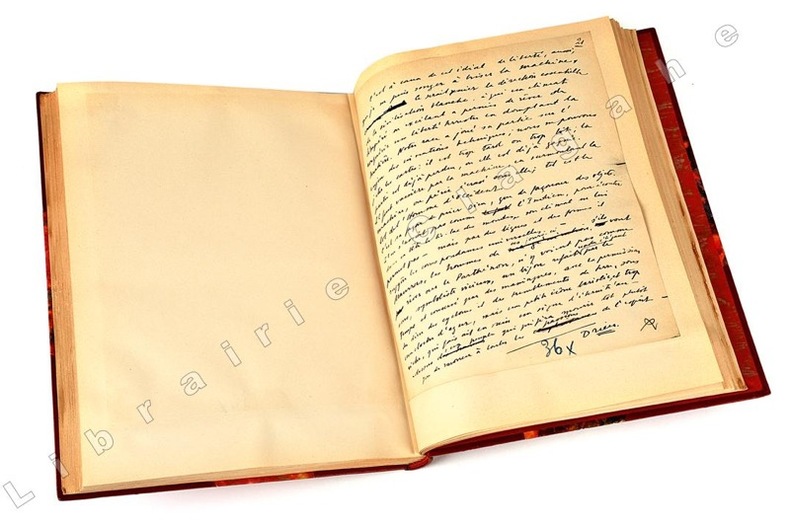
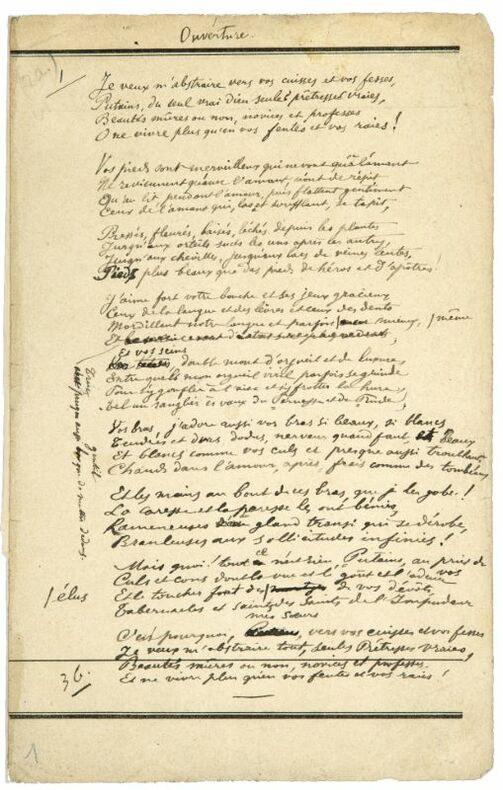
1890888011890 1 page in-8 à l'encre brune (22 x 13.9 cm) sur papier d'hôpital, sous chemise demi-maroquin noir. Trace d'un ancien montage sur onglet. Beau poème libre paru dans le recueil Femmes, imprimé "sous le manteau" en 1890 à Bruxelles chez Kistemaeckers [Dutel, Bibliographie des ouvrages érotiques publiés clandestinement en français entre 1880 et 1920, p.138]. Verlaine rend gloire à la chair féminine et d'abord à ses représentantes, les prostituées (on relèvera la subtilité de cette mise en bouche décrite uniquement en rimes féminines dans le premier quatrain) : "Je veux m’abstraire vers vos cuisses et vos fesses,Putains, du seul vrai dieu seules prêtresses vraies,Beautés mûres ou non, novices et professesO ne vivre plus qu’en vos fentes et vos raies !"Cette ouverture donne le ton, et Verlaine décline en neuf strophes sa passion pour le corps féminin : pieds, bouches, seins, bras, mains, sexes... Les putains sont "soeurs", "seules prêtresses vraies". Il compose une adoration incarnée et pornographique. Verlaine, amant inassouvi, chante la femme non en spectateur attendri, mais en acteur mu par la hantise charnelle :"Et vos seins, double mont d'orgueil et de luxureEntre quels mon orgueil viril parfois se guindePour s'y gonfler à l'aise et s'y frotter la hure :Tel un sanglier ès vaux du Parnasse et du Pinde."Si l'oeuvre de Verlaine est empreinte de volupté, ses derniers productions érotico-pornographiques ont une force brute, nourries d'une spontanéité et d'une urgence flamboyante libérées de tout impératif d'élégance ou moral... une poésie, par la même, profondément humaine. Le manuscrit comporte quelques ratures et une variante : "Prêtresses" au lieu de "compagnes" (vers 34).
1890888011890 1 page in-8 à l'encre brune (22 x 13.9 cm) sur papier d'hôpital, sous chemise demi-maroquin noir. Trace d'un ancien montage sur onglet. Beau poème libre paru dans le recueil Femmes, imprimé "sous le manteau" en 1890 à Bruxelles chez Kistemaeckers [Dutel, Bibliographie des ouvrages érotiques publiés clandestinement en français entre 1880 et 1920, p.138]. Verlaine rend gloire à la chair féminine et d'abord à ses représentantes, les prostituées (on relèvera la subtilité de cette mise en bouche décrite uniquement en rimes féminines dans le premier quatrain) : "Je veux m’abstraire vers vos cuisses et vos fesses,Putains, du seul vrai dieu seules prêtresses vraies,Beautés mûres ou non, novices et professesO ne vivre plus qu’en vos fentes et vos raies !"Cette ouverture donne le ton, et Verlaine décline en neuf strophes sa passion pour le corps féminin : pieds, bouches, seins, bras, mains, sexes... Les putains sont "soeurs", "seules prêtresses vraies". Il compose une adoration incarnée et pornographique. Verlaine, amant inassouvi, chante la femme non en spectateur attendri, mais en acteur mu par la hantise charnelle :"Et vos seins, double mont d'orgueil et de luxureEntre quels mon orgueil viril parfois se guindePour s'y gonfler à l'aise et s'y frotter la hure :Tel un sanglier ès vaux du Parnasse et du Pinde."Si l'oeuvre de Verlaine est empreinte de volupté, ses derniers productions érotico-pornographiques ont une force brute, nourries d'une spontanéité et d'une urgence flamboyante libérées de tout impératif d'élégance ou moral... une poésie, par la même, profondément humaine. Le manuscrit comporte quelques ratures et une variante : "Prêtresses" au lieu de "compagnes" (vers 34).
- Pacific Palisades (CA) 1976-1978, 23 pages A4. - Henry Miller's complete manuscript correspondence with Béatrice Commengé Pacific Palisades (CA) 1976-1978 | 23 pages 21 x 29.7 cm A superb complete set of 17 autograph letters signed by Henry Miller and addressed to the writer Béatrice Commengé, the author most notably of Henry Miller, ange, clown, voyou [Henry Miller: angel, clown, thug] and translator of a number of works by Anaïs Nin. With an autograph envelope addressed by Henry Miller to Béatrice Commengé and an autograph letter signed by Anaïs Nin to Béatrice Commengé. In 1976, Béatrice Commengé, then a young literature student, began writing a thesis on Anaïs Nin and Henry Miller. From her home village in the Périgord region, she wrote to both. Nin, who was very unwell, apologized for not being able to help her. Miller, though, let himself be seduced at the outset by the idea of exchanging letters with an inhabitant of Domme, the village whose beauty he had lauded in The Colossus of Maroussi. Very quickly, impressed with the student's style and determination, he entered into a correspondence with her that would last until - two years before his death - Miller's eyesight broke down completely, preventing him from reading and writing. At this time, Miller, then 85, was living almost as a recluse in Pacific Palisades in California, rejecting the American way of life and its illusions, and dreading all-too frequent offers and invitations. But the old writer was very quickly charmed by Commengé's outlook on his work: «You are a gem! One of the very few ''fanas'' to understand me. Merci! Merci mille fois!» he writes in his second letter. A true epistolary friendship then develops between the ageing writer and his young muse: «I think of you as some sort of terrestrial angel», and «what a delight to get a letter from you»; «Keep writing me, please!» In passionate letters that are written and re-written, with their English mixed with French, words underlined, copious brackets and exclamation points, and post-scriptums squeezed into the margins, Miller examines his work and his memories. He refuses a purely academic correspondence, «To be honest with you, I don't think either A.N. or I, who are naturally very truthful persons, really succeeded with truth as it is conventionally thought of. We are both confirmed 'fabulators'.» Miller recommends the young woman the books he's been reading recently and his old friends: «[Lawrence] Durrel is the friend to talk to about me, [...] he knows me inside out»; «[he] is wonderful when you get to know him. éblouissant même»; «that great master of the French language - Joseph Delteil»; «Delteil is almost a saint. But a lively one,»; «Alf[red Perlès] is the clown, the buffoon, who made me laugh every day». He goes on to congratulate her on abandoning her didactic project in favor of an «imaginary book about [him]» and launches on a much more intimate correspondence. He confesses his shock, as well: «Did you read about the French prostitutes protesting and demonstrating in Paris against my receiving [the legion of honor]? They say I did not treat them well in my books. And I thought I had!!». He also shares his literary tastes: «I prefer the Welsh. They are the last of the poets». He also warns the future translator of Anaïs Nin against his former mistress' duality: «She is or was a complete enigma, absolutely dual. [...] Actually, I suppose there is always this dichotomy between the person and the writer», and confides to her her secrets: «she is slowly dying (of cancer) she refuses to admit it. (This is entre nous!)». He also discusses his latest loves: «I am in love with a very beautiful Chinese actress [...]. I seem to go from one to another, never totally defeated, never wholly satisfied. But this is near 'eternal' love as I've never been.» Indeed, despite his advanced old age, the author of Sexus has lost nothing of his passion for the fairer sex and his correspondent's being a woman i
32921This east coast watercolorist and children's book artist illustrated and often also wrote a wide array of children's books from the 1930s into the 1960s -- including "Wilderness Pet" "Wiggly and Giggly the Little Twin Bears" "Whitetail: King of the Forest" "The Three Puppies" "The Small One" "The Nutcracker of Nuremberg" "The Bluebird" "The Night Before Christmas" "The Enchantment of Santa Claus" "The Christ Child" "Pussy Cat Talks to Her Kittens" "Polly Parrot" "Piccolino" "Is There a Santa Claus" as well as some "Dick and Jane Basic Readers." Offered here is the near-complete original illustration art for Smock's 1937 children's book "Jocko" written by Dorothy Winchell and published by Albert Whitman & Co. of Chicago. Represented here is almost the entire book from front cover art through closing "The End" image -- lacking only 3-4 pages front board graphic frontispiece pages 21 and 31. Most are in the form of ca. 10" X 15" heavy stock art boards most with typeset text blocks pagination and other typeset elements stripped in. All are beautifully inked in black and shaded in pale blue. There is a smaller form full-color title page and half-title page and sixth text page these with the text portions entirely hand lettered. Very good. Stripped-in text blocks are usually slightly discolored from the rubber cement with which they were affixed; occasional light soiling and bit of occasional edgewear. Many original tissue overlays are present and these are generally heavily chipped and sometimes partial given their delicate nature though many contain pencilled coloring instructions etc. Four drawings are present in oversize form two 22" X 15" two 15" X 18½". Overall quite attractive and quite displayable. Jocko the monkey is a fictional character seen in 19th century texts such as the 1875 short story "Jocko the Monkey" by Fanny P. Seaverns. The Steiff company issued a monkey stuffed animal named Jocko in the late 19th century and various other Jocko the Monkey products have appeared over the years from cookie jars to posters. There were a series of silent short films about Jocko in the 1920s etc. -- all interesting predecessors to Hans and Margret Rey's "Curious George" which debuted in France in 1939. "Jocko" is the charming tale of "a bright little monkey" named Jocko and his owner an organ grinder named Rollo. Through no fault of his own Jocko gets lost and causes accidents and chaos all about him. He ends up the center of attention at a circus parade. Jocko is asked to join but luckily Rollo finds him at the last moment and they are happily reunited. A delightful collection from the height of this illustrator's fame. It's most unusual to find the nearly complete artwork from an entire book of this period. unknown books
32921This east coast watercolorist and children's book artist illustrated and often also wrote a wide array of children's books from the 1930s into the 1960s -- including "Wilderness Pet" "Wiggly and Giggly the Little Twin Bears" "Whitetail: King of the Forest" "The Three Puppies" "The Small One" "The Nutcracker of Nuremberg" "The Bluebird" "The Night Before Christmas" "The Enchantment of Santa Claus" "The Christ Child" "Pussy Cat Talks to Her Kittens" "Polly Parrot" "Piccolino" "Is There a Santa Claus" as well as some "Dick and Jane Basic Readers." Offered here is the near-complete original illustration art for Smock's 1937 children's book "Jocko" written by Dorothy Winchell and published by Albert Whitman & Co. of Chicago. Represented here is almost the entire book from front cover art through closing "The End" image -- lacking only 3-4 pages front board graphic frontispiece pages 21 and 31. Most are in the form of ca. 10" X 15" heavy stock art boards most with typeset text blocks pagination and other typeset elements stripped in. All are beautifully inked in black and shaded in pale blue. There is a smaller form full-color title page and half-title page and sixth text page these with the text portions entirely hand lettered. Very good. Stripped-in text blocks are usually slightly discolored from the rubber cement with which they were affixed; occasional light soiling and bit of occasional edgewear. Many original tissue overlays are present and these are generally heavily chipped and sometimes partial given their delicate nature though many contain pencilled coloring instructions etc. Four drawings are present in oversize form two 22" X 15" two 15" X 18½". Overall quite attractive and quite displayable. Jocko the monkey is a fictional character seen in 19th century texts such as the 1875 short story "Jocko the Monkey" by Fanny P. Seaverns. The Steiff company issued a monkey stuffed animal named Jocko in the late 19th century and various other Jocko the Monkey products have appeared over the years from cookie jars to posters. There were a series of silent short films about Jocko in the 1920s etc. -- all interesting predecessors to Hans and Margret Rey's "Curious George" which debuted in France in 1939. "Jocko" is the charming tale of "a bright little monkey" named Jocko and his owner an organ grinder named Rollo. Through no fault of his own Jocko gets lost and causes accidents and chaos all about him. He ends up the center of attention at a circus parade. Jocko is asked to join but luckily Rollo finds him at the last moment and they are happily reunited. A delightful collection from the height of this illustrator's fame. It's most unusual to find the nearly complete artwork from an entire book of this period. unknown
1 S. Qu.-kl.-8vo. An seinen Verleger Fritz Simrock ("S"): "Ich wollte Sie mit inlieg[enden] Berliner u. Leipziger Geschichten dort nicht stören - aber ich muß wohl. Das Wienerische vertraulichst und gelegentlich zurück. Auch hier haben wir das allerherrlichste Wetter u. genießen es. Dr. Wendt ist heute Morgen abgereist. Daran denkt noch gar nicht | Ihr J. Br. | Schöne Grüße an Frau u. Fräulein [...]". Briefwechsel Bd. XI: Brahms Briefe an Peter Joseph Simrock und Fritz Simrock. Bd. 3. Hg: Max Kalbeck. Berlin 1919, S. 128 (Nr. 568).
- Hauteville House 11 et 13 mai 1856, 14x21,5cm, une feuille. - Lettre autographe signée de Victor Hugo datée du 13 mai 1856 à la suite d'une lettre inédite de Madame Victor Hugo à Madame David d'Angers datée du 11 mai. 4 pages sur un feuillet remplié à filigrane "Barbet Smith Street Guernesey". Publiée dans Correspondance de Victor Hugo, Paris, année 1856, p. 246 Dans cette lettre imprégnée des apparitions et spectres qui hantent les Contemplations récemment publiées, Victor Hugo s'adresse à la veuve de son grand ami le sculpteur David d'Angers, fervent républicain et artiste particulièrement admiré des romantiques. En pleine crise mystique, Hugo parle à l'ombre du sculpteur à qui il dédia de sublimes poèmes dans Les feuilles d'automne ainsi que Les rayons et les ombres et réclame auprès de sa veuve son portrait favori, un buste en marbre jadis sculpté par David d'Angers. Après l'expulsion des proscrits de l'île de Jersey, Victor Hugo fait l'achat d'Hauteville House grâce au succès des Contemplations et apprend avec tristesse la disparition d'un ami cher. Il écrit à la veuve du sculpteur sur le même feuillet que sa femme Adèle, également liée avec la famille de David d'Angers, créateur d'un médaillon à son effigie : « Vous êtes la veuve de notre grand David d'Angers, et vous êtes sa digne veuve comme vous avez été sa digne femme ». Le sculpteur de renom s'était déjà lié au premier salon romantique de Nodier à l'Arsenal et fréquentait presque quotidiennement Hugo à la fin des années 1820 dans l'ambiance bonapartiste et bon enfant de la rue Notre-Dame des Champs, en compagnie des frères Devéria, Sainte-Beuve, Balzac, Nanteuil et Delacroix. En 1828, l'écrivain avait posé avec bonheur dans l'atelier de David d'Angers rue de Fleurus, pour un médaillon puis un buste qui avaient été suivis de deux sublimes poèmes célébrant le talent du sculpteur dans Les Feuilles d'Automne et Les rayons et les ombres. De tous ses portraits pourtant nombreux, il chérissait plus que tout autre son buste de marbre signé David d'Angers et n'hésite pas à le réclamer à sa veuve : « Avant peu, peut-être, madame, ma famille vous demandera de lui rendre ce buste qui est ma figure, ce qui est peu de chose, mais qui est un chef-d'uvre de David, ce qui est tout. C'est lui encore plus que moi, et c'est pour cela que nous voulons l'avoir parmi nous ». De ces séances de pose avec le sculpteur naquirent de fructueuses conversations esthétiques et politiques où s'était affirmée leur aversion commune pour la peine de mort. Ils assistèrent au ferrement des galériens qui rejoignaient Toulon depuis Paris, décrit par Hugo dans deux chapitres du Dernier jour d'un condamné. Victime de l'exil comme Hugo, David d'Angers était rentré à Paris avant de rejoindre le monde des morts : « Mon exil est comme voisin de son tombeau, et je vois distinctement sa grande âme hors de ce monde, comme je vois sa grande vie dans l'histoire sévère de notre temps ». La « grande vie » de David d'Angers fut consacrée à façonner les effigies des hommes illustres, par un subtil équilibre de ressemblance et d'idéalisation. Le sculpteur prend finalement place dans le panthéon personnel de Victor Hugo, lui qui avait orné le fronton du véritable Panthéon des grands hommes où repose aujourd'hui l'écrivain : « David est aujourd'hui une figure de mémoire, une renommée de marbre, un habitant du piédestal après en avoir été l'ouvrier. Aujourd'hui, la mort a sacré l'homme et le statuaire est statue. L'ombre qu'il jette sur vous, madame, donne à votre vie la forme de la gloire ». C'était en effet à l'ombre des grands hommes qu'Hugo vécut son exil à Jersey, loin du tumulte de la capitale et dans le silence ponctué par les embruns frappant les carreaux. Hugo s'était plongé dans l'occulte et parlait aux disparus : « David est une des ombres auxquelles je parle le plus souvent, ombre moi-même », déclare-t-il, rappelant le poème final des Contemplations, « Ce que dit la bouche d'ombre », dicté au poète grâce
101 x 189 mm. Floral silk print in simple paper matte. A loving gift from Che to his wife "Aleiducha" (i.e. Aleida March, b. 1936) on the occasion of the birth of their first child, a girl named Aleida, after her mother. March was a member of Fidel Castro's Cuban army, and an active combatant during the revolution. Che writes on the margins: "Para mi Aleiducha, por este día tan especial de engendra maternal eterno" and signs off "with all the love of your dear warrior" ("Con todo el amor de tu querido aguerrido"). Signed simply "Che". - Light staining and edgewear.
Qu.-8vo (106:173 mm). 322 SS. mit 205 Einträgen. Lederband der Zeit mit Rückenvergoldung, Rückenschildchen und Deckelvergoldung. Dreiseitiger Goldschnitt; Kattunpapiervorsätze. Die Beiträge in deutscher, lateinischer, griechischer und hebräischer Handschrift auf Papier, darunter einige Einträge aus der Zeit des Theologiestudiums des Stammbucheigners und späteren Pfarrers Carl Christian Merian (1737-1808) in Halle von mehreren Frauen bzw. Ehepaaren und einigen Personen in Verbindung zu den Franckeschen Stiftungen zu Halle. - Allen voran zu nennen ist der Moralphilosoph und Dichter Christian Fürchtegott Gellert (1715-69), der ein Widmungszitat nach Ciceros "De amicitia" beisteuert: "Fructus ingenii omnisque praestantiae maxime tum capitur, cum in proximum quemque confertur", Leipzig, 9. X. 1759). Unter den weiteren, teils namhaften Beiträgern finden sich Nathanael Ephraim Blanckmeister (1726-88, Pastor), Georg Christian Bodinus, Philipp Adolph Böhmer, Jakob Gottfried Bötticher ("Oberaufseher des Hällisch Waisenhausischen Buchladens", 1692-1762, seine Portraitsammlung 1756 der Bibliothek des Waisenhauses geschenkt), Andreas Cyriacus Breithaupt (Pfarrer, 1705-80), Andreas Elias Büchner (Mediziner, Professor in Halle, später Präsident der Leopoldina, 1701-69), Christian August Crusius (Philosoph, Theologe, 1715-75), Johann Peter Eberhard (Arzt, Theologe, Mathematiker und Physiker, Mitglied der Leopoldina, 1727-79), Sebastian Andreas Fabricius, Johann Justinus Gebauer (Verleger in Halle, 1710-72), Gottfried Gutjahr, Gottlob Friedrich Hillmer, Johann Friedrich Joachim (Jurist, Historiker und Numismatiker, 1713-67), Christian Ludwig Klotz, Gustav Krampe, A. von Krosigk, Köthen (13. V. 1759), Johann Christoph Kühnau (Berlin, 19. IX. 1792, Kirchenmusiker und Komponist, Kantor an der Dreifaltigkeitskirche in Berlin, 1735-1805) und Wilhelmine Kühnau ("Zum Andenken der heute in der Dreifaltigkeitskirche gehaltenen schönen Predigt"), Johann Joachim Lange (1698-1765, Mathematiker, Dichter, Mineraloge), Christian Gottfried Mathesius (Theologe, 1714-80), Georg Friedrich Meier (Philosoph, Ordinarius, Mitglied verschied. gelehrter Gesellschaften, 1718-77), Johann Valentin Polack, Friedrich Eberhard Rambach (1708-75, seit 1756 in Halle als Pastor an der Marktkirche und Superintendent im ersten Saalekreis), J. P. Raspe, Sanfftleben, Benjamin Schultze (Halle 17. X. 1759, Missionar in Südindien, 1689-1760), Friedrich Magnus von Solms (1. XI. 1759), M. von Sperlingen, Johann Christian Stemler (Theologe, 1701-73), Christoph Wolle (Theologe, 1700-61), sowie Johann Christoph Unzer (1714-73), "HochGräfl. Stollberg. Leib-Medicus", mit seiner Frau Sophie Charlotte. - Merian wurde erst Pfarrer in Bruderdorf und später in Dassow. - Einband beschabt. Drei Bll. am Anfang mit biographischer Notiz zum Eigner in blauer Tinte, das erste Blatt nahe am Bug entfernt. Teilweise schwach bräunlich, Tinte vielfach stärker durchschlagend.
Mit koloriertem Kupferstich (Titelblatt) und einer lavierten Federzeichnung. Insgesamt 193 num. Seiten, davon etliche leer und 16 Bll. alt entfernt. Am Schluß 4 Bll. Register. Brauner Original-Lederband mit überaus reicher Rücken- und Deckelvergoldung sowie Buntpapiervorsätzen und Goldschnitt. Qu.-8vo (175:110 mm). Friedrich Heinrich Stock, geboren um 1760, besuchte das Gymnasium in Lemgo und studierte anschließend Jura an der Universität Göttingen. Die meisten und interessantesten der rund 70 Einträge dieses Stammbuches stammen von Gelehrten und Professoren der Universität Göttingen. Zuerst sei hier Johann Nikolaus Forkel (1749-1818) genannt, der hier am 3. IV. 1787 ein Zitat von Aristoteles niederschrieb ("Quod majori labore acquiritur, magis diligitur"): Forkel, der erste Bach-Biograph und Begründer der historischen Musikwissenschaft, war seit 1769 in Göttingen, zunächst als Student, dann als Privatgelehrter und ab 1779 als Universitäts-Musikdirektor. Weiters finden sich Eintragungen von Göttinger Professoren wie Georg Ludwig Böhmer (1715-97; Straf- und Kirchenrechtslehrer), Johann Stephan Pütter (1725-1807, Publizist und Staatsrechtslehrer), Johann Beckmann (1739-1811, Philosoph und Ökonom); Johann Peter Waldeck (1751-1815, Jurist), Justus Friedrich Runde (1741-1807, Jurist und Rechtshistoriker), Justus Claproth (1728-1805, Jurist und Erfinder des Recyclingpapiers) sowie Johann Ludwig Ewald (1748-1822, Theologe und Pädagoge, Hofprediger und Generalsuperintendent in Lippe-Detmold) und Johann Heinrich Bösenberg (1745-1828, Theaterschauspieler und Bühnenautor). Außerdem konnten noch weitere 20 Freunde und Kommilitonen ermittelt werden (eine Liste ist auf Anfrage erhältlich). - Bei den alt entfernten Beiträgen handelt es sich laut Register offenbar hauptsächlich um Familienmitglieder und Bürger Lemgos. - Äußerst gehaltvolles Stammbuch mit namhaften Beiträgern und von sehr schöner Erhaltung.
Mit 71 Einträgen auf 346 (statt 356) SS. und 6 Bll. Personenverzeichnis. Mit 7 Gouachen auf Pergament und 1 koloriertem Kupferstich. Brauner Kalbslederband der Zeit mit reicher Rücken- und Deckelvergoldung und umlaufendem Goldschnitt. Vorsätze in zeitgenöss. Kleisterpapier. Qu.-8vo (175 x 104 mm). Hübsches Album des in Jena studierenden "F.W.S." (so am Vorderdeckel geprägt), in das sich 71 Kommilitonen eingetragen haben. Besonders erwähnenswert sind die hübschen Gouachen, die wohl alle von demselben Künstler stammen und u. a. studentische Szenen (Einzug zu Pferd und in Karossen, nächtliche Versammlungen), ein "Memento mori" mit einem Mönch in einer Klause, Landschaften und Allegorien auf die Tugend zeigen. - Der hübsche Einband mit Rocaille- und Gittermuster nur gering berieben, beschabt und bestoßen; am Hinterdeckel die geprägte Jahreszahl 1756; innen stellenweise leicht fleckig; S. 1 mit photographischem Exlibris eines Walter Amon.
(5), 135 (statt 146) Bll. mit 110 Einträgen (davon 87 im Register verzeichnet). Originaler blau marmorierter Pappband (berieben und bestoßen). Dreiseitiger Rotschnitt. Qu.-8vo (ca. 180 x 103 mm). J. F. L. Sahl war Sohn des fürstlichen Lustgärtners Johannes Lorenz Sahl aus dem Hofgärtnergeschlecht Sahl in Gotha; der Onkel Johann Conrad Sahl (1744-88) war ab 1762 Obergärtner zu Gotha. Die Eintragungen reflektieren die Lebensstationen der Familie in den Jahren kurz vor der revolutionsbedingten Vertreibung aus Buchsweiler (Unterelsass) im Jahre 1793 und Sahls anschließenden Jahren als Kanzlist bei der Provisorischen Regierung in Pirmasens (bis 1794) sowie als Kassensekretär bei der Hessischen Brigade in den Niederlanden (ab 1794-95). - Am 9. Jänner 1792 widmet der landgräfliche Archivar Christian Carl Kuder (1757-1820) Sahl das Wort: "Wo es uns wol gehet, da sey unser Vaterland" (7r); am Folgetag schreibt sich Magdalena Sophia Pfersdorff (1734-99) ein, Mutter des elsässischen Dichters und Wieland-Freundes Karl Friedrich Kasimir Pfersdorff (1769-1847) und über ihren Mann mit der Familie Händels verwandt: "Die Tugend dienst sich selbst zum Lohn / Sie ists allein die uns erhöht / Und der hat mehr als eine Kron / Der sie verdient und nie verschmäht" (16r). Drei Tage später wiederum schreibt sich Sahls Schwester Louise ein: "Sei Edel und gut, so wirst Du auch glüklich sein" (26v). Louise sollte 1794 Johann Conrad Sckell (1768-1834) heiraten, den späteren Hofgärtner in Belvedere, und wurde so Mutter des Dornburger Hofgärtners Karl August Sckell, der für Goethe den Weimarer Gingkobaum pflanzte und dessen Gespräche mit Goethe in dessen Tagebüchern verewigt sind. - "Freund! Der Mann mit edler Seele / ist ein Engel in der Welt, / er sey König oder zähle / sein erbettelt Kupfergeld" (55r), schreibt am 2. Juli 1794 in Antwerpen der Theologe Friedrich Ludwig Lichtenberg (1770-1846), Großneffe von Georg Christoph Lichtenberg, in Sahls Stammbuch. Am 10. September trägt sich der jungverstorbene Lichtenberg-Freund Friedrich Bechstatt (1775-99) ein: "Der Freundschaft heiliges Band trennt ewiges Nichtsseyn nur" (8v). Die undatierte Widmung "Die Wahrheit ist dem Biedermann das Heiligste, Schmeichelei und kriechende Gefälligkeit sind seiner Natur zuwider" (39r) stammt von Daniel Gottlieb Auber (1784-1835), Schwiegervater der Amalie Buff, einer Nichte der Charlotte Buff, die Goethe die Vorlage zur "Lotte" im Werther lieferte. Weiters zu nennen sind auch der elsässische Radierer, Maler und Sammler Friedrich Koch (1771-1832, 139v), der Generalstabsarzt Georg Friedrich Reuling (1739-99, 60r) sowie der Theologe und Schriftsteller Friedrich Ludwig Textor (1765-1822): "Menschenliebe ist besser, als Orthodoxie" (54r). - Der Großteil der Einträge sind in deutscher, sechs in französischer, zwei in niederländischer und drei in lateinischer Sprache abgefasst. Eingetragen haben sich neben den Honoratioren von Buchsweiler, Freunden und Kollegen im Verlauf der jahrelangen Feldzüge auch viele Offiziere der hessischen Truppen, aber auch Kaufleute, Schiffer und Kellermeister der besuchten Orte, daneben eine Reihe von Geistlichen. Beachtlich sind insbesondere die Bezüge zu Georg Lichtenberg und den Sckells, die im Goetheschen Kosmos eine feste Stelle haben. Insgesamt erzählt das Stammbuch eine Vertreibungsgeschichte: die Einträge 1792 in Buchsweiler künden von der noch heilen Welt des Zentrums Hanau-Lichtenbergischer Herrlichkeit vor der Vertreibung durch die französischen Revolutionstruppen, die weiteren Einträge von den kriegsbedingten Ortsveränderungen und Sozialkontakten in den Folgejahren. Ein kulturgeschichtliches Dokument.
Qu.-8vo. 163 Einträge auf zus. 248 SS. (davon 2 nicht paginiert, 71 weiß). Mit reicher Titelillustration, 7 ganzseitigen, 3 halbseitigen und zwei kleinen Aquarellen, 5 montierten und kolorierten Druckgraphiken (davon eine Collage) sowie drei Musikzitaten. Lederband der Zeit mit reicher goldgepr. Rückenverzierung, goldgepr. floralen Deckelbordüren, zentralem Deckelfleuron und Stehkantenvergoldung, dreiseitigem Goldschnitt und marmorierten Vorsätzen. Album mit außergewöhnlich schönen Pinselzeichnungen und kalligraphischen Gestaltungen, die einige der in französischer, deutscher und lateinischer Sprache verfassten Einträge schmücken. Der Stammbuchhalter J. G. Herrmann legte dieses Büchlein gegen Ende seines Besuchs der Kreuzschule in Dresden an und führte es während des Studiums in Leipzig sowie in den ersten Jahren seiner Berufstätigkeit fort. Drei Einträge entstanden erst nach 1800. - Sicherlich am bedeutendsten ist der Eintrag des Dresdner Hofjuweliers Johann Christian Neuber (1736-1808), der sich - sehr selten - mit einer feinen Zeichnung verewigte. Hervorzuheben sind auch Einträge von bekannt gewordenen Söhnen des langjährigen Bürgermeisters von Dresden, Christian Weinlig, namentlich der spätere Komponist und Kreuzkantor Christian Ehregott Weinlig (1743-1813), der Architekt und Oberbauamtszahlmeister Christian Traugott Weinlig (1739-99), der Pharmazeut Christian Gottlob Weinlig (1730-99) und der Geistliche Christian Gotthard Weinlig (1746-79). Weiters finden sich Beiträge von Johann Friedrich Moebius, dem "Peruquier" Gottlieb Dienemann, dem Komponisten Johann Christian Fischer, dem Physiker Christlieb Benedikt Funk[e] (1736-86), dem Organisten der Wenzelskirche in Naumburg Johann Friedrich Graebner (1714-94), dem Pfarrer Johann Gottlieb Holfert (1740-1818), dem Philosophen und Gymnasiallehrer Daniel Gotthold Joseph Hübler (1734-1805), dem Rektor sowie sächsischen Juristen und Beamten in Dippoldiswalde Johann Gotthold Lessing, dem Geh. Kabinettsregistrator Carl Friedrich Lucius (1708-83), dem Stadtmusikus aus Mühlhausen Johann Christoph Poltermann, dem Leiter des von seinem Vater gegründeten Augustusbads in Radeburg Johann Christoph Seydel aus der bekannten Gärtnerfamilie, dem Chirurgen der Artillerie C. G. Wege sowie von Mitgliedern der Familien Facilides, Herrmann, Lechla, Lichtwer, Limmer, Linkge, Nehmitz, Preußner, von Roth, Sinz, Wollesky, Wunderlich u. v. a. m. Die Illustrationen zeigen allegorische Stillleben, Stadtansichten, eine Gartenansicht, römische Gottheiten (Diana, Juno und Hermes sowie Amor und Psyche), eine Darstellung von Hermann dem Cherusker ("der tapfere Held u. Retter Deutschlands") und Landschaften mit einer Schäferin und einem Liebespaar, zudem das kleine Trompe-l'oeil-Aquarell einer geknickten Blattecke. - Der Stammbucheigner, der aus Cämmerswalde gebürtige Jurist J. G. Herrmann, war ab ca. 1777 als Universalerbe seines Großvaters, des Kommissionsrates Karl Gottfried Schubardt, Erb-, Lehn- und Gerichtsherr auf dem sächsischen Rittergut Porschnitz und folglich auch Rechtskonsulent und Gerichtsdirektor in Dresden. Er war der Sohn des Pfarrers in Cämmerswalde, Christian Herrmann (1681-1755), und der Rahel Charitas Schubardt (1697-1777) sowie Bruder des Pfarrers Christian Gotthold Herrmann (1734-92). Herrmann heiratete 1778 in Dresden die Witwe des Oberamtsadvokaten und Sekretärs bei der Oberamtsregierung August Gottfried Fiedler (1736-75), Christiane Eleonore, geb. Richter. - Zwei Seiten mit Spuren alter Montage. Die hs. Paginierung beginnt auf der Versoseite des Vorsatzblatts. Mit Besitzvermerk "Hans Moritz Herrmann" (Riesa 1917) und dessen Erläuterung zum Erhalt dieses Freundschaftsalbums.
Ca. 176 SS. auf 210 Bll. Qu-8vo. (110:163 mm). Mit 2 Aquarellen. Vorwiegend in lateinischer Handschrift auf Papier. Schwarzer Lederband der Zeit mit goldgepr. Rücken und goldgepr. breiten Deckelbordüren mit Eckfleurons, Vorsätzen von Bronzefirnispapier und dreiseitigem Goldschnitt. Umfangreiches, weitgereistes Freundschaftsalbum aus Ungarn mit sehr vielfältigen und unterschiedlichen Einträgen, u. a. von Wolfgang Richard Honorius von Auersperg, David Barányi, Gustav Friedrich Beer, Ernst und Viktor Bengel, Christian Ludwig Bilfinger, Johann Blasius, Jakob Bobor, Jakob Matthias Böhringer, Peter Bosnyák, Johann Ulrich Brastberger, Johann und Andreas Bubenka, Ludwig Heinrich Burry (1721-62, Diakon an der Barfüßerkirche in Augsburg und an der St.-Anna-Kirche), Georg Bernhard Canz, Johann Friedrich Cotta (1701-79), Johann Demian, Ludwig Rudolf Dobner, Leopold Ernst, Josef Richard Eutlhuber, Zacharias Falck, Ludwig Eberhard Fischer, sowie der Theologe Johann Philipp Fresenius (datiert 23. VII. 1754), der 1748 Johann Caspar Goethe und Catharina Elisabeth Textor traute und am 29. VIII. 1749 ihren Sohn Johann Wolfgang taufte. Goethe schilderte Fresenius später als "einen sanften Mann von schönem, gefälligen Ansehen, welcher von seiner Gemeinde, ja, von der ganzen Stadt als ein exemplarischer Geistlicher und guter Kanzelredner verehrt ward" (Dichtung und Wahrheit [1811], Bd. I, S. 335). Ferner sind vertreten der Büchersammler und Jurist Friedrich Wilhelm Frommann (1707-87), Samuel Gazur, Justus Friedrich Goehrung, Georg Gregusch, Johann Friedrich Gross, Moritz Davis Harpprecht, der Theologe Samuel Hajnóczy (Vater des Jakobiners József Hajnóczy), Eberhard Friedrich Hellwag, Jakob Nikolaus Hesler, Daniel Hochholtzer, Wolfgang Friedrich Hochstetter, Johann Friedrich Karlhausen, Sigismund und Johann Samuel Kéler, C. F. Köstlin, Johann Lani (Lányi), Dániel Lehoczky, Johann Friedrich Märklin, Johann Matolai, Michael, Stephan und Matthias Meerwaldt, der Pfullinger Superintendent Gottlieb Immanuel Siegfried Metzger, Karl Stanislaus Mikoviny, Ferdinand Ludwig Mohl, Peter Albert Monincx, Philipp Samuel und Benedikt Wilhelm Münch, Ladislaus Padvan, Gottlieb Christoph Paulus, Johann Adam Paur, der Theologe, Universitätskanzler und hessisch-darmstädtische Generalsuperintendent Christoph Matthäus Pfaff (1686-1760), Michael Pfeiffer, Johann Christoph Eberhard Pichler, Matthias Purtzpichler, Georg und Franz Radvánszky, Fr. Ribiny, Gottlieb Friedrich Rößler, Magnus Friedrich Roos, Johann Ruffini, der Theologe und Tübinger Rektor Christoph Friedrich Sartorius (1701-85), Johann Matthias Schaden, Andreas Schmal, der Jurist und Staatswissenschaftler Heinrich Christian Senckenberg (1704-68), Johann Christian Serpilius, Johann Jakob Stäudlin, Emmerich Horváth Stansich "de Gradecz", Maximilian Friedrich Christoph Steinhofer, Christoph Theophil Stercz, Joseph Torkos (mit hebräisch-lateinischem Eintrag), Franz Tsúrak, Karl Türck von Türckenstein, Johann Konrad Wohlgemuth, und Johann. Zeller. Der aquarellierte Titel zu Beginn mit den Gedächtnispyramiden signiert "G. A. Roesler 1755". - Deckel mit kl. Schnitt- und Schabspuren, der Rücken etwas spröde. Zahlreiche Bll. in der Nähe des Bugs abgetrennt. Durchgehend leicht fleckig, ein Eintrag mit großem Tintenfleck, aber insgesamt sehr gut erhalten.
Zusammen 154 Bll. 8vo. 154 Postkarten des bayerischen Leutnants (ab 1901 Oberleutnants) Richard von Allweyer (geb. 1872), der ab 1900 dem Deutschen Ostasiatischen Expeditionscorps angehörte. 151 Karten sind illustriert und zumeist zusätzlich zu der gedruckten Beschriftung mit handschriftlichen Erläuterungen und Kommentaren versehen. 14 Karten sind postalisch gelaufen, die übrigen vermutlich regelmäßig gesammelt und in Briefen nach Hause verschickt worden. Die Karten beginnen mit Ansichten der Vorbereitungen in Deutschland (darunter eine farbige Ansicht von "Schiessübung und Schiessplatz Jüterbog" sowie eine farbige Innenansicht eines Speisewagens der "Internationalen Eisenbahn-Schlafwagen-Gesellschaft München-Karlsbad"), der Parade der Seebataillone vor dem Kaiser, der Besichtigung des Lazarettschiffs "Gera" durch die Kaiserin und der Transportdampfer "Aachen" und "Crefeld". Mit der "Aachen" führte die Reise nach Shanghai, Tsingtau und Taku, dann nach Japan (Kobe, Yokohama und Kyoto). Mit der "Crefeld" ging es nach Tientsin, ferner gab es Aufenthalte in Peking, Hongkong, wieder Shanghai und nochmals Tsingtau. Die sehr oft von Allweyer kommentierten Karten mit gedruckten Fotos (einige wenige sind Originalabzüge) zeigen Städte, Straßen, einzelne Gebäude, Landschaften, deutsches und chinesisches Militär sowie sonstige Bevölkerung Chinas und Japans in vielfältigen und seltenen Aufnahmen. Die heutigen Millionenmetropolen mit ihren Hochhäusern zeigen sich hier noch als kahle Landschaften mit wenigen Baracken oder als Ansammlung von einstöckigen Holzhütten. Im einzelnen sind Ansichtskarten vorhanden aus: Tsingtau (25), Kiautschou (1), Tsimo (8), Tientsin (8), Shanghai (16), Peking (18), Hongkong (17) und verschiedenen Landschaften (8). Ferner 34 Karten aus Japan (meist ankoloriert), 11 mit Schiffsansichten, 4 aus Deutschland, 1 mit Tuschzeichnung und 3 nicht illustrierte Postkarten. - Beachtliche Quellensammlung zur Situation Ostasiens um 1900.
Large 4to. 1 p. on bifolium with integral address panel. To his wife Charlotte, née Bredt (1833-1928), on plans for travelling along with the family. - On headed paper of the cotton mill of Ermen & Engels.
4to (4) and 8vo (45). Altogether 110¾ pp. on 43 bifolia and 6 single leaves. I: Guillaume Angebault, bishop of Angers (Angers, 7 April 1846), with autograph address on verso and seal residue. - II: Odilon Barrot [Paris, 1845], thanking for "l'Histoire des papes". - III: Cabet's widow, 2 letters (Paris, 7 & 20 March 1857), thanking for the "Dictionnaire" that continues her husband's dream. Both letters on mourning stationery. - IV: Marc Caillard (Paris, 2 Jan. 1874). With stamped monogram and address. - V: Cappelle's widow (Beautiran, 5 May 1870). - VI: Priest Coquand, 4 letters (Paris, 12 May & 26 July 1854, 9 Aug. 1855, 20 July 1856), on the political situation. One letter cut, three letters with lithographed letterhead. - VII: Cardinal Donnet (Agen, 10 Sept., no year). With blindstamped vignette of the "Grand Seminaire". - VIII: Baron Dupotet (Paris, 27 July 1867). - IX: Jules Favre to a prefect (Sceaux, 3 Sept. 1850), for the removal of the interdiction of "l'Histoire des papes" & "Mystères du peuple". - X: Dr. André Gastier (Paris, 21 & 27 Jan., 9 & 25 July, 4 Aug., 8 Nov. 1855). A statement of charges by a further hand on verso. - XI: Baron de Gazan (Paris, 18 Sept. 1843). Lithographed letterhead "Division Hois Paris". - XII: Émile de Girardin (n. p. o. d.). - XIII: Guinard, letter fragment (Paris, 20 March 1857), concerning Cabet. Monogrammed stationery. - XIV: Baroness de Lachâtre, 3 letters (Batignolle & Maison Laffitte, 4 Sept. 1856, 21 June 1859, 19 March 1860). - XV. Paul Lacroix [Paris, Nov. 1841], with autogr. address on verso. - XVI: Denis Larabit, 6 letters (Paris, Luzancy & Irancy, 5 Oct. 1854, 8 Nov. & 3 Dec. 1855, 10 Feb. 1856, 3 Oct. & 30 Sept. 1857) praising Napoléon III (letter, 5 Oct. 1854): "Notre Empereur est déjà un grand Empereur, plus fort que tout les diplomates de l'Europe" ("Our Emperor already is a great Emperor, stronger than all the European diplomats"). - XVII: André-Saturnin Morin, 2 letters (Paris, 17 April [1874] & 19 June 1875), about "la Bibliothèque démocratique". Monogrammed stationery. - XVIII: Michel Morphy, 2 letters (Prison de la Santé, 12 June & 10 July 1883). - XIX: Alfred Naquet (Paris, 29 Oct. 1876), about Félix Pyat. - XX: Jean Robinet (Paris, 13 May 1876). - XXI: A. Rogeard (Marde?, 3 Aug. 1870). - XXII: Abbot Géraud Rouquette (Paris, 3 Feb. 1874). - XXIII: Julien Sacaley (Paris, 30 April 1857), headed "Cabinet de l'Empereur". - XXIV: Jules Simon, 2 letters (2, Paris, n. d. & 1867). With lithogr. address, one letter headed "corp légistlatif". - XXV: Léon Talabot (Paris, 27 Feb. 1848). - XXVI: Mr Thiers, autograph (?) letter with thanks in the name of the council's president ([Paris], 6 April 1840), headed "Présidence du Conseil des Ministres. Cabinet". - XXVII: General Emmanuel de Wimpffen, 4 letters (Paris & Dieppe, 31 Oct. 1878, 24 March & 25 July 1879, 9 Nov. 1883). Interesting letter about approaches to keep Lachâtre's favour, allowing him to return to France. - Includes 5 documents: ADS. 4to. 1 p. Jean-Francois Marecat, serjeant-at-arms, summons (Paris, 17 Feb. 1845), letterpress; DS. 4to. 1 p. on bifolium. Authorisation to visit Montholon at the Château de Ham (Paris, 12 April 1841). Headed "Direction de la Police générale du Royaume"; DS. Folio, 1 p. on bifolium. Help for Sergent-Marceau (Paris, 7 Jan. 1847), lithogr. form with autogr. insertions, headed "Bureau des Secours généraux"; MS. 4to. 2½ pp. on bifolium. Tenancy agreement of Lachâtre's apartment signed by Eugène Scribe (Paris, 12 Jan. 1853). With 2 stamps; ADS. Folio. 1 p. on bifolium. Passport by the state secretary (20 Nov. 1878) for returning to France. Lithogr. letterhead of the "Direction de la Sûreté générale", stamped. - Additional documents: Copy of Lachâtre's criminal record (1877). 4to. 3 pp. on 2 bifolia. Noting the Assize Court in Liège and "insult of morals" ("outrage aux moeurs"); autogr. visiting card signed (107 x 68 mm, 2 pp.). Marguerite Blot to a Madame; ALS. 8vo. 1 p. Aurelie Genry? to Mme Oriol (Fontenay, 24 May n. y.); ALS. 8vo. 2 pp. on bifolium. Eugenie Chapelier to a female friend (Brussels, 9 Nov. n. y.); ALS. 8vo. 1 p. Eduard Patalis to a president (Paris, 14 March 1894?). Letterhead "Le XIXe Siécle"; ALS. 8vo. 1 p. on bifolium. Henri Fursy [i. e. Dreyfus] (Montmartre, 29 Aug. 1901?). Headed "La Boite à Fursy"; AL (fragm.). 8vo. 2 pp. on 2 ff., author and addressee unknown. - Slight damage to some letters.
192720903[Revue: cahier politique et littéraire fondé et rédigé par Pierre Drieu La Rochelle et Emmanuel Berl-1927] ; in-4°, demi-chagrin à coins rouge vif, dos à quatre nerfs encadrant les auteurs et le titre.
4to (205 x 205 mm). ¾ p. With autograph address. Unpublished letter to the Venetian merchant Giovanni Andrea di Bartolomeo di Salodio in Damascus, answering a missive from 6 March with instructions for Salodio’s departure. Salodio was supposed to import cloth or kerchiefs ("fazuoli") dyed in "the most beautiful colours" and thus of the "most striking" appearance: "Chomo tu say al tuo partire de qui [?] te hordenasemo dovessi mandare alchuni fazuoli [...]". - This beautiful letter, written in the dialect of the Venetian merchants known as "zergo", highlights the vast Venetian trade networks in the Middle East. Damascus was of particular interest to the Venetians, as it was one of the few cities in the region where they could rent houses and apartments without restrictions. In the late 15th century as many as 40 Venetians resided permanently in Damascus, and many more merchants, such as Giovanni Andrea di Bartolomeo, visited the city regularly. Damascus offered important trade routes to Central Asia, Arabia, and India, which might have been the origin of the cloth sought after by Piero Alban. - With a small tear from breaking the seal and six pinholes. Occasional damage to the text due to ink corrosion and some browning. D. Howard, "Death in Damascus: Venetians in Syria in the Mid-Fifteenth Century", in: Muqarnas 20 (2003), pp. 143–57.
188589859s. n. | Sans lieu d'édition s. d. [1885] | 23 x 32.5 cm | Relié
2½ SS. auf Doppelblatt. Gr.-8vo. Mit eh. Adresse (Faltbrief). An seinen Verleger Otto Wigand mit der Bitte um finanzielle Unterstützung und über die Arbeit an seinem Buch über "Hegels Lehre von der Religion und Kunst von dem Standpuncte des Glaubens beurtheilt", das noch im selben Jahr bei Wigand erscheinen sollte: "Haben Sie meinen Brief, den ich vor 12 Tagen abgeschickt habe, erhalten? Wenn nicht, so werden Sie errathen, was er enthielt: Die Bitte um Geld, wieder Geld oh immer Geld! Seit Neujahr kann ich oft nicht über einen Pfennig gebieten. Bitte, schicken Sie mir [dann] so schnell u. so bald als möglich eine Summe, mit der ich zunächst meine Sachen in Ordnung bringen kann, 100-150 rtl. Da ich jetzt - wie Ihnen Ruge näher erzählen wird, - für dem Sommer suspendiert bin, so daß ich um ruhig arbeiten zu können, meine Verhältniße gesichert und geordnet [weiß] -, auch deshalb, weil es nöthig seyn wird, daß ich eine Reise nach Osten machen muß, um die Verhältnisse genauer kennen zu lernen, ist es für mich wichtig über meine nächste Zukunft sicher zu seyn. Ich frage daher, wollen Sie den letzten Theil, der Ende April fertig ist u. den Titel hat: Kritik der evangelischen Geschichte der Synoptiker u. des Johannes, dritter u. letzter Theil, u. Ende April oder Anfang May sogleich drucken? [...] Bitte um baldige Antwort u. Loseisung aus dem Eis, in dem ich jetzt festsitze. [...]". - Dem eng mit Karl Marx befreundeten Theologen und Philosophen war zu jener Zeit, aus der dieser Brief datiert, wegen seiner Evangelienkritik und vor allem wegen seiner Teilnahme an der Welcker-Serenade (einer Feierstunde demokratisch gesinnter Bürger am Abend des 28. September 1841 in Berlin zu Ehren des badischen Liberalen Carl Theodor Welcke) die "venia legendi" für Theologie auf Lebenszeit entzogen worden; die von ihm zuvor an der Universität Bonn geförderte Habilitation seines Freundes Marx scheiterte zusammen mit Bauers akademischer Laufbahn.
Large 4to. 3½ pp. on bifolium. In pencil and black ink. List in tabular form, possibly on infrared spectrum.
8vo. 3 pp. and 3 lines on bifolium. To his publisher, asking for the return of an unpublished chapter about the period of "Sturm und Drang" in Germany (to be incorporated in his forthcoming Reminiscences), with further discussion about England’s difficulties in South Africa and Afghanistan: "[...] At present, the terrible complication in China, which has no doubt been accelerated by the difficulties in which England is still involved in South Africa, threatens to have further dangerous consequences in Afghanistan, whose ruler is treated very unwisely by the Government at Simla. The tension between Simla and Kabul is very great. I hear a great deal about it through the former Chief State Secretary (Sultan Mohammed Khan, a gifted Indian by birth, whom I know intimately), who has been in England for some time, and who is on the point of going to Simla, and from there to Kabul. Would an article on China, Afghanistan, and the general situation - perhaps under the title 'New Storm Clouds' - be welcome? [...]". - On stationery with printed address.
4to and oblong 8vo. Altogether 10½ pp. on 13 ff. Series of 11 typed letters and one postcard signed to Francisco ("Paco") Porrúa, his Spanish-language translator and publisher, beginning by thanking him for his copy of "Cronicas Marcianas" with the prologue by Borges ("my wife speaks highly of your careful and sensitive work on this [...] I await publication of EL HOMBRE ILUSTRADO, happily [...]", 6 Nov. 1955), the next speaking of his father's death but pleased at the reception of the "Martian Chronicles" ("Rarely have I been treated so well in my own country [...]", 39 March 1958), talking of writing a screenplay of "And The Rock Cried Out" directed by Carol Reed, the Jean-Louis Barrault adaptation of the "Martian Chronicles", and visiting the set of "Fahrenheit 451" directed by Truffaut, discussing the possibility of producing two of his plays in Buenos Aires ("a startling evening, of great contrast", 17 March 1962), asking for the publication of hardcover editions of his works in Spain (on a letterhead depicting the Illustrated Man, 24 Aug. 1971), sending a list of his works so they can be published in the right order, and other business matters: "Yes, I have written one other play which you have not seen. It is THE DAY IT RAINED FOREVER. I am sending you a copy under separate cover. I am happy to hear that you may publish a book of my plays, which would delight me. For now, I am on my way to London to visit the set of FAHRENHEIT 451 now in film production starring Julie Christie and Oskar Werner and directed by FRANCOIS TRUFFAUT [...]" (17 Feb. 1966). - Small creases, marks and dust-staining, six holes punched for filing. Provenance: Francisco Porrúa; thence by descent to his son.
8vo. 2½ pp. on bifolium. In German. To the wife of the music publisher Ernst Wilhelm Fritzsch, telling her he is on his way to Frankfurt but has little hope of meeting her there: "[...] Now that my suitcase is been packed I can only enclose my best wishes. Bülow, who is here at the moment, often speaks of you and I am sure he would wish to see his greetings included [...]" (transl.). - On stationery with embossed vignette; some small edge tears.