66 595 résultats
Folio. Four two-line systems with altogether 16 bars and three underlaid stanzas. 1 p. Autograph transcript of Hawaii's National Anthem which Berger composed in the year before and which is still valid up to now under the title "Hawai'i Pono'i". Its words were written by King David Kalakaua (1836-91), the last reigning king of the Kingdom of Hawaii, who dated and signed the present copy as "David M. Kahanonesi, Re Kai Hanola". - Berlin-born musician Henri Berger arrived in Hawaii in 1872, having been commissioned by the King to turn a handful of local musicians into a royal orchestra. Berger was closely affiliated to the Royal Family, served as Royal Bandmaster up to 1915, and acquired lasting merits for his efforts to transcribe literally hundreds of traditional Hawaiian melodies, saving them from oblivion. - Somewhat spotty, edges with some browning; small tear in the lower left margin.
Folio. 1 page. Printed and filled in by hand. Commendation for John Bendle, Infantry Captain of the "Albion" Batallion. Bolivar signs (as President of Colombia and General-in-Chief) with his usual flourish at bottom center; his aide Captain Diego Ibarra signs to the right. - Partial remains of original red seal at left. Notation on verso. Some pinholes, age toning at edges, small nick at bottom edge. In very good condition.
Oblong 8vo. 1 page. With autograph address. To Gustav Ophüls, telling him where to find his folk songs, "namely in Nicolay's Almanack, as well as in Kretzschmer and Zuccalmaglio's collection". For some songs Brahms does not know the source: "Erlauben Sie in aller Kürze: meine Volkslieder finden sie zum größten Theil in Nicolay's feinem Almanach u. in Kret[z]schmer's und Zuccalmaglio's Volksliedersammlung (je 2 Theile) für einige (z. B. 'Erlaube mir', 'In stiller Nacht') weiß ich keine gedruckte Quelle [...]". - The pianist and music critic Gustav Ophüls (1866-1926) was director of the district court in Düsseldorf and published a collection of texts set to music by Brahms ("Brahms-Texte. Vollständige Sammlung der von Johannes Brahms componirten und musikalisch bearbeiteten Dichtungen", 1898). In 1921 he also published his memoirs of Brahms ("Erinnerungen an Johannes Brahms"). - In perfect condition.
1 S. Qu.-8vo. Mit eh. Adresse. An seinen Verleger Fritz Simrock in Berlin über eine kleine Korrektur in seinen "49 Deutschen Volksliedern" (WoO 33, 1893/94): "Ich lese eben, daß ich in No. 45 (7tes Heft No. 3) mich verschrieben u. Sie könnten das nach Leipzig melden ehe es der Stecher 6mal wiederholt! Vers 5 muß es heißen: 'Ich schlafe noch' statt nicht. Verzeihen Sie, aber warum sollen wir's nicht so bequemer haben? Hanslick ist heute früh 8 Uhr abgefahren, sagen Sie ihm, daß s[ein] Mädchen um 9 Uhr bei mir war u. ich den schönsten Reise-Proviant hergerichtet hatte! Klinger reiste von hier nach Griechenland u. dachte im Juli etwa zurückzukommen […]". - Von einer vertikalen Knickfalte und einer weiteren in einer Ecke abgesehen ausgezeichnet erhalten. Gedruckt in: Deutsche Brahms-Gesellschaft (Hrsg.), Brahms' Briefe an Peter Joseph Simrock und Fritz Simrock, Bd. IV. (GA Bd. XII), Berlin, 1919, S. 132, Nr. 835.
Oblong (small) 8vo. 16 pages on 8 ff. All with printed letterhead. Interesting, apparently unpublished correspondence detailing Britten's collaboration with the Revd. Kenneth Sherlock (1901-90), rector of St Bartholomew's Church, Orford, in Woodbridge, Suffolk, where all three "Parables for Church Performance" ("Curlew River", "The Burning Fiery Furnace", and "The Prodigal Son") were performed. Britten is very warm in tone to Sherlock and, in a number of letters, alludes to his declining health, which continued to deteriorate until his death in 1976. - 1) A somewhat philosophical letter about Russia, the Russian people and the human spirit generally and further mentioning a forthcoming tour of Germany and Austria. 2 pp. On headed paper ("The Red House, Aldeburgh, Suffolk"). - The remainder on personalised correspondence cards. - 2+3) About Curlew River: "It was wonderful being able to do Curlew River in your wonderful church […] I'm just off to Holland, after having whizzed up north with Rostropovich […]"; "It is lovely that Curlew River can be back where it belongs in 1965!". - 4) Mentioning "The Prodigal Son": "All goes well here now - only a lot of patience is needed! Don't worry - somehow there will be a Prodigal Son in Orford Church in time! [...]". - 5) Thanking Sherlock for his support: "It is always a real joy for us to come and work in Orford Church - not least because of your own unfailing kindness and deep understanding of what we are trying to do [...]". - 6) "Peter and I are just off to USSR via London for a month or so, so I am afraid a meeting about next year will have to wait till September. But Stephen R. can in the meantime give you all our proposals for next year's Festival at Orford [...]". - 7) "I am here for a week or so (before going off to Helsinki, + to USSR again) [...]". - 8) "What a wonderful lot of flowers - how cheering to be reminded that spring and health will not be far away! I was very touched by them [...]". - Letter 1 shows slight separation to the lower fold; 2 to 8 in excellent condition. Not in the Collected Letters, Volume 6 (1966-1976), ed. by Philip Reed & Mervyn Cooke.
4to. 1½ pp. on 2 ff. To Mrs Cowper, written on his re-accession to power in 1951: "I have been preoccupied with national problems since becoming Prime Minister so that it is only just recently that I have been able to consider my personal affairs, and how they affect all the people who have been working for me over the past years [...] I know how efficiently and happily you have looked after my affairs and interests in my constituency over the past years, and I wish you to know how much Mrs Churchill and I have valued your services and your loyalty [...]. - On engraved headed paper bearing the seal of the Prime Minister and blind-stamp of George VI, filing-hole at head.
2 SS. 8vo. An seinen Freund und Gönner, den Unternehmer und liberalen Politiker Nathan Laski (1863-1941), dem er für ein großzügiges Geschenk dankt: "I trust I may be able to fulfill in some small measure the hopes you have formed of my public work. I shall look forward to bringing my wife to Manchester and I am sure you will like her very much. Your friend, Winston S. Churchill". - Laski hatte den jungen Churchill u. a. bei seiner Unterhaus-Kandidatur in Manchester unterstützt; er war der Vater des späteren Labour-Politikers Harold Laski. - Mit blindgeprägtem Wappen des Hosenbandordens am Kopf und auf Briefpapier des "Board of Trade".
4to. ½ page. To a former employee whom he provides with a ticket to an arena box at his show: "My dear Lou: Will be awfully glad to see you. I enclose you a requisition that will admit you and party to an Arena box but [autograph insertion: 'fill in date'] you can fill it in. When you be sure and ask for me and any of my men will bring you to me after the performance. Your old boss [...]". - "Buffalo Bill's Wild West" was one of the most successful American variety shows of the late 19th and early 20th centuries. In 1909 Cody merged with a former rival, Gordon William Lillie ("Pawnee Bill", 1860-1942), to create "Buffalo Bill’s Wild West and Pawnee Bill’s Great Far East". The combined production, sometimes called the "Two Bills Show", featured traditional frontier acts with more exotic attractions like elephants, camels, and belly dancers. Mounting debt and a series of poor investments eventually forced Buffalo Bill to declare bankruptcy and shut down the show in 1915. - On colour-illustrated headed stationery of "Buffalo Bill's Wild West combined with Pawnee Bill's Great Far East", including Cody's and Lillie's portraits in profile. Folded.
4to 2 pp. In French, to André Reichel, nephew of Coubertin's beloved friend, the pioneer sports journalist Frantz Reichel. Himself a boxing, running and rugby champion, Frantz Reichel was very involved in the creation of sports associations such as the "Union of Athletics French Societies" mentioned in this letter, foreshadowing the French Olympic Committee. - "My dear Mr Reichel, It seems you are asking my opinion, for your personal use, I am giving it to you with great pleasure, under the auspices of our dear Frantz, your uncle, whose keepsakes, letters and articles are always with me. But I do not see any reason why I should speak my mind publicly in the newspapers. French athletes have pushed me away so far (much more because of their nonsense than because of their ungratefulness and wickedness) that I do not know anything about them now, and I don't care about their opinion. Unfortunately, in this field, just like in many others, France only follows and gives, with many speeches, the illusion of commanding. Other countries are the real commanders. Fortunately, I am confident that the French energies will wake up soon and that King Louis-Philippe II who is currently in power will be overthrown by a new 1848 revolution. I do not know if it is still possible to use the solutions you are suggesting. I'm afraid not. As I have already written, I was really wrong to accept Mr de Saint-Clair's demands and to use USFSA, mixing clubs and school associations. 44 years ago! During the War, I had the opportunity to fix this mistake. This was the conclusion of my report to the Minister, following the mission he entrusted to me. Please find attached this report which is now very difficult to find and as well the text of the Charter of Sports Reform. I am sending as well a copy of the anthology that was given to me for my 70th birthday in 1932. I can imagine you at your uncle's office in the Figaro newspaper's building. This book will be near the table on which he was writing, where he died, and where we have so many times discussed about his setbacks and hopes [...]".
Folio. Italian manuscript in brown and pink ink on paper. (50) pp. on 30 ff. With calligraphed title and 7 hand-drawn illustrations, comprising a dedication portrait of Marie Louise, Duchess of Parma, her coat of arms on the title-page, 4 scenic designs for the play, and a final vignette with motto. Contemporary giltstamped full calf with pink endpapers. All edges gilt. Beautiful dedication manuscript of Giuseppe dall'Argine's romantic drama that was set to music by count Germano Liberati Tagliaferri (1795-1870) and premiered in 1821 at the Teatro Sanvitale in Parma. Dall'Argine dedicated his play to the ruling Duchess of Parma and second wife of Napoleon, archduchess Marie Louise (1791-1847), who is represented in a fine pen drawing that serves as frontispiece. All illustrations are signed by the author. - This manuscript is probably the only surviving copy of dall'Argine's play. Himself largely forgotten, Giuseppe dall'Argine stems from a leading family of musicians and librettists in Parma, the most prominent members of which were the tenor Luigi dall'Argine (1808-69) and his son Costantino (1842-77), a highly successful composer in his time. Giuseppe dall'Argine is known as the author of another libretto, the comedy "Castello di Valbruno" that was published in Parma in 1825 and again set to music by Germano Liberati Tagliaferri. - Well preserved.
1810442791 manuscrit in-folio br., 1er mars 1810 à septembre 1846, 40 ff. paraphés. . Rappel du titre complet : [ Exceptionnel document manuscrit pour l'histoire de l'édition française 1810-1846 : "Registre aux déclarations" des célèbres Imprimeurs-Libraires Dentu ] "Le présent livre contenant quarante feuillets, et destiné à recevoir l'Inscription par ordre de date du Titre de chaque Ouvrage que voudra imprimer le Sr. Dentu, Imprimeur rue du Pont de Lody n°3, & le nom de l'auteur s'il lui est connu, conformément à l'article 11 du Décret impérial du 5 février 1810, contenant règlement sur l'Imprimerie et la librairie, a été coté & paraphé ... par Nous Louis Nicolas Pierre Joseph Dubois, Commandant de la Légion d'Honneur, Comte de l'Empire, Conseiller d'Etat, Chargé dy 4eme arrondissement de la Police Générale, Préfet de Police du département de la Seine et des Communes de St Cloud, Sevran et Meudon du département de Seine & Oise"
8 pages in-4. [À Évrard Titon du Tillet]. Très belle lettre mêlée de vers à l'auteur du "Parnasse françois". Il a presque terminé sa lecture de la "Description du Parnasse" et des "Essais sur les honneurs": "il n'est point d'effort que vous ne fassiez pour immortaliser les grands hommes qui font honneur à la France. Ce qui me touche le plus sensiblement dans vos travaux, c'est votre bon cœur, votre goût exquis, et votre amour pour notre patrie. […] Vous étiez né pour être Romain [...]". Il loue son œuvre et ses nobles idées. "Non seulement j'aime tout ce qui peut contribuer a la gloire de notre Nation, mais je n'ai oublié aucuns efforts dans les pays étrangers ou j'ai vécu si longtems, pour la défendre contre les atteintes des prejugez, de l'injustice et de l'envie, en cela bien différent de notre Voltaire si estimable d'ailleurs, qui ose faire un point d'honneur d'exalter nos voisins à nos depens [...]". - Et de citer une épigramme inspirée par l'indignation: "Un grand auteur ose avancer | Que le François enseigne à plaire, | Et que l'Anglois montre à penser. | Au second point je suis contraire, | On ne sauroit me le prouver. | Or voici que je hazarde; | L'anglois peut m'apprendre à rêver, | Mais à penser? Que Dieu m'en garde [...]". Destouches aime de plus en plus la solitude, parce qu'elle l'éloigne du fracas d'un monde dont il a senti tous les défauts et tous les ridicules; il félicite l'auteur du Parnasse de son dessein de se confiner dans une aimable retraite: "vous y trouverez mille agréments inconnus à ceux qui ont toujours voltigé dans le tourbillon […] vous y eprouverez qu'on n'est veritablement heureux, qu'autant que les autres ne font point notre bonheur, et vous concurrez enfin que ce n'est point ici bas qu'il faut le chercher [...]". Il cite un quatrain à cet effet, puis reprend : "Vous déplorerez l'aveuglement de ces hommes présomptueux qui pensent que leur merite leur tient lieu de tout, et que le bonheur consiste à faire beaucoup parler de soy; et vous vous écrîrez avec Sénèque le Tragique; | Malheur à l'homme prévenu | Qui sur son mérite se fonde, | Et qui, connu de tout le monde, | Meurt sans jamais s'etre connu. | Vous parviendrez facilement à penser de la sorte [...] Mais du moins différez votre retraitte jusqu'au printems. Se retirer à la campagne pendant l'hyver, c'est commencer par où l'on doit finir [...] Attendez que la belle saison vous invite à quitter Paris". Destouches ira le rejoindre. Il y a des auteurs "qui se piquent d'être tout esprit dans leurs productions; et vous, Monsieur, vous êtes tout cœur dans vos ouvrages [...]". Il prie d'excuser son griffonnage: "je suis comme Made de Sévigné, j'écris tout d'un trait, et je deviendrois froid et languissant, par conséquent très ennuyeux, si je mettois au niveau chaque mot [...]".
4to. 2 pp. on bifolium. To the later Nobel Peace laureate Henri La Fontaine, to whom he sends his recently published book on "Solidarity", referring to La Fontaine's related work "Essai d'une philosophie de la solidarité". - On headed stationery.
8vo. 2 pp. on bifolium. To an acquaintance about art and painters, stating his belief that the influence of the French impressionists Manet, Monet, Sisley, Renoir, Degas, Seurat and Pissaro weighs too heavy on the art of the then-present day for it to discover a completely new direction, and that impressionism is not finished yet: "Je pense que l'influence de Manet, de Monet, de Sisley, de Renoir, de Degas, de Seurat et de Pissaro pèse trop sur l'art d'à présent pour qu'on puisse trouver l'indice d'une direction vraiment nouvelle. Si vous entendez par Impressionnisme l'ensemble des tendances si différentes des peintres de 1870, non, l'impressionnisme n'est pas fini". - He points out that he does not know Gauguin's work well enough to discuss it, and claims that Whistler and Fantin-Latour did not linger on the literary nor on the technical side of their art, while Cézanne likes to assert technical preoccupations: "Je ne connais pas assez l'oeuvre de Gaugain [!] pour vous en parler, quant à Wisther [!] et Fantin-Latour ce sont des peintres sans phrase qui ne se sont attardés ni au côté littéraire ni au côté technique de leur art, tandis que Cézanne se plaît à affirmer très fortement des préoccupations techniques". - In conclusion, Dufy names several painters he frequently thinks about, and mentions his philosophy of trusting nature to provide the means necessary to realise his inspirations: "Des peintres à qui je pense souvent Rembrandt, Vélasquez, Le Lorrain, Manet, Seurat. Je demande à la nature les moyens de réaliser ce que la Vie m'inspire [...]".
Qu.-8vo. 4 Zeilen in Tinte auf lithogr. Telegramm. Schönes Glückwunschschreiben an ihre jüngste Tochter Marie Valerie: "I. k. k. H. Erzherzogin Valerie, Wels. In Gedanken und Wünschen bei Dir". - Marie Valerie von Österreich (1868-1924) und ihr Ehemann Franz Salvator von Österreich-Toskana (1866-1939) wohnten von 1890 bis 1897 auf Schloss Lichtenegg in Wels. Es kann spekuliert werden, dass Elisabeth ihrer Tochter anlässlich der Geburt eines der vier Kinder telegraphierte, die zwischen 1892 und 1896 geboren worden sind. Das Telegramm stammt zweifellos aus der französischen Schweiz. - Wohlerhalten.
1834137271834 P., Perrotin, 1834, 1857, 1860 et 1865, Les Marchands de Nouveautés, 1866 (Supplément), 6 ouvrages en 7 volumes in-8° (242 x 151), 1/2 maroquin vert foncé à coins, filets dorés, dos à nerfs orné, tête dorée, non rogné (V. CHAMPS) de (2) ff. (faux-titre et titre) - XCV-320 pp. ; 413 pp. (faux-titre et titre inclus) - (1) f. (avis au relieur) ; 411 pp. (faux-titre et titre inclus) - (1) f. (avis au relieur) ; (3) ff. (« A Joseph Bernard ») - 397 pp. (faux-titre et titre inclus) - (1) f. (avis au relieur) - 43 pp. (titre inclus) (« Dix chansons, complément des éditions publiées avant 1847 ») - 4 pp. (catalogue de léditeur) - 159 pp. (faux-titre et titre inclus) (« Chansons de Béranger - Supplément ») ; (2) ff. (faux-titre et titre) - III-374 pp. - (1) f. (catalogue de léditeur) ; (2) ff. (faux-titre et titre) - 416 pp. - (1) f. (avis au relieur) ; (2) ff. (faux-titre et titre) - 344 pp. + 1 f. (156 bis et 217 bis au verso) - 8 pp. (catalogue de léditeur).Dos passés. Transferts de quelques gravures, très bel ex. en reliures uniformes de Victor Champs
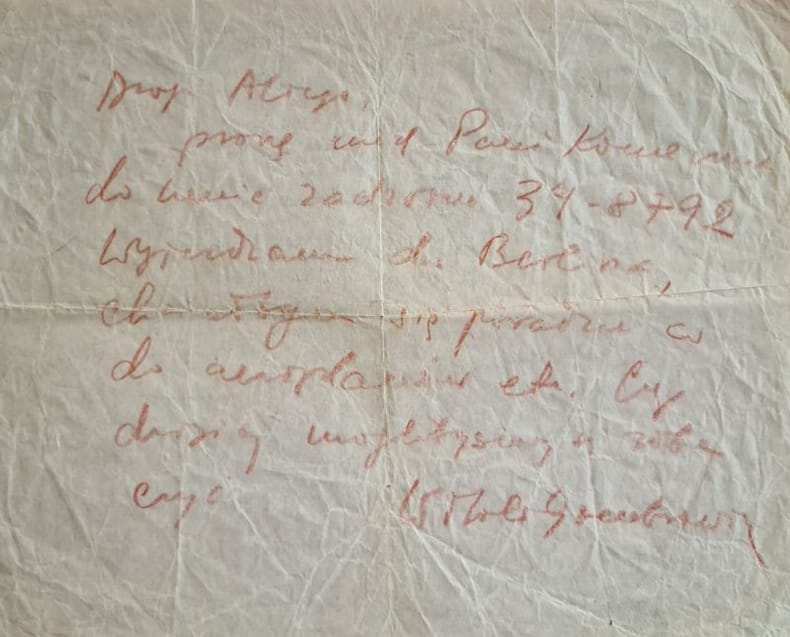
1962516221962 Tapuscrit de 12 pages in-4 avec corrections autographes, 1962 ; 9 lettres, dont 2 autographes et 7 dactylographiées signées, 25 août 1950 - 5 avril 1963, au total 10 pages in-4, 4 enveloppes conservées.Cette importante et rare correspondance de Gombrowicz adressée à une compatriote, exilée tout comme lui en Argentine, témoigne des efforts de l'écrivain pour promouvoir le rayonnement international de son oeuvre. Le précieux fragment tapuscrit que Gombrowicz a offert à sa correspondante recoupe l'ensemble du chapitre XII du Journal. C'est le récit du séjour que Gombrowicz fit en 1962 dans la maison d'Alicia et de son mari, à Hurlingham près de Buenos Aires. Après avoir maudit la promiscuité des transports en commun, l'écrivain se retrouve dans un havre de paix végétal et les peintures de son amie lui inspirent une belle réflexion sur l'art. Le tapuscrit présente une vingtaine de ratures et corrections autographes qui sont autant de variantes par rapport à l'édition imprimée.En 1950, Gombrowicz rencontre Yadwiga Alicia de Giangrande (1916-1999) à Buenos Aires où cette artiste-peintre polonaise a épousé un officier de marine argentin. Le 25 août 1950, comme elle s'apprête à faire un voyage à Paris, il lui envoie ses livres afin qu'elle puisse en parler autour d'elle en France : "Je vous donne tout ce que je possède, "Ferdydurke", le drame "Yvonne" et "Transatlantique". Un fardeau indigeste ! qui a été mal reçu par le groupe Ocampo, mais qu'importe puisque vous allez à Paris, où vous pourrez mesurer la vraie réputation de mon oeuvre ! Après tout, c'est là que se joue mon destin !"Gombrowicz ne croit pas si bien dire : c'est à partir de la publication française de Ferdydurke en 1958 qu'il va rompre son isolement. Dès le 1er mars, Gombrowicz se réjouit d'avoir reçu son contrat d'édition accompagné d'une lettre très positive de Julliard dont il rapporte les propos en français dans le texte : "plusieurs membres de mon comité de lecture m'ont chargé de vous féliciter de cette réussite exceptionnelle". Son traducteur Constantin Jelinski lui assure que Julliard est décidé à publier les Journaux quand leur traduction sera terminée. "J'ai Paris dans les mains" se réjouit-il, d'autant qu'on lui a rapporté que sa personnalité suscitait beaucoup de curiosité de la part des écrivains français. Le 28 décembre de la même année, il donne un compte rendu détaillé des articles qui sont parus sur lui en France. Il en attend d'autres au mois de janvier et cite une publicité de Julliard qui le présente comme "le plus grand écrivain polonais" (en français dans le texte). "C'est un argument formidable pour convaincre les éditeurs argentins de publier les Journaux". D'ailleurs Julian Gorkin, le rédacteur en chef de la revue Cuadernos, lui commande un article écrit par un auteur argentin à propos de Ferdydurke et de son succès en France, qu'il envisage d'accompagner d'extraits des Journaux. Gombrowicz demande donc à sa correspondante si elle connaît "un Argentin qui pourrait écrire quelque chose. Cela devrait être très éloquent puisque je ne me satisfais plus de n'importe quoi. Je me suis tellement éloigné des écrivains d'ici que je ne vois personne qui pourrait le faire. Mais vous connaissez beaucoup de gens et peut-être avez-vous des idées".Cette lettre est accompagnée d'une importante note sur la traduction des Journaux, écrite sans doute par Gombrowicz lui-même à la troisième personne (1 page in-4 dactylographiée avec apostille autographe) : l'auteur revient sur le succès en France de Ferdydurke qui devrait décider les éditeurs argentins non seulement à réimprimer la très bonne traduction espagnole de ce roman parue dix ans plus tôt, mais aussi à s'intéresser aux Journaux. "C'est un peu plus compliqué puisqu'ils n'ont pas été traduits en espagnol. Les éditeurs ne veulent pas prendre de risques avec un livre qu'ils ne connaissent pas. Mais si la traduction était faite, le livre serait sûrement publié tout de suite. D'abord parce qu'il est considéré comme la deuxième grande oeuvre de Gombrowicz, et aussi parce qu'il parle beaucoup d'Argentine. Milosz tient les "Journaux" pour le livre le plus important de la littérature polonaise depuis la guerre. En Pologne il est interdit à cause de sa critique du communisme, mais la presse était enthousiaste et c'est probablement l'oeuvre de Gombrowicz qui fait la plus forte impression sur le lecteur. Si l'on pouvait dès maintenant recevoir de l'argent pour traduire en espagnol les "Journaux", cela permettrait d'accélérer considérablement leur publication. 200 $ suffiraient sans doute, qui seraient déduits des droits d'auteur". Gombrowicz ajoute à la main : "Nous avons des propositions des plus grands éditeurs des USA, d'Italie et d'Allemagne, mais les revenus ne seront pas là avant quelques années".Sensible à ses difficultés, Alicia de Giangrande propose aussitôt à Gombrowicz de traduire elle-même les Journaux. Le 6 janvier 1959, l'écrivain se dit très touché par son offre, tout en réfrénant son enthousiasme : "Traduire un tel volume ne peut se faire rapidement ; c'est un travail d'une année entière et il faut d'abord voir si votre espagnol est suffisant pour accomplir cette tâche (...). Il y a deux méthodes pour faire cette traduction : 1/ payer plus cher (si l'on trouve de l'argent) un très bon traducteur afin d'obtenir une version française 2/ ou alors la réaliser avec une personne noble comme vous : cela voudrait dire que je devrais la surveiller et qu'un écrivain argentin devrait la corriger finalement". Il évoque d'autres traducteurs potentiels comme Asturias ou Landsberg.Mais Alicia s'accroche et Gombrowicz accuse réception le 30 janvier 1959 d'un essai de traduction de 29 pages qu'elle a réalisé à partir des Journaux : "J'ai oublié de vous dire qu'il serait mieux de choisir quelques extraits pour la presse - et surtout pas les pages sur la Pologne qui seront sûrement éliminées !". Il lui répète qu'il a peur de devoir surveiller de trop près la traduction : "c'est trop fatigant pour moi et cela me prend trop de temps".Malgré cette fin de non-recevoir, la correspondance se poursuit sous forme de lettres plus brèves, dont deux entièrement autographes, jusqu'au 5 avril 1963, date à laquelle Gombrowicz lui annonce son départ pour l'Europe : il logera chez Jelenski à Paris, avant d'être reçu à Berlin par la Fondation Ford.
1962516221962 Tapuscrit de 12 pages in-4 avec corrections autographes, 1962 ; 9 lettres, dont 2 autographes et 7 dactylographiées signées, 25 août 1950 - 5 avril 1963, au total 10 pages in-4, 4 enveloppes conservées.Cette importante et rare correspondance de Gombrowicz adressée à une compatriote, exilée tout comme lui en Argentine, témoigne des efforts de l'écrivain pour promouvoir le rayonnement international de son oeuvre. Le précieux fragment tapuscrit que Gombrowicz a offert à sa correspondante recoupe l'ensemble du chapitre XII du Journal. C'est le récit du séjour que Gombrowicz fit en 1962 dans la maison d'Alicia et de son mari, à Hurlingham près de Buenos Aires. Après avoir maudit la promiscuité des transports en commun, l'écrivain se retrouve dans un havre de paix végétal et les peintures de son amie lui inspirent une belle réflexion sur l'art. Le tapuscrit présente une vingtaine de ratures et corrections autographes qui sont autant de variantes par rapport à l'édition imprimée.En 1950, Gombrowicz rencontre Yadwiga Alicia de Giangrande (1916-1999) à Buenos Aires où cette artiste-peintre polonaise a épousé un officier de marine argentin. Le 25 août 1950, comme elle s'apprête à faire un voyage à Paris, il lui envoie ses livres afin qu'elle puisse en parler autour d'elle en France : "Je vous donne tout ce que je possède, "Ferdydurke", le drame "Yvonne" et "Transatlantique". Un fardeau indigeste ! qui a été mal reçu par le groupe Ocampo, mais qu'importe puisque vous allez à Paris, où vous pourrez mesurer la vraie réputation de mon oeuvre ! Après tout, c'est là que se joue mon destin !"Gombrowicz ne croit pas si bien dire : c'est à partir de la publication française de Ferdydurke en 1958 qu'il va rompre son isolement. Dès le 1er mars, Gombrowicz se réjouit d'avoir reçu son contrat d'édition accompagné d'une lettre très positive de Julliard dont il rapporte les propos en français dans le texte : "plusieurs membres de mon comité de lecture m'ont chargé de vous féliciter de cette réussite exceptionnelle". Son traducteur Constantin Jelinski lui assure que Julliard est décidé à publier les Journaux quand leur traduction sera terminée. "J'ai Paris dans les mains" se réjouit-il, d'autant qu'on lui a rapporté que sa personnalité suscitait beaucoup de curiosité de la part des écrivains français. Le 28 décembre de la même année, il donne un compte rendu détaillé des articles qui sont parus sur lui en France. Il en attend d'autres au mois de janvier et cite une publicité de Julliard qui le présente comme "le plus grand écrivain polonais" (en français dans le texte). "C'est un argument formidable pour convaincre les éditeurs argentins de publier les Journaux". D'ailleurs Julian Gorkin, le rédacteur en chef de la revue Cuadernos, lui commande un article écrit par un auteur argentin à propos de Ferdydurke et de son succès en France, qu'il envisage d'accompagner d'extraits des Journaux. Gombrowicz demande donc à sa correspondante si elle connaît "un Argentin qui pourrait écrire quelque chose. Cela devrait être très éloquent puisque je ne me satisfais plus de n'importe quoi. Je me suis tellement éloigné des écrivains d'ici que je ne vois personne qui pourrait le faire. Mais vous connaissez beaucoup de gens et peut-être avez-vous des idées".Cette lettre est accompagnée d'une importante note sur la traduction des Journaux, écrite sans doute par Gombrowicz lui-même à la troisième personne (1 page in-4 dactylographiée avec apostille autographe) : l'auteur revient sur le succès en France de Ferdydurke qui devrait décider les éditeurs argentins non seulement à réimprimer la très bonne traduction espagnole de ce roman parue dix ans plus tôt, mais aussi à s'intéresser aux Journaux. "C'est un peu plus compliqué puisqu'ils n'ont pas été traduits en espagnol. Les éditeurs ne veulent pas prendre de risques avec un livre qu'ils ne connaissent pas. Mais si la traduction était faite, le livre serait sûrement publié tout de suite. D'abord parce qu'il est considéré comme la deuxième grande oeuvre de Gombrowicz, et aussi parce qu'il parle beaucoup d'Argentine. Milosz tient les "Journaux" pour le livre le plus important de la littérature polonaise depuis la guerre. En Pologne il est interdit à cause de sa critique du communisme, mais la presse était enthousiaste et c'est probablement l'oeuvre de Gombrowicz qui fait la plus forte impression sur le lecteur. Si l'on pouvait dès maintenant recevoir de l'argent pour traduire en espagnol les "Journaux", cela permettrait d'accélérer considérablement leur publication. 200 $ suffiraient sans doute, qui seraient déduits des droits d'auteur". Gombrowicz ajoute à la main : "Nous avons des propositions des plus grands éditeurs des USA, d'Italie et d'Allemagne, mais les revenus ne seront pas là avant quelques années".Sensible à ses difficultés, Alicia de Giangrande propose aussitôt à Gombrowicz de traduire elle-même les Journaux. Le 6 janvier 1959, l'écrivain se dit très touché par son offre, tout en réfrénant son enthousiasme : "Traduire un tel volume ne peut se faire rapidement ; c'est un travail d'une année entière et il faut d'abord voir si votre espagnol est suffisant pour accomplir cette tâche (...). Il y a deux méthodes pour faire cette traduction : 1/ payer plus cher (si l'on trouve de l'argent) un très bon traducteur afin d'obtenir une version française 2/ ou alors la réaliser avec une personne noble comme vous : cela voudrait dire que je devrais la surveiller et qu'un écrivain argentin devrait la corriger finalement". Il évoque d'autres traducteurs potentiels comme Asturias ou Landsberg.Mais Alicia s'accroche et Gombrowicz accuse réception le 30 janvier 1959 d'un essai de traduction de 29 pages qu'elle a réalisé à partir des Journaux : "J'ai oublié de vous dire qu'il serait mieux de choisir quelques extraits pour la presse - et surtout pas les pages sur la Pologne qui seront sûrement éliminées !". Il lui répète qu'il a peur de devoir surveiller de trop près la traduction : "c'est trop fatigant pour moi et cela me prend trop de temps".Malgré cette fin de non-recevoir, la correspondance se poursuit sous forme de lettres plus brèves, dont deux entièrement autographes, jusqu'au 5 avril 1963, date à laquelle Gombrowicz lui annonce son départ pour l'Europe : il logera chez Jelenski à Paris, avant d'être reçu à Berlin par la Fondation Ford.
Small oblong 8vo. 1 p. Ordering books from the "Nicolaische Buchhandlung": "Schelver Lebens u. Formengeschichte der Pflanzen / Der deutsche Gilblas - von Göthe / bittet sich aus / Prof. Hegel". - The History of the Life and Forms of the Plant World by the German physician, botanist and natural philosopher Franz Joseph Schelver had just been published by Engelmann in Heidelberg; "Der deutsche Gil Blas oder Leben, Wanderungen und Schicksale Johann Christoph Sachses, eines Thüringers / von ihm selbst verfasst" was another recently-published title. Since 1800 Sachse served as assistant librarian in the Weimar library under Goethe, wo also had contriibuted the preface to the "German Gil Blas". - Occasional light browning and with traces of old mounting on verso.
8vo (17 x 25 cm). (12) pp., numbered 7-18. With the author's autograph inscription, date and signature. Singular material evidence of Sartre's visit to Freiburg in 1952 and the personal relationship between two of the leading figures in continental philosophy from the mid-twentieth century. - Heidegger's influence on Sartre's thought was gratefully acknowledged by the French philosopher from early on in his career as an author. The very title of Sartre's essay in phenomenological ontology, "L'être et le néant" ("Being and Nothingness", 1943) referenced Heidegger's own "Sein und Zeit" ("Being and Time"), which had been published a decade earlier, in 1934. Despite the two thinkers' initial mutual admiration and the apparent overlaps in their thought, their differences became progressively clear throughout the 1940s. Heidegger reacted strongly to Sartre's "L'existentialisme est un humanisme" ("Existentialism is a Humanism", 1946) in a letter to his friend Jean Beaufret. This letter was published the following year in redacted form as "Über den Humanismus" ("On Humanism"), often referred to as the 'Humanismusbrief'. Undeterred by this and increasing criticism of his 'imprecise' engagement with Heidegger's ideas among contemporary commentators, Sartre arranged to meet with his German colleague in December 1952 (cf. Janicaud I, 133f.; Thomä 430). Having been invited to give a lecture (where he found his reception by the students somewhat "cold", (De Beauvoir 311), Sartre had a short meeting with Heidegger at which, "il me regardait avec une infinie pitié. À la fin, je parlais à son chapeau" ("he looked at me with infinte pity. In the end, I was talking to his hat", Cau 253). - Whilst the experience seems thus to have been disappointing from Sartre's point of view, Heidegger nonetheless took the trouble to send him the present offprint "zur Erinnerung an den Freiburger Besuch" ("in memory of the visit to Freiburg") on 12 February 1953. Heidegger's essay on the central concept of 'Logos' opens with reflections on Heraclitus' Fragment B50 and appeared as a chapter in the Festschrift published for the 70th birthday of the art historian Hans Jantzen. - Light browning throughout. Cf. J. Cau, Croquis de mémoire (Paris, 1985). S. de Beauvoir, La force des choses (Paris, 1963). C. Janicaud, Heidegger en France, 2 vols. (Paris, 2001). D. Thomä, Heidegger-Handbuch. Leben - Werk - Wirkung (Stuttgart, 2013).
4to. 29, (3) pp. Contemporary boards (dated 1929) by Eva Aschoff, including the original wrappers. First edition of Heidegger's inaugural lecture, presentation copy in a master binding. Inscribed to the singer Walburga Hedwig Elisabeth Gaehtgens (1915-2002) on the half-title: "Frau Walburga / zur Erinnerung / (24. Juli 1929) / Martin Heidegger". The date is that of the lecture. Gaehtgens married the classicist Ernst Zinn (1910-90) in 1938. Zinn's own ownership, dated 1929, is pencilled into the upper right corner of the half-title. He also added a note on the on the inside wrapper cover: "Binding: Eva Aschoff, Freiburg im Breisgau, 1929". Thus, Zinn acquired the copy in 1929, and it was likely signed by Heidegger in or after 1938. Heidegger and Zinn knew each other since 1929 and kept in contact until the philosopher's death in 1976. - The binding, commissioned by Zinn, is a work by the artist and master bookbinder Eva Aschoff (1900-69), decorated with blue and black circles, lines, and coloured spaces. An additional note by Zinn, dated 1961, is added in blue ink at the lower edge of the half-title. - Binding slightly browned, rubbed and bumped, one corner a little bent. Interior somewhat foxed or browned.
Large 8vo. 1 p. A playful inscription to the leaf of a Paris salonnière's guest book: "To Anna chez elle à où qu'elle se trouve - de son ami / Ernest Hemingemingway". - Edges a little browned. The verso has an additional French inscription by the pianist Magda Tagliaferro.
8vo. 3 pp. In French, to Noel Parfait in Paris: "Your kind letter moves me. You are sad and happy at the same time, and it is quite normal. Homeland is sweet but exile is grand. One goes back home but one has to give up one's freedom. I understand the double shock your soul is experiencing. But it does not matter, dear Parfait. You are going to be happy, I have no doubt about that. You are taking into the darkness that prevails in France nowadays the serenity of a proud conscience and the satisfaction of having overcome the ordeal. You will feel respectable among all the despicable people. That is an austere kind of joy but it is indeed a joy. Thank you for all the details you gave me. I congratulate and envy Dumas, who was able to help you and ensure that you will have enough to live on in Paris. That, plus all the intelligence, style, grace, talent and virtue that you have! I assure you that you are going to do very well. I am sorry for H.M. the world's biggest scoundrel [H.M. stands for His Majesty, most likely Louis-Napoleon], but there is going to be one successful honest man in Paris. I already know seven or eight of them, maybe nine, and that will make ten with you. Our friend must be in Brussels at the moment. Tell him that I am going to answer his letter and ask him to send me, in the meantime, the issue of l'lndependance (by mail, since it costs two sous there and six francs here) in which my note on George Sand was printed. Also, I would like to have his address in Brussels […]". In a postscript, Hugo as added, "Would you be so kind as to have the first of the two letters I am enclosing handed over to Bance, whose address I do not know, and mail the second one in Brussels? Sorry and many thanks". - In February 1860, Hugo was still living in exile on Guernsey, still writing about the darkness that prevails in France and the world's greatest scoundrel. It was an exile that had begun in December 1851 when a coup d'etat took place in France, which eventually resulted in the Second Empire under Napoleon III, and it did not end until the return of liberty and the reconstitution of the republic on 4 September 1870. However, his exile had recently become a voluntary gesture and an act of pride, a time to stand against Louis Napoleon. On 15 August 1859 (the birth of Napoleon I), Napoleon III offered an amnesty to exiles, which was accepted by some, but not Hugo. In a poem, "Ultima verba", he marked his decision, stating "No one will suppose that I personally can take any notice of the thing called an amnesty. In the present condition of France, protest - absolute, inflexible, eternal protest - that is my duty. True to the engagements I have made with my conscience, I shall share the exile of freedom to the end. When freedom returns, I shall return". The truth of the matter was that Hugo could not return during the reign of Napoleon III without inflicting a deep wound on his pride, and he could not resign himself to that. He was also well aware of the status and commercial value of banishment, even though the banishment was now self-imposed. The personal defiance of Napoleon III, the deliberate choice of martyrdom, gave Hugo a new heroic dimension. - With integral address leaf.
4to. 5½ pp. In French. Important text about artistic creation and the avant-garde, published in "Les Lettres françaises" of 17 April 1958 as part of the survey: "What is the avant-garde in 1958?". In Ionesco's view, art must strive to express realities that are "new and ancient, present and inopportune, living and permanent, particular, and, at the same time, universal". A label like "the avant-garde" is a mere afterthought to this goal: "To want to be part of the avant-garde before writing, not to want to be part of it, to refuse or choose an avant-garde is, for a creator, to construe things the wrong way round". For Ionesco the avant-garde is "only the current, historical expression of an inactual actuality (if I may say so), of a trans-historical reality". Therefore he is very sceptical of political art, as the work of art "is nothing if it does not transcend the temporary truths or obsessions of history". Several artists, historical and biblical figures are mentioned as examples of the "profound universalism" Ionesco is arguing for, including Buddha, Shakespeare, the Spanish mystic Juan de la Cruz, Proust, Chekhov, Brecht, and Picasso. In his own work, Ionesco tries "to say how the world appears to me, what it seems to be for me, as sincerely as possible without concern for propaganda, without intention of directing the consciences of contempraries. I try to be an objective witness in my subjectivity". The essence of his theatre is the contradictory, the absurd: "Since I write for the theatre, I am only concerned with personifying, embodying a comic and tragic sense of reality at the same time." Ionesco describes a childhood memory of a senseless act of violence which first invoked the feelings of vertigo, anguish, and transience that he tries to convey in his art: "I have no other images of the world apart from those, expressing the ephemerality and the harshness, the vanity and the anger, the nullity or hideous, useless hatred. This is how existence continued to appear to me". In closing, he aims to reconcile avant-garde and "living tradition", past and present: "One has the impression, also, that the more one is of one's time, the more one is of all times (if one breaks the crust of superficial topicality) [...] The youngest, newest works of art are recognizable and speak to all eras. Yes, King Solomon is my leader; and Job, this contemporary of Beckett". - With a stricken-out title "Avant-garde et tradition", corrections, and typograph marks. The first three pages with a tear minimally affecting the text. Some black fingerstains and stains, minor tears, and browning. Published in: Les Lettres françaises, no. 717, April 1958. Cf. M. Esslin, The theatre of the absurd (London: Eyre & Spottiswoode 1964)
4to. 1 page. To the secretary of the Nordische Gesellschaft (Nordic Society) in Lübeck; a reply to an invitation to participate in the economic propaganda of the Nordische Gesellschaft whose purpose was to reinforce cultural and political co-operation between Germanic and Scandinavian countries. The Nordische Gesellschaft would become a central institution for Alfred Rosenberg, theorist and ideologue of the Nazi government. Heinrich Himmler was a member of the board of directors. "[...] I fear, however, that the benefits likely to ensue either to your Society or to me from the arrangement you suggest might be too slight for it to be worth our while to enter into a formal arrangement. My journalistic output is not now very considerable, and since virtually all of it is prepared for publication in 'The Nation', by no means all of it is of interest to European readers generally. Moreover, it would not in general be possible for me to let you have any article sufficiently long in advance of publication in this country for you to be able to arrange for its publication in daily newspapers in Europe until after it had already appeared here. Finally, I already have arrangements for publication of any articles which are suitable to the general European public in 'Wirtschaftsdienst', which, although it is a weekly, might interfere with circulation in daily newspapers in Germany, and also with the 'Neue Freie Presse' of Vienna [...]". - In fine condition; on stationery with printed address.